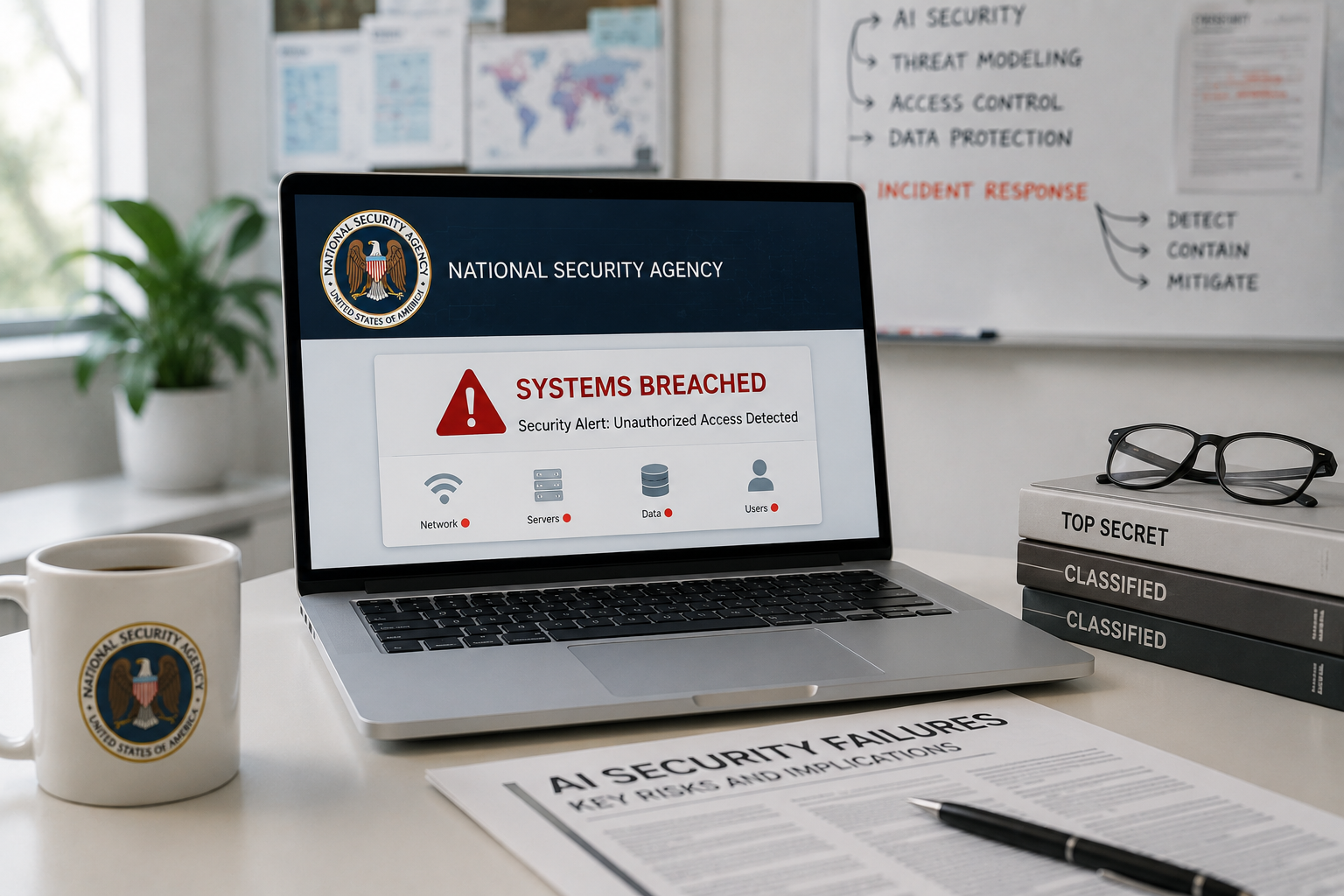
The NSA cybersecurity breach internal systems vulnerability story shocked even seasoned security professionals. America’s most secretive intelligence agency — the one literally tasked with protecting national security communications — discovered its own AI-integrated systems could be compromised from within. Consequently, this revelation has reshaped how we think about AI security at every level, and honestly, it should make every enterprise security team a little uncomfortable.
I’ve been covering cybersecurity for a decade, and I don’t say this lightly: this one genuinely surprised me.
This isn’t just a government problem. When the NSA can’t fully harden its own AI systems, every organization deploying AI tools should be paying close attention. The lessons here apply broadly — from Fortune 500 companies down to startups building on large language models.
How the NSA Found Its Own AI Systems Vulnerable
The timeline matters here.
During congressional testimony in early 2024, NSA officials acknowledged running internal red team exercises against their own AI-augmented systems. The results were alarming. Specifically, their own offensive security teams found exploitable weaknesses in systems that had already passed standard security reviews. Let that sink in — these weren’t systems anyone considered risky.
What the red team found:
- AI systems with overly broad access to classified databases
- Context window manipulation vulnerabilities in internal language models
- Insufficient access controls on AI agent actions
- Logging gaps that made AI-driven lateral movement hard to detect
- Prompt injection paths that bypassed intended security boundaries
Rob Joyce, former NSA Cybersecurity Director, had previously warned about AI’s dual nature — that AI tools amplify both defensive and offensive capabilities. Nevertheless, the internal breach exercises proved the agency’s own defenses weren’t keeping pace with the technology it was actually deploying. That gap between “we know the theory” and “we’ve secured the systems” is where things fall apart.
The NSA cybersecurity breach of internal systems revealed a vulnerability pattern that’ll feel familiar to anyone following AI security research. These weren’t exotic zero-day exploits. They were architectural weaknesses baked into how AI systems interact with sensitive data stores — the boring, structural stuff that’s easy to overlook when you’re moving fast.
To make this concrete: imagine an AI-powered intelligence summarization tool granted read access to five different classified databases because analysts occasionally needed information from all five. Nobody went back to scope that access down after the initial rollout. The tool worked, analysts were happy, and the access question got buried under the next deployment priority. That’s not a hypothetical — that’s the kind of mundane decision that created the overly broad access patterns the NSA’s red team actually found.
Furthermore, the Cybersecurity and Infrastructure Security Agency (CISA) has since published updated guidance partly informed by these findings. That guidance emphasizes that AI system security requires fundamentally different approaches than traditional software security. It’s worth bookmarking if you haven’t already.
Why Well-Resourced Agencies Still Fail at AI Security
Here’s the thing: money and talent don’t automatically solve AI security problems.
The NSA employs some of the world’s best cryptographers and security engineers. Yet the NSA cybersecurity breach internal systems vulnerability persisted until active red teaming exposed it. I’ve seen this pattern repeat across enterprise environments too — smart people, strong budgets, and still blindsided by AI-specific attack vectors.
Several factors explain this paradox:
1. Speed of AI deployment — Agencies rushed to integrate AI tools for intelligence analysis. Security reviews lagged behind deployment timelines.
2. Novel attack surfaces — Traditional security frameworks don’t account for prompt injection, context window poisoning, or AI agent privilege escalation.
3. Complexity explosion — AI systems interact with data in non-deterministic ways. Predicting every possible behavior is essentially impossible.
4. Cultural blind spots — Organizations confident in their security posture often underestimate new threat categories.
The cultural blind spot deserves a closer look, because it’s the most insidious. Security teams that have successfully defended against sophisticated nation-state attacks for years develop — reasonably — a high degree of confidence in their processes. That confidence becomes a liability when a genuinely new threat category arrives. The instinct is to map the new threat onto existing frameworks rather than acknowledge that the frameworks themselves need rebuilding. The NSA wasn’t complacent; they were pattern-matching to the wrong patterns.
Moreover, the NSA’s experience mirrors findings from NIST’s AI Risk Management Framework. NIST specifically calls out the gap between traditional cybersecurity controls and AI-specific threats — and notably, that gap isn’t shrinking fast enough.
The comparison below shows exactly how different AI security is from conventional approaches:
| Security Dimension | Traditional Systems | AI-Integrated Systems |
|---|---|---|
| Attack surface | Network, endpoints, applications | All traditional surfaces plus model inputs, training data, agent actions |
| Access control | Role-based, well-understood | Dynamic, context-dependent, often overly permissive |
| Logging and audit | Mature tooling available | Gaps in tracking AI reasoning and data access patterns |
| Threat modeling | Established frameworks (STRIDE, etc.) | Emerging frameworks, few battle-tested standards |
| Patch management | Regular update cycles | Model behavior changes unpredictably with updates |
| Insider threat detection | Behavioral analytics | AI actions can mask or mimic legitimate user behavior |
Look at that last row — AI actions masking legitimate user behavior. That’s the real kicker. A traditional insider threat detection system flags anomalies against a baseline of human behavior. An AI agent querying hundreds of records in seconds can look indistinguishable from a legitimate bulk data pull — especially if no one defined what “normal” AI behavior looks like in the first place. Similarly, enterprises relying on traditional security playbooks for AI deployments face identical risks, and most of them don’t realize it yet. The NSA cybersecurity breach internal systems vulnerability wasn’t a failure of competence. It was a failure of framework.
Expert Testimony and the Government’s Response
Congressional hearings brought these issues into public view, though fair warning: much of the testimony remains classified.
General Paul Nakasone, then-NSA Director, testified that AI security requires “a fundamentally different mindset.” He stressed that the agency was actively restructuring its approach to AI system hardening. Importantly, he acknowledged that existing security certifications didn’t adequately cover AI-specific threats — which is a remarkable admission from the head of the NSA.
Key excerpts from public testimony and reporting:
- “Our red teams showed that AI systems granted broad data access can be manipulated in ways our existing controls weren’t designed to detect.”
- “The vulnerability isn’t in the AI models themselves — it’s in how we integrate them into classified environments.”
- “We need new standards for AI system accreditation that go beyond traditional Authority to Operate (ATO) processes.”
That last point about ATO processes is worth dwelling on. The Authority to Operate framework was designed for traditional software systems with deterministic, auditable behavior. An AI system that responds differently to the same input depending on context, conversation history, and subtle phrasing variations simply doesn’t fit that model. Certifying it as “secure” under ATO criteria is a bit like certifying a car roadworthy using standards written for horse-drawn carriages — technically a process was followed, but the process wasn’t designed for what you’re actually evaluating.
Consequently, the Department of Defense has accelerated its AI adoption strategy while simultaneously tightening security requirements. The Pentagon’s Chief Digital and AI Office now requires AI-specific red team assessments before deployment in sensitive environments. And honestly, that requirement should be the baseline everywhere — not just in government.
Additionally, the Office of the Director of National Intelligence issued updated guidelines for AI use across the intelligence community. Those guidelines specifically address the NSA cybersecurity breach internal systems vulnerability patterns discovered during testing.
The government’s response follows a predictable but important sequence:
1. Internal discovery through red team exercises
2. Congressional notification and testimony
3. Policy updates across intelligence agencies
4. New security standards development
5. Mandatory AI-specific security assessments
6. Ongoing monitoring and framework refinement
Notably, this response pattern offers a solid template for enterprise organizations. Don’t wait for a real breach — proactively red team your AI systems now. The NSA had the luxury of discovering this internally. You might not.
Connecting Government Failures to Enterprise AI Deployment
Bottom line: if the NSA struggles with this, your company almost certainly does too.
The NSA cybersecurity breach internal systems vulnerability findings connect directly to challenges every organization faces when deploying AI. And I’ve talked to enough enterprise security teams over the years to know that most of them are significantly underestimating their AI-specific exposure.
Context window security represents one of the most overlooked risks out there. AI systems process information within context windows — essentially the working memory of a language model. Attackers can inject malicious instructions into this context through various channels. The NSA’s internal testing confirmed that even classified systems were open to these attacks. This surprised me when I first dug into the technical details, because the attack surface is genuinely hard to picture until you see it in action.
Here’s a practical scenario that illustrates the risk: an analyst uses an AI tool to summarize a batch of incoming documents. One of those documents — sourced externally — contains hidden text formatted to look like a system instruction. The AI processes it as a directive rather than content, and suddenly the model is operating under attacker-controlled parameters. The analyst sees a clean summary. The AI has been redirected. No alarm fires. This is not science fiction; it is a documented attack class that the NSA’s red team specifically tested for.
Agent access controls present another critical challenge. Modern AI deployments increasingly use autonomous agents that take actions on behalf of users — accessing databases, executing code, and communicating with external services. However, most organizations grant overly broad permissions because it’s easier. The NSA’s own systems suffered from this exact problem. It’s the digital equivalent of giving every new hire a master key because you haven’t gotten around to setting up proper access cards.
Here’s what enterprises should take away from the government’s experience:
- Principle of least privilege applies to AI agents too. Don’t give an AI assistant access to every database just because it might need one of them someday.
- Monitor AI system behavior continuously. Traditional endpoint monitoring won’t catch AI-specific anomalies.
- Test adversarially before deploying. The NSA found its vulnerabilities through red teaming — you should do the same.
- Segment AI system access. Keep AI tools isolated from your most sensitive data unless access is strictly necessary.
- Update your threat models. Add AI-specific attack vectors like prompt injection, training data poisoning, and context manipulation.
There’s a real tradeoff embedded in several of these recommendations worth naming directly. Restricting AI agent access and enforcing strict segmentation will reduce the tool’s usefulness — at least initially. An AI assistant that can only see a narrow slice of your data will produce less comprehensive outputs than one with broad access. That friction is the point. The productivity gain from unrestricted access isn’t worth the exposure, but security teams will face pushback from business units that adopted AI specifically for its breadth of capability. Having that conversation early, before deployment rather than after an incident, is far less painful.
The OWASP Top 10 for LLM Applications is a no-brainer starting point for understanding these threats. Meanwhile, MITRE’s ATLAS framework was built specifically for adversarial threat modeling of AI systems — I’d strongly recommend both if your team hasn’t worked through them yet.
Furthermore, the vulnerability in NSA internal systems during this cybersecurity breach exercise showed that security testing itself must evolve. Penetration testing firms now need AI-specific capabilities. Standard vulnerability scanners won’t find prompt injection flaws or context window manipulation opportunities — they simply aren’t built for it. When evaluating vendors for AI security assessments, ask specifically whether their testers have hands-on experience with LLM attack techniques. A firm that excels at network penetration testing is not automatically qualified to red team your AI deployment.
Practical steps for enterprise security teams:
1. Conduct an AI asset inventory — know every AI system in your environment
2. Map data access patterns for each AI tool
3. Implement AI-specific logging that captures prompts, responses, and data access
4. Build AI red team capabilities or hire specialists
5. Create incident response playbooks for AI-specific breaches
6. Review vendor AI security practices before procurement
Broader Implications for National Security and AI Policy
The NSA cybersecurity breach internal systems vulnerability carries implications far beyond any single agency.
Adversarial nations are investing heavily in AI capabilities. China, Russia, and other state actors know that AI systems present new attack surfaces — and they’re actively probing them. Specifically, if the NSA’s own AI tools can be manipulated, similar tools deployed across the Department of Defense, the intelligence community, and critical infrastructure face comparable risks. That’s not a hypothetical. That’s the current situation.
Policy responses are taking shape across multiple fronts:
- Executive orders requiring AI safety and security standards
- New procurement requirements for AI vendors serving government agencies
- Expanded funding for AI security research at national laboratories
- International cooperation on AI security standards through bodies like ISO/IEC
Nevertheless, policy alone won’t solve the problem. Technical solutions must keep pace with evolving threats, and right now they aren’t. The gap between AI capability development and AI security development remains dangerously wide — and that gap is growing, not closing.
The NSA’s internal systems vulnerability exposed during this cybersecurity breach also raises serious questions about supply chain security. Many government AI systems rely on commercial foundation models. If those models contain exploitable weaknesses, every deployment built on top of them inherits those risks. This is the part that keeps me up at night, honestly. A vulnerability in a widely used foundation model isn’t a single agency’s problem — it’s a systemic risk that propagates across every government and enterprise system built on that model simultaneously. The blast radius of a well-placed supply chain attack on an AI foundation model would dwarf most traditional software vulnerabilities.
Additionally, the workforce challenge is real and severe. There aren’t enough security professionals who understand both traditional cybersecurity and AI-specific threats. NIST has estimated the current cybersecurity workforce gap at roughly 500,000 positions in the US alone, and AI security expertise is a subset of that shortage. The NSA and other agencies are competing directly with private sector companies for this scarce talent. Consequently, many organizations — both public and private — are running AI systems without adequate security expertise on staff.
One partial mitigation worth considering: structured cross-training programs that pair existing security engineers with data scientists or ML engineers for dedicated AI security rotations. It won’t close the talent gap, but it builds internal capability faster than waiting for the hiring market to catch up. Several financial institutions have quietly started doing exactly this, embedding security engineers in AI development teams for six-month rotations specifically to build institutional knowledge about AI-specific attack surfaces.
The intelligence community’s experience also highlights the tension between AI adoption speed and security rigor. Agencies face enormous pressure to deploy AI tools quickly for competitive advantage. However, rushing deployment without thorough security assessment creates exactly the kind of vulnerability in internal systems that the NSA discovered. Speed is the enemy of security here, and someone has to say it plainly.
Conclusion
The NSA cybersecurity breach internal systems vulnerability story is a wake-up call — and not the kind you can snooze.
If the world’s most capable signals intelligence agency can’t fully secure its AI systems, no one should assume their own deployments are safe. I’ve reviewed dozens of enterprise security setups over the years, and the organizations that think they’re fine are often the ones most exposed.
Actionable next steps you should take today:
- Audit every AI system in your environment for overly broad data access
- Run AI-specific red team exercises quarterly
- Update your security frameworks to include AI threat vectors
- Train your security team on prompt injection, context window attacks, and agent manipulation
- Review the OWASP LLM Top 10 and MITRE ATLAS framework
- Set up AI security governance with clear ownership and accountability
The NSA cybersecurity breach proved that internal systems vulnerability isn’t theoretical — it’s real, it’s present, and it affects the most sophisticated organizations on earth. Therefore, treat AI security as a board-level concern. Don’t wait for your own red team to find what the NSA found in theirs.
Moreover, share these lessons across your organization. Security isn’t just an IT problem when AI systems can access, process, and act on your most sensitive data. The government learned this the hard way. You don’t have to.
FAQ
What exactly did the NSA discover about its AI system vulnerabilities?
The NSA’s internal red team exercises revealed that AI-integrated systems had overly broad data access, insufficient logging for AI-specific actions, and susceptibility to prompt injection and context window manipulation. Importantly, these weren’t exotic attacks — they exploited architectural weaknesses in how AI tools connected to classified data stores. The NSA cybersecurity breach internal systems vulnerability findings showed that standard security certifications didn’t adequately cover AI-specific threats.
How does this vulnerability affect private companies?
The implications are direct and significant. Private companies use the same types of AI technologies — large language models, autonomous agents, and AI-powered analytics. Consequently, they face the same categories of vulnerability. If the NSA’s resources and expertise weren’t enough to prevent these issues, enterprises should assume their own AI deployments carry similar risks. Proactive red teaming and AI-specific security controls are essential.
What is context window security and why does it matter?
A context window is the working memory of an AI language model. It holds the current conversation, system instructions, and any retrieved data. Attackers can inject malicious instructions into this context through various techniques. Specifically, they might embed hidden commands in documents the AI processes or manipulate the sequence of inputs. The NSA’s testing confirmed that context window attacks could bypass intended security boundaries even in highly controlled environments.
What frameworks exist for AI-specific security testing?
Several frameworks address AI security specifically. The OWASP Top 10 for LLM Applications covers the most critical vulnerabilities in language model deployments. MITRE ATLAS provides an adversarial threat modeling framework for AI systems. Additionally, NIST’s AI Risk Management Framework offers governance-level guidance. These frameworks complement traditional cybersecurity standards but address the unique challenges AI systems introduce.
Keep reading
Here are the latest posts from the blog.
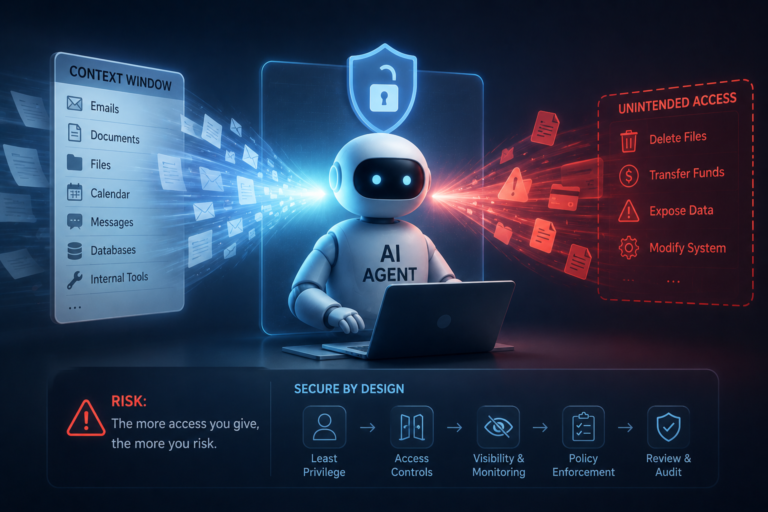
Context window security matters more than most teams realize — and I say that as someone who’s watched organizations make this exact mistake repeatedly over the past decade.…

Researchers at MIT recently proved something that genuinely surprised me — and I’ve been covering AI long enough to be pretty hard to surprise. Their work on MIT AI finds ato…

The story of SpaceX Origin taking on GitHub with 7.5M developers in its corner is reshaping how we think about code infrastructure. Elon Musk’s aerospace company quietly laun…