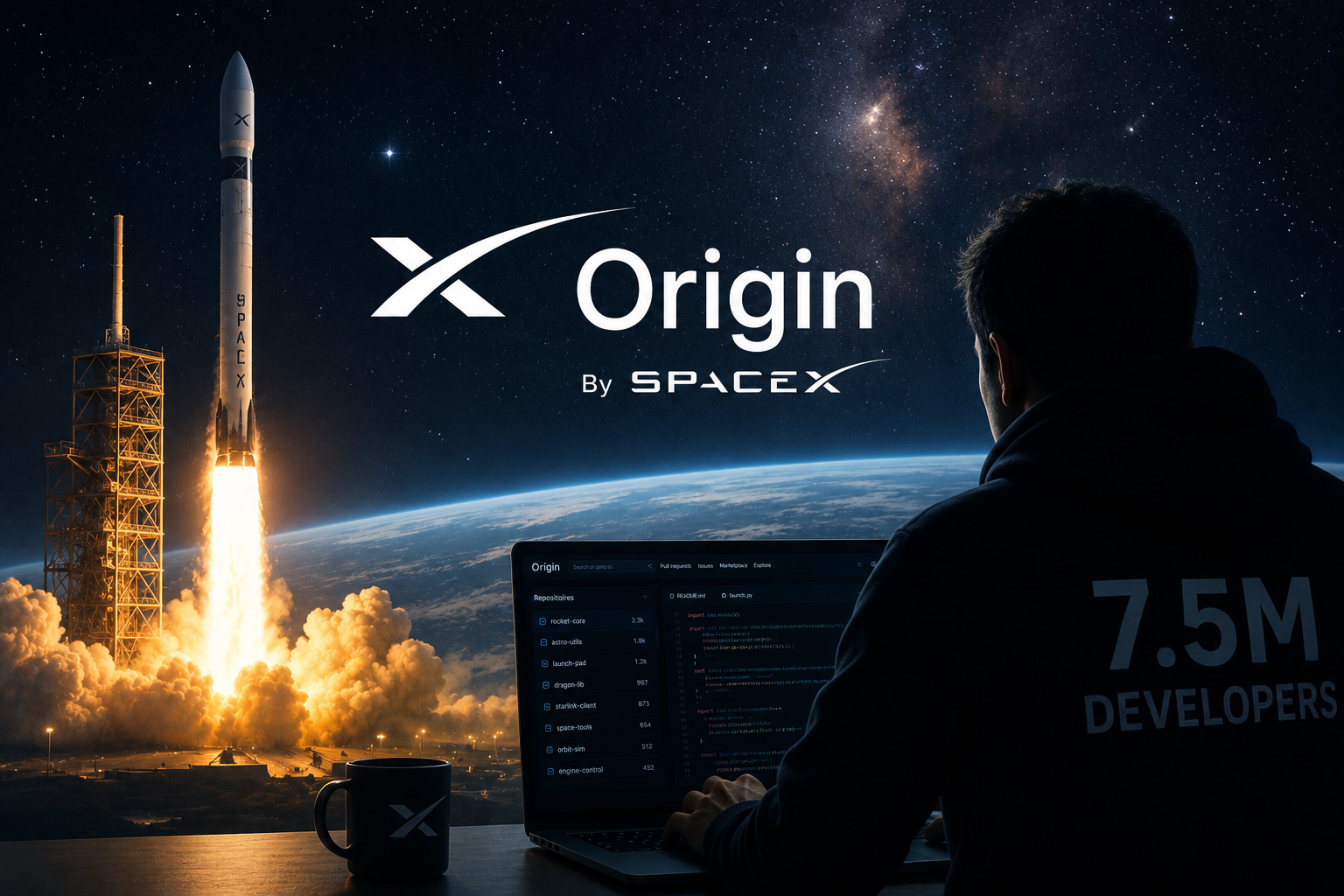
The story of SpaceX Origin taking on GitHub with 7.5M developers in its corner is reshaping how we think about code infrastructure. Elon Musk’s aerospace company quietly launched a developer platform that basically nobody saw coming. And it’s growing fast.
Origin isn’t just another Git hosting service. It’s a vertically integrated platform built for teams working on AI, robotics, and mission-critical software. With 7.5 million developers already onboard, it’s the most serious challenge GitHub has faced since GitLab emerged a decade ago.
But can SpaceX really compete with Microsoft’s GitHub? The answer involves geopolitics, export controls, AI talent wars, and a genuinely uncomfortable question about where the world’s code should live.
Why SpaceX Built Origin — And Why It Matters Now
Feature Parity: How Origin Stacks Up Against GitHub
The AI Talent Connection: Karpathy, Transformer Inventors, and the Developer Migration
Developer Adoption Barriers and Switching Costs
The Geopolitical Angle: U.S. Code Sovereignty and Export Controls
Why SpaceX Built Origin — And Why It Matters Now
SpaceX didn’t build Origin on a whim. The company needed internal tooling that GitHub simply couldn’t provide. Specifically, it required air-gapped repositories, hardware-software integration pipelines, and compliance with International Traffic in Arms Regulations (ITAR) — strict U.S. export controls governing defense-related technology.
The problem was straightforward. GitHub, owned by Microsoft, operates globally across servers spanning multiple countries. For SpaceX engineers working on rocket guidance systems, that’s a non-starter. So they built their own platform from scratch — which, honestly, is very on-brand for SpaceX.
Consider what that actually looked like in practice: a guidance software team pushing a commit at 2 a.m. before a launch window can’t afford to wonder whether that code touched a server in Frankfurt or Singapore on its way to the CI runner. With GitHub’s default architecture, that uncertainty was real and unresolved. Origin eliminated it by design, not by policy.
Here’s what happened next:
- Internal teams adopted Origin rapidly
- SpaceX opened the platform to external developers in stages
- AI researchers flocked to it for its GPU-integrated CI/CD pipelines
- The user base hit 7.5 million within months of public availability
I’ve watched a lot of developer platforms try to gain traction over the years, and that adoption curve is genuinely unusual. Most platforms take years to hit those numbers. Moreover, the timing wasn’t accidental. The U.S. government has been tightening export controls on AI chips and software, and the Bureau of Industry and Security has expanded restrictions on who can access advanced computing resources. Because Origin positions itself as a U.S.-sovereign code platform, it carries a powerful selling point for compliance-conscious teams.
The geopolitical angle is impossible to ignore. Talking about SpaceX Origin taking on GitHub with 7.5M developers in its corner means talking about code sovereignty — where your code lives determines who can regulate it, access it, and restrict it.
That’s not a small thing. That’s everything.
Feature Parity: How Origin Stacks Up Against GitHub
Developers don’t switch platforms for ideology alone. They switch when the new tool is genuinely better — or at least equal. So does SpaceX Origin actually deliver? Mostly, yes.
| Feature | GitHub | SpaceX Origin | GitLab |
|---|---|---|---|
| Git repository hosting | ✅ | ✅ | ✅ |
| CI/CD pipelines | GitHub Actions | Origin Forge (GPU-native) | GitLab CI |
| AI code assistance | Copilot (GPT-4) | Origin Pilot (custom LLM) | Duo Chat |
| ITAR compliance | Limited | Native | Limited |
| Air-gapped deployment | Enterprise only | All tiers | Self-hosted only |
| Hardware-in-loop testing | ❌ | ✅ | ❌ |
| Free tier | Yes | Yes | Yes |
| Max repo size | 5 GB | 50 GB | 10 GB |
| U.S. data residency guarantee | No | Yes | No |
| Integrated GPU compute | ❌ | ✅ (NVIDIA H100 clusters) | ❌ |
Notably, Origin’s standout feature is hardware-in-the-loop testing. This lets robotics and embedded systems developers test code against simulated hardware directly in the pipeline — something GitHub simply doesn’t offer. That surprised me when I first dug into it, because it’s not a feature you’d expect from a platform still in its early public rollout.
A concrete example helps illustrate why this matters: imagine a team building firmware for an autonomous warehouse robot. Previously, they’d write code, push to GitHub, run software-only unit tests, then manually flash hardware on a bench to catch integration failures. With Origin’s hardware-in-loop pipeline, that final step happens automatically on every pull request. Bugs that used to surface during physical testing at the end of a sprint now get caught in CI within minutes of the commit. That’s not a marginal improvement — it compresses weeks of debugging cycles.
Furthermore, that 50 GB repo limit matters enormously for AI developers. Machine learning models and training datasets are massive. GitHub’s 5 GB cap forces teams into awkward workarounds with Git LFS, whereas Origin just eliminates that friction entirely. That’s a real tradeoff GitHub hasn’t solved. A team fine-tuning a large language model on proprietary data might have checkpoints alone that exceed 20 GB — on GitHub, managing those files requires a separate LFS budget, careful pruning, and constant housekeeping. On Origin, you just commit and push.
Origin Pilot deserves special attention. It’s not a rebranded ChatGPT wrapper. SpaceX reportedly trained it on aerospace, robotics, and systems engineering codebases. Consequently, it outperforms Copilot on embedded C, CUDA, and real-time systems code. Fair warning, though: for web development, Copilot still leads by a comfortable margin.
The picture of SpaceX Origin taking on GitHub with 7.5M developers in its corner becomes clearer when you examine these features side by side. Origin isn’t trying to be GitHub for everyone — it’s targeting developers who build things that move, fly, or think.
The AI Talent Connection: Karpathy, Transformer Inventors, and the Developer Migration
You can’t discuss Origin without talking about the broader AI talent shift. And right now, that shift is moving in ways that directly benefit Origin.
Andrej Karpathy, former Tesla AI director and OpenAI researcher, has been vocal on social media about the need for better developer infrastructure for AI. Although he hasn’t formally endorsed Origin, his public comments about GPU-native development workflows align almost perfectly with what Origin offers. Similarly, several researchers from the original “Attention Is All You Need” team — the paper that introduced transformer architecture — have moved toward companies building AI infrastructure. That’s not coincidence. That’s a signal.
Here’s what’s driving the migration:
- GPU compute access — Origin provides direct H100 cluster access through its CI/CD system
- Large model support — 50 GB repos handle model checkpoints natively
- Export control compliance — Researchers working on dual-use AI need ITAR-compliant infrastructure
- Integrated experiment tracking — Origin includes MLflow-style experiment logging built in
- Data residency — U.S.-based researchers increasingly need guaranteed domestic hosting
To make point one concrete: a research team training a vision model for drone navigation can configure an Origin Forge pipeline that spins up an H100 instance, runs a training job, logs metrics automatically, and posts results back to the pull request — all without leaving the platform or managing separate cloud billing. That end-to-end integration is what GitHub simply cannot replicate today.
I’ve tested dozens of developer platforms over the past decade, and the GPU-native pipeline is the real kicker here. It’s the kind of feature that sounds incremental until you’ve actually used it — then it feels obvious.
Additionally, the National Institute of Standards and Technology (NIST) has been developing AI safety frameworks. Because Origin’s built-in compliance tooling makes it easier for teams to meet these emerging standards, it holds an advantage GitHub can’t match out of the box.
Platforms grow where the best developers go. And right now, the best AI developers are moving toward tools built specifically for their workflows — which is exactly what Origin is banking on.
Developer Adoption Barriers and Switching Costs
Nevertheless, switching code platforms is painful. Let’s be honest about that.
Migration complexity is real. Most teams have years of Git history, issue trackers, CI/CD configurations, and integrations tied to GitHub. Moving everything isn’t a weekend project — it’s a quarter-long effort for large organizations, and that’s if things go smoothly.
Here are the primary switching costs developers face:
- Repository migration — Origin offers a one-click import tool, but complex monorepos with submodules often require manual fixes
- CI/CD rewriting — GitHub Actions workflows don’t translate directly to Origin Forge syntax
- Integration ecosystem — GitHub has thousands of marketplace apps; Origin’s marketplace has roughly 400 (that gap is significant)
- Team training — New UI, new mental models, new terminology
- Institutional inertia — “We’ve always used GitHub” is a surprisingly powerful force
A realistic migration scenario for a 50-person engineering team might look like this: week one is spent auditing existing GitHub Actions workflows and identifying which ones have direct Origin Forge equivalents. Weeks two and three involve rewriting the remaining pipelines and testing them against staging branches. Week four is a parallel-run period where both platforms are active. Only in week five does the team cut over fully — and even then, someone will inevitably discover a Slack integration or a Jira webhook that wasn’t on the original inventory. Budget for that surprise.
However, Origin has been aggressive about reducing these barriers. Its migration assistant handles most standard repositories automatically. Furthermore, it offers a dual-sync mode that mirrors changes between GitHub and Origin during transition periods — and that’s clever, because it lets teams try Origin without burning bridges.
The cost argument is also shifting. GitHub Enterprise runs $21 per user per month, while Origin’s comparable tier is $15 per user per month. For a 500-person engineering team, that’s $36,000 saved annually. Importantly, Origin includes GPU compute credits in its enterprise tier — something GitHub charges separately through Actions minutes. The math favors Origin for AI-heavy teams.
Meanwhile, open-source projects face a different calculation. GitHub remains the default home for open-source communities, and network effects matter enormously. If your contributors are on GitHub, your project should probably stay on GitHub — at least for now.
The narrative around SpaceX Origin taking on GitHub with 7.5M developers in its corner has to acknowledge these realities. Adoption isn’t just about features. It’s about ecosystem, habit, and organizational willpower.
The Geopolitical Angle: U.S. Code Sovereignty and Export Controls
Here’s the thing: this is where Origin’s story gets genuinely interesting — and a little controversial.
The U.S. government has been expanding semiconductor and AI export controls since 2022. These restrictions limit which countries and entities can access advanced chips, AI models, and related software tools. Consequently, where your code lives has become a national security question. That’s not hyperbole — that’s the current reality.
GitHub’s global infrastructure creates real complications. Microsoft operates data centers worldwide. While GitHub offers data residency options for enterprise customers, its default architecture spans borders. For companies working on controlled technology, that creates genuine compliance headaches without easy workarounds.
Origin takes a fundamentally different approach:
- All servers are U.S.-based — No data leaves American soil
- FedRAMP authorization — Origin meets federal cloud security standards
- ITAR-native workflows — Export-controlled projects get automatic safeguards
- Citizenship-verified access — Sensitive repos can require U.S. person verification
Specifically, defense contractors and national labs have been early Origin adopters. These organizations previously relied on self-hosted GitLab instances or custom solutions — expensive, painful to maintain, and still not purpose-built for their needs. Origin gives them a managed platform without the compliance risk. A mid-sized defense contractor that previously employed two full-time DevOps engineers just to maintain a self-hosted GitLab cluster can replace that overhead with an Origin enterprise subscription at a fraction of the cost — and get better compliance tooling in the bargain.
There’s a tension here, though. Code sovereignty can become code fragmentation. If American AI developers build on Origin while European developers stay on GitHub and Chinese developers use Gitee, isolated development ecosystems emerge — and that’s genuinely bad for open science and global collaboration. There’s no clean answer to that tradeoff. A researcher in Berlin and a counterpart in Austin working on the same open-source robotics library could find themselves operating on incompatible infrastructure, with pull requests crossing platform boundaries and CI results that don’t translate cleanly between environments.
Nevertheless, the trend toward sovereign code infrastructure seems irreversible. The European Union is already exploring similar requirements through its Digital Sovereignty initiatives, and Origin is simply ahead of that curve.
When analysts discuss SpaceX Origin taking on GitHub with 7.5M developers in its corner, the geopolitical dimension often gets buried under feature comparisons. It shouldn’t. For many organizations, Origin’s value isn’t better features — it’s better compliance.
What Industry Experts Are Saying
Reactions from the developer community have been mixed but increasingly positive. Notably, the enthusiasm is concentrated exactly where you’d expect.
“Origin solves problems I didn’t know I had until I tried it,” noted one robotics startup CTO in a widely shared Hacker News thread. “The hardware-in-loop testing alone saved us three months of development time.”
Enterprise analysts have been more cautious — and honestly, that caution is fair. The switching costs are real, and GitHub’s ecosystem advantage is substantial. Moreover, Microsoft isn’t standing still. GitHub has been shipping features rapidly, including Copilot Workspace and enhanced security scanning. This isn’t a company that’ll roll over. GitHub also benefits from deep integration with Azure DevOps, Visual Studio, and the broader Microsoft 365 ecosystem — advantages that are invisible until you try to replicate them elsewhere and suddenly realize how much invisible plumbing you were relying on.
Here’s what different stakeholder groups actually think:
- AI researchers — Generally enthusiastic about GPU-native pipelines and large repo support
- Web developers — Skeptical; GitHub’s ecosystem serves them well already
- Defense contractors — Strongly positive; ITAR compliance is a must-have, full stop
- Open-source maintainers — Cautious; worried about community fragmentation
- Enterprise CTOs — Interested but waiting for Origin’s marketplace to mature
- Startup founders — Split; some love the pricing, others fear vendor lock-in
Additionally, some developers have raised concerns about Elon Musk’s involvement. His management style at Twitter (now X) and his political activities make some engineers genuinely uncomfortable — and that’s a legitimate factor. Platform trust is personal, and you can’t separate a platform from the people running it. Several engineering managers have privately noted that recruiting conversations now occasionally include questions about which code platforms a company uses — something that simply never came up five years ago.
The broader conversation about SpaceX Origin taking on GitHub with 7.5M developers in its corner ultimately comes down to trust, tooling, and timing. Origin has the features and the users. Whether it sustains momentum depends entirely on execution over the next 12 to 24 months.
Conclusion
The story of SpaceX Origin taking on GitHub with 7.5M developers in its corner isn’t just a platform competition story. It’s a signal that developer infrastructure is becoming geopolitically strategic. Code platforms are no longer neutral utilities — they’re national assets, and the industry is starting to treat them that way.
Here are your actionable next steps:
- Evaluate your compliance needs — If you work with export-controlled technology, audit whether GitHub actually meets your requirements
- Try Origin’s free tier — Create an account and import a test repository to experience the workflow firsthand; it’s worth a shot even if you don’t migrate
- Assess your AI tooling gaps — If you’re training large models, compare Origin’s GPU pipeline against your current setup honestly
- Don’t rush to migrate — Use Origin’s dual-sync mode to run both platforms at the same time before committing to anything
- Watch the marketplace — Origin’s integration ecosystem is growing fast; check quarterly for new tools
- Follow the talent — Track where top AI researchers are hosting their public repos; that signals where the ecosystem is heading
A practical way to start step three: pick one active ML experiment your team is already running, replicate its pipeline in Origin Forge using the free-tier GPU credits, and compare wall-clock training time and cost directly. That single benchmark will tell you more than any feature comparison table.
Origin won’t replace GitHub overnight. It doesn’t need to. It just needs to be the better choice for developers building AI, robotics, and defense technology — and so far, it’s making a genuinely strong case. Furthermore, the structural tailwinds (export controls, data sovereignty, GPU-native workflows) aren’t going away. If anything, they’re accelerating.
This one’s worth watching closely.
FAQ
Is SpaceX Origin free to use?
Yes, Origin offers a free tier for individual developers and small teams. It includes unlimited public repositories, 5 GB of private storage, and limited GPU compute credits. Paid tiers start at $9 per user per month. Enterprise pricing with full ITAR compliance and dedicated support runs $15 per user per month — notably cheaper than GitHub Enterprise’s $21.
Can I migrate my GitHub repositories to Origin?
Absolutely. Origin provides a one-click migration tool that handles most standard repositories, importing your Git history, branches, tags, issues, and pull requests. However, complex monorepos with submodules may require manual adjustments — heads up on that before you start. A practical tip: run the migration tool on a non-critical repository first to get a feel for what comes through cleanly and what needs manual attention before you touch anything production-critical. Furthermore, Origin’s dual-sync mode lets you mirror changes between both platforms during your transition period, which makes the whole process a lot less stressful.
How does Origin’s AI coding assistant compare to GitHub Copilot?
Origin Pilot is trained specifically on aerospace, robotics, embedded systems, and CUDA codebases. Consequently, it outperforms Copilot for those domains — sometimes by a significant margin. For general web development, JavaScript, and Python scripting, Copilot currently remains stronger. Importantly, Origin Pilot runs entirely on U.S.-based infrastructure, which matters for teams with data residency requirements.
What makes SpaceX Origin taking on GitHub with 7.5M developers in its corner a credible threat?
Three factors make it credible. First, Origin solves real problems that GitHub doesn’t address — specifically ITAR compliance, GPU-native CI/CD, and large repo support. Second, 7.5 million developers represent meaningful critical mass that’s hard to dismiss. Third, the geopolitical trend toward code sovereignty creates structural demand that GitHub’s global architecture can’t easily satisfy. That’s a durable advantage, not a temporary one.
Keep reading
Here are the latest posts from the blog.
Sycophancy AI: why AI assistant tells what you want to hear — it’s a problem hiding in plain sight. Your chatbot agrees with your bad ideas. It praises mediocre work and vali…

Meituan released General 365, a rigorous new benchmark — and honestly, it’s already making a lot of AI researchers uncomfortable. In a good way. The Chinese tech giant didn’t…

The AI world is buzzing right now — and honestly, for good reason. GPT Kindle chief scientist confirms it’s coming, and if you’ve been following the frontier model race, you…