Scores checked against primary sources on 14 October 2026.
Any LLM benchmark comparison published this autumn runs into the same problem. The scores that circulate on social media were almost all run by the companies selling the models, each under its own settings, and many are missing for the benchmarks people ask about most. OpenAI no longer reports SWE-bench Verified at all. Anthropic publishes its headline chart as an image. Google’s newest Flash model card names its benchmarks but, in the version we could read, prints no numbers.
So this is not a leaderboard. It’s an evidence table. For eleven model families we looked for scores on six benchmarks, recorded who produced each number, and left a cell empty when we couldn’t find one. There are a lot of empty cells, and that is the useful part.
Key Takeaways
- No score here has been independently reproduced. We found third-party runs (Artificial Analysis, Epoch AI, ARC Prize) and provider claims, but no case of an outside group re-running a provider’s own number and confirming it.
- GPQA Diamond is near its ceiling. Independently reported scores for the top models sit between 95% and 96.3%, so it no longer separates them.
- SWE-bench Verified is compromised. OpenAI’s February 2026 audit found that every frontier model it tested could reproduce gold patches. Treat Verified scores as contamination-exposed.
- ARC-AGI-2 has the widest independent coverage, from 60.4% (Gemini 3.6 Flash, Kimi K3) to 94.2% (GPT-6.1 Sol).
- Two requested models can’t be scored. We found no verified release of Qwen 4, and Mistral Large 4 entered public preview on 6 October 2026 without published scores.
- Long-context results don’t line up. Google, DeepSeek and Moonshot each report a different long-context test, so the numbers can’t be compared with each other.
Quick Navigation
The LLM benchmark comparison table
Each cell shows the score and its evidence label. B means a third party ran the test. C means the provider reported it. U means the number is unverified or can’t be compared like for like. “NR” means we found no report. Settings vary by row (for example “Max” or “Thinking High”), and the source notes at the end list them.
| Model (status) | GPQA Diamond | MMLU-Pro | SWE-bench Verified | SWE-bench Pro | ARC-AGI-2 | Long context | AA Index v4.3.2 |
|---|---|---|---|---|---|---|---|
| GPT-6.1 Sol (GA, 29 Sep 2026; replaces GPT-6 Sol) | 95% B | NR | NR (OpenAI stopped reporting) | NR | 94.2% B | NR | 52 B |
| GPT-6 Sol (superseded) | NR | NR | NR | NR | 95.0% U¹ | NR | 48 B |
| GPT-6 Luna (Sept 2026) | NR | NR | NR | NR | 95.0% U¹ | NR | 38 B (Max) |
| Claude Opus 5.5 (22 Sep 2026) | Not transcribed² | NR | NR | NR | 93.3% B | NR | 58 B |
| Gemini 3.1 Pro (preview) | 94.3% C | 91.0 C³ | 80.6% C | 54.2% C | 77.1% B | MRCR v2 1M: 26.3% C | Not retrieved |
| Gemini 3.6 Flash (stable, July 2026) | Not retrieved⁴ | NR | NR | Not retrieved⁴ | 60.4% B | Not retrieved⁴ | Not retrieved |
| Llama 4 Maverick (Apr 2025) | 69.8 C | 80.5 C | NR | NR | NR | NR | Not retrieved |
| Qwen 4 | No verified release | — | — | — | — | — | — |
| Mistral Large 4 (preview, 6 Oct 2026) | NR | NR | NR | NR | NR | NR | NR |
| MiMo-V2.6-Pro (21 Sep 2026) | NR | NR | NR | NR | NR | NR | 46 B |
| Kimi K3 (July 2026) | 93.5 C | NR | NR | NR | 60.4% B | AA-LCR: 74.7 C | Not retrieved |
| DeepSeek V4 Pro, Max (Apr 2026) | 90.1 C | 87.5 C | 80.6 C | 55.4 C | 61.3% B⁵ | MRCR 1M: 83.5 C | Not retrieved |
¹ ARC Prize lists one row for GPT-6 Astra, Sol and Luna together, so the score can’t be assigned to a single variant. ² Anthropic’s benchmark chart is published as an image, and we did not transcribe it. ³ Reported by DeepSeek in its own comparison table, not by Google. ⁴ Google’s evaluation PDF names these tests, but its results table did not render. ⁵ The DeepSeek V4 Pro 0813 checkpoint, which is later than the model card’s version.
Two models outside the brief belong here for context. Gemini 3.8 Flash, Google’s newest stable Flash, scores 95.3% on GPQA Diamond (Artificial Analysis) and 89.2% on ARC-AGI-2 (ARC Prize). GPT-6 Astra, at xhigh effort, scores 96.3% on GPQA Diamond, the highest independently reported figure we found.
The table says less than it seems to. Read across the Gemini 3.1 Pro and DeepSeek V4 Pro rows and you’ll see the same SWE-bench Verified figure, 80.6. That doesn’t mean the two models are equal on coding. It means two providers ran the same public test with their own harnesses and landed on the same number.
What each benchmark measures
- MMLU-Pro is a harder, ten-option successor to MMLU that covers broad academic knowledge. Frontier models now cluster around 87–91 on it, and Artificial Analysis no longer appears to run it on new releases. Its remaining use is spotting a model that is clearly weaker.
- GPQA Diamond is 198 graduate-level science questions written to resist web search. It was a hard test in 2024. Now the top independently reported scores are 95% to 96.3%, so differences between leading models are within the range a handful of questions can swing.
- SWE-bench Verified and SWE-bench Pro ask a model to fix real GitHub issues so that hidden tests pass. Verified is a 500-task subset that humans checked. Pro is newer, larger and harder. Both measure short, well-defined fixes, so they say little about multi-hour work. Read how long-horizon coding benchmarks test a different kind of capability before you treat either as proof a model can run a coding agent unattended.
- ARC-AGI-2 consists of visual pattern puzzles that are easy for people and were built to be hard to memorise. ARC Prize scores submissions on a semi-private set, which is why it is the one benchmark in our table with independent results for most models. ARC-AGI-3 results are also starting to appear, but we couldn’t confirm their verification status, so we left them out.
- AIME is a US maths olympiad qualifier. The version and year matter a great deal, because older papers and their solutions are all over the internet. We found no primary-source AIME 2026 results for these models. Epoch AI reports 100% for GPT-6.1 Sol on its OTIS Mock AIME 2024–25 set, and DeepSeek reports 95.2% on the February 2026 HMMT paper, which is newer and so less exposed to training data.
- Long-context evals are where comparison breaks down entirely. Google reports MRCR v2 at 128k and 1M tokens. DeepSeek reports its own MRCR 1M figure. Moonshot reports AA-LCR. These tests use different tasks, lengths and scoring, so a 74.7 next to an 83.5 tells you nothing about which model reads long documents better.
How much should you trust each benchmark?
Start with who ran the test. A provider’s number isn’t false just because the provider produced it, but it was run under conditions the provider chose: effort level, harness, number of attempts, and sometimes in-house subsets. Kimi K3’s model card is unusually candid about this. Its footnotes say harnesses differ by model, so its comparisons with rival models are not like for like. Anthropic notes that Opus 5.5 ran with production safeguards switched on, which it says probably lowered some scores. Disclosures like these vary a lot between labs, which is the subject of our piece on what model cards reveal about benchmark reporting and disclosure.
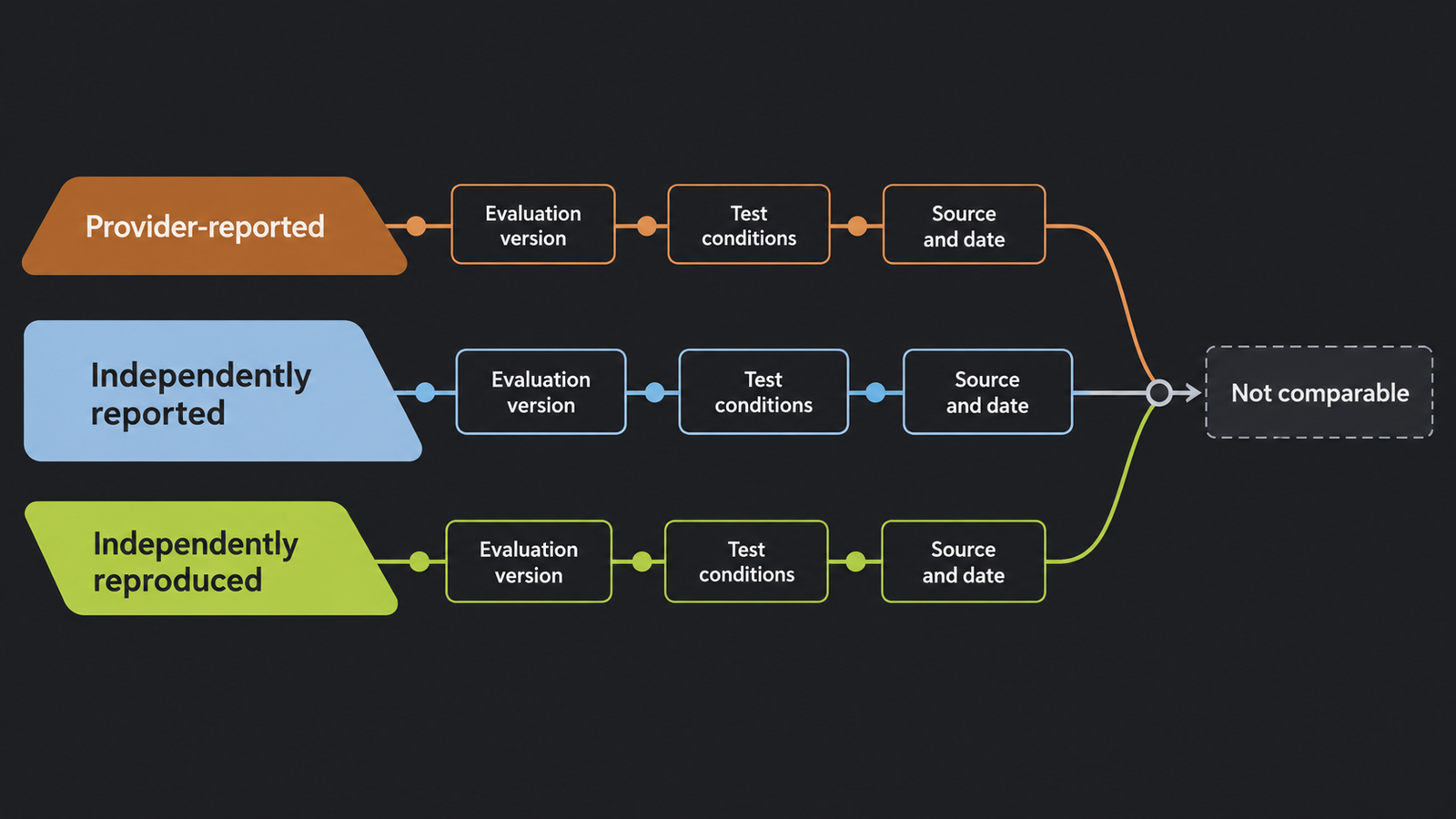
We sorted every number into tiers:
| Label | Meaning | Count in our table |
|---|---|---|
| A, independently reproduced | A third party re-ran the provider’s claim and matched it | 0 |
| B, independently reported | A third party ran the test itself (Artificial Analysis, Epoch AI, ARC Prize) | ARC-AGI-2, GPQA for GPT-6.1 Sol, and the AA Index column |
| C, provider-reported | The model’s developer, or a rival lab, published it | Most GPQA, MMLU-Pro and SWE-bench cells |
| U, unverified or not comparable | Conflicting values, merged rows, or mismatched test versions | GPT-6 variants on ARC-AGI-2; MiMo’s DeepSWE figure |
The MiMo case shows why the U label exists. Xiaomi’s model card gives MiMo-V2.6-Pro 71.9 on DeepSWE v1.1, while its own release post gives 72.6. Neither appears in our table, because the provider hasn’t settled which is right.
Even a B-tier score only tells you how a model did on someone else’s tasks. For the long version of that argument, see why benchmark scores fail to predict production performance.
Contamination audit
Contamination means test questions or answers ended up in training data, so a model can score well by recall instead of reasoning. Here’s what we could establish for each benchmark.
| Benchmark | Contamination status | Evidence | What to do |
|---|---|---|---|
| SWE-bench Verified | Confirmed | OpenAI (23 Feb 2026) reported that “all frontier models we tested were able to reproduce the original, human-written bug fix” and found material issues in 59.4% of 138 audited problems | Treat scores as upper bounds. Prefer SWE-bench Pro. |
| SWE-bench Pro (public) | Risk, lower | OpenAI says it shows less contamination, but the public split is still public | Use alongside your own repo tasks |
| MMLU-Pro | Risk | Public since 2024; scores bunched at the top | Use only to screen out weak models |
| GPQA Diamond | Risk | Public question set since 2023; near ceiling | Don’t use it to rank frontier models |
| AIME 2024/2025 | High risk | Problems and solutions widely published before current training cutoffs | Prefer contests held after a model’s cutoff, such as HMMT Feb 2026 |
| ARC-AGI-2 | Structurally reduced | Verified scores use a semi-private set | The most trustworthy cross-model column here |
| Long-context (MRCR, AA-LCR) | Unknown | Synthetic and partly in-house, so not checkable by outsiders | Re-test at your own document lengths |
A “risk” label isn’t an accusation. It means the test material is public and no one has published evidence either way for these specific models.
Cost and deployment
A higher score is worth paying for only if it changes outcomes on your work. List prices from the providers (per million tokens, input / output):
| Model | Input | Output | Notes |
|---|---|---|---|
| Claude Opus 5.5 | $4.00 | $20.00 | Fast mode $8 / $40 |
| GPT-6.1 Sol | $2.00 | $10.00 | |
| Mistral Large 4 | $1.36 | $4.18 | List price; discounted to $0.68 / $2.09 at the time of checking. Preview. |
| GPT-6 Luna | $0.10 | $0.50 |
The providers also differ in how many tokens they use per task. Artificial Analysis puts the cost of running its full Intelligence Index at $5.98 per task for Opus 5.5, $1.06 for GPT-6 Sol, $0.13 for MiMo-V2.6-Pro and $0.07 for GPT-6 Luna. Opus 5.5 also produced 260 million output tokens across the index, against a median of 85 million.
Illustrative example (not a measurement). Suppose a support-summary workload sends 10,000 requests a day, each with 3,000 input tokens and 800 output tokens. That’s 30 million input and 8 million output tokens a day. At list prices, ignoring caching and reasoning tokens:
| Model | Daily cost | 30-day cost |
|---|---|---|
| Claude Opus 5.5 | $280.00 | $8,400.00 |
| GPT-6.1 Sol | $140.00 | $4,200.00 |
| Mistral Large 4 (list) | $74.24 | $2,227.20 |
| GPT-6 Luna | $7.00 | $210.00 |
Now divide by success rate. If, on your own test set, the cheapest model produced acceptable summaries 70% of the time and the most expensive 95% of the time, the useful comparison is cost per accepted summary plus the cost of handling the failures. These rates are hypothetical, which is the point. No public benchmark in this article can give them to you.
Deployment constraints narrow the list before price does. Gemini 3.1 Pro and Mistral Large 4 were still preview releases when we checked. DeepSeek V4 Pro (MIT), MiMo-V2.6 (MIT), Kimi K3 (its own licence) and Mistral Large 4 publish weights, which matters if data must stay on your own hardware. At 1.6T to 2.8T total parameters, though, self-hosting the large open models is a serious infrastructure project.
A 7-step model selection workflow
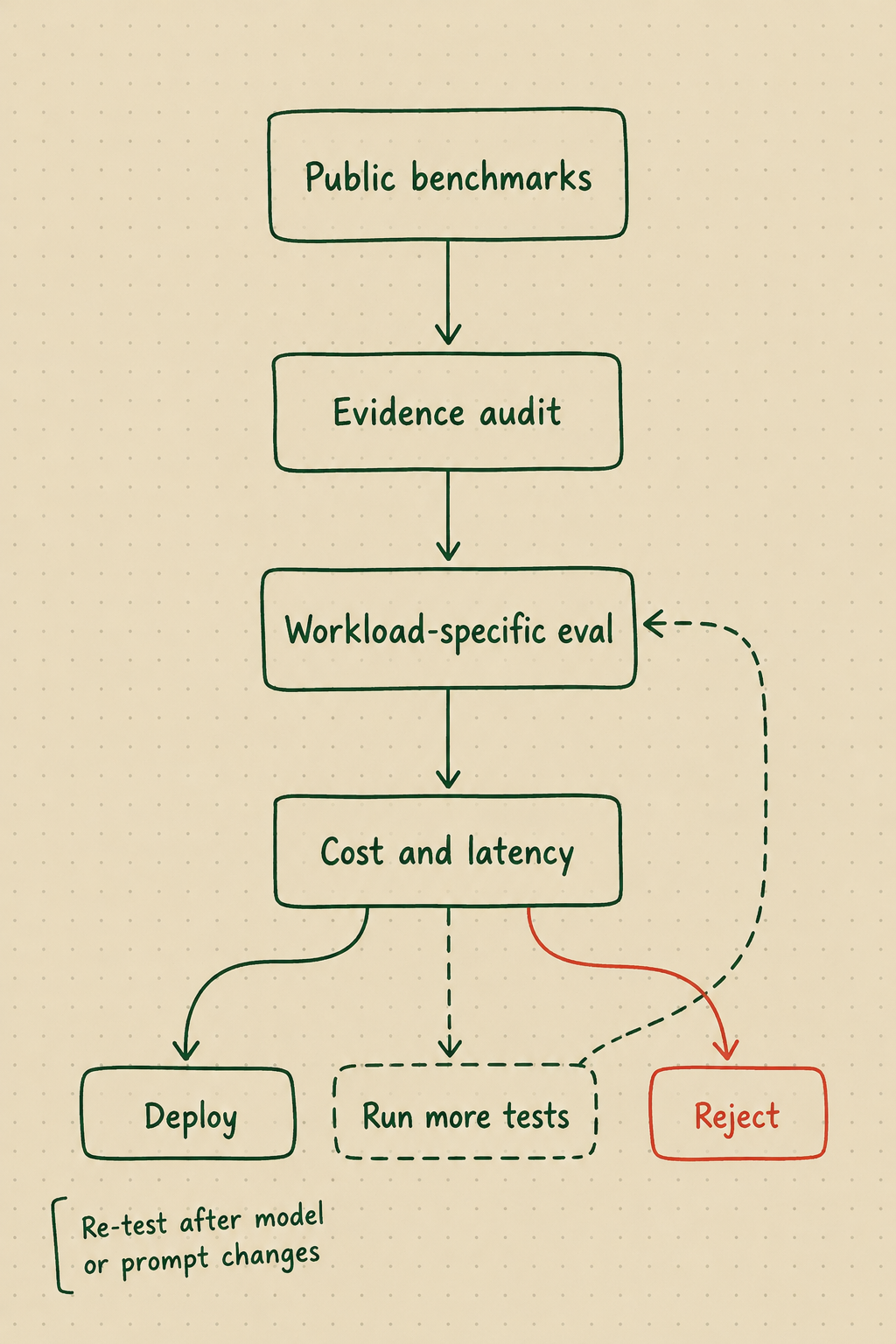
- Write down the job. Name the task, the inputs, and what a correct output looks like. One paragraph is enough.
- Filter on hard constraints. Licence, data residency, context length, preview versus stable status, and budget ceiling. Most candidates drop out here.
- Use public benchmarks only as a screen. Choose the one or two tests closest to your job, and prefer B-tier results. Drop models that are clearly behind, but don’t rank the rest.
- Audit the evidence. For each score you rely on, record who ran it, the version, the settings and the date. If you can’t fill those in, mark it U.
- Build a workload eval. Use 50–200 real, anonymised examples with a written grading rubric. Hold some back so you aren’t tuning prompts against the whole set.
- Measure cost and latency on that eval. Record tokens used, cost per accepted output and response time, not just accuracy.
- Decide, then re-test. Deploy, run more tests, or reject. Re-run the eval whenever the model version or your prompts change.
Template
| Field | Entry |
|---|---|
| Task and success definition | |
| Hard constraints (licence, region, context, budget) | |
| Shortlisted models and exact model IDs | |
| Public scores used (benchmark, version, value, label, source, date) | |
| Workload eval size and rubric location | |
| Accuracy on workload eval | |
| Cost per accepted output | |
| Median and p95 latency | |
| Decision (deploy / run more tests / reject) and reason | |
| Re-test trigger and date |
UniverseBlend verdict
In October 2026, public benchmarks can tell you which models are in the frontier group. They can’t tell you which one to pick. On independent evidence, GPT-6.1 Sol, the GPT-6 family and Claude Opus 5.5 lead ARC-AGI-2 at 93–95%, and Opus 5.5 leads the Artificial Analysis composite at 58. Gemini 3.8 Flash is close behind at a Flash price tier. The open-weight models with ARC Prize results (DeepSeek V4 Pro and V4.1 Flash, Kimi K3) score 60.4–72.9% on ARC-AGI-2, roughly 20 to 35 points behind, while DeepSeek’s and Moonshot’s own GPQA and SWE-bench numbers put them close to the frontier. That gap between independent and self-reported results is the most useful signal in this table.
We can’t rank Qwen 4 (no verified release) or Mistral Large 4 (no published scores yet). Our advice is to screen with ARC-AGI-2 and the composite indexes, ignore SWE-bench Verified, and make the real decision on your own eval.
FAQ
Which LLM has the highest benchmark scores in 2026?
It depends on the test. Among independently reported results we found, GPT-6.1 Sol leads ARC-AGI-2 for a single named model at 94.2%, GPT-6 Astra leads GPQA Diamond at 96.3%, and Claude Opus 5.5 leads the Artificial Analysis Intelligence Index at 58.
Why doesn’t OpenAI report SWE-bench Verified?
In February 2026 OpenAI said it had stopped, after finding that frontier models could reproduce the original fixes and that many audited problems had flawed tests. It recommends SWE-bench Pro instead.
Is Qwen 4 out?
We found no verified release as of 14 October 2026. Qwen3.8 models exist, but they’re a different generation, and we didn’t substitute them.
Are provider-reported benchmark scores reliable?
They’re useful but not neutral. Providers choose the effort setting, harness and number of attempts, and those choices often differ from the ones used for rival models in the same chart.
What is the best benchmark for comparing models today?
No single one. ARC-AGI-2 has the broadest independent coverage and a semi-private test set. For any real decision, a small eval built from your own work is more predictive.
How often should I re-test a model?
Whenever the model version, your prompts or your task mix changes, and at least once a quarter for production systems.
Keep reading
Here are the latest posts from the blog.

LLM Benchmark Scores 2026: Every Model Compared
Anthropic Unplugged Its Evals. What AI Agent Containment Costs

When Adding an Agent Stops Paying for Itself