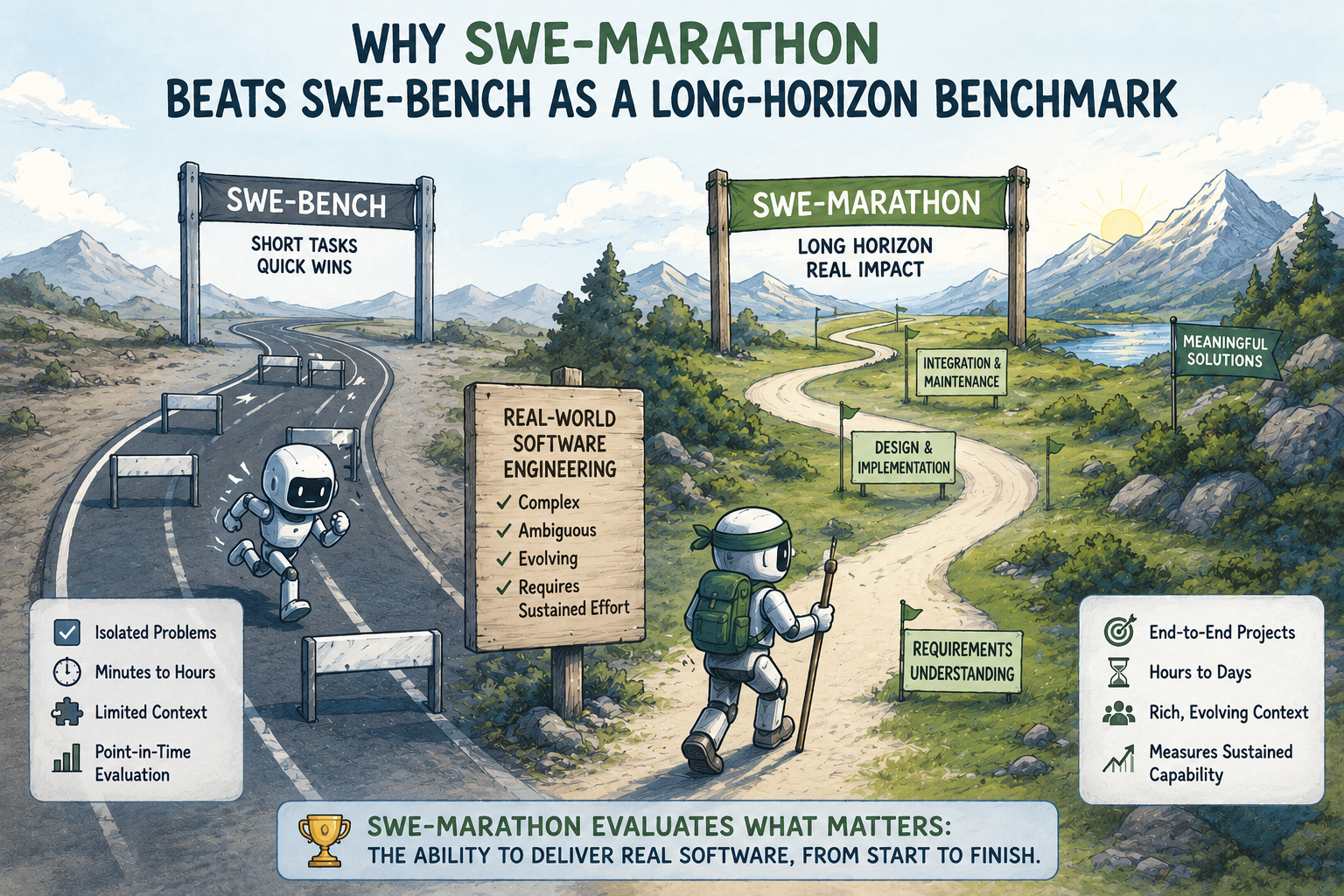
The conversation around long horizon agentic benchmarks why SWE-Marathon matters has hit a genuine tipping point — and honestly, it’s been a long time coming. Software engineering benchmarks are supposed to measure real coding ability. However, the industry’s most popular benchmark — SWE-Bench — is showing serious cracks. Benchmark contamination, short-task bias, and inflated scores are quietly undermining trust in AI evaluation.
SWE-Marathon emerged as a direct response to these failures. It tests what developers actually do: multi-step, multi-file debugging sessions that stretch across hours, not minutes. Understanding long horizon agentic benchmarks and why SWE-Marathon represents a genuine shift is essential for anyone seriously evaluating AI coding agents today.
Why SWE-Bench Falls Short for Real-World Developer Work
Benchmark Contamination: The Hidden Crisis in AI Evaluation
How SWE-Marathon Redefines Long Horizon Agentic Benchmarks
Validation Frameworks That Ensure Benchmark Integrity
What This Means for Teams Evaluating AI Coding Agents
Why SWE-Bench Falls Short for Real-World Developer Work
SWE-Bench launched with a genuinely compelling premise. It pulled real GitHub issues from popular Python repositories and asked AI agents to resolve them. The benchmark quickly became the gold standard — and consequently, every major AI lab started optimizing hard for it.
But here’s the thing: most SWE-Bench tasks are narrow, isolated fixes that typically involve single-file edits with clear error messages. A skilled developer might knock them out in under 30 minutes. Real software engineering rarely works that way, and that gap matters enormously.
The core limitations include:
- Short task horizons — average resolution requires fewer than 50 lines of code changes
- Single-repository focus — no cross-project dependencies or integration challenges
- Narrow scope — most tasks involve bug fixes, not feature development or architectural decisions
- Limited context windows — agents don’t need to reason across large codebases
- Predictable patterns — solutions often follow templated fix patterns that are surprisingly easy to game
Furthermore, the benchmark’s popularity created a perverse incentive. AI labs began training specifically on SWE-Bench task patterns. Some models essentially memorized solutions from training data that overlapped with test cases. This is benchmark contamination, and it’s a bigger problem than most vendors will admit.
Notably, research from Epoch AI has highlighted how benchmark saturation distorts our understanding of actual model capabilities. When every model scores above 40% on SWE-Bench, the benchmark loses its ability to separate genuine progress from optimization tricks. This pattern plays out with benchmark after benchmark — it’s almost clockwork.
Benchmark Contamination: The Hidden Crisis in AI Evaluation
Understanding long horizon agentic benchmarks and why SWE-Marathon addresses contamination requires examining exactly how benchmarks fail. Contamination happens through several mechanisms, and each one quietly erodes validity.
Direct data leakage occurs when benchmark test cases appear in training data. SWE-Bench draws from public GitHub repositories — the same repositories that exist in most large language model training sets. Therefore, models may have already seen the problems and their solutions during training. It’s a bit like grading a student on homework they’ve already submitted.
Indirect contamination is subtler and honestly more insidious. Models trained on coding forums, blog posts, and documentation absorb solution patterns. When SWE-Bench tasks follow common bug-fix templates, contaminated models perform artificially well. Meanwhile, their performance on genuinely novel tasks stays poor — which is the part that actually matters for real work.
Detection methods for benchmark contamination include:
1. N-gram overlap analysis — comparing benchmark solutions against known training corpora
2. Canary string insertion — embedding unique identifiers in benchmark data to trace leakage
3. Performance gap analysis — comparing scores on contaminated vs. clean subsets
4. Temporal filtering — using only issues created after model training cutoff dates
5. Perturbation testing — modifying task descriptions slightly and measuring score drops
Specifically, perturbation testing reveals contamination most effectively. If a model solves a task perfectly but falls apart when you rephrase the issue description, it almost certainly memorized the answer. Genuine understanding survives paraphrasing — memorization doesn’t.
The HELM benchmark framework from Stanford pioneered systematic contamination detection. Their methodology inspired similar efforts across the evaluation community. Nevertheless, most benchmarks still lack solid contamination safeguards — a frustrating gap given how well-understood the problem is.
This is precisely where long horizon agentic benchmarks shine. Why SWE-Marathon resists contamination better comes down to task complexity. Multi-hour, multi-step tasks are exponentially harder to memorize than single-file fixes — and that’s not an accident of design.
How SWE-Marathon Redefines Long Horizon Agentic Benchmarks
SWE-Marathon takes a fundamentally different approach to measuring AI coding ability. Instead of isolated bug fixes, it presents agents with complex, multi-step software engineering challenges. These mirror what professional developers actually encounter on a Tuesday afternoon.
The ambiguity baked into the task specs isn’t a bug — it’s the whole point.
Key design principles of SWE-Marathon:
- Extended time horizons — tasks require sustained reasoning over hours, not minutes
- Multi-file coordination — solutions span multiple files, modules, and sometimes repositories
- Ambiguous specifications — task descriptions mirror real-world issue reports with incomplete information
- Integration complexity — changes must work within existing test suites and CI pipelines
- Iterative debugging — agents must read error outputs and adjust their approach repeatedly
Additionally, SWE-Marathon introduces dynamic task generation. New tasks are created from recent, post-training-cutoff code changes, which dramatically reduces contamination risk. Models can’t memorize what didn’t exist during training — that’s an elegant solution to a genuinely hard problem.
The benchmark also measures process quality, not just outcomes. It tracks how agents explore codebases, form hypotheses, and recover from mistakes. A model that stumbles but self-corrects shows stronger engineering ability than one that pattern-matches to a memorized solution. In production, that distinction matters enormously.
Table: scroll sideways to view all columns when needed.
| Feature | SWE-Bench | SWE-Marathon |
|---|---|---|
| Average task duration | 10–30 minutes | 2–8 hours |
| Files modified per task | 1–2 | 5–15+ |
| Lines of code changed | ~50 | ~200–500 |
| Contamination resistance | Low | High |
| Cross-repo reasoning | No | Yes |
| Ambiguity in task specs | Low | High |
| Process evaluation | No | Yes |
| Dynamic task generation | No | Yes |
| Real-world fidelity | Moderate | High |
The gap between these two benchmarks isn’t incremental — it’s structural. That’s why the conversation around why SWE-Marathon represents the future of long horizon agentic benchmarks isn’t really debatable at this point.
Moreover, the benchmark’s design aligns with how software engineering research defines professional competence. Real developers don’t just fix bugs — they handle ambiguity, manage complexity, and maintain code quality across large systems that other people built and half-documented.
Validation Frameworks That Ensure Benchmark Integrity
A benchmark is only as trustworthy as its validation framework. Full stop.
When discussing long horizon agentic benchmarks and why SWE-Marathon earns credibility, validation methodology matters enormously. This is where a lot of otherwise smart evaluation efforts fall apart.
Temporal isolation is the first line of defense. Benchmark tasks should use code created after the latest model training cutoff. SWE-Marathon enforces this strictly. Consequently, even if a model trained on all of GitHub through 2024, tasks from 2025 remain uncontaminated. It’s not a perfect solution, but it’s a meaningful one.
Adversarial validation involves deliberately testing for memorization. Evaluators create modified versions of tasks with identical logic but different surface features. If a model’s performance drops significantly on modified versions, contamination is almost certainly present. Running this kind of testing is time-consuming — but skipping it is how you end up trusting numbers you shouldn’t.
Human baseline calibration ensures tasks are appropriately difficult. SWE-Marathon has professional developers attempt each task independently. Their completion times and success rates establish ground truth, and AI agent performance is then measured against these human baselines. That detail keeps the benchmark honest.
Multi-dimensional scoring captures more than pass/fail outcomes. Specifically, SWE-Marathon evaluates:
- Correctness — does the solution pass all tests?
- Code quality — does it follow project conventions?
- Efficiency — does it avoid unnecessary changes?
- Robustness — does it handle edge cases?
- Process quality — did the agent reason systematically?
Similarly, the MLCommons organization has established standards for reproducible AI benchmarking. Their protocols stress transparency, reproducibility, and contamination resistance — and SWE-Marathon adopts many of these principles directly.
Although no benchmark is perfectly contamination-proof, layered validation dramatically reduces risk. The combination of temporal isolation, adversarial testing, and human calibration creates a solid integrity framework. This multi-layered approach is what separates serious long horizon agentic benchmarks from leaderboard fodder.
What This Means for Teams Evaluating AI Coding Agents
If you’re choosing an AI coding agent for your team, benchmark scores matter — but which benchmark you trust matters more. The signal quality across different evaluation frameworks varies wildly.
Understanding long horizon agentic benchmarks and why SWE-Marathon provides better signal directly affects real purchasing decisions. Frankly, a lot of teams are getting this wrong.
Practical evaluation steps for engineering leaders:
1. Don’t trust single-benchmark claims. Any vendor citing only SWE-Bench scores is telling an incomplete story. Ask for SWE-Marathon results or comparable long-horizon evaluations — and notice how they respond to that ask.
2. Request contamination analysis. Ask vendors whether their models were trained on data overlapping with benchmark test sets. Reputable companies will have clear answers ready.
3. Run your own evaluations. Use your team’s actual codebase as a test environment. Give the AI agent real issues from your backlog. Nothing beats domain-specific testing, and this step alone will tell you more than any leaderboard.
4. Measure time-to-resolution, not just accuracy. An agent that solves 60% of tasks quickly and correctly may outperform one that solves 80% but requires heavy human review and cleanup.
5. Evaluate failure modes. How does the agent behave when stuck? Does it hallucinate solutions, loop endlessly, or escalate gracefully? SWE-Marathon specifically tests recovery behavior — and that’s the real kicker for production use.
Furthermore, consider the NIST AI Risk Management Framework when evaluating AI tools for production use. Benchmark integrity feeds directly into risk assessment. Inflated benchmark scores lead to overconfidence, which leads to deployment failures that are genuinely painful to untangle.
The shift toward long horizon agentic benchmarks also affects hiring and investment decisions. Teams that understand why SWE-Marathon provides better signal can avoid overpaying for agents that ace simple tests but stumble on real work.
Importantly, this isn’t about declaring SWE-Bench worthless. It still provides useful signal for narrow coding tasks. However, it shouldn’t be the primary criterion for agents handling complex software engineering work. The two benchmarks measure different things — and smart evaluators use both.
The Road Ahead for Long Horizon Agentic Benchmarks
The evolution of AI benchmarks follows a predictable pattern. A benchmark launches, gains popularity, gets saturated, and then a better one replaces it. We’re watching this cycle play out right now — and it’s moving faster than most people realize.
Emerging trends in benchmark design include:
- Continuous benchmark refresh — regularly rotating tasks to prevent contamination buildup
- Multi-modal evaluation — testing code generation alongside documentation, testing, and deployment tasks
- Collaborative benchmarks — measuring how AI agents work alongside human developers, not just solo
- Domain-specific variants — separate benchmarks for web development, systems programming, data engineering, and more
- Adversarial robustness testing — deliberately crafting tasks designed to expose model weaknesses
Additionally, the open-source community is building tools to make benchmark creation more accessible. Projects on GitHub now offer frameworks for generating custom evaluation suites. Teams can create benchmarks tailored to their specific tech stacks and workflows — no more forcing your evaluation into someone else’s template.
Nevertheless, standardization remains critical. Without agreed-upon evaluation protocols, benchmark comparisons become meaningless noise. The community needs shared standards for task difficulty, contamination testing, and scoring methodology — and that consensus is still forming.
The trajectory is clear. Long horizon agentic benchmarks will become the default evaluation method. Why SWE-Marathon succeeds where predecessors failed comes down to three factors: contamination resistance, real-world fidelity, and process-aware evaluation. These aren’t optional features — they’re requirements for meaningful AI assessment.
Conversely, benchmarks that don’t adapt will lose relevance. SWE-Bench can evolve — and likely will — but the fundamental design constraints around short task horizons limit how much improvement is possible within its current framework. That’s not a criticism so much as an acknowledgment of architectural reality.
Conclusion
The question of long horizon agentic benchmarks and why SWE-Marathon represents a better evaluation approach isn’t academic. It has real consequences for how organizations invest in AI tools, how developers trust AI assistants, and how the industry measures genuine progress.
SWE-Bench served its purpose well. It established a shared baseline and moved the conversation forward. However, its susceptibility to contamination, short task horizons, and narrow scope make it insufficient for evaluating modern agentic systems. SWE-Marathon addresses each of these weaknesses directly — and the difference in signal quality is substantial.
Bottom line: if you’re serious about evaluating AI coding agents, you need long horizon agentic benchmarks in your toolkit. That’s why SWE-Marathon deserves your attention right now.
Your actionable next steps:
- Audit your current evaluation process. Are you relying solely on SWE-Bench scores? If so, supplement with long-horizon evaluations immediately.
- Demand transparency from vendors. Ask about contamination testing, training data overlap, and multi-benchmark performance — and treat vague answers as a red flag.
- Pilot SWE-Marathon evaluations. Test your current AI coding tools against its task suite. Compare results with SWE-Bench scores to identify discrepancies worth investigating.
- Build internal benchmarks. Use your own codebase and real issues to create evaluation suites that reflect your actual needs.
- Stay informed. Benchmark methodology evolves quickly. Follow research from organizations working on long horizon agentic benchmarks to understand why SWE-Marathon and similar efforts matter for your team’s decisions.
The future of AI evaluation belongs to benchmarks that resist gaming, mirror real work, and measure genuine capability. SWE-Marathon is leading that charge — and the teams that recognize it early will have a meaningful advantage.
FAQ
What are long horizon agentic benchmarks?
Long horizon agentic benchmarks are evaluation frameworks that test AI agents on extended, multi-step tasks. Unlike traditional benchmarks with quick, isolated problems, these require sustained reasoning over hours. They measure an agent’s ability to handle complex codebases, work through ambiguity, and recover from mistakes — much like a real developer would on an actual project.
Why is SWE-Marathon considered better than SWE-Bench?
SWE-Marathon tests capabilities that SWE-Bench simply doesn’t measure. Specifically, it evaluates multi-file coordination, extended debugging sessions, and process quality. Furthermore, its dynamic task generation and temporal isolation make it far more resistant to benchmark contamination. Understanding long horizon agentic benchmarks and why SWE-Marathon matters comes down to real-world fidelity — it tests what developers actually do, not a simplified version of it.
How does benchmark contamination affect AI evaluation results?
Benchmark contamination inflates scores artificially. When AI models encounter test problems they’ve already seen during training, they can pattern-match to solutions without genuine understanding. Consequently, contaminated benchmarks overstate model capability — and that leads organizations to deploy AI tools that perform well on tests but fail on novel, real-world tasks. It’s a gap that tends to surface at the worst possible moments.
Can SWE-Bench and SWE-Marathon be used together?
Absolutely — and honestly, using both is the smarter approach. They measure different dimensions of coding ability. SWE-Bench remains useful for evaluating quick bug-fix capabilities, while SWE-Marathon assesses complex, long-duration engineering tasks. Using both provides a more complete picture. However, for evaluating agentic AI systems designed for substantial engineering work, SWE-Marathon provides stronger signal by a considerable margin.
What contamination detection methods are most effective?
Perturbation testing and temporal filtering are the most reliable methods. Perturbation testing modifies task descriptions while keeping the underlying problem the same — if performance drops sharply on modified versions, contamination is likely present. Temporal filtering uses only tasks created after model training cutoffs. Additionally, n-gram overlap analysis and canary string insertion provide supplementary detection worth layering in.
How should engineering teams evaluate AI coding agents going forward?
Teams should adopt a multi-benchmark evaluation strategy — no single score tells the full story. Run agents against long horizon agentic benchmarks like SWE-Marathon to understand why real-world performance often diverges from leaderboard rankings. Moreover, test agents on your own codebase with actual issues from your backlog. Measure time-to-resolution, code quality, and failure behavior alongside raw accuracy. That combination will tell you far more than any vendor-provided benchmark summary ever will.
References
Keep reading
Here are the latest posts from the blog.
The 167x AI pricing gap between the cheapest and most expensive large language models isn’t just a fun trivia fact. It’s a decision that can make or break your monthly AI bud…
The ‘ChatGPT moment’ for robotics is closer than most people are giving it credit for. Foundation models — those massive AI systems trained on enormous datasets — are doing f…
The promise sounds almost too good to be true. One software platform, every robot in your fleet, regardless of who built them. Why hardware agnostic AI why Robostral Navigate…
1 thought on “Best Long-Horizon Benchmark: Why SWE-Marathon Beats SWE-Bench”