Market data and filings checked to the close of trading on 24 November 2026.
Institutions paid $83 a share in the Anthropic IPO. When the stock first traded on Nasdaq on 19 November, the price was $111.50. Four sessions later, on 24 November, it closed at $81.91, below the offer price.
Three prices in six days, for the same company, the same filings and the same Claude business. The Anthropic IPO raised $93.5 billion from public investors, the largest offering on record, and a further $26 billion from chipmakers and cloud partners in a separate private placement. Yet the market has already shown it hasn’t settled on what Anthropic is worth. This article treats the listing as three tests, and asks what each says about valuing a frontier AI company that is growing quickly while committing about $900 billion to future compute.
Key Takeaways
- The Anthropic IPO priced at $83 a share, above the $70 to $78 range, and the base deal grew from 825 million to 980 million shares.
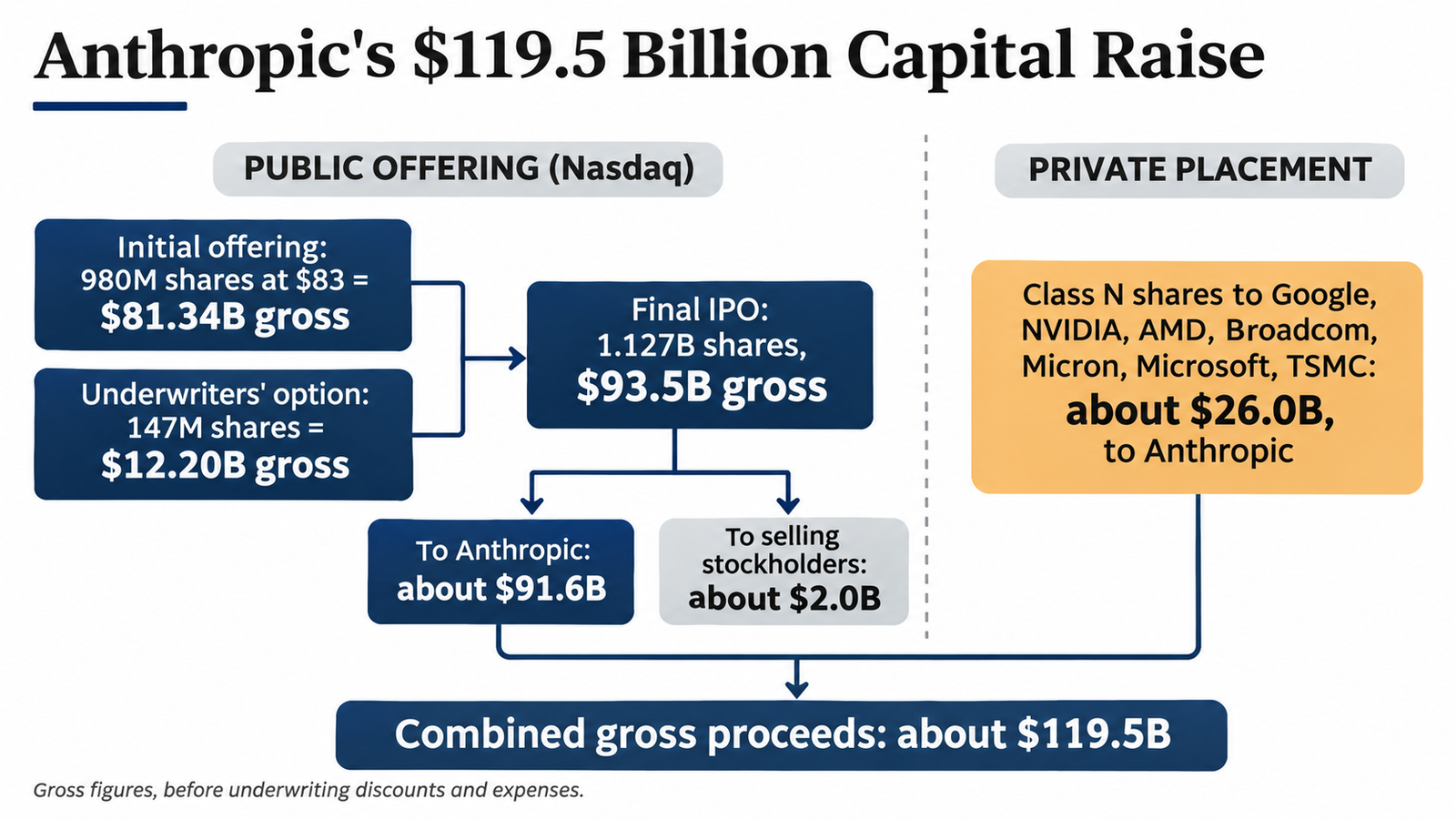
- The final public offering was 1.127 billion shares and $93.5 billion gross, after the 147 million-share option was exercised in full. About $91.6 billion went to Anthropic.
- The $26 billion Class N placement was separate. Combined gross proceeds were about $119.5 billion, not all from public investors.
- $1.5 trillion is a fully diluted valuation. On shares outstanding, $83 was about $1.11 trillion.
- The stock opened at $111.50, closed day one at $97.17 and closed at $81.91 on 24 November, below the offer price after four sessions.
- Aggregate compute commitments are now about $900.9 billion in the final prospectus, with $70.7 billion due in the 12 months after 30 September. They are commitments, not debt.
- Revenue is growing fast but profit is uneven: $16.96 billion in Q3, an operating loss of $567 million, and a net loss driven mostly by non-cash charges.
Quick Navigation
- Test 1: what investors agreed to pay in the Anthropic IPO
- Test 2: what the market paid on Anthropic IPO day
- Test 3: why Anthropic IPO shares fell below $83
- The $900.9 billion compute commitment behind the Anthropic IPO
- Anthropic's revenue and compute economics
- What Anthropic IPO investors are paying for
- What the Anthropic IPO changes for the AI industry
- FAQ
- When did Anthropic go public?
- What was the Anthropic IPO price?
- How much money did the Anthropic IPO raise?
- What is Anthropic's ticker symbol?
- Why did Anthropic price its IPO at $83?
- What valuation did the Anthropic IPO imply?
- Why did Anthropic shares fall below $83?
- What are Anthropic's compute commitments?
- Is Anthropic profitable?
- How does the Anthropic IPO affect the AI industry?
- Closing perspective
Test 1: what investors agreed to pay in the Anthropic IPO
The first test happened before any shares traded. An IPO price is the price at which underwriters sell newly issued and existing shares to institutional investors. It is set after weeks of marketing, and it reflects demand from those buyers, not from the public market.
The Anthropic IPO pricing decision
Anthropic filed a price range of $70 to $78 on 10 November, for 825 million Class A shares. On 18 November it priced at $83, $5 above the top of the range, and enlarged the deal to 980 million shares. The final prospectus splits them into 956,351,354 new shares from Anthropic and 23,648,646 sold by existing holders.
Pricing above the range and selling more shares are both signs that institutional orders exceeded supply. It meant Anthropic raised more money and issued fewer shares per dollar than the range implied. It also meant less of a cushion for anyone buying on the first day.
The Anthropic IPO valuation journey
The same company has carried several valuations in seven weeks. They are not measured the same way, and only some come from Anthropic itself.
| Date | Development | Financial figure | Evidence status |
|---|---|---|---|
| Early October | Investor expectations ahead of a listing | Up to $2 trillion | Press-reported |
| 6 November | Prospective buyers’ discussions (Bloomberg) | $1.2T to $1.3T; some as low as $1.1T | Anonymous-source reporting |
| 10 November | Price range filed | $70 to $78 a share; about $1.26T to $1.40T fully diluted | SEC-filed range; valuation calculated |
| 18 November | IPO priced | $83 a share; about $1.5T fully diluted, $1.11T on shares outstanding | SEC-filed price; valuations reported and calculated |
| 19 November | First trade and first close | $111.50 open (about $2.0T fully diluted); $97.17 close | Market data |
| 20 November | Underwriters’ option exercised in full | 1.127 billion shares; $93.5B gross | Company-disclosed |
| 24 November | Close below offer price | $81.91; about $1.5T, per Bloomberg | Market data |
The early figures were conversations, not offers. The 6 November Bloomberg report, by Bailey Lipschultz, Julien Ponthus and Levin Stamm, attributed its ranges to people familiar with the matter, and the $1.1 trillion figure to just one of them. None of the pre-pricing numbers was ever an Anthropic valuation.
What the $83 price actually meant
A share price becomes a valuation only once you multiply it by a share count, and there are two reasonable counts. After the offering and the option exercise, the prospectus shows 13.37 billion shares outstanding. At $83, that is about $1.11 trillion.
The more widely quoted $1.5 trillion is a fully diluted figure. The Financial Times put it at about $1.49 trillion. That count adds employee stock options, restricted stock units and other securities that could become shares, which implies roughly 18 billion shares. The prospectus lists 1.77 billion Class A shares under options and over 1 billion under unvested RSUs, which shows how large the gap is.
Neither number is wrong. They answer different questions. Market capitalisation on a trading screen usually uses shares outstanding, while fully diluted value is closer to what the whole company would cost if every claim on it became stock.
Test 2: what the market paid on Anthropic IPO day
The Anthropic IPO opening at $111.50
The first trade on 19 November was at $111.50, 34.3% above the offer price. On a fully diluted basis that briefly valued Anthropic at about $2 trillion, the figure investors had talked about in October. The stock touched $115.10, then slid below $100 within the first hour.
It closed at $97.17. That was 17.1% above the IPO price but 12.9% below the opening trade, according to CNBC. Institutions that bought at $83 had a paper gain, while anyone who bought the first public trade was already down.
The broader market was weak that day. The Nasdaq Composite fell about 2.3%, and the Associated Press reported investor anxiety over the ouster of Nvidia’s chief executive and talk of an AI bubble. Anthropic rose in a falling market, which says something about demand for the shares on day one.
The $93.5 billion final offering
The headline figure on listing day was $81.34 billion: 980 million shares at $83. That number grew the next day. Underwriters typically sell more shares than the base deal and hold an option to buy extra shares from the company to cover the gap. This is the over-allotment, or greenshoe, option. On 20 November Anthropic announced that the 147 million-share option had been exercised in full.
| Component | Shares or transaction | Gross amount | Who receives the proceeds |
|---|---|---|---|
| Base offering: new shares | 956,351,354 Class A | $79.38B | Anthropic |
| Base offering: existing shares | 23,648,646 Class A | $1.96B | The seven co-founders, as selling stockholders |
| Underwriters’ option | 147,000,000 Class A | $12.20B | Anthropic |
| Final public offering | 1,127,000,000 Class A | $93.5B | Anthropic about $91.6B; selling stockholders about $2.0B |
| Concurrent private placement | 313,253,007 Class N at $83 | About $26.0B | Anthropic |
| Combined gross proceeds | About $119.5B |
The private placement is separate from the IPO. Google and Nvidia each bought about $10 billion of Class N common stock, with AMD, Broadcom, Micron, Microsoft and TSMC buying smaller amounts. These shares were sold privately to strategic partners, outside the registered offering. They should not be counted as money raised from public investors.
All these figures are gross. The underwriting discount was unusually thin at $0.56 a share, about 0.7%, and nothing on the option shares. The prospectus estimates Anthropic’s net proceeds from the IPO and placement together at about $117.0 billion with the option exercised.
Test 3: why Anthropic IPO shares fell below $83
The third test is still running. After the first-day close, the shares slipped on each of the next three sessions. On 24 November they fell below $83 in premarket trading, touched an intraday low of $75.61 and closed at $81.91, down 6.5% on the day.
That close was 1.3% below the IPO price, 15.7% below the first-day close and 26.5% below the opening trade. Reuters, writing during the session, reported the stock down 12.6% at $76.60. That was an intraday reading, not the close. Bloomberg put Anthropic’s value at about $1.5 trillion at the closing price. That appears to be a fully diluted figure: on shares outstanding, $81.91 is about $1.09 trillion.
Several explanations were offered, and no single one is established. Reuters pointed to a broader technology selloff, worries about AI valuations and infrastructure spending as interest rates rise, and cheaper open-weight models from rivals. It also noted the founders’ share sales: Dario and Daniela Amodei each sold 3,378,378 shares at the offer price, about $280 million apiece, as part of the IPO. CNBC noted that SpaceX took 21 trading days to fall below its offer price after its June listing, against four for Anthropic.
There is also a mechanical factor. A fully exercised over-allotment option means underwriters covered their extra sales by buying from Anthropic, not in the market, so there is no stabilising buyer for the shares. Four days of trading don’t settle whether the IPO was priced well. They show the first public investors had a less generous view than the institutions did.
The $900.9 billion compute commitment behind the Anthropic IPO
The number public investors are weighing hardest is not on the cover of the prospectus. In its final filing, Anthropic says that as of and after 30 September it has entered into purchase commitments and leases with “an aggregate committed spend of approximately $900.9 billion, substantially all of which is related to compute and infrastructure.”
That is not debt and not money already spent. It is a schedule of future payments for cloud capacity, chips and data centres, much of it for facilities not yet built. The filing expects about $451.6 billion before the end of 2030 and most of the rest between 2031 and 2045. About $70.7 billion falls due in the 12 months after 30 September.
Roughly half the total, $451.2 billion, is data centre leases that have been signed but have not yet started. About $186.2 billion, or 21%, is subject to termination rights or conditions, such as a partner securing financing or permits. The filing also estimates a further $150 billion to $175 billion under arrangements with no fixed dollar amount, which are not in the total.
From $518 billion to $900.9 billion
The figures have moved quickly. In October, reporting on Anthropic’s confidential filing put commitments at about $518 billion, as covered in the earlier $518 billion infrastructure commitment analysis. The public S-1/A on 2 November disclosed $895.4 billion, a broader measure that included leases not yet commenced and contracts signed after the quarter. The final prospectus raised it again to $900.9 billion, as about $5.5 billion of new commitments were added.
One change cuts the other way. Between the two filings, the conditional or terminable portion fell from $213.8 billion to $186.2 billion, which suggests some deals moved from conditional to firm. For a fuller breakdown of the components, see our earlier analysis of Anthropic’s $895.4 billion compute commitments.
Investors care because these commitments are fixed while revenue isn’t. If demand keeps growing, early access to scarce compute is an advantage. If it slows, or if models become cheaper to run, Anthropic is still paying for capacity it contracted years earlier. Chips also lose value quickly, so leased capacity can become outdated before the lease ends.
Anthropic’s revenue and compute economics
Revenue is the strongest part of the case. The 2 November S-1/A reported third-quarter revenue of $16.96 billion, against $1.38 billion a year earlier. Nine-month revenue was $33.24 billion.
Profit is less straightforward. Anthropic recorded an operating profit of $974 million in the second quarter, then an operating loss of $567 million in the third, which the filing attributes mainly to $5.0 billion of short-notice compute and a $2.0 billion non-cash donation-matching charge. The nine-month net loss of $104.0 billion is mostly a non-cash charge: $94.3 billion came from revaluing convertible notes as Anthropic’s valuation rose. Operating cash flow was positive, at $6.6 billion over nine months.
That matters for the “$1.70 per compute dollar” figure that circulated from Anthropic’s October investor day and featured in our earlier breakdown of Anthropic’s revenue and compute economics. It came from attendees’ accounts, not a filing. The filing allows a check: third-quarter revenue divided by the “compute and infrastructure” expense line gives $1.72. That is close, but the filing doesn’t break this line into the cost of serving customers and the cost of research, so the ratio is not a gross margin.
The trend is the more useful signal. On the same calculation, revenue per compute dollar rose from $0.68 in the third quarter of 2025 to $2.08 in the second quarter of 2026, then fell to $1.72 as the short-notice compute came in. Improvement is real, but not yet steady.
What Anthropic IPO investors are paying for
At about $1.5 trillion fully diluted, Anthropic was valued at roughly 42 times its trailing 12 months of revenue ($35.3 billion), or about 22 times third-quarter revenue annualised. Both are simple calculations and they move with the share price.
Buyers at that price are paying for growth that is already visible in the filings: a revenue line that rose twelvefold in a year. They are also paying for a share of compute capacity that is scarce, and for a position in enterprise AI that competitors will contest. Against that sit commitments worth about 60% of the fully diluted valuation, uneven operating results, pressure on prices from cheaper models, and dependence on a small group of cloud and chip partners. Several of those partners are also shareholders.
The balance sheet has changed with the listing. Anthropic had $131.9 billion in cash and short-term investments at 30 September. Adding the estimated $117.0 billion in net proceeds gives about $249 billion. That is a simple sum, not a reported figure, and the company has been spending since. Either way, it covers the next 12 months of commitments several times over. The longer question is whether revenue can grow into the commitments after that.
What the Anthropic IPO changes for the AI industry
Becoming public changes Anthropic’s obligations more than its business. It now reports quarterly, faces daily repricing and has to explain its spending to a far wider group of shareholders. The listing also gives it access to public equity and debt markets for future raises, and lets employees and early investors sell over time.
Lock-ups will test that. About 15.5 billion Class A shares are covered by lock-up agreements of up to 180 days, or 365 days for the co-founders and some large holders. Some of those shares can be released early. The Class N shares bought in the private placement are not covered by the underwriters’ lock-up. Anthropic also keeps an unusual governance structure: a Long-Term Benefit Trust holds Class T stock with the power to elect a board majority.
For the rest of the industry, the listing sets a public reference point. Before it, frontier AI valuations came from private rounds. Now there is a daily market price for a pure-play model developer, and other AI companies planning listings will be measured against it.
FAQ
When did Anthropic go public?
Anthropic priced its IPO on 18 November 2026, and its shares began trading on the Nasdaq Global Select Market on 19 November. The offering closed on 20 November.
What was the Anthropic IPO price?
$83 per Class A share, above the filed range of $70 to $78.
How much money did the Anthropic IPO raise?
About $93.5 billion gross from 1.127 billion shares, of which about $91.6 billion went to Anthropic. A separate $26 billion private placement brought combined gross proceeds to about $119.5 billion.
What is Anthropic’s ticker symbol?
ANT, on the Nasdaq Global Select Market.
Why did Anthropic price its IPO at $83?
Anthropic hasn’t explained the pricing decision. Pricing above the range and enlarging the deal usually reflects institutional demand exceeding the shares on offer.
What valuation did the Anthropic IPO imply?
About $1.5 trillion on a fully diluted basis, as reported by the Financial Times. On the 13.37 billion shares outstanding after the offering, $83 equals about $1.11 trillion.
Why did Anthropic shares fall below $83?
No single cause is established. Reported factors include a broad technology selloff, concerns about AI valuations and infrastructure spending, competition from cheaper models and the co-founders’ share sales.
What are Anthropic’s compute commitments?
About $900.9 billion of future purchase and lease commitments, substantially all for compute and infrastructure, according to the final prospectus. They run mostly to 2045 and are not current debt.
Is Anthropic profitable?
Not consistently. It reported an operating profit in Q2 2026 and an operating loss in Q3, and large net losses that were mostly non-cash.
How does the Anthropic IPO affect the AI industry?
It gives frontier AI its first large public-market price, which other AI companies’ valuations and listings will be compared against.
Closing perspective
The Anthropic IPO was a financing success by any measure: a record raise, priced above its range, with the option fully used. The trading since shows something different. Public investors are still working out how much to pay for revenue that grew twelvefold in a year but depends on about $900 billion of compute contracted years ahead. Four sessions can’t answer that question. The quarterly reports will.
This article is for informational and educational purposes only. It is not investment advice, a recommendation to buy or sell Anthropic shares, or a prediction of future stock performance. Financial figures and market data are attributed to their respective sources and are subject to change.
Sources
- Anthropic final prospectus (Form 424B4), SEC, 18 November 2026 (filed 19 November)
- Anthropic S-1/A Amendment No. 1, SEC, 2 November 2026
- Anthropic S-1/A Amendment No. 2, SEC, 10 November 2026 (price range)
- Anthropic announces closing of IPO, Anthropic, 20 November 2026
- Anthropic IPO buyers see valuation as low as $1.1 trillion, Bloomberg, 6 November 2026 (anonymous sources)
- Anthropic prices its IPO at $83 a share, The Next Web, citing the Financial Times, 18 November 2026
- Anthropic IPO takeaways, CNBC, 19 November 2026
- Anthropic begins trading in the biggest IPO on record, Associated Press, 19 November 2026
- Anthropic shares tumble below $83 IPO price, Reuters via Investing.com, 24 November 2026
- Anthropic shares fall below $83 IPO price in fourth trading day, Bloomberg, 24 November 2026
- Anthropic closes below $83 IPO price, CNBC, 24 November 2026
Keep reading
Here are the latest posts from the blog.
Anthropic IPO: The $93.5 Billion Debut and What Happened Next
Megaspeed Explained: How Nvidia’s Chip Scandal Reached Southeast Asia

Browser Agents Compared: What Can They Actually Do in 2026?