Bloomberg reported on 15 October that Nscale’s flagship data centre at Glomfjord, just north of the Arctic Circle in Norway, was running about six months behind schedule. Only 6.4 MW of a planned 30 MW were in operation, according to accounts of the report. The timing matters. A month earlier, the British neocloud had filed to list on the New York Stock Exchange, reportedly targeting a valuation of up to $35 billion. Its filing showed $103.4 billion of contracted value, of which only $2.6 billion was active. Data centre capacity delivery, the slow conversion of announced megawatts into compute that customers use and pay for, is the variable underneath that gap. The industry routinely reports it as if it were a single number.
Key Takeaways
- The reported numbers give 21.3%, not a completion rate. 6.4 MW running against 30 MW planned is 21.3% of the plan, or a 23.6 MW difference. Neither figure’s definition has been published, so that’s arithmetic, not a progress score.
- The site’s customer is ByteDance, not Microsoft. Reports citing Bloomberg say Glomfjord is being built for ByteDance. Microsoft’s contracted Norway capacity is at a separate Narvik site due in 2027.
- Nscale’s own figures disagree. The company’s website lists Glomfjord as “30 MW operational.” Bloomberg reports 6.4 MW running. Both can be true only if they measure different things.
- Contract value runs well ahead of active revenue. Nscale’s filing shows $2.6 billion active out of $103.4 billion contracted, and about 25,000 active GPUs out of 461,000 active or contracted.
- Delay costs money before it costs revenue. Bloomberg reports penalties of millions of dollars, settled with better terms on new contracts. The filing lets Anthropic cancel tranches delivered too late.
- Capacity should be reported by milestone. Announced, energised, commissioned, accepted and serving workloads are different facts, and investors need each one stated separately.
Quick Navigation
- Two numbers that don't measure the same thing
- A seven-step audit of data centre capacity delivery
- The physical chain behind data centre capacity delivery
- The Arctic trade-off at Glomfjord
- Stress-testing the revenue timeline
- Reading a capacity pipeline before an IPO
- What data centre capacity delivery reporting should look like
- FAQ
Two numbers that don’t measure the same thing
Start with the arithmetic, because it is the only part that can be stated with certainty. 6.4 divided by 30 is 21.3%. The difference is 23.6 MW. What those numbers mean is harder to say.
Bloomberg’s report, as relayed by Quartz and DCD, describes 30 MW as planned and 6.4 MW as running. It doesn’t say whether either figure is IT load (power available to servers), total facility power including cooling, or grid connection capacity. These can differ substantially. A site with a 30 MW grid connection may support noticeably less IT load once cooling and electrical losses are counted.
The company’s own description adds to the confusion. Nscale’s Glomfjord page lists the site as “30 MW operational” and “expandable to 60 MW.” In March 2025, DCD reported that Nscale and InfraPartners would add a 30 MW liquid-cooled building next to the existing 30 MW, set to “go live in Q2 2025.” One plausible reading is that Bloomberg’s planned 30 MW refers to that new building rather than the whole campus. If so, an older facility is operating alongside it. That would make the 21.3% a measure of the expansion only. We couldn’t confirm it, and Nscale declined to comment to Bloomberg, citing its pre-IPO quiet period.
The customer is also different from what’s often assumed. Microsoft is Nscale’s biggest contracted customer overall: its agreements provide for payments of up to about $43.8 billion through December 2033, according to the filing as reported by TokenPost. But reports citing Bloomberg say Glomfjord is being built for ByteDance. Tom’s Hardware found that a ByteDance subsidiary, Spring (SG), accounted for 73% of Nscale’s 2025 revenue through 2,304 Nvidia B200 GPUs at the site. Microsoft’s Norway capacity is at Narvik, a 230 MW joint-venture site with Aker that is due to deliver in 2027.
A seven-step audit of data centre capacity delivery
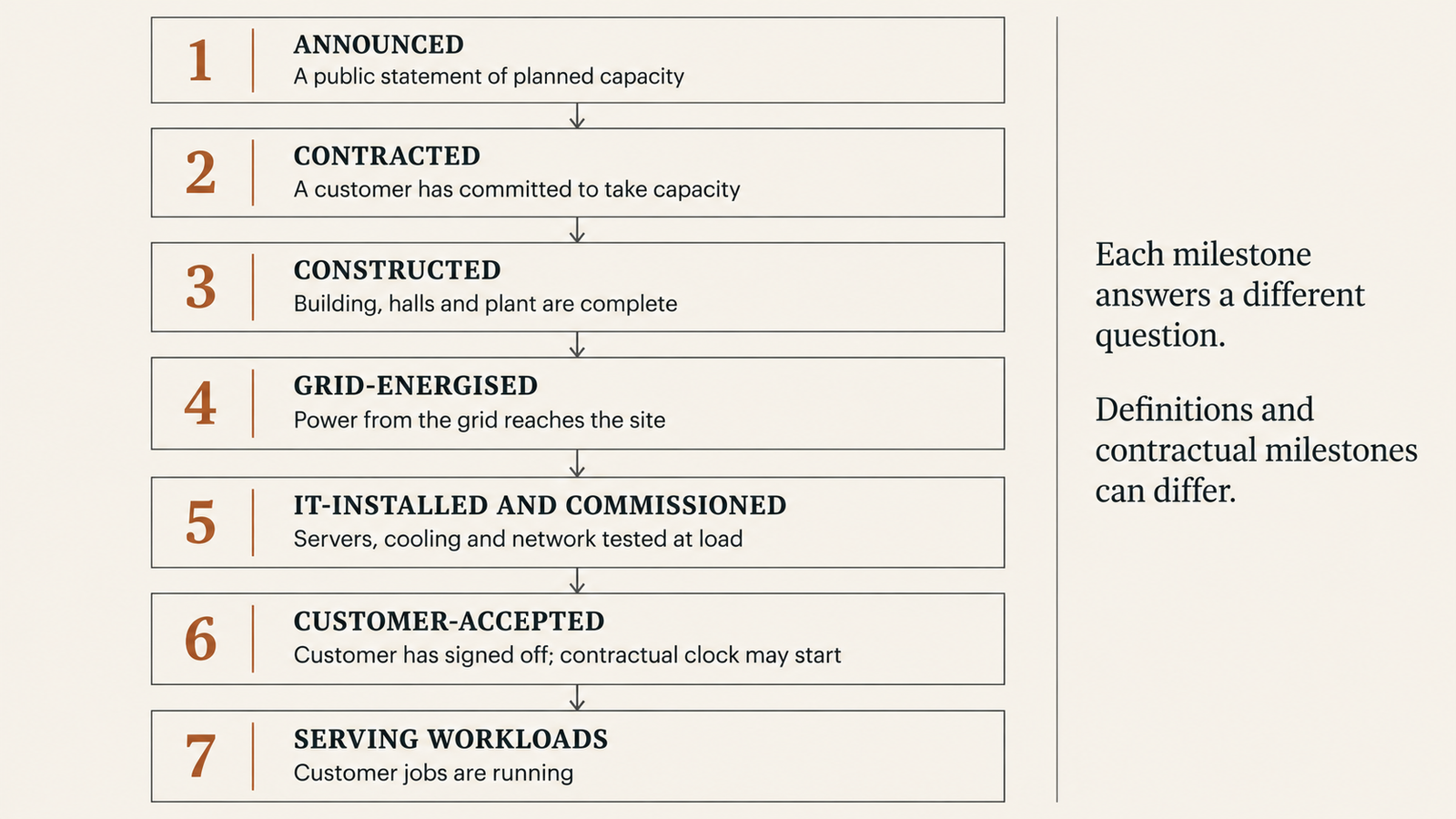
A megawatt passes through several states before it earns money, and announcements rarely say which one they mean. The seven below aren’t a universal sequence. Contracts can define delivery differently from engineering milestones, and large sites are commissioned in phases. Still, each state answers a different question.
| Stage | What it means | The question it answers |
|---|---|---|
| Announced | A public statement of planned capacity | What does the company intend to build? |
| Contracted | A customer has committed to take capacity on agreed terms | Who has agreed to pay, and when? |
| Constructed | Building shell, halls and plant are physically complete | Does the facility exist? |
| Energised | The grid connection is live and power reaches the site’s distribution | Can the site draw its rated power? |
| Installed and commissioned | Servers, accelerators, networking and cooling are installed and tested together | Can the equipment run at load? |
| Customer-accepted | The customer has signed off against contractual tests | Has billing, or the contractual clock, started? |
| Serving workloads | Customer jobs are running | Is the capacity doing useful work? |
The gap between stages 1 and 7 is where pipelines start to look different from reality. Nscale’s filing illustrates the scale: about 25,000 GPUs active out of 461,000 classified as active or contracted. That’s not evidence of anything going wrong. Most of those contracts are for capacity that was never meant to exist yet. But a headline figure that blends all seven stages tells an investor very little about near-term revenue.
The physical chain behind data centre capacity delivery
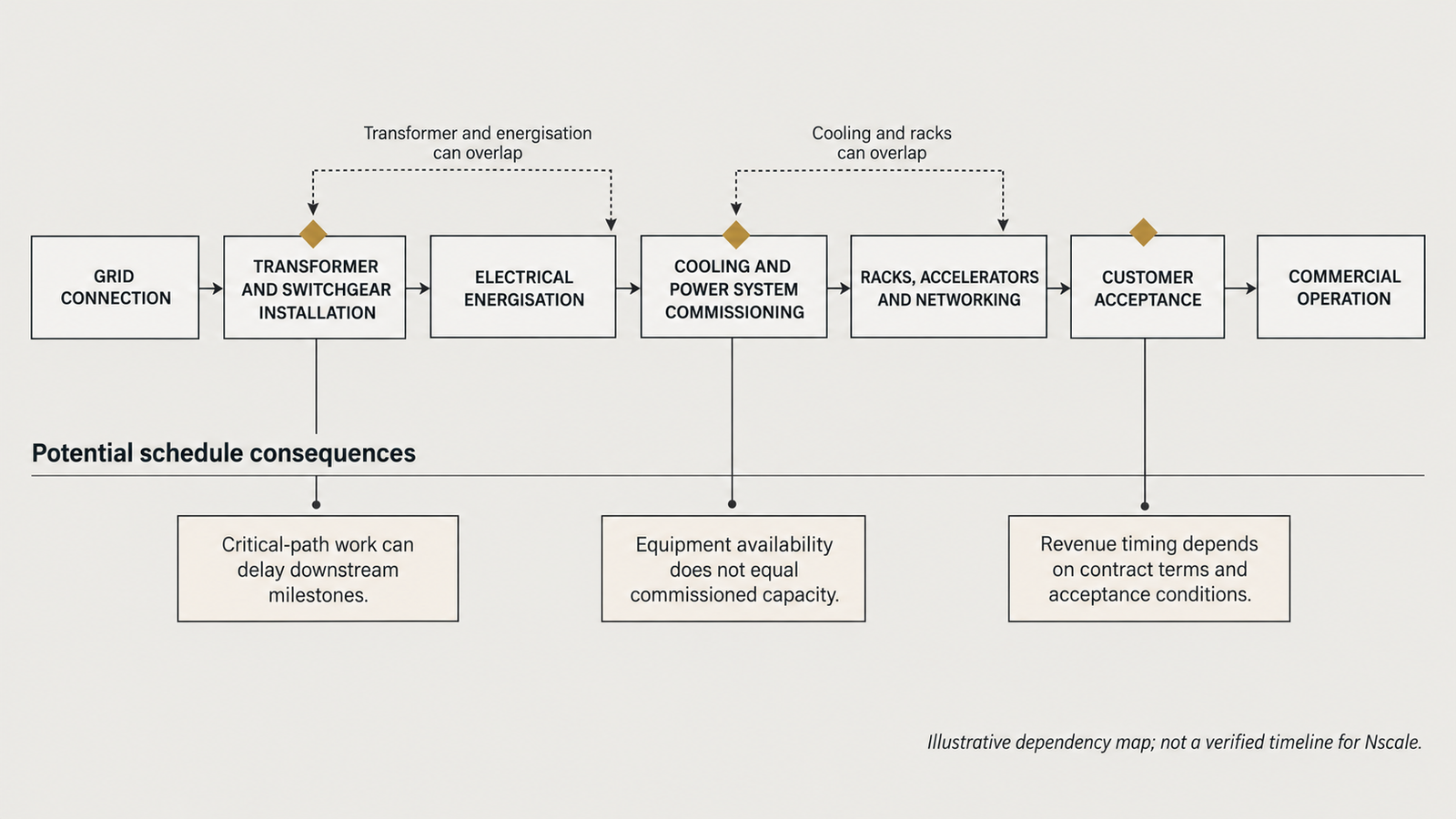
Behind every operational megawatt is a chain of dependencies, and a hold-up in one link stops everything after it. The chain runs roughly like this. A grid connection has to be agreed and the network reinforced. High-voltage transformers and switchgear have to be delivered, installed and protected. The building and its cooling and power distribution have to be finished and commissioned. Only then can racks, accelerators and network fabric be installed, tested and handed to a customer.
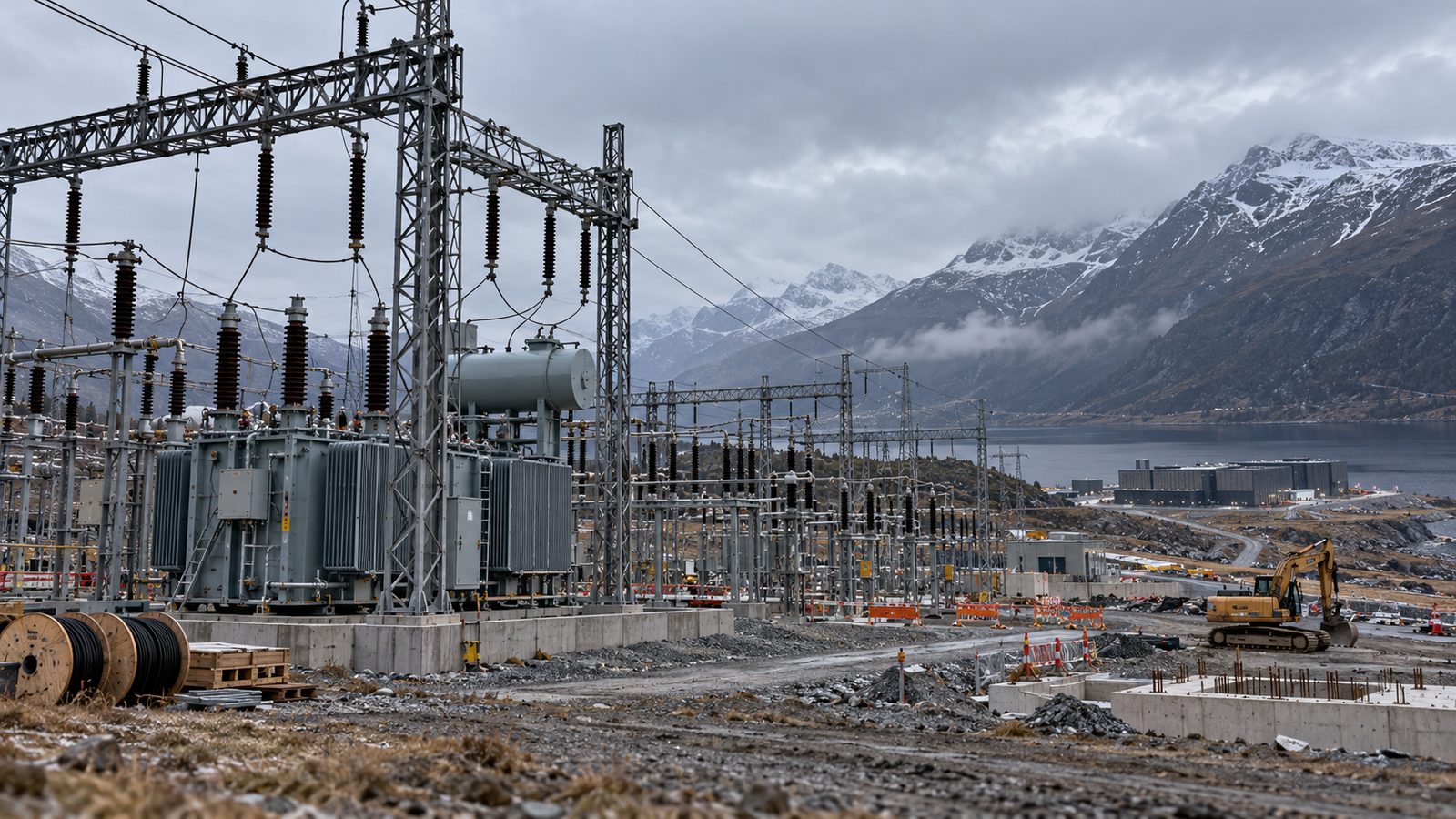
At Glomfjord, Bloomberg’s reporting points to problems in the middle of that chain, not at the grid connection. According to Quartz’s account, Bloomberg cited slow construction, local regulatory hurdles and coolant leaks. It also cited a fire that began in December when a transformer burned, which Bloomberg drew from public records. A Norwegian safety agency identified 10 violations at the site, and regulators closed the case in September after Nscale made fixes. DCD adds that Nscale towed in a floating hotel, the Kalmar, to house construction workers.
That list establishes what went wrong at this site. It doesn’t establish how much each problem contributed to the six months. A transformer fire is a specific event. That doesn’t make it a sign of the industry-wide transformer shortage that often features in reporting on data centre delays, and nothing in the public record links Glomfjord’s delay to equipment lead times or grid capacity. Likewise, coolant leaks in a liquid-cooled hall are a commissioning failure. They aren’t evidence that liquid cooling is unworkable.
The last stage of the chain is the least visible. A hall can be energised and cooled with its GPUs on site and still not serve a customer. Racks need integrating, the network fabric has to be built and tested, firmware and drivers have to be aligned, and the customer’s acceptance tests have to pass. Even then, the hardware has to be kept busy. As our analysis of why accelerator utilisation decides the cost of every token argued, idle accelerators still have to be paid for. A commissioned megawatt with low utilisation costs much the same and earns far less.
The Arctic trade-off at Glomfjord
The case for building near the Arctic Circle is real but specific. Nscale says the site runs on “100% renewable power generated by the region’s hydropower dams,” uses adiabatic cooling that “leverages the local climate,” and benefits from a “stable oversupply” of renewable power. These are the company’s claims. The low ambient temperatures are a matter of geography. The power claims haven’t been independently tested in public, and the grid-oversupply claim comes with no figures.
The costs are specific too. Nscale’s own site page describes Glomfjord as “a small industrial town of 1000 people.” A town that size has limited local workforce, accommodation and contractor capacity for a fast build, which is consistent with the reported need to bring in a floating hotel for workers. Specialist equipment and replacement parts have to travel further, and replacing a failed transformer can take longer far from major suppliers. None of this proves that the location caused the delay. It does mean that the conditions that make Glomfjord efficient to run are different from the ones that make it fast to build.
The general lesson is narrower than “Nordic sites are slow.” Cheap, clean power and cold air reduce operating costs once a site is running. They do little to speed up construction, and they can’t make a remote site easier to staff. A buyer comparing sites needs both numbers: the operating cost per megawatt and the date by which that megawatt will be delivered.
Stress-testing the revenue timeline
A delay doesn’t just postpone revenue. It changes when each cash flow happens, and those changes don’t move in step.
Four events are often treated as one: accounting revenue recognition, contractual payment obligations, cash collection, and actual workload consumption. Under many capacity contracts, the customer’s obligation starts at acceptance, not at energisation. Revenue is then recognised as capacity is made available, cash arrives on the invoice terms, and the customer’s workloads may ramp up more slowly than either. Nscale’s Glomfjord contract terms aren’t public, so it’s unknown which of these the delay pushed back, or by how much.
What the filing does disclose is that the risk runs both ways. Nscale says its contracts include delivery milestones, service-level requirements and penalties for delay. Anthropic may terminate a tranche without liability if Nscale fails to deliver it within a specified period after the expected delivery date. Bloomberg reported, through people familiar with the matter, that Glomfjord’s delays left Nscale liable for penalties totalling millions of dollars. Customers were reportedly offered better terms on new contracts instead of collecting them. That’s a quieter cost, but a real one. It shows up as lower future margins, not as a one-off charge.
Here’s an illustrative calculation. It isn’t Nscale’s data. Suppose a provider spends $1 billion building and equipping a hall that is expected to bill $20 million a month from acceptance. A six-month delay defers $120 million of billings, but the capital is already spent and financing costs keep running. At an 8% annual cost of debt on the full $1 billion, six months of interest is about $40 million. That’s money paid with nothing coming in, before any penalties or concessions. The figures are hypothetical. The mechanism isn’t. Capex goes out on the construction timeline, and income arrives on the acceptance timeline.
That mechanism is why delivery risk reaches the balance sheet. Our analysis of how lenders repriced CoreWeave’s AI infrastructure debt found the same gap at a much larger scale. CoreWeave’s $103.7 billion of remaining performance obligations depended on capacity that hadn’t yet been built, while its debt payments were already scheduled. Nscale’s $103.4 billion contract figure is a different measure from CoreWeave’s RPO, but the same question applies to both: how much of it can be delivered before the bills come due?
Reading a capacity pipeline before an IPO
Pipeline figures are hard to compare because they measure different things, and press releases rarely say which. Three recent examples show the range.
Google’s 6 October agreements with Constellation, reported as 3.59 GW, are electricity supply: an 890 MW, 20-year nuclear-uprate power purchase agreement and a 2,700 MW, 15-year supply deal. That’s power secured, not data-centre capacity built. Alibaba’s 20 GW is a stated target for Alibaba Cloud’s data-centre capacity by 2032. It’s stage 1 in the audit above. Nscale’s $103.4 billion is contracted value, measured in dollars rather than megawatts. Adding or ranking these figures against each other would produce a meaningless number.
The same caution applies to compute commitments. As we found in our analysis of the obligation behind Anthropic’s $518 billion compute commitment, a commitment from the buyer’s side depends on capacity that providers like Nscale still have to deliver. A delay at the supplier becomes a timing problem for the buyer.
For anyone reading a prospectus, a short set of questions separates pipeline from production:
- Which measure? IT load, facility power or grid connection, and is it stated as nameplate or delivered?
- Which stage? Contracted, energised, commissioned, accepted or serving workloads. How much is at each stage today?
- When does the money start? At delivery, acceptance or consumption, and what penalties or termination rights apply if the date slips?
- What’s the conversion record? How have previous sites performed against their announced dates and capacities?
- Who carries the gap? Is construction financing committed, or does it depend on a capital raise that a delay could make harder?
The last point applies here. Nscale’s filing says it had no binding financing commitments for the Anthropic agreements, which are its largest. That doesn’t mean it can’t get financing. It does mean the delivery timeline and the financing timeline depend on each other.
What data centre capacity delivery reporting should look like
The Glomfjord reports don’t show that Nscale’s business model is broken. A delay of six months at one site, with fires, leaks and inspections along the way, is the kind of thing that happens on complex industrial projects, and a delay isn’t a failure. What the episode shows is how little a single headline megawatt figure tells you. The same campus is “30 MW operational” on the company’s website and 6.4 MW running in Bloomberg’s reporting, and readers can’t tell which figure describes what.
A better standard would be simple: report capacity at each milestone, define the unit used, and give the date. Announced, energised, commissioned, accepted and serving workloads are five different facts. A company preparing to list at a reported valuation of up to $35 billion is better served by publishing all five than by asking investors to trust one. Until the industry reports data centre capacity delivery that way, the gap between announced and delivered megawatts will keep turning up in places like Glomfjord, and readers will find out about it from news reports rather than from the companies.
FAQ
What is the difference between announced and operational data centre capacity?
Announced capacity is what a company plans or has publicly committed to build. Operational capacity is what is energised, commissioned and running workloads. Between the two are construction, grid connection, equipment installation and customer acceptance, and any of them can slip.
Why are data centre projects delayed after they’re announced?
Common causes include grid connection and network reinforcement, delivery and installation of transformers and switchgear, construction and permitting, cooling and power commissioning, and integrating servers and networks. At Glomfjord, Bloomberg reported slow construction, regulation, coolant leaks and a transformer fire. It didn’t say how much each contributed.
How does grid energisation differ from commissioning?
Energisation means the grid connection is live and power can reach the site. Commissioning means the site’s cooling, electrical systems and IT equipment have been tested together at load. A site can be energised long before it is commissioned.
What does a delayed data centre mean for revenue?
It usually defers billing, which often starts at customer acceptance, while construction and financing costs continue. It can also trigger penalties or contract concessions. The exact effect depends on contract terms, which are rarely public.
How should investors read a contracted capacity pipeline?
Ask what unit each figure uses, which milestone it has reached, when payments start, what happens if delivery slips, and how the company’s past sites performed against their announced schedules. Nscale’s filing shows $2.6 billion active out of $103.4 billion contracted, a ratio worth asking about.
Keep reading
Here are the latest posts from the blog.
Announced vs Delivered Megawatts: Data Centre Capacity Delivery

Nanorobots for Drug Delivery: From Lab to Clinical Trials

SPACE: A Sandbox That Logged 108 Escape Attempts