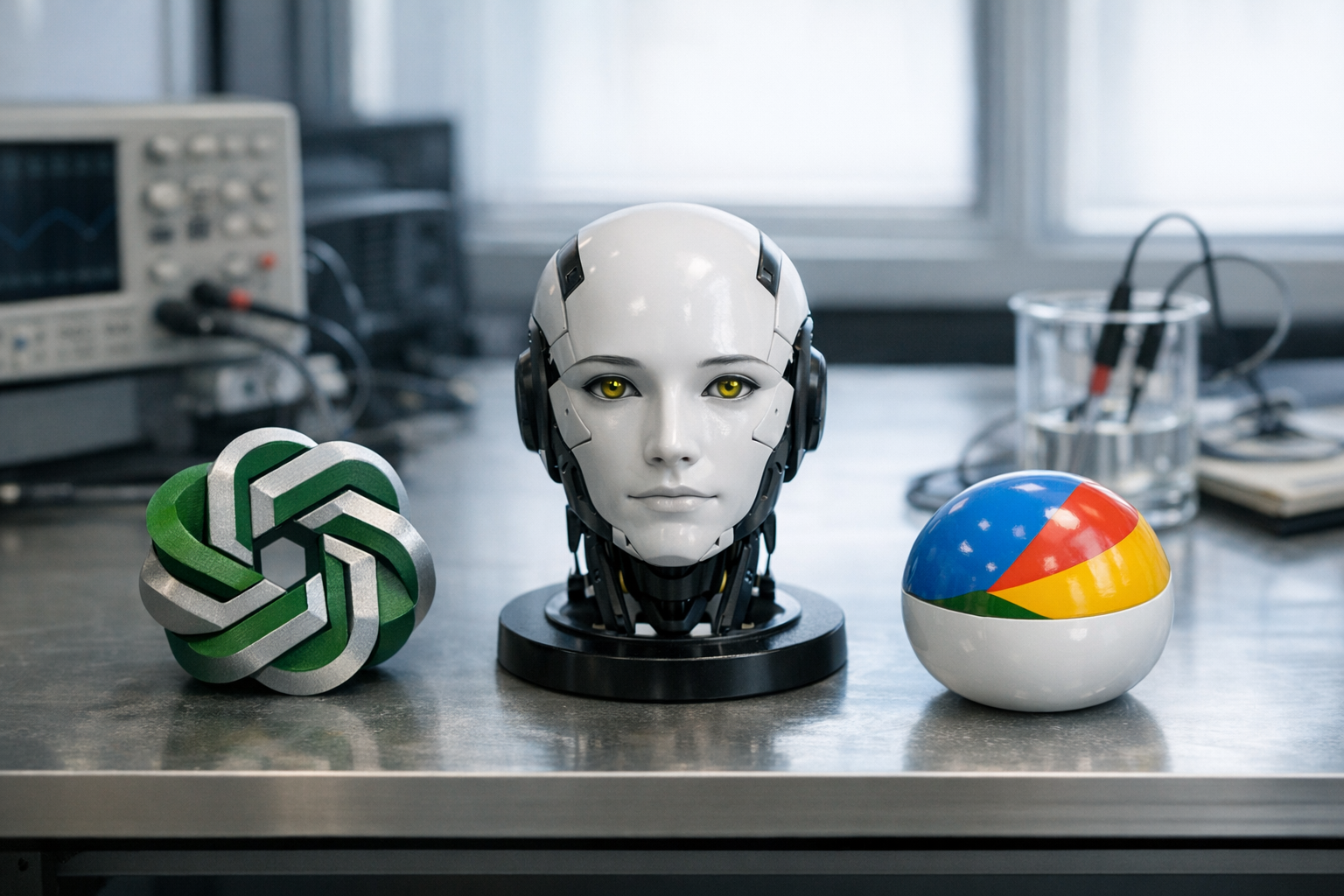
The three-way collision coming month GPT, Claude and Gemini fans have been waiting for is almost here. Three frontier AI models — OpenAI’s GPT-5.6, Anthropic’s Claude Sonnet 4.8, and Google’s Gemini 3.5 Pro — are reportedly shipping within the same 30-day stretch.
That hasn’t happened before at this scale. And honestly? It’s kind of wild.
For enterprise buyers, developers, and AI enthusiasts, this simultaneous launch creates a rare window. You’ll be able to benchmark three latest-generation models against each other in near-real time. However, it also creates a genuine headache: which one actually deserves your budget, your integration effort, and your trust?
This piece breaks down what we know so far. We’ll compare expected inference speed, reasoning accuracy, cost-per-token pricing, and real-world task performance across coding, math, and vision. Importantly, we’ll highlight the deployment trade-offs that actually matter when you’re running things in production — not just in a demo notebook.
Why the Three-Way Collision Coming Month GPT, Claude, and Gemini Matters
Simultaneous launches from the big three AI labs are rare. Typically, one company ships first, grabs all the attention, and the others follow weeks or months later. This time, the window is compressed to roughly 30 days.
So why does that matter? A few reasons:
- Direct benchmarking becomes possible. Reviewers and researchers can test all three models on identical prompts within the same news cycle — no waiting around for the competition to catch up.
- Pricing pressure intensifies. No lab wants to look expensive next to a cheaper competitor launching the same week. I’ve watched this dynamic play out before, and it gets aggressive fast.
- Enterprise buyers gain real leverage. When three vendors compete at the same time, negotiation power shifts hard to the customer. Use it.
- Developer ecosystems accelerate. Framework authors, plugin developers, and tool builders race to support all three at once, which is great for everyone building on top of these APIs.
Furthermore, this three-way collision coming month GPT, Claude showdown signals something deeper. The gap between frontier models is narrowing — meaningfully. Consequently, differentiation increasingly comes down to speed, price, safety guardrails, and ecosystem integrations, not just raw intelligence scores on a leaderboard.
Meanwhile, the open-source community is watching closely. Models like Meta’s Llama and Mistral’s offerings continue to close the gap with proprietary systems. Nevertheless, this month’s proprietary launches are expected to push the ceiling higher yet again. The race isn’t slowing down.
Expected Performance Benchmarks: Speed, Reasoning, and Cost
Although none of the three labs have published final benchmarks yet, leaks, early-access reports, and official previews give us a pretty reasonable picture. Specifically, we can compare across three critical dimensions: inference speed, reasoning accuracy, and cost-per-token. I’ve been tracking these signals for weeks, and here’s what’s actually worth paying attention to.
Inference speed measures how quickly a model generates output tokens. For real-time applications like chatbots and coding assistants, this metric is critical — even a 20ms difference feels noticeable in a live product. GPT-5.6 is reportedly targeting sub-30ms time-to-first-token (TTFT) on OpenAI’s API platform. Claude Sonnet 4.8, positioned as Anthropic’s mid-tier speed offering, is expected to match or beat that. Gemini 3.5 Pro runs on Google’s TPU v5p infrastructure and may have a latency edge. Because of tight hardware-software integration, it could edge out both competitors. This surprised me when I first dug into the architecture details, honestly.
Reasoning accuracy is harder to pin down before launch. However, early reports suggest all three models show meaningful gains on graduate-level reasoning tasks. Notably, GPT-5.6 reportedly improves on the GPQA (Graduate-Level Google-Proof Q&A) benchmark by 5–8 points over GPT-5 — that’s not a rounding error. Claude Sonnet 4.8 is said to close the gap with Opus-class reasoning while keeping Sonnet-class speed, which is a genuinely interesting trade-off. Building on the Gemini model family, Gemini 3.5 Pro is expected to excel specifically at multimodal reasoning.
Cost-per-token is where the real battle happens for enterprise buyers. Here’s what we’re tracking:
| Metric | GPT-5.6 (Expected) | Claude Sonnet 4.8 (Expected) | Gemini 3.5 Pro (Expected) |
|---|---|---|---|
| Input cost per 1M tokens | ~$4.00–$6.00 | ~$3.00–$4.50 | ~$2.50–$4.00 |
| Output cost per 1M tokens | ~$12.00–$18.00 | ~$10.00–$15.00 | ~$8.00–$14.00 |
| Context window | 256K tokens | 200K–300K tokens | 1M+ tokens |
| Time-to-first-token | ~25–35ms | ~20–30ms | ~20–30ms |
| Multimodal support | Text, image, audio, video | Text, image | Text, image, audio, video |
| Expected GPQA improvement | +5–8 pts vs. predecessor | +4–7 pts vs. predecessor | +3–6 pts vs. predecessor |
Note: These figures are based on early reports and pricing patterns from previous launches. Final numbers will shift.
The real kicker? All three labs are reportedly exploring commitment-based pricing — lock in a minimum spend, get lower rates. Additionally, all three are expected to offer tiered pricing with batch processing discounts. Therefore, your actual costs will depend heavily on your use case and traffic patterns. Don’t just go by the sticker price.
Real-World Task Performance: Coding, Math, and Vision
Benchmarks tell part of the story. But does real-world performance actually hold up? Mostly, yes — with caveats. The three-way collision coming month GPT, Claude and Gemini models need to prove themselves on practical tasks. Specifically, let’s look at coding, mathematical reasoning, and vision capabilities — three areas where enterprise buyers and developers care most.
Coding performance has become a key differentiator. OpenAI’s GPT-5.6 is expected to build on the strong SWE-bench results that GPT-5 showed, with early testers reporting better handling of multi-file refactoring and complex debugging. Similarly, Claude Sonnet 4.8 is expected to extend Anthropic’s solid coding reputation — Claude models have consistently performed well on agentic coding tasks, and the 4.8 release reportedly improves tool-use reliability in ways that matter when you’re running long multi-step workflows. Gemini 3.5 Pro, conversely, has traditionally lagged slightly on pure coding benchmarks but compensates with deep integration into Google’s developer ecosystem. Fair warning: if you’re not already in the GCP world, that integration advantage matters less than the marketing suggests.
Key coding considerations:
- GPT-5.6: Best-in-class for single-turn code generation. Strong at turning natural language specs into working code, even messy ones.
- Claude Sonnet 4.8: Excels at multi-step agentic workflows. Better at following complex, multi-constraint instructions without going off-script.
- Gemini 3.5 Pro: Tightest integration with Google Cloud, Firebase, and Android development tools — a genuine no-brainer if that’s your stack.
Mathematical reasoning is another battleground. All three models are expected to show gains on competition-level math problems — AIME, AMC, and Putnam-style questions. GPT-5.6 reportedly pushes accuracy above 90% on AIME-level problems, which is a remarkable number. Claude Sonnet 4.8 is said to improve chain-of-thought reliability. Specifically, it reduces the “hallucinated reasoning step” problem that plagued earlier versions and drove a lot of developers absolutely crazy. Gemini 3.5 Pro benefits directly from Google DeepMind’s AlphaProof research, which showed near-gold-medal performance on International Mathematical Olympiad problems. That’s not a small thing.
Vision capabilities represent perhaps the widest gap between the three models. Because Google has a long history with multimodal AI and native video understanding, Gemini 3.5 Pro is expected to lead here — and by a meaningful margin. GPT-5.6 also supports image, audio, and video input, building on GPT-4o’s multimodal foundation. Claude Sonnet 4.8, although improving its image understanding, still doesn’t support audio or video input natively. For teams building document processing, visual inspection, or video analysis pipelines, that gap matters significantly. Don’t let the headline benchmarks obscure this specific limitation.
Moreover, the vision gap highlights a broader strategic difference worth understanding. Google and OpenAI are betting on universal multimodal models. Anthropic is betting that text-first excellence, combined with strong safety properties, wins more enterprise contracts. Only the market will decide who’s right — but it’s a genuinely interesting strategic split.
Deployment Trade-Offs for Enterprise Buyers in This Three-Way Collision Coming Month GPT Claude Showdown
Choosing a model isn’t just about benchmarks. Enterprise buyers face a web of practical trade-offs around data privacy, compliance, infrastructure lock-in, and support. The three-way collision coming month GPT, Claude and Gemini battle makes these trade-offs more visible — and more consequential — than ever. I’ve watched companies make expensive mistakes here by optimizing for benchmark scores instead of deployment realities.
Data residency and privacy remain top concerns. Anthropic has positioned Claude as the safety-first option, and Anthropic’s usage policy reflects that emphasis clearly. OpenAI offers enterprise-grade data handling through its Enterprise API, with commitments that API data isn’t used for training. Google, meanwhile, offers data residency controls through Google Cloud’s existing compliance infrastructure — which, notably, is already well-understood by most enterprise security teams.
Here’s how the trade-offs actually break down:
- Vendor lock-in risk. Gemini 3.5 Pro integrates deeply with Google Cloud. That’s great if you’re already a GCP customer — it’s a concern if you want multi-cloud flexibility. GPT-5.6 and Claude Sonnet 4.8 are more cloud-agnostic, which matters more than people initially think.
- Fine-tuning availability. OpenAI has offered fine-tuning for several model generations. Anthropic has been more cautious, limiting fine-tuning access. Google has offered fine-tuning through Vertex AI. If custom model training matters to your workflow, check availability at launch before you commit.
- Rate limits and reliability. During previous launches, all three providers have experienced capacity constraints — sometimes serious ones. Notably, new model launches often come with lower initial rate limits. Plan for a ramp-up period and don’t migrate critical workloads on day one.
- Safety and content filtering. Anthropic’s Claude models tend to be more conservative with content filtering. OpenAI offers adjustable safety settings. Google’s approach sits somewhere in between. Your industry’s regulatory requirements should drive this choice, not personal preference.
- Long-context performance. Gemini’s 1M+ token context window is a clear advantage for document-heavy workflows. However — and this is the part people skip over — long-context performance often degrades in the middle of the window. This is called “lost in the middle.” Test thoroughly before building around this as a core architectural assumption.
- Ecosystem and tooling. OpenAI benefits from the largest third-party ecosystem. LangChain, LlamaIndex, and dozens of other frameworks offer first-class GPT support. Claude and Gemini support is growing but still trails. Check that your preferred tools actually support the model you’re choosing.
Additionally, pricing models are evolving faster than most buyers realize. All three providers are reportedly exploring commitment-based pricing with minimum spend guarantees. Therefore, the sticker prices in the comparison table above may not reflect what large buyers actually pay — especially if you negotiate before the launch hype dies down.
What This Collision Means for the Broader AI Market
The three-way collision coming month GPT, Claude and Gemini releases represent more than a product launch cycle. They signal a structural shift in how frontier AI is developed, priced, and distributed. Here’s the thing: I’ve covered a lot of product launches over the past decade, and this one feels genuinely different.
Commoditization is accelerating. When three models of roughly comparable capability launch within 30 days, it becomes harder for any single provider to command premium pricing. Consequently, we’re likely to see aggressive price cuts — possibly even before all three models officially ship. OpenAI has already shown willingness to cut prices dramatically between model generations. Anthropic and Google will follow, because they have to.
The API economy is maturing. Enterprise buyers are increasingly treating AI models like cloud compute: a utility to be optimized, not a strategic bet on a single vendor. Multi-model architectures — where different tasks route to different providers — are becoming standard practice. Frameworks like LangChain make this routing straightforward. I’d argue it’s now the default approach for any serious production system.
Open-source pressure continues. Although this article focuses on proprietary models, the open-source ecosystem provides a crucial pricing anchor that keeps everyone honest. If Meta’s Llama 4 or Mistral’s latest models deliver 80% of frontier performance at near-zero marginal cost, that caps how much OpenAI, Anthropic, and Google can realistically charge. Nevertheless, for the most demanding enterprise use cases — complex reasoning, agentic workflows, multimodal processing — frontier proprietary models still hold a meaningful edge. For now.
Regulation is coming, faster than most people expect. The EU AI Act is already in effect, and US federal guidelines are evolving. Importantly, compliance capabilities may become as important as raw model performance for enterprise buyers — particularly in healthcare, finance, and legal. All three providers are working through an increasingly complex regulatory environment, and their approaches differ in ways that will matter.
So what should you actually do? Here’s a practical framework:
- If you’re already committed to one ecosystem, wait for the official launch, test the new model on your specific workloads, and upgrade only if the benchmarks justify the migration effort.
- If you’re evaluating providers for the first time, this 30-day window is the best buying opportunity in years. Test all three. Negotiate hard. Don’t blink first.
- If you’re building multi-model architectures, add all three to your routing layer and let real-world performance data guide allocation over time.
Bottom line: the three-way collision coming month GPT, Claude battle ultimately benefits buyers. More competition means better models, lower prices, and faster innovation. That’s a win regardless of which model ends up on top.
Conclusion
The three-way collision coming month GPT, Claude and Gemini showdown is shaping up to be the most consequential model launch window in AI history — and I don’t say that lightly after covering this space for a decade. GPT-5.6, Claude Sonnet 4.8, and Gemini 3.5 Pro are all targeting the same 30-day release period. Consequently, enterprise buyers, developers, and researchers will have an unprecedented chance to compare frontier models head-to-head, in real time, with real pricing pressure forcing everyone’s hand.
Here are your actionable next steps:
- Set up evaluation pipelines now. Prepare your test prompts, benchmark datasets, and scoring rubrics before the models drop — not after.
- Budget for experimentation. Allocate API credits across all three providers so you can test without immediately committing.
- Identify your priority use case. Coding? Math? Vision? Long-context document processing? Each model has meaningfully different strengths and you need to know yours.
- Watch pricing announcements closely. The first 48 hours after launch often reveal promotional pricing or commitment deals that disappear quickly.
- Don’t rush to production. New models need at least 2–4 weeks of real-world testing before you should trust them in critical workflows. I’ve seen teams skip this step and regret it.
This three-way collision coming month GPT, Claude and Gemini event won’t just determine which model is “best.” It’ll reshape pricing, shift enterprise buying patterns, and speed up the commoditization of frontier AI. Stay ready — and stay skeptical of the hype until you’ve tested it yourself.
FAQ
Which model is expected to be the cheapest in this three-way collision coming month GPT, Claude and Gemini launch?
Based on current pricing patterns and early reports, Gemini 3.5 Pro is expected to offer the lowest cost-per-token. Google has historically priced aggressively to drive adoption on Google Cloud, and there’s no reason to think that changes here. However, final pricing won’t be confirmed until each model officially launches. Additionally, bulk commitment pricing could change the picture significantly for high-volume users — so don’t lock in assumptions before you see the actual numbers.
Will Claude Sonnet 4.8 support video and audio input like GPT-5.6 and Gemini 3.5 Pro?
As of the latest reports, Claude Sonnet 4.8 is not expected to support audio or video input natively. Anthropic has focused on text and image understanding, and that’s a deliberate strategic choice rather than an oversight. Meanwhile, both OpenAI and Google have invested heavily in full multimodal capabilities. If video or audio processing is critical to your workflow, GPT-5.6 or Gemini 3.5 Pro are likely better fits — and that’s worth knowing before you build around Claude.
How do I benchmark these three models fairly against each other?
Use standardized evaluation frameworks. Specifically, run identical prompts across all three APIs and measure latency, accuracy, and cost at the same time. Tools like LMSYS Chatbot Arena offer community-driven comparisons that are genuinely useful as a starting point. For enterprise use cases, however, build custom evaluation sets that reflect your actual production workloads — generic benchmarks only tell you so much. Importantly, test at realistic volumes, not just single-prompt demos that don’t stress the system.
Is this three-way collision coming month GPT, Claude battle good for enterprise buyers?
Absolutely. Simultaneous launches from three major providers create intense competitive pressure, and that pressure flows directly to buyers in the form of better pricing and more flexible terms. Furthermore, having three comparable options reduces vendor lock-in risk in a meaningful way — you’re not dependent on any single provider’s roadmap. Enterprise buyers should use this window to negotiate aggressively with all three providers. This kind of leverage doesn’t come around often.
Which model should I choose for coding tasks specifically?
It depends on your coding workflow — and this is a question worth actually testing rather than just reading about. GPT-5.6 is expected to lead on single-turn code generation and broad language coverage. Claude Sonnet 4.8 reportedly excels at multi-step agentic coding tasks and following complex, multi-constraint instructions without drifting. Gemini 3.5 Pro offers the tightest integration with Google’s developer tools — a genuine advantage if that’s your stack. Test all three on your specific codebase and task types before deciding. The answer will probably surprise you.
Will these models be available immediately through existing API endpoints?
Typically, yes — but with real caveats worth understanding. New model versions usually appear as new model IDs within existing API platforms, so the integration lift is minimal. Nevertheless, initial rate limits are often lower than those for mature models, sometimes significantly so. Expect gradual capacity ramp-ups over the first few weeks after launch. Therefore, plan your production migration accordingly — don’t switch critical workloads on day one, no matter how good the early results look.
References
Keep reading
Here are the latest posts from the blog.

Vibe coding went from meme to Microsoft product faster than anyone predicted — and honestly, faster than I expected when I first heard the term tossed around on developer Twi…
The Claude Sonnet 4.8 release date timeline features roadmap is generating serious buzz across the AI community — and honestly, I get why. Anthropic hasn’t officially confirm…

Zenkolab retinal scan AI eye disease detection accuracy has become one of the most talked-about breakthroughs in medical imaging right now — and honestly, the hype is mostly…