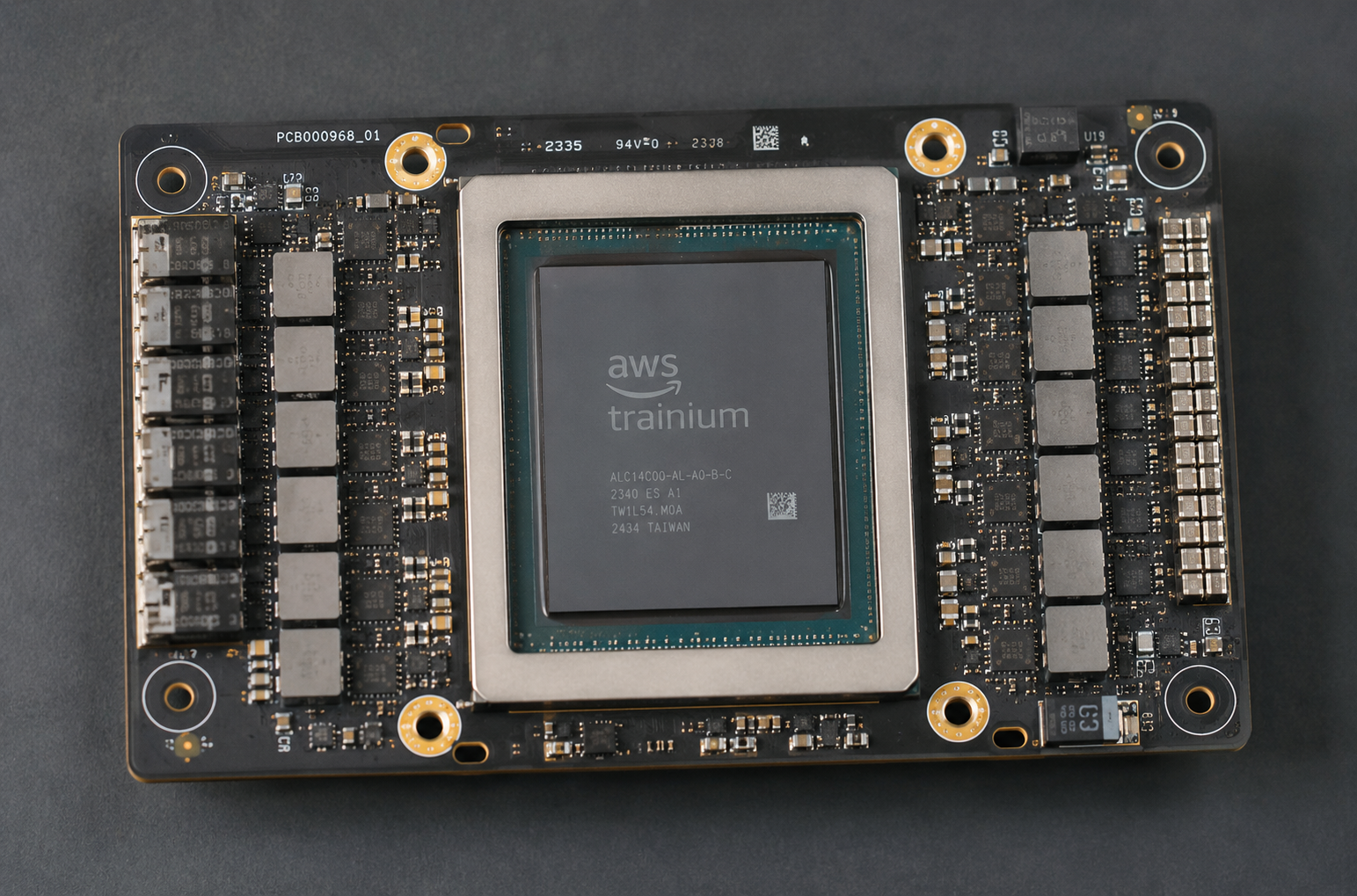
Custom silicon’s rise changes the Trainium TPU Nvidia margins conversation in a way market-share numbers never could. Most coverage frames AWS Trainium and Google TPU as a share story — who’s winning what percentage of the AI chip market. That misses the more important question entirely.
Nvidia could hold 80% market share and still see earnings decline if margins compress from the mid-70s into the mid-50s. A competitor doesn’t need to beat Nvidia outright to matter here. It just needs to be credible enough to force price concessions — and that’s exactly what’s starting to happen in the Trainium TPU Nvidia margins story.
This piece quantifies the real per-token cost gap behind Trainium TPU Nvidia margins, identifies which workloads shift first, and models when Nvidia’s margin compression actually shows up in the numbers. Some of this is verifiable fact. Some of it is a reasoned forecast, and I’ve tried to keep those two things clearly separated.
Key Takeaways on Trainium TPU Nvidia Margins
- Nvidia’s gross margin already moved once (75.0% in FY2025 to 71.1% in FY2026), but that was mostly a one-time China export-control charge, not custom silicon competition yet.
- AWS Trainium3 and Google’s TPU v7 “Ironwood” are the current generation behind the Trainium TPU Nvidia margins story, not the older Trainium2/TPU v5p numbers still cited in most coverage.
- Morgan Stanley estimates inference will eventually exceed 75% of U.S. data center compute demand — and inference is exactly the workload custom silicon targets first.
- CUDA’s moat is real for research and training, but weaker for repetitive, high-volume inference, which is where Trainium TPU Nvidia margins pressure concentrates.
- The margin compression thesis here is a model, not a settled fact — treat specific percentages as informed estimates, not certainties.
Why Trainium TPU Nvidia Margins Are the Real Story, Not Market Share
Quantifying the Per-Token Cost Gap Behind Trainium TPU Nvidia Margins
Which Workloads Move the Trainium TPU Nvidia Margins Needle First
Modeling the Trainium TPU Nvidia Margins Timeline
The CUDA Moat: Why Trainium TPU Nvidia Margins Pressure Builds Slowly
What Trainium TPU Nvidia Margins Mean for the Broader Chip Market
Why Trainium TPU Nvidia Margins Are the Real Story, Not Market Share
For years, Nvidia enjoyed near-monopoly pricing power in AI accelerators, with gross margins in the low-to-mid 70s. AWS Trainium and Google TPU chips aren’t just alternative options anymore — for specific, high-volume workloads, they’re increasingly the economically rational choice, and that’s what makes the Trainium TPU Nvidia margins question different from a simple share fight.
The Trainium TPU Nvidia margins pressure mechanism works in three stages. First, a credible alternative emerges — hyperscalers prove custom silicon works at real production scale. Second, workload migration begins, with price-sensitive inference workloads shifting first. Third, negotiating leverage shifts, and even customers staying on Nvidia GPUs gain room to demand lower prices.
AWS’s current-generation Trainium3, shipped in December 2025, is a 3nm chip delivering roughly 4.4 times the compute of Trainium2, with 144 GB of HBM3e memory. Google’s TPU v7, codenamed Ironwood, has shipped since April 2025 in pods of 9,216 chips, each delivering over 4,600 FP8 teraflops. These are production infrastructure serving billions of queries daily, and Anthropic has reportedly committed to access up to a million Ironwood TPUs through Google Cloud alone.
The economics behind Trainium TPU Nvidia margins pressure are fairly direct. A hyperscaler designing its own chip cuts out Nvidia’s markup entirely. A chip that costs a few thousand dollars to manufacture doesn’t carry an H100 or H200’s tens-of-thousands-of-dollars price tag, and those savings flow straight into lower per-token inference costs.
Quantifying the Per-Token Cost Gap Behind Trainium TPU Nvidia Margins
Numbers tell the real story here. Comparing Nvidia’s H100 against current custom silicon shows why the Trainium TPU Nvidia margins gap is becoming difficult for hyperscalers to ignore.
Nvidia’s H100 costs an estimated $25,000 to $40,000 per unit and runs on the mature, dominant CUDA ecosystem — a genuine advantage in the Trainium TPU Nvidia margins comparison, especially for research. AWS Trainium3 costs a fraction of that to manufacture and pairs with the improving Neuron SDK. Google’s TPU v7 runs on the mature JAX/XLA stack, which Google has invested in for close to a decade.
These aren’t apples-to-apples comparisons, and Nvidia’s software ecosystem provides real value that a spec sheet doesn’t capture. Still, the raw cost gap is striking enough that even a conservative 30% per-token advantage translates into billions of dollars in annual savings at hyperscaler inference volumes.
Where the Savings in Trainium TPU Nvidia Margins Actually Compound
Hyperscalers skip the chip vendor’s profit margin entirely by designing their own silicon. Custom chips also target specific model architectures rather than general-purpose flexibility, cutting wasted transistors, and tighter coupling between chip, interconnect, and software reduces overhead that a general-purpose GPU stack carries.
Power efficiency deserves more attention than it usually gets in the Trainium TPU Nvidia margins conversation. A large inference cluster drawing meaningfully less power doesn’t just save on electricity — it reduces cooling infrastructure requirements and lowers the power-delivery overhead baked into data center construction costs. At hyperscaler scale, those second-order savings are substantial and recurring, not one-time.
Which Workloads Move the Trainium TPU Nvidia Margins Needle First
Not all AI workloads carry equal weight in the Trainium TPU Nvidia margins story. Understanding which workloads migrate first reveals the realistic timeline for margin pressure.
Internal inference at hyperscalers has already moved, and it’s the clearest early evidence in the Trainium TPU Nvidia margins story. Google runs Search, YouTube recommendations, and Gemini inference heavily on TPUs. Amazon routes a growing share of Alexa and internal ML workloads through Trainium. These workloads are high-volume, latency-tolerant, and directly controlled by the chip designer — a straightforward combination to migrate.
Commodity inference APIs are next in the Trainium TPU Nvidia margins progression. Standardized endpoints for popular open-source models are strong candidates, since customers care about cost per token, not which chip runs underneath. AWS can offer cheaper Bedrock inference on Trainium without most customers ever noticing or caring — they see only the invoice line item.
Where Trainium TPU Nvidia Margins Pressure Builds More Slowly
Fine-tuning and adaptation workloads are reasonably strong candidates too, since frameworks like JAX and AWS Neuron already support these workflows well. Large-scale pretraining is the hardest to shift — frontier model training demands massive parallelism and battle-tested distributed training tooling, where CUDA’s advantage is strongest. Even so, Google has trained Gemini models entirely on TPUs, which proves it’s possible even where it isn’t easy.
Some workloads stay on Nvidia longest regardless of cost: research and experimentation, where CUDA’s ecosystem lock-in is real; multi-cloud deployments, since Trainium and TPU exist only inside their respective clouds; and workloads needing frequent architecture changes.
An enterprise running workloads across AWS, Azure, and GCP for redundancy can’t practically standardize on a chip that only exists in one cloud. That keeps a meaningful slice of spending on GPUs regardless of per-token cost, and it’s a real limit on how far the Trainium TPU Nvidia margins shift can go.
Morgan Stanley’s analysts have estimated that inference will eventually account for more than 75% of U.S. data center compute and power demand, while cautioning there’s real uncertainty in how fast that transition plays out. Since inference is exactly the workload custom silicon targets first, that’s the segment where Trainium TPU Nvidia margins pressure will show up before it reaches training.
Modeling the Trainium TPU Nvidia Margins Timeline
Here’s where it’s worth being explicit about the Trainium TPU Nvidia margins model: the rest of this section is a forecast, not settled fact. Nvidia’s own numbers already moved once, from 75.0% in fiscal 2025 to 60.5% in Q1 fiscal 2026. That dip was driven by a $4.5 billion charge tied to U.S. export licensing on H20 chips sold into China, not by Trainium or TPU competition. Margins recovered to the 71–75% range in the following quarters.
That history matters because it shows Nvidia’s margins can move sharply for reasons that have nothing to do with custom silicon. Any model of competitive margin compression needs to account for that noise rather than reading every dip as proof of the thesis.
With that caveat in place, a reasonable model looks like this. In the near term, demand for Nvidia’s training chips still outpaces supply, so reported margins stay resilient even as custom silicon absorbs incremental inference demand that might otherwise have gone to Nvidia — you see slower growth in what could have been, not lost sales you can point to directly.
As Trainium3 and TPU v7 mature further and hyperscalers gain credible alternatives across most inference workloads, Trainium TPU Nvidia margins pressure should show up as shifting negotiating leverage — even for customers who still need Nvidia for training.
A useful historical parallel: when enterprise storage vendors faced credible cloud alternatives in the mid-2010s, list prices didn’t collapse overnight. Discount rates quietly expanded over several quarters before margin erosion became visible in reported numbers. Nvidia’s situation could plausibly rhyme with that pattern, though the magnitude and timing remain genuinely uncertain.
What Could Speed Up or Slow Down Trainium TPU Nvidia Margins Pressure
Several variables could accelerate the timeline: faster-than-expected maturity in Trainium’s software ecosystem, continued open-source model growth reducing training-chip demand growth, or a major cloud provider undercutting inference pricing aggressively. Several variables could delay it too: CUDA’s moat proving deeper than expected, new Nvidia architectures delivering step-change efficiency gains, or custom silicon programs hitting yield problems at scale.
The range of plausible outcomes is genuinely wide. The direction, though, isn’t seriously in question — custom silicon is a bigger structural factor in Nvidia’s economics today than it was two years ago.
The CUDA Moat: Why Trainium TPU Nvidia Margins Pressure Builds Slowly
Any honest look at Trainium TPU Nvidia margins has to address CUDA directly — it’s Nvidia’s most powerful advantage, and also the most frequently overstated one in either direction.
CUDA represents decades of software investment. Millions of developers know it, and thousands of libraries depend on it. For researchers prototyping new architectures, CUDA remains genuinely unmatched, and switching costs are real. But the moat matters much less for production inference than for research, and that distinction is central to the whole Trainium TPU Nvidia margins story.
Inference workloads are repetitive, which matters a lot for the Trainium TPU Nvidia margins case — once a model is optimized for a chip, it runs the same operations billions of times, so the upfront porting cost amortizes quickly at scale. Frameworks like PyTorch, JAX, and TensorFlow increasingly support multiple hardware backends, letting developers write model code once and compile for different targets.
How the Porting Cost Compares in the Trainium TPU Nvidia Margins Trade-Off
Migrating a transformer inference pipeline from CUDA to Neuron SDK typically takes a small team a few weeks for initial functionality, plus tuning time. Against millions of dollars in annual inference savings at high volume, that’s a one-time cost that pays back quickly — a favorable trade in the Trainium TPU Nvidia margins math. The calculus looks different for a research team prototyping a new architecture monthly, which is why CUDA’s moat holds firmly in research while softening in production.
There’s historical precedent for ecosystems eroding under strong enough economic incentive. Intel’s x86 ecosystem was once considered unbreakable; ARM chips now dominate mobile and are gaining fast in servers and laptops. CUDA likely delays custom silicon adoption in the Trainium TPU Nvidia margins story. It probably doesn’t prevent it, since the per-token cost advantages are large enough that hyperscalers have strong reasons not to ignore them indefinitely.
What Trainium TPU Nvidia Margins Mean for the Broader Chip Market
The Trainium TPU Nvidia margins dynamic reshapes the competitive picture well beyond Nvidia’s own numbers.
For hyperscalers, the build-versus-buy calculation has shifted meaningfully. Every major cloud provider now has or is developing custom AI silicon — Microsoft works with AMD and is developing its own Maia chips, and Meta designs its own MTIA inference accelerators. The trend shows no sign of reversing.
For AMD and Intel, the picture is mixed. AMD benefits in the near term as a credible Nvidia alternative but faces similar long-term pressure from custom silicon; its MI300X has won real deployments, though those wins may prove transitional as hyperscaler chips mature further. Intel’s Gaudi accelerators compete in an increasingly narrow middle market.
For startups like Groq, Cerebras, and SambaNova, the environment is getting harder. They lack both Nvidia’s software ecosystem and the captive demand hyperscaler chips enjoy, which narrows their window for establishing a durable position.
For AI application developers, this is unambiguously good news. Competition drives down inference costs, and lower costs make previously uneconomical applications viable — a chatbot interaction that needed to cost five cents to run profitably becomes viable at two cents, which opens up product categories that don’t pencil out today.
For investors, Nvidia remains a formidable company, but the Trainium TPU Nvidia margins question is central to whether current valuations assume margins stay near historical highs indefinitely or account for real compression risk over the next several years.
Conclusion
The Trainium TPU Nvidia margins story is the most significant structural question facing Nvidia’s financial model since its rise to AI dominance. To be clear, this isn’t a bearish take on AI broadly — it’s a realistic look at where chip economics are heading.
What’s verified: hyperscaler custom silicon delivers meaningfully lower per-token inference costs, current-generation chips are already in large-scale production, and inference is the fastest-growing share of total AI compute. What’s modeled, not verified: exactly how much and how fast Nvidia’s margins compress, since that depends on variables — CUDA’s staying power, software maturity, competitive responses — that haven’t fully played out.
A few next steps for different readers. Investors should stress-test Nvidia valuations against a range of margin scenarios, not just today’s levels. Cloud architects should evaluate Trainium and TPU pricing for inference workloads now, since the savings are real even at mid-scale deployment. AI teams should design for multi-hardware portability using JAX or PyTorch with XLA backends, since chip flexibility is becoming a genuine advantage rather than a nice-to-have.
The Trainium TPU Nvidia margins question doesn’t have a fully settled answer yet. But the direction — toward a more normal, competitive semiconductor market rather than one company’s sustained pricing power — looks increasingly clear.
FAQ About Trainium TPU Nvidia Margins
How Much Cheaper Is Inference in the Trainium TPU Nvidia Margins Comparison?
Estimates suggest custom silicon can be meaningfully cheaper per token than equivalent Nvidia GPU instances for inference workloads, though the exact gap depends on model size, batch configuration, and workload characteristics. These savings compound at scale, since the fixed cost of software optimization spreads across billions of tokens — the larger the inference volume, the more compelling the Trainium TPU Nvidia margins case becomes for switching.
Will Custom Silicon Completely Replace Nvidia in the Trainium TPU Nvidia Margins Story?
Unlikely in the near term. Trainium and TPU chips target specific workload segments, primarily high-volume inference, while Nvidia is likely to retain strong positions in frontier model training, research, multi-cloud deployments, and enterprise workloads. Since inference represents a large and growing share of total AI compute demand, though, even a partial shift moves real dollars in the Trainium TPU Nvidia margins equation.
What Is CUDA and Why Does It Matter for Trainium TPU Nvidia Margins?
CUDA is Nvidia’s proprietary programming platform for GPU computing, built over roughly two decades, with tools and libraries millions of developers rely on. It creates real switching costs, since code written for Nvidia GPUs doesn’t automatically run elsewhere. That advantage matters far more for research and novel architecture development than for repetitive, high-volume inference — which is exactly where Trainium TPU Nvidia margins pressure concentrates.
When Will Trainium TPU Nvidia Margins Pressure Actually Show Up in Nvidia’s Numbers?
There’s no confirmed date, and it’s worth separating fact from forecast here. Nvidia’s margins have already moved once, but that specific dip was tied to export-control charges, not competition. A reasonable model suggests visible Trainium TPU Nvidia margins pressure could build as Trainium3 and TPU v7 mature further and hyperscalers gain more negotiating leverage — but the timing and magnitude remain genuinely uncertain.
Which Companies Are Building the Custom Silicon Behind Trainium TPU Nvidia Margins Pressure?
Google (TPU, currently on the v7 “Ironwood” generation), Amazon/AWS (Trainium, currently on Trainium3, and Inferentia), Microsoft (Maia), and Meta (MTIA) all run active custom silicon programs. Broadcom and Marvell also design custom AI chips for hyperscalers under contract. The trend toward custom silicon is industry-wide and well-funded at this point, not a handful of experimental side projects.
Should a Startup Build on Custom Silicon Given the Trainium TPU Nvidia Margins Trend?
Keep reading
Here are the latest posts from the blog.
The irony here is almost too good: Google TPU Anthropic now depends on are the same chips Google’s own researchers are queuing to use. Google designed these Tensor Processing…

Colorado AI Act compliance one month in — has anything actually changed? Every product team, compliance officer, and in-house counsel I’ve talked to lately is asking exactly…

Apple Amazon AI spending is the real story hiding behind today’s earnings reports, and the answer might genuinely surprise you. Both giants report today, and investors are wr…