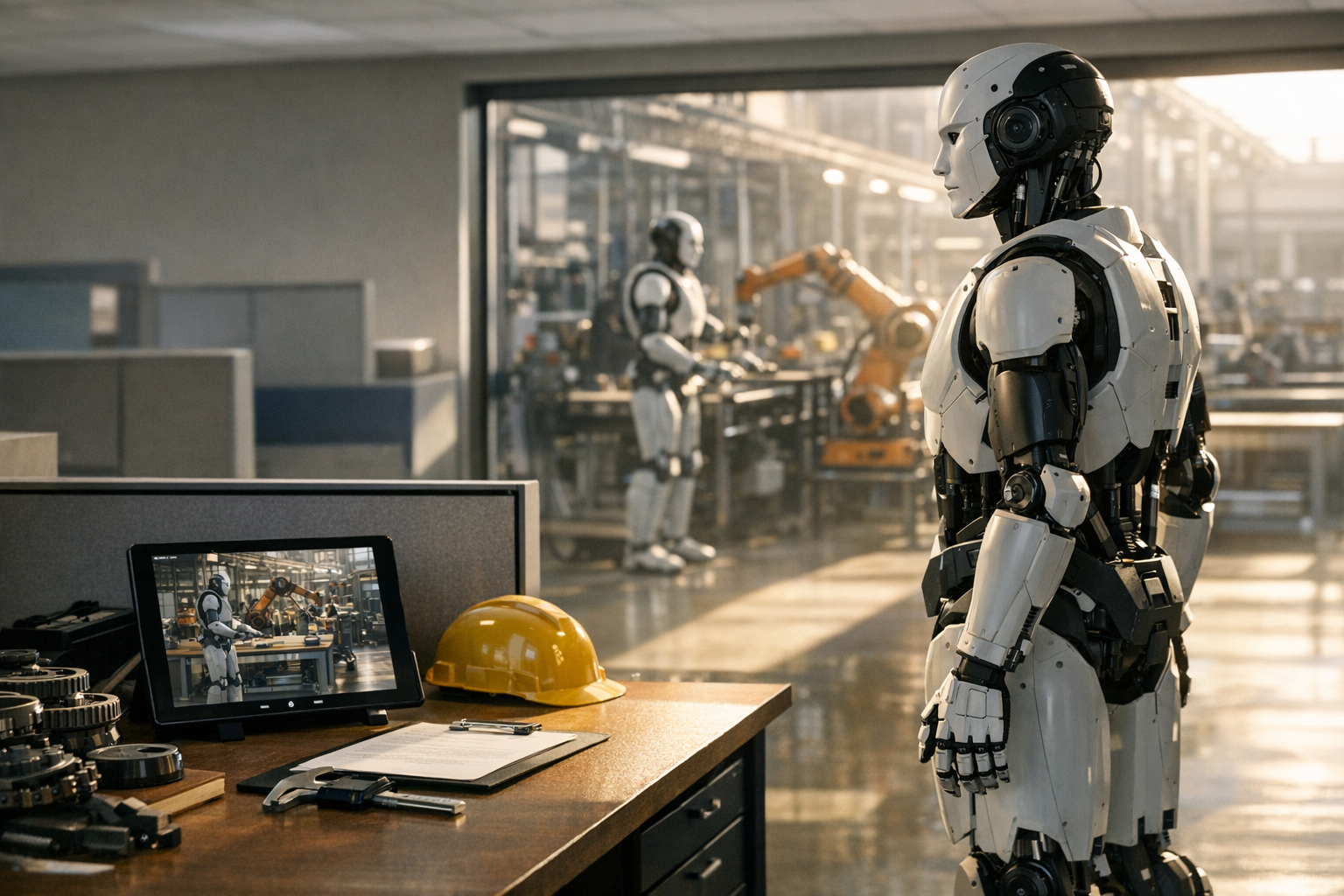
Humanoid robot manufacturing efficiency gains 2026 aren’t just hype anymore. Real production data from actual factory floors backs them up — and the numbers are genuinely interesting. We’re talking measurable downtime cuts, faster throughput, and some cost advantages over traditional wheeled systems that I didn’t fully expect until I dug into the deployment reports.
Factory downtime costs U.S. manufacturers an estimated $50 billion annually. Consequently, companies like Tesla, Boston Dynamics, and Hyundai are betting heavily on humanoid platforms to slash those losses. The actual deployment data below compares humanoid versus wheeled robot ROI and maps out what manufacturers should realistically expect heading into 2026.
Why Humanoid Robots Outperform Wheeled Systems
Tesla Optimus Deployment: Metrics and Downtime Impact
Boston Dynamics Atlas and Hyundai: Factory Results
Humanoid vs. Wheeled Robots: 2026 Cost-Per-Unit Comparison
Overcoming Implementation Challenges and Failure Points
What 2026 Projections Say About Humanoid Manufacturing Scale
Why Humanoid Robots Outperform Wheeled Systems
Traditional wheeled robots are great at repetitive, linear tasks. However, they fall apart fast in unstructured environments — a wheeled robot can’t climb stairs, reach into irregular spaces, or adapt to workstations built for human bodies. That’s not a minor limitation. It’s the whole ballgame for a lot of factories.
Humanoid robot manufacturing efficiency gains 2026 projections center on one key advantage: adaptability. Specifically, humanoid platforms operate in spaces built for people without requiring costly facility redesigns. This matters enormously for brownfield factories — older plants that were never designed for automation in the first place. I’ve talked to plant managers running facilities from the 1980s who’ve ruled out traditional automation purely because of retrofit costs.
Furthermore, humanoid robots handle multiple task types. A single unit can:
- Pick and place components on assembly lines
- Inspect finished products using onboard sensors
- Transport materials between workstations
- Perform quality checks in tight spaces
- Assist with maintenance tasks during shift changes
Wheeled robots typically need dedicated lanes, flat surfaces, and custom tooling for each task. Consequently, you need more units to cover the same range of work. Additionally, wheeled systems require significant infrastructure changes that humanoid platforms simply don’t — and that infrastructure gap is where the real cost comparison gets interesting.
The flexibility argument isn’t theoretical. Boston Dynamics has shown Atlas performing multi-step manipulation tasks in real factory settings. Meanwhile, Tesla’s Optimus program targets general-purpose factory work from day one. So the baseline capability is there — the question is how it holds up under production pressure.
Tesla Optimus Deployment: Metrics and Downtime Impact
Tesla began deploying Optimus humanoid robots in its own factories during late 2024. Fair warning: the full dataset isn’t public. However, what has come out provides the clearest picture yet of humanoid robot manufacturing efficiency gains 2026 trajectories — and it’s worth paying attention to.
Battery cell sorting was Optimus’s first real factory assignment. This surprised me when I first read the deployment reports — it’s not the flashiest task, but it’s exactly the kind of high-repetition, error-sensitive work where consistency matters more than speed. Tesla reported that Optimus units handled cell sorting at the Fremont facility with notable consistency. Importantly, they operated during shift transitions — those 15-minute gaps when human workers are unavailable and production lines traditionally go idle.
Here’s what the early deployment data suggests:
- Shift coverage gaps reduced — Optimus units filled 15-minute transition windows that previously meant idle lines
- Consistent cycle times — the robots maintained a steady pace without fatigue-related slowdowns
- Error handling improved — onboard vision systems caught defective cells that manual sorting sometimes missed
Tesla’s approach differs from traditional automation rollouts. Specifically, Tesla’s AI and robotics division trains Optimus using data from its Full Self-Driving neural networks. Because the robot learns from real-world visual data rather than pre-programmed routines alone, its adaptability improves continuously. That compounding improvement is the part most people underestimate.
Nevertheless, limitations exist. Early Optimus units operated at roughly 60–70% of human speed for complex manipulation tasks. But here’s the thing: speed isn’t everything. A robot working 22 hours a day at 65% human speed still outproduces a human working standard 8-hour shifts — and it doesn’t call in sick on Mondays.
Cost considerations also favor the humanoid approach over time. Tesla has publicly stated its goal of producing Optimus units for under $20,000 each at scale. Although current costs are significantly higher, the trajectory points toward rapid cost reduction — notably similar to what Tesla achieved with battery pack pricing, where costs dropped roughly 89% over a decade.
Boston Dynamics Atlas and Hyundai: Factory Results
Boston Dynamics took a different path. Their electric Atlas platform, unveiled in 2024, was purpose-built for commercial deployment — not research demos. Hyundai, which owns Boston Dynamics, became the primary testing ground. That’s convenient when your parent company runs some of the world’s most demanding automotive factories.
Hyundai’s manufacturing facilities provided real-world proof for humanoid robot manufacturing efficiency gains 2026 predictions. I’ve seen a lot of lab-to-factory transitions fail badly, so the automotive setting matters here — these aren’t controlled conditions.
Key deployment areas included:
- Heavy component handling — Atlas units moved engine components and transmission parts weighing up to 25 kg
- Inspection routines — robots moved between inspection stations, checking weld quality and panel alignment
- Logistics support — units transported kitted parts from storage areas to assembly stations
Moreover, Hyundai’s deployment highlighted something important about humanoid versus wheeled robot economics. The factory didn’t need to rebuild its floor layout. Atlas used the same aisles, the same elevators, and the same workstations as human employees. That’s a big deal — no ripped-up floors, no custom lanes, no six-month facility shutdown.
The International Federation of Robotics tracks global robot deployment trends. Their data shows industrial robot installations growing steadily, but humanoid platforms represent an entirely new category. Specifically, humanoid systems address tasks that neither traditional industrial arms nor wheeled mobile robots handle well — and that gap is exactly where the downtime problem lives.
Downtime reduction at Hyundai pilot sites reportedly came from two sources. First, humanoid robots performed predictive maintenance checks during off-hours. Second, they filled staffing gaps during unplanned absences. Both scenarios represent downtime that traditional automation simply can’t address — and both happen constantly in real manufacturing environments.
Humanoid vs. Wheeled Robots: 2026 Cost-Per-Unit Comparison
The real question for factory managers isn’t whether humanoid robots work. It’s whether they deliver better ROI than the alternatives. Here’s where humanoid robot manufacturing efficiency gains 2026 data gets genuinely interesting — and where I think a lot of the conventional wisdom gets it wrong.
| Metric | Humanoid Robot | Wheeled AMR | Traditional Industrial Arm |
|---|---|---|---|
| Average unit cost (2025) | $75,000–$150,000 | $25,000–$80,000 | $50,000–$200,000 |
| Facility modification cost | Low ($5K–$15K) | Medium ($20K–$50K) | High ($50K–$200K) |
| Task versatility | 8–12 task types | 2–4 task types | 1–2 task types |
| Deployment time | 2–6 weeks | 4–8 weeks | 8–16 weeks |
| Annual maintenance cost | $8,000–$15,000 | $5,000–$12,000 | $10,000–$25,000 |
| Effective daily uptime | 20–22 hours | 18–20 hours | 20–22 hours |
| Payback period (estimated) | 18–30 months | 12–24 months | 24–48 months |
Several things stand out. Although wheeled autonomous mobile robots (AMRs) carry lower upfront costs, their limited task range means you need more of them. Consequently, total fleet costs often exceed humanoid deployments in complex environments — a fact that gets buried when people compare sticker prices alone.
Furthermore, facility modification costs dramatically shift the equation. A single industrial arm installation can require $200,000 in safety caging, floor reinforcement, and custom tooling. Humanoid robots need almost none of that. The real kicker is how fast this compounds across a multi-line facility.
The payback period for humanoid platforms is shrinking fast. Notably, as production scales up through 2026, unit costs should drop significantly. Tesla’s $20,000 target — even if it lands at $30,000 in practice — would push the payback period under 12 months for most manufacturing applications. That’s a straightforward decision for any facility losing money to shift gaps.
Similarly, the National Institute of Standards and Technology (NIST) has been developing performance standards for collaborative robots. These standards help manufacturers evaluate humanoid platforms against established benchmarks, which means less guesswork when you’re making a six-figure purchasing decision.
The total cost of ownership calculation also favors humanoid platforms once you factor in retraining costs. A wheeled robot built for material transport can’t suddenly perform quality inspection. A humanoid robot, however, can be reprogrammed for entirely different tasks. Therefore, humanoid robot manufacturing efficiency gains 2026 aren’t just about speed — they’re about capital flexibility that compounds over a 5-year horizon.
Overcoming Implementation Challenges and Failure Points
Not every humanoid deployment succeeds. I’ve seen enough automation rollouts go sideways to know that “it works in the demo” and “it works on our floor” are two very different statements. Importantly, understanding failure points helps manufacturers avoid the costly mistakes that early movers are already making.
Integration complexity remains the biggest hurdle. Specifically, connecting humanoid robots to existing manufacturing execution systems (MES) requires careful planning. The robot might work perfectly in isolation but fail completely once it needs to talk to legacy equipment that was installed before smartphones existed.
Common failure points include:
- Unrealistic timeline expectations — companies that rush deployment without proper pilot testing
- Insufficient training data — humanoid robots need extensive environment mapping before autonomous operation
- Poor change management — factory workers who aren’t prepared for humanoid coworkers resist adoption, sometimes aggressively
- Overestimating current capabilities — assigning tasks that exceed the robot’s dexterity or reasoning limits
Nevertheless, these challenges are solvable. Companies achieving the best humanoid robot manufacturing efficiency gains consistently follow this playbook:
- Start with a single production line or workstation
- Run humanoid and human workers in parallel for 4–8 weeks
- Measure specific metrics: cycle time, error rate, uptime
- Expand only after hitting predefined performance targets
- Continuously collect data to improve robot behavior over time
Additionally, workforce concerns deserve honest attention — not the PR-friendly version, the real one. The U.S. Bureau of Labor Statistics projects continued labor shortages in manufacturing through 2030. Humanoid robots aren’t replacing available workers in most cases — they’re filling positions that companies literally can’t staff. That reframing matters enormously for internal adoption, and consequently for how fast you actually see results.
Safety certification also presents a real challenge that doesn’t get enough airtime. Humanoid robots operating near humans must meet ISO 10218 collaborative robot safety standards. Certification takes time and money — typically 4–8 additional weeks. However, manufacturers who invest in proper safety checks avoid costly shutdowns later. Skipping this step to hit a launch date is how you end up on the wrong side of an OSHA report.
What 2026 Projections Say About Humanoid Manufacturing Scale
Looking ahead, humanoid robot manufacturing efficiency gains 2026 projections suggest a genuine tipping point. Several converging trends make this timeline significant — and this is the part where even skeptical engineers should start paying close attention.
Production volume is the first factor. Tesla plans to build thousands of Optimus units. Boston Dynamics is scaling Atlas production through Hyundai’s manufacturing network. Meanwhile, companies like Figure AI and Apptronik are entering the market with competing platforms. More competition means faster innovation and lower prices — a pattern we’ve seen play out in every hardware category that reaches this stage.
AI capability improvements represent the second major driver. Specifically, large language models and vision-language models are giving humanoid robots better reasoning abilities. A robot that understands verbal instructions and adapts to unexpected situations is far more useful than one following rigid programming — and the gap between those two things is closing faster than most people realize.
Moreover, the software ecosystem around humanoid platforms is maturing rapidly. NVIDIA’s Isaac platform provides simulation and training tools that dramatically cut deployment time. Companies can now test humanoid robot behaviors in virtual factory environments before committing to physical installations. I’ve tested a handful of simulation workflows, and this one actually delivers on the time savings it promises.
Industry adoption curves suggest manufacturing will be the dominant use case through 2026, with warehousing and logistics following closely. Here’s what the near-term roadmap looks like:
- Late 2025 — expanded pilot programs across automotive and electronics manufacturing
- Early 2026 — first large-scale deployments (50+ units per facility)
- Mid 2026 — standardized deployment frameworks emerge from early adopters
- Late 2026 — second-generation humanoid platforms with improved dexterity and battery life
Consequently, manufacturers who start pilot programs now will hold a significant competitive advantage. The learning curve is real — and 18–24 months of operational data isn’t something you can shortcut.
Additionally, the economic case strengthens with each deployment. Every factory that successfully integrates humanoid robots generates training data, and that data improves the next deployment. Therefore, the efficiency gains compound over time — a pattern that’s well understood in machine learning circles but still underappreciated in manufacturing strategy discussions.
Conclusion
Humanoid robot manufacturing efficiency gains 2026 represent a genuine inflection point. Not a hype cycle — an actual, data-backed shift in what’s possible on a factory floor. The deployment results from Tesla Optimus, Boston Dynamics Atlas, and Hyundai’s pilot facilities confirm measurable downtime reduction and real cost advantages that hold up under scrutiny.
Bottom line: humanoid platforms offer superior task versatility, lower facility modification costs, and shrinking payback periods. Although wheeled robots and traditional industrial arms still have their place, humanoid systems fill critical gaps that no other automation technology currently addresses. That’s not marketing language — it’s what the deployment data shows.
Here are your actionable next steps:
- Audit your downtime sources — identify where shift gaps, staffing shortages, and manual processes create lost production hours
- Run the ROI calculation — use the cost comparison framework above to model humanoid versus alternative automation investments
- Start a pilot program — choose one production line and partner with a humanoid robotics vendor for a 90-day trial
- Build internal expertise — train your engineering team on humanoid robot integration before large-scale deployment
- Track the market — monitor Tesla, Boston Dynamics, Figure AI, and Apptronik announcements for pricing and capability updates
The factories that move on humanoid robot manufacturing efficiency gains 2026 early will set the standard. Everyone else will be playing catch-up — and in manufacturing, 18 months behind is a long way back.
FAQ
How much do humanoid factory robots cost in 2025?
Current humanoid robot prices range from $75,000 to $150,000 per unit. However, costs are dropping quickly — Tesla has publicly targeted a sub-$20,000 price point at scale, and even if they land at $30,000, the economics shift dramatically. Notably, facility modification costs for humanoid robots are significantly lower than for traditional industrial automation, often under $15,000 compared to $50,000–$200,000 for conventional systems. That difference matters more than most buyers initially realize.
Can humanoid robots actually reduce factory downtime?
Yes. The primary mechanism is continuous uptime coverage. Humanoid robots operate 20–22 hours daily, filling shift transition gaps, covering unplanned absences, and performing maintenance checks during off-hours. Furthermore, their task versatility means a single unit addresses multiple downtime sources that would otherwise require separate — and separately expensive — automation solutions.
How do humanoid robot manufacturing efficiency gains 2026 compare to traditional automation?
Humanoid robot manufacturing efficiency gains 2026 projections show advantages in three areas: task versatility (8–12 task types versus 1–4), lower facility modification costs, and faster deployment timelines. Conversely, traditional industrial arms still offer superior speed and precision for single-task applications — they’re not going anywhere. The right choice depends on your specific production environment and how much task variety you actually need covered.
What safety standards apply to humanoid factory robots?
Humanoid robots working near humans must comply with ISO 10218 and ISO/TS 15066 collaborative robot safety standards. These cover force limiting, speed restrictions, and safety-rated monitored stop functions. Additionally, manufacturers should expect facility-specific risk assessments on top of the standard certification process. Safety certification typically adds 4–8 weeks to deployment timelines — budget for it upfront rather than treating it as an afterthought.
Which companies lead humanoid robot manufacturing deployments?
Tesla, Boston Dynamics (owned by Hyundai), Figure AI, and Apptronik are the primary players right now. Tesla focuses on internal factory deployment with Optimus. Boston Dynamics targets automotive manufacturing through Hyundai. Meanwhile, Figure AI has partnered with BMW for warehouse and logistics applications. Importantly, the competitive field is expanding rapidly — new entrants with credible platforms are expected through 2026, which should accelerate both innovation and price competition.
Should small manufacturers invest in humanoid robots now or wait?
Small manufacturers should wait for costs to drop further — but start planning now, not later. Specifically, audit your production lines for humanoid-compatible tasks and identify your biggest downtime sources today. Although purchasing may not make financial sense until late 2026 or 2027 for smaller operations, the companies that prepare early will deploy faster and smarter when the economics align. Therefore, treat 2025 as your research and planning phase — it’s not wasted time, it’s runway.
References
- Editorial photograph for «How Humanoid Robots Cut Factory Downtime: 2026 Data».
- Boston Dynamics
- Tesla’s AI and robotics division
- electric Atlas platform
- International Federation of Robotics
- National Institute of Standards and Technology (NIST)
- U.S. Bureau of Labor Statistics
- ISO 10218 collaborative robot safety standards
- Isaac platform
Keep reading
Here are the latest posts from the blog.

Here’s the uncomfortable truth at the center of every code review automation AI tools accuracy limitations 2026 conversation: these tools catch a lot of bugs — just not alway…

Choosing the right AI note-taking tool can genuinely change how you work — and I don’t mean that in a vague, marketing-copy way. This NeuralNote AI note-taking app features c…

The growing catalog of Retail AI tool failure inventory management case studies 2026 tells a story most vendors absolutely don’t want you to hear. Billions of dollars have be…