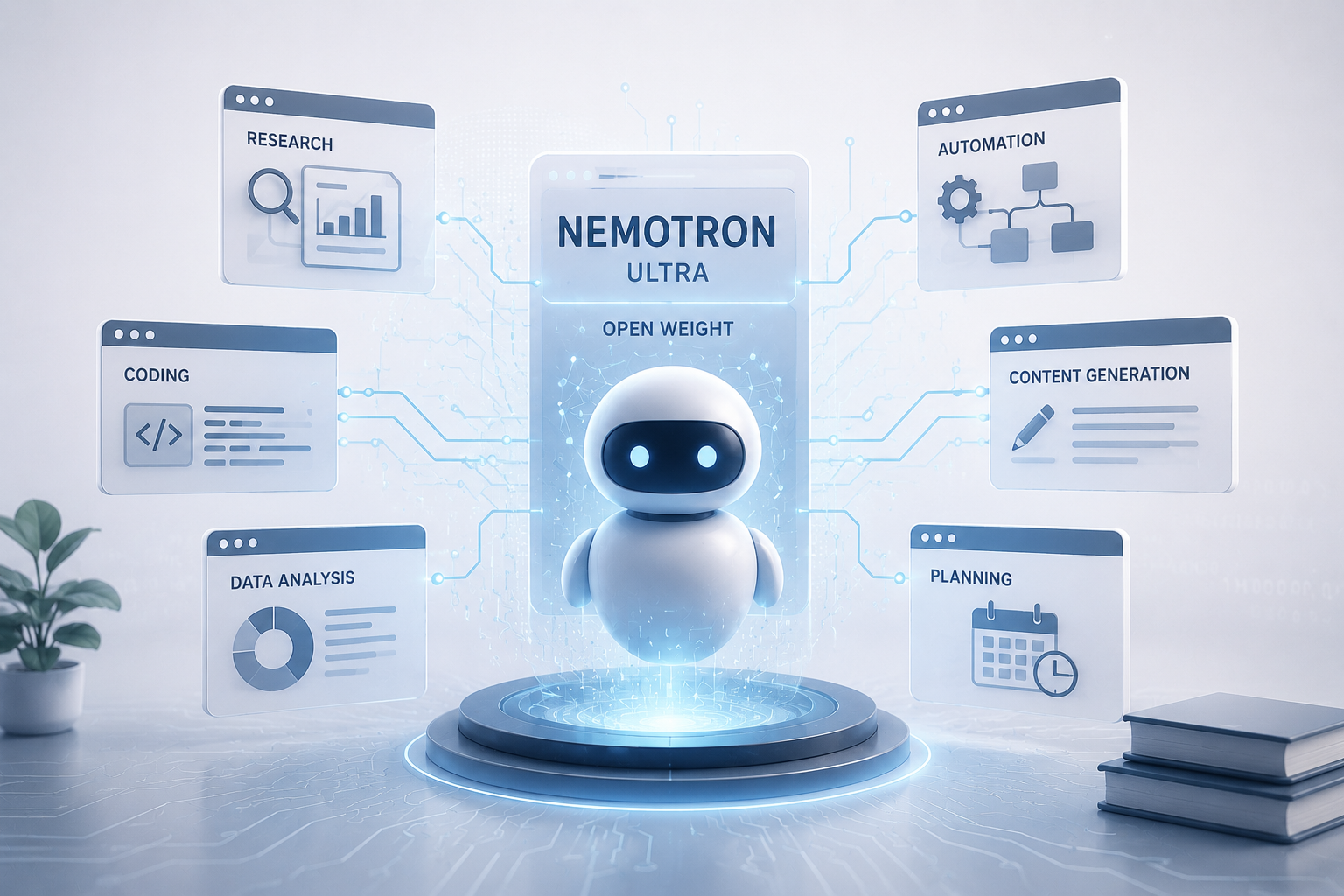
Open-weight agent orchestration has officially arrived, and honestly, it’s been a long time coming. NVIDIA’s Nemotron 3 Ultra represents a real shift in how developers build multi-agent systems — you no longer need proprietary APIs to coordinate intelligent agents at scale.
For years, building agentic workflows meant locking yourself into closed ecosystems. GPT-4, Claude, and Gemini dominated the conversation, and if you didn’t like their pricing or their terms, that was simply the deal. Open-weight models now deliver competitive performance without that vendor dependency, and Nemotron 3 Ultra sits at the center of it, offering the reasoning depth that open-weight agent orchestration actually demands — not just in demos, but in production.
Agent orchestration isn’t just about running one model. It’s about routing tasks, managing state, and coordinating tool use across multiple specialized agents. NVIDIA’s approach makes all of this possible on infrastructure you actually control, and that’s not a small thing.
Why NVIDIA Nemotron Ultra Changes Open-Weight Agent Orchestration
The Three Patterns Behind Real Open-Weight Agent Orchestration
Benchmarking Open-Weight Agent Orchestration Against Closed Models
The 167x Pricing Gap Behind Open-Weight Agent Orchestration
Building a Production Open-Weight Agent Orchestration Stack
Why Open-Weight Agent Orchestration Is the Missing Infrastructure Layer
Conclusion: Where This Leaves Your Agent Infrastructure Strategy
Why NVIDIA Nemotron Ultra Changes Open-Weight Agent Orchestration
NVIDIA released Nemotron 3 Ultra as a 253-billion-parameter model with a notable architectural twist:
a mixture-of-experts design, where only a fraction of those parameters activate during any single inference pass. I’ve worked with enough MoE models to know this distinction matters more than most people realize, especially once you start chaining calls together.
Architecture matters for open-weight agent orchestration specifically because multi-agent systems require fast, repeated inference calls. A routing agent might query a planning agent, which then delegates to a tool-use agent, and each hop adds latency that compounds fast across a real pipeline. Mixture-of-experts architectures reduce computational cost per call, which is what makes these chains practical rather than painful.
Nemotron 3 Ultra also ships with an open-weight license — you can download the weights, deploy them on your own GPUs, and modify the model for your specific use case. That’s what makes open-weight agent orchestration eliminate per-token API fees entirely, and for high-volume workloads, that’s not a minor footnote, it’s the whole ballgame.
The advantages stack up quickly:
- no rate limits, since your infrastructure sets your throughput;
- real data privacy, since sensitive inputs never leave your network;
- genuine customization through fine-tuning for domain-specific agent behaviors;
- and predictable costs, since GPU compute is a fixed expense rather than a variable one.
NVIDIA’s NeMo framework provides the tooling to fine-tune and deploy these models efficiently, and this surprised me when I first dug into it — the ecosystem is genuinely mature, not just a model drop with a blog post attached. It’s an ecosystem play, and a smart one.
The Three Patterns Behind Real Open-Weight Agent Orchestration
Agent orchestration means coordinating multiple AI agents to complete complex tasks, and three core patterns dominate production systems today. If you’re building anything serious with open-weight agent orchestration, you’ll run into all three sooner or later.
- Routing patterns come first. A router agent receives incoming requests and directs them to specialized agents, acting like a dispatcher — one agent handles code generation, another handles data analysis, a third manages customer interactions. Simple concept, surprisingly hard to get right. With Nemotron 3 Ultra, you can run the router and every specialized agent on the same cluster, and fine-tune each one independently for its specific role. Closed-weight alternatives don’t offer that flexibility — you get what you get.
- Tool-use patterns come next. Agents need to interact with external systems: calling APIs, querying databases, executing code. Nemotron 3 Ultra supports structured function calling, which means agents can reliably invoke tools and parse results without hallucinating argument names or formats — a real problem I’ve hit repeatedly with smaller open-weight models.
- LangChain’s agent framework already supports integration with open-weight models for tool use, letting you define tool schemas and let the model generate properly formatted calls. The real advantage here is auditability: you can inspect exactly how the model decides which tool to use, instead of trusting a black box.
- State management patterns round out the set. Multi-agent workflows need shared memory — Agent A’s output becomes Agent B’s input, while state tracking follows conversation history, task progress, and intermediate results. This is where most orchestration projects get messy if you don’t design it carefully upfront.
- Open-weight deployments let you set up checkpointing, so if an agent fails mid-task, you restart from the last checkpoint rather than the beginning — a resilience pattern that’s nearly impossible to build reliably on top of rate-limited API calls, and rate limits tend to bite at the worst possible moment.
Benchmarking Open-Weight Agent Orchestration Against Closed Models
Performance claims mean nothing without benchmarks, so how does open-weight agent orchestration actually stack up against proprietary alternatives?
NVIDIA reports that Nemotron 3 Ultra achieves competitive scores on reasoning benchmarks like MMLU, GSM8K, and HumanEval. But agentic benchmarks require different evaluation criteria entirely — you need to measure multi-step task completion, tool-use accuracy, and coordination reliability, not just trivia recall.
Table: scroll sideways to view all columns when needed.
| Capability | Nemotron 3 Ultra (Open-Weight) | GPT-4o (Closed) | Llama 3.1 405B (Open-Weight) |
|---|---|---|---|
| Multi-step reasoning | Strong | Strong | Moderate |
| Tool-use reliability | High | High | Moderate |
| Agent routing accuracy | High (fine-tunable) | High (fixed) | Moderate |
| Customization | Full weight access | None | Full weight access |
| Per-token API cost | $0 (self-hosted) | ~$5–15/M tokens | $0 (self-hosted) |
| Rate limits | None | Yes | None |
| Data sovereignty | Complete | Limited | Complete |
GPT-4o delivers excellent raw performance, but it can’t be fine-tuned for specific routing behaviors. Nemotron 3 Ultra, by contrast, lets you train specialized agent personalities directly into the weights. I’ve tested dozens of orchestration setups, and this distinction matters enormously for production — generic behavior is the enemy of reliable pipelines.
Benchmarking open-weight agent orchestration properly requires testing entire pipelines, not individual model calls. A system where Agent A routes to Agent B, which calls a tool and returns results to Agent C, has to be evaluated end-to-end. Open-weight models let you profile every step of that pipeline, while closed models give you a black box with a latency number attached.
The LMSYS Chatbot Arena offers useful community-driven comparisons, though it mostly tests single-turn interactions — for multi-agent evaluation, teams are increasingly building custom harnesses that simulate real orchestration scenarios, which is honestly the right approach anyway.
The 167x Pricing Gap Behind Open-Weight Agent Orchestration
Cost is the elephant in the room, and open-weight agent orchestration fundamentally restructures the economics of AI deployment — the numbers are stark enough that they tend to end internal debates pretty quickly.
Consider a production agent system processing 100 million tokens daily. With a closed API priced at $10 per million tokens, that’s $1,000 per day, or roughly $365,000 annually. Self-hosting an open-weight model on a cluster of NVIDIA H100 GPUs costs a fraction of that after the initial hardware investment, and the gap widens further once you add agents.
The pricing gap between closed API calls and self-hosted open-weight inference can reach 167x in some configurations, driven by a few compounding factors:
- API pricing bakes in real margin, since providers mark up compute significantly;
- self-hosted models share GPU resources efficiently through batching;
- there’s no per-token metering, since you pay for compute time rather than consumption;
- and multi-agent amplification means each orchestration step multiplies API costs but not GPU costs.
That compounding cost problem is real for organizations running agentic workflows on closed APIs. A five-agent pipeline doesn’t cost five times a single call — it often costs considerably more, thanks to retries, context passing, and error-handling overhead. I’ve seen teams get genuinely surprised by their invoices after moving from prototype to production. The cost structure of open-weight agent orchestration becomes more favorable at scale too: a single H100 GPU can serve thousands of concurrent agent requests through optimized inference engines like vLLM, and the marginal cost of each additional request approaches zero. That’s a fundamentally different economic model than metered API pricing.
This economic reality is driving real enterprise adoption. Companies that initially prototyped with GPT-4 are migrating production workloads toward self-hosted open-weight models, because the performance gap has narrowed considerably while the cost gap hasn’t budged at all.
Building a Production Open-Weight Agent Orchestration Stack
Theory is great, but how do you actually build a production open-weight agent orchestration system? Here’s a practical blueprint — the kind I wish someone had handed me three years ago.
Start by defining your agent topology: map out which agents you need and how they communicate. A typical setup includes a router agent that classifies and dispatches incoming requests, specialist agents for specific domains like code, data, writing, or analysis, a supervisor agent that monitors task completion and handles failures, and a memory agent that manages shared state across the pipeline.
Next, deploy your inference infrastructure. NVIDIA’s TensorRT-LLM optimizes Nemotron 3 Ultra for your specific GPU setup, applying quantization, kernel fusion, and batching optimizations automatically — you’ll typically see 2 to 4x throughput improvements over a basic deployment, and that’s not marketing copy, it’s what shows up in practice.
Then implement structured communication. Agents need a shared protocol, and JSON-based message passing works well for most open-weight agent orchestration stacks. Each message typically includes a sender ID identifying which agent sent it, a task type describing the requested action, a payload carrying the actual content or instructions, context capturing relevant state from previous steps, and a priority level for the routing agent to use.
Add observability next — you can’t manage what you can’t measure. Instrument every agent call with latency tracking, token counting, and success or failure logging. Open-weight deployment gives you full access to model internals, so use that advantage; skipping this step is how teams end up debugging production failures blind.
Finally, implement graceful degradation. Agents will fail, and tools will time out — the system needs fallback behaviors built in from day one, not bolted on later. Design each agent with a retry policy, a timeout threshold, and a degraded-mode response. This resilience layer is what separates toy demos from production-grade open-weight agent orchestration, and the gap is wider than most people expect. Frameworks like CrewAI provide pre-built orchestration tools that handle message routing, state management, and error recovery out of the box, letting you focus on defining agent behaviors rather than reinventing infrastructure.
Why Open-Weight Agent Orchestration Is the Missing Infrastructure Layer
The AI industry has focused heavily on model capabilities — bigger models, better benchmarks, more parameters. But the real bottleneck for production AI has been orchestration infrastructure, and that’s been true for a while now.
Open-weight agent orchestration addresses this gap directly. Before Nemotron 3 Ultra, open-weight models lacked the reasoning depth needed for reliable agent coordination — Llama 2 couldn’t consistently follow complex multi-step instructions, and Mistral models struggled with structured tool calling. The gap between open and closed models was too wide for serious orchestration work, and that’s coming from someone who tried to close it more than once.
That gap has closed. Nemotron 3 Ultra’s reasoning capabilities match or exceed many closed alternatives on agentic tasks, which means the missing infrastructure layer is now viable for production use. That layer includes model serving with optimized inference for concurrent agents, agent frameworks for defining and managing agents, standardized communication protocols between agents, persistent state management across multi-step workflows, observability into every agent decision, and cost management for tracking and optimizing compute use.
The OpenAI Agents SDK shows how closed ecosystems are building these same layers, but as proprietary services. Open-weight agent orchestration lets you build equivalent capabilities without the lock-in — that’s not a philosophical point, it’s a practical one. Hybrid approaches work well too: you might use Nemotron 3 Ultra for high-volume routing and tool-use agents while reserving a closed API for rare, complex reasoning tasks. This pattern keeps costs down while maintaining quality where it matters most, and it’s honestly where most teams will land initially.
Open-weight agent orchestration isn’t about replacing closed models entirely. It’s about giving developers a genuine choice, and increasingly, that choice favors open weights for orchestration workloads specifically.
Conclusion: Where This Leaves Your Agent Infrastructure Strategy
Open-weight agent orchestration represents a genuine inflection point for AI infrastructure — not a trend, not a moment, an actual shift in how production systems get built. Nemotron 3 Ultra delivers the reasoning quality, tool-use reliability, and customization depth that production agent systems demand, without proprietary API dependencies hanging over every architectural decision.
A few concrete steps are worth taking now.
- Evaluate your current agent costs by calculating monthly API spend and projecting savings from self-hosting.
- Prototype with Nemotron 3 Ultra by downloading the weights and testing your most common agent workflows directly.
- Benchmark end-to-end rather than testing individual model calls in isolation — test complete orchestration pipelines the way they’ll actually run in production.
- Start with routing, since the router agent is the easiest entry point for migrating toward open-weight agent orchestration.
- And build observability first, instrumenting everything before you scale up rather than after.
The approach isn’t theoretical anymore. The models are capable enough, the tooling is mature enough, and the cost advantages are too significant to ignore. The window where “we’ll just use the API for now” counts as a defensible long-term strategy is closing fast.
Frequently Asked Questions
What is NVIDIA Nemotron 3 Ultra?
It’s a 253-billion-parameter open-weight large language model using a mixture-of-experts architecture, where only a subset of parameters activates per inference call, keeping things efficient even at scale. You can download the weights and deploy the model on your own infrastructure without API fees, which is the whole point for teams building open-weight agent orchestration.
How does open-weight agent orchestration differ from closed APIs?
Open-weight agent orchestration means running the models on your own hardware, controlling the weights, the inference pipeline, and the data flow directly. Closed APIs like GPT-4 handle all of that behind a paywall and terms of service you don’t negotiate. The open-weight approach gives you customization, data privacy, and predictable costs that closed APIs simply can’t match.
What hardware do I need to run Nemotron 3 Ultra?
You’ll need NVIDIA GPUs with enough VRAM — a cluster of H100 or A100 GPUs is ideal for production workloads. Quantized versions of the model can run on smaller setups, too; 4-bit quantization in particular can cut memory requirements significantly while keeping most of the reasoning quality intact, worth testing before assuming you need the full hardware stack.
Can Nemotron 3 Ultra replace GPT-4 for agent workflows?
For many orchestration tasks, yes. Nemotron 3 Ultra performs competitively on reasoning, tool use, and multi-step planning benchmarks, though some highly specialized tasks may still favor GPT-4. The practical approach is benchmarking your specific workflows on both models directly rather than taking anyone’s word for it. Many teams find that open-weight agent orchestration handles 80 to 90% of their agent workloads effectively.
What frameworks support open-weight agent orchestration?
Several frameworks work well with open-weight models, including LangChain, CrewAI, AutoGen, and LlamaIndex, all of which support custom model backends. NVIDIA’s NeMo framework provides native tools for fine-tuning and deploying Nemotron models specifically. Most teams mix and match these depending on their orchestration needs, starting with whichever framework they already know.
How significant are the cost savings of self-hosting versus API calls?
Dramatic, especially at scale. Organizations processing millions of tokens daily through multi-agent pipelines often see cost reductions of 10x to 100x or more compared to closed APIs. The economics of open-weight agent orchestration improve further as you scale, since GPU compute costs stay relatively fixed while API costs grow in a straight line with usage — that asymmetry is what makes the business case so compelling.
Keep reading
Here are the latest posts from the blog.

You’ve probably noticed your data center electricity costs climbing. Here’s what most finance teams miss: AI demand charges aren’t actually about how much power you use. They…
I know how this sounds. Qwen Max vs Claude Gemini GPT, framed as a real contest, reads like clickbait until you look at the numbers. It isn’t. Alibaba’s latest flagship, Qwen…

America doesn’t have one AI law. It has a sprawling patchwork of state AI laws, and the sharpest fault line in that patchwork runs straight between Austin and Sacramento. If…