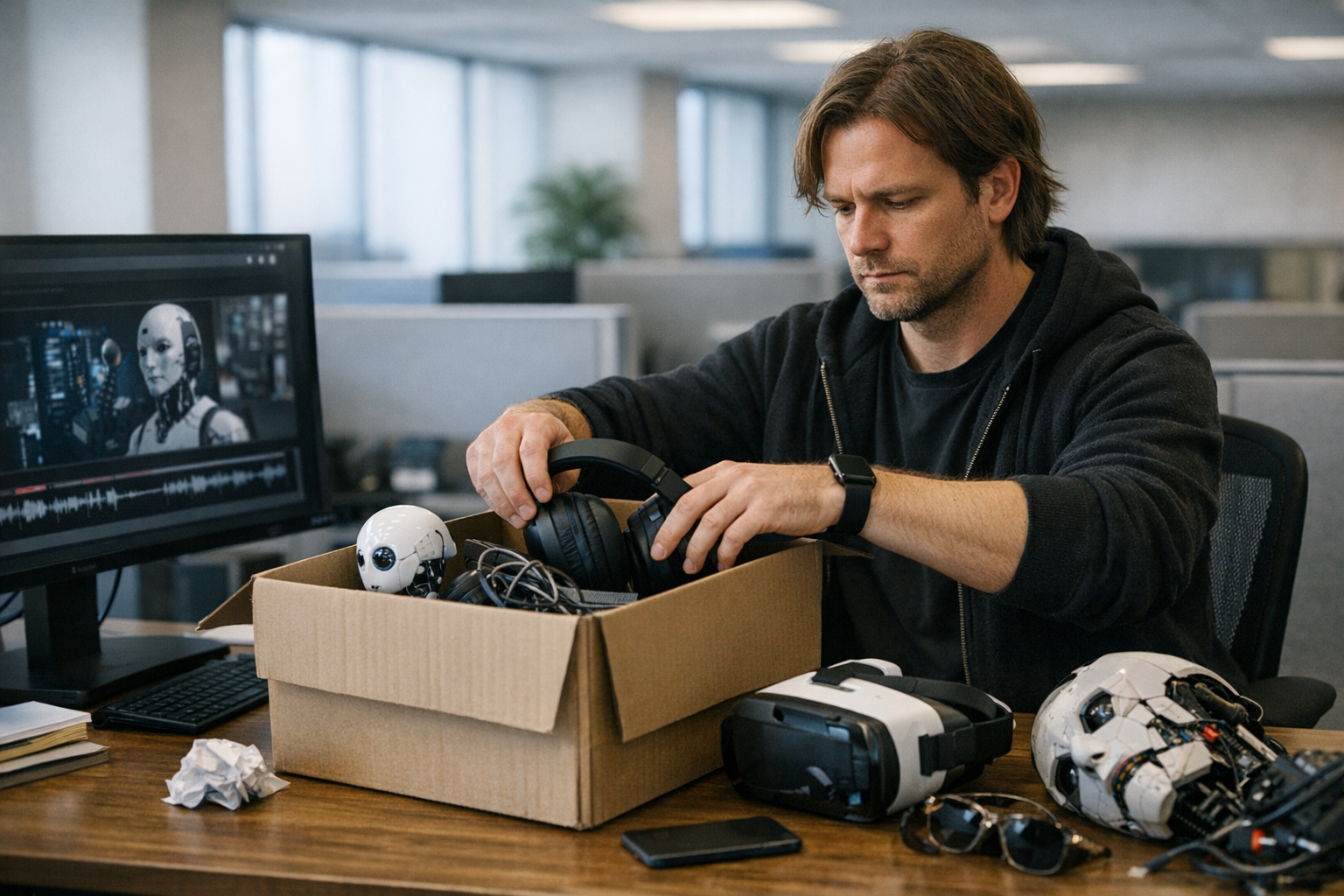
An exclusive departing Meta staffer posts biting anti-AI video — and honestly, it landed like a grenade inside one of the world’s most powerful AI companies. Shared widely across social platforms in early 2025, the video didn’t just take swings at AI hype in general. It went after Meta’s internal safety culture specifically, with names, details, and a level of technical precision that’s hard to dismiss.
This isn’t some isolated venting session from a disgruntled employee. It’s the latest signal in a growing wave of departures and public dissent from researchers who actually built Meta’s AI systems. Furthermore, it raises urgent questions about enterprise AI governance that every tech leader should be paying attention to right now.
The backlash points to something systemic — not just one person’s bad experience.
Why This Anti-AI Video Matters Now
The timing couldn’t be more loaded. Meta has been aggressively expanding its AI capabilities throughout 2024 and 2025, pouring billions into generative AI features across Instagram, WhatsApp, and Facebook. Meanwhile, internal safety teams have reportedly shrunk. I’ve watched this pattern play out at company after company, and it rarely ends quietly.
Several former employees have described a culture where speed consistently trumps caution. The exclusive departing Meta staffer posts biting anti-AI video dropped right as Meta was pushing its Llama models into enterprise markets worldwide — and that timing is not a coincidence.
Key context for why this matters:
- Meta dissolved its Responsible AI team in late 2023
- Safety researchers were moved across product teams — which sounds neutral but functionally isn’t
- Multiple senior AI ethics staffers departed between 2023 and 2025
- CEO Mark Zuckerberg publicly embraced a “move fast” approach to AI deployment
Consequently, the video resonated far beyond Meta’s walls. It became a lightning rod for broader industry anxiety about unchecked AI development. And look, that anxiety is entirely justified.
The departing staffer’s video specifically called out three problems: safety reviews being rushed or skipped entirely, internal dissent being discouraged through subtle cultural pressure, and — notably — external safety researchers being blocked from getting adequate information about Meta’s models.
Notably, this criticism aligns with what MIT Technology Review has documented about AI safety culture across major tech firms. The pattern isn’t unique to Meta. However, Meta’s scale makes the consequences especially hard to shrug off. When you’re talking about models deployed to billions of users, “we’ll fix it later” isn’t really a safety strategy.
A Timeline of Dissent at Meta
Understanding the exclusive departing Meta staffer posts biting anti-AI video requires some historical context — because this wasn’t a sudden eruption. It was the latest chapter in a long story.
2021 — Frances Haugen’s testimony. Although Haugen’s focus was social media harms rather than AI specifically, her whistleblowing set a template. She proved that departing employees could genuinely shape public discourse about Meta’s practices. Her testimony before the U.S. Senate Commerce Committee drew global attention and, more importantly, showed others that going public was survivable.
2023 — Responsible AI team dissolution. Meta disbanded its dedicated Responsible AI team. The official line was that safety work would be “embedded” across all teams. Critics, moreover, called it exactly what it looked like: a dismantling of oversight dressed up in corporate language.
Early 2024 — Senior researcher departures. At least four prominent AI safety researchers left Meta within a six-month window. Several posted detailed LinkedIn statements about their frustrations. Additionally, anonymous sources told reporters about internal Workplace posts expressing serious alarm — the kind of posts that get screenshotted and shared.
Mid-2024 — Open-source safety debates. Meta’s decision to open-source its Llama models sparked fierce debate. Supporters praised the move. Nevertheless, departing staffers warned that the safety guardrails were nowhere near adequate for open release. When I first dug into this, the gap between the PR narrative and the internal concerns was striking.
Early 2025 — The anti-AI video. The exclusive departing Meta staffer posts biting anti-AI content goes viral. Polished, specific, and technically devastating — it’s not a rant. It’s a structured argument, and that’s what makes it stick.
What former staffers have said publicly:
- “Safety was treated as a checkbox, not a priority” — former Responsible AI team member, 2024
- “We raised concerns repeatedly. Leadership listened politely and changed nothing” — anonymous departing researcher, quoted by Bloomberg
- “The culture shifted from ‘move fast and break things’ to ‘move fast and don’t ask questions'” — former senior engineer, LinkedIn post
Therefore, the video represents a culmination rather than a beginning. Each departure built on the last, and each public statement made the next one easier. That’s how these things work — and once the dam cracks, it keeps cracking.
How Meta’s AI Governance Compares to Anthropic’s
Here’s the thing: the exclusive departing Meta staffer posts biting anti-AI video practically invites a direct comparison. So let’s actually make it.
Anthropic, the company behind Claude, offers a stark contrast. Anthropic has published detailed vulnerability disclosure processes and maintains a dedicated trust and safety team with significant authority — not just advisory access, but real decision-making power. I’ve tested and reviewed tools from both companies, and the documentation transparency alone is night and day.
Here’s how the two approaches stack up:
| Governance Area | Meta | Anthropic |
|---|---|---|
| Dedicated safety team | Dissolved in 2023; redistributed | Standalone team with executive access |
| Vulnerability disclosure | Limited public process | Published responsible disclosure policy |
| Model transparency | Open-source models, limited safety docs | Detailed model cards and safety evaluations |
| Internal dissent channels | Informal; reportedly discouraged | Structured feedback mechanisms |
| External safety research | Restricted access for researchers | Bug bounty and red-teaming partnerships |
| Public safety commitments | Signed White House voluntary commitments | Signed White House voluntary commitments; additional self-imposed limits |
| Employee retention (safety) | Multiple high-profile departures | Relatively stable safety team |
Similarly, companies like Google DeepMind and OpenAI have faced their own governance challenges. However, Meta’s combination of team dissolution, open-source release, and researcher exodus creates a uniquely concerning picture. That’s not a hot take — it’s just what the timeline shows.
Importantly, this comparison isn’t about declaring one company “good” and another “bad.” It’s about identifying governance structures that actually work. Anthropic’s approach to vulnerability disclosure, documented in their research publications, gives procurement teams a concrete benchmark to measure against.
The contrast matters enormously for enterprise buyers. Organizations reviewing AI vendors should ask pointed questions — not accept glossy pitch decks. The exclusive departing Meta staffer posts biting anti-AI content is exactly the kind of signal that should make procurement teams pause and dig deeper.
Questions enterprise buyers should ask AI vendors:
- Does your company maintain a dedicated, independent safety team?
- What’s your vulnerability disclosure process?
- How do you handle internal safety concerns from employees?
- Can you provide documentation of safety evaluations for your models?
- What authority does your safety team have to delay or block product launches?
Fair warning: vendors who hedge on these questions are telling you something important.
What This Video Signals About Enterprise AI Governance
The exclusive departing Meta staffer posts biting anti-AI video landed at a moment when enterprise AI adoption is accelerating at a pace that frankly makes me nervous. According to reporting from Reuters, global enterprise AI spending is expected to exceed $200 billion in 2025.
That’s a staggering number — and it represents a lot of organizations deploying AI tools faster than their governance frameworks can possibly keep up.
Moreover, many organizations are essentially trusting their vendors to do the safety work for them. That’s a bet I wouldn’t take.
The governance gaps Meta’s situation exposed:
- Safety team independence. When safety researchers report to product leaders, their concerns get filtered through commercial priorities. Effective governance requires independent safety teams with real authority — not advisory roles that can be politely ignored.
- Departure as the only protest mechanism. When talented researchers can only express concerns by leaving, organizations lose both talent and institutional knowledge. Conversely, companies with strong internal feedback channels retain critical expertise and catch problems earlier.
- Open-source accountability. Meta’s open-source approach to Llama models raises unique questions. Once a model is released, who’s responsible for misuse? The National Institute of Standards and Technology (NIST) has published AI risk management frameworks, though enforcement remains voluntary — which is itself part of the problem.
- Regulatory lag. The EU’s AI Act is the most complete regulation to date. Nevertheless, it’s still being put into practice. In the U.S., AI governance remains largely self-regulated, and the exclusive departing Meta staffer posts biting anti-AI content highlights this regulatory vacuum directly. It’s not subtle.
- Whistleblower protections. Current U.S. law doesn’t adequately protect AI safety whistleblowers. Staffers who speak up risk retaliation, legal action, and real career damage. Although some states have expanded protections, federal legislation hasn’t caught up — and that gap is why we’re watching viral videos instead of reading formal disclosures.
What this means for your organization:
- Don’t assume your AI vendor has adequate safety practices just because they say so
- Build internal AI governance regardless of vendor promises
- Create channels for employees to raise AI safety concerns without career risk
- Monitor public criticism of your AI vendors as an early warning signal — this stuff surfaces before official announcements
- Develop contingency plans for AI tool failures or safety incidents before you need them
The broader lesson is clear. Enterprise AI governance can’t be outsourced entirely to vendors. You need your own frameworks, audits, and accountability structures. Full stop.
How Tech Companies Can Rebuild Trust After Safety Failures
Every time an exclusive departing Meta staffer posts biting anti-AI criticism, it erodes public trust further. But trust can be rebuilt — however, it requires concrete structural action, not carefully worded PR statements.
I’ve seen companies try both approaches. One actually works.
Proven strategies for rebuilding AI safety trust:
- Reinstate independent safety teams. Give them budget, authority, and direct access to leadership. Don’t bury them inside product organizations. Specifically, safety teams should have genuine veto power over launches that fail safety reviews — not just the ability to file a concern.
- Publish transparent safety evaluations. Partnership on AI, a multi-stakeholder organization, has developed frameworks for responsible AI publication. Companies should adopt these standards publicly, not just internally.
- Create structured dissent channels. Google’s internal culture has historically let engineers raise concerns through structured processes. Although imperfect, such systems are meaningfully better than forcing departures as the only option. Companies with better dissent channels also tend to catch problems earlier — it’s not just about morale.
- Bring in external auditors. Independent third-party audits add credibility and catch problems that internal teams might miss, downplay, or simply be too close to see. External audits consistently surface issues that internal reviews miss — the data on this is pretty clear.
- Protect whistleblowers explicitly. Companies should adopt policies that go beyond the legal minimum. Departing employees shouldn’t need to post viral videos to be heard. If that’s your feedback mechanism, something has already gone badly wrong.
- Tie executive compensation to safety metrics. Money talks. When safety outcomes directly affect bonuses, leadership pays attention — and this is arguably the single most effective governance mechanism available. Everything else is secondary.
Additionally, the industry needs collective action. Individual company efforts matter, but industry-wide standards enforced through market pressure and regulation create lasting change. One company doing the right thing is admirable. An entire industry doing it is transformative.
The exclusive departing Meta staffer posts biting anti-AI video shouldn’t just be a news story. It should be a catalyst for structural reform across the entire AI industry. Whether it becomes one depends on how companies, buyers, and regulators respond.
Conclusion
The exclusive departing Meta staffer posts biting anti-AI video captures a genuinely critical moment in AI development. It’s more than one person’s frustration — it reflects systemic governance failures that affect every organization currently using or evaluating AI tools.
Throughout 2024 and 2025, departing researchers have painted a remarkably consistent picture: safety teams dissolved, internal dissent discouraged, speed prioritized over caution. The comparison with Anthropic’s structured approach reveals just how wide the governance gap has become. And importantly, that gap has real consequences for real organizations making real purchasing decisions.
Bottom line: the exclusive departing Meta staffer posts biting anti-AI content isn’t just a tech industry story. It’s a governance story, a trust story, and increasingly, a regulatory story.
Your actionable next steps:
- Audit your AI vendors’ safety practices this quarter — don’t accept vague assurances as a substitute for documentation
- Build internal AI governance frameworks using NIST’s AI Risk Management Framework as a starting point
- Create internal channels for employees to raise AI safety concerns without fear of career consequences
- Monitor departures and public criticism at your AI vendors as early warning signals — they surface before official announcements
- Advocate for stronger AI whistleblower protections in your industry and with legislators
The story of the exclusive departing Meta staffer posts biting anti-AI movement isn’t over. It’s a chapter in a much larger story about whether the AI industry can govern itself before regulators force it to. Your response to that question — as a buyer, builder, or leader — matters more than most people currently realize.
FAQ
Who is the departing Meta staffer who posted the anti-AI video?
The staffer’s identity became public through their social media posts. They were a mid-senior researcher who worked on AI safety-adjacent projects at Meta. Importantly, they aren’t the first to leave publicly — however, the video format made the criticism far more accessible and shareable than the typical LinkedIn departure post. That accessibility is precisely why it spread so quickly.
What specifically did the anti-AI video criticize about Meta?
The video targeted three main areas: the dissolution of Meta’s Responsible AI team, the way safety reviews were rushed or bypassed for product deadlines, and a culture where raising concerns was subtly discouraged rather than openly welcomed. The exclusive departing Meta staffer posts biting anti-AI content was notably specific and technical — not vague or emotional. That specificity is what gave it staying power.
How does Meta’s AI safety approach compare to other Big Tech companies?
Meta’s approach stands out for several reasons. The company dissolved its dedicated Responsible AI team in 2023 and has pursued aggressive open-source AI releases without, critics argue, adequate safety documentation. Conversely, companies like Anthropic maintain independent safety teams with significant authority. Google DeepMind and OpenAI have faced their own challenges — no company is perfect here. Nevertheless, Meta’s combination of factors creates a uniquely concerning governance picture that’s hard to explain away.
What should enterprise buyers do about AI vendor safety concerns?
Enterprise buyers should take several concrete steps. Request documentation of safety evaluations from vendors and specifically ask about the structure and authority of their safety teams — not just whether one exists. Furthermore, review public criticism and departure patterns, because those signals surface early. Build your own internal AI governance frameworks rather than relying solely on vendor assurances. The NIST AI Risk Management Framework provides a solid, no-nonsense starting point.
Are there legal protections for AI safety whistleblowers?
Currently, legal protections for AI safety whistleblowers are limited — and that’s putting it generously. Federal law doesn’t specifically cover AI safety disclosures. Some state laws offer broader whistleblower protections that might apply, depending on circumstances. Although the EU’s AI Act includes some provisions, enforcement mechanisms are still developing. This gap is precisely why departing staffers resort to public videos and social media posts — it’s often the only mechanism that actually works.
What does this mean for the future of AI regulation?
The pattern of departures and public criticism is increasing pressure on regulators in ways that are hard to ignore. Specifically, it strengthens arguments for mandatory safety evaluations, independent audits, and whistleblower protections — all things that currently lack federal teeth in the U.S. The EU is furthest ahead with its AI Act. In the U.S., momentum is building but legislation remains fragmented. Each exclusive departing Meta staffer posts biting anti-AI criticism adds urgency to these regulatory conversations — and the pressure is clearly building.
References
Keep reading
Here are the latest posts from the blog.
Here’s the uncomfortable truth at the center of every code review automation AI tools accuracy limitations 2026 conversation: these tools catch a lot of bugs — just not alway…

Choosing the right AI note-taking tool can genuinely change how you work — and I don’t mean that in a vague, marketing-copy way. This NeuralNote AI note-taking app features c…

The growing catalog of Retail AI tool failure inventory management case studies 2026 tells a story most vendors absolutely don’t want you to hear. Billions of dollars have be…