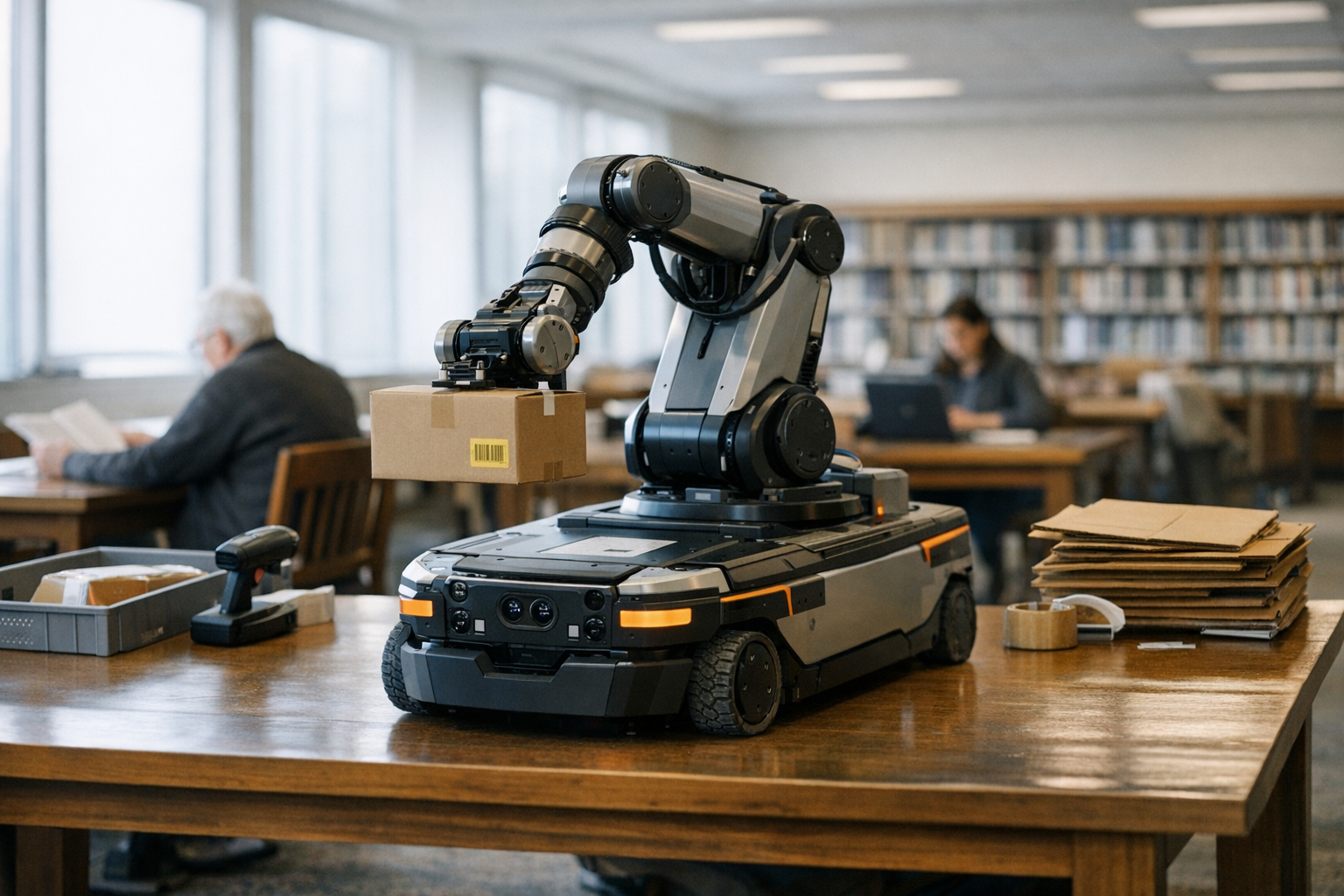
Amazon Vulcan has been awarded the RBR50 Robot of the Year 2026, and frankly, the robotics world needed this moment. Not another humanoid shuffing around a stage. No concept render with a release date of “coming soon.” A genuine machine, running in real warehouses, doing real labor.
The RBR50 Robotics Innovation Awards celebrate the world’s most impactful robots and automation systems each year. So this honor means something. These judges aren’t passing out participation awards. Amazon’s Vulcan was special because it handled real problems rather than theoretical ones.
What is the significance of this beyond the trophy? Because the 2026 RBR50 Robot of the Year granted Amazon Vulcan signifies a sea change. The industry is finally moving away from the hoopla of humanoids to realistic, deployable technologies that actually work. And I, for one, believe it’s high time.
What Amazon Vulcan Actually Does
Amazon Vulcan is a robotic manipulation system designed for warehouse logistics. It’s about the dirty, unpredictable business of picking and organizing individual items—and a heads-up: that job is a lot harder than it seems.
Conventional warehouse robots are limited to strict pathways. They shift bins, pallets and shelves. But they’ve always struggled with “the last inch” – actually getting a single product out of a confused mess of multiple forms and weights and packaging types. Vulcan changes that completely.
I’ve been watching warehouse robotics for years, and this problem has been the industry’s intractable wall. The pile gets messy and most systems either grind to a halt or simply fail. Vulcan doesn’t.
The key technical capabilities are:
- Multi-modal gripping: Vulcan uses both suction and mechanical grippers, switching between them in real time depending on what it’s picking up
- 3D perception: Depth cameras and AI vision identify things no matter their orientation or packing
- Adaptive force control: The technology changes grip pressure based on item fragility (so your shampoo bottle isn’t shattered next to a hardcover book)
- High-speed sorting: Vulcan sorts over 1,000 items per hour per unit
- Self-correcting behavior: Automatically retry failed selections without human interaction
And Vulcan doesn’t work in isolation either. It directly interfaces with Amazon’s existing Proteus autonomous mobile robots and conveyor infrastructure. This is a HUGE deal. A demo is a robot working alone. A robot operating in a system is a product.
The AI backbone is also worth mentioning. Vulcan is built on a foundation model trained on millions of real warehouse interactions. It’s not just simulation-based training – and that is a significant, important distinction. Amazon trained Vulcan on data from actual fulfillment center operations — with all the complexity and edge cases that entails. That real-world foundation is why the 2026 RBR50 Robot of the Year award went to Amazon Vulcan, not a lab prototype. When I first started looking into the technical aspects, I was astonished because most rivals are still largely reliant on fake data.
Why Vulcan Beat the Competition for the 2026 RBR50 Robot of the Year
The RBR50 judges don’t give awards for cool demos. They look at commercial effect, technical innovation and readiness for deployment – and Amazon Vulcan scored highly on all three.
The key difference was deployment scale. Competitors were showing off amazing prototypes, but Vulcan was already in operation in many Amazon fulfillment centers. That is not a pilot program. That is production. And there is a canyon-wide separation between the two.”
Rhoda AI comparison. One of the strong contenders is Rhoda AI which has produced excellent humanoid robots with general purpose manipulation ability. Rhoda’s systems are only in limited trials and haven’t yet demonstrated they can operate at warehouse pace and volume for long stretches. Amazon Vulcan delivers—consistently, at scale, under chaotic real-world situations.
Agility Robotics, Digit. Agility Robotics has joined together with Amazon to test its Digit humanoid robot. Digit is a real possibility for tote-moving operations, but it is nothing near the item-level manipulation throughput of Vulcan. They’re complementing systems, not rivals and Amazon recognizes this.
Figure and other human-shaped companies. Figure and others have drawn billions of financing. Meanwhile, they are still working on fundamental mobility and task dependability. The demo-to-deployment gap remains huge – greater than their pitch decks would have you believe, in my experience observing this space.
Here’s a look at the main platforms evaluated for the award:
| Feature | Amazon Vulcan | Rhoda AI | Agility Digit | Figure 02 |
|---|---|---|---|---|
| Items picked per hour | 1,000+ | ~200 (estimated) | N/A (tote moving) | ~100 (estimated) |
| Production deployment | Yes, multi-site | Limited trials | Pilot stage | Lab/demo only |
| Grasping modalities | Suction + mechanical | Mechanical hands | Mechanical hands | Mechanical hands |
| Integration with existing systems | Deep (Amazon ecosystem) | API-based | Moderate | Minimal |
| Uptime reliability | 95%+ reported | Not disclosed | Not disclosed | Not disclosed |
| Training data source | Real-world warehouse | Simulation + limited real | Simulation-heavy | Simulation-heavy |
This table tells us something crucial. It wasn’t the most sophisticated humanoid form factor that scored the Amazon Vulcan the 2026 RBR50 Robot of the Year. It was about the best solution to a real situation. Look at the uptime column, 95%+ recorded vs. “not disclosed” across the board. That gap is all you need to know.
Also, Vulcan had a structural advantage from Amazon’s vertical integration that no company can simply replicate. Amazon creates the warehouses, designs the procedures and controls the data stream. No early-stage startup can build that ecosystem overnight, no matter how much money they have.
The Bigger Shift: Practical Deployment Over Humanoid Hype
The Amazon Vulcan winning the 2026 RBR50 Robot of the Year award is a much-needed correction to the robotics story. Humanoid robots have been in the headlines for the last three years. Investors were throwing money at bipedal platforms, and social media was abuzz with every new walking video.
But here is the uncomfortable reality. Most humanoid robots can’t do practical job yet. They walk and wave, they sometimes pick up objects, all in controlled circumstances. That’s impressive engineering, it’s not a product.
On the other hand, Amazon Vulcan doesn’t look intriguing. It’s a robot arm with cameras and grippers. Nobody’s posting viral videos of it. But it ships thousands of products a day, cuts fulfillment errors and runs 24/7. The kicker? It’s been doing this quietly while humanoid companies were still refining their demo dance.
That echoes a larger phenomenon in the enterprise technology world. In its studies, the International Federation of Robotics has repeatedly found that industrial and logistics robots generate the most economic value. Humanoids still account for a minuscule fraction of deployed units — and that gap isn’t narrowing as rapidly as the funding announcements would suggest.
Why corporations care about purpose-built robots:
- Predictable ROI – You can measure Vulcan’s cost savings in months, not years
- Lower Risk – Fixed or low mobility robots are far safer to deploy
- Easier maintenance – Less moving parts means less downtime and easier to repair cycles
- Regulatory clarity – Fixed-base robots encounter fewer compliance challenges than mobile humanoids wandering around shared locations.
- Quicker integration – They integrate with existing warehouse management systems without a complete redesign of infrastructure
So here’s a statement from the judges of the RBR50. Innovation isn’t about ‘new’ – it’s about what works. I have seen plenty of enterprise robotics claims over the years and this one genuinely delivers on the numbers.
This is also in keeping with the growing trend for AI agent autonomy in the company. Companies demand systems that do certain jobs, and do them dependably. They don’t want a humanoid jack-of-all-trades to perform everything poorly. Also, the requirement to demonstrate ROI within a fiscal year makes Vulcan’s concentrated approach truly attractive to any operations executive.
How Vulcan Overcomes Enterprise Robotics Adoption Barriers
They are usually predictable barriers to enterprise robotics adoption. Cost, complexity, labor disruption and integration headaches top the list. Importantly, Amazon developed Vulcan to meet these challenges head-on — and that design philosophy is probably as astonishing as the robot itself.
Cost structure. The price per unit for Vulcan has not been disclosed by Amazon. But the system’s modular nature means that the total cost of ownership will be lower than with humanoid alternatives. Its lack of legs, a torso or intricate balance systems means it has less expensive components. Less expensive components = less expensive fails.
Inclusion in the workforce. It is always this delicate conversation. Amazon is betting Vulcan can handle the monotonous, physical effort of picking and leave humans to do quality control, exception handling and supervision. The Bureau of Labor Statistics says warehouse injury rates remain stubbornly high, so robots doing the most physically demanding jobs could really increase worker safety, not just productivity.
Integration systems. Vulcan integrates with Amazon’s warehouse management software via standard APIs. Warehouse managers can observe productivity indicators in real time because it communicates data with inventory systems in real time. They don’t need another robotics crew translating the statistics. That’s a larger concern than it sounds – I’ve seen promising robotics deployments get stuck because the data was in a silo that nobody knew how to get into.
Scalability. A facility might begin with five units and expand to fifty, with each unit operating semi-independently. It does not necessitate a big revamp of infrastructure. You learn to grow into it.
The adoption metrics that matter:
- Deployment time: weeks not months
- Operator training requirement: < 40 hours
- Mean time between failures: over 500 hours (claimed)
- Compatible with typical warehouse racking: yes
These practicalities are why the Amazon Vulcan took up the 2026 RBR50 Robot of the Year award. Judges acknowledged that removing adoption restrictions is as ingenious as constructing the robot itself. So to any company reading this, that’s the lesson worth copying.
In addition, Amazon’s strategy verifies what enterprise robotics researchers have been arguing for years. It’s not about making the most capable robot. It’s building the most deployable version. So every company in this market needs to be stress-testing their deployment story, not simply their demo reel.
What This Means for the Robotics Industry in 2026 and Beyond
Amazon Vulcan Named 2026 RBR50 Robot of the Year, Rippling Through the Entire Robotics Ecosystem Startups, investors and enterprise purchasers are all recalibrating right now, whether they are saying it out loud or not.
The message is clear: For startups. Don’t go after the human form factor unless you have a compelling use case for it. Investors will want to know, “How does this compare to what Amazon has already deployed?” It’s a tough question for an early stage company that doesn’t have production statistics.
For investors: Expect a major shift toward practical robotics.” More money will be put into manipulation, logistics and task specific automation. Humanoid robots isn’t going away, but financing rounds might get smaller or humanoid businesses might go to certain verticals instead of general-purpose platforms. The “do everything” pitch is more difficult to sell.
Enterprise buyers: Real competitive pressure as a result of Amazon’s success with Vulcan. Retailers, logistics providers and manufacturers will accelerate their own usage of robotics. Nobody wants to be slower than Amazon when it comes to order fulfillment – and now there’s proof that the technology works at scale.
For the broader AI industry: Vulcan demonstrates that foundation models perform best when trained on domain-specific, real-world data. The Stanford Human-Centered AI Institute has spotlighted this tendency, noting that general AI skills improve dramatically when focused on specific activities, rather than trying to do everything at once.
And the award also raises important questions regarding competition and market dynamics. Amazon built Vulcan for their own use. But will it ultimately license or sell the technology? That one decision could change the warehouse robotics sector forever – think AWS for fulfillment.
Trends to watch for through 2027:
- Amazon perhaps opening Vulcan up as a service to third-party logistics firms
- Competing platforms from businesses such as Boston Dynamics and ABB were accelerating their development cycles
- More regulatory scrutiny of industrial automation and worker displacement
- More RBR50 awards for deployed systems over prototypes
- Foundation models are becoming the de facto basis for robotic manipulation
But this isn’t the end of humanoid robots, importantly. It’s a reality check, and frankly a good one. It needs time for the technology. Meanwhile, real-world deployment will be handled by purpose-built platforms like Vulcan. This is not a forecast. This is already happening.
Conclusion
Amazon Vulcan was the 2026 RBR50 Robot of the Year with good reason. It’s the triumph of realistic engineering over speculative excitement — and the robotics industry needed someone to make that case at scale.
Vulcan sorts, chooses and processes approximately 1,000 objects an hour. It runs in production, not labs. And it integrates into your existing warehouse infrastructure in weeks, not months. Bottom line: it works and reliably enough that a public figure of 95%+ uptime is being cited. That amount alone should put the competition on edge.
Here are some actionable next steps depending on where you’re sitting:
- Enterprise buyers may see Vulcan’s public throughput metrics and compare them to their own fulfillment processes. Find places where robotic manipulation could really reduce expenses and injury risk
- If you are a robotics business, concentrate hard on deployment readiness and real-world training data – the 2026 RBR50 Robot of the Year award given to Amazon Vulcan shows that judges and customers prioritize working devices above dazzling demos
- If you are an investor, pay greater attention to humanoid robotics claims and ask for deployment dates, not simply demo videos
- If you run a warehouse, start planning for robotic manipulation immediately. The technology has really passed the dependability level.
The Amazon Vulcan is more than an industry prize, though. The 2026 RBR50 Robot of the Year award “That’s a sign that the robots business is maturing at last. The future belongs to working robots, not merely walking robots.
FAQ
What is the RBR50 award and why does it matter?
The RBR50 Robotics Innovation Awards are presented annually by The Robot Report. They recognize the 50 most innovative robotics companies and products worldwide. The award matters because industry experts judge it on real-world impact, not just technical novelty. Winning the 2026 RBR50 Robot of the Year places Amazon Vulcan among the most significant robotics achievements globally — and historically, the winners tend to define where the industry heads next.
How does Amazon Vulcan differ from humanoid robots like those from Figure or Rhoda AI?
Amazon Vulcan is a purpose-built manipulation system, not a humanoid. It doesn’t walk or have a human-like form. Instead, it focuses entirely on picking and sorting warehouse items at high speed. Humanoid robots aim for general-purpose versatility — which sounds appealing until you realize that versatility comes at the cost of reliability in any specific task. However, Vulcan trades that versatility for stronger performance in its specific domain. That focused approach is precisely why the 2026 RBR50 Robot of the Year was awarded to Amazon Vulcan rather than to a more visually impressive but less deployable competitor.
Will Amazon sell Vulcan to other companies?
Amazon hasn’t announced plans to sell or license Vulcan externally. Currently, the system operates exclusively within Amazon’s fulfillment network. Nevertheless, Amazon has a well-documented history of turning internal tools into products — AWS being the most famous example by a wide margin. Industry analysts speculate that Vulcan could eventually become available through Amazon’s robotics-as-a-service offerings, and frankly, it’s a straightforward business move if the technology keeps performing.
How many items can Amazon Vulcan process per hour?
Vulcan reportedly processes over 1,000 individual items per hour per unit. That figure includes picking items from mixed bins, identifying them, and sorting them to the correct destination. This throughput significantly exceeds what most competing manipulation systems achieve — Rhoda AI’s estimated ~200 per hour, for comparison. Importantly, this number comes from production environments, not controlled lab settings. That distinction matters more than people realize.
Does Amazon Vulcan replace human workers?
Amazon positions Vulcan as a complement to human workers, not a replacement. The robot handles repetitive, physically demanding picking tasks, while human workers focus on supervision, quality control, and exception handling. Although automation always raises legitimate workforce concerns, Amazon emphasizes that Vulcan specifically addresses tasks with high injury risk. The company has also committed to retraining programs for affected workers — though, notably, the long-term workforce math is something the industry is still working through honestly.
What AI technology powers Amazon Vulcan?
Vulcan runs on a foundation model specifically trained for robotic manipulation. This model processes visual data from depth cameras and makes real-time grasping decisions — including which gripper type to use and how much force to apply. Crucially, the training data comes from millions of real warehouse interactions, not just simulations. That real-world grounding is a key reason the 2026 RBR50 Robot of the Year was awarded to Amazon Vulcan, because it produces far more reliable behavior in the unpredictable, messy conditions that simulation simply can’t fully replicate.
References
Keep reading
Here are the latest posts from the blog.

Something weird is happening all across corporate America these days. AI Psychosis – The phenomena of firms reducing workers quicker than artificial intelligence can truly me…

IBM pledges $5B to open-source security AI efforts, and honestly, this is one of the largest corporate expenditures I’ve ever seen on software supply chain protection. This a…
The OpenClaw rogue AI safety concerns containment protocols 2026 debate is no longer speculative. It’s critical – and frankly, long overdue. OpenClaw, the open-source autonom…