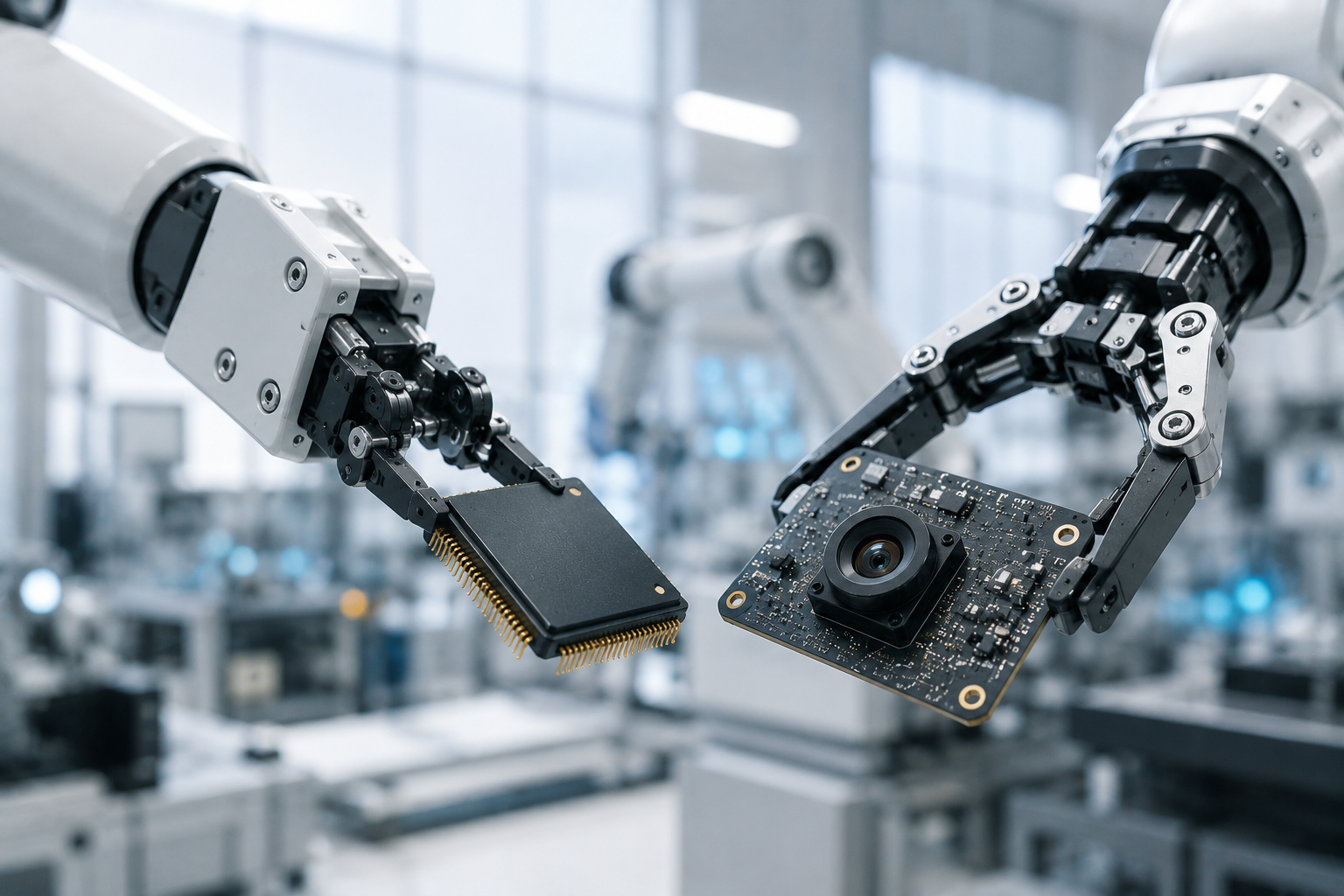
Onsemi acquires Synaptics in a $7B bet on physical AI edge computing, and honestly, the implications are bigger than most people realize. This isn’t just another semiconductor merger. It’s a declaration that the future of autonomous machines depends on tightly integrated hardware stacks — sensors, processors, and software fused into a single platform.
The deal also signals something deeper about where the industry is heading. Specifically, it tells us that edge AI for robots, vehicles, and industrial systems has hit a wall. That wall is the gap between sensing the physical world and processing it fast enough to actually act on it. Onsemi is betting $7 billion that closing this gap requires owning the entire vertical stack. Bold move — but the logic holds up.
Why Sensor Fusion Is the Real Bottleneck for Physical AI
Physical AI is fundamentally different from cloud AI. Large language models can tolerate latency. A robot arm picking parts off a conveyor belt absolutely cannot — we’re talking millisecond decision windows, not the seconds you’d shrug off in a chatbot.
Sensor fusion — combining data from cameras, lidar, radar, and touch sensors — is where most edge AI systems struggle today. The problem isn’t any single sensor. It’s stitching together multiple data streams into a coherent picture of reality, fast enough to matter. I’ve dug into a lot of edge AI architectures over the years, and this handoff between sensing and processing is consistently where things fall apart.
Consequently, the onsemi acquires Synaptics $7B bet on physical AI edge strategy targets this exact pain point. Onsemi already makes image sensors and power semiconductors used in automotive and industrial applications. Synaptics brings edge AI processors, wireless connectivity, and human-interface expertise. Together, they can build a unified perception-to-action pipeline — and that’s genuinely hard to replicate with off-the-shelf components.
Why does this matter now? Several converging trends make 2024–2025 the real inflection point:
- Robotics adoption is accelerating. Warehouse robots, surgical systems, and agricultural drones all need real-time perception that doesn’t phone home to a cloud server.
- Autonomous vehicle programs demand tighter integration. Discrete chip solutions introduce latency and power overhead that safety-critical systems simply can’t afford.
- Industrial IoT endpoints are multiplying fast. Factories need smart sensors that process data locally — not infrastructure that chokes on bandwidth bills.
- Power budgets are shrinking. Edge devices don’t have the thermal headroom of data center chips. Every watt matters.
Moreover, the traditional approach of buying sensors from one vendor and processors from another is genuinely breaking down. Hardware-software co-design isn’t a luxury anymore. It’s table stakes — and the companies that haven’t figured that out yet are going to feel it.
Vertical Integration: The New Playbook for Edge AI Silicon
For decades, specialization ruled the semiconductor industry. One company made sensors, another made processors, a third wrote the software stack. That model worked fine when systems were relatively simple.
Physical AI systems aren’t simple. They’re deeply interdependent — and here’s the thing: the sensor’s output format affects the processor’s efficiency, the processor’s architecture determines which AI models run well, and the software stack has to optimize across both simultaneously. Therefore, vertical integration — owning chip, sensor, and software together — is becoming the winning strategy. This surprised me when I first started tracking these deals, but it’s now pretty obvious in hindsight.
Onsemi acquires Synaptics in this $7B bet on physical AI precisely because neither company could build the full stack alone. Here’s what each brings to the table:
| Capability | Onsemi (Pre-Acquisition) | Synaptics | Combined Entity |
|---|---|---|---|
| Image sensors | Industry-leading CMOS sensors | Limited | Full sensor portfolio |
| Edge AI processors | Basic smart sensor processing | Dedicated edge AI SoCs | Integrated perception pipeline |
| Wireless connectivity | Minimal | Wi-Fi, Bluetooth, USB | Connected edge devices |
| Power management | Deep expertise | Moderate | Optimized power delivery |
| Software/ML stack | Sensor-level firmware | Edge AI frameworks | End-to-end software platform |
| Target markets | Automotive, industrial | IoT, consumer, enterprise | Broad physical AI coverage |
This combination mirrors what we’ve seen from other industry leaders. NVIDIA’s Jetson platform bundles GPU, software, and developer tools into a cohesive edge AI package. Similarly, Qualcomm has been folding AI accelerators into its connectivity chips for years now. The message is clear: fragmented hardware stacks can’t compete at the performance levels physical AI demands.
Additionally, the acquisition gives Onsemi something it desperately needed — a stronger software story. Synaptics has years of experience building firmware, drivers, and AI inference engines for edge devices. That institutional knowledge doesn’t appear overnight. In the physical AI world, software differentiation matters as much as silicon performance — sometimes more.
The timing is also strategic, and notably not an accident. The CHIPS and Science Act is reshaping semiconductor manufacturing incentives across the United States. Companies with broader product portfolios are better positioned to capture both government funding and customer demand. Onsemi’s expanded capabilities make it a far more compelling partner for defense, automotive, and infrastructure programs — the kind of programs where being a one-trick pony is a liability.
How This Connects to the Broader Edge AI Hardware Race
The onsemi acquires Synaptics $7B bet on physical AI edge doesn’t exist in a vacuum. It’s part of a broader industry-wide scramble to own the physical AI hardware stack — and understanding that context reveals why the timing matters so much.
The cloud AI boom is maturing. Massive GPU clusters for training large models will remain important, sure. Nevertheless, the next growth frontier is deploying AI at the edge — in cars, factories, hospitals, and farms. McKinsey estimates that edge AI deployments will grow significantly through the end of the decade, driven by latency requirements and data privacy concerns. The numbers back up the hype here, which isn’t always the case.
Several parallel moves illustrate the trend clearly:
- NVIDIA expanded from data center GPUs to edge robotics platforms. Its Orin and Thor chips target autonomous vehicles and robots directly — that’s not a side project, that’s a strategic pivot.
- Intel acquired Mobileye to own the automotive perception stack outright. That deal followed the same vertical integration logic we’re seeing here.
- AMD purchased Xilinx to add adaptive computing for edge workloads. FPGAs give AMD flexibility in industrial and automotive markets that pure CPU/GPU architectures can’t match.
- Qualcomm has been building edge AI into everything. From smartphones to automotive cockpits, the strategy is AI-everywhere — and it’s working.
Notably, Onsemi’s approach differs from these competitors in one critical way. It starts from the sensor, not the processor. Most edge AI companies begin with compute and bolt sensing on later as an afterthought. Onsemi begins with photons hitting an image sensor and works forward through the entire processing chain. I’ve seen both approaches up close, and the sensor-first philosophy produces meaningfully cleaner architectures.
This sensor-first approach carries real advantages. Designing the sensor and processor together cuts out unnecessary data conversion steps. It also optimizes the data format for AI inference and reduces power consumption — efficiency gains that matter enormously at scale. Furthermore, it creates proprietary capabilities that competitors using off-the-shelf sensors simply can’t replicate without starting over.
Hardware-software co-design is the phrase you’ll hear repeatedly from Onsemi’s leadership going forward. Although this approach requires more upfront engineering investment than buying commodity parts, it produces solutions that are faster, more power-efficient, and significantly harder to copy. The real kicker is what this means for robotics specifically. Today’s robots typically use a patchwork of components from different vendors — a camera module here, a processor board there, middleware from a third party. Each interface introduces latency, power overhead, and potential failure points. Consequently, integrated solutions that eliminate these seams will hold a major competitive advantage as the market matures.
Market Timing: Why 2024–2025 Changes Everything
Understanding why onsemi acquires Synaptics now — and why this $7B bet on physical AI couldn’t wait — requires an honest look at the market dynamics of 2024–2025. The window is real, and missing it would hurt.
Autonomous vehicle programs are entering production. After years of prototyping and pilot programs — some of which felt like they’d never end — several major automakers are shipping vehicles with advanced ADAS that require sophisticated sensor fusion. The shift from Level 2 to Level 3 autonomy demands fundamentally different hardware architectures. Discrete sensor-plus-processor designs introduce too much latency for safety-critical decisions. That’s not a preference, it’s physics.
Meanwhile, the robotics market is seeing unprecedented demand. Warehouse automation, food preparation, last-mile delivery, and agricultural robots are all moving from lab demos to commercial deployment at scale. These robots need perception systems that work reliably in unstructured environments — dusty warehouses, rainy fields, crowded sidewalks. Fair warning: the engineering challenges here are considerably harder than the press releases suggest.
Several technical milestones converged in this specific window:
- Transformer-based vision models now run efficiently on edge processors. Previously, these models required cloud-scale compute — that constraint has genuinely lifted.
- 3D sensing costs have dropped enough for mass-market deployment. Lidar and structured-light sensors are no longer prohibitively expensive for mid-range products.
- Edge AI chip architectures have matured. Purpose-built neural processing units (NPUs) deliver far better performance-per-watt than general-purpose processors — sometimes by an order of magnitude.
- Sensor resolution keeps increasing. Higher-resolution sensors generate more data, which consequently demands tighter integration with local processing to avoid bandwidth bottlenecks.
Importantly, the onsemi acquires Synaptics $7B bet on physical AI reflects a recognition that waiting would be genuinely costly. Companies that establish integrated hardware platforms now will lock in design wins for the next decade. Automotive design cycles run five to seven years from component selection to vehicle production — missing this window means missing an entire generation of vehicles. That’s not a recoverable mistake.
The industrial IoT angle is equally compelling, and honestly underreported. The International Federation of Robotics reports growing robot installations worldwide year over year. Each of those robots needs perception hardware. Suppliers who offer integrated, validated solutions will capture a disproportionate share of that market — buyers in industrial contexts strongly prefer fewer vendors to manage.
Additionally, there’s a defensive motivation worth acknowledging. If Onsemi hadn’t acquired Synaptics, a competitor might have. Losing access to Synaptics’ edge AI processor technology would leave Onsemi with a sensor-only business — increasingly commoditized and vulnerable to margin pressure. The acquisition is therefore as much about blocking competitive threats as creating new opportunities. Sometimes the best deals are the ones you make before you’re forced to.
What This Means for Developers and System Integrators
The onsemi acquires Synaptics $7B bet on physical AI edge isn’t just a story for investors and analysts. It has practical implications for engineers, developers, and companies actually building physical AI systems — and some of those implications are more immediate than people expect.
For robotics developers, the acquisition promises more integrated development platforms. Instead of cobbling together sensors, processors, and software from different vendors — and debugging the seams between them at 2am — developers may soon access unified hardware development kits. These kits would include matched sensors and processors, pre-optimized AI models, and validated reference designs. I’ve spent enough time wrestling with mismatched component stacks to know how much that would actually matter in practice.
For automotive Tier 1 suppliers, the combined Onsemi-Synaptics entity becomes a more capable partner. Tier 1s like Bosch, Continental, and Magna need component suppliers who can deliver complete perception subsystems with validated software — not just individual chips. A single supplier covering both the image sensor and the processing chip simplifies qualification, supply chain management, and liability conversations considerably.
For industrial automation companies, the deal signals that smart sensors are getting meaningfully smarter. Factory sensors that previously just captured data will increasingly process it locally. Anomaly detection, quality inspection, and predictive maintenance can happen at the sensor level, without sending data to a central server — which moreover reduces latency, bandwidth costs, and data privacy exposure simultaneously.
Here’s what developers should do right now:
- Watch for new development platforms. Onsemi will likely release integrated sensor-processor evaluation boards within 12–18 months post-acquisition. Get on those early access lists.
- Learn hardware-software co-design principles. Understanding how sensor characteristics affect AI model performance will become a genuinely valuable — and currently rare — skill.
- Evaluate your current sensor stack. If you’re using discrete components from multiple vendors, consider whether integrated solutions could improve performance and meaningfully reduce costs.
- Track the competitive landscape closely. Other semiconductor companies will respond with their own acquisitions or partnerships. This space will shift rapidly over the next 18 months.
- Engage with Onsemi’s developer ecosystem early. Companies that provide feedback during platform development often get preferred access and support — that’s been true across every major platform launch I’ve covered.
Conversely, there are real risks to consider. Heads up: acquisition integrations don’t always go smoothly, and product roadmaps frequently shift in ways that catch developers off guard. Some Synaptics products might get deprioritized in favor of automotive and industrial applications. Developers currently using Synaptics components for consumer IoT should monitor product lifecycle announcements carefully — and have contingency plans ready.
Furthermore, the combined company will need to show that its integrated solutions actually outperform best-of-breed component approaches. Integration alone doesn’t guarantee superiority — I’ve seen plenty of “unified platforms” that were slower and buggier than the discrete parts they replaced. The engineering execution over the next two to three years will ultimately determine whether the onsemi acquires Synaptics $7B bet on physical AI actually pays off.
Conclusion
The onsemi acquires Synaptics $7B bet on physical AI edge represents one of the most consequential semiconductor deals of 2025. It’s a clear signal that the physical AI era demands vertically integrated hardware platforms. Sensors, processors, and software must work together as a unified system — and the companies that get there first will be very difficult to displace.
This acquisition addresses the central bottleneck in edge AI: the gap between sensing and acting. By combining Onsemi’s sensor leadership with Synaptics’ edge processing and connectivity expertise, the merged company can offer something few competitors can match — a complete perception-to-action pipeline optimized from photon to decision. That’s not marketing copy. That’s a genuinely hard engineering capability to replicate.
The strategic logic is sound. The market timing aligns with accelerating demand in automotive, robotics, and industrial automation. The competitive dynamics make vertical integration increasingly necessary. And the technical trends — transformer models at the edge, falling sensor costs, maturing NPU architectures — all point toward integrated solutions winning. Bottom line: this isn’t a deal that needed a lot of convincing.
For technology leaders, engineers, and investors, the actionable takeaway is straightforward. Physical AI hardware is consolidating rapidly. Companies and developers who embrace integrated, co-designed hardware-software platforms will build better products faster. Those who cling to fragmented component strategies risk falling behind in ways that are genuinely hard to recover from.
What should you do next?
- Study how onsemi acquires Synaptics reshapes the competitive landscape in your specific market — automotive, robotics, or industrial — because the implications differ meaningfully across verticals.
- Evaluate whether your current hardware architecture takes advantage of sensor-processor co-design, or whether you’re leaving performance on the table.
- Engage with emerging development platforms early to influence product direction while it’s still malleable.
- Build internal expertise in edge AI hardware-software integration — it’s a no-brainer career investment right now.
The $7B bet on physical AI isn’t just Onsemi’s wager. It’s a signal about where the entire industry is heading. Pay attention — this one matters.
FAQ
What does the Onsemi acquisition of Synaptics mean for the semiconductor industry?
The onsemi acquires Synaptics $7B bet on physical AI marks a major consolidation move in edge AI semiconductors. It signals that sensor companies and processor companies can no longer operate effectively as independent entities. Vertical integration — owning the full stack from sensor to software — is becoming the dominant competitive strategy. Consequently, expect other semiconductor firms to pursue similar acquisitions or deep partnerships in response. The M&A activity in this space is just getting started.
Why is sensor fusion important for physical AI systems?
Sensor fusion combines data from multiple sensors — cameras, lidar, radar, and others — into a unified understanding of the physical environment. Physical AI systems like robots and autonomous vehicles depend entirely on this capability to function safely. Without fast, accurate sensor fusion, these systems can’t make safe real-time decisions. And here’s the thing: the challenge isn’t individual sensor quality. It’s processing multiple data streams together with minimal latency — and that requires tight hardware integration.
How does this acquisition affect autonomous vehicle development?
The combined Onsemi-Synaptics entity can offer automotive OEMs and Tier 1 suppliers integrated perception modules that pair image sensors with edge AI processors, reducing latency and simplifying the supply chain considerably. Specifically, the shift from Level 2 to Level 3 autonomy requires tighter hardware integration than discrete component approaches typically deliver. This acquisition positions Onsemi as a stronger competitor against NVIDIA and Qualcomm in the automotive perception market — though those are formidable opponents with significant head starts.
Will Synaptics products continue to be available after the acquisition?
Acquisition integrations typically take 12–24 months to fully complete. During this period, existing Synaptics products should remain available. However, long-term product roadmaps will likely shift toward automotive and industrial applications as Onsemi aligns the portfolio with its strategic focus. Consumer IoT products that don’t fit that focus may eventually be deprioritized. Developers using Synaptics components should monitor official announcements closely and plan for potential transitions — don’t get caught flat-footed.
What is hardware-software co-design and why does it matter?
Hardware-software co-design means developing the chip architecture, sensor interfaces, AI accelerators, and software stack as a single integrated system rather than bolting them together after the fact. This approach produces solutions that are faster, more power-efficient, and more reliable than systems assembled from independently designed components. Although it requires greater upfront engineering investment, the performance advantages are substantial for latency-sensitive applications like robotics and autonomous driving — we’re talking meaningful real-world differences, not just benchmark improvements.
Keep reading
Here are the latest posts from the blog.

The world of edge AI vision sensors hardware acceleration inference is evolving fast. Cameras aren’t just capturing images anymore. They’re thinking, deciding, and acting — a…

NVIDIA NemoClaw Isaac Sim lets developers talk to robots using plain English instead of wrestling with complex code. That single shift changes everything. Forget joysticks, f…

The internet works because DNS tells browsers where to go. But agent discovery — why AI agents need a version of this same routing logic — is a question most people haven’t s…