One-third of recent robotics funding deals went straight to defence. That ratio isn’t random, and it isn’t a blip.
Four out of the last twelve robotics funding rounds targeted defence applications — specifically autonomous aerial defence. I’ve been tracking robotics funding for a decade, and that kind of concentration in a single vertical is genuinely unusual. Warehouse automation and surgical robots have dominated this space for years. Something has shifted.
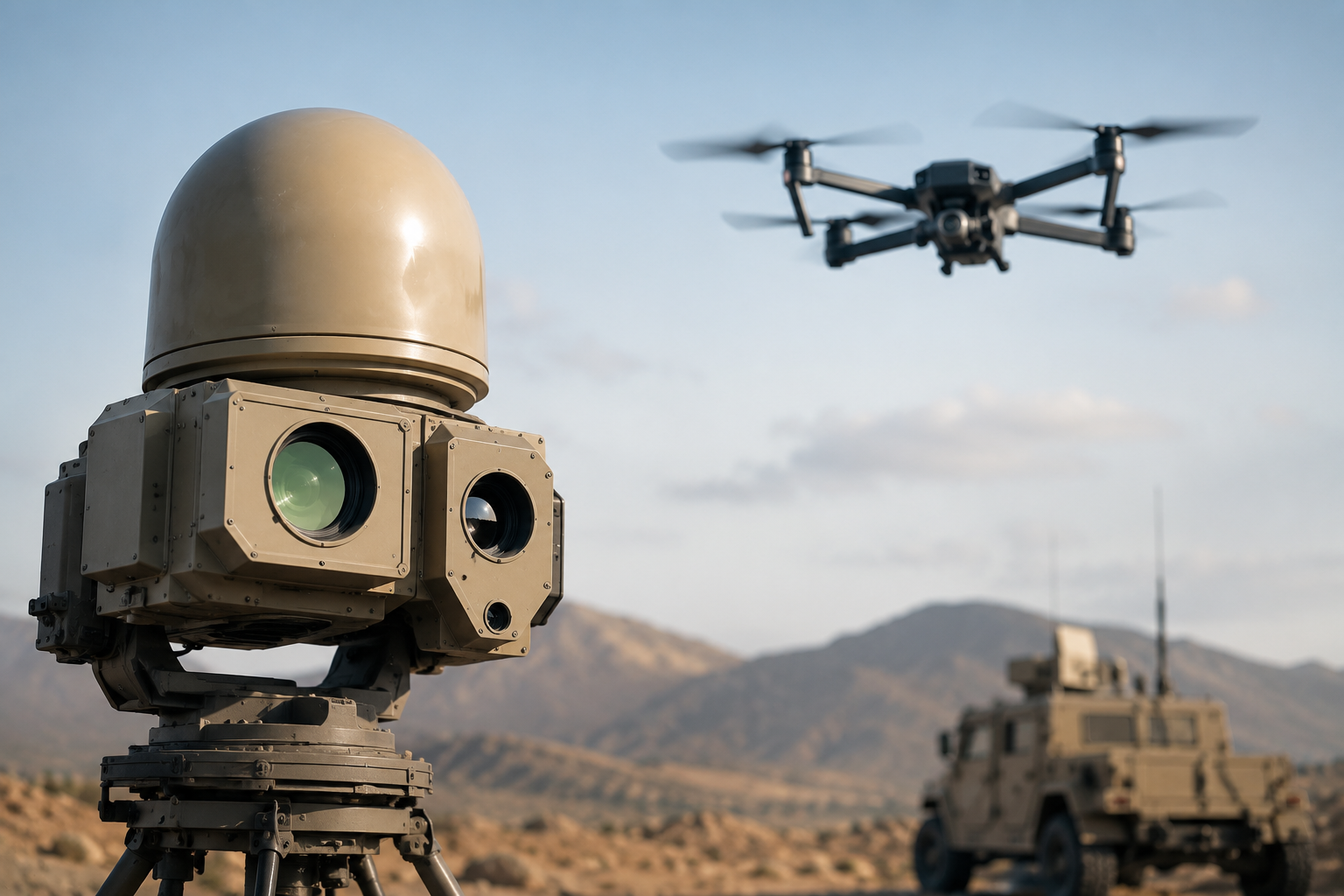
The shift has a clear cause. Cheap commercial drones now carry payloads across borders, swarm critical infrastructure, and overwhelm traditional air defences. The robotics industry is racing to build systems that can detect, track, and neutralize these threats without a human pressing every button. Counter-drone robotics has moved from a niche military procurement category to one of the fastest-growing segments in the entire industry — and the capital flowing into it reflects that.
This piece covers what’s driving the funding pattern, how the technology actually works, who’s building it, and what it means for robotics beyond the battlefield.
Why Defence Is Dominating Robotics Investment Right Now
Look at the numbers across recent funding rounds:
| Category | Deals (Last 12) | Avg. Round Size | Autonomy Level |
|---|---|---|---|
| Warehouse/Logistics | 3 | $45M | Semi-autonomous |
| Surgical/Medical | 2 | $60M | Teleoperated |
| Defence/Counter-Drone | 4 | $85M | Autonomous |
| Agriculture | 2 | $30M | Semi-autonomous |
| Consumer | 1 | $20M | Basic automation |
The average round size for defence deals runs nearly double that of warehouse robotics. Investors aren’t just interested — they’re writing dramatically bigger checks. The autonomy level column tells its own story: counter-drone robotics is pushing the frontier while other categories are still catching up.
Several forces have converged to produce this pattern.
The drone threat is real and accelerating. The Department of Defense has identified small unmanned aerial systems as a top-tier threat. Commercial drones that cost a few hundred dollars can now threaten multi-million-dollar military vehicles and critical civilian infrastructure. That cost asymmetry makes robotic countermeasures look like obvious investments.
Procurement has gotten faster. NATO allies have fast-tracked counter-drone platform procurement in ways that would have been bureaucratically impossible five years ago. The threat moved faster than the procurement process was designed to handle, so the process adapted.
Defence-tech capital is in. Funds like Shield Capital and Lux Capital have dramatically increased their defence allocations. They see a market that analysts forecast could reach $15 billion by 2030, and they’re positioning early.
The gap between defence and other robotics round sizes also reflects genuine technical difficulty. Counter-drone platforms must perform reliably in contested electromagnetic environments, under physical stress, and against adversaries actively trying to defeat them. That bar is higher than optimizing a surgical arm for a controlled operating theatre, and investors price that difficulty into their conviction. A Series B that would be considered large in agricultural drones is almost routine in counter-drone robotics — which tells you something about how seriously capital allocators are taking the threat.
The Technical Leap From Remote Control to Real Autonomy
Early counter-drone systems used a simple model: a human operator watched a screen, identified a threat, and pressed a button. That worked against one or two drones. It fails completely against swarms.
The math is brutal. A human operator needs roughly 8–12 seconds to identify and respond to a single drone. A swarm of 20 drones can cover a kilometre in under 30 seconds. Autonomous systems cut response time to milliseconds. That gap only widens as drone hardware gets cheaper and swarms get larger.
The shift to full autonomy in counter-drone robotics involves three architectural layers that work together.
Perception and sensor fusion. Modern counter-drone systems combine radar, electro-optical cameras, RF detection, and acoustic sensors. Companies like Anduril Industries have built sensor towers that fuse these inputs in real time. A practical example of what this looks like in operation: radar picks up a fast-moving object at 800 metres, the acoustic sensor confirms rotor noise, and the RF detector identifies a commercial drone control signal — all within the same 200-millisecond processing window. No human analyst could synthesize those three data streams that quickly, let alone act on them.
Multi-agent coordination. Instead of one robot responding to one drone, autonomous systems deploy multiple interceptors simultaneously. They share sensor information, divide targets, and avoid collisions without human input. Decentralized decision-making protocols let each robot act independently while maintaining group coherence. Think of it like a well-drilled defensive backfield: each player covers a zone, communicates position, and switches assignments fluidly when the offense changes — except the counter-drone version does this across three-dimensional airspace in milliseconds.
Engagement and neutralization. The final layer handles the actual response. Options include RF jamming, kinetic interception, directed energy, and net capture. Based on threat classification, the system selects the most appropriate method automatically. Choosing the wrong method carries real costs: jamming over a crowded stadium risks disrupting legitimate communications, while kinetic interception in the same environment risks falling debris. The engagement layer has to weigh these tradeoffs in real time, which is why hard-coded rules of engagement matter so much at this stage.
This architecture also connects to broader AI research on multi-agent systems. Reward miscalibration — where an AI optimizes for the wrong objective — becomes life-or-death in defence contexts. Counter-drone robotics systems use constrained optimization with hard safety boundaries rather than open-ended reward functions. That design philosophy is already bleeding into civilian robotics, which is good news for the field overall.
How Swarm Coordination Actually Works
Swarm coordination sounds futuristic. The underlying principles are well-established in robotics research. The real challenge is engineering them for battlefield reliability — a very different problem from making them work in a lab.
The first design choice is centralized versus decentralized control. In a centralized system, one command node tells every robot what to do. If that node goes down — through jamming, destruction, or communication failure — everything fails simultaneously. Decentralized systems distribute intelligence across every unit. Each robot makes local decisions based on shared rules and neighbor communication. Lose 30% of the swarm and the remaining 70% continues coordinating. That resilience is the whole point.
Modern counter-drone swarm coordination typically uses four mechanisms working together.
- Consensus algorithms let robots vote on threat prioritization using Byzantine fault-tolerant protocols. Even if some units are jammed or destroyed, the swarm maintains coherent behavior. The IEEE Robotics and Automation Society has published extensive research on these approaches.
- Task allocation handles dynamic assignment as new threats appear. When a fourth drone enters the engagement zone while three interceptors are already occupied, the algorithm automatically assigns the closest available unit with sufficient battery reserve — no human dispatcher required. This mirrors auction-based algorithms used in multi-robot logistics, adapted for time-critical aerial engagements.
- Formation control maintains optimal spacing for sensor coverage. If one unit is lost, others automatically redistribute to fill the gap. The swarm’s sensing capability degrades gracefully rather than collapsing.
- Communication resilience keeps information flowing when individual links break. Modern systems use frequency-hopping and low-probability-of-intercept waveforms to resist electronic warfare — because an adversary that can jam the swarm’s communication defeats the swarm without engaging any of its interceptors.
One engineering principle that deserves more attention: designing for graceful degradation rather than assuming everything works. A counter-drone robotics system that loses 30% of its units to jamming and continues operating effectively is far more useful than a teleoperated system that loses its single communication link and goes completely dark. Defence robotics teams have developed real expertise here, and civilian robotics companies are only beginning to adopt the same design discipline.
Real-world constraints are severe in ways that civilian applications aren’t. Unlike a chatbot that can occasionally produce a wrong answer, a counter-drone system that misidentifies a commercial aircraft as a threat could cause catastrophe. These systems operate within strict rules of engagement encoded as hard constraints — not guidelines, not suggestions, not tunable parameters.
Who’s Building This — and How Their Approaches Differ
Several companies have moved well beyond prototypes into operational counter-drone robotics systems. Their approaches are notably different, which reflects the fact that no single technology handles every scenario.
Anduril Industries has built its Lattice platform as an autonomous operating system that fuses sensor data and coordinates responses across multiple platforms. Lattice has been deployed along the U.S. southern border and with allied military forces. Their approach emphasizes software-defined hardware — the same physical platform adapts to different missions through software updates. A Lattice-connected sensor tower deployed for border surveillance can be reconfigured for airbase perimeter defence without swapping hardware components, just a software update and a revised rules-of-engagement profile. That flexibility is a smarter long-term bet than building single-purpose hardware for each use case.
Shield AI took a different path. Their Hivemind autonomy stack focuses on enabling aircraft to fly without GPS, communications, or a pilot — a capability that matters enormously in contested environments where adversaries will try to deny exactly those things. Originally designed for indoor reconnaissance, Hivemind now powers larger platforms capable of counter-drone operations. Their V-BAT system demonstrates how vertical-takeoff drones can serve both surveillance and interception roles from the same airframe.
Fortem Technologies specializes in drone-to-drone interception using net capture. Their DroneHunter system autonomously identifies, pursues, and captures hostile drones — one of the few kinetic counter-drone solutions that doesn’t require explosive warheads. Net capture is slower than jamming, but it’s far more compatible with urban environments. At a stadium or public event, DroneHunter can intercept an intruding drone and bring it down intact in a designated safe zone, preserving it as evidence. A jamming system can’t do that.
D-Fend Solutions takes a non-kinetic approach through cyber-takeover. Their EnforceAir system seizes control of hostile drones and lands them safely. This is particularly valuable in dense environments where any kinetic response — even net capture — poses collateral damage risks.
Dedrone (now part of Axon) focuses on detection and classification rather than neutralization. Their platform integrates with various effectors from other vendors, creating a layered architecture where detection and response can be mixed and matched. Their classification accuracy at range is notably better than earlier-generation systems.
The diversity of approaches explains why counter-drone robotics funding hasn’t flowed to a single winner. The market genuinely supports multiple solutions because threat environments vary so dramatically. A jammer that works perfectly at a remote military installation is the wrong tool at a busy international airport. A net-capture system that excels in urban environments is too slow for high-speed threats at open-air infrastructure. Militaries also want vendor diversity to avoid single points of failure, which keeps competition healthy and innovation moving.
| Company | Primary Method | Autonomy Approach | Key Deployment |
|---|---|---|---|
| Anduril | Multi-effector | Centralized AI (Lattice) | U.S. border, allied forces |
| Shield AI | Autonomous flight | Decentralized (Hivemind) | U.S. military |
| Fortem | Net capture | Semi-autonomous pursuit | Critical infrastructure |
| D-Fend | Cyber takeover | Automated detection + control | Airports, urban areas |
| Dedrone | Detection/classification | Sensor fusion platform | NATO allies |
What This Means for Robotics Beyond Defence
The counter-drone robotics funding pattern isn’t just a defence story. It’s a preview of where all robotics is heading, and that’s worth paying attention to even if you’re building warehouse systems or agricultural drones.
- Autonomy is becoming non-negotiable. Defence applications proved definitively that teleoperation doesn’t scale. The same lesson applies to warehouse robotics, agricultural drones, and autonomous vehicles. Any domain facing unpredictable, time-critical scenarios needs genuine autonomy — not remote control with extra steps. A warehouse robot that requires a human to resolve every unexpected obstacle is only marginally better than a forklift. The threshold for what counts as autonomous enough is rising across every sector, driven largely by what defence deployments have demonstrated is achievable.
- Multi-agent systems are the next frontier. Single-robot solutions are giving way to coordinated fleets. Amazon’s warehouse robots already operate in coordinated groups. Autonomous trucking companies are exploring platooning. Counter-drone swarms represent the most demanding version of this model, and the coordination algorithms developed for them will transfer directly to civilian applications. The engineering problems are the same; the stakes in defence just forced faster solutions.
- Safety constraints drive innovation rather than limiting it. Counter-drone robotics companies have built remarkably capable systems within strict rules of engagement, civilian protection requirements, and international humanitarian law. Engineers who have designed engagement logic that must never misidentify a civilian aircraft are extremely well-prepared to design autonomous vehicle systems that must never misclassify a pedestrian. The underlying discipline is identical. Defence-grade safety frameworks will become industry standards over time — the civilian robotics industry will eventually be grateful for the head start.
- The talent pipeline is shifting. Robotics engineers who once gravitated toward consumer products now see defence as the most technically challenging and well-funded domain. Defence-funded research has a long history of producing civilian breakthroughs — GPS, the internet, and computer vision all followed exactly this path. Counter-drone robotics is likely to contribute meaningfully to the next wave.
Several broader implications deserve attention from anyone in the industry:
- Dual-use technology will dominate the next product cycle. Systems built for counter-drone defence will find civilian applications in airport security, infrastructure protection, and large event safety. The hardware is largely the same; the rules of engagement change.
- Regulatory frameworks are tightening. The Federal Aviation Administration is already developing rules for counter-drone operations in domestic airspace. Organizations that engage with this process early will have an advantage over those that wait to see what gets mandated.
- International competition will intensify the market. China’s drone industry produces millions of units annually, creating both the primary threat and the primary market driver for counter-drone robotics countermeasures. That dynamic shows no sign of easing.
- Ethical debates will sharpen as autonomy increases. Autonomous weapons raise serious questions about accountability, proportionality, and the appropriate role of human oversight. The International Committee of the Red Cross has called for new international rules governing autonomous weapons systems, and those conversations will shape what products are commercially viable in different markets.
Off-the-shelf drone components that cost $2,000 two years ago now cost $400. The barrier to building a capable hostile drone keeps falling while the barrier to building an effective autonomous countermeasure remains high. That asymmetry is the single most important structural driver behind the funding pattern, and it shows no sign of reversing through at least 2027.
Conclusion
Four out of twelve recent robotics deals going to defence isn’t noise — it’s signal. The drone threat is real, it’s growing faster than most defence planners anticipated, and it demands autonomous solutions that push robotics technology harder than any civilian application currently does.
Autonomous swarm coordination, decentralized decision-making, and multi-agent systems have moved from research papers to deployed platforms in the span of a few years. Companies like Anduril, Shield AI, Fortem, and D-Fend are proving that constrained autonomy works in demanding real-world environments. The technology is ready, the funding is committed, and the threat isn’t slowing down.
For anyone working in robotics — defence or civilian — a few things are worth acting on now.
- Track counter-drone robotics funding closely. It signals where autonomy breakthroughs are happening before those breakthroughs show up anywhere else. The lessons from swarm coordination and decentralized decision-making will transfer to civilian applications faster than most people expect.
- Study multi-agent coordination seriously. Swarm architectures will define the next generation of robotics across sectors. The foundational algorithms were developed under defence constraints — that’s where the most rigorous thinking happened.
- Engage with the policy process. Regulatory decisions about autonomous systems will shape market opportunities for years. Organizations that participate in those conversations now will be better positioned than those who wait to react.
Counter-drone robotics represents the demanding edge of what autonomous systems can do. The companies mastering it are developing capabilities that will define robotics for the next decade — and the funding community has clearly decided that’s where the next era of the industry is being built.
FAQ
Why are so many recent robotics deals focused on counter-drone defence?
The surge reflects the rapidly growing drone threat. Cheap commercial drones have become tools of asymmetric conflict and infrastructure disruption, and militaries urgently need autonomous systems to counter them at scale. Investors see a market forecast to reach $15 billion by 2030, combined with procurement pipelines that are moving faster than they have historically. Counter-drone robotics offers both strategic importance and strong commercial returns — a combination that attracts serious capital.
What’s the difference between teleoperated and autonomous counter-drone systems?
Teleoperated systems require a human operator to detect, identify, and engage each threat manually. Autonomous systems handle those tasks independently using AI and sensor fusion. The critical difference is speed and scalability. A teleoperated system struggles against multiple simultaneous threats. Autonomous counter-drone robotics systems coordinate responses against swarms of dozens or hundreds of drones without human bottlenecks — and at the speeds involved, that gap is decisive.
How does swarm coordination work in counter-drone robotics?
Swarm coordination uses decentralized algorithms where each robot makes local decisions while maintaining group coherence. Robots communicate via mesh networks, share sensor data, and allocate tasks through auction-based protocols. No single command node controls the swarm, so if individual units are destroyed or jammed, the remaining robots automatically redistribute tasks and maintain coverage. Resilience to partial failure is the defining feature that makes decentralized swarms more effective than centralized systems in contested environments.
Are autonomous counter-drone systems legal under international law?
This is an actively evolving area. Most deployed systems keep a human in or on the loop for lethal decisions. The United Nations Office for Disarmament Affairs continues discussions on autonomous weapons governance. Most counter-drone deployments currently use non-kinetic methods like jamming or net capture, which face fewer legal restrictions than kinetic options. The legal framework is still catching up with where the technology already sits — which is itself a reason to watch this space closely.
Which companies are leading in counter-drone robotics?
Anduril Industries, Shield AI, Fortem Technologies, D-Fend Solutions, and Dedrone are among the most prominent, each with a meaningfully different technical approach. Anduril focuses on AI-powered sensor fusion across multiple platforms. Shield AI specializes in GPS-denied autonomous flight. Fortem uses net capture for urban environments. D-Fend uses cyber-takeover. Dedrone specializes in detection and classification that integrates with other vendors’ effectors. The market supports multiple approaches because no single technology handles every threat environment effectively.
Keep reading
Here are the latest posts from the blog.

Onsemi acquires Synaptics in a $7B bet on physical AI edge computing, and honestly, the implications are bigger than most people realize. This isn’t just another semiconducto…
The world of edge AI vision sensors hardware acceleration inference is evolving fast. Cameras aren’t just capturing images anymore. They’re thinking, deciding, and acting — a…

NVIDIA NemoClaw Isaac Sim lets developers talk to robots using plain English instead of wrestling with complex code. That single shift changes everything. Forget joysticks, f…