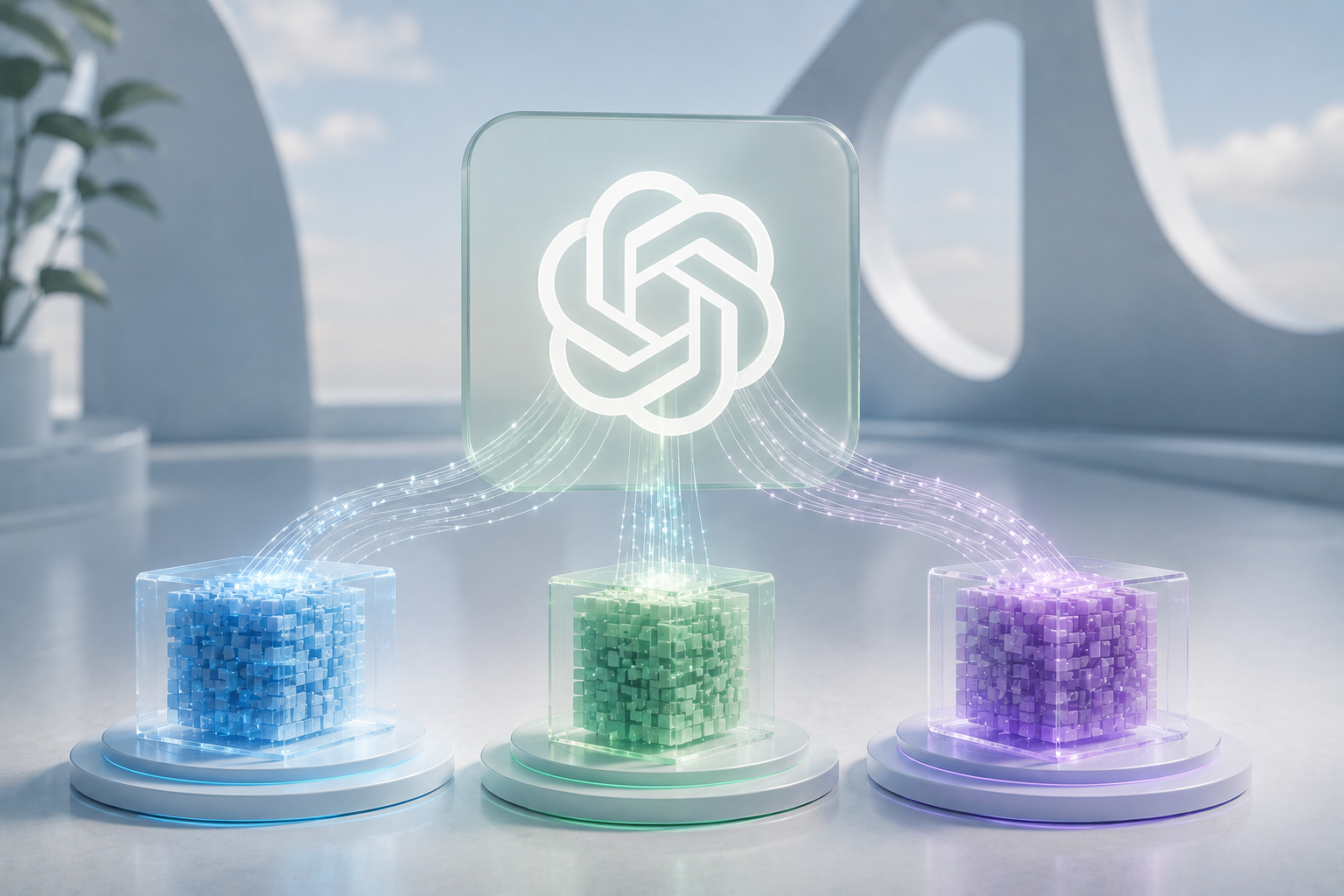
If you’re confused about why OpenAI suddenly has three models instead of one, you’re not alone. This shift caught a lot of developers and enterprise buyers off guard — myself included. OpenAI went from championing a single flagship model to maintaining a full portfolio almost overnight, and the speed of that change was genuinely jarring.
It’s not random, though. It’s a calculated architectural strategy that mirrors what hardware giants like NVIDIA have been doing for decades. Different workloads demand different tools, and a single model can’t serve every use case efficiently at the scale OpenAI now operates. I’ve been watching this space for ten years, and this move felt inevitable the moment inference costs started dominating the conversation.
Understanding the strategy matters practically. Your model choice directly affects cost, latency, accuracy, and user experience in ways that compound significantly at scale. Here’s what’s actually happening and what it means for how you build.
The Three-Tier Architecture Explained
OpenAI now maintains three distinct model tiers, each serving a fundamentally different purpose.
The reasoning tier (o1/o3) handles complex, multi-step problems. These models think before responding — breaking problems into chains of reasoning, verifying their own logic, and producing more accurate outputs on genuinely hard tasks. That depth comes at a cost: they’re slower and more expensive per token. The latency isn’t just a minor inconvenience either. We’re talking 10 to 60 seconds on some queries, which makes them completely wrong for anything user-facing that expects a quick response.
The speed-optimized tier (GPT-4o) prioritizes fast, fluent responses. Real-time applications like chat, content generation, and customer support need low latency, and this tier is purpose-built for exactly those workloads. The “o” stands for “omni,” reflecting multimodal capabilities across text, vision, and audio. The vision and audio integration is more mature than most people expect when they first dig into it.
The lightweight tier (GPT-4o mini) targets cost-sensitive, high-volume workloads. It’s dramatically cheaper and handles simple classification, extraction, and routing tasks where full model intelligence is overkill. I’ve tested it against surprisingly complex prompts, and it handles more than you’d think. For the right task, it’s not a compromise — it’s the correct tool.
The reason OpenAI suddenly has three models is workload diversity. A single model forces painful tradeoffs: you either pay too much for simple tasks or get poor results on complex ones. Three tiers eliminate that tension.
Here’s how they compare directly:
| Feature | o1/o3 (Reasoning) | GPT-4o (Speed) | GPT-4o Mini (Lightweight) |
|---|---|---|---|
| Primary strength | Complex reasoning | Fast multimodal responses | Cost efficiency |
| Latency | High (10–60s) | Low (~1–2s) | Very low (<1s) |
| Cost per million tokens | Highest | Moderate | Lowest |
| Best use case | Math, code, research | Chat, content, real-time | Classification, routing |
| Accuracy on hard tasks | Excellent | Good | Adequate |
| Throughput | Lower | High | Highest |
This tiered approach lets developers match the right model to each task. It also lets OpenAI capture revenue across different price points and customer segments simultaneously — which is very much part of the plan, and there’s nothing wrong with acknowledging that.
The NVIDIA Playbook OpenAI Is Running
NVIDIA doesn’t sell one GPU. It sells dozens. The H100 handles massive training runs. The L40S targets inference. The T4 serves budget-conscious deployments. Each chip occupies a specific price-performance niche, and NVIDIA has made billions off that segmentation strategy.
The reason OpenAI suddenly has three models follows the same logic — and the parallel goes deeper than simple product segmentation.
Training a frontier reasoning model costs hundreds of millions of dollars, and running it at scale costs even more. Inference — actually generating responses — now accounts for the majority of OpenAI’s compute spend. Every unnecessary token from an overpowered model burns real money. That’s not a metaphor; it’s a line item on a data center bill.
NVIDIA understood this decades ago. You don’t use a $30,000 data center GPU for edge inference. Routing “What time is it in Tokyo?” through a reasoning model that spends 15 seconds thinking about it is the software equivalent of that mistake.
The portfolio approach also creates natural upgrade paths. Customers start with mini, discover its limits on harder tasks, move up to GPT-4o, and eventually hit problems that need o3. It’s the same funnel logic behind NVIDIA’s product lineup — and it works because it’s grounded in how customers actually discover their needs, not how vendors wish they would buy.
The strategy also hedges against competition in a way a single-model approach can’t. If a competitor beats OpenAI on speed, GPT-4o competes directly. If another wins on reasoning, o3 responds. A single-model company can’t play defence across multiple fronts simultaneously. The portfolio essentially future-proofs OpenAI against targeted attacks on any single capability — which, in a market moving this fast, matters a lot.
There’s also a hardware efficiency dimension. The lightweight model runs on older, cheaper GPUs. The reasoning model demands the latest silicon. That hardware flexibility cuts infrastructure costs dramatically, and at OpenAI’s scale, “dramatically” means hundreds of millions of dollars annually.
The Cost Math That Made Three Models Inevitable
Cost is the quiet driver behind why OpenAI suddenly has three models, and the numbers are stark enough that they’re worth spending time on.
Running o3 on a complex reasoning task might cost 50 to 100 times more than routing the same query to GPT-4o mini. For an enterprise processing millions of requests daily, that difference translates to millions of dollars annually. I’ve talked to engineering teams who didn’t realize this until their first invoice arrived. It’s an expensive lesson to learn reactively.
Intelligent routing becomes essential once you internalize this. Smart teams don’t send every request to the most powerful model. They build routing layers that classify incoming queries and direct them to the appropriate tier. The routing logic doesn’t have to be sophisticated to be effective — even a simple rule-based system catches most of the easy wins.
A practical framework looks like this:
- Simple queries — FAQ lookups, basic classification → GPT-4o mini
- Standard queries — content generation, summarization, conversation → GPT-4o
- Complex queries — multi-step reasoning, advanced code generation, research synthesis → o1/o3
This mirrors how cloud providers price compute. AWS offers dozens of instance types because no single configuration works for every workload. The same principle now applies to language models, and teams that internalize it early will carry a meaningful cost advantage over those still defaulting to the biggest model available.
A well-designed routing system can cut inference spending by 60 to 80 percent compared to sending everything to the top-tier model. That’s not a minor optimization — it’s the difference between a sustainable AI deployment and one that quietly bleeds cash.
Token economics add another layer that catches people off guard. Reasoning models like o3 generate internal “thinking” tokens that users never see, but those hidden tokens still cost money. A query producing 200 visible tokens might consume 2,000 tokens internally. The true cost of reasoning models is often five to ten times what the output length suggests. This isn’t obvious from the documentation, and it’s genuinely surprising the first time you see it in a billing breakdown.
Matching Workloads to the Right Tier
Knowing that OpenAI suddenly has three models is only half the equation. The other half is knowing which model to deploy where — and this is where most teams make decisions they later regret.
Customer-facing chatbots almost always belong on GPT-4o. Users expect fast, natural responses. They won’t wait 30 seconds for a reasoning model to work through their question, and in practice, most users can’t distinguish between GPT-4o and o3 on conversational tasks anyway. Speed and fluency win here over maximum accuracy.
Internal analytics and research tools benefit from o1/o3. When an analyst asks a model to synthesize quarterly data, identify trends, and suggest strategies, reasoning capability matters more than response speed. These users will wait for better answers. The accuracy gap on genuinely complex analytical tasks is significant — not marginal — and that gap justifies the cost and latency for these specific use cases.
High-volume processing pipelines demand GPT-4o mini. Classifying support tickets, extracting entities from documents, moderating content — these tasks need throughput and cost efficiency above everything else. In benchmarks on classification tasks, mini has matched GPT-4o’s accuracy at roughly 10 percent of the cost. For these workloads, using a more powerful model isn’t better engineering — it’s just waste.
Many enterprises need all three tiers running simultaneously. A single application might use mini for input classification, GPT-4o for response generation, and o3 for edge cases requiring deeper analysis. This multi-model setup is more common in production than people discuss publicly.
Industry patterns by sector illustrate the diversity:
- E-commerce uses mini for product categorization, GPT-4o for customer chat, and o3 for fraud detection reasoning.
- Healthcare deploys mini for appointment scheduling, GPT-4o for patient communication, and o3 for diagnostic support.
- Legal teams use mini for document sorting, GPT-4o for contract summarization, and o3 for case law analysis.
- Software engineering teams reach for mini for code linting, GPT-4o for code completion, and o3 for complex debugging sessions.
The pattern across all of these is consistent: the tier decision maps to the stakes and complexity of the task, not to some general preference for quality. Sending everything to the most capable model isn’t a quality strategy — it’s a failure to think about the problem.
How Distillation Keeps the Tiers Connected
The reason OpenAI suddenly has three models connects to a technique called model distillation — where a smaller model learns to mimic a larger one’s outputs. The larger model generates training data that teaches the smaller model to approximate its behavior. It’s an apprenticeship at enormous scale.
This matters for understanding the three-tier strategy because distillation is how the tiers stay connected and improve together. GPT-4o mini likely learned from GPT-4o’s outputs. GPT-4o may have absorbed reasoning patterns from o1. Each tier feeds the others — which is an elegant piece of systems architecture that’s easy to miss when you’re just looking at the product lineup.
The cycle reinforces itself:
- the reasoning model solves the hardest problems and generates high-quality training data;
- that data trains the speed-optimized model to handle moderately complex problems better;
- those outputs then train the lightweight model to handle routine tasks more reliably;
- and user feedback from all three tiers flows back to improve the next generation.
It’s a flywheel, not three separate products.
Distillation carries real risks worth acknowledging. Research has shown that distilled models can inherit biases and errors from their teacher models — the apprentice learns from the master’s mistakes as well as their strengths. Competitors can also use distillation techniques to approximate a model’s capabilities at much lower cost, which is one reason OpenAI has been notably careful about what training methodology details it discusses publicly.
The future almost certainly brings more tiers. Domain-specific models for medical reasoning, legal analysis, and code generation are logical next steps. An ultra-lightweight tier for edge deployment on mobile devices follows naturally from the trajectory. Cascade architectures — where a query starts at the cheapest tier and automatically escalates if the model’s confidence is low — are already being explored and work well when implemented carefully. The three-model structure isn’t a destination; it’s a point on a longer roadmap.
What Developers and Buyers Should Actually Do
The multi-tier reality demands a different approach to architecture and budgeting than most teams currently use. A few things are worth changing immediately.
Stop defaulting to the biggest model. This is the most common mistake I see. Teams prototype with GPT-4o or o3, fall in love with the output quality, and ship it everywhere. Bills explode. Latency causes user complaints. The fix feels risky because quality has become associated with a specific model, but the association is often wrong — the task just wasn’t hard enough to need the expensive option.
Start with the smallest model that meets your quality threshold. Try GPT-4o mini first and test it against your actual quality benchmarks — not generic benchmarks, your specific use cases. Move up a tier only when mini genuinely fails your requirements. This bottom-up approach saves money and often reveals that simpler models handle more tasks than expected. It’s a humbling discovery, but a useful one.
Build routing abstraction early. Don’t hardcode model names into application logic. Create a routing layer that can swap models without changing application code. This gives you flexibility as pricing changes, new models launch, and your understanding of your workload evolves. Teams that skip this step rewrite routing logic every time OpenAI releases something new.
Concrete steps worth taking this quarter:
- Audit your current model usage — categorize every API call by complexity and identify which calls could move to a cheaper tier without meaningful quality loss.
- Build a routing classifier — even a simple rule-based system cuts costs significantly before you invest in anything fancier.
- Benchmark all three tiers against your specific use cases, because generic public benchmarks don’t predict domain-specific performance reliably.
- Monitor cost per query rather than just total spend — this metric surfaces optimization opportunities that aggregate numbers obscure.
- Plan for model updates proactively — OpenAI ships new versions frequently, and routing logic should adapt without requiring major rewrites.
The strategic context matters here. The reason OpenAI suddenly has three models is that workload economics made a single model approach unsustainable. The same logic applies to how you buy and deploy these models. Treating your AI budget as a single line item rather than a portfolio is the equivalent of routing everything through the reasoning model — it’s simpler to set up and more expensive to run.
Conclusion
Every major AI provider has now converged on multi-tier strategies. Anthropic offers Claude in multiple tiers — Opus, Sonnet, Haiku. Google provides Gemini Ultra, Pro, and Nano. Meta releases Llama models in different sizes for different deployment contexts. This convergence happened independently at multiple companies facing the same economics, which is usually a good signal that the logic is sound.
The single-model era is definitively over. It ended not because anyone decided it should, but because the cost and performance mathematics of inference at scale made maintaining it financially unsustainable. OpenAI’s move was the most visible expression of a shift that was already underway across the industry.
For developers and enterprise buyers, the actionable conclusion is simple even if the implementation isn’t: audit your workloads, match each task to the right tier, build routing infrastructure that makes switching between tiers easy, and budget for a portfolio rather than a single product. The teams doing this well right now are building a cost advantage that will compound as their usage scales.
The multi-tier era is here and it’s structural, not transitional. The question isn’t whether to adapt to it — it’s how quickly you get there before the teams around you do.
FAQ
Why does OpenAI suddenly have three models instead of one?
OpenAI introduced multiple models because different tasks genuinely require different capabilities. Reasoning-heavy tasks need o1/o3. Fast, general-purpose tasks suit GPT-4o. High-volume, cost-sensitive tasks belong on GPT-4o mini. A single model couldn’t optimize for all three priorities simultaneously, and at the inference volumes OpenAI now operates, the cost of that mismatch was enormous. The multi-tier approach delivers better performance and economics across the board.
Which OpenAI model should I use for my project?
Start with GPT-4o mini for simple tasks like classification, extraction, and routing. Use GPT-4o for conversational AI, content generation, and real-time applications where latency matters. Reserve o1/o3 for complex reasoning tasks like advanced coding, mathematical proofs, or multi-step research analysis. Many projects benefit from using all three in different parts of the same pipeline — that’s not over-engineering, it’s matching tools to tasks.
How much can I save by routing across multiple OpenAI models?
Well-designed routing systems typically cut inference costs by 60 to 80 percent compared to routing everything through the top-tier model. The key is keeping reasoning models for tasks that actually require deep reasoning. If 70 percent of your queries are simple enough for GPT-4o mini, you’ll see dramatic cost reductions quickly. At high volumes, the math becomes compelling very fast.
Is OpenAI’s multi-model strategy unique or is the whole industry doing this?
The whole industry has converged on this. Anthropic offers Claude across multiple tiers. Google provides Gemini in multiple sizes. Meta releases Llama in different configurations. The convergence happened independently at multiple companies facing the same economics — which is a good signal that it reflects a genuine structural reality rather than a trend any single company invented.
What is model distillation, and how does it relate to OpenAI’s three models?
Model distillation is a technique where a smaller model learns from a larger model’s outputs. OpenAI uses distillation to transfer capabilities from more powerful models down to lighter, faster versions. GPT-4o mini performs better than its size and cost would suggest because it learned from GPT-4o’s behavior. This keeps all three tiers connected and improving together — it’s why the lightweight model handles more than you’d expect when you first test it.
Will OpenAI add more models beyond three?
Almost certainly. The trend points toward more specialization, not less. Domain-specific models for healthcare, legal, and financial applications are logical next steps. Edge-optimized models for mobile deployment follow naturally from where distillation research is heading. The question of why OpenAI suddenly has three models will eventually become why OpenAI has ten — and that’s probably the right direction as use cases diversify and the economics of specialization become more compelling at each new scale.
References
Keep reading
Here are the latest posts from the blog.
There’s a supply chain story unfolding in the semiconductor industry that most people outside it haven’t fully absorbed — and it’s determining who wins the AI hardware race m…

Light moves faster than electrons. It generates less heat. It consumes dramatically less power. Those three facts have been true for decades, but only recently has the engine…

Every robotics team hits the same wall eventually. They need massive amounts of training data, and collecting it the traditional way is brutally expensive — in time, money, a…