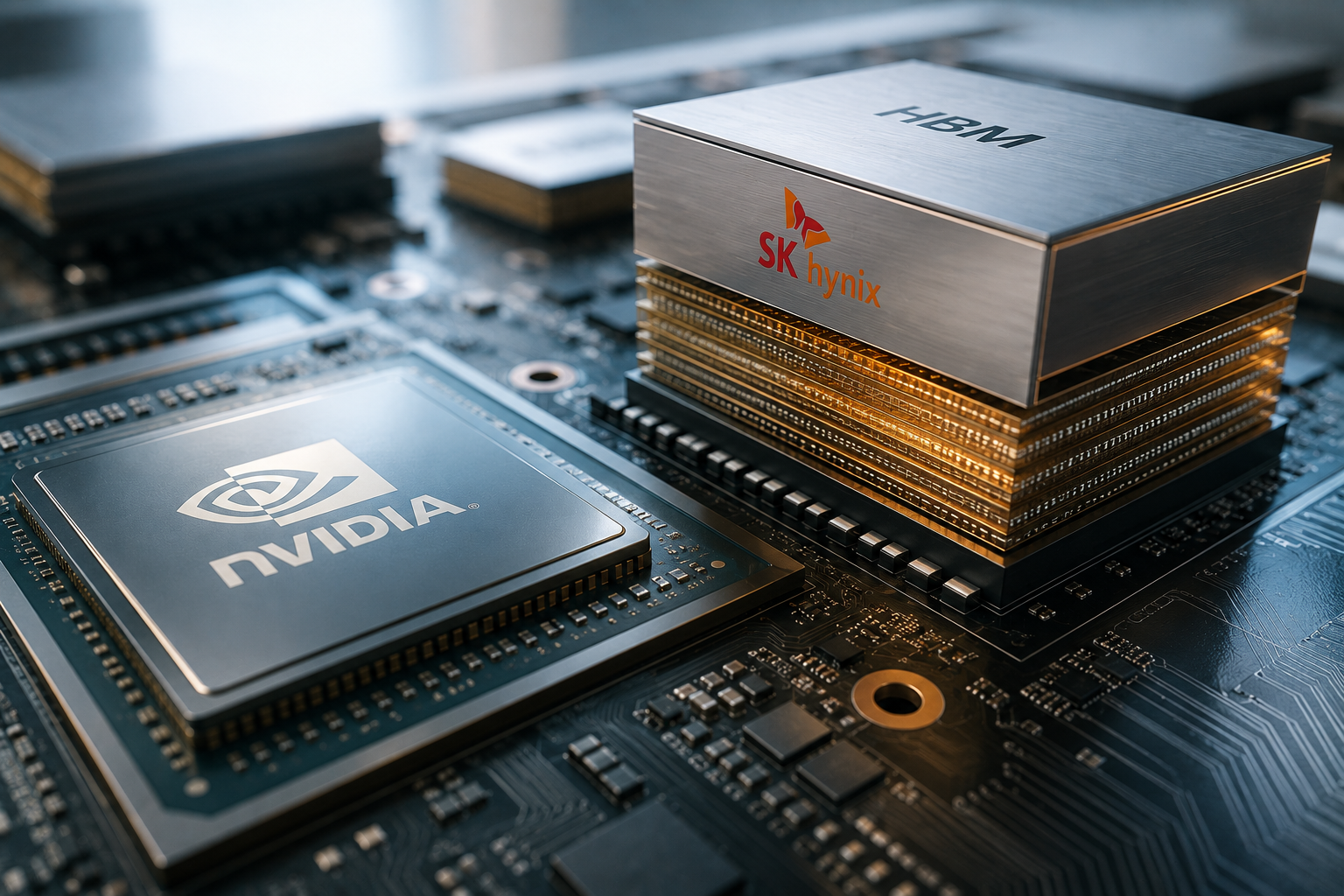
There’s a supply chain story unfolding in the semiconductor industry that most people outside it haven’t fully absorbed — and it’s determining who wins the AI hardware race more than any algorithm or chip architecture.
Every serious AI accelerator needs High Bandwidth Memory. HBM stacks DRAM dies vertically, connects them through thousands of tiny wires called through-silicon vias, and feeds data to GPUs at speeds that traditional memory architectures can’t touch. Without enough HBM, NVIDIA can’t ship enough H100s or B200s. And right now, there isn’t enough HBM.
That shortage has made the partnership between NVIDIA and SK Hynix the most strategically important deal in the semiconductor industry. It determines which companies can scale AI infrastructure and which ones spend months on a waitlist. It carries implications for Samsung, Micron, every major cloud provider, and anyone planning AI deployments in the next two to three years.
This is how it got here, what it means, and where it goes next.
What HBM Is and Why There Isn’t Enough of It
Traditional DDR memory sits on a circuit board next to a processor. HBM does something fundamentally different — it stacks memory dies vertically and connects them through thousands of through-silicon vias, delivering 5 to 10 times the bandwidth of DDR5. When those numbers first started circulating, a lot of people assumed they were exaggerated. They weren’t.
Modern AI models are memory-hungry in a specific way. A single inference pass on a large language model can require moving hundreds of gigabytes of parameters through memory. HBM isn’t a nice-to-have for high-end AI chips — it’s what makes them function at their intended performance levels at all.
The manufacturing problem is what creates the shortage. HBM production yields are significantly lower than standard DRAM, and the process involves multiple memory dies bonded with extreme precision, advanced packaging using TSV technology, rigorous thermal testing under high power loads, and tight integration with the GPU’s interposer. Each of those steps introduces failure points that standard DRAM manufacturing doesn’t face.
SK Hynix currently produces HBM3E, the latest generation. Even with aggressive capacity expansion, supply falls well short of demand. Industry analysts estimate HBM demand for AI accelerators will exceed 100 million units annually by 2026, and current production capacity covers roughly half of that. The shortage isn’t a temporary allocation problem — it’s a structural mismatch between how fast AI infrastructure demand is growing and how long it takes to build new fabrication capacity.
This directly limits NVIDIA’s ability to ship GPUs. It limits every cloud provider’s ability to build out AI data centers at the pace their customers are demanding. The SK Hynix and NVIDIA supply chain has become an active chokepoint for the entire AI industry, not a theoretical risk.
How the NVIDIA and SK Hynix Partnership Actually Developed
The relationship between NVIDIA and SK Hynix stretches back over a decade, but most people don’t realize how deep the co-design work goes or how early it started.
2013–2018: Early collaboration. SK Hynix was among the first to commercialize HBM technology. NVIDIA adopted HBM2 for its Tesla P100 GPU, and the two companies began co-developing memory specifications tailored specifically to GPU architectures. The collaborative design work that matters today started in this period, years before most people were paying attention to HBM.
2020–2022: HBM3 development. As AI training workloads exploded, NVIDIA needed faster memory and worked with SK Hynix on HBM3, which doubled bandwidth compared to HBM2E. Critically, SK Hynix beat Samsung to market with qualified HBM3 chips. That first-mover advantage turned out to be enormous — not just for that product cycle, but for establishing the trust that shapes sourcing decisions today.
2023: The H100 ramp. NVIDIA’s H100 became arguably the most sought-after chip in history. Each H100 requires 80GB of HBM3, and SK Hynix secured the majority of NVIDIA’s orders. Samsung struggled with yield issues on its own HBM3 production during this period. That stumble cost Samsung dearly, and the reputational damage with NVIDIA proved harder to repair than the technical problems.
2024–2025: Deepening the relationship. NVIDIA and SK Hynix announced expanded co-development agreements. SK Hynix committed to building new fabrication capacity in South Korea and exploring an advanced packaging facility in Indiana. The two companies also began jointly designing HBM4, which will integrate memory and logic on a single package. When I first read the details of this collaboration, what struck me was how far it goes beyond a typical supplier relationship — this is closer to a joint R&D program than a purchasing agreement.
2026 and beyond: HBM4 integration. The next step involves placing custom logic dies within the HBM stack itself, which blurs the line between memory and processor in ways that have significant implications for AI chip architecture. SK Hynix’s role evolves from supplier to co-architect.
Most chip companies treat memory suppliers as interchangeable vendors. NVIDIA treats SK Hynix more like a design partner. That distinction matters enormously for supply chain stability — and for everyone trying to compete with NVIDIA.
What This Means for Samsung and Micron
The tight NVIDIA and SK Hynix relationship creates serious competitive pressure on the other two HBM producers. Both Samsung and Micron make HBM. Neither has matched SK Hynix’s position with NVIDIA, and the gap is wider than headline market share numbers suggest.
Samsung’s yield challenges. Samsung is the world’s largest memory maker by revenue, which makes its HBM struggles more striking. Its HBM3E products faced persistent quality issues, with reports indicating that Samsung’s HBM3E failed NVIDIA’s qualification tests multiple times in 2024. Samsung has since improved its yields, but trust lost with a customer like NVIDIA takes a long time to rebuild — and in a supply-constrained market, NVIDIA doesn’t need to take chances on a supplier still establishing its track record.
Micron’s late entry. Micron began shipping HBM3E in 2024 and has secured some NVIDIA orders. Its HBM production volume remains a fraction of SK Hynix’s output, and scaling HBM manufacturing takes years, not quarters. Micron is investing heavily in its Boise, Idaho facility, but new fabrication capacity doesn’t respond to urgency. You can’t accelerate the timeline by spending more money — the processes have their own constraints.
Here’s where the three companies stand:
| Factor | SK Hynix | Samsung | Micron |
|---|---|---|---|
| HBM3E qualification with NVIDIA | First to qualify | Delayed qualification | Qualified in 2024 |
| Estimated HBM market share (2024) | ~50% | ~30% | ~20% |
| HBM4 co-development with NVIDIA | Active partnership | Independent development | Limited engagement |
| New fab investments | Icheon & Indiana | Pyeongtaek expansion | Boise expansion |
| 12-high stack production | In mass production | Ramping up | Early production |
The competitive gap isn’t only about technology specs. It’s about the kind of trust built over years of delivering on multi-billion-dollar commitments. NVIDIA needs guaranteed supply for GPU orders that were sold months or years in advance. SK Hynix has consistently delivered on those commitments. Samsung and Micron haven’t yet established the same level of reliability in NVIDIA’s eyes.
The HBM shortage also forces cloud providers — Microsoft, Google, Amazon — to compete for limited GPU allocations. These companies can’t simply switch to alternative chips. The entire AI software stack — CUDA, cuDNN, TensorRT — is optimized for NVIDIA hardware. The supply chain bottleneck at the memory level cascades through the entire AI ecosystem. It’s constraints all the way down.
The Geopolitics Nobody Is Talking About Enough
The SK Hynix and HBM supply chain story can’t be separated from geopolitics. Memory manufacturing is concentrated in a handful of countries, and governments are actively reshaping those supply chains in ways that introduce new complications alongside new resilience.
South Korea’s dominance creates concentration risk. SK Hynix and Samsung together produce roughly 80% of the world’s HBM, and both are headquartered in South Korea. That geographic concentration is a real, non-theoretical risk. A conflict on the Korean Peninsula or a trade dispute could disrupt global AI chip production in ways that no amount of procurement planning fully mitigates. Analysts sometimes wave this away as unlikely, but that’s exactly the kind of tail risk that serious infrastructure planners have to account for.
U.S. CHIPS Act incentives are reshaping the map. The CHIPS and Science Act provides substantial subsidies for semiconductor manufacturing on American soil. SK Hynix has announced an advanced packaging facility in Indiana. Micron received CHIPS Act funding for its domestic expansion. These investments aim to reduce dependence on Asian supply chains — though the timelines are measured in years, and the facilities won’t meaningfully shift supply dynamics until the late 2020s at the earliest.
China’s restricted access changes the competitive landscape. U.S. export controls prevent NVIDIA from selling its most advanced GPUs to Chinese customers. Those controls also restrict the sale of HBM and advanced packaging equipment to Chinese manufacturers. Chinese companies like CXMT are years behind in HBM development as a result. This creates a two-tier AI hardware market effectively divided along geopolitical lines — and that divide is widening rather than narrowing.
Japan’s equipment role is underappreciated. Japan doesn’t produce HBM chips, but Japanese companies like Tokyo Electron supply critical manufacturing equipment. Japan has aligned its export controls with U.S. policy, which means the supply chain dependencies for HBM extend well beyond the memory makers themselves. It’s a genuinely global web.
Key geopolitical risks affecting HBM supply include potential
- Taiwan Strait disruptions to advanced packaging services,
- South Korean export restrictions that could limit HBM shipments to certain markets,
- rare earth material dependencies flowing through China,
- and trade policy shifts that fragment global memory standards.
Control over HBM production translates directly into control over AI capability, and governments have figured that out.
How the HBM Shortage Determines Who Can Actually Scale AI
The partnership between NVIDIA and SK Hynix ultimately determines something very practical: which companies can deploy AI at scale, and which ones are stuck waiting.
The economics of inference versus training have shifted in ways that make this more acute than it would have been two years ago. Training a large AI model requires enormous compute for weeks or months, but it’s a finite process. Inference — running that trained model to serve real users — runs continuously, 24 hours a day, across millions of requests. Inference now consumes more total GPU capacity than training. That shift changes everything about how you think about supply constraints, because the demand is constant rather than periodic.
The capacity math for a major cloud provider running a ChatGPT-scale service is instructive.
- Each server node uses 8 GPUs.
- Each GPU requires 6 to 8 HBM stacks.
- A large deployment needs thousands of server nodes.
- The aggregate HBM requirement across Microsoft Azure, Google Cloud, Amazon Web Services, and Oracle Cloud — before accounting for enterprise customers building private AI infrastructure — dwarfs current production capacity.
Companies with early access to NVIDIA GPUs — and therefore early access to SK Hynix HBM — gain a meaningful and compounding competitive advantage. They can offer AI services sooner and at greater scale. Smaller cloud providers and startups face longer wait times and pay more for allocations when they’re available. The HBM shortage effectively creates a hierarchy of AI capability based almost entirely on supply chain access, and that hierarchy is self-reinforcing.
This dynamic also explains why AMD and Intel face such an uphill battle even when their AI chips perform competitively on paper. They still need HBM. SK Hynix’s capacity is largely committed to NVIDIA. AMD has secured HBM supply from Samsung and Micron, but the volume gap remains significant.
Custom silicon efforts from Google and Amazon partially sidestep the problem. Google’s TPU v5p uses HBM but sources it independently of the NVIDIA relationship. Amazon’s Trainium chips use HBM2E from multiple vendors. These alternative architectures reduce dependence on the NVIDIA–SK Hynix axis — but they require massive software investment to compete with NVIDIA’s CUDA ecosystem, and building that toolchain is a multi-year effort that most enterprises aren’t positioned to replicate.
Where HBM4 Takes This Next
NVIDIA and SK Hynix are already looking past today’s shortage toward next-generation memory that will deepen their partnership further.
HBM4 represents a genuine architectural shift rather than an incremental improvement.
- Logic-on-memory integration allows custom logic dies to be placed at the base of the memory stack, which means NVIDIA could embed compute functions directly in memory — reducing data movement, which is one of the biggest efficiency costs in current AI workloads.
- Higher stack counts push from 8 or 12 stacked dies toward 16 or more.
- Wider interfaces double the number of data channels per stack.
- Improved thermal management addresses the reliability challenges that come with taller stacks in dense data center environments.
SK Hynix targets HBM4 mass production in late 2025 or early 2026. The JEDEC standard for HBM4 was developed with significant input from both NVIDIA and SK Hynix — which ensures the memory specification aligns precisely with NVIDIA’s GPU roadmap. That co-development advantage is genuinely hard for Samsung or Micron to replicate quickly, because it reflects years of joint engineering work, not just a decision to prioritize HBM4 investment.
The scale of capital commitment involved is striking.
- SK Hynix is spending over $10 billion on new fabrication lines in Icheon and Cheongju.
- The planned Indiana advanced packaging facility focuses specifically on HBM assembly.
- NVIDIA is reportedly providing financial commitments to guarantee purchase volumes — an extraordinary level of customer involvement in a supplier’s capital spending that signals how seriously NVIDIA takes the supply risk.
HBM4 could reshuffle competitive dynamics in ways that aren’t fully predictable. Samsung is investing aggressively in its own HBM4 development, and if Samsung solves its yield issues, it could recapture meaningful market share. Micron’s U.S.-based production could appeal to customers seeking supply chain diversification, particularly given the geopolitical pressures already in play. SK Hynix’s current advantage is substantial, but the race for HBM4 market share is genuinely open in a way that HBM3E wasn’t.
The HBM shortage won’t disappear overnight. Capacity is expanding, but demand is growing faster. Every new AI model, every new inference deployment, every new enterprise AI application adds more pressure to a system that’s already strained. The NVIDIA and SK Hynix supply chain will remain the central constraint in AI hardware economics for years — probably longer than most organizations are currently planning for.
Conclusion
For technology leaders planning AI infrastructure, the HBM situation has practical implications that are worth acting on now rather than when the constraints become personally painful.
Lead times for GPU servers are directly tied to memory availability. Understanding the SK Hynix production timeline isn’t an exercise in semiconductor trivia — it’s input to realistic deployment planning. Organizations that assume AI infrastructure will be available when they need it are regularly surprised by how wrong that assumption is.
Diversifying your AI hardware strategy is worth the software investment it requires. Google TPUs and AWS Trainium rely on different memory supply chains than NVIDIA. Building at least some capability on alternative platforms reduces exposure to a single supply chain bottleneck that you have no ability to influence.
Geopolitical developments affect HBM availability in ways that can move faster than annual planning cycles. U.S. CHIPS Act investments, South Korean export policies, and China trade restrictions have all shifted meaningfully in the past two years and will continue to shift. Organizations with longer planning horizons need to track this more actively than they probably are.
HBM4 transitions will drive hardware refresh cycles in 2026 and 2027. Budgeting for those refreshes now, rather than reacting when next-generation GPUs ship, avoids the cost and delay of scrambling for allocations after the fact.
The companies that understand how SK Hynix’s production capacity shapes AI infrastructure availability — and plan accordingly — will be better positioned than those treating GPU procurement as a routine purchasing exercise. The supply chain constraints are real, they’re structural, and they’re going to persist longer than the current news cycle suggests.
FAQ
What is HBM and why does it matter for AI chips?
HBM stands for High Bandwidth Memory. It stacks multiple DRAM dies vertically, connected by through-silicon vias, delivering much higher data bandwidth than traditional memory architectures. AI chips need this bandwidth because large language models and other AI workloads move enormous amounts of data during inference and training. Without HBM, modern GPUs like NVIDIA’s H100 and B200 can’t function at their intended performance levels — it’s not optional hardware.
Why is there an HBM memory shortage?
Manufacturing HBM is extraordinarily difficult. Yields are lower than standard DRAM, each stack requires precise bonding of 8 to 12 individual dies, and the process involves multiple failure points that standard memory production doesn’t face. Demand has simultaneously surged far beyond what anyone projected. SK Hynix, Samsung, and Micron are all expanding capacity, but new fabrication lines take 2 to 3 years to build. That timeline doesn’t respond to urgency or money.
How does the NVIDIA and SK Hynix partnership affect GPU availability?
SK Hynix supplies the majority of HBM for NVIDIA’s data center GPUs. If SK Hynix can’t produce enough HBM, NVIDIA can’t assemble enough GPUs. This creates a cascading effect where cloud providers receive fewer servers and enterprises wait longer for AI infrastructure. The partnership’s production targets function as a proxy for global AI compute availability — which is an unusual amount of influence for a single supplier relationship to carry.
Can Samsung or Micron replace SK Hynix as NVIDIA’s primary HBM supplier?
Not in the short term. Samsung has faced qualification challenges with its HBM3E products, and rebuilding trust with NVIDIA after those issues takes time that can’t be compressed. Micron has successfully qualified its HBM3E but produces at much lower volumes than SK Hynix. Both are viable secondary suppliers. Replacing SK Hynix as NVIDIA’s primary partner would require years of consistent quality performance and capacity building — neither of which can be rushed.
What is HBM4 and when will it be available?
Keep reading
Here are the latest posts from the blog.
Onsemi acquires Synaptics in a $7B bet on physical AI edge computing, and honestly, the implications are bigger than most people realize. This isn’t just another semiconducto…

The world of edge AI vision sensors hardware acceleration inference is evolving fast. Cameras aren’t just capturing images anymore. They’re thinking, deciding, and acting — a…

NVIDIA NemoClaw Isaac Sim lets developers talk to robots using plain English instead of wrestling with complex code. That single shift changes everything. Forget joysticks, f…