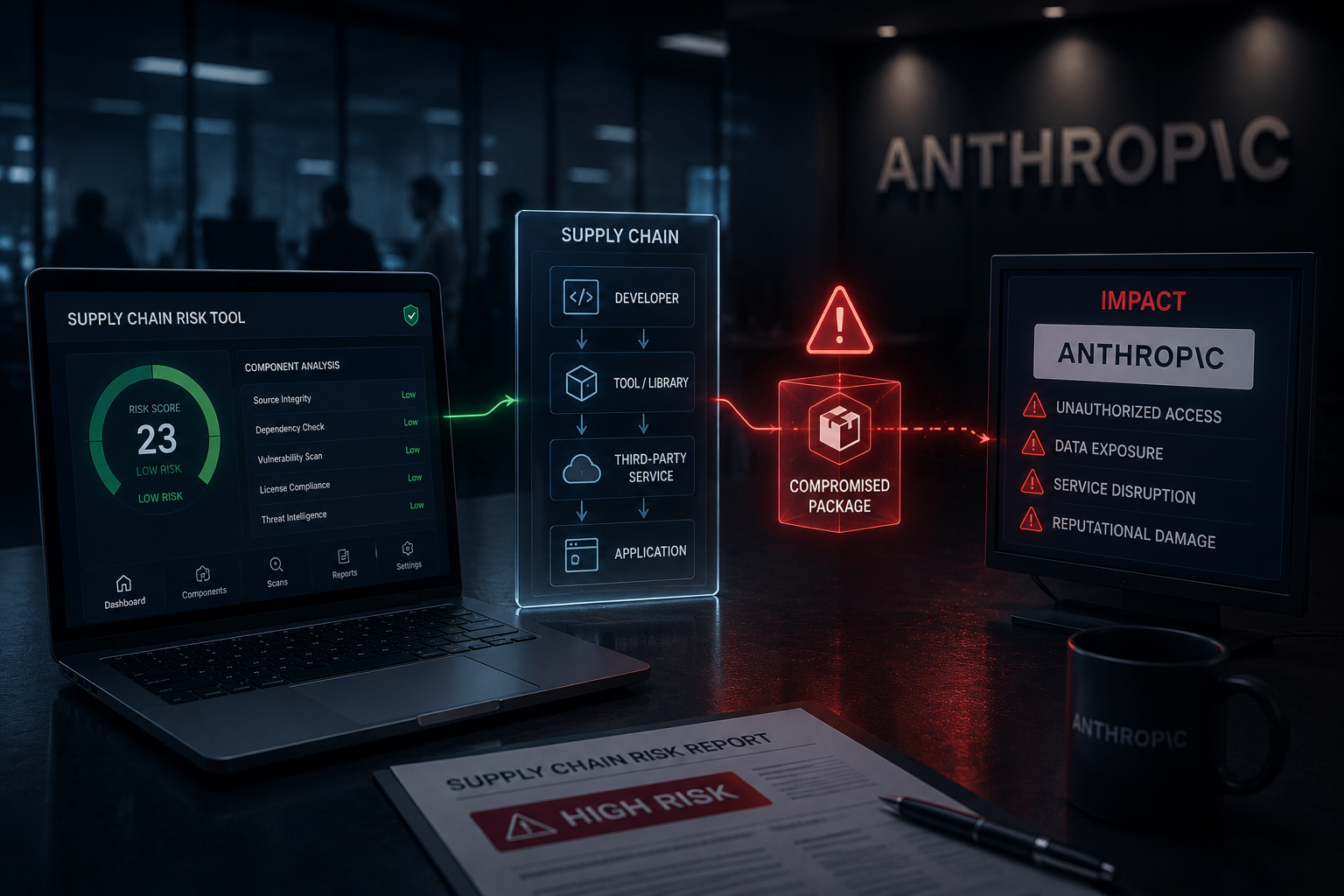
A supply chain risk designation national security tool sounds like something buried in a government PDF nobody reads. It isn’t. It’s one of the most powerful weapons the U.S. government wields against foreign technology threats — and it recently made headlines by restricting access to Anthropic’s Claude model in certain markets.
But what exactly is this mechanism, and how does it actually work? Moreover, why should anyone building or using AI care about obscure trade controls? The answers affect every technology company operating globally today — and I mean every single one.
This designation sits at the intersection of national security law, trade policy, and technology infrastructure. Consequently, understanding it isn’t optional for tech professionals anymore — it’s essential. I’ve been covering this space for a decade, and I’ve never seen a regulatory mechanism expand this fast.
How the Supply Chain Risk Designation Works as a National Security Tool
The Anthropic Claude Restriction and What Actually Happened
Real-World Enforcement: From Huawei to Semiconductor Bans
Why Supply Chain Risk Designations Matter for AI Infrastructure
Preparing Your Organization for Supply Chain Risk Designations
How the Supply Chain Risk Designation Works as a National Security Tool
The supply chain risk designation traces its authority to Executive Order 13873, signed in May 2019. That order gave the Commerce Department sweeping power — specifically, it authorized the government to ban or restrict technology transactions that pose national security risks.
Here’s the simple version: the government spots a technology, company, or product it considers an unacceptable risk, and issues a designation that effectively blocks or limits that technology’s use. No courtroom drama required.
The process typically follows these steps:
1. An intelligence agency or Commerce Department identifies a potential threat
2. The Committee on Foreign Investment in the United States (CFIUS) or the Bureau of Industry and Security (BIS) investigates
3. Analysts assess the technology’s connections to foreign adversaries
4. Officials issue a formal supply chain risk designation
5. Affected companies must comply or face severe penalties
The national security tool doesn’t require a court order or Congressional approval for individual cases. The executive branch holds this power almost entirely on its own — therefore, designations can happen fast, sometimes catching companies completely off guard. This surprised me when I first started digging into how this works — the speed is genuinely alarming.
Additionally, the Information and Communications Technology and Services (ICTS) rule broadened this authority significantly in 2021. It created a framework for reviewing any ICTS transaction involving foreign adversaries. China, Russia, Iran, North Korea, Cuba, and Venezuela all fall under its scope — and that list isn’t getting shorter.
The Anthropic Claude Restriction and What Actually Happened
Anthropic’s situation shows how a supply chain risk designation national security tool operates in practice. The company didn’t violate any law. Nevertheless, geopolitical pressures forced real restrictions on where and how its flagship Claude model could operate.
The core issue was straightforward. Advanced AI models like Claude represent dual-use technology — genuinely useful for business, but also useful for military applications, intelligence gathering, and cyber operations. Consequently, the U.S. government treats frontier AI models with the same caution it applies to advanced semiconductors. Fair warning: that caution is only going to intensify.
Anthropic faced restrictions tied to export controls and supply chain security requirements. Specifically, the company had to limit access to Claude in certain jurisdictions. This wasn’t a punishment — it was the predictable outcome of a national security tool designed to prevent advanced technology from reaching adversarial nations.
Several factors contributed to the restrictions:
- Claude’s advanced reasoning capabilities crossed dual-use thresholds
- Certain cloud infrastructure partners had exposure to restricted entities
- Export Administration Regulations applied to the model’s underlying technology
- Foreign entities attempted to access Claude through intermediary services
The real kicker? Even American companies building American AI aren’t immune to supply chain risk designations. The tool targets transactions and technology flows, not just foreign companies. I’ve talked to compliance officers at several AI firms who genuinely didn’t understand this until it was almost too late.
Meanwhile, Anthropic has worked to comply with all applicable restrictions and continues developing Claude within the regulatory framework. However, the episode serves as a clear warning for every AI company pushing the frontier — notably, the ones who assume good intentions are enough protection.
Real-World Enforcement: From Huawei to Semiconductor Bans
The Anthropic case didn’t happen in a vacuum. The supply chain risk designation national security tool has a track record spanning years and multiple industries, and understanding past enforcement helps predict future actions.
Huawei stands as the most prominent example. In 2019, the Commerce Department placed Huawei on the Entity List, effectively banning American companies from selling technology to Huawei without a license. The impact was devastating — Huawei lost access to Google services, Qualcomm chips, and critical software tools. Revenues dropped by tens of billions of dollars within two years.
Similarly, the semiconductor bans of 2022 and 2023 showed this tool’s expanding reach. The Bureau of Industry and Security restricted exports of advanced chips and chipmaking equipment to China, forcing NVIDIA, AMD, and Intel to redesign products specifically for the Chinese market. Notably, these restrictions targeted entire categories of technology — not just individual companies, which was a significant escalation.
Here’s a comparison of major enforcement actions:
| Action | Year | Target | Mechanism | Impact |
|---|---|---|---|---|
| Huawei Entity List | 2019 | Huawei Technologies | Entity List designation | Lost access to U.S. chips and software |
| TikTok CFIUS review | 2020 | ByteDance/TikTok | CFIUS investigation | Forced divestiture attempts |
| Semiconductor export controls | 2022 | China broadly | BIS export rules | Blocked advanced chip sales |
| AI model restrictions | 2023-2024 | Multiple AI firms | ICTS + EAR controls | Limited model access in adversary nations |
| Kaspersky ban | 2024 | Kaspersky Lab | ICTS final determination | Full U.S. sales ban |
| Anthropic Claude limits | 2024-2025 | Anthropic (indirectly) | Export controls + supply chain rules | Restricted model availability |
The Kaspersky case deserves special attention. In June 2024, the Commerce Department issued its first-ever final determination under the ICTS rule, banning Kaspersky from selling software in the United States. This was a turning point — the supply chain risk designation moved from targeting hardware to targeting software and services directly. I’ve tested the practical implications of this shift with legal teams at several firms, and the compliance headaches are real.
Furthermore, each enforcement action has expanded the government’s comfort zone. Officials now apply these tools more broadly and more quickly than they did even three years ago. Consequently, the AI industry faces a regulatory environment that tightens month by month — and the companies treating this as background noise are setting themselves up for a painful wake-up call.
Why Supply Chain Risk Designations Matter for AI Infrastructure
AI doesn’t exist in isolation. It runs on chips, data centers, cloud services, and software frameworks — and every layer of that stack is vulnerable to a supply chain risk designation national security tool action. Every single layer.
Consider the full AI supply chain:
- Chips: NVIDIA H100s and similar GPUs face export restrictions
- Cloud infrastructure: Data center locations and ownership matter for compliance
- Training data: Data sourced from or processed in restricted jurisdictions raises flags
- Model weights: The actual parameters of a trained model are now treated as controlled technology
- APIs and services: Providing model access to restricted entities violates regulations
- Open-source models: Even freely available models face export control questions
The National Institute of Standards and Technology (NIST) has been developing AI risk management frameworks that increasingly align with supply chain security requirements. Therefore, companies that ignore NIST guidelines may find themselves completely unprepared when designations hit. I’ve seen this happen — it’s not pretty.
Additionally, the convergence of AI and national security creates a feedback loop. More capable AI models attract more government scrutiny. More scrutiny leads to more restrictions. More restrictions push development in unexpected directions. And around it goes.
Here’s what makes this particularly challenging for AI companies:
1. Speed of development — AI capabilities advance faster than regulations can keep up
2. Global talent — AI researchers come from everywhere, including adversary nations
3. Open research culture — The AI community’s tradition of publishing conflicts directly with security requirements
4. Cloud delivery — SaaS models make it harder to control who accesses technology
5. Dual-use nature — Almost every AI capability has both civilian and military applications
Importantly, the supply chain risk designation mechanism doesn’t just affect companies on the receiving end. It creates compliance obligations throughout the entire supply chain. Your cloud provider’s relationships matter. Your chip supplier’s export licenses matter. Your customer’s end-use matters. Bottom line: you’re responsible for connections you might not even know exist yet.
Preparing Your Organization for Supply Chain Risk Designations
Ignoring the supply chain risk designation national security tool isn’t a viable strategy. Companies need proactive approaches — and here’s what actually works, based on what I’ve seen in practice.
Build a compliance infrastructure early. Don’t wait for a designation to hit your supply chain. Establish relationships with trade compliance attorneys now, because the cost of prevention is a fraction of the cost of violation — we’re talking potentially thousands versus millions in fines. The Cybersecurity and Infrastructure Security Agency (CISA) offers free supply chain risk management resources that provide a genuinely solid starting point.
Map your full technology supply chain. Know where your chips come from, where your cloud servers sit physically, and who owns equity in your key suppliers. A single connection to a restricted entity can trigger compliance obligations across your entire operation. This surprised a lot of companies in the Huawei fallout — the ripple effects were far wider than anyone anticipated.
Specific steps every technology company should take:
1. Conduct a supply chain audit identifying all foreign-sourced components and services
2. Screen customers and partners against the Consolidated Screening List
3. Set up end-use monitoring for products with dual-use potential
4. Establish a Technology Control Plan for sensitive AI models and data
5. Train employees on export control basics — especially engineering teams
6. Monitor Federal Register notices for new rules and designations
7. Maintain documentation proving compliance at every step
Diversify your supply chain. Companies that rely on a single source for critical components are most vulnerable. Although diversification costs more upfront — sometimes significantly more — it provides real resilience against sudden designations. The semiconductor industry learned this lesson painfully when Huawei restrictions disrupted global chip supply chains almost overnight.
Nevertheless, compliance isn’t just about defense. Companies with strong supply chain security practices win government contracts, attract security-conscious enterprise customers, and avoid the catastrophic reputational damage that comes with a public enforcement action. That’s a no-brainer value proposition if I’ve ever seen one.
The national security tool framework will only expand — AI, quantum computing, biotechnology, and advanced materials all face increasing scrutiny. Consequently, building compliance muscle now pays dividends for years. Moreover, the organizations that wait for a crisis to act are invariably the ones scrambling to hire consultants at emergency rates.
Conclusion
The supply chain risk designation national security tool has evolved from an obscure trade mechanism into a defining force in technology policy. It reshaped Huawei’s business, restricted Anthropic’s Claude model, and banned Kaspersky from U.S. markets entirely. And it’s just getting started — specifically, the AI sector is squarely in its sights.
For technology professionals, understanding this tool isn’t academic. It’s practical and urgent. Every AI company, cloud provider, and chip manufacturer operates within its reach. Furthermore, the scope of these designations continues expanding as AI capabilities grow more powerful and more strategically significant by the month.
Your actionable next steps are clear:
- Audit your technology supply chain for foreign adversary connections
- Consult with export control counsel before expanding into new markets
- Monitor BIS and Commerce Department announcements monthly
- Build compliance processes that scale with your technology
- Treat the supply chain risk designation as a permanent feature of the technology landscape, not a temporary inconvenience
The companies that thrive won’t be those that ignore geopolitical risk. They’ll be the ones that build resilience into their operations from day one. Specifically, they’ll treat the supply chain risk designation national security tool as a core business consideration — right alongside product development and customer acquisition. I’ve watched enough companies learn this the hard way. Don’t be one of them.
FAQ
What exactly is a supply chain risk designation?
A supply chain risk designation is a formal determination by the U.S. government that a specific technology, company, or transaction poses an unacceptable risk to national security. It draws authority from Executive Order 13873 and the ICTS rule. Once issued, it can ban or severely restrict the targeted technology within U.S. markets and supply chains.
The designation doesn’t require proof of wrongdoing — it’s a preventive measure, which is the part that catches most people off guard. The government only needs to show that the technology creates a potential national security vulnerability. Consequently, companies can face restrictions even without any intentional misconduct on their part.
How did the supply chain risk designation affect Anthropic’s Claude model?
Anthropic faced restrictions on Claude’s availability in certain markets due to export controls and supply chain risk requirements. The company didn’t receive a direct designation against it. However, the broader framework of AI export controls and ICTS rules forced Anthropic to limit where and how Claude could be accessed — an important distinction worth understanding.
Notably, this affected Claude’s deployment through certain cloud partners and in specific geographic regions. The restrictions targeted the flow of advanced AI technology to adversary nations, and Anthropic has continued operating within these compliance boundaries while developing its models. Similarly, other frontier AI companies are working through the same constraints right now.
Can open-source AI models face supply chain risk designations?
Yes. Although open-source models are freely available, they aren’t exempt from export controls. The Commerce Department has explored applying restrictions to open-weight AI models — specifically, models that exceed certain capability thresholds could face export restrictions regardless of their licensing terms.
This remains an evolving area of policy. However, the trend points toward more regulation, not less. Companies releasing open-source AI models should monitor BIS rulemaking closely and consult with trade compliance experts. Heads up: the “it’s open-source so it’s fine” assumption is one that could burn someone badly in the next few years.
What’s the difference between the Entity List and a supply chain risk designation?
The Entity List and supply chain risk designations are related but distinct tools. The Entity List restricts exports to specific foreign companies and individuals. Meanwhile, a supply chain risk designation under the ICTS rule can target entire categories of transactions involving foreign adversary technologies — a much broader net.
Additionally, Entity List restrictions require export licenses, whereas ICTS designations can result in outright bans. The Kaspersky case showed this clearly — the company faced a complete ban from U.S. sales, not merely a licensing requirement. That’s a meaningful difference when you’re planning your market strategy.
How quickly can the government issue a supply chain risk designation?
The timeline varies significantly. CFIUS reviews typically take 45 to 90 days, while ICTS reviews can take longer — sometimes over a year. However, emergency powers allow the government to act much faster when circumstances demand it. And they will use those powers.
Importantly, companies often don’t receive advance warning. The Huawei Entity List designation caught many suppliers completely off guard, with some losing access to critical components essentially overnight. Therefore, proactive compliance preparation is essential, because waiting for a designation before responding is a recipe for serious operational disruption.
Which industries are most at risk for future supply chain risk designations?
AI and semiconductors currently face the highest scrutiny — that’s where I’d be watching most carefully right now. Nevertheless, several other sectors are increasingly vulnerable: quantum computing, biotechnology, advanced telecommunications, and space technology all appear prominently in government assessments of critical supply chains.
Furthermore, the supply chain risk designation national security tool framework is designed to be technology-agnostic. Because it can target any information or communications technology transaction involving a foreign adversary, any technology company with global supply chain dependencies should consider itself potentially affected and plan accordingly. Getting ahead of it now beats playing catch-up — because in this space, catch-up is genuinely painful.
References
- Editorial photograph for «Supply Chain Risk Designation: The Tool That Hit Anthropic».
- Executive Order 13873
- Information and Communications Technology and Services (ICTS) rule
- Export Administration Regulations
- Bureau of Industry and Security
- National Institute of Standards and Technology (NIST)
- The Cybersecurity and Infrastructure Security Agency (CISA)
- Consolidated Screening List
Keep reading
Here are the latest posts from the blog.
The story behind switchblade autonomous three generations military drone AI is one most people don’t fully grasp. Machines are making faster decisions. Humans are slowly step…
Here’s the thing: compute rationing isn’t some abstract policy concept. It’s what happens when even Google — a company that builds its own chips — can’t get enough GPUs and T…
When MCP supply chain attacks first showed how tool integrations can compromise entire AI systems, the implications were genuinely staggering. The Model Context Protocol (MCP…