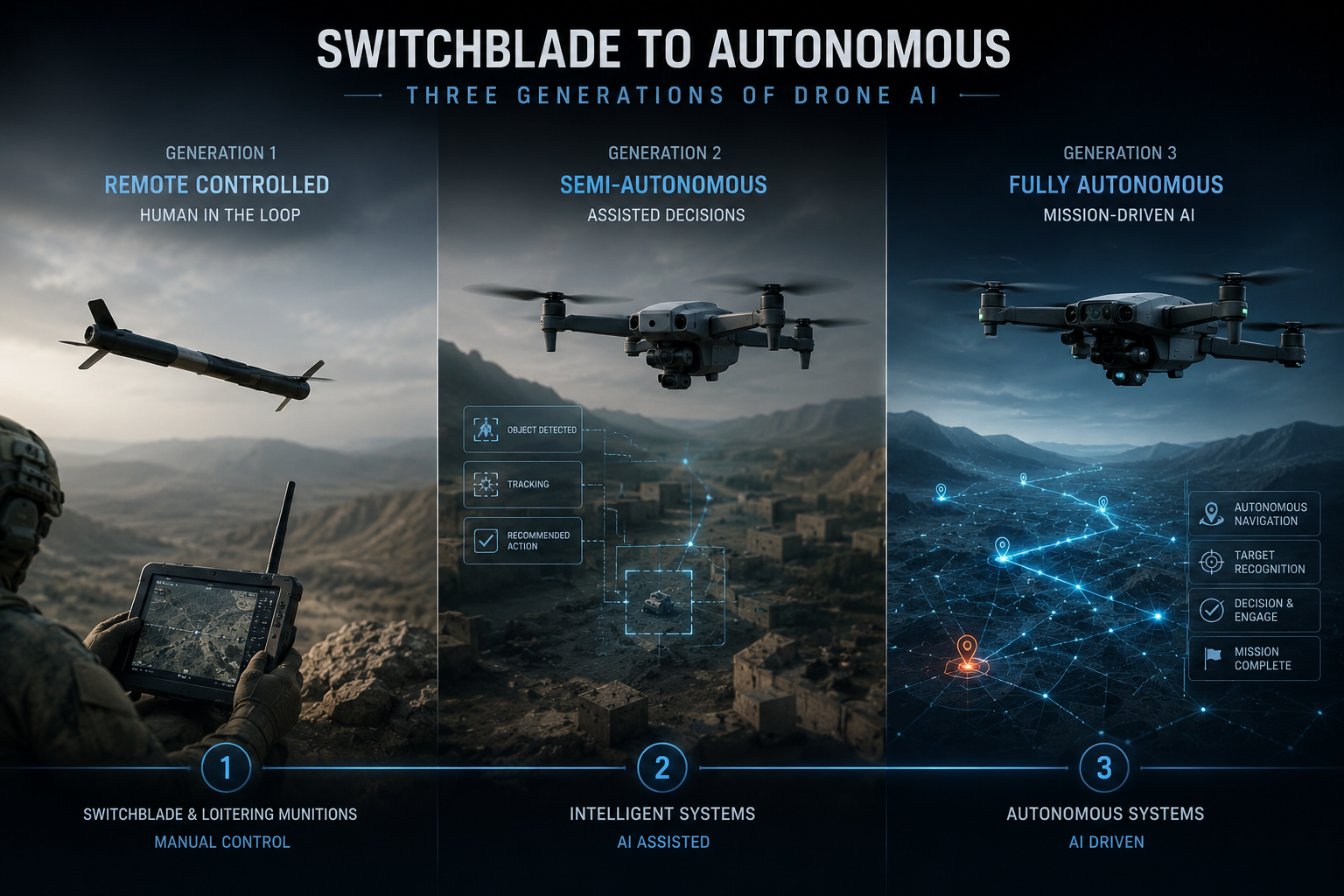
The story behind switchblade autonomous three generations military drone AI is one most people don’t fully grasp. Machines are making faster decisions. Humans are slowly stepping back from the trigger. That tension — between speed and control — defines modern drone warfare more than any single weapons system.
I’ve been tracking military tech for a decade, and this shift feels different. It’s not just an upgrade cycle. It’s a fundamental renegotiation of who — or what — gets to decide when someone dies.
Military drones have moved through three distinct generations of artificial intelligence. Each generation pushed autonomy further, and each raised harder ethical questions. Understanding these shifts matters enormously, particularly as the U.S. Department of Defense races to deploy AI-driven systems at scale.
How the Three Generations Actually Break Down
The framework of switchblade autonomous three generations military drone AI isn’t just academic. It maps directly to how autonomy has evolved on real battlefields. Specifically, each generation marks a fundamental shift in who — or what — makes critical decisions under pressure.
Generation 1: Remote control with basic automation. Early military drones like the MQ-1 Predator were essentially remote-controlled aircraft with expensive autopilots. A human pilot sat thousands of miles away, flying manually. The AI handled stabilization and navigation waypoints — nothing more. However, every targeting decision required a human operator. The drone couldn’t tell a tank from a school bus. A person was always watching. Always.
Generation 2: Semi-autonomous targeting and loitering. This is where the AeroVironment Switchblade enters the picture — and where things get genuinely interesting. The Switchblade 300 and 600 represent a real leap forward. These loitering munitions can identify target types using onboard sensors, orbit an area on their own, and wait for the right moment. Nevertheless, a human operator still authorizes the strike. The AI recommends; the human decides. That distinction matters more than it might sound.
Generation 3: Autonomous engagement and swarming. This generation is emerging now, and fair warning: the policy conversation hasn’t come close to catching up. Drones in this category can operate in swarms, coordinate without human input, and potentially select targets on their own. The DoD’s Replicator initiative aims to field thousands of these autonomous systems. Importantly, the central question — whether these systems should ever fire without human approval — remains completely unresolved.
| Generation | Example Systems | AI Capability | Human Role | Decision Latency |
|---|---|---|---|---|
| Gen 1 | MQ-1 Predator, RQ-7 Shadow | Navigation, stabilization | Full manual control | Seconds to minutes |
| Gen 2 | Switchblade 300/600, Harop | Target recognition, loitering | Approve/abort strikes | Sub-second to seconds |
| Gen 3 | Collaborative Combat Aircraft, drone swarms | Swarm coordination, autonomous targeting | Supervisory or none | Milliseconds |
Consequently, the jump from Gen 2 to Gen 3 isn’t just a technical upgrade — it’s a philosophical one. It asks whether a machine should ever decide to kill. And nobody’s really answered that yet.
DoD and NATO Classifications vs. Civilian SAE Levels
Most Americans understand self-driving car levels. The SAE International framework runs from Level 0 (no automation) to Level 5 (full autonomy). It’s clean, linear, and widely adopted in the auto industry. Military autonomy classifications work differently — and moreover, they focus on something civilian standards barely touch: lethal authority.
The DoD uses three primary categories for autonomous weapons:
- Human-in-the-loop (HITL): A human must authorize every engagement. The system can’t fire without explicit approval. Gen 1 drones fit here cleanly.
- Human-on-the-loop (HOTL): The system can engage targets on its own, but a human monitors and can intervene. The Switchblade operates near this boundary — a human can abort a strike mid-flight, which surprised me when I first dug into the specs.
- Human-out-of-the-loop (HOOTL): The system selects and engages targets without any human involvement. No military currently admits to deploying HOOTL lethal systems, although some defensive systems — like Israel’s Iron Dome — already operate this way against incoming rockets.
Similarly, NATO has developed its own autonomy framework through STANAG agreements. NATO classifies unmanned systems across interoperability levels (LOI 1–5), addressing data sharing and control handoffs between allied forces. However, NATO hasn’t set binding rules on lethal autonomy thresholds. Not even close.
The critical difference from civilian standards? SAE levels measure driving capability. Military classifications measure kill-chain authority. A self-driving car at Level 4 might take a wrong turn. A HOOTL drone at the equivalent level might strike the wrong target. The stakes simply aren’t comparable — and anyone who treats them as equivalent is missing the point.
Furthermore, civilian autonomy standards assume a predictable environment — roads, lanes, traffic signals. Military autonomy must handle adversarial environments where enemies actively try to confuse sensors. Specifically, electronic warfare, GPS jamming, and decoys can all degrade AI performance in ways a Tesla has never encountered. This makes the three generations of military drone AI progression far more complex than any civilian parallel.
The Kill Chain, Decision Latency, and Why Speed Forces Autonomy
Here’s the thing: understanding switchblade autonomous three generations military drone AI requires understanding why militaries want autonomous systems in the first place. The answer isn’t laziness — it’s speed. Pure, brutal, unforgiving speed.
The traditional kill chain has six steps:
1. Find a target
2. Fix its location
3. Track its movement
4. Target it with a weapon
5. Engage (fire)
6. Assess the result
In Gen 1 systems, every step involved human decision-making. A Predator operator might take 15–20 minutes to complete this cycle. That worked fine against stationary targets in Afghanistan. It won’t work against a Chinese anti-ship missile battery that moves every few minutes.
Decision latency is the core problem. Modern adversaries move faster than human decision loops allow. Consequently, the push toward autonomous engagement isn’t about convenience — it’s about survival. A drone swarm facing electronic jamming can’t wait for a satellite uplink to a human operator thousands of miles away. It needs to decide in milliseconds. I’ve talked to enough defense engineers to know this pressure is real, not theoretical.
The Switchblade 300 shows this tension perfectly. Its loiter time runs approximately 15 minutes, and its range sits at about 10 kilometers. Within that window, a human operator must identify, confirm, and authorize a strike. Against infantry targets, that’s tight but manageable. Against a moving armored column with active air defense? The timeline collapses fast.
Notably, the Defense Advanced Research Projects Agency (DARPA) funds programs like ACE (Air Combat Evolution) specifically to compress decision timelines. These programs train AI to make tactical decisions faster than any human pilot could. The goal isn’t full autonomy — yet. It’s collaborative autonomy, where AI handles speed-critical decisions while humans set the strategic boundaries.
This creates a paradox within the military drone AI space. The better the AI gets, the less time humans have to intervene. And the less time humans have, the more pressure builds to remove them from the loop entirely. It’s not a conspiracy. It’s just physics.
Regulatory Gaps: Where Policy Hasn’t Caught Up
So where does the rulebook stand? Honestly, it’s a mess — and that’s not hyperbole.
The technology behind switchblade autonomous three generations military drone AI is advancing faster than any regulatory framework. The gaps aren’t minor. They’re structural.
DoD Directive 3000.09 is the primary U.S. policy governing autonomous weapons. Issued in 2012 and updated in 2023, it requires that autonomous and semi-autonomous weapon systems be designed to allow commanders and operators to exercise “appropriate levels of human judgment.” That sounds reassuring. However, the directive doesn’t define what “appropriate” means, doesn’t set specific autonomy thresholds, and doesn’t ban HOOTL lethal systems outright. It’s guidance dressed up as policy.
Meanwhile, international law offers even less clarity. The International Committee of the Red Cross (ICRC) has called for new legally binding rules on autonomous weapons. The United Nations Convention on Certain Conventional Weapons has been debating this since 2014. No binding agreement has emerged — not one. Countries like Russia and the United States have resisted binding restrictions, arguing they’d hamper legitimate defense capabilities.
Key regulatory gaps include:
- No international definition of “autonomous weapon.” Countries define autonomy differently, making treaties nearly impossible to draft, let alone enforce.
- No testing standards for military AI reliability. Civilian AI has benchmarks. Military AI largely doesn’t — and that gap is enormous.
- No accountability framework for autonomous strikes. If a HOOTL drone kills civilians, who’s responsible? The programmer? The commander? The AI? Nobody has a clean answer.
- No arms control regime for drone swarms. Existing treaties cover nuclear, chemical, and biological weapons. Autonomous swarms fall outside every current framework.
Additionally, the commercial drone industry operates under FAA regulations that have no military equivalent for autonomy levels. The FAA requires remote identification, altitude limits, and visual-line-of-sight rules for civilian drones. Military drones operate under entirely separate authorities. Therefore, lessons from civilian drone regulation rarely transfer to defense contexts — the two worlds barely talk to each other.
The result is a patchwork of national policies, voluntary guidelines, and unresolved international debates. While diplomats talk, engineers build. The three generations of military drone AI keep advancing regardless. That’s the real kicker.
Where the Line Is — And Who Gets to Draw It
Nobody has drawn the line yet.
But the debate around switchblade autonomous three generations military drone AI reveals exactly where the fault lines sit — and they’re sharper than most public coverage suggests.
The technical line is already blurring. Gen 2 systems like the Switchblade can technically operate with minimal human input. The human-in-the-loop requirement is a policy choice, not a technical limitation — removing it would be straightforward from an engineering standpoint. Conversely, adding meaningful human oversight to Gen 3 swarm systems may be technically impractical. I’ve seen no credible argument that solves that problem cleanly.
The ethical line depends on whom you ask. Some military ethicists argue that AI might actually make more ethical targeting decisions than stressed, fatigued human operators. Machines don’t panic, don’t seek revenge, and follow their programming precisely. Others counter that reducing killing to an algorithm strips warfare of moral weight — that accountability requires a human who can feel the gravity of the decision. Both arguments have genuine merit, and I don’t think either side has won.
The strategic line is perhaps most consequential. If the U.S. restricts autonomous weapons while adversaries don’t, a capability gap opens. China is investing heavily in autonomous military AI. Russia has deployed semi-autonomous systems in Ukraine. Importantly, neither country has adopted restrictions comparable to DoD Directive 3000.09. That asymmetry shapes every policy conversation in Washington right now.
Several principles could guide where the line ultimately falls:
- Meaningful human control should remain over life-and-death decisions. This doesn’t require a human to approve every shot — it means humans set the rules of engagement that AI follows.
- Accountability must be traceable. Every autonomous engagement should produce an auditable decision log. No exceptions.
- Testing standards must exist before deployment. No autonomous lethal system should go operational without rigorous, standardized evaluation.
- International norms need teeth. Voluntary guidelines aren’t enough. Binding agreements — even limited ones — would at least establish baselines to build from.
Nevertheless, drawing these lines requires political will that doesn’t currently exist. The technology is moving. The policy isn’t. And every month that passes makes the gap harder to close — not impossible, but harder.
Conclusion
The progression of switchblade autonomous three generations military drone AI represents one of the most consequential technological shifts in modern warfare. From manually piloted Predators to semi-autonomous Switchblades to emerging autonomous swarms, each generation has pushed machines closer to independent lethal decision-making. We’re not talking about a distant future — this is happening now, in active procurement programs and real conflict zones.
Understanding this three-generation framework matters for several concrete reasons. It shows how decision latency drives autonomy requirements. It exposes the gap between military and civilian autonomy standards. Additionally, it highlights regulatory voids that no government or international body has adequately addressed — voids that grow more dangerous with every new deployment.
Therefore, if you’re tracking this space, focus on three things. First, watch DoD acquisition programs like Replicator for signals about where Gen 3 deployment is actually heading. Second, monitor international negotiations at the CCW for any movement on autonomous weapons treaties — slow going, but important. Third, pay attention to how the Switchblade family evolves, because it remains the clearest real-world example of where the autonomy boundary sits today.
The line between human and machine authority in warfare hasn’t been drawn. But the switchblade autonomous three generations military drone AI framework gives us the vocabulary to have that conversation — and that conversation genuinely can’t wait much longer.
FAQ
What makes the Switchblade different from traditional military drones?
The Switchblade is a loitering munition, not a traditional drone. Traditional drones like the MQ-9 Reaper carry weapons and return to base after a mission. The Switchblade is the weapon — it flies to a target area, loiters until a target appears, then crashes into it. This design places it squarely in Gen 2 of the military drone AI framework. A human operator still authorizes the final strike, but the drone handles navigation and target tracking on its own. It’s a meaningful distinction, and one that gets blurred constantly in news coverage.
How do military autonomy levels compare to self-driving car levels?
They don’t compare cleanly. SAE self-driving levels (0–5) measure a vehicle’s ability to handle driving tasks. Military autonomy classifications — human-in-the-loop, human-on-the-loop, and human-out-of-the-loop — measure who controls lethal force. A Level 4 autonomous car might inconvenience passengers with a wrong route. A human-out-of-the-loop weapon system could kill people without any human approval. The consequences are fundamentally different, which is why military classifications focus on authority rather than capability.
Are any fully autonomous lethal drones deployed today?
No country officially admits to deploying fully autonomous lethal drones (human-out-of-the-loop). However, several defensive systems already operate on their own. Israel’s Iron Dome intercepts rockets without human approval for each engagement, and the U.S. Navy’s Phalanx CIWS automatically shoots down incoming missiles. These systems target objects, not people. Notably, the distinction between defensive autonomy and offensive autonomy is a key policy boundary in the three generations of military drone AI discussion — and it’s one that’s getting harder to maintain as offensive systems grow more capable.
What is the DoD Replicator initiative?
Replicator is a DoD program announced in 2023 to rapidly field thousands of autonomous systems. It aims to counter China’s numerical military advantage through mass deployment of affordable, AI-driven platforms. The initiative represents a significant push toward Gen 3 autonomous capabilities. Specifically, it focuses on systems that can work together in contested environments where communication with human operators may be unreliable or impossible. Bottom line: it’s the clearest signal yet that Gen 3 isn’t theoretical anymore.
Why can’t existing arms control treaties cover autonomous drones?
Existing arms control frameworks were designed for specific weapon categories — nuclear warheads, chemical agents, biological weapons, landmines. Autonomous drones don’t fit neatly into any of them. Additionally, there’s no international consensus on what makes a weapon “autonomous.” A drone that navigates on its own but requires human strike authorization occupies a genuine gray zone. Furthermore, major military powers have resisted binding restrictions, arguing that autonomy is a capability, not a weapon type, and therefore shouldn’t face the same regulatory treatment. It’s a convenient argument — and unfortunately, it’s been working.
Who is legally responsible if an autonomous drone kills civilians?
This question has no settled answer — and that should concern everyone. Under current international humanitarian law, commanders bear responsibility for strikes conducted under their authority. However, if an AI system independently selects and engages a target, the chain of responsibility becomes genuinely unclear. Some legal scholars argue the commander who deployed the system is responsible. Others point to the developers who designed the targeting algorithm. Consequently, this accountability gap is one of the strongest arguments for maintaining meaningful human control over autonomous weapon systems — particularly as the switchblade autonomous three generations military drone AI framework keeps evolving in ways that make clean accountability harder, not easier.
References
Keep reading
Here are the latest posts from the blog.
Here’s the thing: compute rationing isn’t some abstract policy concept. It’s what happens when even Google — a company that builds its own chips — can’t get enough GPUs and T…
When MCP supply chain attacks first showed how tool integrations can compromise entire AI systems, the implications were genuinely staggering. The Model Context Protocol (MCP…
AeroVironment’s revenue jumping to roughly $2.8 billion isn’t just an earnings beat. It’s a signal about how militaries actually fight wars now — and, more importantly, how t…