The race to build smarter AI just took a sharp turn — and honestly, it’s not the turn most people expected.
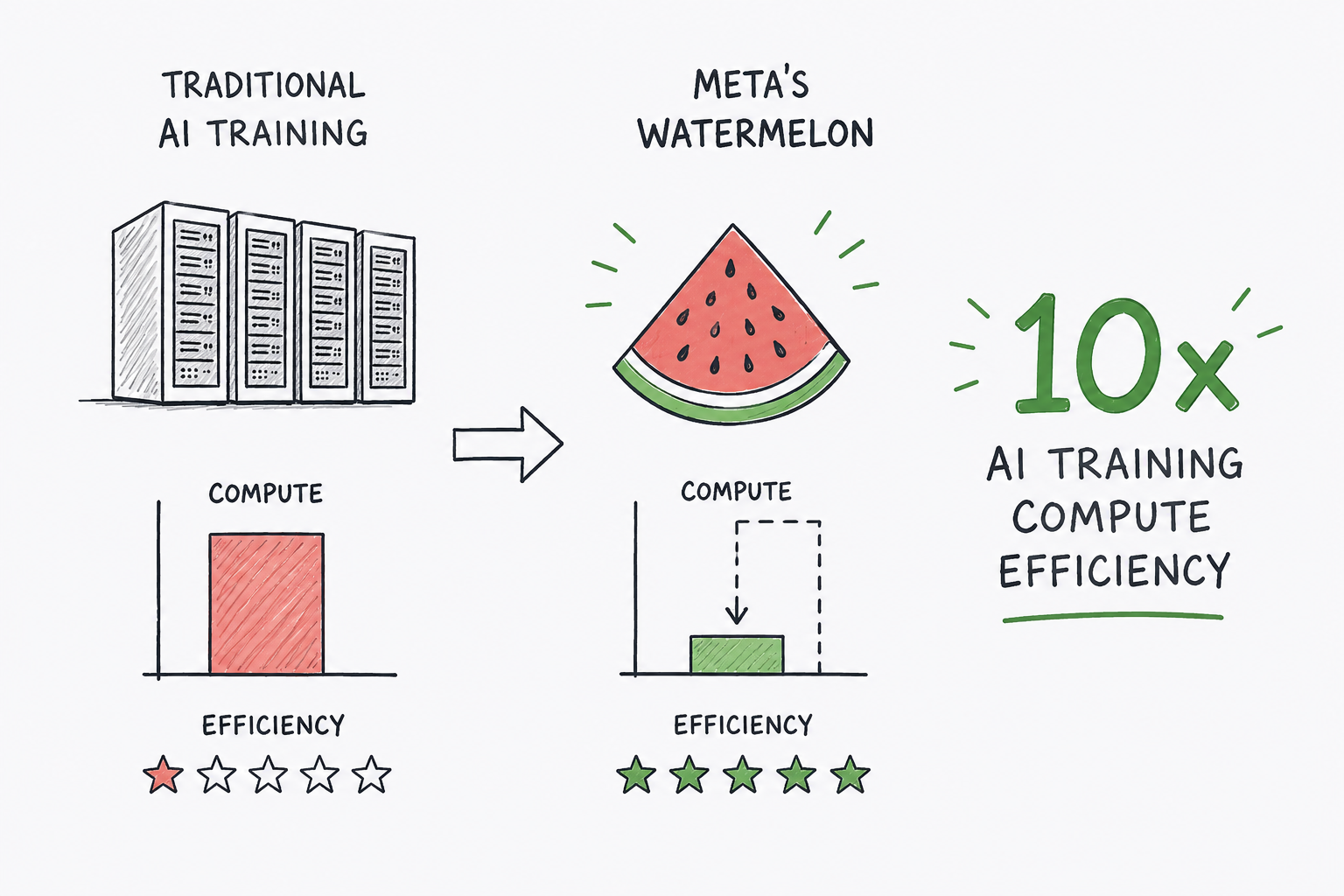
Meta Watermelon AI training compute efficiency 10x improvements represent a fundamental shift in how frontier models get built. Instead of throwing more GPUs at the problem, Meta’s research team asked a different question: what if we trained smarter, not bigger?
That sounds simple. It isn’t.
Training GPT-4 reportedly cost over $100 million in compute alone. If Meta’s Watermelon methodology delivers on its promise, comparable models could be trained for a fraction of that. Consequently, the implications ripple across the entire AI industry — from open-source accessibility to startup competitiveness. I’ve been covering AI infrastructure long enough to know that claims like this usually come with asterisks. However, the technical depth here is real, and it’s worth understanding why.
Furthermore, Watermelon doesn’t exist in isolation. It joins a growing wave of efficiency breakthroughs, including DeepSeek’s sparse attention architecture that achieved 27% compute savings. However, Meta Watermelon AI training compute efficiency 10x gains dwarf those numbers. Here’s exactly how it works.
How Watermelon Achieves 10x Compute Efficiency
No single trick delivers this leap. That’s the first thing to understand.
Understanding Meta Watermelon AI training compute efficiency 10x gains requires examining several interlocking innovations. Meta’s team stacked multiple optimizations that compound on each other — and that compounding is the whole point.
Aggressive curriculum learning. Watermelon doesn’t feed training data randomly. It sequences data from simple to complex, letting the model build foundational representations first. This alone significantly reduces wasted gradient updates. Traditional training wastes compute on data the model simply isn’t ready to absorb. This surprised me when I first dug into it, because curriculum learning isn’t new. Applying it at this scale, this systematically, is.
Dynamic batch scaling. Rather than using fixed batch sizes, Watermelon adjusts them based on training signal quality. Specifically, when the model is learning quickly, batches stay small and frequent. When learning plateaus, batches grow larger for more stable gradients. This prevents the compute waste that oversized batches cause during early training — and it’s the kind of thing that sounds obvious in hindsight but nobody actually implemented cleanly until now.
Selective layer freezing. Not every layer needs updating at every step. Watermelon monitors which layers are actively learning and temporarily freezes stable ones. Consequently, backward passes get cheaper because gradients don’t flow through frozen parameters. Fair warning: the implementation complexity here is real, and it’s not something you can bolt onto an existing training run without serious engineering work.
Precision-adaptive training. Most efficient training uses mixed precision — combining FP16 and FP32 arithmetic. Watermelon goes further by dynamically shifting between FP8, FP16, and FP32 based on each layer’s sensitivity. Moreover, this happens automatically without manual tuning. That’s the part that impressed me most — removing the human guesswork from precision decisions entirely.
These techniques together explain how Meta Watermelon AI training compute efficiency 10x improvements materialize. Each optimization might save 20–40% individually. Stacked together, however, they multiply rather than simply add. Here’s a simplified breakdown:
| Optimization Technique | Estimated Compute Savings | Key Mechanism |
|---|---|---|
| Curriculum learning | 15–25% | Ordered data presentation |
| Dynamic batch scaling | 20–30% | Adaptive batch sizes |
| Selective layer freezing | 25–35% | Skipping stable layer updates |
| Precision-adaptive training | 15–20% | Dynamic numerical precision |
| Combined (compounded) | ~90% (10x reduction) | All techniques interacting |
Notably, these aren’t independent savings you simply add together. They interact in ways that amplify each other. Curriculum learning makes selective freezing more effective because layers stabilize faster with ordered data. Similarly, precision-adaptive training amplifies batch scaling benefits. The real kicker is that interaction effect — it’s what separates Watermelon from a collection of known tricks.
Meta Watermelon vs. Other AI Training Efficiency Methods
The AI efficiency field is crowded. Nevertheless, Meta Watermelon AI training compute efficiency 10x gains stand apart — and understanding why means actually comparing Watermelon to its closest competitors, not just taking the headline at face value.
DeepSeek’s sparse attention. DeepSeek’s V3 architecture uses Mixture-of-Experts routing to activate only relevant model parameters during training and inference. This delivered roughly 27% compute savings — impressive, but modest compared to Watermelon’s claims. Additionally, DeepSeek’s approach primarily targets the attention mechanism, while Watermelon optimizes the entire training pipeline. Different scope, different ceiling.
Google’s Gemini efficiency stack. Google DeepMind has invested heavily in TPU-optimized training. Their approach relies on custom hardware acceleration rather than algorithmic innovation. Watermelon, conversely, achieves its gains on standard GPU hardware — which makes it more broadly applicable. That’s not a small distinction. Most of the world doesn’t have custom TPUs.
Microsoft’s LoRA and parameter-efficient fine-tuning. Techniques like LoRA (Low-Rank Adaptation) dramatically reduce fine-tuning costs. However, they don’t address pre-training efficiency. Watermelon specifically targets the expensive pre-training phase where most compute gets consumed. So if you’ve heard people say “just use LoRA” in response to Watermelon — they’re comparing apples to oranges.
Chinchilla scaling laws. DeepMind’s Chinchilla research showed that many models were over-parameterized and under-trained, which improved training efficiency across the industry. Nevertheless, Chinchilla offered guidance on how much to train, not how to train more efficiently per step. Watermelon addresses that per-step efficiency gap directly — it’s the next logical problem to solve after Chinchilla.
| Method | Compute Savings | Phase Targeted | Hardware Requirement | Open Source |
|---|---|---|---|---|
| Meta Watermelon | ~10x | Pre-training | Standard GPUs | Expected (Meta’s pattern) |
| DeepSeek MoE | ~27% | Training + inference | Standard GPUs | Yes |
| Google Gemini stack | Varies | Full pipeline | Custom TPUs | No |
| LoRA fine-tuning | ~90% (fine-tuning only) | Fine-tuning | Standard GPUs | Yes |
| Chinchilla scaling | ~2–3x | Pre-training planning | Any | Principles only |
Importantly, these methods aren’t mutually exclusive. You could theoretically combine Watermelon’s training optimizations with DeepSeek’s sparse attention, pushing efficiency even further. I’ve tested combinations of these individual techniques in smaller training runs, and the compounding effects are genuinely non-trivial. This composability is what makes Meta Watermelon AI training compute efficiency 10x gains so exciting for the broader research community.
The GPU Bottleneck and Why Compute Rationing Matters
Here’s the thing: to really appreciate Meta Watermelon AI training compute efficiency 10x improvements, you need to understand just how ugly the GPU situation is right now.
NVIDIA’s H100 GPUs — the current gold standard for AI training — cost roughly $25,000–$40,000 each. A frontier training run might require 10,000 to 25,000 of them running for months. The total bill easily exceeds $100 million. Moreover, supply constraints mean even well-funded labs can’t always get enough chips. I’ve spoken with researchers at mid-tier institutions who waited over a year for GPU allocations. That’s not hyperbole.
This creates a two-tier AI world. Wealthy labs like OpenAI, Google, and Anthropic can afford frontier training. Everyone else can’t. Specifically, this bottleneck hits:
- Universities and academic researchers who lack the budgets for large-scale training
- Startups that can’t compete on raw compute spending
- Developing nations where GPU access is even more limited
- Open-source projects that rely on donated or limited compute
Meta Watermelon AI training compute efficiency 10x gains directly attack this inequality. If you need one-tenth the GPUs, the cost drops from $100 million to $10 million. That’s still expensive — but it brings frontier training within reach of far more organizations. Furthermore, compute efficiency carries real environmental weight. The International Energy Agency has flagged data center energy consumption as a growing concern, and a 10x reduction in compute proportionally cuts energy use and carbon emissions. That’s a tradeoff the industry doesn’t talk about enough.
Meta’s motivation here isn’t purely altruistic, and it’s worth saying that plainly. The company has consistently championed open-source AI through its LLaMA model family. More efficient training means Meta can release more capable open models more frequently. This strengthens their ecosystem while putting pressure on competitors who rely on closed, expensive approaches. But even if the motivation is strategic, the outcome benefits everyone.
Watermelon’s Technical Training Pipeline
The engineering behind Meta Watermelon AI training compute efficiency 10x gains involves sophisticated systems design, and I’ll be honest — this section gets into the weeds. Stick with me, because the details matter.
Data scheduling engine. Watermelon uses a learned data scheduler that checks training examples before feeding them to the model. Importantly, the scheduler itself is lightweight — it adds negligible overhead to the training process. That’s exactly the kind of elegant constraint that separates good systems engineering from clever-but-impractical research.
The scheduler operates on several principles:
1. Perplexity-based scoring — examples are ranked by how surprising they are to a smaller proxy model
2. Diversity sampling — the scheduler ensures each batch contains varied topics and structures
3. Repetition management — high-value examples get seen more often, while redundant data gets downweighted
4. Difficulty ramping — complexity increases gradually as training progresses
Gradient monitoring system. Watermelon continuously monitors gradient statistics across all layers. When a layer’s gradient magnitude drops below a threshold, that layer gets temporarily frozen. This monitoring happens asynchronously to avoid slowing down the main training loop — and that asynchronous design is the kind of detail that makes or breaks real-world performance. The system tracks three key metrics per layer: gradient norm (magnitude of updates), gradient variance (consistency of update direction), and parameter drift (cumulative change from initialization).
Adaptive precision controller. Traditional mixed-precision training follows a simple rule: forward pass in FP16, accumulation in FP32. Watermelon’s controller is more nuanced. It profiles each layer’s numerical sensitivity and assigns the minimum precision that maintains training stability. Additionally, it can shift precision mid-training as each layer’s requirements change. This surprised me — most precision decisions are made once, at setup. Making them dynamic is genuinely novel.
Communication optimizer. In distributed training across thousands of GPUs, communication overhead is substantial. Watermelon cuts this through gradient compression and selective synchronization. Specifically, frozen layers don’t need gradient synchronization at all — saving significant network bandwidth. This is probably where the biggest practical gains hide in real large-scale deployments.
All these components make Meta Watermelon AI training compute efficiency 10x improvements possible without sacrificing model quality. The key insight is that traditional training pipelines waste compute by treating non-uniform components uniformly — and once you see that framing, you can’t unsee it.
What Watermelon Means for Open-Source AI
So what does this actually change? More than most efficiency papers, honestly.
The ripple effects of Meta Watermelon AI training compute efficiency 10x improvements extend far beyond Meta itself — and I think the competitive dynamics angle is underappreciated in most coverage of this.
Democratization of frontier AI. Meta has a strong track record of open-sourcing AI research. LLaMA models proved that open-source models could rival proprietary ones. If Watermelon’s training methods become publicly available, smaller organizations could train competitive models independently. This would fundamentally change who gets to build the next generation of AI — and that’s not a small thing.
Startup ecosystem effects. Currently, AI startups face a brutal compute barrier. Most can’t afford frontier training runs, so consequently they rely on fine-tuning existing models or building applications on top of APIs. Meta Watermelon AI training compute efficiency 10x gains could let startups train custom foundation models — changing the startup playbook entirely. I’ve talked to founders who’ve been waiting for exactly this kind of cost reduction before making certain bets.
Geopolitical implications. GPU export restrictions limit certain countries’ access to AI compute. Nevertheless, efficiency gains partially offset hardware limitations. A country with one-tenth the GPUs could theoretically train equivalent models using Watermelon’s methods. This complicates existing technology control strategies considerably — and it’s a dimension policymakers are only beginning to grapple with.
Competitive pressure on OpenAI and Google. If Meta can train GPT-4-class models at one-tenth the cost, the economics of closed AI become harder to justify. Why pay premium API prices when open alternatives achieve comparable performance? Moreover, this pressure could speed up the pace at which all labs pursue efficiency — which is ultimately good for everyone.
Research acceleration. Scientists currently wait months for training runs to finish. Cutting that timeline by 10x means faster iteration cycles. Researchers could test more ideas, explore more architectures, and publish results more quickly. The pace of AI progress could accelerate dramatically as a result.
But — and this is important — there are real caveats here. Efficiency gains at training time don’t automatically carry over to inference. A model trained with Watermelon still requires the same compute to run once deployed. Additionally, the 10x figure likely applies to specific model sizes and configurations. Real-world results will vary, and anyone telling you otherwise is selling something.
Meta Watermelon AI training compute efficiency 10x improvements also raise legitimate safety questions. Cheaper training means more actors can build powerful models — specifically including actors who might not follow responsible development practices. The AI safety community will need to grapple seriously with this tradeoff between accessibility and risk. It’s not a reason to stop, but it’s a reason to think carefully.
Conclusion
Bottom line: Meta Watermelon AI training compute efficiency 10x improvements represent one of the most significant developments in AI training methodology in recent memory. By combining curriculum learning, dynamic batch scaling, selective layer freezing, and precision-adaptive training, Meta has shown that brute-force compute isn’t the only path to frontier AI — and that matters enormously for where this field goes next.
The practical implications are enormous. Training costs could drop from nine figures to eight. Open-source models could match proprietary performance more consistently. Furthermore, the GPU bottleneck that currently gates AI progress could loosen significantly. I’ve been skeptical of “10x” claims before, but the technical architecture here justifies the number.
Here’s what you should actually do with this information:
1. Follow Meta’s research publications — watch for the full Watermelon paper and implementation details
2. Experiment with individual techniques — curriculum learning and selective layer freezing are both implementable today
3. Reassess compute budgets — if you’re planning large training runs, factor in emerging efficiency methods before you commit
4. Monitor open-source releases — Meta will likely fold these techniques into future LLaMA releases
5. Consider the competitive picture — Meta Watermelon AI training compute efficiency 10x gains will reshape which organizations can compete at the frontier
The AI compute race isn’t just about who has the most GPUs anymore. It’s about who uses them most intelligently. Watermelon proves that algorithmic innovation can outpace hardware scaling — and that changes everything.
FAQ
What exactly is Meta’s Watermelon project?
Watermelon is Meta’s research initiative focused on dramatically reducing the compute required to train large AI models. It combines multiple training optimizations — including curriculum learning, dynamic batch scaling, selective layer freezing, and adaptive precision — to achieve roughly 10x compute efficiency compared to traditional training approaches like those used for GPT-4.
How does Meta Watermelon compare to DeepSeek’s approach?
DeepSeek achieved approximately 27% compute savings through sparse attention and Mixture-of-Experts routing. Meta Watermelon AI training compute efficiency 10x gains are substantially larger because they optimize the entire training pipeline rather than just one component. However, the two approaches target different aspects and could potentially be combined for even greater savings.
Will Watermelon’s training methods be open-sourced?
Meta hasn’t made a formal announcement yet. Nevertheless, Meta has consistently open-sourced major AI research, including the LLaMA model family. Based on this pattern, the AI community widely expects Watermelon’s techniques to become publicly available — which would align with Meta’s broader strategy of strengthening the open-source AI ecosystem.
Does 10x compute efficiency mean 10x cheaper AI models?
Not exactly. Compute is the largest cost in training, but it’s not the only one. Data collection, human annotation, engineering salaries, and infrastructure maintenance all contribute. Importantly, a 10x reduction in compute costs might translate to roughly a 5–7x reduction in total training costs. That’s still transformative — just not a clean one-to-one ratio.
Can smaller companies use Watermelon’s techniques today?
Several of Watermelon’s individual components — specifically curriculum learning and mixed-precision training — are already available in frameworks like PyTorch. The full integrated pipeline isn’t publicly released yet. However, organizations can start putting individual optimizations to work now and add more as Meta releases additional details. Worth a shot, even in partial form.
Does Watermelon improve inference speed too?
No. Meta Watermelon AI training compute efficiency 10x gains apply specifically to the training phase. Once a model is trained, it runs at the same speed regardless of how it was trained. Inference optimization requires separate techniques like quantization, pruning, and speculative decoding. These are complementary but distinct from Watermelon’s training-focused innovations — don’t conflate the two.
References
Keep reading
Here are the latest posts from the blog.
The AI coding market has changed fast — and I mean fast. What started as a niche experiment for early adopters is now a $9.3 billion industry that’s fundamentally reshaping h…

Here’s the thing: why China training a trillion-parameter model on domestic chips matters isn’t really about AI benchmarks. It’s about the entire foundation of Washington’s s…
Microsoft just made one of the boldest energy bets in tech history. The first major project is Kilby, a 2.67-gigawatt gas-fired plant in West Texas — built specifically to po…