When a security researcher finds a flaw in an AI system, what actually happens next? The vulnerability disclosure process turns AI security findings from dangerous secrets into shipped patches — but the path from “I found something bad” to “it’s fixed” is rarely clean. It involves coordination, trust, legal frameworks, and sometimes genuinely tense negotiations between independent researchers and billion-dollar companies.
And it matters more than ever right now. AI systems are handling medical diagnoses, financial transactions, and critical infrastructure. A single unpatched vulnerability could affect millions of people. Furthermore, as the Five Eyes alliance warns about AI-related cyber threats, the defensive infrastructure behind disclosure deserves serious attention — not just from security teams, but from anyone building or deploying AI.
How Vulnerability Disclosure Works in AI Security
Vulnerability disclosure is the structured process of reporting security flaws to whoever is responsible for fixing them. Specifically, it bridges the gap between finding a bug and actually deploying a patch. The vulnerability disclosure process turns AI security research into concrete defensive action — when it works, anyway.
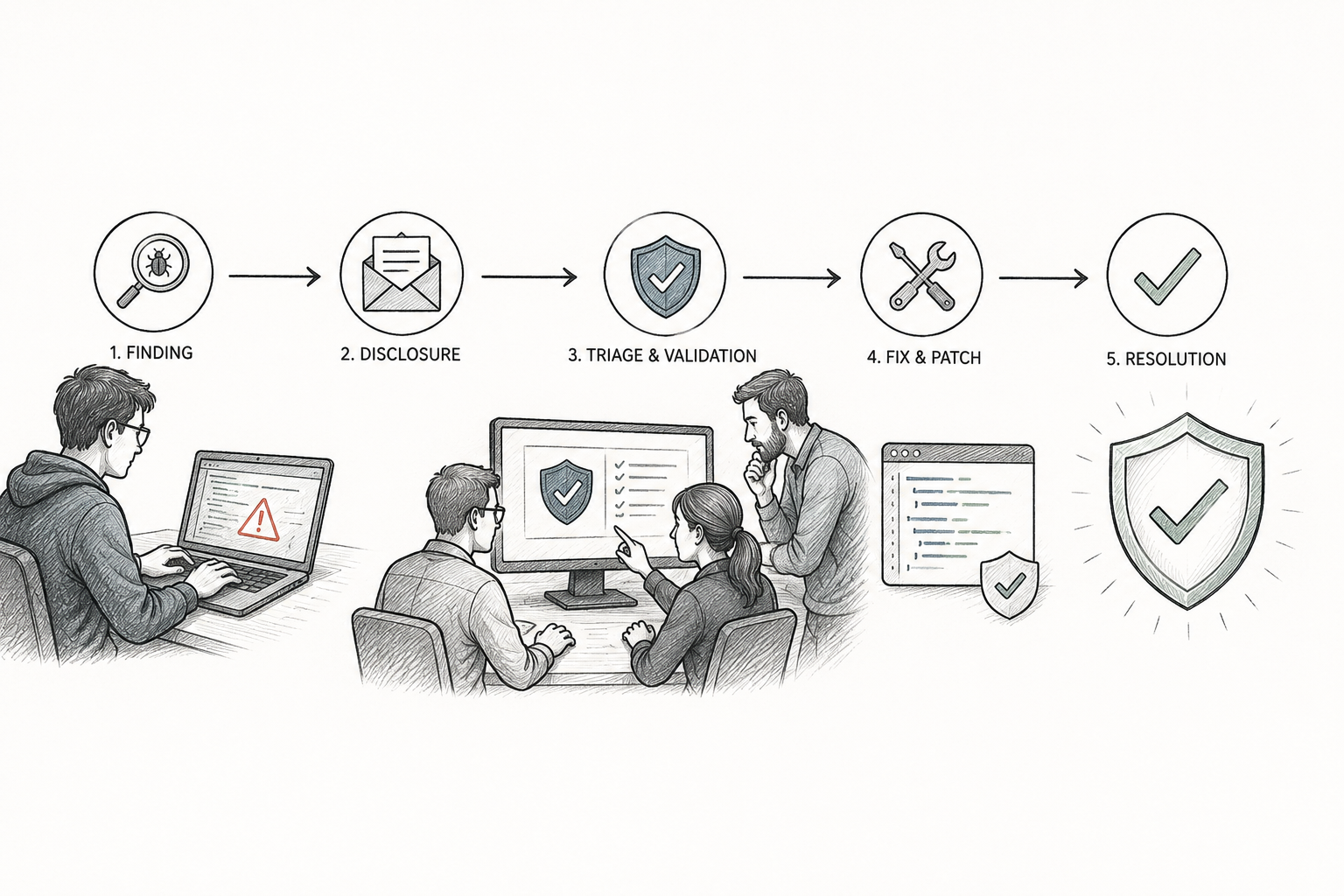
Here’s how the typical flow looks:
1. Discovery — A researcher identifies a flaw in an AI model, API, or deployment pipeline.
2. Documentation — They write up a detailed report: reproduction steps, severity assessment, potential impact.
3. Initial contact — The researcher reaches out through whatever designated security channel the vendor actually maintains.
4. Acknowledgment — The vendor confirms receipt, usually within 24–72 hours.
5. Triage and validation — The vendor’s security team reproduces and assesses the bug internally.
6. Patch development — Engineers build, test, and stage a fix.
7. Coordinated release — Both parties agree on a public disclosure date after the patch ships.
Neat on paper. However, real-world timelines are genuinely messy. Researchers sometimes wait months for a meaningful response. Vendors occasionally dispute severity ratings in ways that feel more like stalling than honest disagreement. Embargo periods — the agreed-upon silence before public disclosure — can stretch uncomfortably long.
Responsible disclosure differs from full disclosure in one critical way: responsible disclosure gives vendors time to fix flaws before the public learns about them. Full disclosure publishes everything immediately, patch or no patch. Most AI labs strongly prefer the responsible approach. Nevertheless, researchers retain the right to go public if vendors ignore them — and good ones will exercise that right.
I’ve watched this dynamic play out repeatedly over the years, and the researchers who set firm deadlines upfront tend to get faster responses. It’s not adversarial — it’s just smart negotiation.
The CERT Coordination Center at Carnegie Mellon has published guidelines that many AI companies now follow. Their 45-day disclosure window has become something of an industry benchmark, although AI vulnerabilities often need longer timelines due to model retraining requirements. That 45-day standard was built for traditional software — it’s already straining under AI’s complexity.
The Embargo Period: Where Trust Meets Tension
The embargo period is arguably the most delicate phase of the entire process. During this window, the vulnerability disclosure process turns AI security coordination into a genuine trust exercise. Both sides agree to stay quiet while the fix ships — and that agreement can be fragile.
What actually happens during an embargo:
- The vendor patches the vulnerability in private branches
- Security teams verify the fix doesn’t introduce new bugs (this happens more than you’d think)
- Communications teams draft advisories and CVE descriptions
- The researcher prepares their public write-up for post-embargo release
- Both parties lock in a specific date and time for coordinated publication
Embargo periods for AI vulnerabilities tend to run longer than traditional software bugs. Because AI model fixes often require retraining, fine-tuning, or deploying new guardrails, you can’t simply push a code commit and call it done. Consequently, 90-day windows are now common for AI-specific flaws — and even that sometimes isn’t enough.
Tensions typically arise when:
- Vendors request extensions well beyond the agreed timeline, often without clear justification
- Researchers suspect the vendor isn’t actively working on a fix at all
- A third party independently discovers and publishes the same vulnerability mid-embargo
- The flaw is actively being exploited in the wild, making silence feel irresponsible
Google’s Project Zero famously enforces a strict 90-day deadline — after that, they publish regardless. This policy has genuinely forced major vendors to prioritize fixes in ways polite requests never did. Meanwhile, AI labs have adopted similar but slightly more flexible approaches, which is reasonable given the complexity involved.
Notably, Anthropic’s security team has publicly committed to acknowledging vulnerability reports within 48 hours. OpenAI operates a bug bounty program through Bugcrowd with tiered payouts based on severity. Meta’s AI red team handles disclosures for their open-source Llama models through their existing security reporting infrastructure. Each approach reflects different organizational priorities — and honestly, each has real tradeoffs.
Here’s the thing: the embargo period works when both sides are acting in good faith. When they’re not, it just delays the inevitable.
Case Studies: Real AI Vulnerability Disclosures
Examining actual cases shows how the vulnerability disclosure process turns AI security theory into messy, instructive practice. Each major AI lab handles things differently, and the differences are telling.
Prompt injection attacks on GPT-4 (2023–2024)
Researchers discovered that carefully crafted prompts could override system instructions in GPT-4. This surprised me when I first dug into the details — the attack surface was broader than most people assumed at the time. The disclosure timeline looked roughly like this:
- Discovery and documentation: 2 weeks
- Initial report to OpenAI: Day 1
- Acknowledgment from OpenAI: Within 24 hours
- Patch deployed (improved input filtering): Approximately 30 days
- Public disclosure: After patch confirmation
Thirty days to patch is actually fast. Worth noting.
Llama 2 safety bypass (2023)
Because Meta released Llama as open-source, the disclosure dynamic shifted considerably. Researchers published findings more quickly since anyone could inspect the model weights anyway. Meta’s response involved updating safety fine-tuning and publishing revised model cards. The open-source nature actually accelerated the fix cycle — which is a genuinely interesting counterintuitive result. Moreover, community contributors flagged additional edge cases that Meta’s internal team had missed.
Anthropic’s Claude jailbreak vectors (2024)
Multiple researchers reported methods to bypass Claude’s constitutional AI safeguards. Anthropic triaged reports quickly, typically within 48 hours. Importantly, they credited researchers publicly after deploying fixes — a small thing that builds enormous goodwill in the security community. The average time from report to patch was roughly 45 days, which is notably faster than the 90-day industry standard.
Here’s a comparison of how major AI labs handle disclosure:
Table: scroll sideways to view all columns when needed.
| Factor | OpenAI | Anthropic | Meta (Llama) | Google DeepMind |
|---|---|---|---|---|
| Primary channel | Bugcrowd platform | Direct email | Facebook Whitehat | Google VRP |
| Acknowledgment time | 24–48 hours | 24–48 hours | 48–72 hours | 24 hours |
| Typical embargo | 90 days | 60–90 days | Shorter (open-source) | 90 days (Project Zero standard) |
| Bug bounty range | $200–$20,000 | Case-by-case | $500–$50,000+ | $500–$31,337+ |
| Public credit | Yes, if requested | Yes | Yes | Yes |
| Retraining included | Sometimes | Often | Community-driven | Sometimes |
Additionally, the MITRE CVE program has started assigning CVE identifiers to AI-specific vulnerabilities. This standardization matters more than it might seem — it gives the broader security community a consistent way to track and reference AI flaws without reinventing the taxonomy every time.
How AI Disclosure Differs From Traditional Software
Traditional software vulnerabilities follow well-established patterns. Buffer overflows, SQL injection, cross-site scripting — these have decades of precedent, tooling, and institutional knowledge behind them. AI vulnerabilities are fundamentally different. Therefore, the vulnerability disclosure process for AI security demands genuinely new thinking, not just adapted old frameworks.
Key differences include:
- Reproducibility is harder. AI models can behave non-deterministically. A prompt injection that works today might fail tomorrow after a model update — or just randomly, depending on temperature settings. Researchers must document exact model versions, API parameters, and environmental conditions carefully.
- Severity assessment is subjective. Traditional bugs have relatively clear impact metrics. An AI generating harmful content sits in a gray area — specifically, how do you score a jailbreak that produces offensive text versus one that leaks actual training data? I’ve seen reasonable security professionals disagree sharply on this, and both sides had valid points.
- Patches aren’t binary. You can’t just fix a line of code and ship it. AI patches might involve retraining with new safety data, adding output filters, adjusting reinforcement learning from human feedback (RLHF) parameters, or deploying classifier-based guardrails — sometimes all of the above simultaneously.
- The attack surface keeps shifting. Every model update changes the vulnerability picture. A fix for one version might not carry over to the next. Similarly, multimodal models introduce entirely new attack vectors through images, audio, and video inputs that nobody had fully anticipated.
- Open-source complicates timelines. When model weights are public, anyone can find and exploit vulnerabilities. Embargo periods lose much of their meaning. Conversely, open-source models benefit from community-driven fixes that closed-source models simply can’t access.
Moreover, AI vulnerabilities often fall into categories that didn’t meaningfully exist five years ago:
- Prompt injection — Manipulating model behavior through crafted inputs
- Training data extraction — Forcing models to reveal memorized private data (this one’s particularly alarming at scale)
- Model poisoning — Corrupting training data to introduce backdoors
- Alignment bypass — Circumventing safety guardrails and content policies
- Supply chain attacks — Compromising model weights, tokenizers, or dependencies
Each category demands different expertise from both researchers and vendor security teams. Consequently, AI labs are building specialized red teams that genuinely understand machine learning internals — not just traditional penetration testers handed a new target.
The real kicker? We’re still figuring out the right frameworks for most of these. The field is moving faster than the standards bodies can keep up.
Building an Effective AI Vulnerability Disclosure Program
For organizations deploying AI systems, having a solid disclosure program isn’t optional anymore. The vulnerability disclosure process turns AI security from reactive firefighting into proactive defense. I’ve seen companies skip this and pay for it badly — a researcher goes public without warning because there was no clear channel to report through, and suddenly it’s a PR crisis on top of a security crisis.
Essential components:
- Clear reporting channels. Publish a security.txt file on your domain. Maintain a dedicated email address that someone actually monitors. Consider partnering with platforms like HackerOne or Bugcrowd for managed intake — they handle a lot of the operational overhead.
- Defined scope. Specify which AI systems are in scope. Include model APIs, fine-tuned deployments, training pipelines, and inference infrastructure. Explicitly exclude third-party dependencies you don’t control, or you’ll get flooded with reports about things you can’t fix.
- Response SLAs. Commit to specific acknowledgment and resolution timelines and actually honor them. The industry standard is 24–72 hours for acknowledgment and 90 days for patch deployment.
- Legal safe harbor. Explicitly state that good-faith security research won’t trigger legal action. Without safe harbor language, researchers won’t report to you — they’ll publish independently instead, often without warning. This is a no-brainer.
- Reward structure. Bug bounties work. They push researchers toward responsible reporting rather than black-market sales, and the math is obvious — paying a researcher $10,000 beats a breach that costs millions. Tier your rewards by severity. AI-specific vulnerabilities often warrant higher payouts due to their complexity.
- Post-fix communication. Credit researchers publicly. Publish advisories. Update your security documentation. This builds trust and encourages future reports from people who might otherwise stay quiet.
Common mistakes to avoid:
- Ignoring reports or responding too slowly (the fastest way to guarantee public disclosure)
- Disputing severity without technical justification — researchers notice when it feels like stalling
- Requesting unreasonable embargo extensions with no explanation
- Failing to credit researchers after the fix ships
- Treating all AI vulnerabilities as “expected behavior” (fair warning: this one causes real damage to your reputation in the security community)
Importantly, the NIST AI Risk Management Framework provides structured guidance for organizations building these programs. It specifically addresses vulnerability management as a core function of trustworthy AI deployment — and it’s worth reading even if you don’t adopt it wholesale. Additionally, organizations that align with NIST guidance tend to build more defensible programs when things inevitably go wrong.
Bottom line: a disclosure program costs relatively little to build and an enormous amount to not have.
Conclusion
The vulnerability disclosure process turns AI security findings into the patches that protect millions of users. Without this infrastructure, every discovered flaw would just sit there — either as a dangerous secret or a published exploit with no fix in sight. Responsible disclosure isn’t just a best practice. It’s the connective tissue between AI security research and real-world safety, and it’s genuinely underappreciated.
Here’s what you should actually do next:
- If you’re a researcher: Document your findings thoroughly. Use official reporting channels. Respect embargo periods — but set firm deadlines for vendor response upfront, and stick to them.
- If you’re a vendor: Build a disclosure program now, before you need it. Publish clear policies, offer legal safe harbor, and respond quickly. Your reputation in the security community is built almost entirely on how you handle these moments.
- If you’re an AI user: Pay attention to security advisories. Update your AI tools and APIs promptly. The vulnerability disclosure process turns AI security research into the patches keeping your data safe — but only if you actually install them.
The AI security ecosystem is still maturing, and notably, the frameworks emerging from major labs show real progress. Nevertheless, we’re still early. As AI systems grow more powerful and more deeply embedded in critical systems, this process will only become more consequential. Stay informed, stay updated, and take security advisories seriously — even when the technical details feel abstract.
FAQ
What is vulnerability disclosure in AI security?
Vulnerability disclosure is the structured process where security researchers report flaws in AI systems to the responsible vendor, who then develops and deploys a fix before the finding goes public. Specifically, this vulnerability disclosure process turns AI security research into actionable patches that actually protect users — rather than just interesting conference talks.
How long does a typical AI vulnerability disclosure take?
Most major AI labs aim for a 90-day window from initial report to deployed fix. However, AI-specific vulnerabilities sometimes take longer — model retraining, safety fine-tuning, and guardrail updates add real complexity. Simple API-level fixes might ship in 30 days, whereas complex model-level issues can take 120 days or more. Fair warning: if a vendor is being vague about timeline, that’s usually a sign something is stuck.
Do AI companies pay bug bounties for vulnerability reports?
Yes, and the numbers are meaningful. OpenAI pays between $200 and $20,000 through their Bugcrowd program. Meta’s program can pay $50,000 or more for critical findings. Anthropic handles rewards on a case-by-case basis. Additionally, Google DeepMind falls under Google’s broader Vulnerability Reward Program, which tops out at $31,337 (yes, that’s intentional). The variance is wide, but the incentive to report responsibly rather than sell to a broker is real.
What’s the difference between responsible and full disclosure?
Responsible disclosure gives vendors a set timeframe to fix the vulnerability before public announcement. Full disclosure publishes everything immediately, regardless of patch status. Most AI security researchers prefer responsible disclosure — and so do I, honestly, because it actually results in fixes. Nevertheless, switching to full disclosure is a legitimate response when a vendor ignores reports or stalls indefinitely. It’s a last resort, not a first move.
Can researchers face legal consequences for reporting AI vulnerabilities?
Potentially, yes — and without proper safe harbor protections, the legal risk is real enough that many researchers simply won’t report at all. Reputable AI companies publish explicit safe harbor language in their security policies specifically to protect good-faith researchers. Importantly, always review a company’s vulnerability disclosure policy before submitting reports. Organizations without safe harbor language present meaningful legal risk, and that’s not paranoia — it’s happened.
How does open-source AI change vulnerability disclosure?
Open-source models like Meta’s Llama fundamentally alter disclosure dynamics. Since anyone can access model weights, traditional embargo periods lose much of their effectiveness — you can’t keep a secret when the source material is public. Consequently, the community often identifies and patches vulnerabilities faster than closed-source alternatives. However, malicious actors have the same access. The vulnerability disclosure process for open-source AI security becomes a more public, community-driven effort — which has real advantages, but also means you can’t quietly fix something before the bad actors notice it.
References
Keep reading
Here are the latest posts from the blog.

Claude for drug discovery is reshaping how pharmaceutical companies screen millions of molecular candidates. Anthropic’s model isn’t just a chatbot with a lab coat — it’s bec…
The concept of robot-as-a-service explained why renting robot smarter than buying has genuinely reshaped how companies approach automation. Five years ago, deploying a robot…

The Five Eyes warning AI cyberattacks months years timeline has genuinely rattled the cybersecurity world — and honestly, it should. Intelligence agencies from the United Sta…