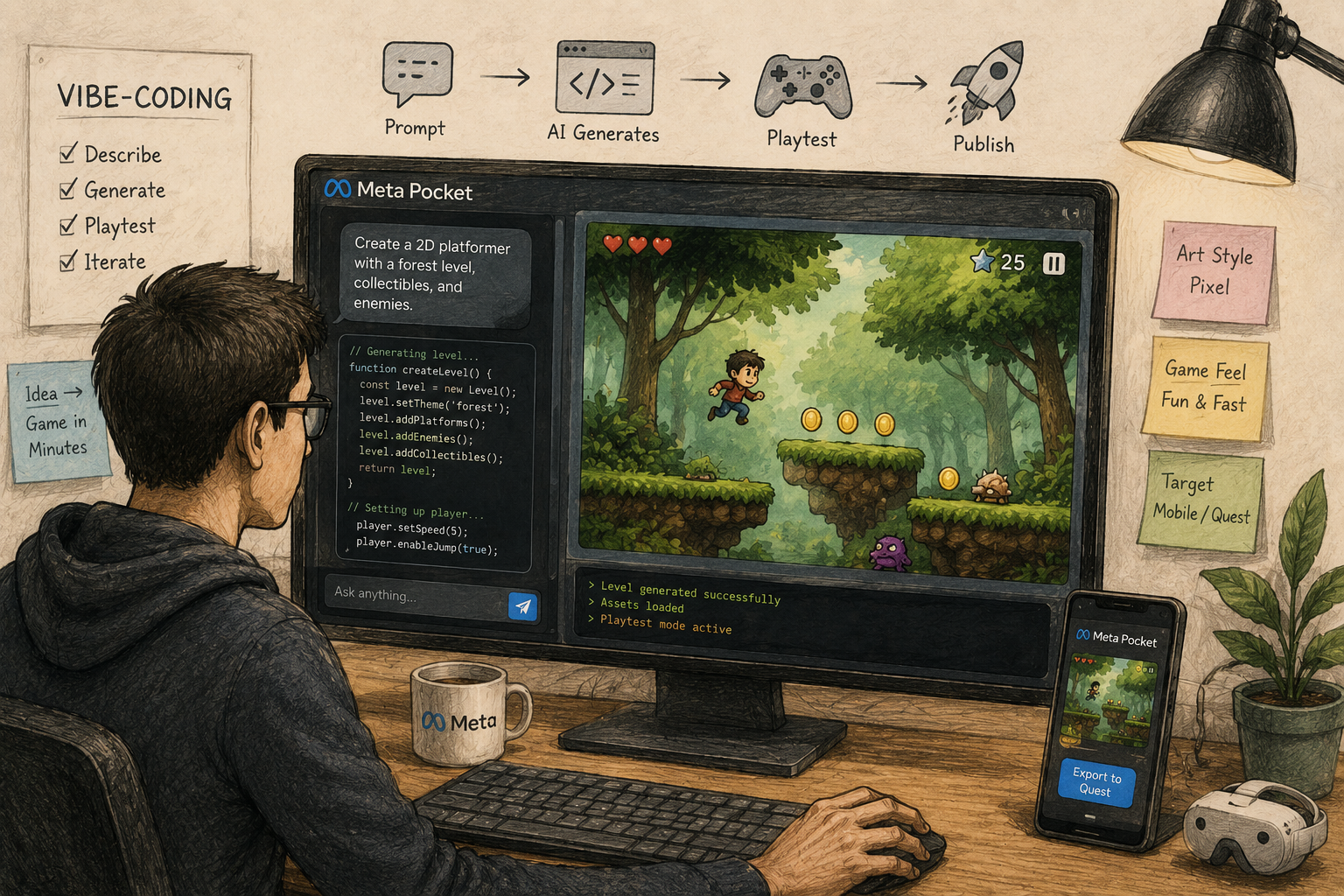
The conversation around game engine AI coding tools Meta Pocket vibe-coding is heating up fast — and honestly, it deserves more attention than it’s getting. Meta quietly introduced Pocket as an internal game development tool, and what makes it interesting isn’t the AI angle (everyone has that now). It’s that Pocket is fundamentally different from the general-purpose coding assistants we’ve all been wrestling with for the past few years.
Instead of autocompleting your lines of code, Pocket lets developers describe game mechanics in plain language. The AI then generates playable prototypes. This approach — called vibe-coding — eliminates the traditional gap between creative vision and technical execution. For game developers specifically, that’s a seismic shift.
What Is Vibe-Coding and Why Does It Matter for Game Development?
How Meta’s Pocket Differs From General-Purpose AI Coding Assistants
Meta’s Compute Efficiency Moat: Why They Can Afford This
Competitive Positioning: Meta Pocket vs. Unity and Unreal Engine Tooling
What Is Vibe-Coding and Why Does It Matter for Game Development?
Vibe-coding is a term coined by Andrej Karpathy, former Tesla AI director — and I’d argue it’s one of the more honest framings of where AI-assisted development is actually heading. The concept is straightforward: describe what you want in natural language, the AI writes the code, you iterate by describing changes rather than debugging syntax. No stack traces. No hunting for missing semicolons at midnight.
Specifically, vibe-coding differs from traditional AI-assisted coding in one crucial way. Tools like GitHub Copilot suggest completions within your existing workflow, so you’re still fundamentally thinking in code. Vibe-coding flips this entirely — you think in experiences, feelings, and game mechanics instead. That’s a bigger mental shift than it sounds.
Here’s what that looks like in practice:
- “Make the character feel floaty when jumping, like early Mario games”
- “Add a particle effect when enemies explode — something satisfying and crunchy”
- “Create a puzzle where gravity reverses every 10 seconds”
I’ve worked with enough game dev teams to know that those three prompts would previously generate hours of back-and-forth between designers and engineers. A designer would sketch the floaty jump in a doc, an engineer would interpret it, implement something, and then the designer would say “no, floatier” — and that loop might run four or five times before everyone agreed. With vibe-coding, the designer can run that loop themselves in minutes. Consequently, developers spend less time wrestling with physics engines and rendering pipelines and more time actually designing fun things. Meta’s Pocket takes this philosophy and builds it directly into a game engine AI coding workflow.
Furthermore, vibe-coding democratizes game creation in a way that feels real rather than theoretical. Junior developers can prototype ideas that previously required senior engineering talent. Solo indie creators can build in hours what once took weeks. Consider a solo developer who has a strong visual design sense but limited C++ experience — historically, they’d either spend months learning the language or pay a contractor to implement core mechanics. Vibe-coding collapses that constraint entirely. The barrier to entry drops dramatically — and I don’t say that lightly, because I’ve watched a lot of “game-changing” tools fail to deliver on exactly that promise.
Nevertheless, vibe-coding isn’t magic. It works best for rapid prototyping and early iteration. Complex multiplayer networking or serious performance optimization still requires human expertise. A prompt like “make the netcode lag-free for 64 concurrent players” will produce something, but whether it holds up under real load is a different question. The sweet spot is ideation and early development — exactly where most game projects stall out.
How Meta’s Pocket Differs From General-Purpose AI Coding Assistants
General-purpose AI coding tools like GitHub Copilot and Claude by Anthropic are genuinely excellent at writing Python scripts or React components. However, they weren’t built for game development’s unique challenges, and that gap shows up fast when you try to use them on a real project.
Game development involves real-time physics, 3D rendering, audio synchronization, input handling, and state management — all running at once. A general-purpose AI assistant doesn’t understand that a “wall jump” implies specific collision detection, animation blending, and input buffering requirements. It’ll give you something, but whether it actually plays correctly is another question entirely. I’ve seen developers paste general-purpose AI output into Unity, have it compile cleanly, and then watch the character clip through walls on the first test run — because the AI wrote syntactically valid code that was mechanically wrong for the context.
Meta’s Pocket addresses game-specific workflows in several concrete ways:
- Physics-aware code generation. Pocket understands game physics concepts natively. It doesn’t just write code — it writes code that plays correctly.
- Asset-integrated pipeline. The tool connects directly to asset libraries, textures, and audio files. Descriptions like “add a wooden door” actually produce a door with appropriate textures and collision mesh. This surprised me when I first dug into the details.
- Real-time preview. Generated code compiles and runs instantly, so you see results right away rather than after a full build cycle.
- Iterative refinement. Each prompt builds on previous context. The AI remembers your game’s existing mechanics and style, which is the real kicker here.
That last point matters more than it might seem. If you tell Pocket your game uses a low-gravity setting and pixel-art aesthetics early in a session, subsequent prompts about new mechanics will respect those constraints automatically. General-purpose tools lose that thread constantly — you end up re-explaining your project’s context every few prompts, which kills momentum.
Moreover, Meta Pocket vibe-coding tools are trained on game-specific data — a critical distinction that doesn’t get nearly enough attention. General-purpose models learn from GitHub repositories spanning every domain imaginable, whereas Pocket’s training data focuses specifically on game logic, rendering patterns, and interactive design. That specificity matters more than raw model size.
Additionally, Meta holds a unique structural advantage here. The company operates one of the world’s largest VR gaming platforms through Meta Quest. That gives them access to proprietary data about how players actually interact with games — behavioral data that competitors simply don’t have and can’t easily acquire.
Table: scroll sideways to view all columns when needed.
| Feature | GitHub Copilot | Claude Code | Meta’s Pocket |
|---|---|---|---|
| Primary focus | General coding | General coding + reasoning | Game development |
| Game physics awareness | Limited | Limited | Native |
| Real-time preview | No | No | Yes |
| Asset integration | No | No | Yes |
| Vibe-coding support | Partial | Partial | Full |
| Training data | Public repos | Mixed sources | Game-specific + proprietary |
| VR/AR optimization | No | No | Yes |
| Pricing model | Subscription | Usage-based | TBD (internal tool) |
Notably, this comparison shows why game engine AI coding tools need vertical specialization. Horizontal tools are powerful but generic. Meta’s approach is narrow but deep — and in tooling, deep usually wins.
Meta’s Compute Efficiency Moat: Why They Can Afford This
Building vertical AI tools is expensive. So why can Meta afford to develop Pocket while others can’t?
The answer lies in infrastructure advantages that are genuinely hard to replicate. Meta’s Watermelon project achieved significant compute efficiency gains across their AI infrastructure. Specifically, these optimizations reduce the cost of running large language models internally. When inference costs drop meaningfully, you can deploy AI in more places — including niche tools like game engines that wouldn’t otherwise make economic sense.
Furthermore, Meta operates at a scale that spreads development costs across billions of users. Even if Pocket initially serves a relatively small developer community, Meta benefits in ways that compound over time:
1. Platform lock-in. Developers building with Pocket create games for Meta’s ecosystem. That feeds the Quest platform and Horizon Worlds directly.
2. Data flywheel. Every game built with Pocket generates training data. Better training data produces better AI, and better AI attracts more developers. I’ve seen this loop play out in other verticals — it’s genuinely powerful.
3. Talent attraction. Advanced AI tools draw top game developers to Meta’s platforms, which matters more than most analysts acknowledge.
Importantly, Meta’s open-source strategy with LLaMA models also plays a meaningful role here. By open-sourcing their foundation models, Meta builds community goodwill and ecosystem adoption. Pocket can then sit on top of these models as a proprietary, value-added layer — smart architecture, honestly. It’s a pattern worth recognizing: give away the foundation, monetize the application layer. Meta has executed this playbook before, and it tends to work.
Consequently, Meta’s position in the game engine AI coding tools Meta Pocket vibe-coding space isn’t purely about technology. It’s about economics. They’ve built an infrastructure advantage that makes vertical AI tools financially viable in a way that competitors simply can’t match right now.
Meanwhile, competitors face harder math. Unity and Epic Games (Unreal Engine) don’t operate hyperscale data centers. They’d need to partner with cloud providers or acquire AI infrastructure — and both options are expensive with messy dependencies attached. A partnership with AWS or Azure solves the compute problem but introduces margin pressure and strategic dependency that neither company would welcome.
Competitive Positioning: Meta Pocket vs. Unity and Unreal Engine Tooling
The game engine market has been a two-horse race for years. Unity dominates mobile and indie development, while Unreal Engine leads in AAA and high-fidelity projects. Meta’s Pocket doesn’t compete with either directly — yet. But the pressure it creates is real.
Unity’s AI efforts have focused on tools like Unity Muse and Unity Sentis, providing AI-assisted asset generation and in-game machine learning. However, they don’t offer true vibe-coding capabilities. Developers still write C# scripts manually. Fair warning if you’ve been reading the Unity marketing materials: the gap between what they’re promising and what’s actually shipping is noticeable.
Unreal Engine’s approach centers on Blueprints, a visual scripting system that lowers the coding barrier but isn’t AI-powered. Epic has added some AI features, but nothing approaching Pocket’s natural language game creation. Blueprints are genuinely useful — I’ve used them — but they’re a different category of tool entirely. Blueprints still require you to think in nodes, connections, and execution flow. That’s more approachable than raw C++, but it’s not the same as typing “when the player enters the cave, the torches should flicker and the ambient audio should shift to something tense.”
Here’s where Meta’s Pocket creates real competitive pressure:
- Unity and Unreal charge licensing fees or revenue shares. Meta could offer Pocket free to drive platform adoption — and given their economics, that’s a credible threat.
- Traditional engines require months of serious learning. Vibe-coding with Pocket requires minutes of experimentation.
- Unity and Unreal serve all platforms. Pocket optimizes specifically for Meta’s hardware — Quest headsets and Ray-Ban Meta glasses — which is a narrow focus that also happens to be where VR development is actually growing.
Similarly, Meta’s approach mirrors what happened in web development. Specialized frameworks like Next.js didn’t replace general-purpose tools — they made specific workflows dramatically faster. Meta Pocket vibe-coding could do exactly the same for VR and AR game development.
Although Pocket is currently an internal tool, developer adoption signals suggest a broader release is coming. Meta has been hiring game engine engineers and AI researchers specifically for interactive content creation. Job postings reference “natural language game authoring” and “AI-assisted interactive experiences” — those aren’t accidental phrase choices.
Nevertheless, Meta faces real challenges here. The game development community is deeply invested in existing engines, and switching costs are genuinely high. I’ve talked to enough studio leads to know that “better tool” alone doesn’t move the needle — ecosystem effects do. Plugins, tutorials, community forums, asset stores. Building that takes years, not months. Meta’s best path forward is probably not asking studios to abandon Unity or Unreal, but rather positioning Pocket as the fastest way to prototype and validate ideas before committing to a full production build in an established engine.
Key developer adoption signals worth watching:
- Beta program announcements for external developers
- Integration with existing game development workflows (importing Unity/Unreal assets)
- Community-created tutorials and templates
- Third-party plugin support
- Open-source components that developers can actually inspect and modify
The Broader Impact on the $9.3 Billion AI Coding Market
The AI coding market is projected to reach $9.3 billion — and game engine AI coding tools Meta Pocket vibe-coding represents a fascinating vertical slice of that opportunity. Most market growth has come from horizontal tools so far. Meta’s move signals a meaningful shift toward specialization, and I think it’s the right bet.
Specifically, vertical AI coding tools could split the market in some genuinely interesting ways:
1. Domain-specific assistants. Game development is just the beginning. Expect AI coding tools built for robotics, embedded systems, data pipelines, and more — each trained on domain-specific patterns rather than generic GitHub data.
2. Platform-native AI. Instead of third-party plugins bolted onto existing environments, platform owners build AI directly into their development toolchains.
3. Prompt-first development. Vibe-coding normalizes the idea that natural language is a valid programming interface. That’s a bigger cultural shift than most people are pricing in right now.
Moreover, Meta’s entry supports a broader thesis I’ve held for a while: the most valuable AI coding tools won’t be the most general — they’ll be the most contextually aware. A tool that understands game development deeply will always outperform a general tool on game development tasks. That seems obvious in retrospect, but the market took a while to get there. The analogy is a general-purpose contractor versus a specialist who has spent a decade building the same type of structure. The specialist doesn’t just work faster — they anticipate problems the generalist wouldn’t even recognize.
Additionally, this trend affects hiring and team composition in ways worth thinking about seriously. Studios using game engine AI coding tools may need fewer junior programmers but more creative directors and game designers. The bottleneck shifts from implementation to imagination — and that’s not a bad thing, though it does require studios to rethink how they structure teams. A practical tip for studio leaders navigating this now: don’t wait for the tooling to mature before having the organizational conversation. The studios that will adapt fastest are the ones already experimenting with hybrid workflows where designers own early prototyping and engineers focus on systems that AI genuinely can’t handle yet.
Consequently, educational institutions will need to adapt. Game development programs currently emphasize C++, shader programming, and engine architecture. Tomorrow’s curriculum might prioritize game design theory, player psychology, and effective AI prompting. That’s a significant overhaul, and most programs aren’t ready for it yet. The schools that move early — building courses around iterative AI-assisted design rather than pure syntax instruction — will produce graduates who are immediately more useful to studios operating in this new environment.
Although some developers worry about job displacement — and I get it, the concern is legitimate — history suggests a different outcome. Every productivity tool in game development, from visual scripting to prefab systems, has expanded the market rather than shrinking it. More people making games means more games, which means more demand for skilled developers. The pie gets bigger.
Conclusion
The rise of game engine AI coding tools Meta Pocket vibe-coding marks a genuine turning point for interactive content creation — and I don’t use “turning point” loosely. Meta’s combination of proprietary training data, compute efficiency gains, and platform incentives positions them uniquely in this space in ways that are hard to replicate quickly.
Here are actionable next steps depending on your role:
- Game developers: Start experimenting with vibe-coding workflows today. Use Claude or ChatGPT to prototype game logic in natural language. Build the muscle memory before Pocket becomes publicly available — because it will.
- Studio leaders: Evaluate how AI-assisted game development could speed up your pipeline. Consider pilot projects that test natural language prototyping alongside traditional workflows. The data you gather now will be valuable.
- Investors and analysts: Watch Meta’s developer tools announcements closely. The Meta Pocket vibe-coding approach could become a significant driver of Quest platform adoption, and the market isn’t fully pricing that in yet.
- Aspiring game creators: Honestly, this is your moment. The technical barriers that once blocked non-programmers from game development are falling fast. Start building something.
The game development industry has always been about turning creative visions into interactive experiences. Game engine AI coding tools like Meta’s Pocket simply shorten the distance between vision and reality — and that’s not just a technological improvement. It’s a genuine shift in who gets to make games, and how quickly they can do it.
FAQ
What exactly is Meta’s Pocket tool?
Meta’s Pocket is an internal game development tool that uses AI to generate playable game prototypes from natural language descriptions. Rather than writing traditional code, developers describe game mechanics, visuals, and interactions conversationally. The AI then produces working code optimized for Meta’s platforms, including Quest VR headsets.
How does vibe-coding differ from using GitHub Copilot for game development?
Vibe-coding works at a fundamentally different level than tools like GitHub Copilot. Copilot suggests code completions within your existing codebase, so you’re still thinking in code. Vibe-coding lets you describe desired experiences in plain English, and the AI handles the entire translation from concept to working game logic. Importantly, Meta Pocket vibe-coding is also trained specifically on game development patterns, unlike general-purpose assistants.
Is Meta’s Pocket available to external developers yet?
As of now, Pocket remains an internal Meta tool. However, multiple signals suggest a broader release is planned. Meta has been hiring for roles related to “natural language game authoring.” Additionally, their history with open-source AI tools like LLaMA suggests they may release components publicly. Watch Meta’s developer conferences for announcements.
Will vibe-coding replace traditional game programmers?
No. Vibe-coding excels at rapid prototyping and early-stage development. Complex systems like multiplayer networking, performance optimization, and custom rendering pipelines still require skilled programmers. Nevertheless, game engine AI coding tools will change what programmers spend their time on. Expect less boilerplate coding and more architectural decision-making.
How does Meta’s compute infrastructure give them an advantage in game engine AI tools?
Meta operates one of the world’s largest AI compute infrastructures. Their Watermelon project significantly reduced inference costs. Consequently, Meta can afford to run AI models for specialized use cases like game development, where the immediate revenue return is smaller. Competitors without hyperscale infrastructure face much higher per-query costs, making vertical AI tools economically harder to justify.
Keep reading
Here are the latest posts from the blog.
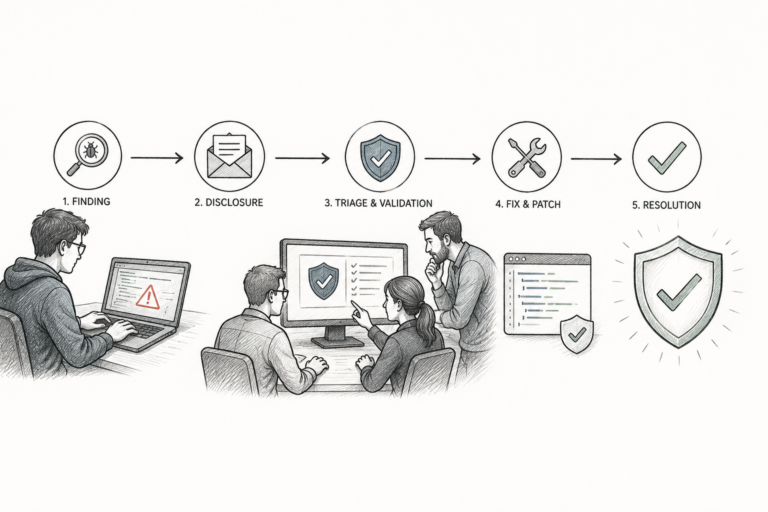
When a security researcher finds a flaw in an AI system, what actually happens next? The vulnerability disclosure process turns AI security findings from dangerous secrets in…

Anthropomorphic AI laws are quietly reshaping how the world thinks about artificial intelligence — and most people in the West haven’t noticed yet. Specifically, China’s late…

Microsoft Frontier Company AI infrastructure investment strategy is, without exaggeration, the most aggressive capital deployment in tech history. With a reported $100 billio…