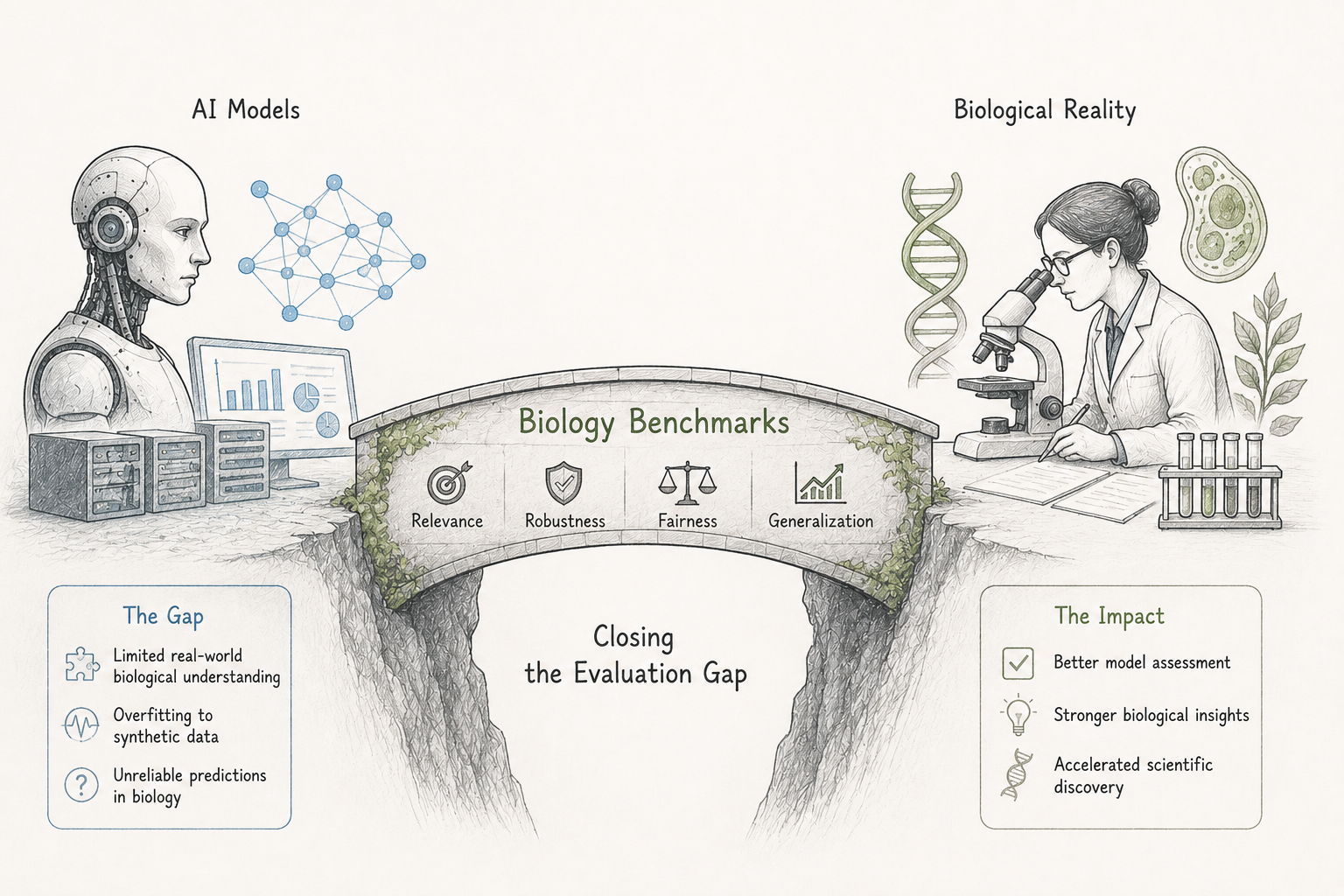
The gap between what AI promises and what it actually delivers in biology isn’t shrinking — it’s growing. Benchmark datasets AI model evaluation biology tools exist specifically to close that gap. But most organizations still lean on general-purpose tests that tell you almost nothing useful about real-world performance in life sciences.
Think about it this way: you wouldn’t test a surgeon’s skills with a multiple-choice quiz. So why would you evaluate a biology-focused AI model with generic language benchmarks? Specialized evaluation frameworks like GeneBench-Pro represent a fundamental shift in how we measure AI readiness for regulated scientific work — and honestly, it’s a shift that’s long overdue.
Here’s the thing: this matters right now. Billions are flowing into AI infrastructure for drug discovery and genomics. However, without validated benchmarks, nobody can actually prove these investments are working. The result is an evaluation gap that threatens trust, slows adoption, and quietly burns through resources.
How General-Purpose Benchmarks Fail Life Sciences
Most AI models get tested on benchmarks like MMLU, HellaSwag, or HumanEval. These measure general knowledge, reasoning, and coding ability — useful for comparing chatbots, sure, but terrible for evaluating molecular biology performance. I’ve watched teams spend months celebrating MMLU scores before discovering their model couldn’t interpret a basic gene expression dataset.
Here’s why general benchmarks fall short:
- Surface-level biology questions. MMLU includes some biology items, but they’re undergraduate-level recall questions. They don’t test whether a model can interpret gene expression data or predict protein interactions.
- No wet-lab grounding. General benchmarks never ask models to design primers, analyze CRISPR off-target effects, or interpret mass spectrometry results. Consequently, high scores don’t translate to anything useful in an actual lab.
- Missing regulatory context. Biotech operates under FDA and EMA oversight. General benchmarks ignore compliance-relevant reasoning entirely — which is a serious blind spot.
- Static evaluation. Biology knowledge evolves rapidly, but general benchmarks update slowly. Therefore, they can’t capture whether a model understands recent discoveries or is just repeating older training data.
Notably, a model scoring 90% on MMLU biology might completely fail at interpreting a differential gene expression dataset. Consider a concrete example: a team evaluating an LLM for RNA-seq analysis found the model aced every MMLU biology item thrown at it, then produced biologically nonsensical fold-change interpretations when handed a real DESeq2 output file. The link between general benchmark scores and domain-specific performance is weak at best — and that disconnect is precisely why benchmark datasets AI model evaluation biology frameworks need dedicated, serious attention.
Furthermore, general benchmarks treat biology as one big subject. In reality, computational biology, structural biology, genomics, and pharmacology each demand distinct capabilities. A model that’s excellent at sequence alignment might struggle badly with metabolic pathway analysis. A tool that confidently annotates protein domains may produce garbage output when asked to interpret a dose-response curve from a high-throughput screen. One-size-fits-all testing misses these critical differences, and you won’t know until something breaks in production.
A practical tip here: before committing to any AI platform for biology work, ask the vendor to run their model on at least two tasks from genuinely different subdisciplines — say, variant annotation and metabolic pathway reconstruction. The performance gap between those two tasks tells you far more than any single aggregate score.
GeneBench-Pro and Domain-Specific Biology Benchmarks
GeneBench-Pro represents a new generation of benchmark datasets AI model evaluation biology tools — built by scientists, for scientists. It tests AI models on tasks that mirror actual research workflows. Rather than asking “What is DNA?” it asks models to predict gene regulatory networks from ChIP-seq data. That’s a meaningful difference.
What makes GeneBench-Pro different:
1. Task-based evaluation. Models face real experimental scenarios, not trivia questions. Each task maps to a genuine research activity.
2. Multi-modal testing. The benchmark includes sequence data, tabular datasets, imaging inputs, and natural language queries. This reflects how biologists actually work — not how benchmark designers imagine they work.
3. Difficulty stratification. Tasks range from basic annotation to complex multi-step reasoning, which shows exactly where models break down. This surprised me when I first dug into the framework — the granularity of failure analysis is genuinely useful.
4. Reproducibility standards. Every evaluation follows documented protocols. Results can be independently verified, which matters enormously in regulated environments.
To make difficulty stratification concrete: a Tier 1 task might ask a model to identify the canonical start codon in a short provided sequence — straightforward recall. A Tier 3 task asks the model to integrate ChIP-seq peak data, RNA-seq expression values, and known transcription factor binding motifs to propose a plausible regulatory mechanism for a differentially expressed gene. The gap in model performance between those two tiers is often dramatic, and it’s exactly the kind of signal that helps teams decide whether a model is ready for research use or still needs fine-tuning.
Meanwhile, GeneBench-Pro isn’t alone in this space. Several other specialized benchmarks have emerged recently. BioASQ tests biomedical question answering and information retrieval. BLURB evaluates models on biomedical language understanding tasks, and MoleculeNet focuses on molecular property prediction.
Additionally, the NCBI provides reference datasets that many benchmarks use as ground truth. These curated databases keep evaluation standards scientifically rigorous. Without trusted reference data, even a beautifully designed benchmark loses credibility fast.
The following table compares key biology-focused benchmark datasets AI model evaluation biology frameworks:
Table: scroll sideways to view all columns when needed.
| Benchmark | Focus Area | Task Types | Data Modalities | Regulatory Relevance |
|---|---|---|---|---|
| GeneBench-Pro | Genomics & gene regulation | Prediction, annotation, pathway analysis | Sequence, tabular, text | High |
| BioASQ | Biomedical QA | Question answering, summarization | Text | Medium |
| BLURB | Biomedical NLP | NER, relation extraction, classification | Text | Medium |
| MoleculeNet | Molecular properties | Property prediction, toxicity screening | Molecular graphs, SMILES | High |
| MMLU (Biology) | General biology knowledge | Multiple choice recall | Text only | Low |
| ProteinGym | Protein fitness | Variant effect prediction | Sequence, structure | Medium |
One tradeoff worth acknowledging: more comprehensive benchmarks like GeneBench-Pro require substantially more setup time than running a model through MMLU. Configuring the multi-modal evaluation pipeline, sourcing the appropriate reference datasets, and establishing a reproducible compute environment can take a team a week or more the first time through. That upfront cost is real. The payoff, however, is evaluation data you can actually defend to a regulator or a scientific advisory board — which is worth considerably more than a fast but shallow score.
Specifically, GeneBench-Pro’s real strength lies in testing end-to-end workflows. A model doesn’t just answer a question — it must process raw data, apply the right methods, and produce clear results. That’s what researchers actually face on a Tuesday afternoon. Fair warning, though: the evaluation setup takes real effort to configure properly.
Validated Benchmarks Bridge Compute and Trustworthy Deployment
Raw computing power means nothing without proof it’s producing reliable results.
Microsoft has announced massive infrastructure investments for AI workloads, and Microsoft Azure now offers specialized compute clusters built for scientific AI. Nevertheless, hardware alone doesn’t build trust in regulated environments — and I’ve seen organizations learn that lesson the expensive way.
Benchmark datasets AI model evaluation biology frameworks serve as the essential bridge between infrastructure investment and real-world deployment. Here’s how that bridge actually works:
- Validation evidence. Regulators need documented proof that AI tools perform reliably. Benchmark results provide that evidence directly — not anecdotes, not demos.
- Performance baselines. Organizations need to know if upgrading compute actually improves outcomes. Benchmarks measure this objectively, which makes budget conversations much cleaner.
- Vendor comparison. Benchmarks offer objective comparison criteria when choosing between AI platforms. Without them, you’re just trusting marketing claims.
- Risk quantification. Benchmarks reveal failure modes before deployment, preventing costly errors in clinical or research settings.
A short scenario illustrates the vendor comparison point well. Imagine two AI platforms competing for a genomics contract. Platform A scores higher on general NLP benchmarks. Platform B scores modestly lower on those same tests but outperforms Platform A by fifteen percentage points on variant pathogenicity prediction tasks drawn from ClinVar. Without domain-specific benchmarks in the evaluation process, the procurement team would have selected the wrong tool — and likely discovered the problem only after months of integration work.
Anthropic’s Claude has shown molecular screening capabilities that could genuinely change early-stage drug discovery. However, those capabilities only matter if validated against trusted benchmarks. A model that screens millions of compounds needs to prove its predictions match experimental results — otherwise it’s an expensive coin flip.
Consequently, the relationship between compute, models, and benchmarks forms a triangle. Remove any side, and the whole structure collapses. More compute enables larger models, larger models need harder benchmarks, and better benchmarks justify further compute investment. It’s a reinforcing loop — and benchmarks are the piece most organizations underinvest in.
Moreover, biotech companies operating under Good Laboratory Practice (GLP) and Good Manufacturing Practice (GMP) standards simply can’t deploy unvalidated tools. Benchmark datasets AI model evaluation biology results become part of the validation documentation — they’re not optional extras. They’re regulatory necessities, full stop.
The financial stakes reinforce this point. A single failed drug candidate costs hundreds of millions of dollars. If AI screening tools cut that failure rate by even a few percentage points, the ROI is enormous. Proving that reduction, however, requires rigorous and reproducible benchmarks — not a well-designed slide deck.
Building Effective Benchmark Datasets for Biology AI
Creating useful benchmark datasets AI model evaluation biology tools isn’t simple. Bad benchmarks are worse than no benchmarks — they create false confidence and actively mislead investment decisions. Therefore, benchmark design requires careful attention to a few core principles.
Data quality and provenance. Every data point needs clear sourcing. Benchmark creators should use peer-reviewed datasets from repositories like UniProt or the Protein Data Bank. Synthetic data should be clearly labeled and used sparingly — I’ve seen benchmarks quietly inflate scores by leaning too heavily on synthetic examples. A useful rule of thumb: if more than twenty percent of your benchmark tasks rely on synthetic data, document exactly how that data was generated and run a separate analysis showing whether model performance on synthetic tasks correlates with performance on experimentally verified ones. If it doesn’t, the synthetic tasks are doing more harm than good.
Contamination prevention. Large language models may have seen benchmark data during training — a problem called data contamination that artificially inflates scores. Effective benchmarks use holdout strategies and temporal splits to reduce this risk. Specifically, data generated after a model’s training cutoff provides much cleaner evaluation signal. One practical approach is to include a small set of tasks built around very recent publications — papers from the last three to six months — where contamination is structurally impossible. Models that perform well on those tasks are demonstrating genuine generalization, not memorization.
Task relevance. Every benchmark task should map to a real research or clinical need. Abstract puzzles don’t help anyone. Instead, tasks should reflect actual workflows:
1. Interpreting variant pathogenicity from genomic data
2. Predicting drug-target binding affinity
3. Identifying biomarkers from transcriptomic profiles
4. Designing experimental controls for CRISPR experiments
5. Summarizing clinical trial results with appropriate caveats
6. Detecting batch effects in high-throughput screening data
Scoring transparency. How answers get scored matters enormously. Binary right/wrong scoring misses critical nuance, because biology often involves probabilistic answers and degrees of correctness. Good benchmarks use graduated scoring rubrics that reward partially correct reasoning — which, notably, also makes them harder to game. For example, a task asking a model to rank five candidate drug compounds by predicted toxicity might award full credit for a perfect ranking, partial credit for getting the top two correct, and zero credit only when the highest-toxicity compound is ranked safest. That granularity surfaces real differences between models that a pass/fail rubric would flatten entirely.
Community governance. The best benchmarks grow through community input. MLCommons provides a solid model for collaborative benchmark development across organizations. Similarly, biology benchmarks benefit from input by diverse researchers across subspecialties — not just the team that built them.
Additionally, benchmark maintenance is ongoing work — not a one-time project. Biology knowledge changes constantly: new gene annotations appear weekly, drug interaction databases update monthly. A benchmark frozen in time quickly becomes obsolete. Therefore, effective benchmark datasets AI model evaluation biology frameworks need versioning and regular update cycles built in from the start.
Avoiding common pitfalls also deserves attention — and these come up more often than you’d think:
- Don’t over-index on English-language biomedical literature. Biology is global.
- Don’t ignore edge cases. Rare diseases and uncommon organisms matter.
- Don’t confuse memorization with reasoning. Good benchmarks test both, separately.
- Don’t forget calibration. Models should know when they don’t know — that’s arguably as important as raw accuracy.
That last point about calibration is underappreciated. A model that confidently produces a wrong drug interaction prediction is far more dangerous than one that flags uncertainty and defers to a human reviewer. Benchmarks that include explicit calibration tasks — asking models to express confidence levels and then measuring whether those confidence levels match actual accuracy rates — provide a much fuller picture of deployment readiness than accuracy metrics alone.
The Business Case for Biology AI Benchmarking
Investing in benchmark datasets AI model evaluation biology tools isn’t just a scientific concern. It’s a business necessity — and the organizations figuring that out now are pulling ahead.
Faster regulatory approval. The FDA’s Digital Health Center of Excellence increasingly evaluates AI-enabled tools. Complete benchmark results simplify the approval process by showing due diligence and systematic validation. I’ve talked to regulatory teams who say this documentation alone cuts months off review timelines.
Reduced development costs. Teams waste months building on models that seem capable but quietly fail on domain-specific tasks. Upfront benchmarking cuts that waste. Importantly, it redirects engineering effort toward models that actually perform where it counts. One mid-sized genomics company ran a domain-specific benchmark evaluation before committing to a fine-tuning project and discovered their chosen base model performed poorly on the specific variant interpretation tasks central to their product. Switching base models before fine-tuning began saved an estimated four months of engineering time and avoided a significant sunk-cost trap.
Investor confidence. Biotech investors increasingly ask about AI validation methods. “We tested it on MMLU” doesn’t cut it anymore — and honestly, it probably shouldn’t have cut it two years ago either. Detailed benchmark results from domain-specific evaluations build credible, defensible narratives.
Partnership opportunities. Pharmaceutical companies partnering with AI firms want standardized evidence that travels cleanly across organizations. Conversely, companies without benchmark data struggle to close partnership deals — no matter how impressive the demo looks.
Talent attraction. Top computational biologists want to work with rigorous tools. Although this benefit is indirect, organizations that invest in proper evaluation attract better talent — and that advantage compounds significantly over time.
The market reflects this shift. Startups focused on AI evaluation in biology have raised significant funding recently, and enterprise platforms now include benchmarking modules alongside their core AI features. The ecosystem has recognized that evaluation infrastructure is just as important as model development — sometimes more so.
Furthermore, the cost of skipping benchmarking is rising. As AI tools become more common in drug development pipelines, regulatory scrutiny intensifies. A single deployment failure traced to poor evaluation could trigger industry-wide consequences. Smart organizations treat benchmark datasets AI model evaluation biology investment as risk mitigation — not overhead.
Conclusion
The gap between general AI evaluation and biology-specific needs is real, consequential, and not going away on its own. Benchmark datasets AI model evaluation biology frameworks like GeneBench-Pro are closing that gap — turning vague capability claims into measurable, reproducible evidence that actually holds up.
Here’s what you should do next:
1. Audit your current evaluation approach. If you’re relying solely on general benchmarks, you’re essentially flying blind in biology applications.
2. Adopt domain-specific benchmarks. Integrate tools like GeneBench-Pro, BioASQ, or MoleculeNet into your model selection process — not as an afterthought, but from the start.
3. Document everything. Treat benchmark results as regulatory documentation from day one. You’ll thank yourself later.
4. Contribute to benchmark development. Share anonymized evaluation data with community efforts. Better benchmarks help everyone, including your competitors — and that’s fine.
5. Align compute investments with evaluation needs. Don’t scale infrastructure without scaling your ability to measure what that infrastructure actually produces.
Bottom line: the organizations that take benchmark datasets AI model evaluation biology seriously will lead the next wave of AI-driven discovery. Those that don’t will spend more, move slower, and face greater regulatory risk. That’s not a prediction — it’s already happening. The choice is straightforward.
FAQ
What are benchmark datasets for AI model evaluation in biology?
Benchmark datasets AI model evaluation biology tools are standardized test sets designed to measure how well AI models perform on biological tasks. They include curated data, defined tasks, and scoring rubrics. Unlike general benchmarks, they test domain-specific skills like gene annotation, protein structure prediction, and drug interaction analysis.
How does GeneBench-Pro differ from general AI benchmarks?
GeneBench-Pro tests models on realistic biological workflows rather than generic knowledge questions. It includes multi-modal data types like sequences, tabular results, and imaging data. Additionally, it sorts tasks by difficulty level. General benchmarks like MMLU only scratch the surface of biology knowledge with basic recall questions.
Why can’t organizations just use MMLU biology scores to evaluate models?
MMLU biology questions are undergraduate-level multiple choice items that test memorization, not scientific reasoning. A model can score perfectly on MMLU biology yet fail at interpreting real experimental data. Therefore, MMLU scores provide almost no signal about a model’s readiness for actual research or clinical applications.
How do biology benchmarks support regulatory compliance?
Regulated biotech environments require documented validation of computational tools. Benchmark datasets AI model evaluation biology results provide that documentation by showing systematic testing against known standards. The FDA and other agencies increasingly expect this type of evidence for AI-enabled tools used in drug development and diagnostics.
What role does compute infrastructure play in AI benchmarking?
More powerful compute enables larger models and faster evaluation cycles. However, compute alone doesn’t guarantee better outcomes. Benchmarks measure whether additional compute translates into improved performance on meaningful tasks. Consequently, benchmarking helps organizations justify and optimize their infrastructure investments.
How often should biology AI benchmarks be updated?
Biology knowledge evolves rapidly, so benchmark datasets should be versioned and updated at least annually. Ideally, new task sets are added quarterly to reflect emerging research areas. Importantly, older versions should remain available for longitudinal comparison. Stale benchmarks risk testing models against outdated scientific understanding.
Keep reading
Here are the latest posts from the blog.
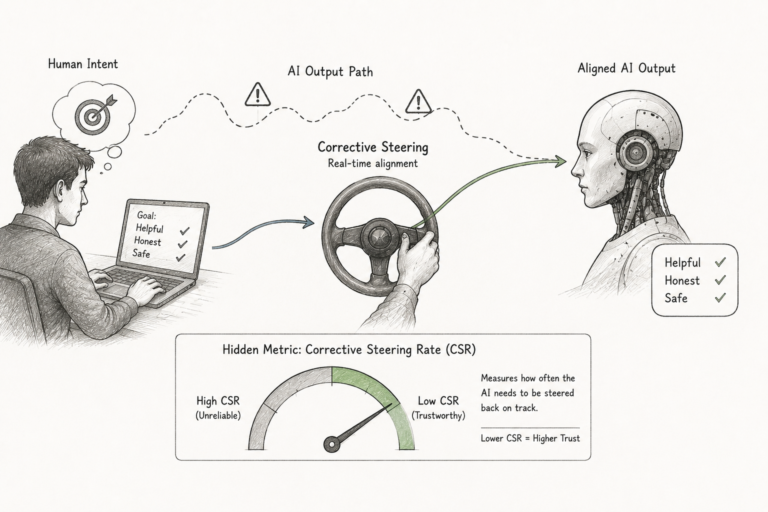
When you hand an AI agent the keys to a critical workflow, you’re trusting it won’t drive off a cliff. Corrective steering AI hidden metric tells how much that trust is actua…

The conversation around game engine AI coding tools Meta Pocket vibe-coding is heating up fast — and honestly, it deserves more attention than it’s getting. Meta quietly intr…
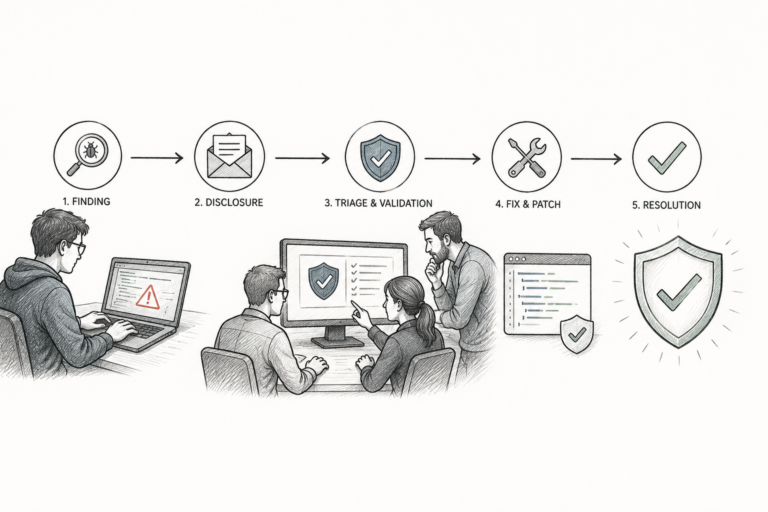
When a security researcher finds a flaw in an AI system, what actually happens next? The vulnerability disclosure process turns AI security findings from dangerous secrets in…