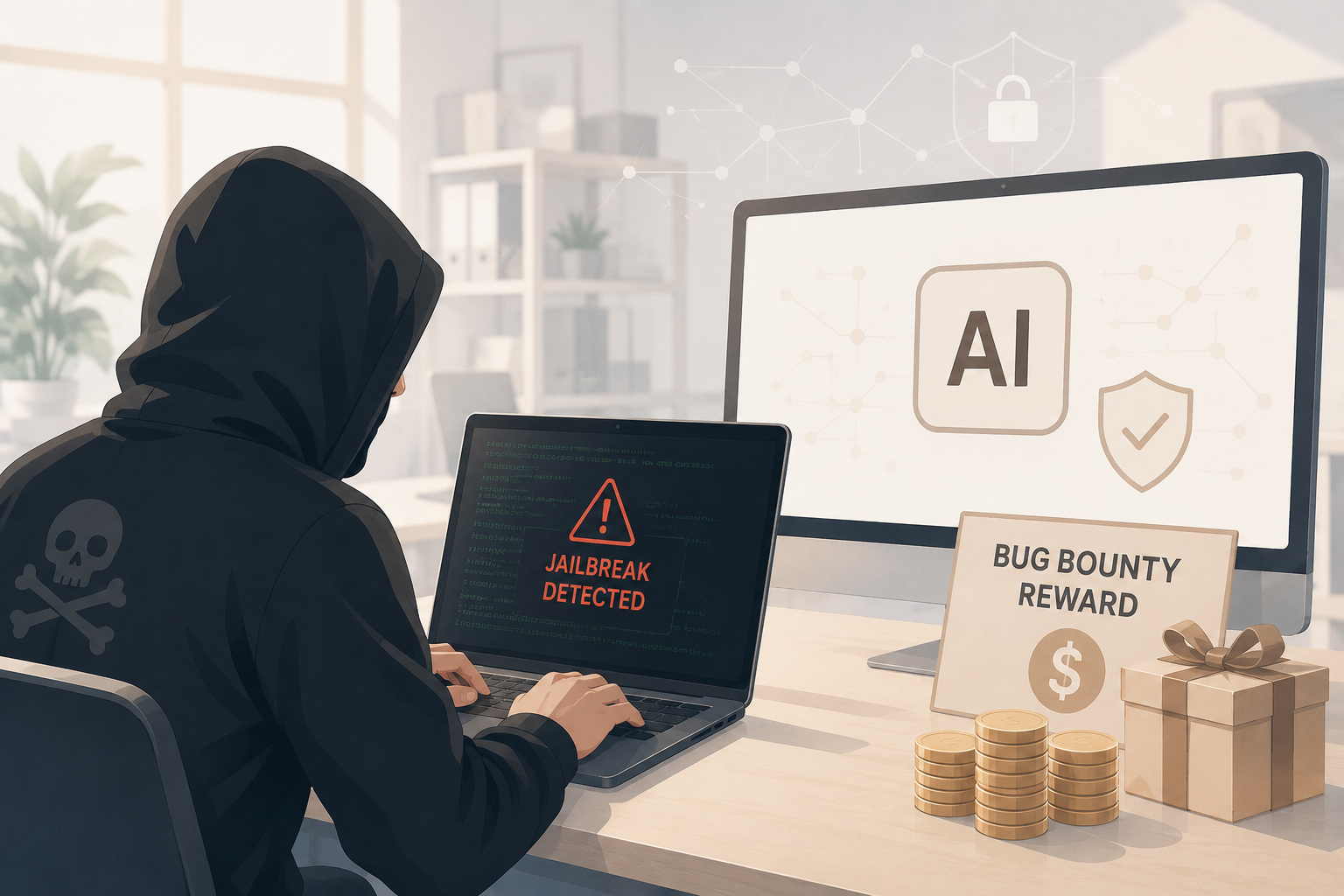
Anthropic’s jailbreak bug bounty now pays hackers to break Claude. Anthropic just expanded its partnership with HackerOne. Now it pays outside security researchers to find jailbreaks in Claude. That’s a genuine shift in how the AI industry treats safety, and it’s not a subtle one.
This isn’t a PR stunt, either. It’s an admission that internal red-teaming alone can’t keep pace with adversarial creativity. That took real guts to say out loud.
Why does this matter so much? Because jailbreaks aren’t theoretical anymore. Researchers routinely bypass safety guardrails using prompt injection, role-play exploits, and multi-turn manipulation. These techniques are well-documented and openly shared in the security community. So paying outsiders to surface these weaknesses mirrors a model cybersecurity proved out decades ago.
But it also raises a bigger question: can a jailbreak bug bounty actually help build standardized benchmarks for AI robustness? That’s what this piece digs into.
Why Internal Red-Teaming Isn’t Enough for an AI Jailbreak Bug Bounty
How a Jailbreak Bug Bounty Program Creates Data for Safety Benchmarks
What “Safety” Actually Means When You’re Chasing Jailbreaks
How Anthropic’s Jailbreak Bug Bounty Compares to Other AI Safety Programs
From Bug Reports to Industry Standards: The Road Ahead for Jailbreak Bug Bounty
Conclusion: Where This Leaves AI Safety Research
Frequently Asked Questions About Jailbreak Bug Bounty Programs
Why Internal Red-Teaming Isn’t Enough for an AI Jailbreak Bug Bounty
Internal red teams are valuable. But they share a fundamental limitation: groupthink. People inside a company share context, assumptions, and blind spots that are nearly invisible from the inside. External researchers don’t carry that baggage, and that’s exactly the point.
The groupthink problem
This plays out constantly in traditional cybersecurity. The most embarrassing vulnerabilities almost never get caught internally. They get caught by some researcher who came at the problem from a completely different angle. Anthropic’s jailbreak bug bounty through HackerOne targets this gap directly. Specifically, it targets what Anthropic calls “universal jailbreaks” — techniques that reliably bypass safety filters across many different prompts. These are far more dangerous than a one-off trick, and they’re also far harder for an internal team to stumble across on a consistent basis.
What makes universal jailbreaks different
A jailbreak bug bounty has real structural advantages over internal-only testing. Thousands of researchers think differently than a fifty-person red team, full stop. Bug bounties also run continuously, not during a scheduled quarterly sprint. Payouts attract skilled adversarial researchers who might otherwise sell exploits elsewhere. And because HackerOne requires structured reports, the program creates reusable, organized safety data almost as a side effect.
The cybersecurity industry proved this model decades ago. Microsoft, Google, and Apple all run bug bounty programs, and together they’ve paid hundreds of millions to outside researchers. AI safety is simply catching up.
There’s a real difference worth flagging, though. Traditional bug bounties find code problems: buffer overflows, authentication bypasses, memory leaks. A jailbreak bug bounty targets behavioral problems instead. The “bug” isn’t broken code — it’s a model doing something it fundamentally shouldn’t do. That distinction matters enormously for benchmarking, because you can’t measure behavioral safety the same way you measure code security. This is precisely where the industry is still finding its footing.
How a Jailbreak Bug Bounty Program Creates Data for Safety Benchmarks
Here’s the thing: every jailbreak report submitted through a program like Anthropic’s is a data point. Collectively, those reports could form the foundation of standardized adversarial benchmarks. That’s the angle most coverage misses entirely.
What a jailbreak benchmark could look like
Right now, AI safety benchmarks are fragmented enough to make a security engineer wince. Researchers use different attack taxonomies, different success criteria, and different evaluation methods. OWASP published a Top 10 list for LLM vulnerabilities, but it’s a classification framework, not a measurement tool. A real jailbreak-derived benchmark would need several pieces:
- attack categories like prompt injection, context manipulation, encoding tricks, and persona hijacking;
- severity scoring similar to CVSS scores in cybersecurity, rating harm rather than just cleverness;
- reproducibility metrics showing how consistently a jailbreak works across model versions;
- patch resistance showing whether a fix closes the hole for good;
- and cross-model transferability showing whether the same trick works on GPT-4, Claude, and Gemini alike.
Why bug bounty data beats academic testing
Bug bounty programs generate this data almost automatically. Researchers have to show reproducibility to earn a payout, so they describe their method and show the harmful output. That structured reporting is exactly what benchmark designers need, and it’s data no academic lab will produce at this scale on its own. NIST has also been building AI risk management frameworks that need exactly this kind of real-world grounding, and bug bounty data could feed directly into those evaluation criteria. This isn’t just about patching Claude. It’s about building measurement infrastructure for the whole industry.
Academic red-teaming brings rigorous methodology but limited attack diversity, since it comes from university research labs. Internal red teams bring deep model knowledge but suffer from groupthink and a narrow scope. Automated adversarial testing tools like Garak or ART scale well but miss creative human attacks. Crowdsourced testing reaches massive scale but produces noisy, unstructured data. A jailbreak bug bounty sits in a genuine sweet spot: it combines human creativity with structured reporting, and no other approach on that list matches that combination.
| Benchmark Approach | Data Source | Strengths | Weaknesses |
|---|---|---|---|
| Academic red-teaming | University research labs | Rigorous methodology | Limited attack diversity |
| Internal red teams | Company employees | Deep model knowledge | Groupthink, narrow scope |
| Bug bounty programs | External researchers | Diverse, continuous, incentivized | Inconsistent severity standards |
| Automated adversarial testing | Tools like Garak, ART | Scalable, repeatable | Misses creative human attacks |
| Crowdsourced testing | Public users | Massive scale | Noisy, unstructured data |
What “Safety” Actually Means When You’re Chasing Jailbreaks
When companies say their AI is “safe,” what do they actually mean? There’s no universal answer, and a jailbreak bug bounty forces a more concrete definition than the industry has been comfortable with so far.
Three things robustness actually measures
Safety in this context usually comes down to three things. First, refusal accuracy: the model correctly refuses harmful requests. That sounds simple, but it isn’t — a model that refuses too aggressively becomes useless, while one that’s too permissive becomes dangerous, and plenty of models miss that narrow target in both directions. Second, robustness under adversarial pressure: can the model hold its safety behavior when users deliberately try to break it? This is what jailbreaks actually test, and it also measures how much effort an attack requires, because a jailbreak that takes 200 carefully crafted prompts is a very different problem than one that works on the first try. Third, consistency across contexts: a model might refuse a direct harmful request but comply once the same request is wrapped in a fictional scenario, or it might handle English-language attacks well while failing completely against encoded or translated prompts. This kind of inconsistency is more common than most benchmarks suggest.
Why static benchmarks keep falling behind
Measuring all this needs standardized test suites that don’t really exist yet at the scale required. The MLCommons AI Safety Working Group has started building exactly this, testing models against hazard categories like violent crimes, hate speech, and self-harm instructions. It’s a solid start, but it isn’t enough on its own, because academic benchmarks use static test sets while attackers don’t stay static. They adapt, share techniques, and move fast. A jailbreak bug bounty gives the industry something static benchmarks structurally can’t: a continuously updated threat picture, since every new technique submitted becomes a potential test case.
That sets up a feedback loop worth understanding.
- Researchers find jailbreaks through bug bounties.
- Companies patch the vulnerabilities.
- Benchmark designers add the attack patterns to test suites.
- Future models get tested against those patterns before release.
- Then researchers find new jailbreaks that bypass the patches, and the cycle starts again. It mirrors how antivirus signature databases evolved over thirty years.
It’s messy and iterative, but it actually works.
How Anthropic’s Jailbreak Bug Bounty Compares to Other AI Safety Programs
Anthropic isn’t operating alone here. Several companies are tackling AI safety through very different mechanisms, so the comparison is worth doing carefully.
What OpenAI, Google, and Meta do instead
OpenAI runs a bug bounty program through Bugcrowd, but it focuses mainly on traditional security issues like API key leaks, data exposure, and infrastructure bugs. Jailbreaks are explicitly out of scope, and OpenAI handles them instead through internal red-teaming and its Preparedness Framework. That’s a defensible choice, but it reflects a genuinely different philosophy. Google DeepMind folds AI safety issues into its broader Vulnerability Reward Program, though the scope is wide enough that jailbreak research isn’t specifically incentivized the way Anthropic’s program does it. Meta open-sources its Llama models, so the community finds jailbreaks organically, with no formal bounty structure at all. There’s something honest about that approach, even though it means Meta gets no structured reporting back in return.
Anthropic pays up to $15,000 through HackerOne specifically for universal jailbreaks. OpenAI’s Bugcrowd payouts run $200 to $20,000 but stay focused on infrastructure security. Google’s VRP covers jailbreaks only partially, paying $100 to $31,337 across broad AI and security issues. Meta pays $500 to $300,000 through HackerOne but excludes jailbreaks, focused instead on platform security. Microsoft covers jailbreaks partially too, through MSRC, paying $500 to $250,000 across Azure AI and general security work.
Why the payout numbers matter
Anthropic’s program is the only major one that explicitly centers jailbreaks as the primary bounty target. That signals something: Anthropic is treating behavioral safety failures with the same institutional seriousness as code vulnerabilities. What a company puts in scope reflects what it actually cares about. The payout structure tells its own story too. $15,000 for a critical universal jailbreak is modest next to traditional security bounties, but it’s meaningful for a category that barely existed as a formal discipline three years ago.
Some critics think these payouts are still too low, and they have a point. Sophisticated jailbreak techniques take real expertise and real time. A researcher who finds a universal bypass could arguably sell that knowledge for far more on gray markets. So bounty amounts will likely need to climb as the field matures and competition for top researchers heats up.
| Company | Bug Bounty Platform | Jailbreaks in Scope? | Payout Range | Focus Area |
|---|---|---|---|---|
| Anthropic | HackerOne | Yes — primary focus | Up to $15,000 | Universal jailbreaks |
| OpenAI | Bugcrowd | No | $200–$20,000 | Infrastructure security |
| Google VRP | Partially | $100–$31,337 | Broad AI + security | |
| Meta | HackerOne | No | $500–$300,000 | Platform security |
| Microsoft | MSRC | Partially | $500–$250,000 | Azure AI + security |
From Bug Reports to Industry Standards: The Road Ahead for Jailbreak Bug Bounty
A jailbreak bug bounty points toward something bigger than any single company’s safety efforts. It points toward industry-wide standardization, which is a much harder problem than running one good bounty program.
Five things the industry still needs to build
A shared taxonomy needs to exist first. Right now, one researcher’s “prompt injection” is another’s “context manipulation.” OWASP and NIST are working on this, but progress is slow, and structured bug bounty reports could speed that process up considerably. Anonymous data sharing needs to happen too: companies sharing anonymized attack categories and success rates, not exact prompts, so benchmark designers can build complete test suites without exposing specific exploitable holes. That trade-off is real, since companies would be sharing a form of competitive intelligence, but safety is a shared problem.
Severity standardization matters just as much. Cybersecurity has CVSS. AI safety needs an equivalent, because a jailbreak that produces mildly inappropriate content isn’t remotely the same as one that generates dangerous synthesis instructions, and scoring systems need to reflect that precisely rather than roughly. Temporal tracking would help too, following how long a jailbreak survives after discovery — a vulnerability that persists for months despite being reported points to a deeper architectural problem, while a quickly patched one suggests the safety process is actually working.
Cross-model testing rounds out the list. When a jailbreak works on Claude, does it also work on GPT-4 or Gemini? That transferability data would be enormously valuable for building better benchmarks, since safety failures affect everyone regardless of which model happens to be running underneath. The Partnership on AI has been pushing for exactly this kind of cross-industry collaboration, and jailbreak bug bounty data could give those efforts real material to work with.
The biggest risk is fragmentation. If every company builds its own private jailbreak database without sharing patterns, the industry loses the network effects that make vulnerability databases powerful in the first place. The MITRE ATT&CK framework succeeded specifically because it stayed open and collaborative. AI safety benchmarks need that same spirit, because hoarding jailbreak data privately helps no one in the long run, including the companies doing the hoarding.
Conclusion: Where This Leaves AI Safety Research
A jailbreak bug bounty like Anthropic’s represents more than one company’s safety initiative. It signals a real maturing of the field, moving from ad hoc internal testing toward structured, incentivized, externally validated discovery.
A few things are worth taking away.
- Bug bounty programs generate structured adversarial data that academic benchmarks can’t match at this scale.
- Jailbreak reports can feed directly into standardized safety benchmarks, similar to how CVE databases transformed cybersecurity, but only if the industry builds shared infrastructure to actually use them.
- Anthropic’s program is currently unique in targeting behavioral vulnerabilities rather than code bugs specifically, which is a meaningful philosophical choice.
- And the industry still needs shared taxonomies, severity scores, and anonymous data-sharing protocols to turn individual reports into collective safety infrastructure.
If you’re a security researcher, sign up and start testing. Focus on universal jailbreaks — techniques that work reliably across sessions and prompt variations — and document your method thoroughly, since a well-documented report earns more and contributes more to the broader benchmarking effort. If you’re an AI developer, watch how this program evolves over the next twelve months, and consider setting up something similar for your own models; even a small bounty program generates adversarial data you can’t manufacture internally, at a cost far lower than the alternative. And if you’re a policymaker or standards body, push for anonymized data-sharing frameworks before fragmentation gets worse, and advocate for shared severity scoring, because raw bug bounty data is only as useful as the benchmarks eventually built from it.
The era of treating AI safety as a purely internal concern is ending. External accountability and measurable benchmarks are where this is heading, and a jailbreak bug bounty like Anthropic’s is an early, genuinely important step in that direction.
Frequently Asked Questions About Jailbreak Bug Bounty Programs
What exactly is Anthropic’s jailbreak bug bounty program?
Anthropic partnered with HackerOne to pay outside security researchers for finding jailbreaks in Claude. The program specifically targets “universal jailbreaks” that reliably bypass safety guardrails across multiple interactions. Researchers submit structured reports, and Anthropic evaluates severity and pays out accordingly — a novel focus on behavioral rather than code-level vulnerabilities.
How much can researchers earn from reporting jailbreaks?
Anthropic reportedly pays up to $15,000 for critical universal jailbreaks, though exact amounts depend on severity, reproducibility, and impact. Simple one-off tricks earn far less than systematic bypasses that survive model updates. These amounts are modest next to traditional security bounties, but they’re significant for this emerging category, and they’ll likely rise as the program matures.
How does a jailbreak bug bounty differ from a traditional cybersecurity one?
Traditional bug bounties target code problems like SQL injection or buffer overflows. A jailbreak bug bounty targets behavioral problems instead — a model producing harmful output despite its safety training. Reproducibility is harder to define here because language models are probabilistic, not deterministic, and severity scoring has to account for harm categories rather than just technical impact.
Can bug bounty data actually improve AI safety benchmarks?
Yes, and this may be the most underappreciated benefit of the whole approach. Every report contains an attack category, a method, a success rate, and a harm assessment. Together, those reports form a continuously updated dataset that no academic lab can replicate at scale, and benchmark designers can use anonymized patterns to test models against real-world attack vectors instead of theoretical ones.
Why doesn’t OpenAI include jailbreaks in its bug bounty program?
OpenAI’s Bugcrowd program excludes jailbreaks and model output issues, handling those instead through internal red-teaming and its Preparedness Framework. Scope management is a likely reason, since jailbreak reports could otherwise overwhelm a bounty program with low-quality, hard-to-evaluate submissions. Anthropic’s decision to include them directly challenges that separation, and it may push competitors to reconsider their own approach.
What types of jailbreaks are most valuable to report?
Keep reading
Here are the latest posts from the blog.

The NVIDIA Halos safety stack might be the most important thing NVIDIA has announced for robotics, and it got about a tenth of the attention it deserved. Every humanoid robot…

Open-weight agent orchestration has officially arrived, and honestly, it’s been a long time coming. NVIDIA’s Nemotron 3 Ultra represents a real shift in how developers build…

You’ve probably noticed your data center electricity costs climbing. Here’s what most finance teams miss: AI demand charges aren’t actually about how much power you use. They…