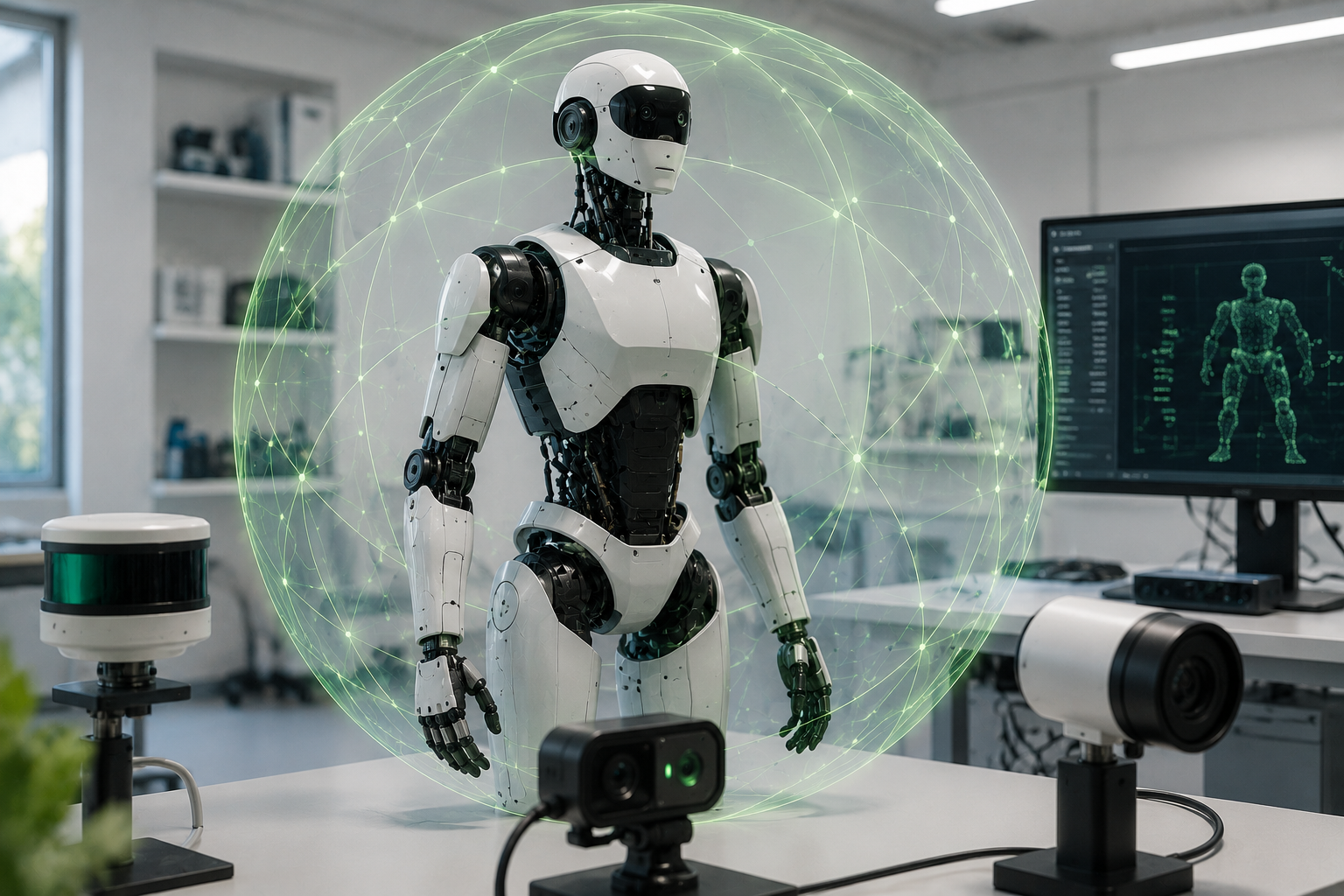
The NVIDIA Halos safety stack might be the most important thing NVIDIA has announced for robotics, and it got about a tenth of the attention it deserved. Every humanoid robot that actually ships into a real environment is going to need this kind of validated safety layer — not as a nice-to-have, but because without it, no manufacturer can responsibly put a walking, grasping machine next to actual human beings and sleep at night.
NVIDIA introduced Halos as a complete safety framework designed to certify, validate, and monitor robotic systems across their entire lifecycle. Think of it as the seatbelt-plus-airbag-plus-crash-testing equivalent for robots that share your workspace, your hospital, or your home.
Timing matters here too. Companies like Figure, Agility Robotics, and Apptronik are sprinting to deploy humanoids in warehouses and beyond. Speed without safety isn’t a feature, it’s a liability waiting to detonate, and the NVIDIA Halos safety stack is NVIDIA’s attempt to solve that problem before it becomes a crisis rather than after.
Why the NVIDIA Halos Safety Stack Is a Humanoid Need, Not a Luxury
Architecture Breakdown: How the NVIDIA Halos Safety Stack Works
How the NVIDIA Halos Safety Stack Bridges Lab Benchmarks and Real Deployment
Liability and Why Competitors Lack an Equivalent NVIDIA Halos Safety Stack
What Regulators Are Watching For
Conclusion: Where This Leaves Humanoid Manufacturers
Frequently Asked Questions About the NVIDIA Halos Safety Stack
Why the NVIDIA Halos Safety Stack Is a Humanoid Need, Not a Luxury
Most robotics companies obsess over capability first. Can it walk? Can it grasp? Can it climb stairs? Exciting milestones, sure, but they tend to skip the harder question of what actually happens when something goes wrong.
Safety isn’t a feature you bolt on at the end. I’ve watched enough hardware startups rush to demos to know that’s exactly how teams tend to think about it, and it’s exactly backwards. The NVIDIA Halos safety stack addresses several gaps every humanoid will need solved before anyone signs a deployment contract:
- runtime monitoring that continuously checks motor torques, joint positions, and force limits while the robot is actually operating;
- behavioral guardrails that hard-constrain the robot from exceeding safe speed, force, or proximity thresholds near people;
- failure mode detection that catches sensor degradation, actuator faults, or software anomalies before they become incidents;
- and compliance mapping that aligns robot behavior with existing standards like ISO 10218 and ISO/TS 15066.
Traditional industrial robots hide behind cages. Humanoids don’t get that luxury — they’ll hand tools to workers, move through crowded hallways, and operate within arm’s reach of people all day, which means the safety requirements are orders of magnitude more complex. That’s not hyperbole, it’s just physics and probability.
The automotive industry figured this out decades ago. Cars don’t ship without crash testing, ABS validation, and regulatory sign-off, and humanoid robots shouldn’t ship without an equivalent process. That’s precisely the gap the NVIDIA Halos safety stack is built to fill. The liability exposure here is genuinely industry-defining — a single serious injury caused by an uncertified humanoid robot could trigger regulatory crackdowns that set the whole sector back years, and insurance companies are already watching closely, wanting validated safety frameworks before underwriting anything at real scale.
Architecture Breakdown: How the NVIDIA Halos Safety Stack Works
Understanding the NVIDIA Halos safety stack means looking at its layered architecture, which operates across three distinct tiers that every humanoid manufacturer will eventually need working together.
- The first layer is simulation and validation. Before a robot moves in the real world, Halos uses NVIDIA Isaac Sim to run millions of safety scenarios — not a handful of curated demos, but genuine edge cases like a child running toward the robot, a wet floor mid-task, or a sensor failure at the worst possible moment. This layer generates safety performance metrics that map directly to certification requirements rather than just internal benchmarks.
- The second layer is the runtime safety monitor, which runs on dedicated compute hardware separate from the robot’s main AI processing. That separation is critical and honestly underappreciated: if the primary AI system crashes or produces unexpected outputs, the safety monitor keeps running independently, able to trigger emergency stops, dial back joint velocities, or shift the robot into a safe default posture. This monitor runs deterministic code — no neural networks, no probabilistic outputs, just hard, verifiable safety logic you can formally inspect.
- The third layer is fleet-level analytics. Once robots deploy at scale, the NVIDIA Halos safety stack aggregates safety telemetry across the entire fleet, identifying patterns no individual robot could catch on its own. If three robots in different facilities experience similar near-miss events within a week, the system flags a potential systemic issue, which feeds back into the simulation layer as a continuous improvement loop that actually works. A fourth piece, the compliance engine, runs across all three layers, mapping everything back to standards like ISO 10218 and ISO/TS 15066 with a full audit trail.
- The runtime safety monitor specifically uses “safety envelopes” — mathematically defined boundaries for every joint, actuator, and movement the robot can perform. The system doesn’t wait for a violation and then react; it acts before any parameter reaches the boundary, which is a meaningful distinction. This architecture also tackles a genuinely hard problem: modern humanoid robots use large neural networks for decision-making that are powerful but inherently unpredictable, and you can’t formally verify a billion-parameter model. The NVIDIA Halos safety stack wraps those unpredictable AI systems inside a predictable, verifiable safety cage — exactly how aerospace and automotive safety engineering has worked for decades, just newly applied to robots.
| Architecture Layer | Function | Runs On | Key Characteristic |
|---|---|---|---|
| Simulation & validation | Pre-deployment safety testing | NVIDIA Isaac Sim (cloud/local) | Millions of edge-case scenarios |
| Runtime safety monitor | Real-time operational guardrails | Dedicated safety compute (on-robot) | Deterministic, independent of main AI |
| Fleet analytics | Post-deployment pattern detection | Cloud infrastructure | Cross-fleet anomaly identification |
| Compliance engine | Standards mapping and audit trails | Integrated across all layers | ISO 10218, ISO/TS 15066 alignment |
How the NVIDIA Halos Safety Stack Bridges Lab Benchmarks and Real Deployment
There’s a massive gap between crushing benchmarks in a lab and operating safely in the wild. I’ve tested dozens of robotic systems over the years, and this gap is where most of them quietly fall apart. The NVIDIA Halos safety stack specifically addresses this — something every humanoid will need before anyone hands over a purchase order.
Capability benchmarks answer “can the robot do the thing?” but they don’t answer equally important questions:
- Can the robot do the task safely when conditions change unexpectedly?
- What happens when sensor data gets noisy or unreliable mid-operation?
- How does it behave when it hits a scenario outside its training distribution?
- Can it fail without causing harm on the way down?
Halos introduces what NVIDIA calls “safety-aware evaluation,” pairing every capability benchmark with a corresponding safety benchmark. A robot that picks up a box quickly but applies 40% more force than specified fails the safety evaluation outright. Speed without control isn’t a feature — it’s a hazard wearing a capability label.
The NVIDIA Halos safety stack also connects directly into NVIDIA’s broader robotics ecosystem. NVIDIA’s GR00T foundation model provides the AI backbone for humanoid behavior, and Halos acts as the safety wrapper around GR00T’s outputs — every action the foundation model proposes passes through Halos validation before the robot actually executes it. This mirrors what happened with large language models and content safety filters: models generate outputs, safety layers review and constrain them. Here, GR00T generates robot actions and the Halos safety stack reviews and constrains those actions before they reach the real world. The parallel is deliberate, and it’s a smart framing.
Physical safety is categorically harder than content safety, though. A bad chatbot response might irritate someone; a bad robot action could break someone’s arm. The stakes demand a fundamentally more rigorous approach, which is why Halos borrows formal verification methods from aerospace and automotive engineering, specifically IEC 61508 for functional safety — a serious engineering standard, not marketing language.
Liability and Why Competitors Lack an Equivalent NVIDIA Halos Safety Stack
The legal picture for humanoid robots is still forming, but the NVIDIA Halos safety stack positions manufacturers to address the liability questions every humanoid will need to answer clearly before any serious enterprise customer signs off.
Product liability law is fairly unambiguous: manufacturers are responsible for foreseeable harm caused by their products. A humanoid robot operating in a warehouse without a certified safety stack is a lawsuit looking for a location. Insurance underwriters, corporate legal teams, and regulators all want documented evidence of safety validation, not a pitch deck and a demo video. The NVIDIA Halos safety stack provides exactly that documentation —
- auditable safety test results from simulation,
- runtime safety logs with timestamped intervention records,
- compliance reports mapped to international standards,
- and fleet-wide safety performance dashboards.
No other robotics platform currently offers an equivalent integrated safety stack, and the gaps are significant.
- Boston Dynamics has excellent hardware safety features, but its approach is proprietary and robot-specific, which doesn’t generalize across different humanoid platforms as the ecosystem expands.
- Tesla’s Optimus program has mentioned safety in presentations, but Tesla hasn’t published a complete safety framework comparable to the NVIDIA Halos safety stack, and its approach appears tightly coupled to its own hardware rather than useful to the broader industry.
- Open-source frameworks like ROS 2 include some safety features too, but they lack the integrated simulation-to-deployment pipeline Halos provides — ROS 2’s safety lifecycle nodes are genuinely useful, just not enough for humanoid certification at scale. Agility Robotics has internal safety protocols in development, but nothing public and complete enough to compare directly.
Companies building humanoids on NVIDIA’s platform inherit a safety stack already designed for certification, while competitors have to build equivalent systems from scratch — expensive, slow, and risky in a market where timing matters enormously. NVIDIA’s position as a platform provider also creates compounding network effects: more manufacturers adopting the NVIDIA Halos safety stack means richer fleet analytics, which means better safety models, fewer incidents, lower insurance costs, and faster regulatory approval. That flywheel is hard to replicate once it starts spinning.
| Company/Platform | Safety Framework | Simulation Integration | Certification Support | Fleet Analytics |
|---|---|---|---|---|
| NVIDIA Halos | Complete, multi-layer | Deep (Isaac Sim) | ISO mapping included | Yes |
| Boston Dynamics | Proprietary, hardware-specific | Limited public detail | Robot-specific | Limited |
| Tesla Optimus | Not publicly documented | Internal tools | Unknown | Unknown |
| ROS 2 (open source) | Basic lifecycle nodes | Gazebo (separate) | Community-driven | No |
| Agility Robotics | Internal safety protocols | Partial | In development | Limited |
What Regulators Are Watching For
Regulatory frameworks for humanoid robots don’t fully exist yet, but they’re coming faster than most people in the industry expect, and the NVIDIA Halos safety stack anticipates much of what regulators will demand.
NIST has been actively developing performance metrics for robotic systems covering manipulation, mobility, and human-robot interaction, and its measurement frameworks will almost certainly shape future regulation. Halos is designed to generate exactly the kind of data those frameworks call for. In Europe, the EU AI Act already classifies certain robotic systems as high-risk, and while the act focuses primarily on AI software, its requirements for risk management, transparency, and human oversight apply directly to humanoid robots operating near people — requirements the Halos safety stack addresses in ways that are documentable and auditable, not just claimed.
A few regulatory trends are worth watching closely.
- Mandatory safety certification, similar to CE marking for industrial equipment, will likely be required before humanoid deployment becomes legal in major markets.
- Continuous monitoring requirements are coming too, since regulators won’t accept one-time testing and will want ongoing evidence of real-world safety performance.
- Incident reporting obligations will require manufacturers to report safety incidents and show corrective actions with documented timelines.
- And explainability mandates will require that when a robot takes an action, operators can understand why, rather than accepting “the AI decided” as an answer.
Halos addresses all four trends directly: its simulation layer supports initial certification, its runtime monitor enables continuous monitoring, its fleet analytics supports incident reporting, and its safety envelope approach provides explainability, since every intervention traces back to a specific, documented boundary condition. The European Machinery Regulation is also being updated to explicitly address autonomous mobile machines, and humanoid robots fall squarely in scope. First movers in safety certification stand to gain a lasting trust advantage, similar to how “Intel Inside” became a quality signal for PCs — “safety validated by Halos” could become the equivalent trust marker for humanoid deployments.
Conclusion: Where This Leaves Humanoid Manufacturers
The NVIDIA Halos safety stack isn’t optional. It’s the foundation every humanoid will need before it ships anywhere that matters — a warehouse, a hospital, a home. Without complete safety validation, humanoid robots stay expensive lab demos: impressive to watch, impossible to deploy responsibly.
Halos solves three problems at once: pre-deployment validation through simulation, runtime safety monitoring through independent hardware, and fleet-wide safety intelligence through cloud analytics. No other platform currently matches this integrated approach, and building it independently would take years and tens of millions of dollars.
For robotics companies evaluating their path to market, a few steps matter most.
- Integrate early rather than treating safety as a final checkbox — building on the NVIDIA Halos safety stack from day one is far cheaper than retrofitting later.
- Map your compliance requirements clearly, since Halos helps but you still need to understand your own obligations across target markets first.
- Invest heavily in simulation coverage, aiming for millions of scenarios rather than thousands, since that’s where the real surprises get caught before deployment rather than after.
- And plan for fleet analytics from the start, even at ten robots, building your telemetry pipeline for the scale you’re actually aiming for.
The humanoid robotics race isn’t only about who builds the most capable robot. It’s about who builds the safest one and proves it, and the NVIDIA Halos safety stack is NVIDIA’s bet that safety and capability aren’t competing priorities — they’re inseparable.
Frequently Asked Questions About the NVIDIA Halos Safety Stack
What exactly is the NVIDIA Halos safety stack?
It’s a multi-layered safety framework for robotic systems, particularly humanoid robots, combining pre-deployment simulation testing, real-time safety monitoring during operation, and fleet-wide analytics after deployment. It helps manufacturers validate that their robots meet safety standards before shipping, and it runs independently from the robot’s main AI systems, ensuring safety holds even if the primary software fails or produces unexpected outputs.
Why does every humanoid robot need a safety stack like this before shipping?
Humanoid robots operate alongside people in unpredictable environments, and unlike industrial robots behind safety cages, they have to handle unexpected situations safely every single time. A complete safety stack prevents injuries, reduces liability exposure, and satisfies emerging regulatory requirements, while insurance companies and enterprise customers increasingly demand documented safety validation before agreeing to deployments. Without something like the NVIDIA Halos safety stack, manufacturers face legal and commercial barriers that don’t go away on their own.
How does this differ from existing robot safety features in ROS 2?
ROS 2 includes basic safety lifecycle nodes and some fault-handling capabilities, which are useful but not enough on their own. It lacks the integrated simulation-to-deployment pipeline the NVIDIA Halos safety stack provides, along with built-in compliance mapping to ISO standards, fleet-level safety analytics, and independent runtime monitoring on dedicated hardware. Halos is purpose-built for certification-grade validation, while ROS 2’s safety features are more general-purpose and community-maintained — a good starting point, not a finish line.
Can robotics companies use Halos without using other NVIDIA products?
Currently, the NVIDIA Halos safety stack is tightly integrated with NVIDIA’s robotics ecosystem, including Isaac Sim for simulation and Jetson/Thor for compute hardware. The safety principles themselves are platform-agnostic, but the implementation relies on NVIDIA’s specific tools and hardware. Companies not on NVIDIA’s platform would need to build equivalent safety systems independently, which is technically possible but significantly more expensive and time-consuming.
What safety standards does the NVIDIA Halos safety stack help address?
It maps to several international standards, including ISO 10218 for industrial robot safety, ISO/TS 15066 for collaborative robot operation, and IEC 61508 for functional safety of electronic systems, while also aligning with emerging requirements under the EU AI Act and European Machinery Regulation. The framework generates compliance documentation manufacturers can present directly to certification bodies and regulators — the kind of paper trail that actually moves approvals forward.
When will Halos-certified humanoid robots actually reach consumers?
Commercial humanoid deployments are expected to begin in controlled industrial settings between 2025 and 2027, with consumer-facing deployments realistically landing in 2028 or beyond depending on how fast regulatory frameworks solidify. The NVIDIA Halos safety stack is already being integrated into development pipelines by leading humanoid manufacturers, and early enterprise deployments in warehouses and manufacturing facilities will serve as the proving grounds worth watching closely.
Keep reading
Here are the latest posts from the blog.
Open-weight agent orchestration has officially arrived, and honestly, it’s been a long time coming. NVIDIA’s Nemotron 3 Ultra represents a real shift in how developers build…

You’ve probably noticed your data center electricity costs climbing. Here’s what most finance teams miss: AI demand charges aren’t actually about how much power you use. They…
I know how this sounds. Qwen Max vs Claude Gemini GPT, framed as a real contest, reads like clickbait until you look at the numbers. It isn’t. Alibaba’s latest flagship, Qwen…