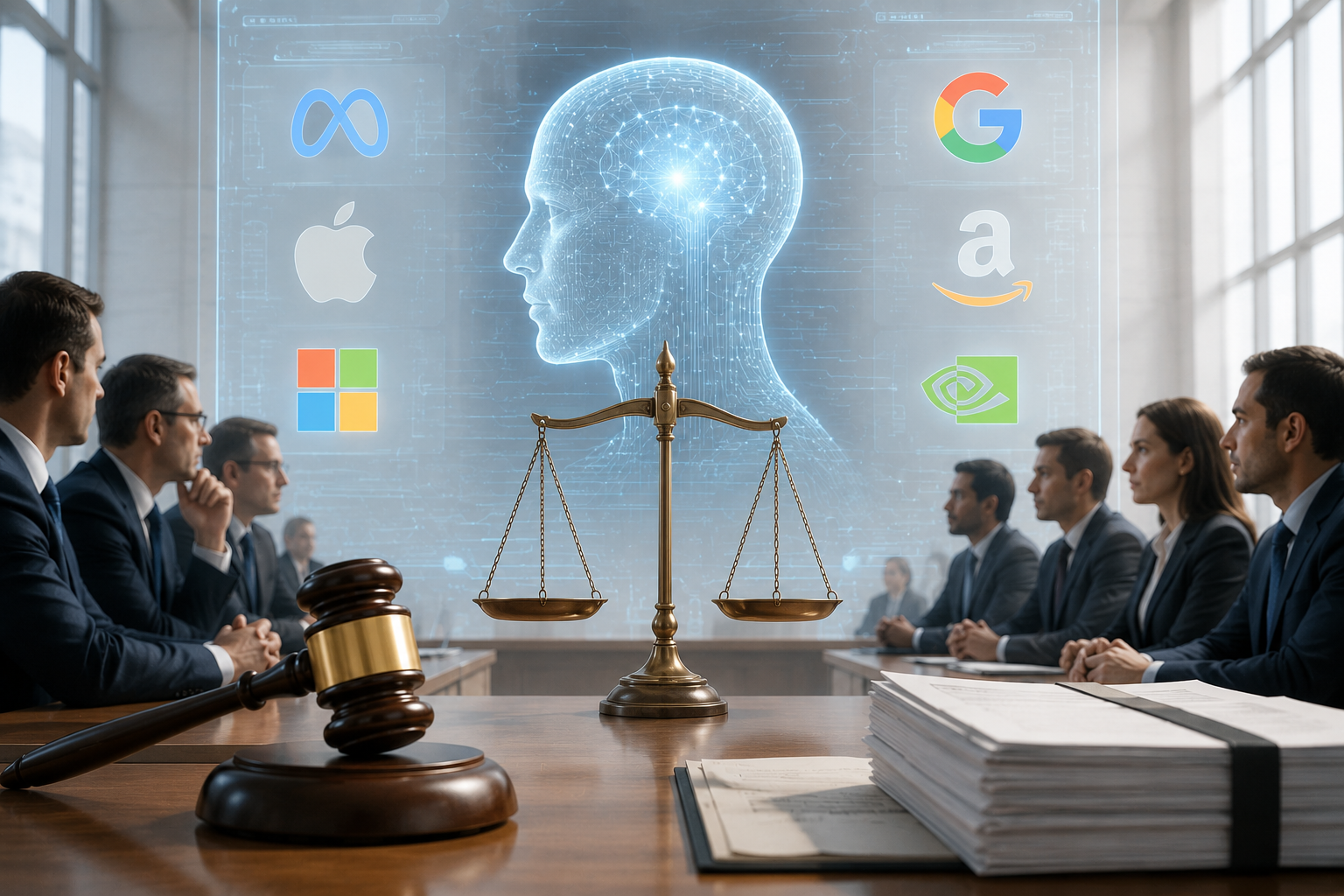
Two years ago, Anthropic and OpenAI were fighting the exact same war. Authors, publishers, and newsrooms accused both companies of scraping books and articles into their training data without asking anyone’s permission — or writing anyone a check. By the middle of 2026, that shared battlefield has split into two completely different stories.
Anthropic’s AI copyright settlement — a record $1.5 billion deal with authors and publishers — is sitting one signature away from final court approval. OpenAI, meanwhile, just got accused in a federal filing of lying about its own ability to search its training data, and is now fighting off a sanctions motion from The New York Times and a dozen other newsrooms.
One company paid its way out. The other is digging in for a fight that could shape AI copyright law for the next decade. Here’s what’s actually happening in both cases, what each strategy is costing, and what it means if you’re building an AI product without a spare billion dollars lying around.
What’s Actually Happening in the Anthropic vs OpenAI Story
Inside Anthropic’s $1.5 Billion AI Copyright Settlement
Why OpenAI Is Skipping an AI Copyright Settlement of Its Own
Settlement vs. Lawsuit: What Each Strategy Actually Costs
What This AI Copyright Settlement Precedent Means for Every AI Company
The Business Logic Behind an AI Copyright Settlement Strategy
What’s Actually Happening in the Anthropic vs OpenAI Story
Strip away the legal jargon, and both cases start the same way. Sometime around 2023 and 2024, authors and news organizations discovered that leading AI labs had trained their models on copyrighted material — in some cases legally licensed, in other cases, according to court filings, pulled straight from pirate book repositories. Lawsuits followed almost immediately.
What’s changed is how each company chose to respond once the pressure got serious. Anthropic’s AI copyright settlement path led it into mediation, then a $1.5 billion agreement, then nearly a year of court procedure to get that agreement finalized. OpenAI took the opposite road: refuse to settle, argue fair use, and let the discovery process play out — a decision that’s now producing headlines about hidden evidence and demands for sanctions.
Neither approach is obviously “the smart one.” They’re both bets, just on different tables. Anthropic bet that certainty was worth $1.5 billion. OpenAI is betting that a courtroom win is worth years of legal exposure and a bruising discovery fight. Let’s look at each in detail.
Inside Anthropic’s $1.5 Billion AI Copyright Settlement
The case, known as Bartz v. Anthropic, began with three nonfiction authors — including writer Charles Graeber — and eventually covered roughly 482,460 books. More than 506,000 potential claimants, representing 99.5% of the eligible works, received direct notice of the settlement.
Here’s the detail that gets lost in most coverage:
- Anthropic didn’t actually lose the argument that AI training itself can be fair use.
- The presiding judge, William Alsup, ruled for the three named plaintiffs that training a model on legally acquired books was transformative and protected.
- What Anthropic lost — and what this AI copyright settlement is actually resolving — is the separate claim that it illegally acquired hundreds of thousands of books in the first place, by downloading them from shadow libraries like Library Genesis and Pirate Library Mirror.
- Training on stolen copies isn’t the same legal question as training on purchased ones, and that distinction is likely to outlive this case.
The claim numbers are unusual for a class action. Typical claim rates hover around 10%. This settlement pulled in a 91.3% claim rate — 440,490 of the 482,460 eligible works — after a late surge before the March 30, 2026 deadline. That high participation means each claimant’s share landed closer to the original estimate of roughly $3,000 per work rather than the larger payout some had projected earlier in the year, once you back out attorneys’ fees (plaintiffs’ counsel requested 20–25% of the fund), administrative costs, and a reserve for future expenses.
Anthropic isn’t paying all $1.5 billion at once. It already deposited an initial $300 million into escrow, owes another $300 million within five days of final approval, and will pay the remaining $900 million in two $450 million installments tied to the anniversaries of the settlement’s preliminary approval. Beyond the money, Anthropic must destroy the pirated files it downloaded within 30 days of final judgment and formally certify that none of the pirated datasets were used to train any commercially released model.
As for timing: the final approval hearing happened on May 14, 2026, but the judge didn’t rule from the bench. Additional briefing followed, and as of the most recent public filings, no signed final order had been entered yet. The settlement’s own administrators have floated payments beginning as early as August 2026, though the Authors Guild has suggested late fall is more realistic once appeals windows are accounted for.
It’s also worth keeping this AI copyright settlement in perspective. Anthropic is reportedly valued near $965 billion as it prepares for a possible public listing. A $1.5 billion settlement is real money, but relative to that valuation, it’s closer to a rounding error than an existential threat — which tells you something about why Anthropic was willing to write the check in the first place.
Why OpenAI Is Skipping an AI Copyright Settlement of Its Own
OpenAI’s legal exposure started with The New York Times and Microsoft in 2023, then grew to include the Daily News, the Center for Investigative Reporting, and Ziff Davis (CNET’s parent company) in 2024. Rather than negotiate its own AI copyright settlement, OpenAI chose to fight on fair use grounds — arguing that training on publicly available text is transformative and doesn’t meaningfully harm the market for the original work.
That strategy just took a serious hit. On July 9, 2026, the NYT-led coalition filed a motion in Manhattan federal court asking the judge to sanction OpenAI for what they called a “deliberate and systemic effort to obstruct discovery.” The core allegation: for roughly two years, OpenAI told the court and the plaintiffs it lacked the tools to search its training data and ChatGPT output logs for copyrighted material — while, according to a February 2026 deposition of OpenAI privacy engineer Vinnie Monaco, it had already built exactly those tools. The newsrooms say OpenAI had assembled an internal database of about 78 million de-identified ChatGPT conversations, along with a detection tool nicknamed “Project Giraffe” that used a bloom filter to flag regurgitated content — built shortly after the lawsuit was filed, not after discovery required it.
The plaintiffs also allege OpenAI negotiated down an original request for 120 million chat logs to a sample of just 20 million, and are now asking the court to bar OpenAI from relying on that reduced sample, treat substantial regurgitation of their content as an established fact, and force OpenAI to cover the legal costs of chasing down the evidence. OpenAI has pushed back hard, with a spokesperson accusing the Times of trying to invade user privacy as its underlying case “weakens.” Separately, OpenAI has appealed a court order requiring it to retain consumer ChatGPT logs indefinitely, calling that demand a privacy overreach in its own right.
None of this comes cheap for either side. The Times alone has disclosed more than $28 million in litigation costs fighting AI companies, including $4.2 million in the first quarter of 2026 — and that’s before counting OpenAI’s own legal spend, engineering hours pulled into discovery, and executive time spent on depositions. It’s also not OpenAI’s only front: a separate December 2025 suit from journalists including John Carreyrou and Philip Shishkin named OpenAI alongside Meta, Google, Anthropic, xAI, and Perplexity over alleged book piracy, meaning OpenAI is defending several overlapping copyright arguments at once rather than resolving them with one AI copyright settlement.
Settlement vs. Lawsuit: What Each Strategy Actually Costs
| Factor | Anthropic (Settlement) | OpenAI (Litigation) |
|---|---|---|
| Upfront cost | ~$1.5 billion in licensing | ~$100M+ in legal fees (estimated) |
| Ongoing obligations | Annual licensing renewals likely | None if fair use wins |
| Risk of injunction | Eliminated | Significant if court rules against |
| Timeline to resolution | Immediate | 2–5 years minimum |
| Precedent impact | Confirms licensing model | Could establish fair use for AI |
| Reputational effect | Positive with creators | Negative with creators, positive with investors |
The hidden costs cut in different directions. Litigation drags in engineering time for data audits, executive time for depositions, and — as OpenAI is discovering — real reputational damage when a discovery dispute turns into a story about an AI copyright settlement you refused to make and evidence you allegedly hid instead. Settlement carries its own quieter costs: installment obligations stretching into 2027, a certification process publishers will likely point to in future negotiations, and pricing pressure that tends to land, eventually, on customers.
What This AI Copyright Settlement Precedent Means for Every AI Company
The most useful thing to come out of the Anthropic case isn’t the dollar figure — it’s the legal framework underneath it. Judge Alsup’s ruling effectively separated two questions that had been treated as one: is training on copyrighted text fair use, and did you acquire that text legally in the first place? Anthropic won the first question and settled the second.
That split matters enormously for how the next wave of AI copyright settlement conversations will go. If courts keep treating “how you got the data” as the more decisive question, then a company with clean, licensed, or purchased training data has a real shot at a fair use defense — while a company that scraped shadow libraries or pirated content doesn’t get to hide behind “but the output is transformative.” OpenAI’s discovery fight adds a second wrinkle: even a strong fair use argument on the merits can be undermined if a court decides you misrepresented what you could search or what you deleted. A judge inclined to punish that behavior doesn’t need to rule on fair use at all to make a company’s life very difficult.
If OpenAI loses the sanctions fight and the underlying case eventually breaks against it, its position starts looking a lot like Anthropic’s a year ago — needing an AI copyright settlement anyway, just later, more expensively, and with discovery-misconduct penalties stacked on top of the base liability.
Should Smaller AI Startups Pursue an AI Copyright Settlement of Their Own?
Most companies building AI products don’t have $1.5 billion for licensing or $28 million for a single plaintiff’s legal fees, let alone their own. So what should smaller labs actually take from this?
Start with data provenance, not legal theory. The Anthropic case suggests that how you acquired your training data will matter more than clever arguments about what the model does with it afterward. If your dataset includes material pulled from shadow libraries, scraped without licenses, or acquired through gray-market means, “transformative use” isn’t going to save you the way it might for a company with clean sourcing.
Practical moves worth making now: audit exactly what’s in your training corpus and document it properly, because “we didn’t track it” is a terrible answer to a subpoena. Prioritize licensing for the highest-risk categories — fiction, journalism, and academic publishing — rather than trying to license everything. Watch how the OpenAI sanctions ruling lands, since it will signal how seriously courts take transparency claims about training data and logs going forward. And consider collective licensing arrangements; the Anthropic settlement essentially built a template — including a class structure, a per-work valuation, and a claims process — that smaller consortiums could plausibly adapt.
The Business Logic Behind an AI Copyright Settlement Strategy
Anthropic’s early AI copyright settlement isn’t just a legal outcome — it’s a business asset. A company that can tell enterprise customers “our training data is licensed and our pirated-source certification is a matter of public record” has a genuine selling point in procurement conversations where legal exposure is increasingly a line item. That’s especially true as enterprise buyers, particularly in regulated industries, start asking AI vendors directly about training data provenance before signing contracts.
OpenAI’s calculation runs the other way. It trains on a vastly larger volume of data than Anthropic, so a full licensing program would cost far more than $1.5 billion — plausibly an order of magnitude more. A courtroom win on fair use, even a narrow one, would preserve a permanent cost advantage over every company that already paid to license its data. That’s a rational bet for a company at OpenAI’s scale, even accounting for the reputational cost of a sanctions fight playing out in public. Both strategies make sense from inside each company’s own risk model; they just optimize for different things.
Conclusion
On the Anthropic side, expect a signed final approval order at some point in the second half of 2026, followed by the first wave of payments to claimants — the settlement’s own administrators have pointed to August 2026 as an early estimate, though appeals or further objections could push that later.
On the OpenAI side, the sanctions motion filed on July 9, 2026 needs a ruling before the underlying fair use case can move much further. If the court agrees that OpenAI misrepresented its capabilities during discovery, expect financial penalties, evidentiary restrictions on OpenAI’s own data samples, and a weaker negotiating position heading into any future settlement talks. Layered on top of that is the separate December 2025 suit from journalists spanning OpenAI, Meta, Google, Anthropic, xAI, and Perplexity — a reminder that this fight extends well past any single company or plaintiff.
Anthropic and OpenAI started this fight from the same place and ended up running two completely different experiments in how AI companies manage copyright risk. Anthropic’s AI copyright settlement bought certainty, a defensible provenance story, and a clean exit from a piracy claim it was always going to lose — while preserving a real legal win on the fair use question itself. OpenAI is betting that fighting all the way through, discovery scars and all, is worth more than writing a check, because a courtroom victory would apply industry-wide and permanently.
Neither bet is finished playing out. But the framework emerging from these cases — that acquisition method matters more than end use, and that discovery conduct can sink a strong legal argument on its own — is going to shape how every AI company, large or small, thinks about training data for years to come.
FAQ
How is OpenAI’s legal strategy different from Anthropic’s?
OpenAI is fighting copyright claims in court rather than settling. The company argues that training AI on copyrighted text qualifies as fair use. If OpenAI wins, it won’t need to pay licensing fees at all. However, if it loses, the costs could far exceed what Anthropic spent on settlements — and the precedent would ripple across the entire industry.
What is the fair use defense in AI copyright cases?
Fair use is a legal doctrine that allows limited use of copyrighted material without permission. It considers four factors: the purpose of the use, the nature of the copyrighted work, how much was used, and the effect on the market. OpenAI argues AI training is transformative and therefore qualifies. Courts haven’t definitively ruled on this yet — and the Warhol decision makes the outcome less predictable than OpenAI’s public statements suggest.
Will the outcome of these cases affect smaller AI companies?
Absolutely. If courts establish that AI training requires licensing, smaller companies will face significant costs they may not be able to afford. Conversely, a fair use victory would level the playing field considerably. Meanwhile, smaller labs should monitor the NYT v. OpenAI case closely and consider targeted licensing for their highest-risk training data — don’t wait for the verdict to start thinking about this.
Could Congress pass legislation that resolves AI copyright disputes?
Congressional action is possible but unlikely in the near term. Legislators have held hearings and introduced bills, but AI copyright remains politically complex. Both tech companies and creative industries have powerful lobbying operations pulling in opposite directions. Additionally, the courts may resolve key questions before Congress acts, making legislation feel less urgent to members who’d rather not take a side.
What should content creators do to protect their work from AI training?
Content creators should register their copyrights with the U.S. Copyright Office, which meaningfully strengthens legal claims. They should also consider joining organizations like the Authors Guild that negotiate collective licensing deals on members’ behalf. Furthermore, creators can use robots.txt directives and opt-out mechanisms offered by some AI companies — though the legal force of those mechanisms is still being tested. Notably, understanding why Anthropic paid billion authors wouldn’t sue helps creators recognize exactly how much leverage they actually have in these negotiations.
Keep reading
Here are the latest posts from the blog.
UBTECH’s $17,600 emotion-aware companion robot landed in China with surprisingly little regulatory friction. The Walker S2, equipped with facial recognition and emotional ana…

Nvidia’s trillion-dollar backlog versus its trillion-dollar stock slide is one of the most confusing stories I’ve watched play out on Wall Street in a decade of covering tech…

California’s AB 489 draws a hard line between human clinicians and AI-generated medical advice. Signed into law in late 2024, it’s the most significant state-level move yet o…