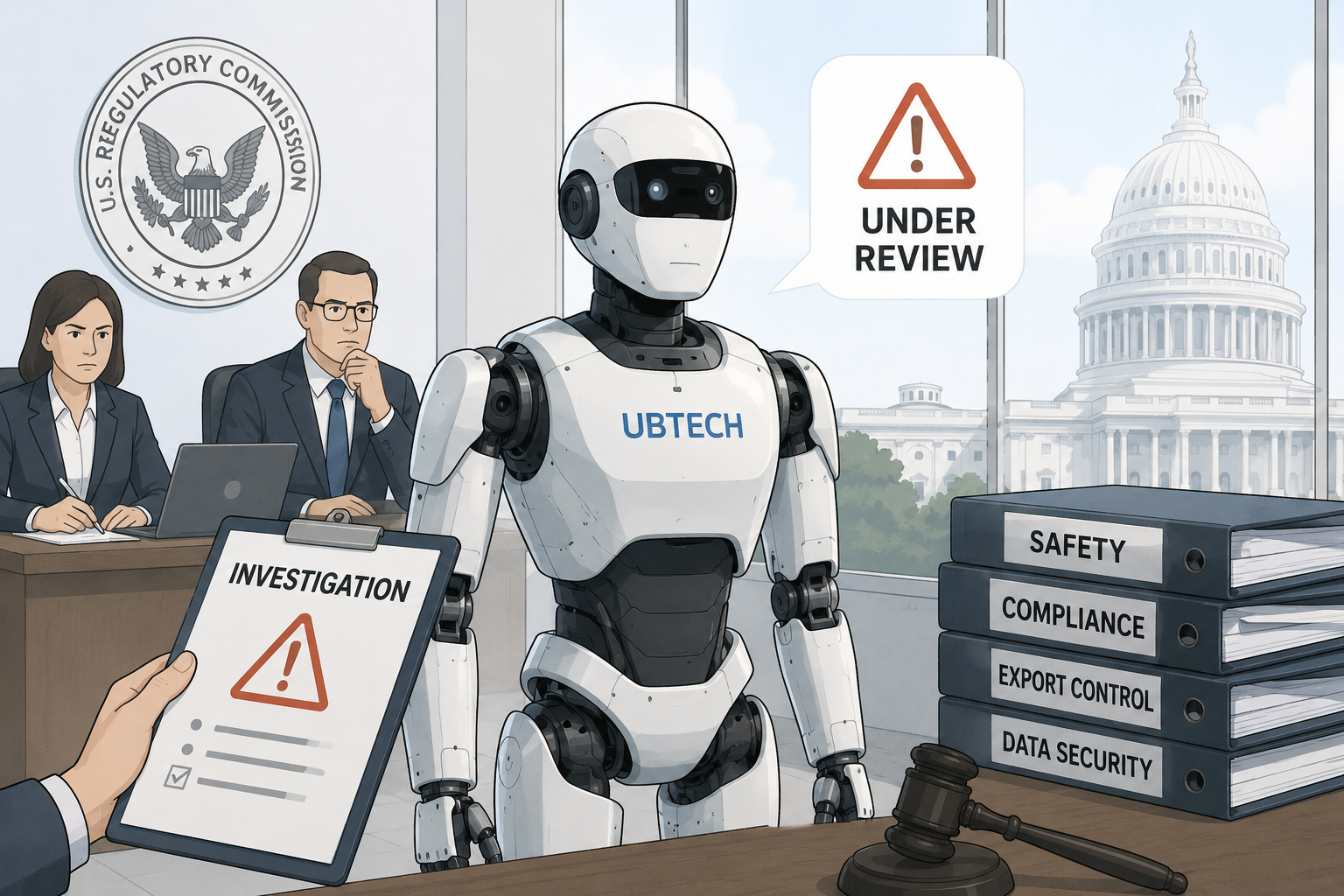
UBTECH’s $17,600 emotion-aware companion robot landed in China with surprisingly little regulatory friction. The Walker S2, equipped with facial recognition and emotional analysis, sailed through domestic approvals like a novelty gadget. But what happens when it crosses the Pacific?
That question is keeping robotics lawyers up at night. It should keep UBTECH’s product team up too. American regulators don’t just ask “does it work?” They ask “could it harm vulnerable people?” For a robot that claims to read human emotions, that answer gets complicated fast.
This isn’t happening in a vacuum, either. Companies like Agility Robotics and NVIDIA have already shown how US compliance reshapes robotics business models from the ground up. UBTECH’s emotion-aware robot faces a gauntlet that could double its price tag, or push its US launch back by years.
The FDA Problem: Why UBTECH’s Emotion-Aware Robot Looks Like a Medical Device
FTC Scrutiny: Does UBTECH’s Emotion-Aware Robot Actually Work?
California’s AB 489 and the State-Level Patchwork Facing UBTECH’s Robot
What Agility Robotics and NVIDIA Teach UBTECH’s Emotion-Aware Robot About US Compliance
The Hidden Cost of Bringing UBTECH’s Emotion-Aware Robot to America
Conclusion: Where This Leaves UBTECH’s US Launch Plans
Frequently Asked Questions About UBTECH’s Emotion-Aware Robot
The FDA Problem: Why UBTECH’s Emotion-Aware Robot Looks Like a Medical Device
The Food and Drug Administration doesn’t regulate robots. It regulates medical devices. That distinction matters enormously for UBTECH’s emotion-aware robot, and it’s a trap I’ve watched foreign companies stumble into repeatedly.
Where the classification risk actually sits
If UBTECH suggests the Walker S2 can detect depression, anxiety, or cognitive decline, the FDA would classify it as a medical device almost immediately. It could fall under Class II or even Class III device categories, and Class III requires full premarket approval, which is as brutal as it sounds.
A few things would trigger FDA jurisdiction:
- marketing materials mentioning mental health monitoring,
- claims about detecting emotional distress in elderly users,
- any suggestion the robot supplements clinical care,
- or integration with health data platforms and electronic health records.
China’s National Medical Products Administration never raised these concerns. Chinese regulators treated the Walker S2 as consumer electronics — no clinical trials, no premarket notification, no equivalent to America’s 510(k) pathway required. Must’ve been a smooth morning at that approvals office.
Why the “intended use” trap is so easy to fall into
So UBTECH faces a binary choice for the US market: strip all health-adjacent language from marketing, or spend $5 million to $15 million on FDA clearance. Neither option is cheap, and neither is fast. Companies almost always underestimate both.
The “intended use” trap catches many foreign robotics companies off guard. The FDA doesn’t just read official marketing copy. It monitors social media, press releases, and even investor presentations. One careless slide mentioning “wellness monitoring” could trigger scrutiny, because the agency casts a remarkably wide net.
The FDA has also grown more aggressive about software-as-a-medical-device enforcement. A robot analyzing facial expressions to infer emotional states sits squarely in that gray zone. The agency’s Digital Health Center of Excellence has published guidance making clear that emotion-detection algorithms could qualify as clinical decision support tools, a designation with real teeth.
FTC Scrutiny: Does UBTECH’s Emotion-Aware Robot Actually Work?
The FTC would approach UBTECH’s emotion-aware robot from a different angle entirely. Does the emotion recognition actually work? And if not, is charging $17,600 for it deceptive? The science, it turns out, is shakier than the marketing implies.
Why “AI washing” has become a real enforcement target
This isn’t hypothetical. The FTC has already acted against companies making unsubstantiated AI claims. In 2023, the agency warned businesses about “AI washing,” exaggerating what algorithms can actually do. Emotion recognition technology specifically has a troubled track record, and regulators have noticed.
A few concerns stand out.
- Can the robot reliably distinguish emotions across different demographics, ages, and cultural backgrounds?
- Does UBTECH hold peer-reviewed evidence supporting its accuracy rates?
- Does the $17,600 price reflect genuine capability, or does it exploit consumer misunderstanding of AI?
- And is the robot marketed toward elderly users or children who can’t properly evaluate its claims?
The FTC’s enforcement philosophy has shifted meaningfully in recent years. Commissioner Alvaro Bedoya has publicly questioned whether emotion recognition technology works at all, and the scientific consensus backs his skepticism. A landmark 2019 meta-analysis by the Association for Psychological Science found that facial expressions don’t reliably map to internal emotional states. That’s not a minor caveat. That’s the foundation of the entire product feature in question.
What happened to Amazon and Microsoft’s own emotion-reading tools
UBTECH isn’t alone in this predicament, either. Amazon retired its Rekognition emotion-detection feature, and Microsoft removed emotion-reading capabilities from its Azure Face API. These weren’t voluntary decisions made out of goodwill. They reflected growing regulatory pressure that became impossible to ignore.
The cost of FTC compliance goes beyond legal fees. UBTECH would need independent validation studies, revised marketing materials, and possibly prominent disclaimers about the limits of emotion detection. Chinese regulators never required any of this substantiation. UBTECH could market emotion awareness as a feature without proving it meets any particular standard. That gap is striking, and it’s worth sitting with.
California’s AB 489 and the State-Level Patchwork Facing UBTECH’s Robot
State-level AI legislation adds another layer of complexity for UBTECH’s emotion-aware robot. California’s approach is particularly relevant, and particularly unforgiving.
Why biometric data changes the compliance math
AB 489 specifically targets AI-generated content disclosures, but California’s broader framework carries real implications here too. The state’s Consumer Privacy Act and its amendments treat biometric data, including facial geometry used for emotion detection, as sensitive personal information. There’s no wiggle room there.
California law would require explicit opt-in consent before collecting facial expression data, clear disclosure of how emotion data gets stored and shared, the right for consumers to delete all collected emotional analysis data, and restrictions on selling that data to third parties.
Illinois’s Biometric Information Privacy Act would apply too, and BIPA has real claws. It requires written consent before collecting biometric identifiers, and it includes a private right of action, meaning individual consumers can sue directly without waiting for a state attorney general to act. Companies have paid hundreds of millions in BIPA settlements. This is the one that keeps compliance teams awake at night.
Fifty states, fifty different answers
China requires only limited biometric consent, has no meaningful private right of action, doesn’t classify emotion data as sensitive, and enforces violations administratively. California requires consent under the CCPA, allows limited private action, classifies emotion data as sensitive, and fines up to $7,500 per violation. Illinois goes further still, with full private right of action under BIPA and fines between $1,000 and $5,000 per violation. Texas sits somewhere in between, with consent required under its own biometric law but a private right of action limited to the attorney general, and fines up to $25,000 per violation.
So UBTECH can’t just comply with one set of rules. It needs a strategy for every state where it sells, which is a problem Chinese domestic sales never presented. Colorado, Connecticut, Virginia, and several other states have enacted their own AI and privacy laws too, each with slightly different requirements. Compliance attorneys describe this patchwork as a “full employment act for lawyers,” and a fifty-state compliance strategy could easily exceed $2 million annually, a significant burden even on a $17,600 consumer product.
| Regulatory Dimension | China | California | Illinois | Texas |
|---|---|---|---|---|
| Biometric consent required | Limited | Yes (CCPA) | Yes (BIPA) | Yes (CUBI) |
| Private right of action | No | Limited | Yes | Yes (AG only) |
| Emotion data classified as sensitive | No | Yes | Yes | Unclear |
| Mandatory data deletion rights | Limited | Yes | Yes | No |
| Penalties for violations | Administrative | Up to $7,500/violation | $1,000–$5,000/violation | $25,000/violation |
| Child-specific protections | Basic | Extensive (COPPA+) | Via BIPA | Limited |
What Agility Robotics and NVIDIA Teach UBTECH’s Emotion-Aware Robot About US Compliance
UBTECH’s emotion-aware robot isn’t entering an empty market. Other robotics companies have already worked through US regulatory requirements, and their experiences are genuinely instructive, sometimes painfully so.
Two very different lessons from two different companies
Agility Robotics’ planned public offering through a SPAC showed how US securities rules intersect with robotics in unexpected ways. The SEC required detailed risk disclosures about regulatory uncertainty, forcing Agility to put a number on compliance costs that hadn’t yet materialized. The company disclosed that regulatory changes could make its business model unviable in certain markets, not exactly the language investors want to read. This matters directly for UBTECH, because any US public markets play or partnership with a US-listed firm would trigger similar disclosure requirements.
NVIDIA’s safety stack offers a more constructive lesson. Because US customers demanded rigorous safety validation, NVIDIA built Isaac Sim and its robotics safety framework specifically to help companies meet US and EU standards. The platform includes tools for testing robot behavior in simulated environments before deployment, and NVIDIA invested heavily in this infrastructure because American buyers required it, not out of generosity.
Why companion robots face a harder road than industrial ones
Agility reportedly spent 18 to 24 months on safety certification alone. NVIDIA built an entire software division around compliance tooling. Boston Dynamics maintains a dedicated regulatory affairs team of more than 15 people. UBTECH would need comparable investment for US operations.
These companies primarily make industrial robots, though, and companion robots face even stricter scrutiny. That distinction matters more than people realize. A warehouse robot that malfunctions damages goods. A companion robot that misreads emotions could cause real psychological harm to an elderly person living alone. Regulators treat these risks very differently, and they’re right to.
The timeline implications are severe. Agility’s US regulatory journey took roughly two years. For UBTECH’s emotion-aware robot, with its emotion-detection claims and consumer-facing use case, three to four years seems realistic — years during which competitors establish market presence and customer loyalty.
The Hidden Cost of Bringing UBTECH’s Emotion-Aware Robot to America
UBTECH’s robot is already expensive at $17,600. US regulatory compliance would push that price significantly higher, and the math here is uncomfortable.
Adding up the compliance bill
- FDA consultation and potential clearance could run $500,000 to $15 million depending on classification.
- FTC substantiation studies could cost $200,000 to $2 million for independent validation.
- A fifty-state privacy compliance strategy needs $1.5 to $3 million in initial setup, plus $500,000 or more annually.
- Safety certification through organizations like Underwriters Laboratories adds $100,000 to $500,000.
- Legal and regulatory affairs staffing runs $800,000 to $1.5 million a year.
- Insurance and liability coverage adds another $200,000 to $1 million annually.
- And ongoing monitoring and compliance updates add $300,000 or more every year on top of that.
The total first-year cost could realistically reach $10 to $20 million. Spread across a limited production run, that adds thousands to each unit’s price. A $17,600 robot could easily become a $25,000 to $30,000 robot, which is a very different conversation with consumers.
Why skipping compliance isn’t actually an option
There’s an opportunity cost too, one that rarely shows up in these calculations. Engineers working on compliance documentation aren’t building new features. Lawyers reviewing marketing copy slow down product launches. Every dollar spent on regulation is a dollar not spent on R&D, and in a fast-moving category like companion robotics, that gap compounds quickly.
Still, skipping compliance isn’t a real option. Penalties for selling an unregistered medical device start at $15,000 per violation. FTC fines can reach millions. BIPA settlements have exceeded $600 million for a single company. “Hope regulators don’t notice” has never been a winning market-entry strategy.
The competitive disadvantage is real, too. Chinese robotics companies can move faster domestically, test emotion-detection algorithms on larger populations without consent frameworks, and market health-adjacent features without substantiation requirements. By the time UBTECH’s emotion-aware robot clears US regulatory hurdles, Chinese competitors may be two full product generations ahead.
But US regulatory approval carries its own market value worth emphasizing. It signals safety and reliability to global buyers, and European, Japanese, and Australian regulators often accept US certifications as baseline evidence. So a US-approved product can command premium pricing worldwide, partially offsetting the compliance burden. It’s not a perfect trade-off, but it’s a real one.
Conclusion: Where This Leaves UBTECH’s US Launch Plans
UBTECH’s emotion-aware robot represents a genuine collision between Chinese innovation speed and American regulatory caution. The Walker S2 launched in China with minimal friction. Bringing it to the US is a fundamentally different challenge, one involving the FDA, the FTC, a patchwork of state biometric laws, and compliance costs that could reshape the product’s entire economics.
The FDA would scrutinize health claims. The FTC would demand proof that emotion detection actually works. State laws from California to Illinois would impose biometric consent requirements. Each layer adds cost, time, and complexity, and they don’t stack neatly.
A few things are worth taking away.
- Robotics startups entering the US should budget 30 to 50% of first-year revenue for compliance.
- Investors should factor two-to-four-year regulatory timelines into robotics valuations.
- Consumers should treat emotion-detection claims skeptically until independent validation exists.
- And policymakers should ask whether the current patchwork approach actually serves public safety or mostly just creates barriers to entry.
The regulatory gap between China and the US isn’t closing. If anything, it’s widening. UBTECH’s emotion-aware robot will either adapt to American requirements or remain a product US consumers can only watch from afar. Either way, the story says something real about how different societies balance innovation against protection, a tension that isn’t going away anytime soon.
Frequently Asked Questions About UBTECH’s Emotion-Aware Robot
Will UBTECH’s $17,600 emotion-aware robot be available in the United States?
UBTECH hasn’t announced a firm US launch date. Given the regulatory hurdles outlined here, a release would likely require two to four years of compliance work, addressing FDA, FTC, and state-level requirements before selling directly to American consumers. UBTECH could also partner with a US distributor that handles regulatory affairs, though that adds its own complications.
Does the emotion-detection technology in UBTECH’s robot actually work?
The scientific evidence is genuinely contested. A major review by the Association for Psychological Science found that facial expressions don’t reliably indicate internal emotional states, a significant problem for a product built around that premise. UBTECH hasn’t published peer-reviewed validation studies for its specific implementation, so consumers should approach emotion-awareness claims with healthy skepticism, regardless of how polished the demo looks.
How would the FDA classify an emotion-aware companion robot?
Classification depends entirely on marketing claims and intended use. If UBTECH positions the robot purely as entertainment, the FDA likely wouldn’t intervene. But any suggestion that it monitors mental health, detects depression, or supplements clinical care could trigger Class II medical device classification, requiring at minimum a 510(k) premarket notification. One stray phrase in a press release can shift that calculus entirely.
What privacy risks does UBTECH’s emotion-aware robot pose?
The robot continuously collects facial expression data, voice patterns, and behavioral information. In the US, that qualifies as biometric information under several state laws. Risks include unauthorized data sharing, inadequate security leading to breaches, and surveillance concerns most buyers won’t think to ask about. US privacy laws would require explicit consent, data minimization, and deletion rights that Chinese regulations simply don’t mandate.
How does the regulatory burden compare between the US and China for robotics companies?
China’s environment for consumer robotics is significantly less restrictive, and that gap is growing rather than shrinking. Chinese companies face fewer premarket requirements, less substantiation burden for AI claims, and no state-by-state compliance patchwork. China also lacks a private right of action equivalent to Illinois’s BIPA, meaning Chinese consumers can’t individually sue over biometric violations the way American consumers can — a structural difference with real consequences for how companies design and market their products.
Could US regulatory requirements actually benefit consumers considering this robot?
Absolutely, and this point is underrated. US regulations would force UBTECH to prove its emotion-detection claims actually work, require transparent data practices and meaningful consent, and ensure the robot meets safety standards for home use with vulnerable populations. These requirements raise prices and delay availability, but they also protect consumers from spending $17,600 on technology that might not deliver on its promises. For a product this expensive, aimed at people who may be elderly or emotionally vulnerable, that oversight seems more than justified. It seems necessary.
Keep reading
Here are the latest posts from the blog.

Nvidia’s trillion-dollar backlog versus its trillion-dollar stock slide is one of the most confusing stories I’ve watched play out on Wall Street in a decade of covering tech…

California’s AB 489 draws a hard line between human clinicians and AI-generated medical advice. Signed into law in late 2024, it’s the most significant state-level move yet o…
Anthropic’s jailbreak bug bounty now pays hackers to break Claude. Anthropic just expanded its partnership with HackerOne. Now it pays outside security researchers to find ja…