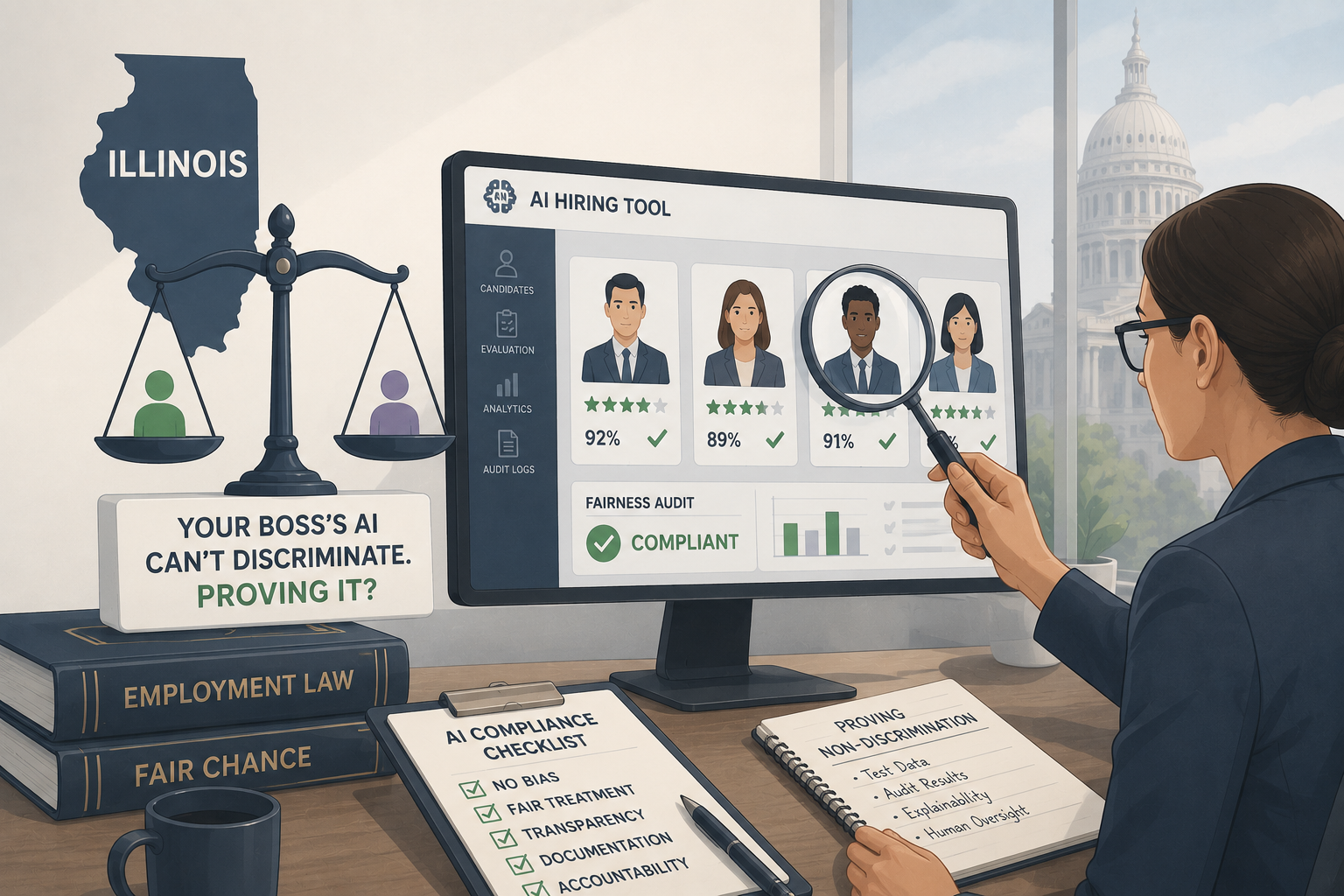
Illinois passed a law saying an employer’s AI can’t discriminate against candidates or employees. That part is straightforward. What isn’t straightforward is what comes next: how does a company actually prove its AI discrimination risk is under control, when the law itself never spells out the test?
The amendments to the Illinois Human Rights Act now explicitly cover automated decision-making in employment — screening resumes, scoring interviews, ranking candidates, flagging people for promotion. But the statute creates a real legal obligation without handing employers a step-by-step playbook for proving they’ve met it. That gap between “you must not discriminate” and “here’s exactly how you demonstrate that” is where most companies are currently stuck.
So HR and legal teams are left asking a genuinely hard question: how do you prove a machine isn’t biased? The honest answer involves audit frameworks, third-party testing, and documentation that can survive actual scrutiny — not a vendor’s word that their tool is “bias-free.” This piece skips the general regulatory overview and goes straight to implementation: which bias detection methods hold up, which auditors are worth hiring, what your documentation trail needs to include, and what real case outcomes look like when companies get AI discrimination compliance right — and badly wrong.
Why Proving You’ve Avoided AI Discrimination in Illinois Is So Hard
Bias Detection Methods That Actually Catch AI Discrimination
Third-Party Auditors Who Can Verify You’ve Avoided AI Discrimination
Documentation That Proves You Took AI Discrimination Seriously
Real Cases: Companies That Passed and Failed AI Discrimination Audits
Your AI Discrimination Compliance Checklist
Why Proving You’ve Avoided AI Discrimination in Illinois Is So Hard
Illinois didn’t just prohibit discriminatory AI outcomes. It created an accountability gap, because the law tells employers what result they must avoid without telling them exactly how to demonstrate they’ve avoided it. There’s no specified testing method written into the statute and no defined acceptable bias threshold — the legislative text stays quiet on both, and that silence is the whole problem.
That ambiguity is the core challenge behind every AI discrimination compliance effort in the state right now. Employers have to prove a negative — that their AI isn’t producing discriminatory outcomes — without a standardized measuring stick handed to them. In practice, most organizations are borrowing audit frameworks from other jurisdictions and adapting federal guidelines just to have something to stand on.
A few specific features of the Illinois law make AI discrimination exposure especially tricky to manage:
- No safe harbor provision. Good-faith effort alone doesn’t protect you if the actual outcome turns out to be discriminatory.
- Broad scope. The law reaches recruiting, hiring, promotions, and terminations — not just the hiring stage most companies assume it’s limited to.
- Private right of action. Employees can sue directly rather than relying solely on agency enforcement, which meaningfully raises the stakes.
- Intersectional analysis expected. Regulators want bias testing across multiple protected categories at once, not evaluated one at a time in isolation.
The burden of proof effectively sits with the employer here. Saying your AI is fair isn’t enough — you need documented evidence. Avoiding AI discrimination in Illinois means having audit processes that are repeatable and defensible, not a verbal assurance that “we ran some internal checks.” That phrase alone won’t hold up if a complaint ever gets filed.
Bias Detection Methods That Actually Catch AI Discrimination
Not every bias test carries the same weight. Some only catch surface-level issues. Others dig into the structural patterns that a simple pass/fail metric misses completely, and the difference matters enormously when you’re trying to prove you’ve avoided AI discrimination rather than just hoping you have.
Audit reports that actually hold up under scrutiny tend to combine several methodologies rather than relying on one supposedly definitive test. Here’s what’s proven effective in practice:
Disparate impact analysis is still the starting point, rooted in the EEOC’s Uniform Guidelines on Employee Selection Procedures.
The four-fifths rule gives you a baseline: if a protected group’s selection rate falls below 80% of the highest-performing group’s rate, that’s treated as a presumption of adverse impact. But the four-fifths rule alone isn’t sufficient proof against AI discrimination — a lot of HR teams stop here and shouldn’t.
Beyond that baseline, a genuinely thorough approach layers in:
- Statistical parity testing — comparing selection rates across demographic groups at every decision stage, from resume screening through interview invitations to final offers, since bias can enter at any single stage.
- Equalized odds analysis — checking whether the AI’s true-positive and false-positive rates stay consistent across groups. A tool can hire qualified candidates from one group while rejecting equally qualified candidates from another, and the overall numbers can still look fine on the surface.
- Counterfactual fairness testing — changing a candidate’s demographic attributes while holding qualifications constant, then checking whether the AI’s recommendation shifts. If it does, that’s a real signal of AI discrimination worth investigating immediately.
- Feature importance auditing — examining which input variables actually drive the AI’s decisions. Proxy variables like zip code or university name can smuggle in racial or socioeconomic bias without anyone building the system intending that outcome.
- Longitudinal outcome tracking — since bias can emerge over time as models drift, quarterly retesting catches AI discrimination that a single one-time audit would completely miss.
No single method catches every form of AI discrimination on its own. A solid audit combines at least three of these approaches together. NIST’s AI Risk Management Framework offers a genuinely useful structure for organizing these tests into a coherent program, and since it’s free, there’s not much excuse for skipping it as a starting point.
Third-Party Auditors Who Can Verify You’ve Avoided AI Discrimination
Proving you’ve avoided AI discrimination often means bringing in outside experts, because internal teams face a real conflict of interest — not from bad faith, but because it’s genuinely hard to audit your own work objectively. Third-party auditors add credibility and catch blind spots your own team has stopped noticing.
The market for this kind of AI bias auditing has matured quickly. Here’s how the major players stack up:
| Vendor/Tool | Type | Key Strength | Limitation | Approximate Cost |
|---|---|---|---|---|
| ORCAA (O’Neil Risk Consulting) | Full-service audit firm | Deep statistical expertise; led NYC Local Law 144 audits | Higher cost; longer timelines | $50K–$200K per audit |
| Holistic AI | Platform + consulting | Automated bias scanning with human review | Less customization for niche models | $30K–$100K annually |
| Credo AI | Governance platform | Policy-to-evidence mapping; board-ready reports | Requires internal technical capacity | SaaS pricing varies |
| IBM AI Fairness 360 | Open-source toolkit | Free; extensive algorithm library | Requires data science team to implement | Free |
| Google What-If Tool | Open-source visualization | Excellent for exploratory analysis | Not a compliance-grade audit tool | Free |
| Aequitas (UChicago) | Open-source toolkit | Designed for public-sector decision systems | Limited commercial support | Free |
Budget shapes this decision a lot. Smaller companies often start with open-source tools like IBM’s AI Fairness 360 and escalate to a full-service auditor once the stakes climb. Larger enterprises typically need the documentation rigor that firms like ORCAA or Holistic AI provide out of the gate. The gap between “we ran a free toolkit once” and “we engaged a qualified third-party auditor” is exactly the gap that tends to matter most if AI discrimination litigation ever arrives.
The auditor you choose directly affects legal defensibility. Courts and regulators simply give more weight to independent, third-party assessments — that’s just the reality of how these cases get evaluated. Auditors with real experience in employment law, not just general data science, tend to produce reports that hold up better under actual scrutiny.
Before signing with anyone, it’s worth confirming a few things: ask for sample audit reports up front, verify the auditor’s experience is specific to employment AI rather than general machine learning, make sure they test for every Illinois-protected category (immigration status gets missed surprisingly often), and confirm they’ll deliver litigation-ready documentation rather than a summary slide deck.
Documentation That Proves You Took AI Discrimination Seriously
Even a genuinely fair AI system can create serious legal exposure without the paperwork to back it up. That’s a frustrating reality, but it’s the one companies actually operate under. Avoiding AI discrimination in practice, in front of a court or the Illinois Department of Human Rights, requires a documentation trail that connects policy to actual practice — not just policy to good intentions.
A solid documentation package should include:
- Model cards — a standardized description of what the AI does, what data trained it, and its known limitations.
- Bias audit reports — dated, signed assessments from qualified auditors covering every protected category, not a partial sample.
- Impact assessments — pre-deployment analyses predicting potential AI discrimination effects before the tool ever goes live.
- Notice records — proof that candidates and employees were actually told AI was involved in decisions affecting them.
- Remediation logs — records of identified bias issues and the specific steps taken to fix them, not just an acknowledgment that a problem existed.
- Vendor contracts — agreements that include anti-discrimination warranties and audit rights. If a vendor won’t sign one, that itself is worth paying attention to.
- Training records — evidence that HR staff actually understand the tools they’re using and where those tools fall short.
A growing number of companies are building dedicated AI governance repositories to hold all of this in one place. Platforms like Credo AI and OneTrust are built specifically for this kind of centralized compliance record-keeping, and they’re worth a serious look if your documentation is currently scattered across inboxes and shared drives.
Retention matters too. Employment records in Illinois generally need to be kept for at least five years, and AI audit documentation should follow the same timeline — longer if litigation seems likely.
Here’s the part that trips companies up most: documentation has to be contemporaneous. Records created after a complaint lands look defensive and reactive. Records built proactively, before anything goes wrong, look responsible and systematic. That distinction alone can shape how an AI discrimination case actually plays out.
Real Cases: Companies That Passed and Failed AI Discrimination Audits
Real examples show the gap between theory and practice better than any framework document can. Illinois-specific case law is still limited given how recent the law is, but parallel enforcement actions and voluntary audits already offer genuinely useful lessons about what proving you’ve avoided AI discrimination looks like in practice.
Case 1 — a staffing platform’s proactive audit (passed). A national staffing company operating in Illinois hired ORCAA to audit its resume-screening algorithm ahead of the law’s enforcement date. The audit found the model was disproportionately filtering out candidates with employment gaps — a pattern that correlated strongly with gender and disability status. The company retrained the model, removed gap length as a feature entirely, and documented the process from start to finish. When a candidate later filed a complaint, the company produced its full audit trail, and the complaint was dismissed. That’s the outcome proactive AI discrimination compliance actually buys a company.
Case 2 — a mid-size retailer’s chatbot screening failure. A retailer used an AI chatbot to screen candidates, scoring them partly on response speed and vocabulary complexity — which sounds neutral until you sit with it for a moment. An internal review triggered by employee complaints found non-native English speakers scoring significantly lower across the board. The company had no documentation of the AI’s decision logic and had never run bias testing before deployment. The resulting settlement exceeded $400,000 in combined legal fees and remediation costs — an expensive way to learn what proactive auditing would have caught for a fraction of that.
Case 3 — NYC’s Local Law 144 as an early preview. New York City’s Local Law 144 already requires annual bias audits of automated employment tools, and several companies failed their first audits because they only tested for race and gender, ignoring age, disability, and other categories. Illinois’s protected-class list is broader, which means companies simply copying an NYC audit playbook are likely to fall short of what Illinois actually requires — a false sense of security that’s more dangerous than having no audit at all.
A few patterns repeat across every one of these cases: proactive auditing before complaints arise is dramatically cheaper than defending after the fact, documentation quality often matters as much as the audit results themselves, testing too narrow a set of protected categories creates false confidence rather than real compliance, and a vendor’s claim of a “bias-free” tool never substitutes for independent verification — no matter how confident the sales pitch sounds.
Your AI Discrimination Compliance Checklist
Turning all of this into something usable takes structure. This checklist pulls the audit frameworks, documentation requirements, and case-study lessons above into a practical sequence rather than a list to skim and forget.
Pre-deployment phase:
- Inventory every AI tool used in employment decisions — recruiting, screening, interviewing, promotion, termination
- Obtain model cards or technical documentation from each AI vendor; push back if they won’t provide them
- Conduct a pre-deployment impact assessment for each tool
- Confirm vendor contracts include anti-discrimination warranties and audit cooperation clauses
- Set up a notice protocol informing candidates and employees when AI is involved in decisions about them
Audit phase:
- Select a qualified third-party auditor with employment law experience, not just data science credentials
- Test for disparate impact across every Illinois-protected category — race, color, religion, sex, national origin, ancestry, age, disability, marital status, sexual orientation, military status, and immigration status
- Apply at least three bias detection methodologies, at minimum statistical parity, equalized odds, and counterfactual fairness
- Document every finding, including passing results — they matter as evidence too
- Build specific remediation plans for any disparities identified
Ongoing compliance phase:
- Schedule quarterly bias retesting to catch model drift before it becomes a liability
- Maintain a centralized AI governance repository holding every audit artifact
- Train HR staff annually on AI tool limitations and escalation procedures
- Monitor regulatory updates from the Illinois Department of Human Rights — this area is moving fast
- Retain all documentation for a minimum of five years
Avoiding AI discrimination in Illinois isn’t a one-time project you close out and file away. It’s a continuous program, and companies that treat auditing as a checkbox exercise are the ones who end up exposed once enforcement actually ramps up.
Conclusion: Final Thoughts on AI Discrimination in Illinois
Illinois has made its position clear: an employer’s AI cannot produce discriminatory outcomes, and good intentions alone won’t prove otherwise. Demonstrating real compliance takes structured audit frameworks, credible third-party validation, and documentation solid enough to survive scrutiny — not a vendor’s assurance or an internal check nobody wrote down. The companies handling this well treat AI discrimination prevention as an ongoing operational commitment, not something they scramble to address after a complaint lands.
Your next steps, in order: this week, inventory every AI tool touching an employment decision anywhere in your organization — the number is usually higher than people expect. This month, request model cards and bias testing data from every vendor; if they can’t produce them, treat that as a red flag worth acting on. This quarter, bring in a qualified third-party auditor to run baseline bias testing across every Illinois-protected category. And on an ongoing basis, build a governance repository, schedule quarterly retests, and train your HR team annually rather than once and done.
The regulatory environment here is only going to get stricter. Companies that build solid AI discrimination audit programs now will have a genuine advantage — legally and reputationally — over the ones scrambling to catch up later. The cost of prevention is a fraction of the cost of remediation, and that’s not an exaggeration once you’ve seen what a reactive settlement actually costs.
FAQ About AI Discrimination Compliance
What AI tools does the Illinois anti-discrimination law actually cover?
Any automated decision-making tool used in an employment context — resume screeners, chatbot interviewers, video analysis software, predictive performance tools, and promotion algorithms all fall under it. It applies regardless of whether the employer built the tool in-house or bought it from a vendor, so “our vendor said it was compliant” isn’t a defense on its own. Illinois’s AI discrimination protections apply equally to proprietary and third-party systems.
How often should companies test their AI hiring tools for bias?
Quarterly retesting is best practice at minimum. AI models drift as they process new data over time, and that drift can introduce AI discrimination risk that wasn’t present at launch. Applicant pools and workforce demographics also shift seasonally in ways that affect outcomes. Annual audits, like the ones required under NYC’s Local Law 144, are a floor, not a ceiling — companies operating in Illinois should aim to exceed that baseline.
Can free tools like IBM AI Fairness 360 satisfy Illinois’s compliance requirements on their own?
They’re a strong starting point for internal analysis and genuinely useful for ongoing monitoring, but they typically don’t produce the litigation-ready documentation regulators and courts expect to see. Most legal advisors recommend using open-source tools for continuous monitoring while still engaging a third-party auditor for the formal compliance assessment. That combination balances cost efficiency against real legal defensibility.
What happens if an audit actually finds AI discrimination in a hiring tool?
Finding it during an audit isn’t automatically a legal violation on its own — what matters most is what the company does next. Document the finding clearly, build specific remediation steps, retest after changes are made, and keep records of the entire process. Ignoring or burying an audit finding, on the other hand, creates significant legal liability, and courts do notice the difference. Proactive remediation actually strengthens a company’s position, which feels counterintuitive but holds up consistently in practice.
Does Illinois require notifying candidates about AI use?
Yes. The Illinois Artificial Intelligence Video Interview Act already requires notice and consent for AI-analyzed video interviews, and the broader anti-discrimination framework reinforces that same transparency expectation across the board. Companies should inform candidates whenever AI plays a material role in a decision about them, and written notice with a clear opt-out is the safer approach — verbal notice leaves too much ambiguity if a dispute arises later.
How does Illinois’s law differ from New York City’s Local Law 144?
Illinois covers a broader set of protected categories, including immigration status and military status, which NYC’s framework doesn’t emphasize as heavily. Illinois also allows private lawsuits from affected individuals, while NYC leans mainly on agency enforcement and civil penalties. And Illinois’s law reaches further along the employment lifecycle — beyond hiring into promotions and terminations. Companies already navigating both laws can generally build one unified audit framework strict enough to satisfy the tougher requirements of each.
Keep reading
Here are the latest posts from the blog.
Two years ago, Anthropic and OpenAI were fighting the exact same war. Authors, publishers, and newsrooms accused both companies of scraping books and articles into their trai…
UBTECH’s $17,600 emotion-aware companion robot landed in China with surprisingly little regulatory friction. The Walker S2, equipped with facial recognition and emotional ana…

Nvidia’s trillion-dollar backlog versus its trillion-dollar stock slide is one of the most confusing stories I’ve watched play out on Wall Street in a decade of covering tech…