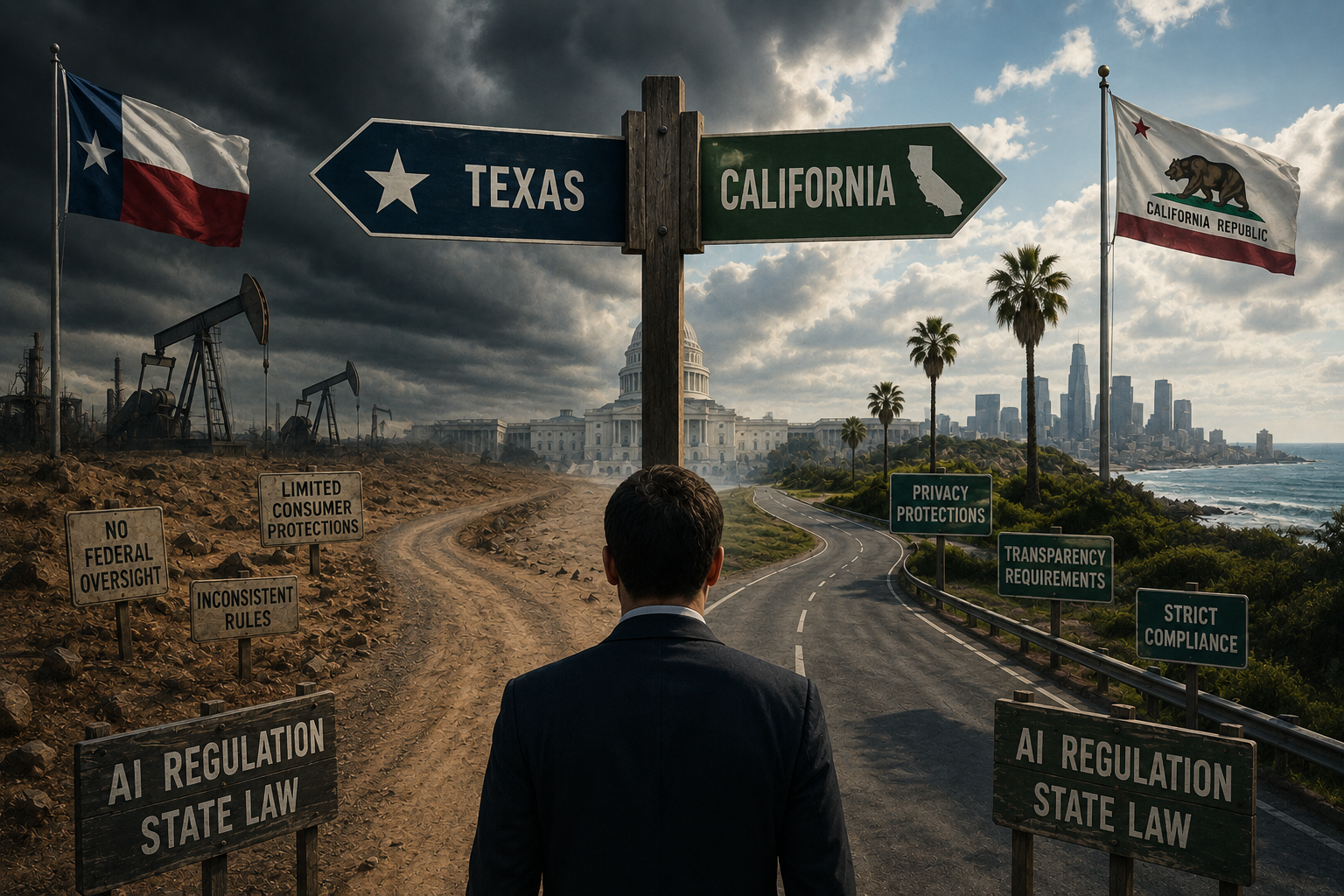
America doesn’t have one AI law. It has a sprawling patchwork of state AI laws, and the sharpest fault line in that patchwork runs straight between Austin and Sacramento. If you’re trying to figure out how state AI laws actually apply to your product, you’re really asking two questions at once: what does California require, and what does Texas let you skip.
Texas favors innovation-first governance. California leads with consumer protection mandates. Every company deploying AI across state lines ends up staring at a compliance puzzle with no clean single answer, because state AI laws weren’t designed as one system — they were designed as fifty separate experiments running at the same time. I’ve spent the last several years watching this fragmentation accelerate, and it’s only getting messier. This is a practical playbook for in-house counsel and product teams trying to survive it.
Why State AI Laws Split Sharply Between Texas and California
Congress hasn’t passed comprehensive federal AI legislation, so individual states are writing their own rules, and two states are setting the poles that the rest of the country’s state AI laws orbit around.
California’s approach builds on its privacy legacy. The California Consumer Privacy Act (CCPA) already regulates automated decision-making, and although SB 1047 was vetoed in 2024, that veto wasn’t a rejection of strict oversight — it was a negotiating move. Future state AI laws out of Sacramento will almost certainly require risk assessments, algorithmic audits, and transparency disclosures. The direction of travel is unmistakable.
Texas’s approach leans libertarian. The Texas Business Organizations Code puts ease of doing business first. Governor Abbott’s executive orders actively encourage AI adoption in government services, and the state imposes far fewer compliance burdens on private-sector AI developers than California does. It’s a genuinely different philosophy behind these state AI laws, not just lighter paperwork.
Here’s a concrete example. A fintech startup using an AI model to approve or deny personal loans faces mandatory bias disclosures, opt-out rights, and pending audit requirements the moment a single California resident applies. That same startup, serving only Texas residents, faces none of those obligations today. Same model, same underlying risk, two completely different regulatory realities.
This divide matters because other states don’t stay neutral — they pick a side in the state AI laws debate. Colorado, Illinois, New York, Connecticut, and Virginia have generally followed California’s model. Florida, Tennessee, Utah, Georgia, and Arizona lean toward Texas’s lighter-touch approach. Ohio, Michigan, Pennsylvania, and North Carolina remain genuinely undecided or hybrid.
Colorado’s SB 24-205 ranks among the most detailed state AI laws in the country, requiring deployers of “high-risk” AI systems to run impact assessments every year. That’s not a light ask. Illinois already enforces its Artificial Intelligence Video Interview Act, which governs AI in hiring with notice-and-consent requirements that catch a lot of companies off guard. The result is a compliance map that looks more like a quilt than a rulebook, and the quilt keeps getting bigger.
A Side-by-Side Look at State AI Laws in Five Key States
Understanding state AI laws in the abstract only gets you so far. What actually matters is how specific obligations differ across jurisdictions.
California requires algorithmic transparency for high-risk systems, has bias-audit requirements moving through pending bills, enforces strict data residency rules under the CCPA and CPRA, mandates hiring disclosures, and is expanding AI liability through case law, with penalties up to $7,500 per violation. Texas requires none of that formally — no transparency mandate, no bias-audit requirement, minimal data residency rules, no hiring-specific law, and only limited statutory liability. Colorado sits closer to California, with required transparency, annual impact assessments, and deployer liability up to $20,000 per violation. Illinois focuses narrowly on hiring, requiring bias audits under its AI Video Interview Act with liability on employers, up to $1,000 per violation. Florida mirrors Texas closely across nearly every category.
That comparison tells a clear story about how state AI laws diverge in practice. States aligned with California impose meaningfully more obligations. States aligned with Texas impose far fewer. Even the light-touch states are evolving quickly, though, and I wouldn’t bet on that gap staying this wide for long.
One tradeoff is worth naming directly. California’s stricter state AI laws genuinely do create compliance costs that fall harder on smaller companies — a well-resourced enterprise can absorb annual algorithmic audits, while a fifteen-person startup often can’t. Texas’s lighter approach removes that burden but also removes the accountability mechanisms that protect consumers from opaque automated decisions. Neither extreme is obviously correct, which is part of why this debate keeps circling.
The scale of this is worth sitting with. The National Conference of State Legislatures tracked more than 700 AI-related bills introduced across all fifty states in a single year. Seven hundred. Any compliance team tracking state AI laws needs to treat that number as a baseline, not an outlier.
Building a Playbook to Handle State AI Laws Everywhere
Knowing how state AI laws differ is step one. Building a compliance program that holds up across all of them is the harder part, and where most teams stumble.
Start by mapping your AI footprint by state — every state where your system touches users, employees, or decisions, not just where your headquarters sits. A hiring tool used by a remote workforce can trigger obligations under a dozen different state AI laws at once, and the exposure is almost always larger than teams expect. A practical way to run this exercise: pull a ninety-day sample of user or applicant records, tag each one with a state, and count how many unique states show up. Most teams discover three or four they hadn’t considered, so do this before building your compliance matrix, not after.
Next, identify your highest-risk use cases, since most state AI laws focus on specific applications rather than AI in general. Automated hiring decisions, credit and lending decisions, insurance underwriting, healthcare diagnostics, law enforcement and surveillance tools, and housing eligibility determinations all draw the heaviest scrutiny across state AI laws right now.
The single most important tactical decision is defaulting to the strictest standard rather than building fifty separate workflows. Adopting California’s and Colorado’s requirements as your baseline usually satisfies lighter state AI laws elsewhere automatically. The tradeoff is real — more engineering time on disclosures, more legal time on impact assessments Texas doesn’t technically require — but separate compliance tracks per state create overhead that compounds as new state AI laws keep passing. Most teams that try the state-by-state route eventually consolidate anyway, usually after a near-miss that scared everyone into action.
Set up algorithmic impact assessments next. Colorado requires them annually, and California will likely follow. NIST’s AI Risk Management Framework provides a solid, free template, worth using early rather than waiting for a regulator to ask. Budget at least four to six weeks for a first assessment on a moderately complex system, since gathering documentation from engineering, product, and legal at the same time always takes longer than expected.
Build a disclosure and transparency layer into your product now rather than retrofitting it later. A simple pattern that satisfies most current state AI laws: a one-sentence disclosure near the point of decision — “this result was generated with the assistance of an automated system” — paired with a link to a fuller explanation. Finally, assign someone to monitor legislative changes quarterly. The NCSL database is a strong starting point, and IAPP alerts add another useful layer so you’re not blindsided by a new state law that dropped while your team was focused elsewhere.
Data Residency and Liability Traps Inside State AI Laws
Beyond transparency and bias audits, state AI laws introduce two underappreciated challenges that tend to bite companies late, often during diligence or after an enforcement action: data residency and liability allocation.
Data residency is messier than it looks. California’s CPRA gives consumers the right to know where their data is stored and processed. Texas imposes no comparable requirement. But if your AI model trains on data from California residents, CPRA obligations follow that data regardless of where your servers physically sit — and removing data from an already-trained model is technically difficult in ways most legal teams haven’t fully worked through.
Picture a mid-sized HR software company training a resume-screening model on historical hiring data collected from customers across thirty states. A California resident whose resume was in that dataset files a CPRA deletion request. The company can delete the raw record from its database, but the model’s weights, already shaped by that record, can’t be surgically edited out. That’s an unresolved legal question in California right now, and regulators are watching it closely as state AI laws continue to develop around exactly this gap.
The practical complications stack up quickly. Cloud providers may store data across multiple regions without your explicit knowledge. Training datasets often contain records from residents of many states simultaneously. Cross-border data transfers within the US can trigger conflicting state-level rules. And data provenance documentation is often nonexistent at companies that didn’t plan for this from the start.
Liability allocation is equally tangled, and the inconsistency across state AI laws is genuinely strange. Colorado places liability primarily on AI “deployers” — the companies using AI systems in consumer-facing decisions. Some proposed California bills instead target “developers,” the companies that build the underlying models. Illinois puts the burden specifically on employers. Apply all three frameworks to the same AI hiring tool and you get three different parties holding the liability bag.
That means a single AI product can face different liability theories in different states at the same time, and most vendor contracts don’t account for any of this yet. If a Colorado regulator fines a deployer for a biased hiring outcome, and that deployer’s vendor contract says nothing about indemnification for AI-related regulatory penalties, the deployer absorbs the entire cost, even if the bias originated inside the developer’s model. The practical fixes are straightforward: put clear liability allocation clauses in vendor contracts, keep data provenance records showing where training data originates, buy AI-specific insurance coverage now that it exists, and document your model development process thoroughly in case of future discovery. It’s also worth watching the EU AI Act closely, since its risk classification system is actively shaping American state AI laws — Colorado’s tiered approach already mirrors the EU framework, and that’s not a coincidence.
What Federal Action Could Mean for State AI Laws
The fragmentation behind today’s state AI laws might not last forever. Federal legislation could preempt state rules, or it could make things considerably more complicated before it makes them simpler.
Several federal proposals are circulating already. Senator Schumer’s bipartisan SAFE Innovation Framework outlines principles but lacks real enforcement teeth. Executive orders from the Biden administration set AI safety standards for federal agencies, but those don’t directly bind private companies, a distinction that matters enormously in practice. A company building AI tools exclusively for private-sector clients can largely ignore federal agency AI standards today, even though those standards are often the most detailed guidance available.
Three scenarios could play out for state AI laws, and only one is genuinely clean. Full federal preemption would simplify compliance enormously but is politically unlikely near-term, since states guard their regulatory authority fiercely and California won’t cede ground without a fight. Floor preemption — Congress setting minimum standards while letting states go further — is essentially the CCPA model applied nationally: California keeps stricter rules, Texas adopts the federal floor, and complexity decreases without disappearing. No federal action means the status quo continues, state AI laws keep multiplying, and enterprises run multi-state compliance programs indefinitely. Honestly, that last scenario looks like the most probable near-term outcome.
The Supreme Court’s evolving stance on the administrative state adds another wrinkle. The Loper Bright decision limiting agency deference may affect how federal agencies set AI-related rules going forward, and that’s a variable most compliance teams tracking state AI laws aren’t watching closely enough. If agencies like the FTC or CFPB lose authority to interpret their own guidance expansively, the burden of filling those gaps shifts back to state legislatures, accelerating the exact fragmentation this piece is describing.
For product teams, the safest bet remains building for the strictest standard among current state AI laws. Treat California and Colorado requirements as your design baseline. If federal law eventually arrives, you’ll already exceed it, which is a much better position than scrambling to catch up.
Conclusion
The reality behind today’s state AI laws won’t simplify anytime soon, and anyone telling you otherwise is selling something. Regulatory fragmentation is the defining challenge for AI governance in America right now. Texas and California represent two fundamentally different philosophies about who bears the cost of AI risk, and every other state is staking out its own position somewhere on that spectrum.
The practical next steps are straightforward: audit your AI footprint across all fifty states now, since the exposure is probably larger than you think; adopt California and Colorado standards as your baseline rather than the median; use NIST’s free framework for impact assessments; assign someone to track new state AI laws quarterly; update vendor contracts with explicit liability allocation language; and build transparency features into every AI-powered product before the law forces you to. Companies that treat this as a strategic priority rather than a legal nuisance will move faster and face fewer expensive surprises. The window to get ahead of state AI laws is narrowing, not widening.
FAQ
How many US states currently have AI-specific laws?
Roughly twenty states have enacted AI-specific legislation as of early 2025, though more than forty have introduced AI-related bills, and the NCSL tracks these developments in real time. Many existing privacy laws, like California’s CPRA, already cover automated decision-making even without the word “AI” in the title — a trap plenty of companies fall into, assuming a law doesn’t apply just because it doesn’t say “AI.”
Why does the Texas-California split matter more than other state differences?
Texas and California are the two largest state economies in the country, and they anchor opposing regulatory philosophies behind their respective state AI laws — California prioritizes consumer protection and algorithmic accountability, Texas prioritizes business flexibility and innovation speed. Most other states model their approach after one of these two, which makes understanding this one divide a practical map for the entire country.
Can a company just comply with California and ignore everything else?
Mostly, but not entirely. California generally sets the highest bar among state AI laws, but some states have genuinely unique requirements California doesn’t replicate — Illinois’s notice-and-consent rules for AI hiring, or Colorado’s specific impact-assessment timelines. A California-first strategy covers most of your obligations, but you’ll still need to check for state-specific outliers, particularly around hiring and employment.
Which AI use cases face the most scrutiny across state AI laws?
Hiring and employment decisions draw the most scrutiny by a wide margin. Credit decisions, insurance underwriting, and healthcare applications attract heavy regulation in multiple states too, and facial recognition used in law enforcement is banned or restricted outright in several cities and states. Any system that meaningfully influences consequential decisions about individuals will likely face regulation eventually, regardless of which industry it sits in.
Will federal legislation eventually replace state AI laws?
It’s possible, but not something to plan around. Congress moves slowly on technology regulation while states move fast. Even if federal legislation passes, it may set a floor rather than a ceiling, letting states like California keep stricter standards, similar to how CCPA coexists with federal privacy frameworks today. Enterprises should plan for continued state-level fragmentation for at least the next three to five years, regardless of what happens in Washington.
Keep reading
Here are the latest posts from the blog.

Agility Robotics SPAC going public through a $2.5 billion deal is a genuinely historic moment. It’s the first humanoid robotics company to trade on a public market, full stop…
OpenAI NYT Lawsuit: Why OpenAI May Be Forced to Reveal Its Training Secrets I’ve spent the better part of a decade writing about tech legal battles, and most of them follow a…

When Fable 5 went dark for 19 days, a lot of people in this industry had the same uncomfortable realization at roughly the same time. It wasn’t really about the outage itself…