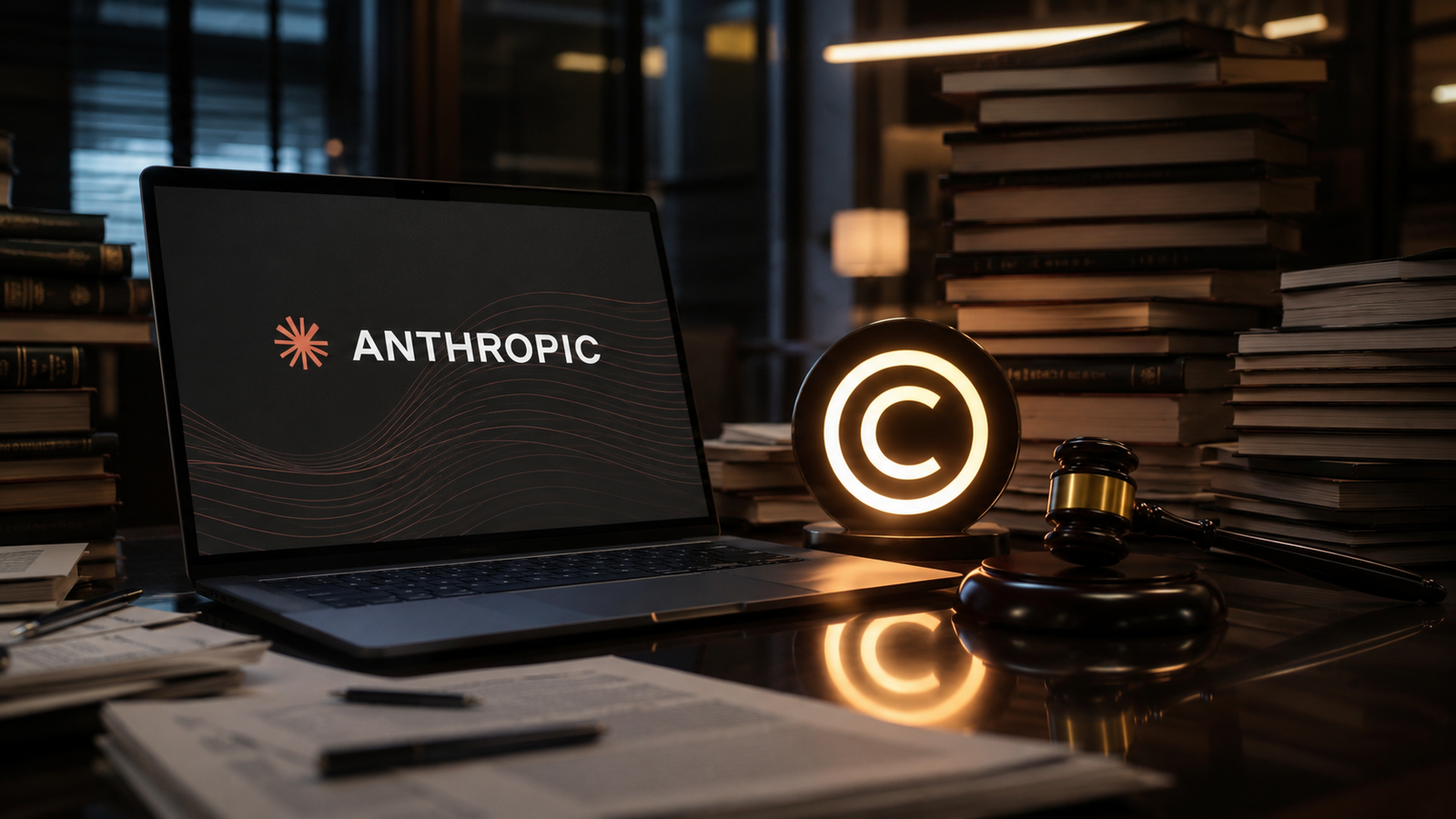
The $1.5 billion Bartz v. Anthropic settlement received final court approval on July 20, 2026. The important distinction is between the court’s case-specific fair-use analysis and the separate claims resolved by the settlement. Approval of the settlement is not the same as completed distribution of money to every claimant. Final approval order.
The settlement addresses claims involving books downloaded from pirate libraries. It should not be summarized as a universal ruling that all AI training is lawful or that every acquisition claim produces the same result. The fair-use order explains the distinctions the court made on this record.
This piece breaks down what the Anthropic copyright settlement actually requires, why the fair-use ruling underneath it cuts against the narrative that AI training itself is now illegal, and how it connects to parallel cases against Meta, Stability AI, and OpenAI.
Key Takeaways on the Anthropic Copyright Settlement
- The Anthropic copyright settlement resolves Bartz v. Anthropic, where authors alleged Anthropic downloaded roughly 500,000 pirated books to train Claude.
- Anthropic will pay about $3,000 per work into the $1.5 billion fund and destroy the pirated files it downloaded.
- A separate ruling in the same case found training on lawfully acquired books can be fair use — the settlement is about piracy, not training itself.
- Meta won a similar fair-use ruling in Kadrey v. Meta, while Getty lost most of its copyright claims against Stability AI.
- NYT v. OpenAI is a separate, still-active case now centered on a sanctions motion over alleged evidence destruction, not a settlement.
What the Anthropic Copyright Settlement Actually Covers
Why Training Was Fair Use but Piracy Wasn’t
How Kadrey v. Meta and Getty v. Stability AI Fit the Same Pattern
How the Anthropic Copyright Settlement Connects to NYT v. OpenAI
What This Means for AI Labs, Authors, and Investors
What the Anthropic Copyright Settlement Actually Covers
The Anthropic copyright settlement grew out of Bartz v. Anthropic, filed in August 2024 by authors Andrea Bartz, Charles Graeber, and Kirk Wallace Johnson in the Northern District of California. Their claim: Anthropic had downloaded hundreds of thousands of books from shadow libraries to train the Claude family of models.
Specifically, the authors alleged Anthropic pulled books from Library Genesis in June 2021 and from Pirate Library Mirror in July 2022. Anthropic also reportedly bought physical books, stripped their bindings, and scanned every page to build what the company internally described as a permanent library of “all the books in the world.”
The court described an estimated payment of about $3,000 per qualifying work from the $1.5 billion fund. That is not a guaranteed amount for each author or an automatic damages rule for other cases; allocation and administration matter. Court order.
The Numbers and Timeline Behind the Settlement
Final approval was granted by Judge Araceli Martínez-Olguín on July 20, 2026. The official settlement administrator currently expects the first distributions on or before November 15, 2026 for eligible works meeting the stated conditions; disputed allocations can take longer. This is a current expectation, not confirmation that every claimant has been paid.
The approval order and administrator’s notices provide the authoritative record for participation, allocation and payment. Use those documents rather than an unsourced claims-rate percentage to assess the settlement.
Why Training Was Fair Use but Piracy Wasn’t
Judge Alsup’s fair-use order analyzed particular uses and copies in the record. It must be read as a case-specific decision, not a general license for every training dataset or acquisition method.
The court treated the training use at issue differently from retaining pirated copies in a general library. A model’s outputs, the use being challenged and the evidentiary record remain relevant; the decision does not establish that models can never reproduce protected expression.
The piracy was the separate problem. Downloading books from shadow libraries and retaining them in a permanent, searchable library — rather than acquiring them lawfully — fell outside that protection. The Anthropic copyright settlement resolves that second issue specifically: the acquisition method, not the training method.
Why This Distinction Matters for Every AI Lab
This nuance changes what the Anthropic copyright settlement actually signals. It isn’t proof that training AI on copyrighted material is broadly illegal. It’s proof that how you acquire your training data carries real, separate legal exposure, even when the training itself would otherwise be defensible.
That’s a more precise — and more actionable — lesson than “AI training is now illegal.” A lab that licenses or lawfully purchases its training content is in a meaningfully different legal position than one that scrapes pirate sites, even if both end up training similar models in similar ways.
How Kadrey v. Meta and Getty v. Stability AI Fit the Same Pattern
The Anthropic copyright settlement didn’t happen in isolation. Two days after the underlying Bartz ruling, a parallel case against Meta produced a related but distinct result, and a UK case against Stability AI went a different way entirely.
In Kadrey v. Meta, thirteen authors — including Richard Kadrey and Sarah Silverman — alleged Meta trained its Llama models on pirated books from shadow libraries like Z-Library and Books3. On June 25, 2025, Judge Vince Chhabria granted Meta summary judgment, finding the training itself was fair use.
Importantly, Judge Chhabria was explicit that this wasn’t a blanket endorsement. He wrote that the ruling “does not stand for the proposition that Meta’s use of copyrighted materials to train its language models is lawful” — only that these particular plaintiffs hadn’t proven market harm. Future plaintiffs with better evidence, he suggested, could win.
Where Meta’s Case Diverged From Anthropic’s Settlement
The acquisition and market-harm issues in Kadrey should be assessed from that case’s actual order. The Bartz settlement does not establish that another court approved every method of obtaining training data.
Getty Images v. Stability AI took yet another path. The UK High Court largely rejected Getty’s copyright claims in November 2025, ruling that Stable Diffusion’s training happened overseas and that AI model weights aren’t themselves “copies” of the training images under UK law. Getty won only a narrow trademark claim, tied to its watermark appearing in some outputs. A separate US case is still proceeding in federal court in California.
These disputes involve different facts, claims, jurisdictions and procedural records. They should not be tallied into a general rule that training is usually lawful while acquisition alone creates liability.
How the Anthropic Copyright Settlement Connects to NYT v. OpenAI
The Anthropic copyright settlement is often mentioned alongside NYT v. OpenAI, and the pairing makes sense, but the two cases aren’t parallel in the way headlines sometimes suggest. The New York Times sued OpenAI and Microsoft in December 2023, alleging millions of Times articles were used to train GPT-3.5 and GPT-4 without permission. That case is still active, and the core copyright claims have already survived a motion to dismiss.
Unlike the Anthropic copyright settlement, NYT v. OpenAI hasn’t settled. Instead, it escalated in July 2026 when the Times and more than a dozen other publishers filed a sanctions motion accusing OpenAI of withholding and destroying evidence during discovery.
The Sanctions Motion: A Different Kind of Legal Pressure
The publishers’ motion alleges OpenAI misrepresented its ability to search training data and chat logs for copyrighted material. A deposition of an OpenAI engineer reportedly revealed the company had already built internal tools — including a dataset of roughly 78 million de-identified ChatGPT conversations and a detection system referred to internally as part of “Project Giraffe” — before telling the court such searches weren’t feasible.
Publishers also allege OpenAI deleted billions of ChatGPT conversations after a court preservation order took effect. OpenAI has denied the allegations, and the sanctions motion remains pending as of this writing.
The Anthropic copyright settlement and the NYT sanctions fight cover genuinely different ground. One resolves a piracy claim with a payment and a destruction order. The other tests whether a company misled a court during litigation itself — a separate kind of exposure that has nothing to do with how the training data was originally acquired.
What This Means for AI Labs, Authors, and Investors
For AI labs, the Anthropic copyright settlement sharpens a specific question: not “can we train on copyrighted material,” but “how did we acquire it, and can we document that lawfully.” That’s a narrower, more manageable compliance question than a blanket ban would be, and it explains why licensing deals between AI labs and publishers have become more common.
For authors and publishers, the settlement is the clearest financial acknowledgment yet that pirating books for AI training carries real cost. Andrea Bartz, one of the named plaintiffs, has said she hopes the case is the first of many steps toward a fairer environment for creators — while acknowledging that one settlement doesn’t resolve the deeper tension between AI development and creative rights.
What Investors and Enterprises Should Actually Check
For diligence, ask what data a company obtained, under what rights and with what records. The estimated per-work payment in this settlement is not a universal $3,000 liability rate for other datasets or defendants.
For enterprises buying AI tools, the practical question is similar. A vendor that can document lawful data acquisition is in a different risk category than one that can’t, even if the underlying training approach looks identical from the outside.
What Comes Next After the Anthropic Copyright Settlement
The Anthropic copyright settlement closes one case, but it doesn’t resolve the broader question of AI training and copyright, since courts are actively reaching different conclusions across different facts. Kadrey suggests training is often defensible fair use. Getty suggests jurisdiction and technical definitions matter enormously. The NYT sanctions motion suggests litigation conduct itself can become its own liability.
Further acquisition and licensing disputes are possible. That is an outlook, not a court holding; the costs and outcomes of future disputes cannot be inferred from the amount of this settlement.
The NYT sanctions motion, if granted, could matter well beyond that one case. A sanction for evidence destruction sends a different signal than a settlement — it suggests courts are willing to punish litigation conduct, not just underlying copyright violations, which raises the stakes for how AI labs handle discovery going forward.
Conclusion
The settlement provides a concrete example of acquisition-related copyright exposure. It does not resolve AI-training copyright law for every company, dataset or use. Read its obligations together with the underlying orders and current payment notices.
If you’re building or investing in AI, a few concrete steps follow. Document where your training data comes from, and keep that documentation in a form that would hold up in discovery. Watch the NYT v. OpenAI sanctions motion closely, since it tests a different kind of exposure than Bartz did — what a company does during litigation, not what it did during training. And treat licensing conversations with content owners as a real cost to plan for, not a hypothetical future expense.
The Anthropic copyright settlement won’t be the last case like this, and the pattern across Bartz, Kadrey, and Getty suggests the next ones will keep turning on the same narrow question: not whether you trained on copyrighted material, but how you got it.
FAQ About the Anthropic Copyright Settlement
What Is the Anthropic Copyright Settlement About?
The Anthropic copyright settlement resolves Bartz v. Anthropic, a class action filed by authors who alleged Anthropic downloaded roughly 500,000 books from shadow libraries like Library Genesis and Pirate Library Mirror to train its Claude models. Anthropic agreed to pay $1.5 billion, roughly $3,000 per qualifying work, and to destroy the pirated files it had downloaded.
Did a Court Rule That AI Training on Books Is Illegal?
No — and this is the most misunderstood part of the Anthropic copyright settlement. In an earlier ruling in the same case, Judge William Alsup found that training AI models on lawfully acquired books can be fair use. The settlement addresses a separate issue: Anthropic’s use of pirated copies downloaded from shadow libraries, not the training method itself.
When Was the Anthropic Copyright Settlement Finalized?
The July 20, 2026 final-approval order is available on the official documents page. Distribution and allocation steps continue separately; final approval should not be described as confirmation that all class members have received payment.
Does the Anthropic Copyright Settlement Apply to Other AI Companies?
No, not directly. Settlements bind only the parties involved, so the Anthropic copyright settlement doesn’t create a legal obligation for other AI labs. It does, however, establish a well-documented reference point that plaintiffs’ attorneys and courts may cite in future cases involving similar piracy-based acquisition claims.
How Is the Anthropic Copyright Settlement Different From Kadrey v. Meta?
Both cases concerned AI training and copyrighted books, but their facts and evidentiary records differed. The Bartz settlement cannot establish the scope of Kadrey’s ruling or authorize another company’s acquisition method. Read each order separately.
How Is the Anthropic Copyright Settlement Different From NYT v. OpenAI?
The Anthropic copyright settlement resolved specific piracy claims with a payment and a data-destruction order. NYT v. OpenAI is a separate, still-active case that hasn’t settled — it’s currently centered on a sanctions motion accusing OpenAI of withholding and destroying evidence during discovery, a different kind of legal exposure than the underlying training-data claims.
Keep reading
Here are the latest posts from the blog.
The irony here is almost too good: Google TPU Anthropic now depends on are the same chips Google’s own researchers are queuing to use. Google designed these Tensor Processing…
Colorado AI Act compliance one month in — has anything actually changed? Every product team, compliance officer, and in-house counsel I’ve talked to lately is asking exactly…
Apple Amazon AI spending is the real story hiding behind today’s earnings reports, and the answer might genuinely surprise you. Both giants report today, and investors are wr…