A model retirement can break a production system that nobody has touched in months. The application code stays the same while the model ID it calls stops resolving, and the next request returns an error. Asking which model is newest doesn’t help much here. What matters is which identifier each environment is running, what its provider has published about that identifier, and how many working days remain before the date. This page collects the model deprecation dates that the major providers have published, with each row checked against the provider’s own documentation.
The timing is not abstract. On 23 October 2026, the day after this check, OpenAI is scheduled to shut down o1, o1-pro, o3-mini, o4-mini, gpt-4-turbo and several other legacy snapshots on its API.
Quick answer: what developers need to know
- Model deprecation dates tell you when a provider stops supporting a model ID. Retirement (or shutdown) dates tell you when requests to it start failing. They are separate events, often months apart.
- Deprecated usually still works. Anthropic defines a deprecated model as “still functional but no longer recommended”. Microsoft lets existing Azure customers keep using deprecated models, while blocking new customers.
- The same model can retire on different dates on different platforms. Claude Sonnet 4.5 retires on the Claude API on 2026-11-30 but on Amazon Bedrock on 2027-04-08.
- A missing date means the provider hasn’t published one. It doesn’t mean the model is safe indefinitely. “Not sooner than” dates are floors, not schedules.
- The verified tracker is in section 1. Each row links to its primary source.
Key Takeaways
- Keep an inventory of every model ID, platform and region you call. It’s the only way to know which deadlines apply to you.
- Treat the deprecation date and the retirement date as two separate events. Plan to the retirement date, and start when the deprecation notice arrives.
- Check the same model on every platform you use. OpenAI and Azure, and Anthropic and Bedrock, publish different dates for the same models.
- Check the replacement’s own retirement date before migrating to it.
- Evaluate replacements on your own work. A newer model can cost more, answer differently or need a different request format.
- Treat a missing date as unknown, not safe.
The providers that publish the most detail, OpenAI and Anthropic, are also the easiest to plan around. The gaps sit with the providers that list models as “deprecated or retired” without dates, and with cloud platforms whose schedules drift from the model developer’s own. For teams running several models across several clouds, the inventory and the monthly check are the controls that actually prevent an outage.
Quick Navigation
- Model deprecation dates: the current tracker
- Model deprecation dates by provider
- What a retirement date actually means
- Why model deprecation dates matter for AI infrastructure and costs
- A practical model migration checklist
- How the model deprecation dates in this tracker are maintained
- Frequently Asked Questions
- What are model deprecation dates?
- Does deprecated mean a model is no longer available?
- How can I check whether an AI model has been retired?
- What happens when an AI model reaches its retirement date?
- How do I find the recommended replacement for a retired model?
- Should production systems use model aliases or dated model identifiers?
- How often should a model deprecation tracker be checked?
- Can a provider change a retirement date?
Model deprecation dates: the current tracker
Each row below comes from the provider’s own lifecycle page, read on 22 October 2026. “Announced” is the date the provider published the notice, where it gives one. “Retirement” is the provider’s shutdown, retirement or end-of-life (EOL) date, in the provider’s own terminology. “Replacement” is shown only when the provider names one. “Last verified” is the date UniverseBlend checked the row, which is not the date the provider changed it.
Rows are grouped by urgency. Dates are YYYY-MM-DD.
A. Retirement scheduled within 90 days (by 2027-01-20)
Table: scroll sideways to view all columns when needed.
| Provider | Model / endpoint ID | Status | Announced | Retirement | Recommended replacement | Migration notes | Last verified | Source |
|---|---|---|---|---|---|---|---|---|
| OpenAI API | o1, o1-2024-12-17, o1-pro, o3-mini, o4-mini, gpt-4-turbo, gpt-4, gpt-3.5-turbo, gpt-4.1-nano, gpt-4o-2024-05-13, gpt-image-1 and their fine-tunes | Retirement scheduled | 2026-04-22 | 2026-10-23 | Per ID: gpt-5.6-sol, gpt-5.6-terra or gpt-5.6-luna; o1-pro → gpt-5.6-sol with reasoning.mode: pro | Fine-tuned ft-gpt-4, ft-gpt-3.5-turbo and ft-o4-mini models shut down the same day. Fine-tunes can’t be carried across, so each needs re-evaluating on the replacement. | 2026-10-22 | OpenAI deprecations |
| Google Gemini API | deep-research-pro-preview-12-2025 (managed agent, preview) | Preview; retirement scheduled | Not verified | 2026-10-23 (earliest possible) | deep-research-preview-04-2026 | Agent IDs carry their own preview lifecycle. | 2026-10-22 | Gemini deprecations |
| Google Gemini API | veo-3.1-generate-preview, veo-3.1-fast-generate-preview, veo-3.1-lite-generate-preview, gemini-omni-flash-preview | Preview; shutdown date reached on verification day | Not verified | 2026-10-22 | gemini-omni-1.1-flash | Video generation moves to a different model family, so prompts and output handling need retesting. | 2026-10-22 | Gemini deprecations |
| OpenAI API | v1/prompts (reusable prompts), Evals dashboard and API, Agent Builder | Retirement scheduled | 2026-06-03 | 2026-11-30 (Evals read-only from 2026-10-31) | Prompts: move into application code. Evals: Promptfoo. Agent Builder: Agents SDK or ChatGPT Workspace Agents | These are platform features, not models. Export prompt and eval definitions before the read-only date. | 2026-10-22 | OpenAI deprecations |
| AWS Bedrock | anthropic.claude-3-5-sonnet-20240620-v1:0, anthropic.claude-3-5-sonnet-20241022-v2:0, anthropic.claude-3-7-sonnet-20250219-v1:0, anthropic.claude-3-sonnet-20240229-v1:0, anthropic.claude-3-haiku-20240307-v1:0 (some Regions) | Legacy | Legacy from 2026-10-10 (Claude 3 models 10, 13 or 15 Oct by Region) | 2026-11-13 | No official replacement identified on the lifecycle page | Bedrock does not migrate automatically. Claude 3 Haiku appears with different EOL dates for different Regions, so check yours. | 2026-10-22 | Bedrock model lifecycle (Legacy) |
| Google Gemini API | gemini-2.5-flash-preview-tts, gemini-2.5-pro-preview-tts, gemini-3.1-flash-tts-preview | Preview; retirement scheduled | Not verified | 2026-11-17 (earliest possible) | gemini-3.8-flash-tts or gemini-3.8-flash-lite-tts | Voices and audio formats may differ, so listen-test before switching. | 2026-10-22 | Gemini deprecations |
| Google Gemini API | gemini-3.1-flash-live-preview, gemini-2.5-flash-native-audio-preview-12-2025 | Preview; retirement scheduled | Not verified | 2026-11-17 (earliest possible) | gemini-3.8-live | Live sessions depend on latency and turn-taking behaviour, so test them under real-time load. | 2026-10-22 | Gemini deprecations |
| Azure OpenAI | o3 (2025-04-16), o3-pro (2025-06-10), o3-deep-research (2025-06-26), o3-mini (2025-01-31), o4-mini (2025-04-16) | Deprecated | Not verified | 2026-11-19 | gpt-5.6-sol (o3 family); gpt-5.6-terra (o3-mini, o4-mini) | After retirement, requests return 410 Gone. Provisioned deployments are not auto-upgraded. | 2026-10-22 | Azure model retirement schedule |
| Anthropic (Claude API) | claude-sonnet-4-5-20250929 | Deprecated | 2026-09-30 | 2026-11-30 | claude-sonnet-5-5 | This date applies to the Claude API only; Bedrock’s is 2027-04-08. | 2026-10-22 | Anthropic model deprecations |
| OpenAI API | gpt-image-1-mini, gpt-image-1.5, chatgpt-image-latest | Retirement scheduled | 2026-06-02 | 2026-12-01 | gpt-image-2.5-sunburst or gpt-image-2.5-flare | chatgpt-image-latest is a “-latest” alias, so anything pinned to it stops resolving on this date. | 2026-10-22 | OpenAI deprecations |
| Azure OpenAI | gpt-4o (2024-05-13) | Deprecated | Not verified | 2026-12-09 | gpt-5.6-sol | Standard deployments are auto-upgraded region by region; provisioned deployments must migrate manually. | 2026-10-22 | Azure model retirement schedule |
| OpenAI API | gpt-5-2025-08-07, gpt-5-mini-2025-08-07, gpt-5-nano-2025-08-07, gpt-5-pro-2025-10-06, o3-2025-04-16, o3-pro-2025-06-10 | Retirement scheduled | 2026-06-11 | 2026-12-11 | gpt-5.6-sol, gpt-5.6-terra, gpt-5.6-luna by size; pro variants use reasoning.mode: pro | The pro models change from separate IDs to a reasoning mode, so request parameters change too. | 2026-10-22 | OpenAI deprecations |
| OpenAI API | tts-1, tts-1-hd, gpt-4o-mini-tts-2025-03-20, gpt-4o-mini-tts-2025-12-15 | Retirement scheduled | 2026-10-01 | 2027-01-06 | gpt-realtime-2.1-mini | The replacement is a realtime model, so the integration pattern changes as well as the ID. | 2026-10-22 | OpenAI deprecations |
| AWS Bedrock | anthropic.claude-opus-4-1-20250805-v1:0 | Legacy (public extended access since 2026-10-08) | Legacy from 2026-07-08 | 2027-01-08 | No official replacement identified on the lifecycle page | Already retired on the Claude API (2026-08-05); on Bedrock it runs five months longer. | 2026-10-22 | Bedrock model lifecycle (Legacy) |
| OpenAI API | gpt-4o-2024-08-06, gpt-4o-2024-11-20, gpt-4o-mini-2024-07-18, gpt-4.1-2025-04-14, gpt-4.1-mini-2025-04-14 | Retirement scheduled | 2026-10-14 | 2027-01-14 | gpt-6-luna | Fine-tuned versions follow the base model’s schedule. Azure retires the same snapshots on 2027-04-14. | 2026-10-22 | OpenAI deprecations |
| OpenAI API | gpt-realtime, gpt-audio, gpt-4o-realtime, gpt-4o-audio, gpt-realtime-mini, gpt-audio-mini, gpt-4o-mini-realtime, gpt-4o-mini-audio | Retirement scheduled | 2026-07-20 | 2027-01-20 | gpt-realtime-2.1, gpt-realtime-2.1-mini or gpt-audio-1.5 per ID | Voice agents need end-to-end latency testing, not just text evals. | 2026-10-22 | OpenAI deprecations |
B. Retirement scheduled after 2027-01-20
Table: scroll sideways to view all columns when needed.
| Provider | Model / endpoint ID | Status | Announced | Retirement | Recommended replacement | Migration notes | Last verified | Source |
|---|---|---|---|---|---|---|---|---|
| Azure OpenAI | gpt-5, gpt-5-mini, gpt-5-nano (2025-08-07) | GA, retirement date published | Not verified | 2027-02-09 | No official replacement identified | OpenAI’s own API shuts the same snapshots on 2026-12-11, two months earlier. | 2026-10-22 | Azure model retirement schedule |
| OpenAI API | whisper-1, gpt-4o-transcribe, gpt-4o-mini-transcribe, gpt-4o-transcribe-diarize, endpoint /v1/audio/translations | Retirement scheduled | 2026-08-26 | 2027-02-26 | gpt-live-transcribe or gpt-transcribe; v1/realtime/translations for the endpoint | The endpoint path changes, so this needs code changes, not just a config edit. | 2026-10-22 | OpenAI deprecations |
| Google Gemini API | gemini-2.5-flash-image | Retirement scheduled | Not verified | 2027-03-15 (earliest possible) | gemini-3.1-flash-lite-image | Image output style changes with the model, so review outputs visually. | 2026-10-22 | Gemini deprecations |
| AWS Bedrock | meta.llama3-70b-instruct-v1:0, meta.llama3-8b-instruct-v1:0, meta.llama3-1-70b-instruct-v1:0, meta.llama3-1-8b-instruct-v1:0, meta.llama3-3-70b-instruct-v1:0, meta.llama4-maverick-17b-instruct-v1:0, meta.llama4-scout-17b-instruct-v1:0, mistral.mistral-7b-instruct-v0:2, mistral.mixtral-8x7b-instruct-v0:1, deepseek.r1-v1:0, deepseek.v3-v1:0, google.gemma-3-4b-it, google.gemma-3-12b-it, google.gemma-3-27b-it | Legacy | Legacy from 2026-09-30 | 2027-03-30 | No official replacement identified on the lifecycle page | Public extended access date is “to be announced”. New Provisioned Throughput can’t be created during Legacy. | 2026-10-22 | Bedrock model lifecycle (Legacy) |
| OpenAI API | gpt-5.1, gpt-5.3-codex, gpt-5.4-nano | Retirement scheduled | 2026-10-01 | 2027-04-01 | gpt-6-sol (gpt-5.1, gpt-5.3-codex); gpt-6-luna (gpt-5.4-nano) | Azure lists gpt-5.1 as the replacement for some gpt-4o versions, yet OpenAI retires it first. Check the replacement’s own date. | 2026-10-22 | OpenAI deprecations |
| AWS Bedrock | anthropic.claude-sonnet-4-5-20250929-v1:0 | Legacy | Legacy from 2026-10-08 | 2027-04-08 | No official replacement identified on the lifecycle page | Public extended access begins 2027-01-08. Existing customers can lose access after 15 days of inactivity during Legacy. | 2026-10-22 | Bedrock model lifecycle (Legacy) |
| Azure OpenAI | gpt-4o (2024-08-06, 2024-11-20), gpt-4o-mini (2024-07-18), gpt-4.1, gpt-4.1-mini, gpt-4.1-nano (2025-04-14) | Deprecated (gpt-4o 2024-11-20: Legacy) | Not verified | 2027-04-14 | gpt-5.1 for gpt-4o; none listed for the others | Fine-tuned deployments of these models run to 2027-10-01 or 2027-10-14. | 2026-10-22 | Azure model retirement schedule |
| Google Gemini API | gemini-3.1-flash-lite | Retirement scheduled | Not verified | 2027-05-07 (earliest possible) | gemini-3.5-flash-lite | A GA model with a published one-year horizon. | 2026-10-22 | Gemini deprecations |
| Google Gemini API | gemini-embedding-001 | Retirement scheduled | Not verified | 2028-05-14 (earliest possible) | gemini-embedding-2 | Changing the embedding model means re-embedding the whole corpus, so plan the storage and compute for it. | 2026-10-22 | Gemini deprecations |
C. Retired in 2026 (selected)
Table: scroll sideways to view all columns when needed.
| Provider | Model / endpoint ID | Status | Announced | Retirement | Recommended replacement | Migration notes | Last verified | Source |
|---|---|---|---|---|---|---|---|---|
| OpenAI API | chatgpt-4o-latest | Shut down | 2025-11-18 | 2026-02-17 | gpt-5.1-chat-latest (itself shut down 2026-07-23) | A replacement that later retired too. | 2026-10-22 | OpenAI deprecations |
| Anthropic (Claude API) | claude-3-7-sonnet-20250219 | Retired | 2025-10-28 | 2026-02-19 | claude-sonnet-5-5 | Requests to retired Claude models fail. | 2026-10-22 | Anthropic model deprecations |
| Google Gemini API | gemini-3-pro-preview | Shutdown date passed | Not verified | 2026-03-09 | gemini-3.1-pro-preview | The preview ran for under four months (released 2025-11-18). | 2026-10-22 | Gemini deprecations |
| Cohere | embed-english-v2.0, embed-english-light-v2.0, embed-multilingual-v2.0, c4ai-aya-expanse-8b, c4ai-aya-vision-8b | Retired | Not verified (entry dated 2026-04-04) | 2026-04-04 | embed-v4.0 or v3.0 embeddings; command-a-03-2025, command-r7b-12-2024 or command-a-reasoning-08-2025 for chat | Embedding replacements require re-indexing. | 2026-10-22 | Cohere deprecations |
| Anthropic (Claude API) | claude-3-haiku-20240307 | Retired | 2026-02-19 | 2026-04-20 | claude-haiku-4-5-20251001 | Anthropic’s pricing page lists Haiku 4.5 at $1 input / $5 output per 1M tokens. Compare that with your current spend before switching. | 2026-10-22 | Anthropic model deprecations |
| Google Gemini API | gemini-2.0-flash, gemini-2.0-flash-001, gemini-2.0-flash-lite, gemini-2.0-flash-lite-001 | Shutdown date passed | Not verified | 2026-06-01 | gemini-3.6-flash; gemini-3.1-flash-lite for Lite | Google calls its table dates the “earliest possible”, so the actual cutoff wasn’t confirmed here. | 2026-10-22 | Gemini deprecations |
| Anthropic (Claude API) | claude-sonnet-4-20250514, claude-opus-4-20250514 | Retired | 2026-04-14 | 2026-06-15 | claude-sonnet-5-5; claude-opus-4-8 | On Bedrock, Claude Sonnet 4 reached EOL later, on 2026-10-14. | 2026-10-22 | Anthropic model deprecations |
| Anthropic (Claude API) | claude-opus-4-1-20250805 | Retired | 2026-06-05 | 2026-08-05 | claude-opus-4-8 | The Claude API gave 61 days’ notice; Bedrock keeps it until 2027-01-08. | 2026-10-22 | Anthropic model deprecations |
| OpenAI API | Assistants API | Shut down | 2025-08-26 | 2026-08-26 | Responses API and Conversations API | An entire API surface was removed, not just a model. | 2026-10-22 | OpenAI deprecations |
| OpenAI API | Videos API, sora-2, sora-2-pro and dated snapshots | Shut down | 2026-03-24 | 2026-09-24 | No official replacement identified | No migration path was published. | 2026-10-22 | OpenAI deprecations |
D. Active or preview, with published lifecycle context
Table: scroll sideways to view all columns when needed.
| Provider | Model / endpoint ID | Status | Announced | Retirement | Recommended replacement | Migration notes | Last verified | Source |
|---|---|---|---|---|---|---|---|---|
| Anthropic (Claude API) | claude-haiku-4-5-20251001 | Active | Not applicable | Not publicly announced (floor “not sooner than 2026-10-15” has passed) | Not applicable | A passed floor date doesn’t mean the model has retired. Expect a deprecation notice with at least 60 days’ warning. | 2026-10-22 | Anthropic model deprecations |
| Anthropic (Claude API) | claude-opus-4-5-20251101 | Active | Not applicable | Not publicly announced (floor 2026-11-24) | Not applicable | This is the next Claude floor date to watch. | 2026-10-22 | Anthropic model deprecations |
| Anthropic (Claude API) | claude-mythos-preview | Deprecated | 2026-06-09 | To be announced | Not listed | Deprecated, but without a retirement date. | 2026-10-22 | Anthropic model deprecations |
| Google Gemini API | gemini-2.5-pro, gemini-2.5-flash, gemini-2.5-flash-lite | Active (restricted) | Not applicable | None announced | Not applicable | Google says these “are not deprecated” but limits access to users who have used them before. | 2026-10-22 | Gemini deprecations |
| Google Gemini API | gemini-3.5-flash, gemini-3.7-flash | Auto-routed | Not verified | Not applicable | Routed to gemini-3.6-flash and gemini-3.8-flash | The ID still answers, but a different model serves it. Re-run evals. | 2026-10-22 | Gemini deprecations |
| Google Gemini API | gemini-3.1-pro-preview | Preview | Not applicable | None announced | Not applicable | Earlier Pro previews were shut down roughly four to nine months after release. | 2026-10-22 | Gemini deprecations |
| Mistral AI | Older IDs such as mistral-large-2411, mistral-medium-2505, mistral-small-2503, codestral-2501, pixtral-large-2411 | Deprecated or retired (not distinguished) | Not published | Not published | Not published on the models page | Mistral lists these together without dates, so check your ID with Mistral support. | 2026-10-22 | Mistral models |
Model deprecation dates by provider
OpenAI
OpenAI uses “deprecation” for the process and “shutdown” or “sunset” for the moment a model “is no longer accessible”, in the words of its deprecations page. The page is the most complete schedule of any provider. Every entry has a heading date, exact snapshot IDs, a shutdown date and usually a named replacement. It also covers things that aren’t models: the Assistants API, reusable prompts, the Evals platform and Agent Builder. Several 2026 notices route replacements through a reasoning parameter, so o3-pro users move to gpt-5.6-sol with reasoning.mode: pro, which changes the request body as well as the model name.
Anthropic
Anthropic publishes a status table with four states: Active, Legacy, Deprecated and Retired. It commits to “at least 60 days’ notice before model retirement for publicly released models”, according to its model deprecations page. Its 2026 notices hit that window closely. Opus 4.1 was announced on 5 June and retired on 5 August. Active models carry a “not sooner than” date, which is a floor rather than a plan: Claude Haiku 4.5’s floor of 15 October 2026 has passed and the model is still listed as Active. From the 4.6 generation onward, Anthropic’s model ID documentation says a dateless ID such as claude-sonnet-4-6 “maps to a single, fixed model snapshot”.
Google Gemini API
Google labels its table dates as “the earliest possible dates on which a model might be retired” and announces exact dates separately, via release notes. Preview models turn over fast: gemini-3-pro-preview was released on 18 November 2025 and shut down on 9 March 2026. Google also auto-routes some retired IDs at the API level. Calls to gemini-3.5-flash are served by gemini-3.6-flash, so code keeps working while the model behind it changes. Google Cloud’s enterprise platform has its own lifecycle page, which did not render for this check and is not covered here.
Azure OpenAI
Azure OpenAI runs its own schedule for the same OpenAI models. Microsoft’s retirement policy defines deprecated as closed to new customers but still usable by existing ones, and retired as “All inference requests return 410 Gone“. GA models get 60 days’ notice and previews 30. Retirement dates “aren’t extendable”. Standard deployments can be auto-upgraded region by region, but provisioned deployments cannot. The dates diverge from OpenAI’s. gpt-5-2025-08-07 shuts down on OpenAI’s API on 11 December 2026 but stays on Azure until 9 February 2027.
Amazon Bedrock
Amazon Bedrock uses Active, Legacy and EOL. Its lifecycle documentation sets either a six-month or a 45-day Legacy period. It also states that “only the Amazon Bedrock dates on the model card apply, even if they differ from the provider’s dates”. Two clauses are easy to miss. During Legacy, existing customers “may lose access after 15 days of inactivity”. And after EOL, migration “will not happen automatically”.
Cohere and Mistral
Cohere and Mistral publish less. Cohere’s deprecations page defines its terms clearly (deprecated models stay available to anyone who used them within 90 days of the announcement), but some entries give no separate shutdown date. Mistral’s models page lists dozens of older IDs as “deprecated or retired” with no dates and no replacements, which is the largest gap in this tracker.
What a retirement date actually means
Providers use different words for similar events, and the differences decide what breaks and when.
- Deprecation is a notice. Requests still succeed. On Azure and Cohere, deprecation also stops new customers from starting to use the model.
- Legacy is a warning before deprecation, used by Anthropic, Azure, Bedrock and Cohere. On Bedrock, though, Legacy already comes with an EOL date.
- Retirement, shutdown, sunset or EOL is the date requests start failing. Microsoft documents the failure as
410 Gone. - API or endpoint retirement removes a surface, not a model. OpenAI’s Assistants API shut down on 2026-08-26, and code built on it broke even where the underlying model was still available through the Responses API.
- Alias changes and auto-routing keep the ID working but change the model behind it. OpenAI’s
chatgpt-image-latestand Google’s routed Flash IDs both fall into this category. - Preview expiry follows a shorter cycle. Azure guarantees 30 days’ notice for previews instead of 60, and Google’s preview models often last only a few months.
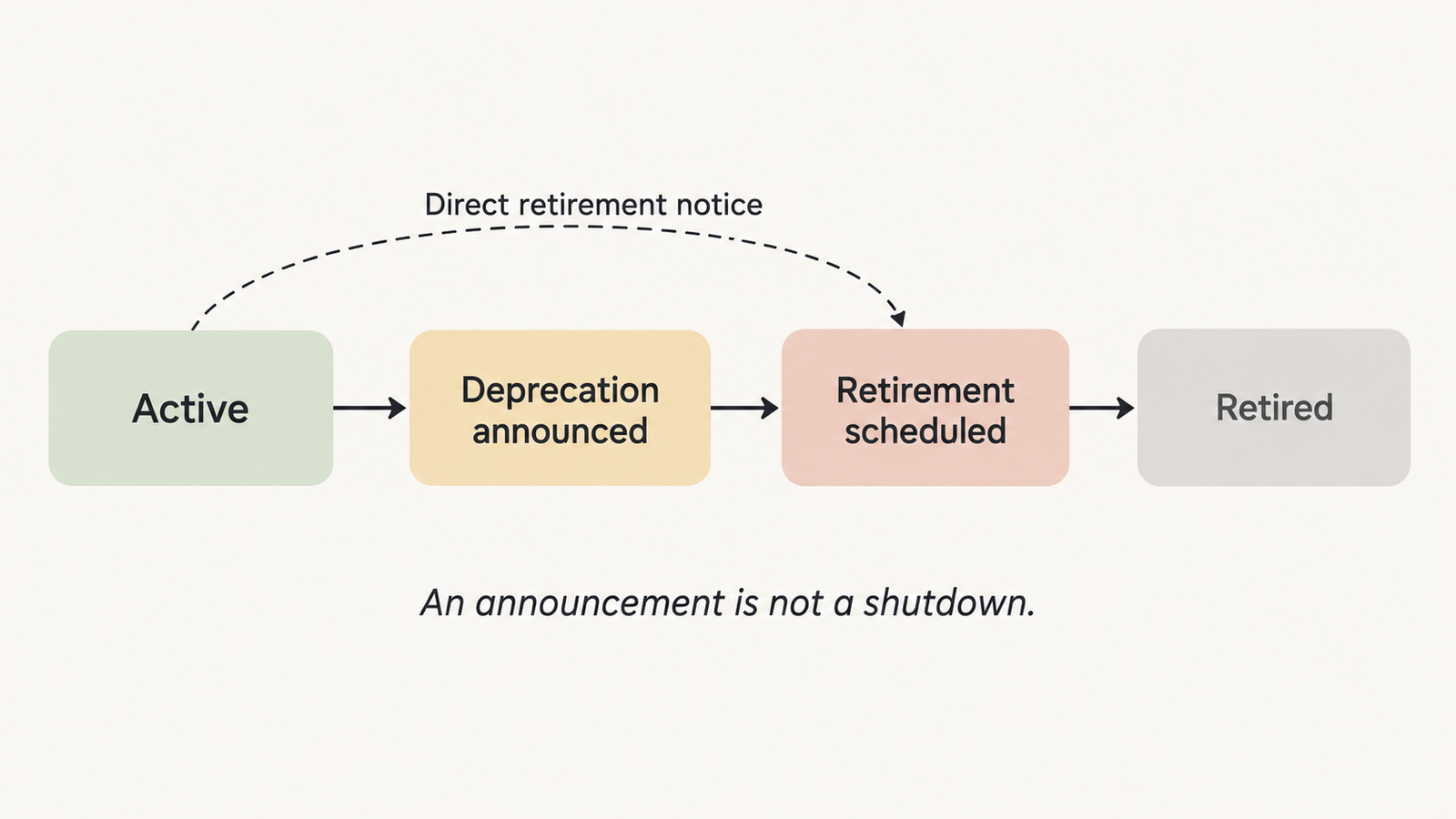
A retirement date is also scoped to a platform. Claude Opus 4.1 stopped working on the Claude API on 2026-08-05 but runs on Bedrock until 2027-01-08. Teams that call the same model through two clouds have two deadlines.
Finally, a date in a table isn’t proof that the shutdown happened. Google’s dates are explicitly the earliest possible, and Bedrock’s page lists models under “reached EOL” by Region. The only reliable check is to call the model ID from your own account.
Why model deprecation dates matter for AI infrastructure and costs
The cost of a retirement is rarely the replacement’s token price. It is the work forced by the deadline: inventorying where the ID is used, re-running evaluations, rewriting prompts that relied on one model’s habits, and re-approving outputs in regulated workflows. UniverseBlend’s guide to what breaks when your model version retires maps that work week by week. A tracker only tells you when it has to be finished.
Replacement models have different economics even when they are described as more capable. Anthropic’s recommended successor to claude-3-haiku-20240307 is claude-haiku-4-5-20251001, which its pricing page lists at $1 input and $5 output per million tokens. A team moving off a small, older model should re-budget rather than assume the new one costs the same. Reasoning-mode replacements can produce more output tokens for the same task. Embedding replacements, such as Cohere’s v2 to v4 or Google’s gemini-embedding-001 to gemini-embedding-2, mean re-embedding every stored document. That is a compute bill and a re-indexing window, not a config change.
Serving and capacity change too. Bedrock blocks new Provisioned Throughput for Legacy models, and Azure does not auto-upgrade provisioned deployments, so reserved capacity has to be re-bought or re-created on the new model. Latency and throughput profiles differ between models, which can change how many replicas or how much rate-limit headroom a service needs.
Contracts and regions add another layer. A team on Azure may have more time than one on the OpenAI API, but Azure’s dates “aren’t extendable”. AWS lets a private arrangement continue access past EOL, but that depends on the provider. If your AI contract doesn’t state notice periods, the questions in our model vendor risk checklist are the ones to raise before the next renewal.
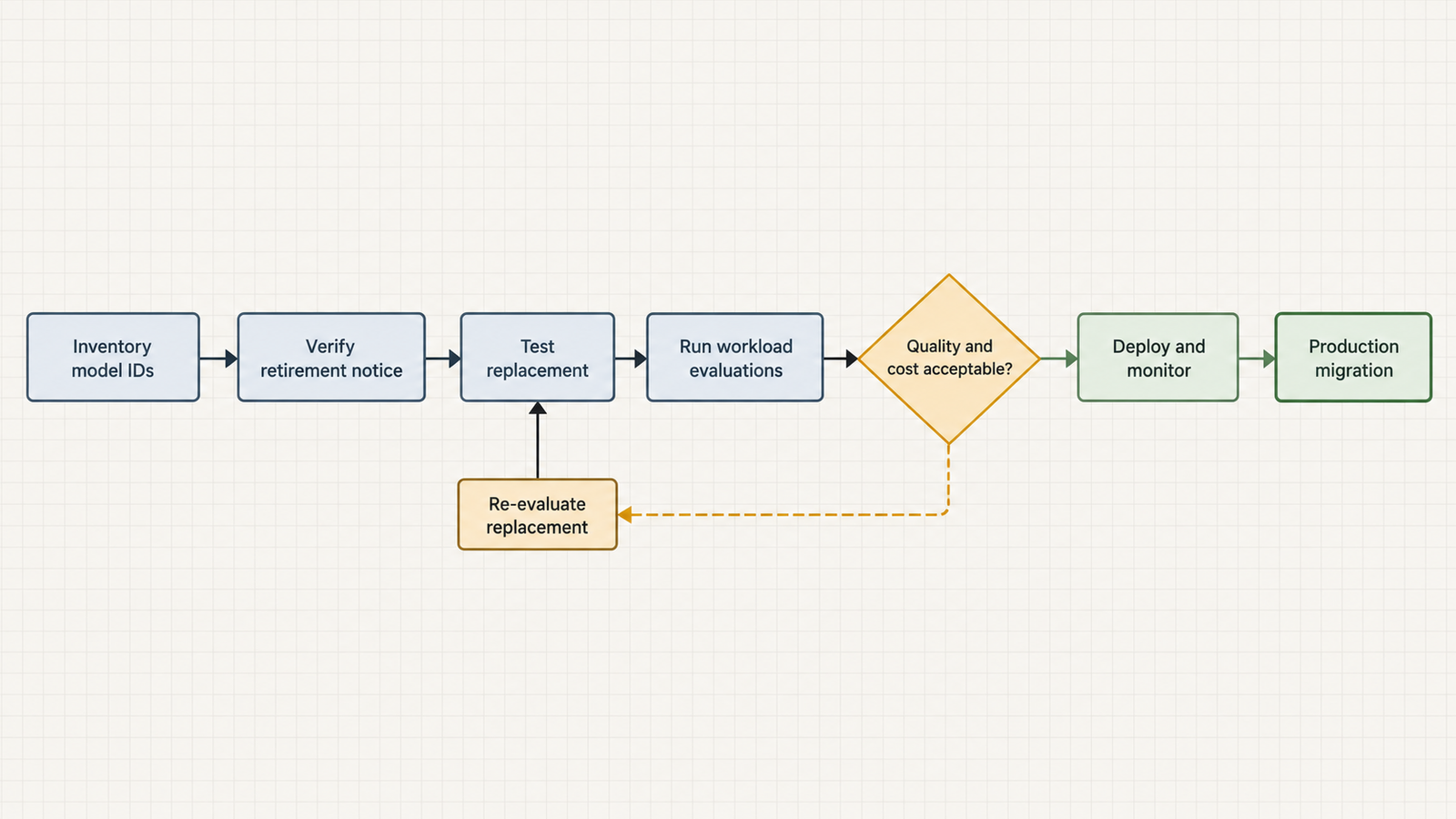
A practical model migration checklist
- Inventory every model ID in code, config, infrastructure templates, notebooks and scheduled jobs. Record the platform (direct API, Azure, Bedrock, Google Cloud), region and environment for each, because dates differ between them.
- Confirm the notice at the source. Read the provider’s lifecycle page and note both the announcement date and the retirement date. Check the replacement’s own retirement date, too.
- Shortlist the named replacement and one alternative. The provider’s recommendation is a starting point, not a guarantee that it fits your workload.
- Compare cost, latency and throughput on your real request mix, including output-token counts on reasoning models.
- Run your own evaluation set, 50 to 200 real, anonymised examples scored against a written rubric. Public benchmarks can screen candidates but can’t choose for you, as our LLM benchmark comparison explains.
- Validate the contracts the application depends on: tool-calling schemas, structured-output parsing, refusal behaviour, token limits, streaming and any
reasoningparameters. - Test the rollout and the rollback in staging. Keep the old ID callable until the cutover is proven, because after the retirement date there is nothing to roll back to.
- Update configuration, dashboards and alerts. Alert on
404,410and model-not-found errors by model ID, so that a missed reference shows up as an alarm instead of a customer complaint. - Finish before the deadline, not on it. Rolling, region-by-region upgrades and timezone ambiguity make the final day unreliable.
- Record the migration date and the evaluation result, so the next retirement starts from a known baseline.
How the model deprecation dates in this tracker are maintained
Every row was checked by hand against the linked provider page on 22 October 2026. There is no automated monitoring behind this page, and coverage is selective, not exhaustive. The tracker includes models and endpoints that are likely to sit in production systems, plus examples that show how lifecycle rules work.
The planned review cadence is monthly, with an extra update whenever a provider publishes a notice that affects a listed row or a widely used model. The page keeps two dates separate. A row’s announcement date belongs to the provider, and the last-verified date belongs to UniverseBlend. The article’s modified date changes only when a row’s data changes, a row is added or removed, or the guidance is materially revised. Re-checking a page without finding a change updates the last-verified date but not the modified date.
Frequently Asked Questions
What are model deprecation dates?
They are the dates a provider publishes to mark lifecycle changes for a specific model ID: when it was deprecated, and when it will be retired or shut down. Providers use different terms, so read each one’s definitions.
Does deprecated mean a model is no longer available?
Usually not. Anthropic, Azure and Cohere all keep deprecated models working for existing users until the retirement date. Azure and Cohere close them to new customers on deprecation.
How can I check whether an AI model has been retired?
Check the provider’s lifecycle page for your platform, then call the model ID from your own account. On Bedrock, the modelLifecycle field in ListFoundationModels reports the state per Region. Azure’s Models API exposes a deprecationDate.
What happens when an AI model reaches its retirement date?
Requests to it fail. Microsoft documents a 410 Gone response, and Anthropic says requests to retired models fail. The exception is auto-upgrade or auto-routing, which some Azure deployments and some Google IDs use. There, requests succeed but a different model answers them.
How do I find the recommended replacement for a retired model?
Use the provider’s deprecation notice, which usually names one. Bedrock’s lifecycle page does not, and Mistral’s models page doesn’t either. In those cases, choose from the provider’s active model list and evaluate the candidates yourself.
Should production systems use model aliases or dated model identifiers?
Pinned identifiers are the safer default for production. Aliases such as -latest can change the model without a code change. Anthropic’s IDs from the 4.6 generation onward are fixed snapshots even without a date suffix. Check each provider’s convention.
How often should a model deprecation tracker be checked?
Monthly at minimum, and whenever a provider emails a notice. Short preview windows (30 days on Azure) mean that quarterly checks can miss a deadline entirely.
Can a provider change a retirement date?
The policies differ. Microsoft says its retirement dates “aren’t extendable”. Google presents its dates as the earliest possible and confirms exact dates separately. AWS allows continued access past EOL only under a private arrangement with the model provider. Assume a date can move earlier for previews, and don’t plan around it moving later.
Keep reading
Here are the latest posts from the blog.
Model Deprecation Tracker: Retirement Dates by Provider

Context Engineering: Cost, Latency and Security in AI Agents
AI API Pricing 2026: Every Model, Input and Output