On the official price lists, GPT-6.1 Sol costs half as much per token as Claude Opus 5.5: $2 against $4 per million input tokens, and $10 against $20 for output. Send each model one 300,000-token prompt that returns a 2,000-token answer, though, and the bills come out at $1.23 and $1.24. OpenAI doubles the input rate once a prompt passes 272,000 tokens. Anthropic charges Opus 5.5 the same rate across its whole 1M-token window. The headline ratio says 2:1. For that request, the real ratio is close to 1:1.
That gap between the published rate and the invoice is the subject of this guide. The tables below give the verified rates. The rest of the guide covers the rules that decide what you actually pay.
Key Takeaways
- Output tokens usually decide the bill. In the worked example below, output is 2 million of 22 million tokens but makes up roughly half of the cost before caching and nearly all of what remains after it.
- Cache reads cost 2% to 10% of the ordinary input rate, depending on provider and model. Caching discounts only the input side, so in the worked example a 98% hit rate on the cache-eligible tokens cuts the bill by about 31%, not 90%.
- Cache writes are a separate line item at OpenAI (1.25× input for 30 minutes) and Anthropic (1.25× for 5 minutes, 2× for one hour). DeepSeek and Google bill caching differently, so cached rates are not like-for-like across providers.
- Long-context thresholds can reprice a whole request. OpenAI’s GPT-6 models double input and cache rates above 272K input tokens. Gemini 3.1 Pro Preview reprices above 200K. Opus 5.5 has no long-context tier.
- Three of the requested names do not match a documented, priced API model: Qwen 4, a current first-party Llama API price, and an official Kimi K3 price we could read directly. Details are in the status table.
- Gemini 3.6 Flash prices double on 1 January 2027, according to Google’s pricing page. Any budget that runs into next year needs both rates.
Quick Navigation
- AI API pricing comparison: the October 2026 snapshot
- Which requested models could be verified
- The cost behind the headline rate
- Cached-input pricing in practice
- A worked example: 22 million tokens, with and without caching
- When a cheaper model costs more
- Hosted API versus open-weight deployment
- A practical API cost-estimation method
- What changes the bill
- Conclusion
- Frequently asked questions
- Which AI API is cheapest for input tokens?
- Which AI API is cheapest for output tokens?
- Which providers offer cached-input pricing?
- How much can prompt caching save?
- Does batch processing reduce API costs?
- Why does long-context pricing sometimes increase?
- Are open-weight models cheaper than hosted APIs?
- How should a startup estimate its monthly API bill?
- How often should AI API prices be rechecked?
AI API pricing comparison: the October 2026 snapshot
All prices below are in US dollars per one million tokens, for the standard (real-time) service tier, as published on each provider’s official pricing page and checked on 22 October 2026. Providers did not all change prices on that date; it is simply the date we checked. The table is split in two so it stays readable on a phone. Table 1 gives the token rates, and Table 2 gives the conditions that change them.
Table 1. Token rates (USD per 1M tokens, standard tier, verified 22 Oct 2026)
Table: scroll sideways to view all columns when needed.
| Provider | Model / API ID | Input | Output | Cached input | Cache writes |
|---|---|---|---|---|---|
| OpenAI | GPT-6.1 Sol gpt-6.1-sol | $2.00 | $10.00 | $0.10 | $2.50 (30-min TTL); $5.00 (12-h TTL) |
| OpenAI | GPT-6 Sol gpt-6-sol | $2.00 | $10.00 | $0.20 | $2.50 |
| OpenAI | GPT-6 Luna gpt-6-luna | $0.10 | $0.50 | $0.01 | $0.125 (30-min); $0.25 (12-h) |
| Anthropic | Claude Opus 5.5 | $4.00 | $20.00 | $0.20 | $5.00 (5-min); $8.00 (1-h) |
| Anthropic | Claude Sonnet 5.5 | $2.00 | $10.00 | $0.10 | $2.50 (5-min); $4.00 (1-h) |
Gemini 3.1 Pro Preview gemini-3.1-pro-preview | $2.00 | $12.00 | $0.20 | Storage: $4.50 per 1M tokens per hour | |
Gemini 3.6 Flash gemini-3.6-flash | $0.75 | $3.75 | $0.075 | Storage: $0.50 per 1M tokens per hour | |
| Mistral | Mistral Large 4 mistral-large-4 | $1.36 | $4.18 | $0.14 | Not published |
| DeepSeek | deepseek-v4-pro (V4-Pro-0813) | $1.32 | $3.96 | $0.044 | Not applicable (misses billed as input) |
| DeepSeek | deepseek-flash (V4.1-Flash-1017) | $0.30 | $1.20 | $0.006 | Not applicable (misses billed as input) |
| Alibaba Cloud | Qwen3.8-Max qwen3.8-max | $2.00 | $6.00 | See pricing conditions | Not published |
| MiniMax | MiniMax-M3.1-Flash | $0.15 | $0.60 | $0.015 | Not published |
| Moonshot AI | Kimi K3 kimi-k3 | $3.00* | $15.00* | $0.30* | Not verified |
Kimi K3 figures are from Together AI’s serverless price list, a third-party host. Moonshot’s own price table did not render for verification. DeepSeek rates are peak-hour rates; off-peak rates are half.
Table 2. Conditions that change the rate
Table: scroll sideways to view all columns when needed.
| Model | Long-context tier | Batch discount | Pricing condition |
|---|---|---|---|
| GPT-6.1 Sol, GPT-6 Sol, GPT-6 Luna | Above 272K input tokens: 2× input and cache rates, 1.5× output, for the whole request | 50% (Batch and Flex) | Fast mode 2×; regional processing +10% |
| Claude Opus 5.5, Sonnet 5.5 | None; full 1M window at standard rates | 50% | US-only inference 1.1×; Opus 5.5 Fast mode $8 / $40 |
| Gemini 3.1 Pro Preview | Above 200K: $4.00 input, $18.00 output, $0.40 cache | 50% | Preview model |
| Gemini 3.6 Flash | None listed | 50% | From 1 Jan 2027: $1.50 / $7.50 / $0.15 cache |
| Mistral Large 4 | Not published | Not published for this model | Public Preview (v26.10) |
| DeepSeek V4 Pro and Flash | None; 1M context | Not published | Off-peak 50% off; peak is 01:00–04:00 and 06:00–10:00 UTC on weekdays |
| Qwen3.8-Max | Single tier, 0–1M | Not labelled | Batch and cache discounts cannot be combined |
| MiniMax-M3.1-Flash | Not published | Not published | No effective date shown |
| Kimi K3 | No context-length tiering (official quickstart) | Not verified | Cache writes billed by 5-min or 1-h TTL; rates not verified |
Table labels. Not published: the provider’s official page gives no figure. Not applicable: the provider’s billing model has no such charge. Not verified: a figure exists but we could not confirm it on an official page. See pricing conditions: the rate depends on a rule described elsewhere. A missing cache price never means free caching.
Which requested models could be verified
This article started from a list of model names. Not all of them match a documented API product.
Table: scroll sideways to view all columns when needed.
| Requested name | Status | What we found |
|---|---|---|
| GPT-6 Sol | Verified current model | Still priced on its own model page, but GPT-6.1 Sol is newer and has cheaper cache reads |
| GPT-6 Luna | Verified current model | Priced as listed above |
| Opus 5.5 | Verified current model | Claude Opus 5.5, priced as listed above |
| Gemini 3.1 Pro | Verified, preview | API ID gemini-3.1-pro-preview |
| Gemini 3.6 Flash | Verified current model | Rates double on 1 Jan 2027; Gemini 3.8 Flash has the same rates |
| Llama | No first-party API price located | Llama 4 (April 2025) is the latest Llama release; Meta’s newest open-weight model is Muse Spark Open |
| Qwen 4 | Name could not be verified | Alibaba’s newest documented models are Qwen3.8-Max and Qwen3.8 Flash |
| Mistral Large 4 | Verified, Public Preview | Released 6 October 2026 |
| MiniMax M3.1 Flash | Verified current model | $0.15 / $0.60 is correct, in USD per 1M tokens |
| DeepSeek | Verified current models | Two models, with peak and off-peak pricing |
| Kimi | Verified model; price unconfirmed at source | kimi-k3 is current; the official price table did not render |
Two corrections are worth stating plainly. No Alibaba documentation we found describes a “Qwen 4”, so this article prices Qwen3.8-Max instead and labels it as Qwen3.8-Max. On Mistral, the marketing pricing page still says “Mistral Large costs $0.5 /M tokens in and $1.5 /M tokens out”. The developer documentation shows that rate belongs to Mistral Large 3. Large 4 lists at $1.36 and $4.18.
The cost behind the headline rate
A pricing page lists up to six token categories, and a real request can touch all of them.
- Ordinary input is every prompt token that the provider processes from scratch: the system prompt, tool definitions, retrieved documents, conversation history and the user’s message.
- Output covers every token the model generates. On reasoning models that includes hidden thinking tokens. Google says this directly: Gemini output prices include thinking tokens. A model that thinks for 4,000 tokens before writing a 300-token answer bills 4,300 output tokens.
- Cached input is prompt content the provider has already processed and stored, so it is billed at a reduced read rate.
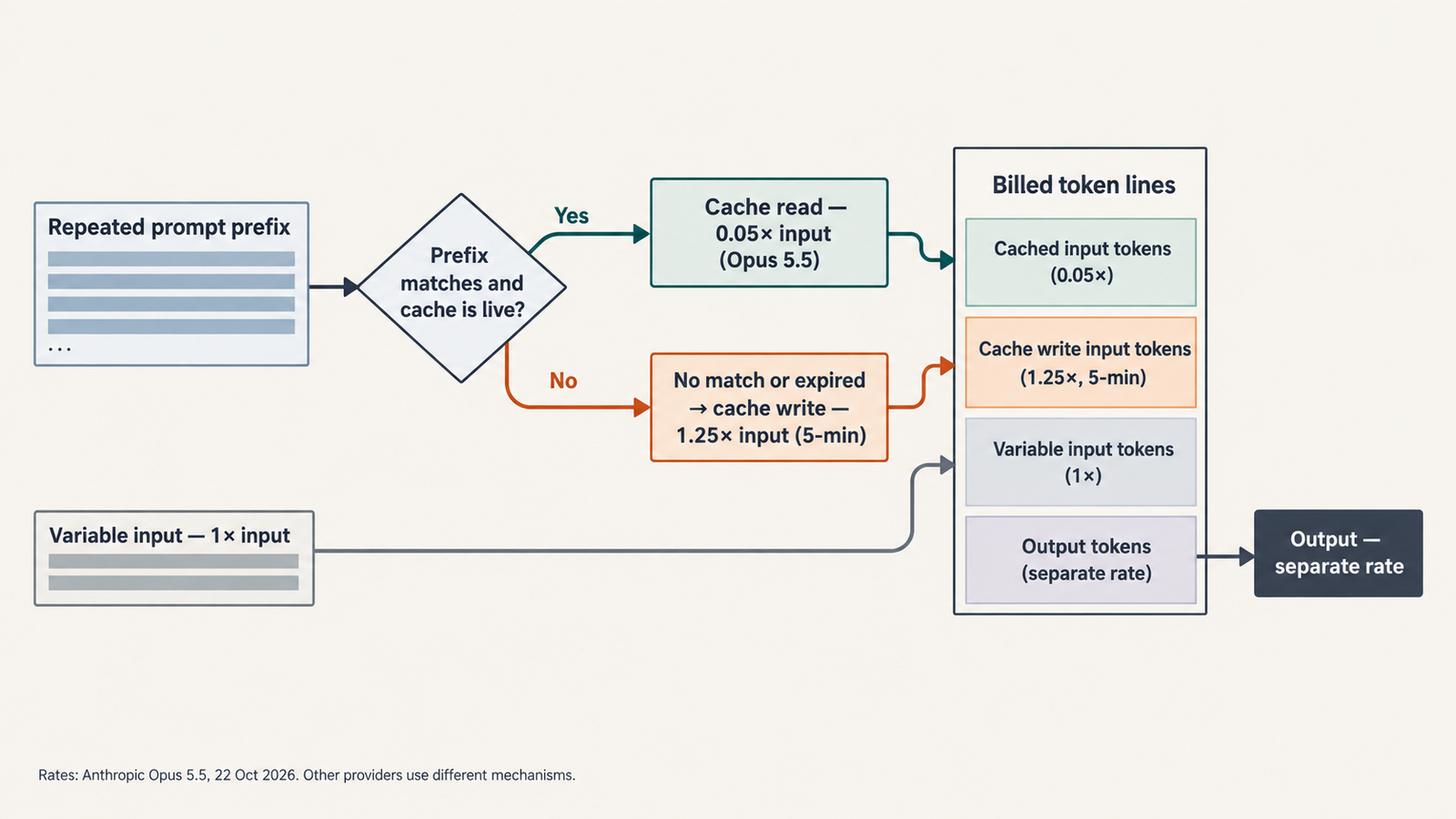
- Cache writes are the cost of storing that prefix the first time. OpenAI and Anthropic charge a premium for this. Google instead charges hourly storage on explicit caches.
- Long-context tiers reprice a request once its prompt passes a threshold. OpenAI applies the higher rate to the entire request, not just the tokens above the line.
- Batch pricing takes 50% off at OpenAI, Anthropic and Google in exchange for asynchronous processing. It suits evaluations, backfills and document processing. It doesn’t suit anything a user is waiting on.
The headline input and output pair is therefore the lowest price a request can reach, with no conditions applied. Most real workloads pay for at least two of the other four categories.
Cached-input pricing in practice
Prompt caching stores the processed form of a repeated prompt prefix, so the provider can skip recomputing it on the next request. The provider passes part of that saving back as a lower rate on the tokens that hit the cache. The mechanism differs enough between providers that a cached rate on one page is not directly comparable with a cached rate on another.
Anthropic’s prompt-caching documentation uses explicit breakpoints, with up to four per request. The minimum cacheable prompt for Opus 5.5 is 512 tokens. The default cache lives for five minutes and is refreshed at no cost each time it is used. A 5-minute write costs 1.25× the base input rate and a 1-hour write costs 2×. Reads cost 0.1× on most models, but 0.05× on Opus 5.5 and Sonnet 5.5. Changing a tool definition invalidates the whole cache.
OpenAI’s prompt-caching guide says GPT-5.6 and later support both implicit and explicit caching. The minimum is 1,024 tokens. The default lifetime is at least 30 minutes, and a 12-hour option is available in the Responses API. Writes cost 1.25× ordinary input for the 30-minute lifetime and 2.5× for 12 hours. Reads cost 0.1×, or 0.05× on GPT-6.1 Sol. The guide adds that “cache-write pricing is not an additive fee”: each input token is billed at exactly one rate.
Google’s context-caching documentation says implicit caching is on by default for Gemini 2.5 and newer, with a 4,096-token minimum on Gemini 3.1 Pro Preview and 3.6 Flash. Explicit caches add hourly storage charges, listed on the pricing page.
DeepSeek lists only two input rates, cache hit and cache miss. A cache miss is simply the ordinary input rate.
Three practical consequences follow:
- A cache hit is not guaranteed. The prefix has to match exactly. Any change to a timestamp, a tool list or a thinking setting early in the prompt breaks it.
- Writes cost money only at some providers. At Anthropic, a 1-hour cache write costs 2× input. The prefix must then be read at least twice before the write pays for itself.
- A cheaper read rate does not guarantee a cheaper bill. It does nothing to output, and it does nothing if your traffic pattern lets the cache expire between requests.
A worked example: 22 million tokens, with and without caching
This example is hypothetical. The workload is invented to show the mechanics. The rates are Anthropic’s official Opus 5.5 rates as listed on 22 October 2026.
Workload
- 10,000,000 ordinary input tokens (user messages and retrieved documents that change on every request).
- 10,000,000 cache-eligible input tokens: a 50,000-token shared prefix (system prompt, tool definitions and a reference document) sent with 200 requests.
- 2,000,000 output tokens.
Assumption about cache creation. Traffic gaps let the 5-minute cache expire four times, so the prefix is written four times: 4 × 50,000 = 200,000 write tokens. The remaining 9,800,000 cache-eligible tokens are reads.
Rates (Opus 5.5, USD per 1M tokens): input $4.00; 5-minute cache write $5.00; cache read $0.20; output $20.00.
Formula: Total = (ordinary input × input rate) + (cache writes × write rate) + (cache reads × read rate) + (output × output rate), with each token count divided by 1,000,000.
Table: scroll sideways to view all columns when needed.
| Line | Tokens | Rate | Cost |
|---|---|---|---|
| Ordinary input | 10,000,000 | $4.00 | $40.00 |
| Cache writes (5-min) | 200,000 | $5.00 | $1.00 |
| Cache reads | 9,800,000 | $0.20 | $1.96 |
| Output | 2,000,000 | $20.00 | $40.00 |
| Total with caching | $82.96 | ||
| Total without caching (20M input at $4) | $120.00 |
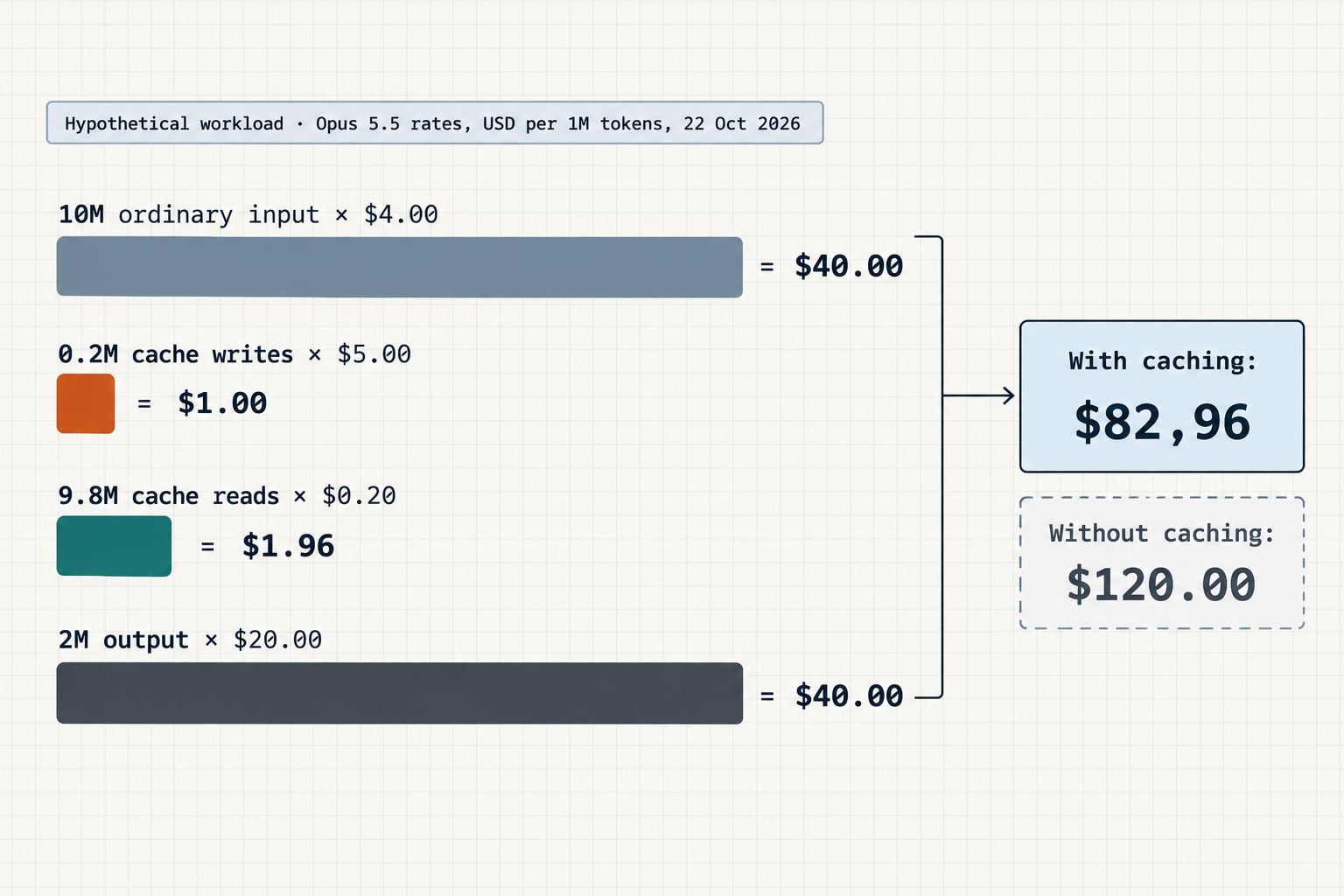
Caching saves $37.04, or 30.9%. On the cached tokens alone, the effective rate falls from $4.00 to about $0.30 per million (writes plus reads, divided by 10 million). The total bill falls by less than a third, because ordinary input and output make up $80 of what remains, and caching touches neither.
The same workload on GPT-6.1 Sol, at $2.00 input, $2.50 write, $0.10 read and $10.00 output, costs $41.48 with caching against $60.00 without. That is the same 30.9% saving, because OpenAI’s write and read multipliers for this model happen to mirror Anthropic’s. Switching to 1-hour Anthropic writes ($8.00) raises the Opus total to $83.56. That costs more here, but it would cost less if longer gaps between requests were forcing extra rewrites.
When a cheaper model costs more
The opening example has a sharper version. GPT-6.1 Sol, with a 270,000-token prompt and a 2,000-token answer:
- 270,000 × $2.00 + 2,000 × $10.00 = $0.56
Add 10,000 tokens to that prompt, taking it to 280,000:
- 280,000 × $4.00 + 2,000 × $15.00 = $1.15
A 3.7% longer prompt roughly doubles the cost, because the long-context rate applies to the whole request. At 300,000 tokens, GPT-6.1 Sol ($1.23), Gemini 3.1 Pro Preview ($1.24 at its above-200K rates) and Opus 5.5 ($1.24) all land within about a cent of each other. In that band, a choice between them should rest on output quality and latency rather than price.
The second trap is costing a single call instead of a successful task. Cost per success = cost per attempt ÷ success rate. Hypothetical example: a pipeline step sends 20,000 input tokens and receives 3,000 output tokens. On MiniMax-M3.1-Flash ($0.15 / $0.60) one attempt costs $0.0048; on Opus 5.5 ($4 / $20) it costs $0.10. Even if the small model succeeds half the time and Opus 5.5 nine times in ten, the token cost per success is about $0.01 against $0.11. On tokens alone, the cheaper model still wins.
What flips the comparison is what a failure sets off: a human review, a rolled-back change, a customer ticket. If each failure costs $2 of someone’s time, the expected cost per attempt becomes about $1.00 for the small model and $0.30 for Opus 5.5. These success rates are invented for illustration. Measure your own before treating any per-token figure as the cost of the work.
Hosted API versus open-weight deployment
Several models in the table publish their weights: Mistral Large 4 (weights promised), Kimi K3, Qwen3.8-Max (released openly as Qwen3.8-2.4T-A95B) and Meta’s Muse Spark Open. That makes them available to self-host. It doesn’t make them free.
The hosted rates above are directly comparable with each other. Self-hosted costs are not comparable with them on a per-token basis until you supply your own figures for:
- GPU rental or ownership cost per hour, and how many GPUs the model needs at your chosen quantization.
- Achieved throughput in tokens per second at your real batch size and input/output mix.
- KV-cache memory for your context lengths, which caps concurrency.
- Utilisation: an accelerator that sits idle 80% of the time costs five times more per token than one at full load.
- Engineering, orchestration, monitoring, storage and on-call time.
UniverseBlend’s breakdown of self-hosted LLM cost and its five hidden fees works through these layers with stated assumptions. For current accelerator rates, see our GPU cloud pricing 2026 guide. We do not quote a universal self-hosted price per million tokens, because no honest one exists.
Third-party hosts sit between the two. Together AI lists Llama 3.3 70B at $1.04 per million tokens for both input and output, and DeepSeek V4 Pro at the same $1.32 and $3.96 DeepSeek charges at peak. Hosted open-weight prices can match or exceed the original lab’s API, so check both.
A practical API cost-estimation method
- Log a representative day of traffic and count tokens per request in four buckets: stable prefix, variable input, visible output and reasoning output.
- Find the prefix share. If 40% or more of input tokens repeat across requests within the cache lifetime, caching is worth engineering for.
- Estimate the hit rate honestly. Count how often gaps between requests exceed the cache lifetime (5 minutes, 30 minutes or 1 hour, depending on provider and setting). Each gap means another write.
- Check every threshold. Record your 95th-percentile prompt length and compare it against 200K (Gemini 3.1 Pro), 272K (GPT-6 family), 256K (several Qwen3.x Plus and Flash models) and 512K (MiniMax-M3).
- Apply the formula for each candidate model and multiply by monthly volume.
- Move what can wait to batch. Anything that can tolerate hours of delay usually gets 50% off.
- Add a margin for retries and failed requests. Our analysis of AI API rate limits in 2026 explains why failed calls still consume capacity.
What changes the bill
- OpenAI: whole-request repricing above 272K input tokens; cache writes at 1.25× (30 minutes) or 2.5× (12 hours); Fast mode at 2×; regional processing at +10% for models released on or after 5 March 2026.
- Anthropic: no long-context surcharge on Opus 5.5; a 512-token cache minimum; US-only inference at 1.1×.
- Google: the above-200K tier on Gemini 3.1 Pro Preview; Flash prices doubling on 1 January 2027; hourly storage for explicit caches.
- DeepSeek: time-of-day pricing, with weekday peak windows at double the off-peak rate.
- Alibaba Model Studio: tiered input pricing on many Qwen Plus and Flash models; batch and cache discounts that cannot be stacked.
- MiniMax: M3 pricing that changes above 512K input tokens; a Priority tier at 1.5×.
Conclusion
Pick the model on quality for your task first. Then let cost choose between the models that pass. Within that shortlist:
- Output-heavy work (long generation, agents that write code): compare output rates first.
- Prefix-heavy work (support bots, RAG with a fixed corpus, agents with long tool lists): compare cache read and write rates, and check whether your traffic keeps the cache warm.
- Long-document work above 200K tokens: the threshold matters more than the headline rate.
- Offline work: price it at batch rates.
Recheck the rates before you commit a budget. Three of the prices in this article carry a known end date, a preview label or a pending change.
Frequently asked questions
Which AI API is cheapest for input tokens?
Among the models checked on 22 October 2026, GPT-6 Luna has the lowest standard input rate, at $0.10 per million tokens. DeepSeek’s deepseek-flash drops to $0.15 off-peak, and MiniMax-M3.1-Flash is $0.15. These are small models, though, and not substitutes for frontier models on hard tasks.
Which AI API is cheapest for output tokens?
GPT-6 Luna, at $0.50 per million output tokens. Among the larger models, DeepSeek V4 Pro ($3.96 at peak, $1.98 off-peak) and Mistral Large 4 ($4.18) cost well below Opus 5.5 ($20) and Gemini 3.1 Pro Preview ($12).
Which providers offer cached-input pricing?
All of the providers verified here publish a cached-input rate except Alibaba, which points to a separate caching page instead of listing a per-model figure. Cache-write charges and eligibility rules differ by provider.
How much can prompt caching save?
The read discount is roughly 90% to 98% on cached tokens, depending on the model. On a whole bill, the saving depends on how much of the input is a repeated prefix and how much of the cost is output. In our worked example it was about 31%.
Does batch processing reduce API costs?
Yes. OpenAI, Anthropic and Google each publish 50% off for asynchronous batch jobs. The other providers’ batch discounts could not be verified per model.
Why does long-context pricing sometimes increase?
Longer prompts need more compute and memory per request, and some providers price that in with a threshold. OpenAI applies its higher rate to the entire request once the prompt passes 272K input tokens.
Are open-weight models cheaper than hosted APIs?
Only at sustained, high utilisation with engineering capacity to spare. The weights are free to download, but running them means paying for hardware, operations and idle capacity.
How should a startup estimate its monthly API bill?
Measure real token counts per request, split them into prefix, variable input and output, apply each candidate model’s formula, and then add 10% to 20% for retries. Recheck after the first month of production traffic.
How often should AI API prices be rechecked?
Monthly at minimum, and before any budget commitment. This snapshot already contains a scheduled price change (Gemini Flash) and two preview-labelled models.
How these prices were checked. Every rate in Tables 1 and 2 was read from the provider’s official pricing or model page on 22 October 2026, except the Kimi K3 rates, which are labelled as third-party. Totals and derived long-context rates are our own calculations from those published rules.
Keep reading
Here are the latest posts from the blog.

AI API Pricing 2026: Every Model, Input and Output

What the Model Context Protocol Actually Is, and What It Opens Up
Chinese Open-Weight Models Compared: DeepSeek vs Qwen & More