Last updated: 25 November 2026. The Entity List rule is scheduled for formal publication in the Federal Register on 25 November.
On Monday 23 November, two institutions made decisions about the same story within hours of each other. Nvidia’s board announced that Jensen Huang was back as president and chief executive, 12 days after his resignation took effect. That afternoon, the US Commerce Department filed a rule adding Megaspeed, a Singapore-based AI cloud company, and six related companies in Malaysia, Singapore and Thailand to its Entity List.
A corporate board chose who runs a company. A federal committee chose which foreign businesses need a US licence to receive American technology. Neither document says one decision caused the other.
They belong together because both lead back to one question. How do you control where advanced AI chips end up when they are bought in one country, installed in a second and used from a third? This case file separates what is confirmed from what is alleged.
Key Takeaways
- Nvidia reinstated Jensen Huang effective 22 November and announced it on 23 November.
- BIS listed seven companies: three under Malaysia, three under Singapore (including Megaspeed) and one under Thailand.
- The listing covers all items subject to the EAR, with a presumption of denial, from 23 November.
- A designation is an export control, not a criminal finding. No charges have been announced.
- Singapore bills, Malaysia hosts, and all three countries now face a separate advanced-chip licence rule.
- Physical diversion and remote access raise different legal questions; a 16 November rule now covers large-scale remote access.
- Compliance now reaches the data centre, where exporters must check who is using the compute.
- US, Singaporean, Malaysian and Nvidia investigations remain open.
Quick Navigation
- Megaspeed: what happened and when
- What the Megaspeed Entity List designation means
- Megaspeed and the seven companies named by the US
- How Nvidia's leadership crisis unfolded
- Why Southeast Asia matters to the Megaspeed case
- Megaspeed, chip diversion and offshore compute access
- What the Megaspeed case means for AI infrastructure companies
- What happens next for Megaspeed
- FAQ
- What is Megaspeed, and why was it added to the US Entity List?
- Which seven companies were added with Megaspeed?
- Does the Megaspeed designation ban all business with the company?
- Does the designation prove Megaspeed committed a crime?
- What is the difference between chip diversion and offshore GPU leasing?
- Why did Nvidia reinstate Jensen Huang?
- Is the Megaspeed investigation finished?
Megaspeed: what happened and when
Megaspeed International Pte. Ltd. sells AI computing capacity built on Nvidia hardware. In December 2025, Bloomberg described it as a spinoff of a Chinese gaming business that had become, in under three years, “the single largest Southeast Asian buyer of Nvidia Corp. chips.”
Most of the official chronology comes from a joint Commerce and Justice Department statement dated 16 November.
Table: scroll sideways to view all columns when needed.
| Date | Event | What is confirmed | Source |
|---|---|---|---|
| 2024 | Commerce opens an investigation | For “potential export control violations” | Commerce–DOJ |
| Feb 2025 | Singapore police and customs investigate server purchase declarations | Among several companies investigated | Singapore Home Affairs Ministry |
| May 2025 | Commerce asks Nvidia for records of direct or indirect sales to the company | Stated by both departments | Commerce–DOJ |
| June 2025 | Nvidia adds the company to its “no sell” list | Nvidia says the cutoff remains | Commerce–DOJ; Nvidia |
| June 2025 | US agents and Singaporean officers carry out an end-use check and interview CEO Alice Huang | Stated by both departments | Commerce–DOJ |
| 11 Nov 2026 | Nvidia’s board accepts Huang’s resignation; CFO Colette Kress becomes interim CEO | Effective immediately; announced 12 Nov | Nvidia Form 8-K |
| 16 Nov 2026 | Timeline published; DOJ leads the criminal investigation; BIS issues a remote-access rule | No charges announced | Commerce–DOJ; BIS |
| 22 Nov 2026 | Nvidia’s board reinstates Huang | Effective immediately | Nvidia Form 8-K |
| 23 Nov 2026 | Reinstatement announced; Entity List rule filed for public inspection at 4:15 pm | Rule in force from public inspection | Nvidia; Federal Register |
| 25 Nov 2026 | Formal Federal Register publication | Scheduled | Federal Register |
The Nvidia dates are easy to blur. Its Form 8-K gives 22 November as the effective date of the reinstatement. Nvidia announced it on 23 November and signed the filing that day. The resignation followed the same pattern: accepted on 11 November, announced the next morning.
What the Megaspeed Entity List designation means
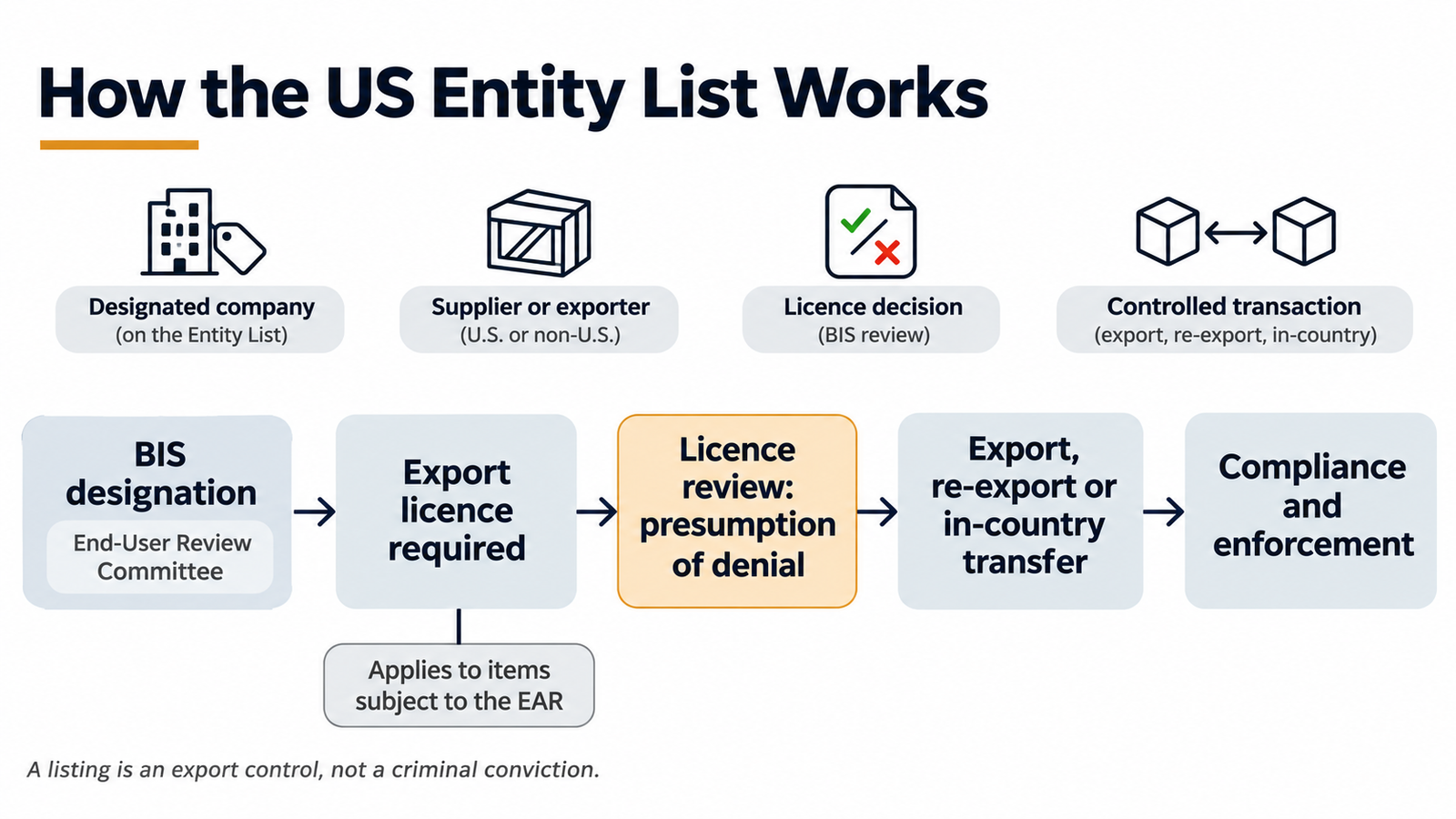
The Entity List is run by the Bureau of Industry and Security (BIS), the Commerce agency that administers the Export Administration Regulations (EAR). Additions are decided by majority vote of the End-User Review Committee, an interagency group chaired by Commerce. The legal test, in section 744.11(b) of the EAR, is reasonable cause to believe, based on specific and articulable facts, that a party poses a significant risk of acting against US national security or foreign policy interests.
The rule gives its reason in one sentence: “the significant risk of these entities being or becoming involved in the diversion of advanced computing commodities to unauthorized end uses or end users.”
Each exporter, re-exporter or transferor must check whether a deal needs a licence, and shipping without one risks enforcement action.
Table: scroll sideways to view all columns when needed.
| Provision | What the rule says | What it means in practice |
|---|---|---|
| Licence requirement | “For all items subject to the EAR” | Far more than GPUs: US-origin goods, software and technology, plus some foreign-made items |
| Review policy | “Presumption of denial” | BIS starts from refusal; applicants must overcome it |
| Transactions covered | Exports, re-exports and in-country transfers | Applies inside Malaysia, Singapore and Thailand too |
| Effective date | The date of public inspection | In force from 23 November |
| Savings clause | Shipments already en route under actual orders | May proceed if completed within 30 days |
Why a foreign company falls under US rules
The EAR follows the item rather than the company’s nationality. A US-origin chip stays “subject to the EAR” after it leaves the United States, and some foreign-made products built with US technology are covered too. A distributor in Taiwan selling covered items to a listed company in Malaysia still needs a US licence.
What a Megaspeed listing does not mean
A listing is not a criminal conviction or a charge, and the Justice Department has announced no charges. It is also not a Treasury sanctions designation, which would freeze assets and block most dealings. It controls which items can flow to these seven companies.
Megaspeed and the seven companies named by the US
Table: scroll sideways to view all columns when needed.
| Listed destination | Legal entity name | Aliases and listed locations | Relevant designation |
|---|---|---|---|
| Malaysia | MSFusion Sdn. Bhd. | Johor Bahru, Kuala Lumpur, Eko Galleria (Johor), Kota Tinggi | All EAR items; presumption of denial |
| Malaysia | PT Megaspeed International | Eko Galleria (Johor), Johor Bahru, Klang | All EAR items; presumption of denial |
| Malaysia | Speedmatrix Sdn Bhd. | a.k.a. Speedmatrix; same addresses as PT Megaspeed | All EAR items; presumption of denial |
| Singapore | Apex Enterprise Solutions (Singapore) Private Limited | a.k.a. Apex; Bras Basah Road | All EAR items; presumption of denial |
| Singapore | Megaspeed International Pte. Ltd. | a.k.a. 7Road International; Beach Road, Collyer Quay | All EAR items; presumption of denial |
| Singapore | Swiftdata Pte. Ltd. | Sin Ming Lane, Venture Drive | All EAR items; presumption of denial |
| Thailand | Megaspeed (Thailand) Co., Ltd. | a.k.a. 7Road International; Bangkok | All EAR items; presumption of denial |
That is three companies under Malaysia, three under Singapore, including Megaspeed itself, and one under Thailand.
The country heading shows where the list places each company, not who owns it or where it was incorporated. “PT” is the Indonesian form for a limited company, yet PT Megaspeed International is listed under Malaysia with three Malaysian addresses. The rule doesn’t explain how the seven are related, and shared names or addresses alone don’t prove ownership.
How Nvidia’s leadership crisis unfolded
Nvidia’s 8-K gives no reason for Huang’s departure. On the 17 November earnings call, board chair Harvey Jones called it a “voluntary resignation” for “personal behaviour inconsistent with the company’s code of conduct,” Al Jazeera reported. He said the board “does not intend to reinstate Jensen as CEO.”
Five days later, it reversed course. Nvidia’s announcement says the vote was unanimous. Independent directors had formed a committee to investigate “in light of recent reporting that Mr. Huang has been the target of a foreign intelligence effort.” The board said it “received input from senior levels of the United States government” and concluded the reinstatement “poses no national security risk.”
According to Al Jazeera, US officials have accused Alice Huang of working with China’s Ministry of State Security, as first reported by the New York Times and Financial Times. No court has tested the claim, and she has not commented publicly. China called it “groundless speculation.” Singapore’s Home Affairs Ministry said she was not investigated there for espionage. Police found insufficient evidence of offences over server declarations, but warned her for knowingly understating her role and barred her from re-entering. The Commerce–DOJ statement mentions neither Jensen Huang nor espionage.
On 16 November, President Donald Trump told reporters he “would not mind” Huang’s return. Of Alice Huang, he said: “I don’t know that she was a spy at all.” After the reinstatement, he said he had personally intervened with the board, according to Al Jazeera. The board’s statement names no official.
Nvidia’s governance changes after Megaspeed
The independent directors’ investigation “will proceed to conclusion.” A new National Security and Export Control Committee of independent directors will “oversee trade compliance and national security risks.” A new Chief Compliance Officer will report to the Nominating and Corporate Governance Committee, and Nvidia says it will keep cooperating with government investigations.
The reporting line matters: a compliance chief who answers to independent directors can raise concerns about senior management without going through them. None of this is an admission of wrongdoing.
The market reaction
Nvidia closed at $165.05 on 23 November, up $39.52, or 31.5%, from $125.53, according to Yahoo Finance. The S&P 500 rose 4.7% and the Nasdaq about 6.5%, after seven straight down days for the S&P. Nomura’s Charlie McElligott attributed much of the move to short covering and options hedging. The reinstatement set off the rally; positioning and a market-wide rebound shaped its size.
Why Southeast Asia matters to the Megaspeed case
Singapore is where chips are billed. In the quarter to July 2025, Nvidia reported $10.2 billion billed to Singapore, 22% of revenue, according to The Wall Street Journal’s Heard on the Street. Prime Minister Lawrence Wong has said most advanced chips recorded as Singapore sales never cross its borders. On 17 November he said Singapore could facilitate US checks and would take “clear and firm” action against circumvention, The Star reported.
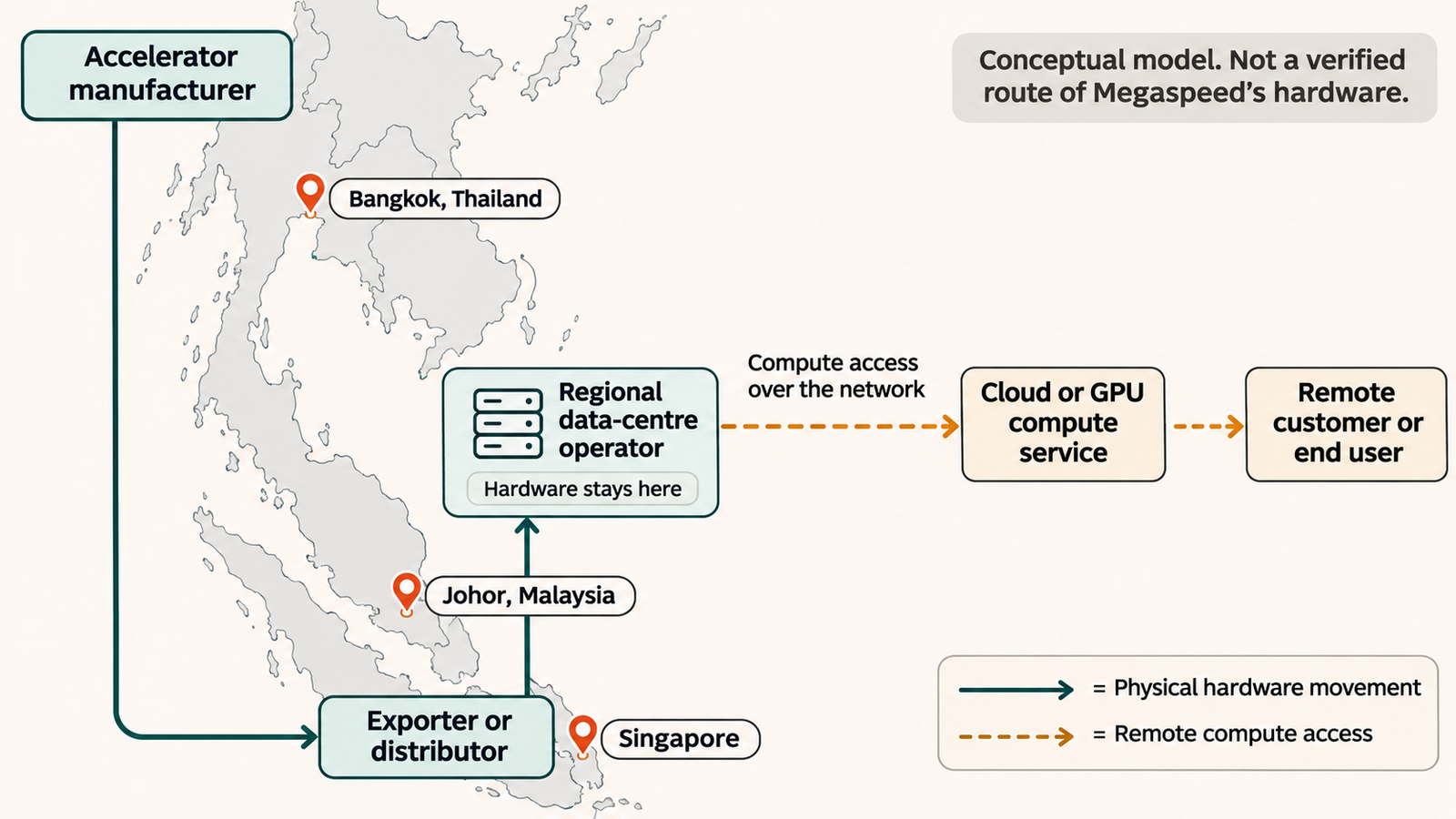
Malaysia is where the hardware sits. Five of the seven distinct Malaysian addresses in the rule are in Johor, across the causeway from Singapore. Malaysia’s trade ministry, MITI, says Speedmatrix is a tenant at Malaysian data centres that brings in its own servers and chips. Importing chips needs no permit, but re-exporting US AI chips has required one since July 2025. MITI says it “never cleared” either company and is checking with customs whether chips left Malaysia lawfully.
Thailand is the smallest piece. The rule lists one company at an office tower in central Bangkok and says nothing about what it operates.
On 16 November, BIS put all three countries, plus Indonesia and Brazil, on a new list requiring a licence for the most advanced AI chips. Buyers headquartered in the US can be exempt if exporters file reports. That covers shipments to every data-centre operator there, listed or not.
Megaspeed, chip diversion and offshore compute access
Export controls were built to track objects crossing borders. A GPU rented out by the hour from a rack in Johor hasn’t been exported to anyone. Until 16 November, Al Jazeera noted, Chinese firms could legally use remote access to top-end computing in countries such as Singapore and Malaysia. We covered that gap in our piece on how offshore GPU leasing complicates export controls.
The remote-access rule BIS announced on 16 November narrows it. According to Pillsbury’s summary, a licence is now needed when a data centre provides more than 12 million units of “aggregate TPP”, a measure of processing performance, to companies headquartered in Macau or Country Group D:5, which includes China. Existing arrangements have 90 days to get one.
Table: scroll sideways to view all columns when needed.
| Arrangement | What physically moves | Where the hardware remains | Relevant export-control question |
|---|---|---|---|
| Physical chip export | Chips or servers | The buyer’s site | Is a licence needed for this destination and user? |
| Hardware ownership | Legal title | The owner’s data centre | Who is the real end user? |
| Server leasing | Rack space | The operator’s facility | Does the operator know who its tenant serves? |
| GPU compute leasing | Nothing physical | A regional data centre | Who is the main user, and how much compute? |
| Cloud access | Data and results | The provider’s region | Where is the customer headquartered? |
| Remote AI training | Data in, model out | The data centre abroad | Does a D:5-headquartered firm benefit? |
| Unauthorised physical diversion | Chips moved on without a licence | Somewhere other than declared | A potential violation, the conduct under investigation |
These arrangements aren’t legally equivalent, and leasing to lawful customers isn’t illegal. The company has not been charged or found to have broken any rule.
Bloomberg reported that the company had imported tens of thousands more chips than Nvidia counted when checking its data centres. If chips are where they should be, the question is who uses them. If they aren’t, the question is where they went.
What the Megaspeed case means for AI infrastructure companies
Table: scroll sideways to view all columns when needed.
| Stakeholder | Immediate implication | Main compliance or business concern |
|---|---|---|
| Nvidia | Board oversight and a compliance chief | Showing its customer checks work |
| GPU distributors and server makers | Licence for any EAR item to the seven | Screening affiliates and former names |
| Data-centre operators | Tenants face new scrutiny | Knowing who a tenant’s customers are |
| Cloud and GPU-as-a-service providers | Remote-access licence above the threshold | Verifying customer headquarters |
| Investors and lenders | Hardware tied to listed firms is harder to move | Collateral and tenant risk |
| Enterprise customers | Buying compute stays lawful | Provider compliance clauses |
| Regional governments | Pressure to tighten re-export checks | Data-centre investment versus US trust |
Bloomberg reported in April that Bain Capital’s Bridge Data Centres had replaced Megaspeed with another tenant at a Malaysian facility where 68.4 megawatts had been earmarked for it, according to a memo to lenders.
Compliance is moving from the shipping dock to the server rack. Exporters must now ask data centres how they vet customers, and a refusal presumptively establishes “knowledge” unless resolved. That adds cost, and it feeds into how export controls reshape the economics of AI compute.
What happens next for Megaspeed
These developments are confirmed or scheduled:
- Federal Register publication on 25 November, with a 30-day savings clause for goods in transit.
- The US criminal investigation, led by the Justice Department. No charges have been announced.
- Singapore’s police investigation into the company and six individuals.
- Malaysia’s checks on possible unlawful re-exports.
- Congress. Commerce Secretary Howard Lutnick has agreed to testify before the Senate Banking Committee on 10 December, CBS News reported. Treasury Secretary Scott Bessent said other agencies had favoured a listing “for months, but Commerce has the pen.”
Beyond those, prosecutors could bring charges or close the case, and the company could seek removal from the list, which the EAR allows.
Megaspeed says it runs a “legitimate and lawful business.” In a 15 November statement reported by the Associated Press, it said media claims about its business and supply chain were “not supported by verifiable evidence,” and that outside counsel was conducting an internal investigation.
Whatever investigators find, the rules have already moved. A month ago, renting GPUs in Johor to a China-headquartered customer was largely outside US export rules. Now it needs a licence above a threshold, and seven companies need one for any item subject to the EAR.
FAQ
What is Megaspeed, and why was it added to the US Entity List?
It is a Singapore-based seller of AI computing built on Nvidia chips. BIS listed it and six related companies over a “significant risk” of involvement in diverting advanced computing items.
Which seven companies were added with Megaspeed?
MSFusion, PT Megaspeed International and Speedmatrix under Malaysia; Apex Enterprise Solutions, Megaspeed International and Swiftdata under Singapore; and Megaspeed (Thailand).
Does the Megaspeed designation ban all business with the company?
No. It requires a US licence for any item subject to the EAR, and applications are presumed to be denied. It is not an asset freeze.
Does the designation prove Megaspeed committed a crime?
No. It reflects a judgment about risk. No charges have been announced, and the company says it operates lawfully.
What is the difference between chip diversion and offshore GPU leasing?
Diversion moves hardware where its licence doesn’t allow. Leasing keeps hardware in place and sells access, which is lawful for permitted customers.
Why did Nvidia reinstate Jensen Huang?
The board said input from senior US officials satisfied it that his return posed no national security risk.
Is the Megaspeed investigation finished?
No. US, Singaporean and Malaysian inquiries are all ongoing.
Keep reading
Here are the latest posts from the blog.
Megaspeed Explained: How Nvidia’s Chip Scandal Reached Southeast Asia

Browser Agents Compared: What Can They Actually Do in 2026?
UBTECH Walker S2: The Humanoid Robot Built for Factory Work