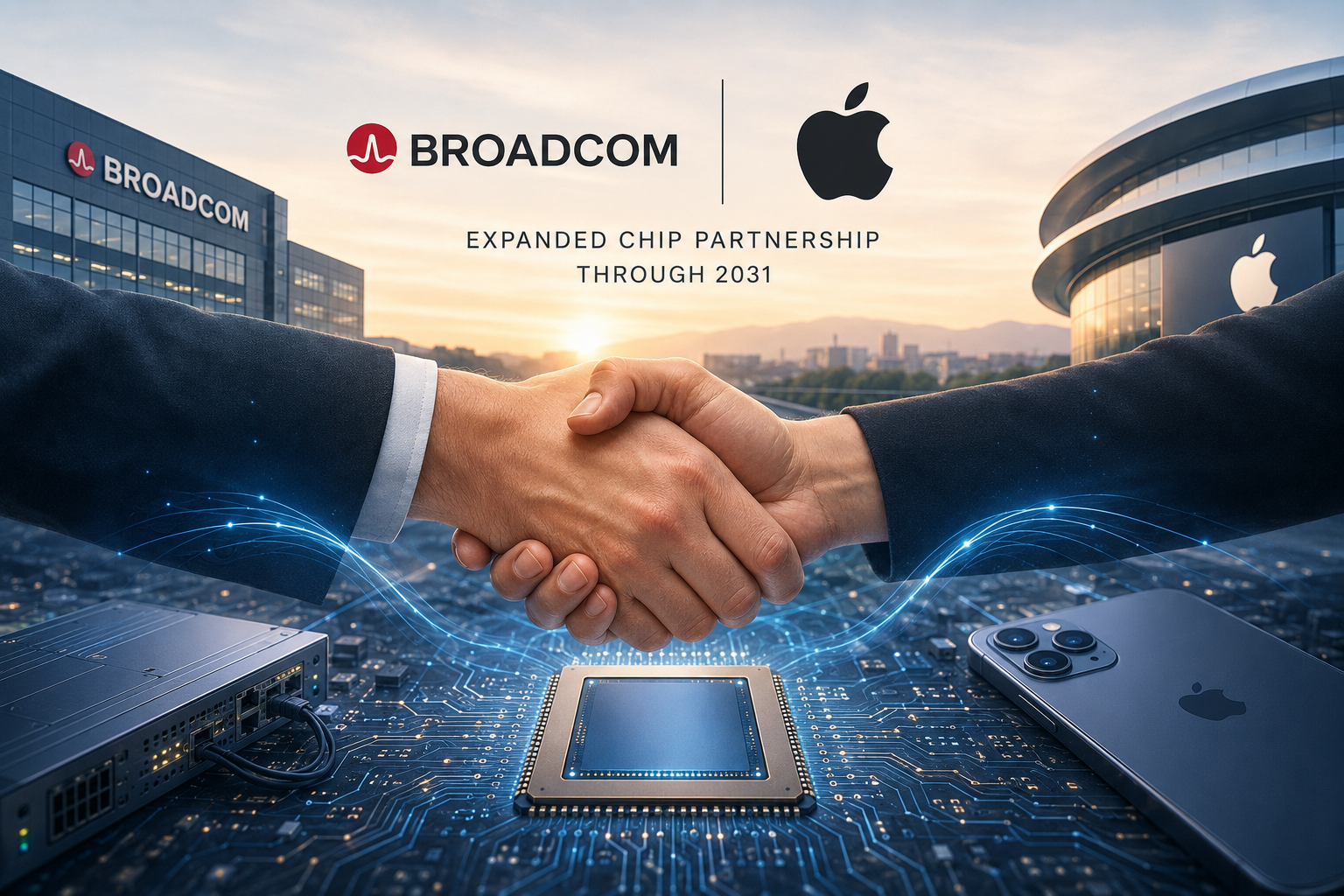
The broadcom apple expanded chip partnership through 2031 is, honestly, one of the most significant deals in a decade of covering this industry. Announced in May 2023 and valued at billions of dollars, it locks Broadcom in as a primary supplier of custom silicon for Apple’s product lineup — and the ripple effects go well beyond these two companies.
But why should you care? Because this isn’t a routine vendor renewal. Apple’s doubling down on vertical integration, Broadcom’s securing its most valuable customer, and competitors like Qualcomm and Intel are watching nervously from the sidelines. Furthermore, this deal carries real implications for AI compute, geopolitical risk, and the future of consumer electronics hardware. It’s worth paying attention.
Why the Broadcom Apple Expanded Chip Partnership Through 2031 Matters
This isn’t just another procurement deal — not even close.
The broadcom apple expanded chip partnership through 2031 represents a fundamental shift in how tech giants think about hardware strategy. Apple already designs its own M-series and A-series processors, which is impressive on its own. However, it still relies on specialized components from partners like Broadcom for things it hasn’t — or can’t — bring fully in-house yet.
Specifically, Broadcom supplies several critical components for Apple devices:
- Wi-Fi and Bluetooth chips used across iPhones, iPads, and Macs
- Radio frequency (RF) filters essential for 5G connectivity
- Custom wireless modules designed exclusively for Apple products
- Touch controllers and other sensor components
And here’s the thing: these aren’t off-the-shelf parts you could swap out with something from another vendor. Apple and Broadcom co-develop many of these components together. Consequently, the relationship runs far deeper than a typical buyer-supplier arrangement — Broadcom dedicates entire engineering teams and manufacturing capacity specifically to Apple’s roadmap. That level of commitment is genuinely unusual in this industry.
To put it in concrete terms: when Apple’s silicon team begins planning a new iPhone generation roughly two to three years before launch, Broadcom engineers are already in the room. They’re not responding to a spec sheet — they’re helping write it. That kind of early-stage involvement means Broadcom’s wireless components are tuned to Apple’s power budgets, antenna geometries, and thermal envelopes before a single prototype is built. No third-party supplier working from a finished spec can match that level of integration, which is exactly why switching costs are so high on both sides.
Moreover, this partnership anchors Broadcom’s revenue in a significant way. Apple accounted for approximately 20% of Broadcom’s net revenue in fiscal 2023, according to its Form 10-K. Losing that business would be catastrophic, so both sides have strong incentives to make this work long-term.
The 2031 timeline is notably ambitious — and that’s an understatement. Most semiconductor supply agreements span three to five years. An eight-year commitment signals deep trust and genuinely aligned strategic visions. Additionally, it gives both companies the stability to invest in next-generation technologies without constantly worrying about contract renewals eating up executive bandwidth. A shorter deal, say through 2026, would force both sides back to the negotiating table right as Wi-Fi 7 devices are hitting mainstream adoption — precisely the worst moment to introduce uncertainty into a joint engineering program.
Supply Chain Resilience and Geopolitical Risk Reduction
One of the most underappreciated angles of the broadcom apple expanded chip partnership through 2031 is what it does for supply chain resilience. The COVID-19 pandemic exposed just how fragile global chip supply chains really are — and Apple, like every major tech company, learned some painful lessons during the 2020–2022 chip shortage. The anxiety in the industry during those years was palpable.
Consider what actually happened during that period: Apple reportedly had to delay production of certain iPad models because it couldn’t secure enough display driver chips, and the company was forced to cannibalize components originally allocated to Macs in order to keep iPhone lines running. Those aren’t abstract supply chain problems — they translate directly into missed revenue quarters and frustrated customers who wait months for backordered products. A long-term commitment with guaranteed allocation priority is a direct response to exactly that kind of disruption.
Locking in a long-term partnership reduces several key risks:
1. Supply allocation priority — Broadcom will prioritize Apple’s orders over smaller customers during shortages
2. Manufacturing planning — Eight years of demand visibility lets Broadcom invest in capacity without guessing
3. Technology co-development — Joint R&D ensures components match Apple’s exact specifications years in advance
4. Pricing stability — Long-term agreements typically include negotiated pricing frameworks that protect both parties
A practical tip for supply chain managers watching this deal: the allocation priority point is often underestimated. During a shortage, a supplier with a long-term contractual obligation to a customer will protect that customer’s volumes first and reduce shipments to spot-market buyers. Companies that rely on short-term or transactional purchasing arrangements are always last in line — and last in line during a chip shortage can mean six to twelve months of production delays.
Geopolitical tensions add another layer of urgency here. The U.S.-China trade war has disrupted semiconductor supply chains repeatedly, and there’s no sign of that changing anytime soon. Although Broadcom is headquartered in the United States, global chip manufacturing still exposes both companies to multiple jurisdictions. Nevertheless, having a committed U.S.-based partner meaningfully reduces Apple’s dependence on suppliers in geopolitically sensitive regions.
The CHIPS and Science Act, signed into law in 2022, provides federal incentives for domestic semiconductor manufacturing. This legislation aligns almost perfectly with the Broadcom-Apple partnership — both companies can tap government support to build or expand U.S.-based production facilities. Importantly, this reduces reliance on overseas fabrication plants, which is a big deal in the current climate.
Similarly, Apple has been diversifying its assembly operations beyond China, expanding manufacturing in India and Vietnam. A stable chip supply from Broadcom complements this geographic diversification strategy nicely. Together, these moves create a more resilient end-to-end supply chain — one that’s a lot harder to disrupt. Think of it as a layered defense: Apple is diversifying assembly geography at the same time it’s locking in component supply from a domestic partner. Either measure alone is helpful; together they significantly reduce the number of single points of failure in the production process.
Competitive Advantages Over Qualcomm, Intel, and Other Rivals
The broadcom apple expanded chip partnership through 2031 doesn’t exist in a vacuum. It directly reshapes the competitive picture, and some players feel it more than others.
Here’s how the major players compare:
Table: scroll sideways to view all columns when needed.
| Factor | Broadcom + Apple | Qualcomm | Intel | MediaTek |
|---|---|---|---|---|
| Partnership duration | Through 2031 | No long-term Apple deal | No Apple relationship | No Apple relationship |
| Custom silicon capability | Deep co-development | Standard modem supply | Foundry services only | Off-the-shelf chips |
| Revenue dependency | ~20% from Apple | Declining Apple revenue | Minimal Apple exposure | Zero Apple revenue |
| 5G/Wi-Fi expertise | Industry-leading | Strong in modems | Limited | Growing |
| AI integration focus | Increasing | Strong | Strong | Moderate |
| U.S. manufacturing | Expanding | Limited | Significant | Minimal |
Qualcomm is the biggest loser here. Apple has been developing its own 5G modem to replace Qualcomm’s chips — that’s not a secret. Although Qualcomm extended its modem supply deal with Apple through 2026, the writing is on the wall. Apple wants to own its entire wireless stack, and Broadcom’s partnership helps bridge that gap by providing complementary RF and connectivity components in the meantime.
The tradeoff worth noting: as Apple internalizes more modem functionality, Broadcom’s role in the wireless stack could theoretically shrink too. The difference is that Broadcom has actively co-evolved its roadmap with Apple’s, whereas Qualcomm has largely supplied standard modem silicon. That distinction — co-development partner versus component vendor — is what gives Broadcom durability that Qualcomm lacks in this relationship. Qualcomm sells Apple a product; Broadcom helps Apple build one.
Meanwhile, Intel’s struggles in mobile and its pivot to foundry services make it largely irrelevant to Apple’s component strategy. Conversely, MediaTek focuses primarily on Android devices and doesn’t compete directly for Apple’s business. So the field is less crowded than it looks.
The broadcom apple expanded chip partnership through 2031 gives both companies a genuine competitive moat — the kind that’s hard to replicate. Apple gets guaranteed access to best-in-class wireless components. Broadcom gets revenue stability alongside a prestigious design partner. Competitors can’t easily copy that kind of deep, long-term collaboration. It takes years to build, which is precisely the point.
How This Partnership Drives AI Compute Strategy
This deal isn’t just about Wi-Fi chips and RF filters anymore. It’s increasingly about AI — and that’s easy to miss if you’re only reading the headlines.
The broadcom apple expanded chip partnership through 2031 runs straight through Apple’s AI ambitions. Apple Intelligence, announced in 2024, relies heavily on on-device processing for AI tasks. That approach demands highly efficient, tightly integrated hardware — and every component matters, including the wireless chips that handle data transfer between devices and cloud services.
Broadcom’s custom components play a crucial role in this AI strategy:
- Low-latency wireless connectivity enables faster communication with Apple’s Private Cloud Compute servers
- Power-efficient RF modules preserve battery life during AI workloads
- Custom neural processing support in connectivity chips reduces bottleneck effects
- Edge computing integration allows smarter data routing between on-device and cloud AI
Here’s a concrete scenario that illustrates why this matters: when a user asks Siri to summarize a long email thread using Apple Intelligence, the system decides in real time whether to handle that request on-device or offload it to Private Cloud Compute. That routing decision depends on available compute, battery state, and network latency. If the wireless chip can’t deliver a fast, reliable connection with minimal power draw, the experience degrades — responses slow down, battery drains faster, and the whole feature feels unreliable. Broadcom’s custom RF modules are a direct input to whether that experience feels magical or mediocre.
Additionally, Broadcom itself is a serious player in AI infrastructure. The company supplies custom AI accelerators to hyperscale data centers, and its networking chips power the backend infrastructure that companies like Google and Meta use for AI training. Therefore, Broadcom brings AI expertise from both the consumer and enterprise sides at once — which is a genuinely rare combination.
This creates a fascinating bridge between consumer hardware and enterprise AI infrastructure. Apple’s partnership with Broadcom mirrors, in some ways, Microsoft’s massive infrastructure bets on AI compute. Both strategies recognize that hardware partnerships now drive software capabilities — you simply can’t build great AI experiences without great silicon underneath. That’s not marketing fluff; it’s just physics.
Notably, the long 2031 timeline gives both companies real room to co-develop AI-specific wireless technologies. Wi-Fi 7 and future Wi-Fi 8 standards will incorporate AI-driven features like intelligent beamforming and predictive channel selection. Broadcom is already a leader in Wi-Fi 7 technology, and having Apple as a committed partner accelerates development and deployment of these innovations considerably. The timeline isn’t just about security — it’s about what you can actually build when you’re not worried about contract renewals.
What This Means for Investors and the Broader Market
The financial implications of the broadcom apple expanded chip partnership through 2031 are substantial. Wall Street pays close attention to long-term commitments like this one, and for good reason — they provide revenue visibility that analysts consistently value above almost everything else.
For Broadcom investors, the deal offers several benefits:
1. Predictable revenue stream from Apple for nearly a decade
2. Justification for increased R&D spending on custom silicon
3. Protection against customer concentration risk through a formal agreement
4. Enhanced credibility when pursuing other major partnerships
For Apple investors, the advantages are equally clear:
1. Supply chain stability reduces the risk of product delays
2. Custom components create differentiation that competitors can’t easily match
3. Long-term pricing agreements protect margins
4. Reduced litigation risk compared to adversarial supplier relationships
The broader semiconductor market benefits too. Long-term partnerships encourage investment in manufacturing capacity and signal confidence in continued demand for advanced chips. Furthermore, they set a precedent that other companies are already starting to follow — extended agreements have become noticeably more common over the past 18 months. Samsung and Google have deepened their Tensor chip collaboration along similar lines, and Amazon has pursued long-horizon agreements with its Annapurna Labs partners. The Broadcom-Apple deal didn’t create this trend, but it’s the clearest and most public example of where the industry is heading.
However, risks exist, and it’s worth being honest about them. An eight-year commitment means less flexibility. If a superior technology emerges from a different supplier — and in semiconductors, that’s never impossible — Apple may be stuck with Broadcom’s approach. Although contracts typically include performance benchmarks and exit clauses, switching costs remain genuinely high. There’s also an innovation risk running in the other direction: if Apple’s internal teams develop wireless capabilities faster than expected, Broadcom could find itself supplying components for a shrinking slice of Apple’s stack. The 2031 timeline is long enough that both scenarios are plausible, which is why the performance benchmarks embedded in these agreements matter so much.
The Semiconductor Industry Association has noted that long-term partnerships between designers and suppliers are becoming more common. This trend reflects the increasing complexity and cost of chip development — no single company can do everything alone. Consequently, strategic alliances like the Broadcom-Apple deal will likely become the norm rather than the exception over the next decade.
Importantly, this partnership also affects the job market in a tangible way. Broadcom has committed to investing in U.S.-based engineering talent specifically for Apple-related projects. That means more high-paying semiconductor jobs in states like California, Texas, and Massachusetts. The ripple effects extend to universities, research labs, and the broader innovation ecosystem. Engineering programs at schools like Stanford, MIT, and Carnegie Mellon are already seeing increased recruiting interest from both companies — and that pipeline of talent, built over years, becomes another structural advantage that competitors can’t quickly replicate.
Conclusion
The broadcom apple expanded chip partnership through 2031 is far more than a supply agreement. It’s a strategic blueprint for how hardware partnerships will shape the next decade of technology. From supply chain resilience to AI compute strategy, this deal touches every critical dimension of modern tech competition.
Here are actionable takeaways for different audiences:
- Investors should monitor Broadcom’s quarterly earnings for Apple-related revenue trends. The partnership provides a floor for Broadcom’s semiconductor segment — and that floor matters.
- Tech professionals should watch how custom wireless components evolve. The co-development model between Broadcom and Apple will influence industry hiring and skill requirements significantly.
- Supply chain managers should study this deal as a template. Long-term partnerships with guaranteed capacity allocation are becoming essential in a volatile geopolitical environment.
- Competitors need to respond. Qualcomm, Intel, and MediaTek must find their own strategic anchors or risk falling further behind — and the window isn’t getting any wider.
Bottom line: the broadcom apple expanded chip partnership through 2031 confirms that vertical integration and deep supplier relationships aren’t optional anymore. They’re survival strategies. Companies that master hardware partnerships will dominate the AI era. Those that don’t will struggle to keep up — and struggling to keep up in semiconductors is a very expensive problem to have.
FAQ
What does the Broadcom Apple expanded chip partnership through 2031 actually cover?
The deal covers Broadcom’s development and supply of custom components for Apple devices. Specifically, this includes Wi-Fi and Bluetooth chips, RF filters for 5G connectivity, and other custom wireless modules. Both companies’ engineering teams co-develop these components together — it’s not a catalog order situation. The partnership extends through 2031, making it one of the longest semiconductor supply agreements in the industry.
How much revenue does Apple generate for Broadcom?
Broadcom reported that Apple accounted for approximately 20% of its net revenue in fiscal 2023. However, exact figures fluctuate quarterly based on product launch cycles. Notably, this revenue concentration is precisely why the long-term agreement matters so much to Broadcom’s financial stability — it converts uncertainty into predictability.
Will this partnership affect Qualcomm’s relationship with Apple?
Yes, it likely will. Apple has been working to reduce its dependence on Qualcomm by developing its own 5G modem. Broadcom’s expanded chip partnership through 2031 with Apple complements this effort directly. While Qualcomm still supplies modems to Apple through 2026, the long-term trend points clearly toward Apple internalizing more wireless capabilities. Broadcom fills the gaps that Apple can’t yet handle in-house — and that’s a meaningful advantage.
How does this deal reduce geopolitical supply chain risk?
Both Broadcom and Apple are U.S.-headquartered companies. By committing to a long-term partnership, they reduce dependence on suppliers in geopolitically sensitive regions. Additionally, the CHIPS Act incentivizes domestic chip production, and this alignment between corporate strategy and government policy strengthens supply chain resilience against trade disruptions and export controls considerably.
What role does AI play in the Broadcom-Apple partnership?
AI is an increasingly important dimension — and it’s going to become the dominant one. Apple’s on-device AI features, branded as Apple Intelligence, require highly efficient wireless components to function well. Broadcom’s custom chips enable low-latency data transfer between Apple devices and cloud servers. Furthermore, future wireless standards like Wi-Fi 7 and Wi-Fi 8 will incorporate AI-driven features, and the partnership gives both companies time to co-develop those advanced technologies together rather than scrambling at the last minute.
Should investors buy Broadcom stock because of this partnership?
This article doesn’t provide financial advice — heads up on that. Nevertheless, the broadcom apple expanded chip partnership through 2031 does offer meaningful revenue visibility that analysts tend to respond to positively. Investors should consider the full picture, including Broadcom’s AI infrastructure business, its VMware acquisition, and broader market conditions. Consulting a financial advisor before making investment decisions is always the right move.
References
Keep reading
Here are the latest posts from the blog.
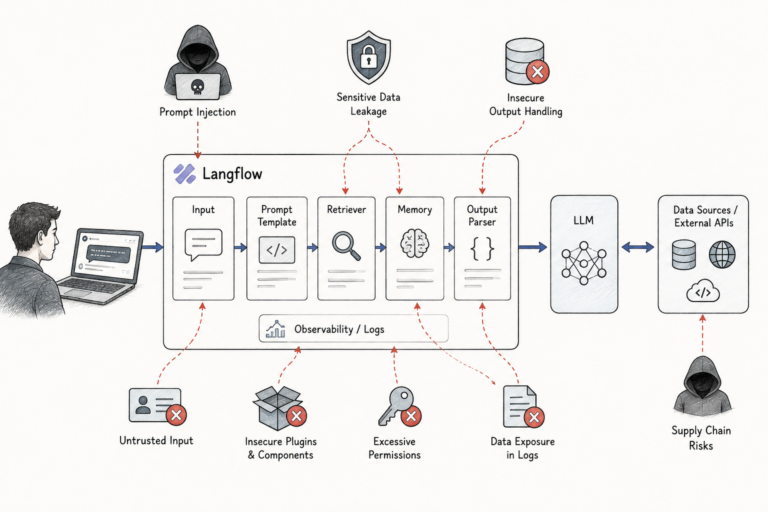
The Langflow LLM application attack surface — why building with visual AI frameworks matters — is something most security teams are dangerously underprepared for. And I mean…

Multilateral AI governance sounds noble on paper. But getting 169 countries to agree on anything about AI? Nearly impossible. Different economies, wildly different values, di…

The emergence of agentic ransomware hasn’t just shifted the threat environment — it’s blown up the assumptions most security teams have been operating on for years. Specifica…