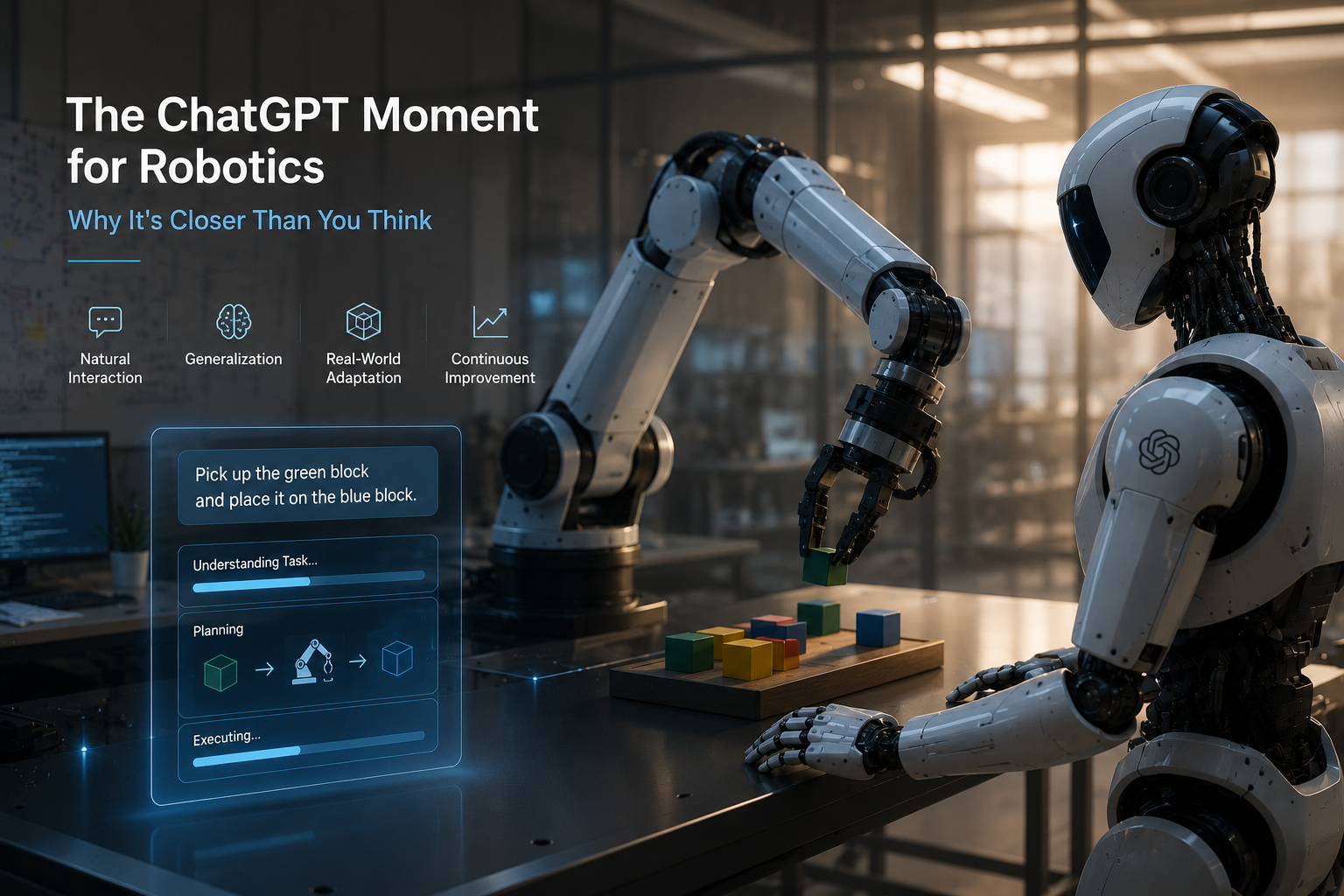
The ‘ChatGPT moment’ for robotics is closer than most people are giving it credit for. Foundation models — those massive AI systems trained on enormous datasets — are doing for robots what large language models did for text generation. We’re approaching a genuine tipping point where robots won’t just execute scripted commands anymore. They’ll understand context, adapt on the fly, and learn in ways that honestly feel different from anything we’ve seen before.
Cast your mind back to late 2022. ChatGPT stunned the world overnight — suddenly, anyone could hold a genuinely sophisticated conversation with a machine. Robotics is now on the verge of something remarkably similar. The convergence of foundation models, massive datasets, and unprecedented compute is accelerating this shift faster than most experts predicted — including, frankly, me.
Why Foundation Models Are Transforming Robotics
The Companies Racing Toward the Robotics ChatGPT Moment
The Compute and Infrastructure Arms Race Behind the Scenes
Benchmark Datasets and the Evaluation Challenge
Robot-as-a-Service and the Business Model Shift
Why Foundation Models Are Transforming Robotics
For decades, programming a robot meant painstaking, task-specific code. Want it to pick up a cup? Thousands of lines of code, just for that one action. Change the cup’s shape, and you’re basically starting over. I’ve watched this problem frustrate robotics teams for years — it simply doesn’t scale.
Foundation models change everything. Instead of hand-coding individual behaviors, researchers now train large neural networks on vast robot interaction datasets. These models learn general-purpose skills. Consequently, a robot trained this way can handle novel objects and environments it’s genuinely never encountered before — and that’s not marketing language, that’s what the benchmarks are showing.
The parallel to LLMs is striking. Because ChatGPT trained on billions of text examples, it generalizes across topics effortlessly. Similarly, robotics foundation models absorb millions of demonstrations — grasping, walking, manipulating, moving through space. The result is a robot that generalizes rather than memorizes. This surprised me when I first dug into the research, honestly.
Specifically, three breakthroughs are driving this transformation:
- Vision-language-action (VLA) models that combine seeing, understanding language, and taking physical action into a single unified system
- Simulation-to-real transfer techniques that let robots train in virtual environments, then carry those skills into the messy physical world
- Diffusion policy models that generate smooth, human-like motion from nothing but high-level instructions
Google’s RT-2 (Robotics Transformer 2) showed this powerfully. It combined a large vision-language model with robotic control — and the robot followed instructions it had never seen during training. That’s the kind of generalization that signals a true inflection point. I’ve seen a lot of demos that don’t hold up under scrutiny. This one actually delivers.
Moreover, why the ‘ChatGPT moment’ for robotics is so close becomes obvious when you look at the pace of iteration. RT-1 launched in late 2022. RT-2 followed months later with dramatically improved capabilities. Each version shrinks the gap between scripted machines and genuinely intelligent robots — and those gaps are shrinking faster each time.
The Companies Racing Toward the Robotics ChatGPT Moment
Several major players are pouring billions into making this moment real. Their approaches differ, but the goal is identical: build robots that think and adapt like humans do. And the funding numbers are not subtle.
Tesla’s Optimus represents perhaps the most ambitious bet on the table. Elon Musk has repeatedly called Optimus Tesla’s eventual most valuable product — a bold claim, but not an absurd one when you understand the training advantages Tesla brings. Their self-driving program generated massive neural network expertise. That means the company arrives at humanoid robotics with a head start most competitors can’t easily replicate. Furthermore, access to real-world data from millions of vehicles on actual roads strengthens that edge considerably.
Figure AI has attracted staggering investment — $675 million from Microsoft, NVIDIA, OpenAI, and Jeff Bezos, among others. Their Figure 02 humanoid integrates OpenAI’s language models directly into its control stack. The robot can hold a conversation while performing physical tasks at the same time. That’s not a party trick — it’s a clear signal that the ‘ChatGPT moment’ for robotics is already showing up in real hardware.
Boston Dynamics has spent decades perfecting robot mobility, and that institutional knowledge matters more than people realize. Their Atlas platform now combines that deep hardware expertise with modern AI. Additionally, their partnership with Hyundai provides manufacturing scale that few competitors can come close to matching.
Meanwhile, several other companies are making significant strides:
- Physical Intelligence (Pi) raised $400 million to build a universal robot foundation model — essentially a “GPT for physical actions”
- 1X Technologies, backed by OpenAI, is developing humanoid robots specifically for home environments
- Covariant (now part of Amazon) built foundation models specifically for warehouse robots, which is arguably where the real near-term money is
- Sanctuary AI focuses on general-purpose humanoid robots through their Carbon platform
Notably, the competitive picture reveals something important that I think gets undersold. This isn’t just a startup game. Microsoft, Google, Amazon, NVIDIA — the world’s largest tech companies are all placing enormous bets here. That level of corporate commitment typically signals an approaching inflection point. I’ve been watching this industry long enough to know that when all the big players move at once, something real is happening.
The Compute and Infrastructure Arms Race Behind the Scenes
Here’s the thing: understanding why the ‘ChatGPT moment’ for robotics is so close requires understanding the infrastructure fueling it. The compute numbers involved are genuinely staggering.
Microsoft’s reported $100 billion investment in AI infrastructure isn’t just about chatbots. A significant portion targets the physical AI stack — the servers, GPUs, and data centers needed to train robot foundation models at scale. NVIDIA’s Omniverse platform was specifically designed for robot simulation, and it runs directly on this infrastructure. That’s not a coincidence — it’s a strategy.
Here’s why compute matters so much for robotics specifically:
1. Simulation at scale — Training a robot in the real world is slow and brutally expensive. Simulation lets you run millions of training episodes at once. But each simulation requires massive GPU resources — we’re talking tens of thousands of GPUs for serious training runs.
2. Multimodal processing — Robot foundation models process vision, language, touch, and proprioception (body awareness) all at once. That’s far more computationally intensive than text-only LLMs, and the gap is larger than most people appreciate.
3. Real-time inference — A chatbot can take two seconds to respond. A robot catching a falling object cannot. Edge computing and optimized inference engines are therefore critical, and this is a genuinely hard engineering problem.
NVIDIA’s Isaac platform provides the simulation and deployment tools that many companies in this space rely on. Their GR00T foundation model, specifically designed for humanoid robots, is a direct play at becoming the operating system of the robotics revolution. Fair warning: if NVIDIA pulls that off, it changes the competitive dynamics dramatically.
Consequently, the infrastructure arms race mirrors what happened with LLMs almost exactly. Companies that secure compute advantages early will likely dominate. However — and this is the real kicker — not every breakthrough requires more hardware. Sometimes smarter algorithms win. Meta’s efficiency-focused approach to leaner training proved that in the LLM space, and the same dynamic could play out here.
Table: scroll sideways to view all columns when needed.
| Factor | LLM Revolution (2020-2023) | Robotics Revolution (2023-2026) |
|---|---|---|
| Key breakthrough | Transformer architecture | Vision-language-action models |
| Training data | Internet text (trillions of tokens) | Robot demonstrations + simulation |
| Compute requirement | Thousands of GPUs | Tens of thousands of GPUs + simulation clusters |
| Primary bottleneck | Data quality and RLHF | Real-world data collection and sim-to-real gap |
| Deployment model | Cloud API | Edge computing + cloud hybrid |
| Time to mainstream | ~3 years | ~3-5 years (estimated) |
| Key players | OpenAI, Google, Meta, Anthropic | Tesla, Figure AI, Boston Dynamics, NVIDIA |
Benchmark Datasets and the Evaluation Challenge
You can’t improve what you can’t measure. Therefore, the ‘ChatGPT moment’ for robotics partly depends on building better evaluation tools — and this is one area where robotics is genuinely behind where LLMs were at a comparable stage.
Several important benchmarks have emerged:
- Open X-Embodiment — A collaboration across 21 institutions, pooling over one million robot demonstrations from 22 different robot types. Coordinated through Google DeepMind, this dataset is the closest thing to a “Common Crawl” for robotics — and it’s a big deal.
- CALVIN — A benchmark for evaluating long-horizon language-conditioned tasks in manipulation, where robots must chain together multiple steps
- RoboCasa — Focused on household robot tasks, specifically testing generalization across kitchen environments (a surprisingly hard domain)
- ManiSkill — A GPU-accelerated benchmark for manipulation skills with thousands of object variations
Nevertheless, evaluating robots remains fundamentally harder than evaluating chatbots. A chatbot’s output is text — relatively straightforward to score. A robot’s output is physical action in a complex, unpredictable environment. Success depends on physics, timing, force, and dozens of variables that shift constantly.
Importantly, the Open X-Embodiment project highlights a trend I find genuinely exciting. Researchers are sharing data across institutions and robot platforms in a way that didn’t happen even five years ago. This collaborative approach mirrors exactly how the NLP community built the shared datasets that ultimately enabled ChatGPT. The robotics community is following the same playbook — just running a few years behind schedule.
The evaluation challenge also connects directly to safety. A chatbot that makes an error produces bad text. A robot that makes an error could break things — or hurt people. Consequently, benchmark datasets must test not just raw capability but reliability and safety margins too. That’s a harder problem, and it’s not getting enough attention yet.
Robot-as-a-Service and the Business Model Shift
The ‘ChatGPT moment’ for robotics isn’t purely a technical story. It’s an economic one — and honestly, the business model shift might matter as much as the technology itself.
Think about how cloud computing democratized access to servers. Similarly, robot-as-a-service (RaaS) lets companies rent robot capabilities instead of buying expensive hardware outright. A warehouse operator doesn’t need to purchase a $250,000 robot and figure out how to maintain it. They subscribe to a service, the robots show up, and the AI keeps improving automatically. That’s a fundamentally different conversation to have with a CFO.
This model is already gaining real traction:
- Amazon deploys over 750,000 robots across its fulfillment centers, increasingly powered by foundation model capabilities — that’s not a pilot program, that’s infrastructure
- Locus Robotics offers warehouse robots on a per-pick pricing model, so you only pay for what the robot actually does
- Bear Robotics provides restaurant service robots through monthly subscriptions
- Formic offers manufacturing robots with no upfront cost whatsoever — customers pay by the hour
Additionally, the RaaS model creates a powerful data flywheel. Every deployed robot generates training data. That data improves the foundation model. The improved model makes every robot in the entire fleet smarter overnight. This is exactly how ChatGPT improved through massive user interaction — and it’s the same compounding dynamic playing out in physical hardware now.
The International Federation of Robotics reports that global robot installations keep hitting record numbers year after year. Although industrial robots have dominated historically, service robots are the fastest-growing segment by a significant margin. Foundation models will accelerate this trend dramatically — and the RaaS model is what makes it financially accessible enough to spread.
Furthermore, the economic incentives are aligning almost perfectly right now. Labor shortages in manufacturing, logistics, and healthcare create urgent demand. Foundation models reduce the customization cost for each new deployment. And RaaS eliminates the capital expenditure barrier. All three forces are pushing in the same direction at once — that’s a setup for rapid adoption.
What’s Still Missing Before the True Breakthrough
Despite all this momentum, several real gaps remain before the ‘ChatGPT moment’ for robotics becomes a full reality. I’d be doing you a disservice if I glossed over them.
Hardware limitations persist. Robot hands still can’t match human dexterity — not even close. Batteries limit operational time in ways that matter enormously for real deployments. Sensors, although improving rapidly, still struggle in cluttered or poorly lit environments. No foundation model, however sophisticated, can overcome hardware that physically cannot perform a task.
The sim-to-real gap hasn’t closed completely. Robots trained in simulation often struggle when confronting real-world messiness — unexpected textures, lighting changes, objects that behave slightly differently than their simulated counterparts. Researchers are narrowing this gap meaningfully, but it remains significant. I’ve seen impressive simulation demos fall apart on a real factory floor, and it’s humbling every time.
Safety and regulation lag behind capability. The National Institute of Standards and Technology (NIST) is working on robotics safety standards, but frameworks for autonomous robots operating alongside humans are still genuinely immature. Conversely, the AI safety conversation has largely focused on language models, leaving physical AI somewhat underexamined. That’s a problem we’ll need to solve before widespread deployment happens.
Data scarcity relative to LLMs is real. The entire Open X-Embodiment dataset — a landmark achievement — contains roughly one million demonstrations. GPT-4 trained on trillions of text tokens. Robotics data is orders of magnitude smaller, and that gap matters. Simulation helps bridge it, but synthetic data has inherent limitations that researchers are still working through.
Alternatively, some experts argue these gaps will close faster than anyone expects. The same exponential improvement curves that shaped LLM development may apply here too. Each breakthrough enables the next, creating compounding progress that’s notoriously hard to predict from the outside.
Key milestones worth watching for:
1. A single foundation model that controls multiple robot form factors effectively — not just one specialized platform
2. Robots that learn new tasks from a single human demonstration (we’re not there yet, but it’s coming)
3. Consumer-priced humanoid robots under $20,000
4. Regulatory frameworks for autonomous robots operating in public spaces
5. A viral consumer robot moment — the “ChatGPT launch” equivalent that makes everyone suddenly pay attention
Conclusion
The ‘ChatGPT moment’ for robotics is closer than the skeptics believe — and I’ve been watching this space long enough to say that with some confidence. Foundation models, massive compute investments, growing datasets, and new business models are converging at the same time. The technical trajectory is clear. The economic incentives are aligned. And the world’s most powerful companies are betting billions on this outcome.
However, “closer” doesn’t mean “tomorrow.” Realistic timelines suggest two to five years before we see a true mainstream breakthrough — a robot that captures public imagination the way ChatGPT did in November 2022. But the building blocks are falling into place right now, faster than most people realize.
Here’s what you should do with this information:
- If you’re a business leader, start evaluating RaaS options for your operations now. Early adopters will gain significant competitive advantages — notably in logistics and manufacturing, where the ROI is already measurable.
- If you’re a developer, learn about vision-language-action models and robot simulation platforms like NVIDIA Isaac. These skills will be in enormous demand, and the window to get ahead of the curve is still open.
- If you’re an investor, pay attention to the infrastructure layer — compute providers, simulation platforms, and sensor manufacturers — not just the headline-grabbing humanoid companies. The picks-and-shovels play is real here.
- If you’re simply curious, follow the Open X-Embodiment project and company announcements from Figure AI, Tesla, and Boston Dynamics. The next twelve months will move fast — bookmark this one.
The ‘ChatGPT moment’ for robotics isn’t a question of if. It’s a question of when. And all signs point to soon.
FAQ
What exactly does the ‘ChatGPT moment’ for robotics mean?
The ‘ChatGPT moment’ for robotics refers to an inflection point where robots become dramatically more capable and accessible — similar to how ChatGPT made AI feel suddenly useful to everyone overnight. Specifically, it means foundation models will let robots understand natural language commands, adapt to new tasks without reprogramming, and operate in unstructured, messy environments. It’s the shift from narrow, scripted automation to general-purpose robotic intelligence — and it’s a meaningful distinction.
How close are we to the robotics ChatGPT moment actually happening?
Most industry experts estimate two to five years from a true mainstream breakthrough. The underlying technology — vision-language-action models, large-scale simulation, and efficient inference hardware — is advancing rapidly. Nevertheless, challenges in hardware dexterity, safety regulation, and real-world data collection still need meaningful resolution. The pace of progress suggests the earlier end of that timeline is increasingly plausible, moreover with each new model generation arriving faster than the last.
Which companies are leading the race toward this breakthrough?
Several companies are at the forefront. Tesla (Optimus), Figure AI (Figure 02), Boston Dynamics (Atlas), and NVIDIA (GR00T foundation model) are among the most prominent. Additionally, startups like Physical Intelligence, 1X Technologies, and Sanctuary AI are making important contributions that don’t always get the coverage they deserve. Google DeepMind’s research on RT-2 and the Open X-Embodiment datasets also plays a critical role in advancing the field — particularly on the research side.
What role does compute infrastructure play in the robotics revolution?
Compute infrastructure is absolutely foundational — full stop. Training robotics foundation models requires tens of thousands of GPUs running massive simulations at once. Moreover, deployed robots need powerful edge computing for real-time decisions that simply can’t wait for a round-trip to the cloud. The infrastructure investments from Microsoft, NVIDIA, and others in data centers and specialized AI chips directly enable the ‘ChatGPT moment’ for robotics. Without sufficient compute, the models can’t be trained or deployed effectively — it’s that straightforward.
Will foundation model robots replace human workers?
History suggests technology creates more jobs than it eliminates, although the transition period can be genuinely disruptive for specific industries. Foundation model robots will likely handle dangerous, repetitive, or physically demanding tasks first — which is arguably where we want them. Importantly, the robot-as-a-service model means businesses can add to their human workforce rather than replace it outright. New roles in robot supervision, maintenance, training, and programming will emerge. The net effect on employment will depend heavily on policy decisions and retraining programs — and those conversations need to start now.
Keep reading
Here are the latest posts from the blog.
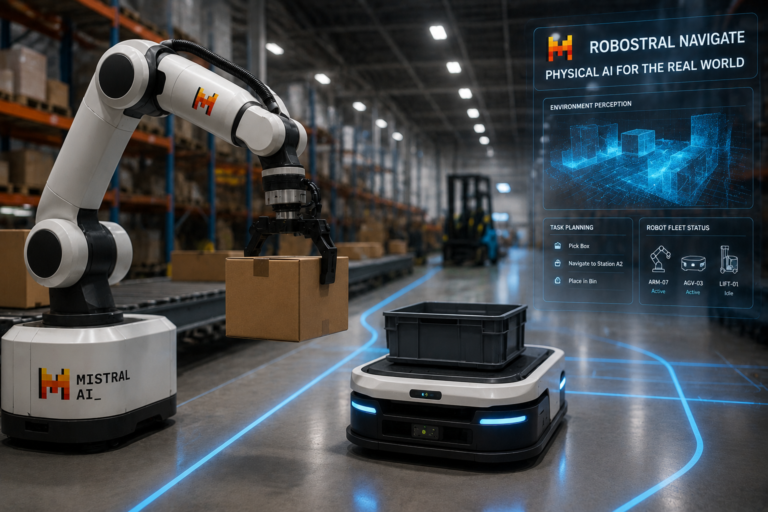
Europe just made its boldest move in the robotics race. Physical AI robots Europe Mistral Robostral Navigate represents a serious attempt to challenge American and Chinese do…
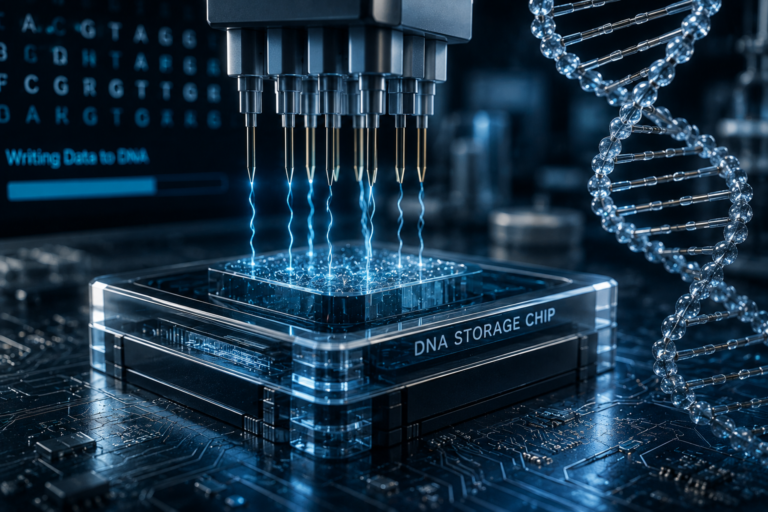
Understanding DNA storage chip architecture how electrical synthesis works is becoming genuinely essential for anyone tracking where data infrastructure is actually headed. A…

The broadcom apple expanded chip partnership through 2031 is, honestly, one of the most significant deals in a decade of covering this industry. Announced in May 2023 and val…