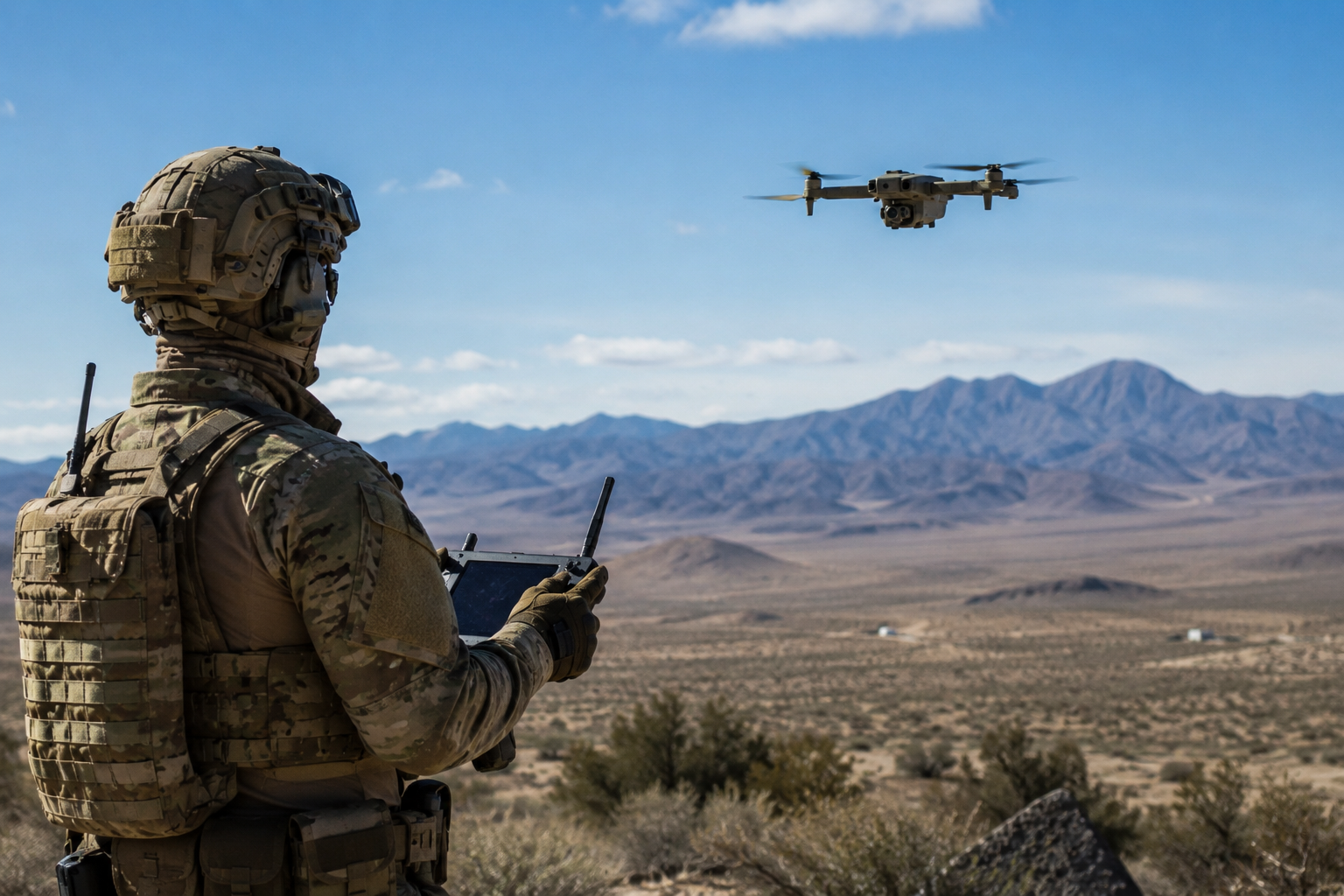
AeroVironment’s revenue jumping to roughly $2.8 billion isn’t just an earnings beat. It’s a signal about how militaries actually fight wars now — and, more importantly, how they’re planning to fight the next one.
I’ve followed this company for years, and the speed of this acceleration surprised even me. AeroVironment spent decades building small unmanned aircraft systems for the U.S. military — grinding, unglamorous work that most investors ignored. Its Switchblade loitering munitions and Puma surveillance drones became household names in defence circles long before the broader market caught on. Then geopolitical pressure turned steady, reliable growth into explosive demand almost overnight.
What’s happening here isn’t a one-conflict spike. It marks an inflection point where tactical drones moved from niche tools to essential warfighting platforms — and understanding why reveals a lot about where the defence drone market is heading over the next decade.
How AeroVironment’s Revenue Surge Reflects Broader Market Dynamics
AeroVironment’s Loitering Munition Systems segment drove much of the growth. Switchblade 300 and Switchblade 600 orders surged as the U.S. Department of Defense funneled weapons to Ukraine. The acquisition of Arcturus UAV expanded the company’s medium-altitude capabilities, which matters more than it sounds — it means AeroVironment now captures revenue from reconnaissance, strike, and intelligence missions simultaneously. Three separate budget lines, one vendor relationship. That diversification is exactly what separates durable growth from a single-conflict revenue spike.
Several factors fueled the acceleration in parallel:
- The Ukraine conflict moved Switchblade systems from “promising technology” to “proven combat hardware” in months, with massive U.S. security assistance packages including thousands of units.
- Indo-Pacific contingency planning drove new procurement for expendable drones — the kind military planners are willing to lose in a contested strait.
- Middle East tensions spiked counter-drone and ISR demand as threat environments grew more complex.
- Allied nations began replacing donated stockpiles with fresh orders, creating a secondary wave of demand that wasn’t in anyone’s original model.
- And the U.S. Department of Defense pushed drone funding to record levels with bipartisan political support that’s genuinely unusual in Washington.
AeroVironment’s backlog grew substantially alongside the revenue. A fat backlog improves future revenue visibility, which is exactly what Wall Street rewards with higher valuations — no mystery there.
The Unit Economics That Are Reshaping Military Doctrine
The economics beneath AeroVironment’s growth reveal why the defence drone market is expanding faster than traditional defence categories — and why the expansion looks structural rather than cyclical.
Traditional military aircraft cost tens of millions per unit. Tactical drones cost thousands to low hundreds of thousands. That cost difference doesn’t just change procurement math — it changes how militaries think about deploying force.
Expendability is the key concept. A Switchblade 300 costs roughly $6,000 per unit. A Hellfire missile costs approximately $150,000. Military planners can deploy dozens of loitering munitions for the price of one traditional precision-guided weapon. Procurement volumes skyrocket as a result — and so does AeroVironment’s order flow. When I first ran these numbers, the cost-per-effect ratio was genuinely staggering.
Procurement cycles for small drones are also dramatically shorter than for manned aircraft. A fighter jet program takes 15–20 years from concept to deployment, assuming everything goes well, which it usually doesn’t. A new drone variant can reach the field in 18–24 months. That compressed timeline means revenue ramps faster, and it means AeroVironment can respond to emerging threats before competitors have even filed a proposal.
| Platform | Approximate Unit Cost | Development Cycle | Reusability | Annual Volume Potential |
|---|---|---|---|---|
| Switchblade 300 | ~$6,000 | 12–18 months | Expendable | Tens of thousands |
| Switchblade 600 | ~$50,000–$100,000 | 18–24 months | Expendable | Thousands |
| Puma 3 AE | ~$250,000 (system) | 24–36 months | Reusable | Hundreds |
| MQ-9 Reaper | ~$32 million | 10–15 years | Reusable | Dozens |
| F-35 Fighter | ~$80 million | 20+ years | Reusable | Low dozens |
The volume potential column explains why the defence drone market trends so heavily toward smaller, cheaper systems. Militaries can buy in volume, absorb combat losses without a congressional hearing, and update designs rapidly based on real battlefield feedback. Higher-value systems like AeroVironment’s JUMP 20 and Arcturus platforms still matter for longer-endurance missions — and they carry stronger margins — so the company’s revenue mix is actually becoming more favorable over time, not less.
According to Drone Industry Insights, the global military drone market is expected to exceed $30 billion annually within the next several years. AeroVironment’s growing share of that market explains its revenue trajectory directly, and significant runway remains.
Three Geopolitical Theaters Driving Demand Simultaneously
No analysis of AeroVironment’s position is complete without examining the geopolitical catalysts. Three theaters are reshaping global drone procurement at the same time — and they’re not taking turns.
Ukraine changed everything. The conflict showed that small, cheap drones could destroy tanks, disable artillery, and carry out precision strikes in ways that military theorists had predicted but never seen proved at scale. Ukrainian forces used commercial and military drones to devastating effect against Russian armor. This wasn’t theoretical anymore — the world watched drone warfare prove its value on YouTube in real time, in a way that no Pentagon briefing could replicate.
The U.S. responded by shipping thousands of Switchblade systems through security assistance packages. AeroVironment ramped production accordingly. European allies began placing their own orders — the UK, France, and Australia suddenly recognized they needed similar capabilities urgently, not in five years. Those European order cycles are slower than U.S. procurement, but they’re coming.
Taiwan contingency planning represents another major demand driver. Military strategists studying a potential conflict in the Taiwan Strait emphasize the need for expendable drone swarms that can saturate defenses and complicate targeting. The Center for Strategic and International Studies has published extensively on how expendable drones could help defend against amphibious assault. AeroVironment’s systems fit this use case closely, which is why procurement conversations are accelerating that weren’t happening three years ago.
Middle East tensions continue generating demand for counter-drone operations, border surveillance, and force protection missions. The Abraham Accords opened new export markets for American drone manufacturers, expanding AeroVironment’s addressable market geographically as well as by volume.
Key demand signals that continue compounding:
- NATO standardization is creating long-term recurring procurement as alliance members align on common drone platforms.
- AUKUS and bilateral Indo-Pacific agreements are translating into real contracts.
- Gulf states are investing heavily in drone capabilities with serious budgets behind those ambitions.
- Counter-terrorism operations in Africa require ISR drones in complex, low-infrastructure environments.
- Northern nations are deploying surveillance UAS as strategic competition in the Arctic intensifies.
These overlapping signals create a reinforcing effect on the defence drone market. Each new conflict or security challenge validates the drone-first approach — and each validation triggers additional procurement from someone new. The demand persists regardless of which specific crisis dominates the headlines, which is what makes the growth look structural rather than episodic.
How AeroVironment Compares to Its Competitors
AeroVironment doesn’t operate in a vacuum. Understanding its revenue growth requires comparing it against competitors — but the competitive picture is more nuanced than a simple market share chart suggests.
moved entirely to defence and enterprise markets after exiting the consumer drone space, which was a smarter strategic call than it got credit for at the time. Its ANAFI USA drone earned U.S. government approval as a trusted platform — no small feat given current supply chain scrutiny. Parrot is growing rapidly in the NATO market and benefits from European concerns about relying on American or Chinese technology. That gives it a lane AeroVironment can’t easily occupy, though its revenue remains much smaller.
DJI dominates commercial markets but faces increasing restrictions in defence applications. The FCC and Congress
have moved to restrict DJI products over national security concerns, and those restrictions are tightening, not loosening. Although DJI drones appear on battlefields worldwide — including on both sides in Ukraine, which is its own uncomfortable story — allied military procurement is systematically excluding them. That exclusion directly benefits AeroVironment and other Western manufacturers in ways that are structural, not temporary.
Emerging competitors deserve attention. Shield AI, Skydio, and L3Harris are investing heavily in military drone capabilities. Shield AI’s V-BAT and Skydio’s X10D target overlapping markets with genuinely impressive technology. I’ve tested some of these platforms firsthand, and the capability gap between AeroVironment and the newer entrants is closing faster than incumbents would like to admit.
| Company | Primary Market | AI Capability | Government Trust Level | Revenue Scale |
|---|---|---|---|---|
| AeroVironment | Military tactical | Growing | Very high (Blue UAS) | ~$2.8B |
| Parrot | Defence/enterprise | Moderate | High (NATO approved) | ~$100M+ |
| Shield AI | Military autonomy | Advanced | High | ~$500M+ |
| Skydio | Defence/enterprise | Advanced | High (Blue UAS) | Growing rapidly |
| DJI | Commercial/consumer | Advanced | Restricted/banned | ~$4B+ (total) |
| L3Harris | Military ISR | Moderate | Very high | Segment of larger company |
AeroVironment’s advantage isn’t just technology — it’s institutional trust built over decades. Delivering reliable systems to the U.S. military created deep confidence among procurement officers who’ve seen plenty of promising vendors fail to deliver. When they need to move fast, they default to proven suppliers. This incumbency advantage supports AeroVironment’s growth in ways that don’t show up cleanly in a product comparison but matter enormously in how defence contracts actually get awarded.
AI and Edge Inference: Where the Defence Drone Market Goes Next
The next chapter of this story will be written by artificial intelligence. Edge AI — processing intelligence directly on the drone rather than relaying data back to operators — is transforming what tactical drones can do in contested environments, and AeroVironment is positioning accordingly.
Why does edge inference matter so much in this context? In modern conflict, communication links get jammed and GPS signals get spoofed — this is happening right now in Ukraine, not in some future scenario. A drone that relies on constant human control becomes useless when communications fail. A drone with onboard AI can identify targets, avoid obstacles, and complete missions on its own even when the signal goes dark. That’s not a nice-to-have feature anymore. It’s a requirement that shapes procurement decisions.
AeroVironment has been investing in autonomy capabilities across its portfolio. The Switchblade 600 uses advanced target recognition that meaningfully reduces operator workload. The company’s work with defence AI firms is expanding what’s possible on small, weight-constrained platforms — and the progress is moving faster than most people outside the industry realize.
Key AI capabilities reshaping tactical drone payloads in the current defence drone market:
- Automatic target recognition identifies vehicles, personnel, and infrastructure without requiring human input on every decision, which matters enormously when operators are managing multiple systems simultaneously.
- Swarm coordination allows multiple drones to work together on missions without centralized control, spreading decision-making across the network in ways that make the system resilient to individual unit loss or jamming.
- Electronic warfare resistance enables AI-driven navigation when GPS and communications are actively blocked by adversaries — the scenario that makes traditional remotely piloted vehicles unreliable in high-end conflict.
- Adaptive mission planning lets drones adjust routes and objectives in real time based on changing conditions on the ground, reducing the need for human intervention at moments when intervention may not be possible.
- Counter-drone autonomy uses AI-equipped drones to detect and neutralize enemy UAS — turning the platform into both sensor and weapon simultaneously.
The hardware enabling these capabilities is getting smaller and cheaper at a pace that would have seemed implausible five years ago. NVIDIA’s Jetson platform runs AI inference on devices small enough to fit inside tactical drones without meaningfully affecting flight characteristics. That’s a remarkable engineering achievement with significant commercial implications for companies like AeroVironment that need to pack more intelligence into smaller airframes.
The counter-drone market adds another dimension. As drone threats grow, militaries need systems to defeat enemy UAS — and AeroVironment’s capabilities in this space complement its offensive portfolio naturally. The company can sell both the sword and the shield, often to the same customer in the same budget cycle. That dual-sided positioning is genuinely unusual in the defence drone market and contributes to the revenue diversification that makes the growth look durable.
Conclusion
AeroVironment’s trajectory reflects a generational shift in military strategy that’s been building for years but finally became impossible to ignore. Cheap, smart, expendable drones are replacing expensive legacy platforms, and that trend isn’t reversing.
For investors tracking the defence drone market, a few specific things are worth monitoring closely. Backlog growth is more informative than headline revenue — it tells you where the business is twelve to eighteen months from now, not where it is today. International order announcements signal whether demand is broadening beyond the U.S. military, which is the question that separates a good business from a great one. AI integration milestones indicate whether AeroVironment is keeping pace with the technological evolution that will define the next generation of platforms. And competitor movements from Shield AI and Skydio deserve attention — they’re moving fast and they know where the market is heading.
Setting a quarterly calendar reminder to review AVAV’s backlog figures and international contract announcements alongside earnings will tell you more than the headline revenue number ever will.
For technology professionals, the opportunity lies in the convergence of autonomy, edge computing, and defence applications. The skills powering commercial AI — computer vision, sensor fusion, edge inference, swarm coordination algorithms — are increasingly relevant to military systems. Demand for people who understand both the technology and the operational context is significantly outpacing supply. Companies bridging that gap are positioned for sustained growth that most market observers are still underestimating.
The defence drone market revolution isn’t coming. AeroVironment’s revenue figures confirm it’s already here.
FAQ
Why did AeroVironment’s revenue grow so dramatically?
AeroVironment’s revenue surged primarily because of massive demand for Switchblade loitering munitions and tactical surveillance drones. The Ukraine conflict created urgent procurement needs that couldn’t wait for normal acquisition timelines. Indo-Pacific strategy and Middle East tensions drove parallel demand from separate budget lines simultaneously. The growth reflects compounding geopolitical factors rather than any single catalyst — which is why it looks durable rather than episodic.
How does the Ukraine conflict affect the defence drone market?
Ukraine demonstrated that small, inexpensive drones could neutralize expensive armored vehicles at a cost ratio that fundamentally changes military planning. This battlefield proof convinced militaries worldwide to accelerate drone procurement. AeroVironment saw order volumes spike in ways that overwhelmed initial production capacity. The conflict also revealed significant gaps in counter-drone capabilities, creating additional demand on the defensive side of the ledger — which AeroVironment is also positioned to serve.
What makes AeroVironment different from DJI or Parrot in defence markets?
AeroVironment designs systems specifically for military use from the ground up, not adapted commercial products. Its platforms meet stringent DoD cybersecurity and reliability standards that commercial-origin systems struggle to satisfy. DJI faces hard restrictions due to Chinese ownership and data security concerns that are not going away. Parrot competes meaningfully but at much smaller scale. AeroVironment’s decades-long relationship with the U.S. military provides an incumbency advantage built on delivered performance that’s extremely difficult to replicate quickly.
How is AI changing tactical drone capabilities?
AI lets drones operate autonomously when communications are jammed or GPS is denied — scenarios now standard in modern conflict. Edge inference allows automatic target recognition, swarm coordination, and adaptive mission planning without a reliable data link. AI-equipped drones can also counter enemy UAS threats independently, adding a defensive capability layer to offensive platforms. These capabilities make each drone more effective per dollar, driving higher demand and supporting the defence drone market’s growth projections well into the next decade.
What are the key risks to continued defence drone market growth?
Budget constraints remain the most obvious risk — political shifts could reduce overall defence spending in ways that hit procurement first. Export control regulations might limit international sales at exactly the moment when international demand is accelerating. Technological disruption from competitors like Shield AI or Skydio could erode market share in higher-margin autonomy segments. The structural trend toward drone-centric warfare appears durable across multiple geopolitical scenarios, however, and has bipartisan political support that most defence programs can’t claim.
How large is the global military drone market expected to become?
Keep reading
Here are the latest posts from the blog.

Imagine needing a government permit just to open a chatbot. That’s not science fiction — it’s where we actually are. Export controls now determine who gets to use the most po…

When automakers talk about “self-driving” and “autonomous” vehicles, they’re often describing wildly different things. Tesla calls its software Full Self-Driving. Waymo opera…

Animation has always been the awkward middle child of the design-to-code handoff. Designers sketch interactions in their heads, write vague specs in Notion documents nobody r…