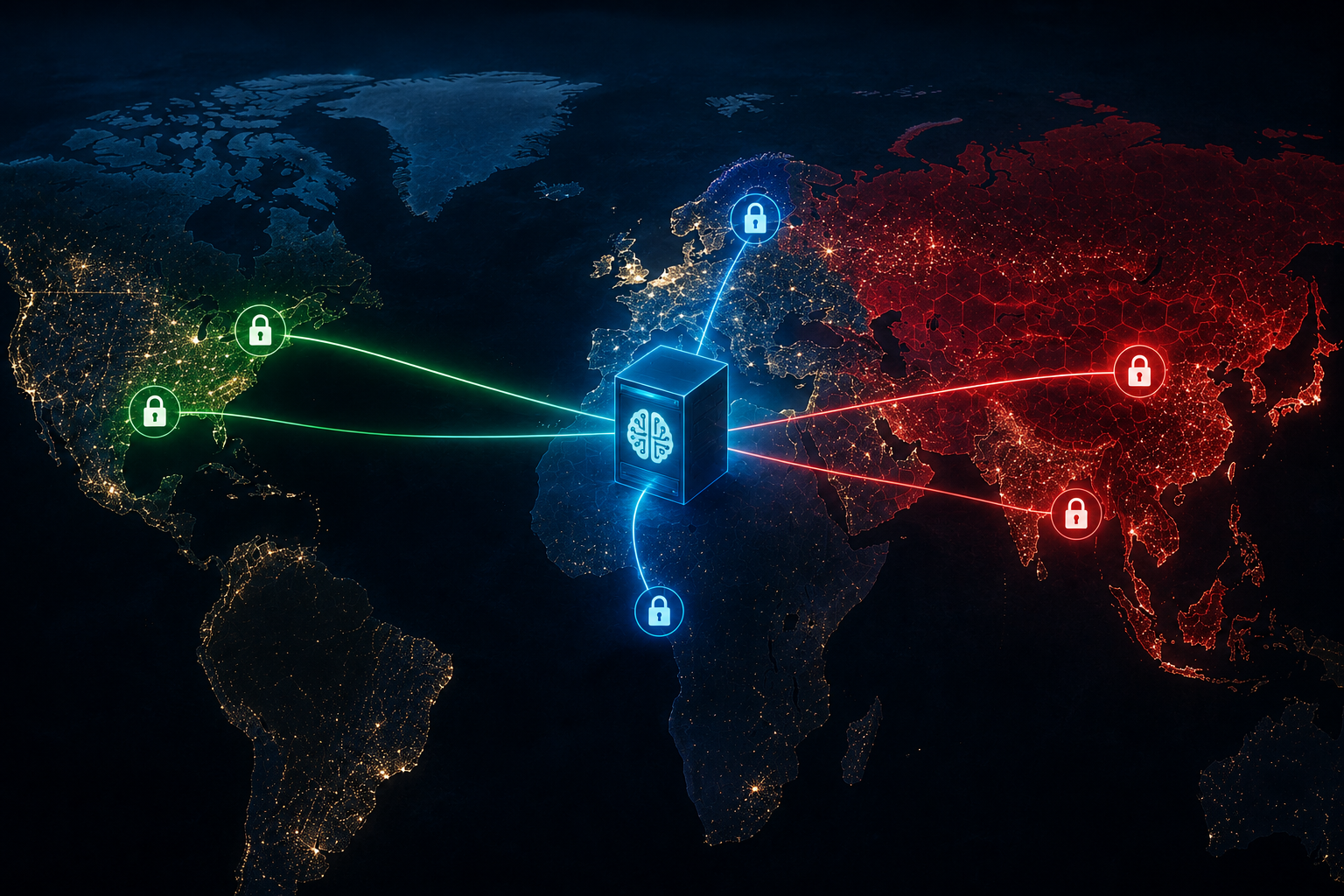
Geopolitical AI access: why location matters isn’t just a theoretical concern anymore. It’s a daily reality for millions of researchers, developers, and businesses worldwide — and most people in comfortable tech hubs don’t think about it until it hits them directly.
The country you live in determines which AI tools you can use. Full stop.
OpenAI, Google, and Anthropic don’t serve every nation equally. Some countries face outright bans, while others deal with feature restrictions or quietly degraded service. Furthermore, these restrictions are tightening — not loosening. This situation has shifted dramatically in just the past two years, and understanding the enforcement picture has become genuinely essential for anyone working in global technology.
The New Geography of AI Restrictions
The map of AI access looks nothing like the open internet we once imagined.
Geopolitical AI access matters because location determines whether you can even sign up for frontier models like GPT-4, Claude, or Gemini. And the boundaries are more aggressive than most people realize.
OpenAI’s restricted list is the most well-known example. As of 2025, OpenAI blocks access from roughly 30 countries and territories — including China, Russia, Iran, North Korea, Syria, and Cuba. However, it also sweeps in nations that genuinely surprise observers, like Belarus, Venezuela, and several Central African states. It’s broader than the headlines suggest.
Why do these restrictions exist? Three primary forces drive them:
- U.S. export control laws — The Bureau of Industry and Security (BIS) maintains entity lists and country-based restrictions that AI companies must follow.
- Sanctions compliance — OFAC (Office of Foreign Assets Control) sanctions prohibit U.S. companies from providing services to designated countries.
- Corporate risk management — Companies sometimes restrict access beyond what’s strictly required, just to avoid regulatory headaches down the road.
Notably, these aren’t voluntary choices by AI labs — they’re legal obligations. A U.S.-based company that provides AI services to sanctioned nations risks massive fines and criminal prosecution. Consequently, compliance teams at OpenAI, Google, and Anthropic maintain strict geofencing systems. It’s not about values; it’s about liability.
Meanwhile, the U.S. Department of Commerce keeps expanding its controls. The October 2023 semiconductor export rules and subsequent 2024 updates specifically targeted AI-capable chips. These chip restrictions create a second layer of AI access limits. Countries can’t build their own frontier models without advanced hardware, so even the workaround gets blocked.
Country-by-Country Breakdown: Who Can Access What
Understanding geopolitical AI access requires looking at specific providers and specific nations. The restrictions aren’t uniform, and enforcement mechanisms vary significantly across platforms. Similarly, what counts as “blocked” differs between a hard ban and a payment-infrastructure gap — a distinction that matters enormously for people living this reality.
Here’s a comparison of access restrictions across major AI providers:
| Country/Region | OpenAI (GPT-4/ChatGPT) | Google (Gemini) | Anthropic (Claude) | Meta (Llama — Open Source) |
|---|---|---|---|---|
| United States | Full access | Full access | Full access | Full access |
| EU/UK | Full access | Full access | Full access | Full access |
| Japan/South Korea | Full access | Full access | Full access | Full access |
| China | Blocked | Blocked | Blocked | Downloadable* |
| Russia | Blocked | Blocked | Blocked | Downloadable* |
| Iran | Blocked | Blocked | Blocked | Downloadable* |
| India | Full access | Full access | Full access | Full access |
| Brazil | Full access | Full access | Full access | Full access |
| Cuba | Blocked | Blocked | Blocked | Downloadable* |
| UAE/Saudi Arabia | Full access | Full access | Limited | Full access |
*Open-source models like Llama can technically be downloaded anywhere, although Meta’s license technically restricts sanctioned nations.
The asterisk on open-source models matters enormously. Meta’s Llama models exist in a genuine gray zone. The weights are publicly available, and anyone with internet access can theoretically download them. Nevertheless, Meta’s acceptable use policy explicitly prohibits use in sanctioned countries. So you’ve got a technical free-for-all sitting right next to a legal prohibition — and nobody’s quite figured out how to reconcile that.
Key observations from this breakdown:
- Gulf states enjoy broad access despite complex diplomatic relationships with the U.S. The UAE has become a major AI investment hub — worth watching if you’re thinking about where global AI infrastructure is heading.
- India faces zero restrictions from major providers. Its massive developer population has full, unrestricted access to frontier models, which is one reason Indian AI talent has grown so fast recently.
- Southeast Asian nations generally have access, although some smaller countries run into API limits that aren’t officially documented anywhere.
- African nations face a genuine patchwork — some have full access, while others face restrictions based on sanctions or simply lack of payment infrastructure support. The second category is often overlooked in policy conversations.
Importantly, geopolitical AI access: why location matters extends well beyond outright bans. Even in permitted countries, users regularly encounter tiered access. Certain API features, model versions, or enterprise tools may not be available everywhere — and you often won’t find a clear explanation for why.
How Enforcement Actually Works
Blocking a country from using AI sounds straightforward. The reality is far messier.
Geopolitical AI access restrictions rely on multiple enforcement layers, each with different strengths and weaknesses. The gaps are bigger than most compliance teams would probably like to admit.
IP address geofencing is the first line of defense. AI providers check your IP address against known ranges from restricted countries, which blocks most casual users. However, VPNs can bypass this easily. Specifically, a user in Tehran with a U.S.-based VPN could access ChatGPT without much technical difficulty.
Phone number verification adds another layer. OpenAI requires phone verification for new accounts, and numbers from sanctioned countries get rejected. Additionally, some providers cross-reference phone number country codes with IP locations — which catches some VPN users who forget to think about their SIM card.
Payment method screening creates a third barrier. Credit cards and payment systems from sanctioned nations typically can’t process transactions with U.S. companies. Consequently, even if someone bypasses IP and phone checks, paying for API access becomes genuinely difficult.
KYC (Know Your Customer) requirements for enterprise accounts represent the strictest enforcement tier. Companies seeking API access for commercial use must verify their identity and location. The Bureau of Industry and Security requires exporters of controlled technology to screen customers against denied party lists — and enterprise sales teams take this seriously in ways that consumer signups don’t.
But here’s the thing: enforcement is imperfect. Determined users in restricted countries regularly access these tools. VPN use is widespread, third-party resellers operate in gray markets, and open-source model weights flow freely once released. Anyone building compliance programs on the assumption that technical barriers are airtight is in for a rude surprise.
The enforcement gap creates a genuinely strange situation. Casual users in sanctioned countries often find workarounds within an afternoon, while legitimate researchers and companies in those same countries — the ones who’d use AI responsibly — can’t get official access, support, or enterprise agreements. Therefore, the current system arguably punishes compliance while failing to stop determined circumvention.
This paradox sits at the heart of every serious debate about why geopolitical AI access and location matter for policy design.
Real-World Impact on Researchers and Companies
The human cost of AI access restrictions often gets completely lost in policy discussions.
Geopolitical AI access barriers create concrete, measurable harm to real people and organizations — not just abstract competitive disadvantages in some government whitepaper.
Academic researchers in restricted countries face severe disadvantages. A machine learning researcher in a sanctioned nation can’t use GPT-4’s API for experiments. They can’t benchmark work against frontier models or access the latest tools that peers in permitted countries use daily. Consequently, the global AI research community fractures along geopolitical lines — and we all lose the contributions those researchers would have made.
Startups and businesses face even steeper challenges. Consider these scenarios:
- A health-tech startup in a restricted country can’t integrate Claude for medical text analysis
- A translation company can’t access Gemini’s multilingual capabilities through official channels
- An education platform can’t use GPT-4 to build tutoring tools for local students
Multinational corporations encounter a different version of this problem. A U.S. company with employees in restricted countries must work through genuinely complex compliance requirements. Can their Russia-based engineer access the company’s AI development tools? The answer often depends on specific license terms, legal interpretations, and which lawyer you ask — which isn’t a satisfying answer when you need to ship a product.
Moreover, the European Union’s AI Act adds another dimension entirely. EU regulations focus on AI safety rather than geopolitical access. Nevertheless, they create additional compliance layers that affect how AI services get delivered across borders — and the interaction between EU rules and U.S. export controls isn’t always clean.
The talent drain effect deserves special attention. Skilled AI researchers in restricted countries increasingly relocate just to access frontier tools. This brain drain benefits receiving countries but devastates local tech ecosystems — specifically, countries that might develop responsible AI capabilities lose the very people who could build them.
Additionally, geopolitical AI access restrictions shape global competition in ways that cut against their stated purpose. China’s response to being cut off from U.S. AI tools has been massive domestic investment. Companies like Baidu, Alibaba, and newer players like DeepSeek have built genuinely competitive alternatives. Similarly, Russia has accelerated development of domestic AI systems, although with considerably less success so far.
The irony is hard to miss. Restrictions intended to maintain U.S. technological advantage may actually accelerate competitors’ self-sufficiency. Although the short-term impact slows restricted nations, the long-term consequences remain genuinely uncertain — and that uncertainty should make policymakers uncomfortable.
The Evolving Regulatory Framework Behind AI Access
Understanding geopolitical AI access: why location matters requires examining the legal structure underneath it. Multiple regulatory frameworks interact to produce the current restriction picture, and no single document captures all of it.
U.S. Export Administration Regulations (EAR) form the foundation. The Commerce Department classifies AI models and related technology under export control categories. The Federal Register regularly publishes updates to these classifications, and they’ve been publishing a lot of updates lately. Recent rules have specifically addressed:
- Foundation models above certain parameter thresholds
- AI training infrastructure and cloud computing access
- Technical data related to AI development
- Chips capable of powering AI training workloads
OFAC sanctions operate separately from export controls. They prohibit virtually all transactions with comprehensively sanctioned countries. This means AI companies can’t provide even free services to users in these nations without a specific license. No exceptions for good intentions.
The AI Diffusion Rule, announced in early 2025, represents the most significant recent development. It creates a tiered system for AI chip and model exports:
- Tier 1 — Close allies with unrestricted access (about 18 countries)
- Tier 2 — Most other countries with capped access levels
- Tier 3 — Arms-embargoed and sanctioned nations with near-total restrictions
Notably, this framework explicitly acknowledges that location determines AI access. It turns what was previously a patchwork of company-level decisions into actual government policy — a significant escalation worth paying attention to.
Allied nations are responding with their own frameworks. Japan and the Netherlands have aligned their semiconductor export controls with U.S. policies. The UK is developing its own AI governance approach. Furthermore, international bodies like the OECD are working on multilateral AI governance principles, although multilateral agreement on anything moves slowly.
The compliance burden on AI companies is substantial and genuinely underappreciated from the outside. They must simultaneously handle:
- U.S. federal export controls
- OFAC sanctions requirements
- EU data protection and AI regulations
- Individual country laws where they operate
- Their own terms of service and acceptable use policies
Consequently, many AI companies now maintain large legal and compliance teams dedicated solely to managing geopolitical access questions. These costs are real, and they ultimately reach customers through pricing. Regulatory complexity isn’t free.
What This Means for U.S. Tech Professionals
Even if you’re based in the United States, geopolitical AI access: why location matters affects your work in ways that sneak up on you.
If you work for a multinational company, you likely encounter access restrictions regularly — or you will soon. Sharing AI-powered tools with overseas colleagues requires compliance screening. Specifically, you need to verify that colleagues in foreign offices aren’t located in restricted jurisdictions. That conversation gets awkward fast if nobody’s thought about it in advance.
If you’re building AI-powered products, you must decide which markets to serve. Geofencing your application adds real development costs. Moreover, you need legal counsel to determine which countries your AI product can legally operate in — and “I assumed it was fine” isn’t a compliance strategy.
Practical steps for U.S. tech professionals:
- Audit your AI supply chain. Know which providers you depend on and understand their geographic restrictions thoroughly.
- Review your company’s compliance program. Ensure your organization has clear policies for AI tool access across international offices — ideally before an incident forces the conversation.
- Monitor regulatory changes. The Commerce Department’s BIS website publishes regular updates to restricted entity and country lists.
- Consider open-source alternatives. For international collaborations, open-source models may offer more flexibility, although license restrictions still apply — don’t assume “open source” means “no rules.”
- Document your compliance efforts. If regulators ever question your practices, documentation is what protects you.
The competitive implications matter too. U.S. companies that can’t deploy AI tools globally face real disadvantages against competitors from less restrictive jurisdictions. Although the U.S. leads in AI development, access restrictions may meaningfully limit the global market reach of American AI products — and that tension isn’t getting resolved anytime soon.
Additionally, understanding these dynamics helps you make smarter career decisions. Roles in AI compliance, export control, and international tech policy are growing fast. These positions essentially didn’t exist five years ago, and now they rank among the most in-demand specializations in tech law.
Conclusion
Geopolitical AI access: why location matters is no longer an abstract policy discussion. It’s a practical reality shaping how AI tools get built, deployed, and used worldwide — and the gap between people who understand this and people who don’t is becoming a real professional disadvantage.
The current picture creates clear winners and losers. Citizens of allied nations enjoy full access to frontier AI models, while people in sanctioned countries face significant barriers. Meanwhile, everyone in between handles a complex patchwork of partial restrictions that nobody fully maps out for them.
Your actionable next steps are straightforward. First, understand which restrictions apply to your specific situation. Second, build compliance awareness into your development workflows before you need it. Third, stay informed about regulatory changes — they’re happening fast, and the AI Diffusion Rule alone reshaped things in 2025. Fourth, consider how open-source models might complement restricted proprietary tools in your international work.
The geography of AI access will keep evolving. New regulations, new alliances, and new technologies will reshape the map. Nevertheless, one thing stays constant: where you are determines what AI you can use. That’s the core reality behind geopolitical AI access: why location matters — and it isn’t changing anytime soon.
FAQ
Which countries are completely blocked from accessing ChatGPT and GPT-4?
OpenAI blocks access from approximately 30 countries and territories. The most notable include China, Russia, Iran, North Korea, Syria, Cuba, and Belarus. However, the complete list changes periodically as sanctions and export control policies evolve. Check OpenAI’s current terms of service for the latest restricted country list — don’t rely on anything you read more than a few months ago.
Can people in restricted countries use VPNs to access AI tools like Claude or Gemini?
Technically, VPNs can bypass IP-based geofencing. However, doing so typically violates both the AI provider’s terms of service and potentially U.S. law. Geopolitical AI access restrictions exist because of legal requirements, not just corporate preference. Users who get around these controls risk account termination — and in some cases, they may face legal consequences in their own countries too.
How do AI access restrictions affect open-source models like Meta’s Llama?
Open-source models create a unique enforcement challenge that nobody has cleanly solved. Once model weights are publicly released, they can be downloaded from essentially anywhere. Nevertheless, Meta’s license agreement explicitly prohibits use in sanctioned countries. Importantly, the practical enforcement of these license terms is extremely difficult. This gap between legal restriction and technical reality remains one of the biggest unresolved issues in geopolitical AI access policy.
Are U.S. allies like the EU and Japan affected by any AI access restrictions?
Generally, no. Close U.S. allies enjoy full access to frontier AI models. The AI Diffusion Rule’s Tier 1 category includes about 18 allied nations with unrestricted access. Furthermore, EU countries, Japan, South Korea, Australia, and the UK face no meaningful restrictions on accessing commercial AI tools. However, these nations do have their own AI regulations that affect how tools get deployed domestically — the EU’s AI Act being the most consequential example.
What happens to a U.S. company if it accidentally provides AI services to a sanctioned country?
Violations of U.S. export controls and sanctions can result in severe penalties — fines reaching millions of dollars and potential criminal prosecution. Additionally, the company could face removal from government contracts, which is devastating for anyone doing federal work. Therefore, most U.S. AI companies invest heavily in compliance infrastructure. If an accidental violation does occur, voluntary self-disclosure to OFAC or BIS can significantly reduce penalties — so document everything and don’t try to quietly paper it over.
Will AI access restrictions get stricter or more relaxed in the future?
Current trends strongly suggest restrictions will tighten. The AI Diffusion Rule formalized a tiered access system that didn’t previously exist, and moreover, growing geopolitical tensions between the U.S. and China make relaxation unlikely in the near term. Conversely, some industry voices argue that overly strict controls push innovation overseas — and they have data to back that up. The most likely outcome is continued tightening with occasional targeted exemptions for specific research or humanitarian purposes. Understanding geopolitical AI access: why location matters will only become more important for tech professionals in the years ahead.
References
Keep reading
Here are the latest posts from the blog.

Table of contents Introduction Why This Matters Step-by-Step Implementation Comparison Table Common Mistakes to Avoid FAQ Conclusion Introduction Choosing between teleoperati…

Table of contents Introduction Why This Matters Step-by-Step Implementation Comparison Table Common Mistakes to Avoid FAQ Conclusion Introduction Look, picking the right appr…

Cybercriminals are accelerating ransomware attacks educational technology providers isn’t just a headline anymore. It’s a full-blown crisis — and it’s happening right now, ac…