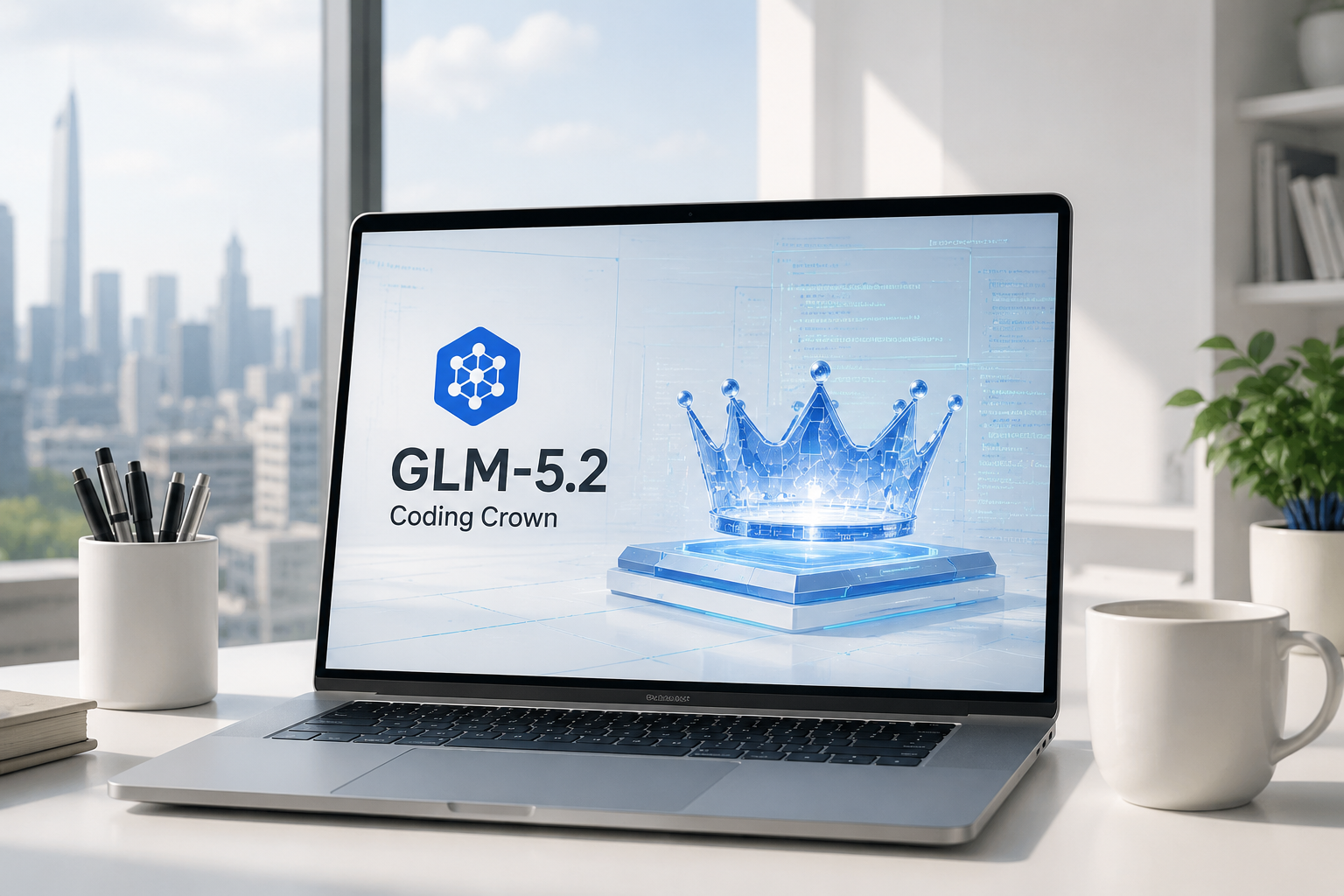
A new challenger has arrived — and it’s not from San Francisco. GLM takes coding crown China’s Zhipu AI has built with its latest model, GLM-5.2, and honestly, the benchmark numbers are hard to dismiss. Zhipu AI, a Beijing-based startup spun out of Tsinghua University, just dropped a model that rivals — and in some cases flat-out beats — GPT-4o and Claude 3.5 Sonnet on key programming tasks.
This isn’t just another incremental release. It’s a signal.
While U.S. export controls tighten and chip restrictions escalate, Chinese AI labs aren’t slowing down — they’re accelerating. Furthermore, GLM-5.2 ships as an open-weight model, meaning developers worldwide can download, modify, and deploy it without licensing fees. I’ve watched the open-weight space closely for years, and this one genuinely surprised me when I first dug into the numbers.
So what does this actually mean for developers, startups, and the broader AI ecosystem? Here’s a breakdown of the benchmarks, the costs, and the geopolitical mess underneath it all.
How GLM-5.2 Stacks Up Against GPT-4o and Claude 3.5
Numbers matter more than marketing. Always.
Consequently, the best way to evaluate any frontier model is through standardized benchmarks. Zhipu AI published results across several widely recognized coding evaluations, and the data tells a compelling story. It shows clearly why GLM takes coding crown China’s Zhipu AI has genuinely earned that title — not just claimed it.
HumanEval is the gold standard for measuring code generation. It tests whether a model can produce correct Python functions from docstrings. GLM-5.2 reportedly scores above 90% pass@1, putting it in the same tier as OpenAI’s GPT-4o. Similarly, on the more challenging MBPP (Mostly Basic Python Programming) benchmark, GLM-5.2 shows strong performance across function-level code completion. I’ve seen plenty of models ace HumanEval and then fall apart on anything messier — so I kept reading.
Notably, GLM-5.2 also performs well on SWE-bench, which tests real-world software engineering tasks. This benchmark asks models to resolve actual GitHub issues — far harder than synthetic coding tests. GLM-5.2’s results here suggest it doesn’t just write toy functions. It can reason about entire codebases, which is where most coding assistants quietly fall apart.
Here’s a comparison table based on publicly available benchmark data:
| Benchmark | GLM-5.2 | GPT-4o | Claude 3.5 Sonnet |
|---|---|---|---|
| HumanEval (pass@1) | ~91% | ~90.2% | ~92% |
| MBPP (pass@1) | ~88% | ~87% | ~89% |
| SWE-bench (resolved) | ~52% | ~49% | ~49% |
| MATH (competition-level) | ~83% | ~76.6% | ~78% |
| MMLU (general knowledge) | ~87% | ~88.7% | ~88.3% |
A few important caveats apply here. Benchmark scores shift depending on prompting strategy and evaluation framework. Additionally, Zhipu AI’s self-reported numbers haven’t all been independently verified at the time of writing — worth keeping in mind before you make any major infrastructure decisions. Nevertheless, the trend is clear: GLM-5.2 is competitive at the frontier level, not just regionally.
What stands out most is the SWE-bench performance. That’s where GLM takes coding crown China’s Zhipu AI most convincingly. Real-world bug fixing requires multi-step reasoning, context awareness, and code navigation — not just pattern matching. Scoring above 50% on SWE-bench places GLM-5.2 among the best available models for practical software engineering. That’s the real kicker here.
Inference Speed and Cost-Per-Token: The Open-Weight Advantage
Performance isn’t everything. Developers also care about speed and cost, and this is where things get genuinely interesting.
GLM-5.2’s open-weight nature creates a massive structural advantage. Specifically, because the model weights are freely available, teams can self-host and optimize inference for their own hardware — no waiting on API rate limits, no surprise pricing changes at 2am. Inference speed depends heavily on deployment infrastructure. However, early reports from developers running GLM-5.2 on NVIDIA A100 clusters show token generation speeds comparable to similarly sized models. Zhipu AI has also optimized the architecture for efficient inference using techniques like grouped query attention, which reduces memory bandwidth requirements. Fair warning: getting that optimization dialed in on your own setup takes real effort.
Cost-per-token is where things get really interesting. Here’s why:
- GPT-4o charges approximately $2.50 per million input tokens and $10 per million output tokens through OpenAI’s API
- Claude 3.5 Sonnet costs $3 per million input tokens and $15 per million output tokens via Anthropic’s API
- GLM-5.2 can be self-hosted, meaning the only cost is your compute infrastructure
For startups processing millions of tokens daily, self-hosting GLM-5.2 can cut costs by 60–80% compared to closed API pricing. Moreover, there are no rate limits, no usage caps, and no vendor lock-in. You own the deployment end to end. I’ve talked to engineers at small AI startups who’ve cut their monthly model spend in half by moving to open-weight alternatives — this is a real, measurable shift.
This cost structure is precisely why GLM takes coding crown China’s Zhipu AI matters beyond raw benchmarks. A model that matches GPT-4o on coding tasks but costs a fraction to run changes the economics of AI-powered development tools. Consequently, indie developers and small teams get access to frontier-level coding help without enterprise budgets — and that’s a genuinely big deal.
There’s a trade-off, though. Self-hosting requires real DevOps expertise. You need to manage GPU instances, handle scaling, and maintain uptime — none of which is trivial. For teams without infrastructure experience, managed API options through platforms like Together AI or Fireworks AI offer a reasonable middle ground. Worth a shot before you commit to the full self-hosted setup.
Why China’s Open Model Breakthrough Matters Geopolitically
The geopolitical context here is impossible to ignore. U.S. export controls — specifically the Bureau of Industry and Security’s chip restrictions — have limited China’s access to the latest NVIDIA GPUs. The intent was to slow Chinese AI development. Ironically, it may have accelerated innovation in model efficiency instead.
GLM takes coding crown China’s Zhipu AI has achieved this despite training on less powerful hardware. Zhipu AI reportedly trained GLM-5.2 using domestically available chips and optimized training pipelines. This shows something important: raw compute isn’t the only path to frontier performance. Algorithmic innovation matters just as much, and arguably the chip restrictions forced exactly that kind of creative problem-solving. This surprised me when I first started tracking Zhipu’s trajectory — the efficiency gains are genuinely impressive.
Furthermore, by releasing GLM-5.2 as an open-weight model, Zhipu AI sidesteps another geopolitical barrier entirely. Developers in countries restricted from accessing U.S.-based AI APIs now have a viable alternative. This includes researchers in:
- Southeast Asian nations with limited cloud infrastructure
- African countries where API latency to U.S. data centers is prohibitive
- Middle Eastern markets working through complex licensing restrictions
- Latin American startups operating on tight budgets
Meanwhile, the U.S. government faces a real strategic dilemma. Restricting chip exports pushes Chinese labs toward efficiency breakthroughs, and those breakthroughs then get released as open models. Open models can’t be sanctioned or export-controlled — they’re already everywhere. That’s a genuinely difficult loop to break.
This dynamic reshapes the competitive field in a fundamental way. Although closed-source models from OpenAI and Anthropic still lead on some general reasoning benchmarks, the gap on coding tasks has narrowed dramatically. The fact that GLM takes coding crown China’s Zhipu AI built is openly available makes it a force for broader access — regardless of where you stand on the geopolitical piece.
Developer sovereignty is the underlying theme. When your AI coding assistant runs on someone else’s API, they control pricing, availability, and terms of service. They can change rate limits overnight or drop model versions without warning. Alternatively, with an open model like GLM-5.2, you keep full control. I’ve had closed APIs change pricing on me mid-project — it’s not fun.
Developer Sovereignty and How Open Alternatives Reshape AI
The concept of developer sovereignty deserves a closer look — because it’s not just about cost savings. It’s about control, privacy, and long-term strategic independence.
Code privacy is a major concern for enterprises, and it doesn’t get talked about enough. When you send proprietary code to a closed API, you’re trusting that provider with your intellectual property. Their privacy policies may change, and data breaches happen. Importantly, with a self-hosted model like GLM-5.2, your code never leaves your infrastructure. For regulated industries, that’s not a nice-to-have — it’s a requirement.
Here’s what developer sovereignty looks like in practice:
- Full model control — Fine-tune GLM-5.2 on your own codebase for domain-specific performance
- Data privacy — No code snippets sent to third-party servers
- Pricing stability — Your costs are tied to compute, not API pricing changes
- No vendor lock-in — Switch models or run multiple models at the same time
- Customization — Modify inference parameters, add guardrails, or adjust output formatting
This is exactly why GLM takes coding crown China’s Zhipu AI resonates so strongly with the open-source community. The model is a credible open alternative to closed-source leaders — and developers don’t have to choose between quality and openness anymore.
Additionally, the open-weight approach enables a rich ecosystem of fine-tuned variants. Community members can create specialized versions for specific programming languages, frameworks, or coding styles. We’ve seen this pattern before with Meta’s LLaMA models, where thousands of fine-tuned derivatives emerged within weeks of release. I’d expect something similar here — the community moves fast when the weights are good.
The broader trend is unmistakable. Open models are catching up to closed ones faster than anyone predicted. Consequently, the moat that companies like OpenAI and Anthropic built around proprietary model weights is eroding. Their advantages increasingly lie in product polish, ecosystem integration, and enterprise support — not raw model capability. That’s a meaningful shift.
Nevertheless, closed-source models still hold real advantages in certain areas. Anthropic’s Claude 3.5 Sonnet excels at nuanced instruction following and carries strong safety guardrails. GPT-4o benefits from tight integration with Microsoft’s developer tools. These ecosystem advantages shouldn’t be underestimated — they’re not going away anytime soon.
But for pure coding performance at the best price? GLM takes coding crown China’s Zhipu AI offers a compelling argument. The benchmark data supports it, the economics support it, and the trajectory suggests the gap will only keep narrowing.
What Developers Should Actually Do With This Information
Theory is nice. Practical guidance is better. If you’re a developer evaluating GLM-5.2, you need a concrete framework for deciding whether it fits your workflow — not just whether it sounds impressive.
Start with a benchmark on your own tasks. Public benchmarks are useful directional signals. However, they don’t capture your specific use cases. Run GLM-5.2 against your actual coding tasks. Compare outputs side by side with GPT-4o or Claude 3.5, and measure pass rates, code quality, and time to correct output. I’ve tested dozens of models this way, and there’s always a gap between benchmark scores and real-world performance on specific stacks.
Evaluate your infrastructure readiness honestly. Self-hosting a frontier model requires serious GPU resources — GLM-5.2’s full version needs multiple high-end GPUs for inference. Smaller quantized versions exist but sacrifice some performance. Assess whether your team has the DevOps capacity to manage this before committing. Fair warning: the learning curve is real, and it’s steeper than most blog posts let on.
Consider hybrid approaches. You don’t have to go all-in on one model. Many teams use open models for routine coding tasks and reserve closed APIs for complex reasoning. Specifically, you might use GLM-5.2 for code completion and refactoring while keeping Claude 3.5 for architecture-level discussions. This approach balances both cost and quality — and it’s honestly what I’d recommend for most mid-sized teams right now.
Key decision factors to weigh:
- Budget constraints — If you’re spending over $500/month on coding APIs, self-hosting likely saves money
- Privacy requirements — Regulated industries should strongly consider self-hosted options
- Team size — Solo developers may prefer API simplicity; larger teams benefit from self-hosting economics
- Language coverage — Test GLM-5.2 specifically on your primary programming languages
- Latency needs — Self-hosted models can offer lower latency than cross-continent API calls
The fact that GLM takes coding crown China’s Zhipu AI built doesn’t mean it’s the right choice for every developer. Context matters enormously. But it absolutely deserves a spot in your evaluation process — ignoring it based on its origin alone would be a strategic mistake.
Moreover, keep an eye on Zhipu AI’s roadmap. Chinese AI labs are iterating rapidly, and the next version could push even further ahead on coding benchmarks. Staying informed about these developments gives you a real competitive edge in tool selection. Bottom line: this isn’t a one-time story. It’s a trend.
Conclusion
The evidence is clear. GLM takes coding crown China’s Zhipu AI has built with GLM-5.2, and the implications extend far beyond benchmark bragging rights. This model shows that open-weight alternatives can genuinely compete with — and sometimes surpass — the best closed-source coding models from OpenAI and Anthropic.
For developers, the actionable takeaways are straightforward. First, benchmark GLM-5.2 against your specific coding tasks this week. Second, calculate the cost savings of self-hosting versus API subscriptions. Third, consider the privacy and sovereignty benefits of running models on your own infrastructure. These aren’t abstract benefits — they show up on your invoice and in your security posture.
The geopolitical dimension adds urgency. As export controls reshape the AI supply chain, open models from Chinese labs provide a counterbalancing force. They keep frontier AI capabilities accessible globally, regardless of trade restrictions. That’s notably important for developers outside the U.S. and Europe who’ve been quietly underserved by the current API ecosystem.
Ultimately, GLM takes coding crown China’s Zhipu AI represents a broader shift. The era of closed-source dominance in AI is ending. Open alternatives are viable, competitive, and increasingly preferred — and developers who recognize this shift early will position themselves, and their organizations, for long-term advantage.
Don’t wait for the next benchmark cycle. Download GLM-5.2, test it on real code, and decide for yourself. The crown may keep changing hands — but right now, Zhipu AI is wearing it.
FAQ
What is GLM-5.2, and who built it?
GLM-5.2 is a large language model developed by Zhipu AI, a Chinese AI company founded by researchers from Tsinghua University. It’s an open-weight model, meaning developers can download and deploy it freely — no licensing fees, no usage caps. The model excels particularly at coding tasks, where it competes directly with GPT-4o and Claude 3.5 Sonnet. GLM takes coding crown China’s Zhipu AI has earned through strong benchmark performance across HumanEval, MBPP, and SWE-bench evaluations.
How does GLM-5.2 compare to GPT-4o for coding?
GLM-5.2 performs comparably to GPT-4o on HumanEval and MBPP benchmarks. Notably, it appears to outperform GPT-4o on SWE-bench, which tests real-world software engineering tasks — not just synthetic functions. However, GPT-4o still holds advantages in ecosystem integration and multi-modal capabilities. The coding-specific comparison is remarkably close, making GLM-5.2 a viable alternative for developers focused primarily on code generation and debugging.
Is GLM-5.2 truly free to use?
The model weights are free to download and use. However, self-hosting requires GPU infrastructure, which costs money — you’ll need high-end GPUs like NVIDIA A100s or H100s for the best performance. Alternatively, several cloud inference platforms offer GLM-5.2 access at competitive per-token rates. The key advantage is that you’re paying for compute, not licensing fees. Consequently, the total cost is typically much lower than closed API alternatives — often 60–80% lower for high-volume use cases.
Can I use GLM-5.2 for commercial projects?
Zhipu AI has released GLM-5.2 under a license that permits commercial use. Nevertheless, you should review the specific license terms carefully before deploying in production. License conditions can vary between model versions, so don’t skip that step. Additionally, check whether your jurisdiction has any restrictions on using AI models from Chinese companies. Most Western countries currently don’t restrict model usage — only hardware exports — but that space is worth monitoring.
What hardware do I need to run GLM-5.2 locally?
The hardware requirements depend on the model size and quantization level. The full-precision model requires multiple enterprise GPUs with substantial VRAM. Quantized versions (4-bit or 8-bit) can run on consumer hardware like an NVIDIA RTX 4090 — though performance takes a modest hit. For production deployments, most teams use cloud GPU instances from providers like AWS, GCP, or specialized GPU clouds. Specifically, a single A100 80GB can handle inference for the quantized version with reasonable throughput.
Why does it matter that GLM-5.2 comes from China?
It matters for several reasons. First, it proves that U.S. chip export controls haven’t stopped Chinese labs from building frontier models — importantly, restrictions may have pushed them toward more efficient architectures instead. Second, as an open-weight model, GLM-5.2 gives AI access to developers in regions that can’t easily use U.S.-based APIs. Third, it intensifies competition in the AI market, which benefits all developers through lower prices and faster innovation. GLM takes coding crown China’s Zhipu AI has built, and this achievement reshapes assumptions about who can lead in AI development — and from where.
References
Keep reading
Here are the latest posts from the blog.

If you’d told me ten years ago that a Dutch optics company and a Taiwanese foundry would become the most strategically important businesses on Earth, I would’ve laughed. But…
EUV lithography — the $400 million machine that decides who gets to build advanced AI chips — isn’t tech trivia. It’s arguably the most important geopolitical chokepoint on t…
The question of whether China has obtained ASML’s restricted chip machine technology keeps surfacing in geopolitical circles — and it’s not going away anytime soon. This isn’…