Published 28 October 2026. This is a developing financing story. As of publication, SpaceX had signed a binding commitment letter (24 October), but the master finance lease hadn’t been signed, the fixed rate hadn’t been set, and the deal hadn’t closed. We will update this article when SpaceX discloses pricing or closing.
SpaceX announced on 26 October that it had secured “the largest committed GPU financing”: roughly $40 billion of Nvidia Vera Rubin equipment, to be bought by an Apollo-managed entity and leased to SpaceX. The Form 8-K filed the same day is more careful. It describes a binding commitment letter signed on 24 October, a lease that has not yet been signed, and a fixed rate that will be set “at pricing.”
That missing rate is the most interesting part of the deal. In October, CoreWeave’s unsecured bonds traded at yields near 15%. Earlier in the year, the same company’s best-protected GPU loan carried a fixed rate of about 5.9%. Both are claims on one company’s GPU business. The difference came from who was expected to pay. SpaceX GPU financing will be priced by the same logic, and the documents suggest the investors are underwriting SpaceX far more than they are underwriting the chips.
Key Takeaways
- Committed, not closed or priced. SpaceX signed a binding commitment letter on 24 October. The fixed rate, the master lease and closing come later, with closing expected before the end of 2026.
- $40 billion is principal only. Interest and ongoing costs come on top. On illustrative assumptions, each percentage point on the rate adds roughly $1 billion of interest.
- Rent repays the full hardware cost. Each quarterly payment covers one-twentieth of a tranche’s cost, so investors depend on SpaceX paying far more than on what used GPUs fetch.
- SpaceX’s contracts end before the lease does. Only about 6% of its $63 billion backlog falls more than three years out. The lease runs to roughly 2032.
- CoreWeave shows the customer setting the price. Its contract-backed, A3-rated GPU loan carried about 5.9% fixed. Its unsecured notes yielded near 15%. The instruments differ, so the gap reflects structure, not chips.
- SpaceX’s earlier GPU leases look costlier than its bonds. Our estimate from its 10-Q puts the Valor lease debt at about 10.7% a year, against 5.35% to 6.65% coupons on its unsecured bonds.
Quick Navigation
- How the SpaceX GPU financing actually works
- Whose credit backs SpaceX GPU financing
- CoreWeave: one GPU business, two prices
- SpaceX GPU financing already has a costlier precedent
- Where the chips still matter in SpaceX GPU financing
- The missing number in SpaceX GPU financing
- Three ways SpaceX GPU financing could play out
- What to watch next in SpaceX GPU financing
- What SpaceX GPU financing says about AI credit
- Frequently asked questions
How the SpaceX GPU financing actually works
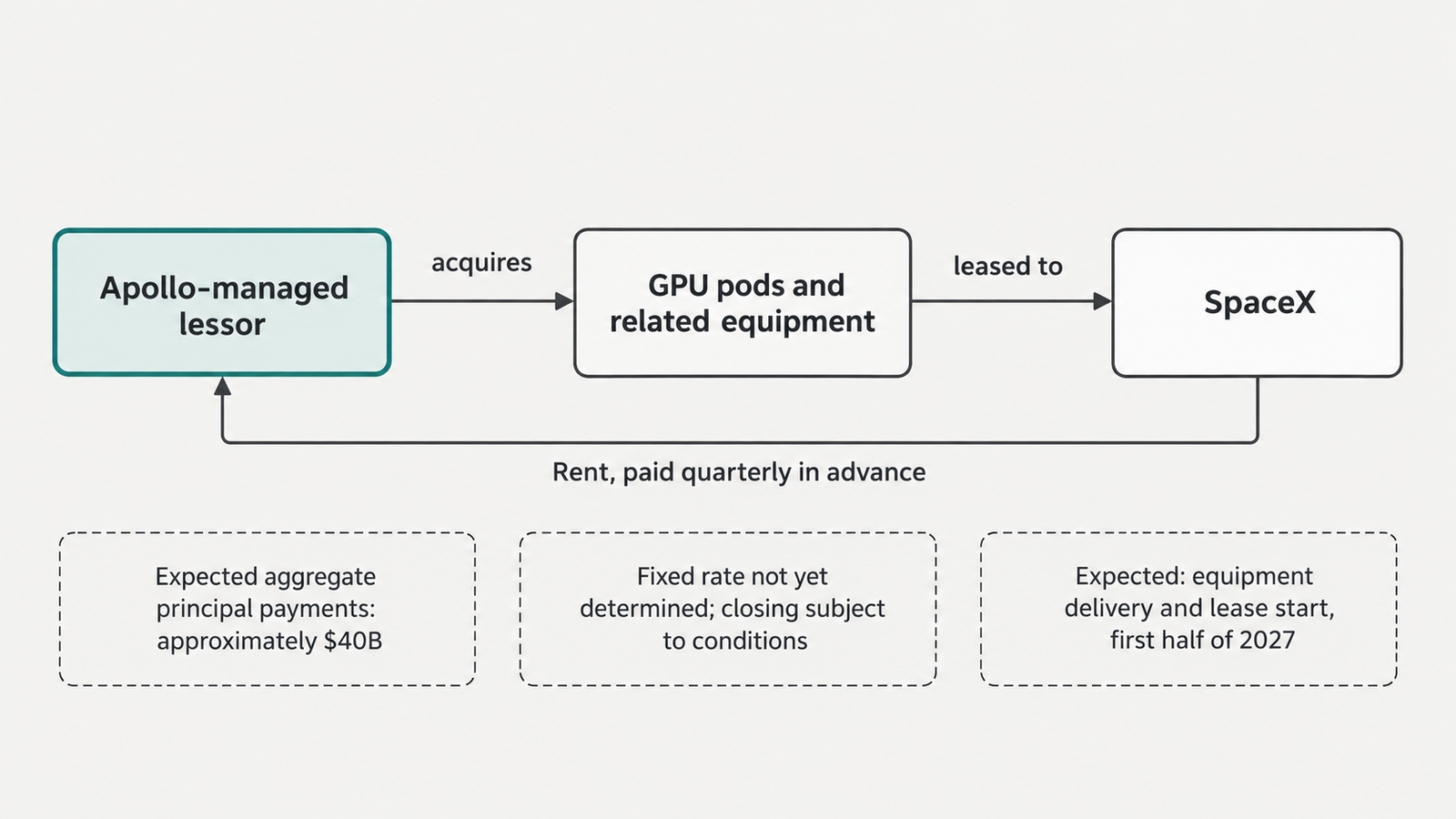
The 8-K describes a lessor “managed by Apollo Global Management” that will acquire “graphics processing unit pods and related equipment” and lease them to SpaceX for use at data centres SpaceX selects. Apollo and Goldman Sachs lead the financing parties, with Goldman as sole structuring agent. Funds managed by BlackRock, Goldman Sachs Asset Management and KKR-advised accounts made anchor commitments.
The investors won’t hold a single loan. Bloomberg reported that the debt will take the form of private bonds issued by an entity that sits off SpaceX’s balance sheet. Pimco bought about $4 billion of an “A2” tranche that sits between more senior and more junior slices, according to Bloomberg’s sources. So the risk is layered before it reaches anyone’s portfolio.
The rent formula is the most revealing disclosure. Equipment arrives in tranches, and each tranche gets its own lease schedule of roughly five to five and a quarter years. Rent is paid quarterly in advance and “will generally consist of” one-twentieth of the tranche’s financed cost, plus a fixed-rate charge on the outstanding balance, plus certain ongoing costs.
Twenty payments of one-twentieth each return the full cost of the equipment. The lessor is counting on SpaceX’s payments, not on selling used Rubin racks in 2032. The 8-K is silent on end-of-term ownership, purchase options, guarantees and prepayment. Elon Musk called it on X “primarily callable debt”, but the filing describes no call feature.
The issuing entity may sit off SpaceX’s balance sheet, but the lease won’t. Under US accounting rules, a lessee records a finance lease as a liability once it commences.
What the $40 billion does and doesn’t include
SpaceX “expects aggregate principal payments under the lease schedules over their respective terms to total approximately $40 billion.” That is the equipment cost being financed. The fixed-rate charge and the ongoing costs come on top, and neither has a published figure yet.
The scale matters. SpaceX reported $38.8 billion of long-term debt and capital lease obligations at 30 September in its third-quarter Form 10-Q. Once every tranche has commenced, principal alone runs to about $2 billion a quarter. For context, SpaceX generated $13.1 billion of operating cash flow in the first nine months of 2026 and held $89.9 billion of cash and marketable securities at quarter-end.
Four dates that are easy to confuse
Table: scroll sideways to view all columns when needed.
| Milestone | Date | Status |
|---|---|---|
| Commitment letter signed | 24 October 2026 | Done |
| Announcement and 8-K | 26 October 2026 | Done |
| Pricing (fixed rate set) | Before the master lease is signed | Not yet disclosed |
| Master lease signed and deal closed | Expected before end of 2026 | Subject to unspecified conditions |
| Lease schedules begin | On delivery, expected first half of 2027 | Expected |
Musk said on 25 October that the financing had closed. The company’s own filing, made a day later, does not say that. Where the two differ, this article follows the filing.
Whose credit backs SpaceX GPU financing
SpaceX has investment-grade ratings: Baa1 from Moody’s, BBB+ from Fitch and BBB from S&P, all with stable outlooks, according to Reuters on 18 June. Musk’s claim that “we’re investment grade and have Starlink & launch revenue” is accurate on the first point. Reuters also reported that S&P viewed the AI segment as the uncertain part, because of its capital needs and competition.
Bond investors have been less generous than the agencies. A Bloomberg Opinion column in July calculated that SpaceX’s average spread over Treasuries was slightly wider than the average for BB-rated, sub-investment-grade debt. On 21 October, the spread on SpaceX’s 6.6% notes due 2046 widened to 2.64 percentage points, and its five-year credit default swaps were near record highs, according to Bloomberg and ICE data relayed by Seoul Economic Daily.
These four measures answer different questions. A rating is an agency’s opinion of default risk. Musk’s description is an issuer’s claim. A bond’s yield is what investors pay today for an existing security with its own maturity and liquidity. The lease rate will be a negotiated price for a new, tranched instrument. None of them substitutes for the others.
The operating picture is strong but concentrated. Third-quarter revenue was $14.6 billion: $7.56 billion from the Super Intelligence (SI) segment, $5.25 billion from Starlink and $1.77 billion from launch. One SI customer supplied 34.5% of it. Nine-month capital spending of $48.1 billion far exceeded operating cash flow. SpaceX’s CFO cites payback periods under a year on SI infrastructure, without publishing the calculation.
A backlog that ends before the lease does
SpaceX reported a backlog of $63.0 billion at 30 September. It expects 67% of that to be recognised within a year, 27% in one to three years and 6% after that. Six per cent is about $3.8 billion. The lease payments, by contrast, run from 2027 to roughly 2032.
The contracts are also shorter than they look. Google’s agreement to pay $920 million a month runs to June 2029, but either side can end it on 90 days’ notice after 31 December 2026, TechCrunch reported from SpaceX’s filing. Anthropic’s $1.25 billion-a-month Colossus 1 agreement runs through 2029.
So the later years of rent are not covered by any contract SpaceX has disclosed. Investors are lending against SpaceX’s ability to keep selling compute, and behind that, against Starlink and launch. That is the opposite of how CoreWeave structures its cheapest debt.
CoreWeave: one GPU business, two prices
CoreWeave is the cleanest test of the idea that the customer, not the hardware, sets the price of GPU debt. The company borrows in two very different ways, and the price gap between them is wide.
The first is the delayed-draw term loan, or DDTL, raised inside a special-purpose subsidiary. CoreWeave’s March 2026 overview of DDTL 4.0 describes an $8.5 billion facility priced at SOFR plus 2.25 percentage points, with a fixed tranche at about 5.9%. Moody’s rated it A3. Lenders hold a first-priority claim on the equipment, the data-centre leases and the cloud contract with an unnamed investment-grade customer, and the loan is non-recourse to CoreWeave itself. CoreWeave says that cost is about 1.75 points below DDTL 3.0, which was priced at SOFR plus 4% in 2025 against an OpenAI contract.
The second is ordinary unsecured bonds. In mid-October, CoreWeave’s 9.75% notes due 2031 traded at a yield to maturity of about 15.8%, as we covered in our analysis of CoreWeave’s secured loans and unsecured bonds. No specific assets back those notes.
Several things differ between the two. One is a rated, secured loan priced at origination in March; the other is a market yield on an unsecured bond in a much worse October. Neither is backed by the chips in the SpaceX deal. The comparison still shows something useful: an A3 rating on a GPU loan came from the investment-grade customer’s contract and the security package around it. CoreWeave’s own credit, priced near 15%, was largely kept out of the loan.
SpaceX’s lease points the other way. The 8-K doesn’t mention any customer contract pledged to the lessor, and SpaceX’s contracts are shorter than the lease. The rent comes from SpaceX’s general resources. That puts the lease closer to SpaceX’s own corporate credit than to a contract-backed CoreWeave loan, with tranching and the equipment adding protection on top.
SpaceX GPU financing already has a costlier precedent
The Apollo deal is not SpaceX’s first GPU lease. Fortune reported from SpaceX’s IPO prospectus that entities of Valor Equity Partners, led by SpaceX director Antonio Gracias, signed three GPU leases with an xAI subsidiary in October 2025, January 2026 and April 2026. SpaceX guarantees the payments. The obligations total close to $20 billion over their terms, and SpaceX’s auditor treated the arrangements as loans, with the GPUs as collateral.
SpaceX’s quarterly filings let us estimate what that money costs. Related-party debt stood at $12.9 billion on 30 September. Related-party interest expense was $864 million for the first nine months and $513 million for the first half, which leaves $351 million for the third quarter. Annualised against the quarter’s average balance, that is about 10.7%. This is our calculation, not a disclosed rate, and the interest line may include fees or other related-party items.
For comparison, SpaceX’s $25 billion of unsecured bonds, priced in June, carry coupons from 5.35% on the 2031 notes to 6.65% on the 2056 notes. If our estimate is close, the company’s existing GPU leases cost several points more than its plain unsecured debt.
There are good reasons for some of that gap. The first lease was signed when xAI was a separate company whose own secured notes carried a 12.5% coupon, according to the same Fortune report. Related-party terms are also not a clean market price. That makes the Apollo rate a useful test. A rate near SpaceX’s bond curve would show that SpaceX’s credit now carries its GPU leases. A rate near the Valor level would suggest investors still price SpaceX’s AI hardware as a separate risk.
Where the chips still matter in SpaceX GPU financing
The hardware doesn’t disappear from the analysis. It decides how much investors recover if SpaceX stops paying, and it shapes how large the senior and junior tranches can be. The question is what a fleet of used Vera Rubin systems would fetch in the circumstances where SpaceX can’t pay.
Nvidia’s Rubin announcement describes the Vera Rubin NVL72 rack as 72 Rubin GPUs and 36 Vera CPUs, and claims up to ten times lower inference cost per token than Blackwell for mixture-of-experts models. That is a vendor claim, but it shows the lender’s problem: each generation is sold on making the last one cheaper to replace, and Rubin won’t stay Nvidia’s newest platform for five years.
That is the residual-value problem in AI chip financing, and it bites hardest when borrower stress and collateral value move together. If AI demand falls, SpaceX’s SI revenue and used-GPU prices fall at once. Book value won’t help, for the reasons in how accelerator depreciation changes the economics of AI infrastructure.
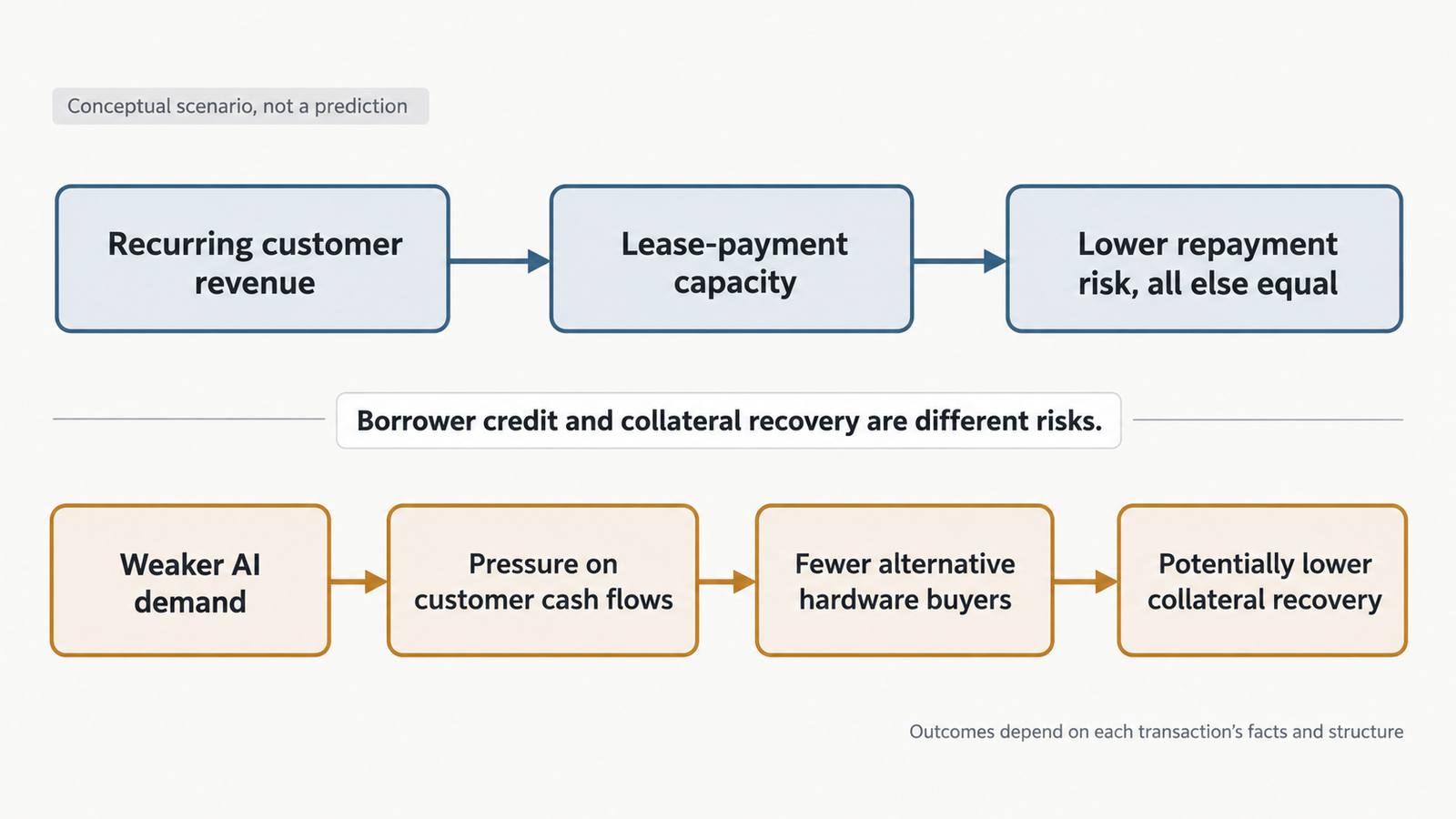
SpaceX’s answer is that its rent doesn’t depend only on AI. Musk wrote that debt markets had “almost entirely shut off access” for companies without substantial revenue outside AI data centres. Starlink and launch are that revenue. The lessor is buying exposure to SpaceX’s whole business, with the GPUs as a backstop.
Location matters too. CoreWeave’s DDTL 4.0 lenders hold a claim on the data-centre leases. The SpaceX 8-K says nothing about site access, and racks that need specific power and liquid cooling are hard to repossess.
The missing number in SpaceX GPU financing
The fixed rate will be set at pricing, which comes before the master lease is signed. Bloomberg reported that a volatile week for AI debt had disrupted pricing discussions. Until SpaceX discloses the rate, nobody outside the deal can say how investors weighed SpaceX’s credit against the hardware.
The rate also determines the cost. Because the balance falls by one-twentieth each quarter, the average balance over a five-year schedule is roughly half the original cost. On that basis, each percentage point on the rate adds about $0.95 billion to $1.05 billion of interest across $40 billion of principal. The range depends on whether the charge is calculated before or after each payment, which the 8-K doesn’t specify. These are illustrative figures that ignore delivery timing and ongoing costs.
A worked example: one tranche, three lessees
Take a $1 billion tranche of identical racks on the same rent formula: twenty quarterly principal payments of $50 million, with interest on the balance left after each payment. Only the lessee and the protections change. The rates are borrowed from the instruments discussed above. They are not quotes for the SpaceX deal.
Table: scroll sideways to view all columns when needed.
| Lessee and protection | Illustrative rate | Interest over the lease | Total paid |
|---|---|---|---|
| GPU cloud SPV with a pledged contract from an investment-grade customer (like DDTL 4.0) | 5.9% | $140 million | $1.140 billion |
| Subsidiary lease guaranteed by an investment-grade parent, related-party lessor (SpaceX’s estimated Valor cost) | 10.7% | $254 million | $1.254 billion |
| GPU cloud’s own unsecured credit (CoreWeave 2031 notes yield) | 15.0% | $356 million | $1.356 billion |
The hardware is the same in every row. The interest bill more than doubles between the first and last rows because the source of repayment changes. The first row also shows that a company whose own bonds yield near 15% can borrow cheaply when a stronger customer stands behind the contract.
Three ways SpaceX GPU financing could play out
These are conceptual scenarios, not predictions. They show who absorbs the damage as conditions change.
Table: scroll sideways to view all columns when needed.
| Strong AI demand | Weaker AI demand | Sector-wide downturn | |
|---|---|---|---|
| SpaceX SI revenue | Grows with capacity | Falls; customers like Google can exit on 90 days’ notice after 2026 | Falls sharply |
| Rent capacity | Covered by SI alone | Covered with help from Starlink and launch | Depends heavily on Starlink and launch |
| Used Rubin values | Firm | Softer as buyers wait for newer chips | Weak, with few buyers |
| Who takes the loss first | Nobody | SpaceX shareholders, through lower returns on compute | Shareholders, then junior lease tranches if SpaceX defaults |
In the first two columns, the lease investors are mostly protected by SpaceX’s balance sheet. Only the third column, where SpaceX itself is in trouble and used GPUs are hard to sell at the same moment, tests the hardware’s value.
What to watch next in SpaceX GPU financing
- The rate. Near SpaceX’s unsecured bond yields would support the argument here. Well above them would mean investors are charging extra for AI or equipment risk.
- The master lease. If filed, look for guarantees, purchase options, prepayment rights, default terms and any pledge of customer contracts or data-centre leases.
- Closing, expected before the end of 2026 under conditions the filing doesn’t describe.
- SpaceX’s spreads and default swaps. Wider spreads before pricing would likely mean a higher lease rate.
- The Google contract after 31 December, when its termination right becomes live.
- Backlog length in the annual report, and first deliveries in 2027, when rent starts.
Three findings would change this conclusion: a customer contract pledged to the lessor, a third-party guarantee, or a rate far above SpaceX’s own debt.
What SpaceX GPU financing says about AI credit
The question was how much of the price of AI hardware financing reflects the hardware and how much reflects the customer. On the documents available, the customer dominates. CoreWeave got investment-grade pricing by putting a stronger customer’s contract between lenders and itself. SpaceX is the customer in its own deal, and the rent formula repays the full equipment cost from SpaceX’s cash flows.
The chips still set the floor on recovery. That matters most in the scenario where SpaceX and the AI market weaken together. The rate, when SpaceX discloses it, will show how much investors charged for that scenario.
Frequently asked questions
What is SpaceX’s $40 billion GPU lease?
It is a planned master finance lease. An Apollo-managed lessor will buy Nvidia Vera Rubin GPU pods and related equipment and lease them to SpaceX for its data centres. SpaceX expects principal payments of about $40 billion across lease schedules of roughly five years each. Interest and certain ongoing costs are charged on top of that.
Has SpaceX’s GPU financing closed?
Not according to SpaceX’s filings as of 28 October 2026. SpaceX signed a binding commitment letter on 24 October. The master lease will be signed after pricing, and closing is expected before the end of 2026, subject to conditions the filing doesn’t describe. Musk said on X that the deal had closed, but the 8-K describes a commitment.
What interest rate will SpaceX pay?
It hasn’t been disclosed. The 8-K says a fixed rate will be set at pricing, before the master lease is signed. Bloomberg reported that pricing talks were still under way on 25 October. On illustrative assumptions, each percentage point on the rate adds roughly $1 billion of interest across the $40 billion.
Who owns the GPUs under the lease?
The Apollo-managed lessor acquires the equipment and leases it to SpaceX, according to the 8-K. The filing doesn’t say what happens at the end of the term or whether SpaceX can buy the equipment. Because rent repays one-twentieth of each tranche’s cost every quarter, the lessor recovers the full cost through rent if SpaceX pays as scheduled.
Is SpaceX investment grade?
Yes, by the agencies. Moody’s rates it Baa1, Fitch BBB+ and S&P BBB, all with stable outlooks as of June 2026. Bond markets have been more sceptical. SpaceX’s spreads and credit default swaps widened through October, and a Bloomberg Opinion column argued in July that its bonds traded more like high-yield debt.
Why compare SpaceX with CoreWeave?
CoreWeave borrows against GPUs in two ways that are priced very differently. Its A3-rated loan, secured by an investment-grade customer’s contract, carried a fixed rate of about 5.9%. Its unsecured notes yielded about 15.8% in October. The instruments differ, so the comparison shows how structure and customer credit drive price. It doesn’t show that the chips are equivalent.
What happens to the GPUs if AI demand falls?
SpaceX would still owe rent, which it could pay from Starlink and launch revenue. The equipment’s value matters mainly if SpaceX defaults. Then investors depend on resale prices for used Vera Rubin systems, which would probably be weak in the same downturn. Junior tranches would take losses first.
What should readers watch next?
Watch for the pricing disclosure and the fixed rate, the master lease terms if SpaceX files them, and closing before year-end. Also watch SpaceX’s bond spreads, the status of the Google contract after 31 December 2026, and the first Vera Rubin deliveries in 2027.
Keep reading
Here are the latest posts from the blog.

LLM Cost per Task: How to Calculate the Real API Cost
SpaceX’s $40B GPU Lease: The Customer Sets the Price

Gemini 4 Argon Pricing Doubles Dec 1: What It Costs