Published 25 October 2026 · Last verified 25 October 2026 · By the UniverseBlend editorial desk
On 21 October, Meta set the latest marker for AI infrastructure spending, telling investors it expects to spend $135 billion to $145 billion on capital expenditure in 2026, a figure that includes principal payments on finance leases.
Side by side, the two statements describe one problem from opposite ends. Meta shows how much money is going in. Amazon shows how little of that money has yet become compute that a customer can rent.
In this story, AI infrastructure spending means cash spent on long-lived assets — land, buildings, electrical and cooling plant, servers, accelerators, memory and networking — that hyperscalers expect to run AI and cloud workloads.
Key Takeaways
- Meta’s 21 October guidance narrowed its 2026 range to $135–145 billion; the $145 billion ceiling has stood since April. With $85.8 billion spent by September, the range implies $49–59 billion of fourth-quarter capex, 41–70% above the third quarter.
- Amazon has not raised its ~$220 billion forecast since 30 July. Jassy’s 23 October remarks described capacity commitments and an appetite to spend more, not a new budget.
- “Sold out” applies to large, committed blocks of AWS capacity. Jassy said Amazon still keeps capacity back for on-demand EC2 and its Bedrock inference service.
- Estimates of 2026 hyperscaler spending run from about $794 billion (consensus cited by Goldman Sachs, all capex, US) to about $900 billion (J.P. Morgan, AI capex, five US firms) to $957 billion (TrendForce, nine global cloud providers). They measure different things and cannot be added together.
- Memory prices are inflating the dollar figures. Jassy attributed most of Amazon’s $20 billion increase to memory costs, and TrendForce estimates DRAM and NAND will take 47% of large cloud providers’ capex this year.
- AWS’s $496 billion backlog equals roughly 2.9 years of its current revenue run rate. Its duration, pricing and margin are not disclosed.
- Utilisation of new capacity, contract pricing, and price versus volume inside capex would show whether the spending works. None is disclosed.
Quick Navigation
- The AI infrastructure spending ledger
- The money arrives before the compute
- The memory allocation problem
- Training and inference compete for the same buildout
- Sold-out capacity versus profitable capacity
- What to watch next
- Conclusion
- FAQ
- What is AI capex in 2026?
- Why is Meta spending up to $145 billion on capital expenditure?
- Why is Amazon's AWS capacity sold out through 2027?
- How do HBM and conventional DRAM affect AI infrastructure costs?
- Does higher AI capex guarantee higher cloud profits?
- How can businesses tell whether AI infrastructure spending is producing returns?
The AI infrastructure spending ledger
The headline numbers come in three kinds: what companies have spent, what they say they will spend, and what analysts think the sector will spend. They should never share a column without labels.
| Who | Figure and period | Status | What it does not establish |
|---|---|---|---|
| Meta | $135–145bn, 2026, incl. finance-lease principal | Guidance, 21 Oct 2026 | AI share; price inflation within it |
| Amazon | ~$220bn cash capex, 2026 | Management expectation, 30 Jul 2026; unchanged at 25 Oct | AWS share (includes retail, logistics, satellites) |
| Alphabet | $195–205bn, 2026 | Guidance, 22 Jul 2026 | Split between Cloud customers and Google’s own use |
| Microsoft | ~$175bn, calendar 2026 | Guidance as reported, 29 Jul 2026 | Lower than April’s ~$190bn because of lease accounting, not cuts |
| Five US hyperscalers incl. Oracle | ~$900bn AI capex, 2026 | J.P. Morgan estimate, 19 Oct 2026 | Company disclosure; uses J.P. Morgan’s AI definition |
| US hyperscalers | ~$794bn total capex, 2026 | Consensus cited by Goldman Sachs, 7 Aug 2026 | AI share; Goldman says it overstates US AI investment by ~$200bn |
| Nine global cloud providers | $957bn, 2026 | TrendForce estimate, 14 Oct 2026 | Includes ByteDance, Tencent, Alibaba, Baidu; not additive to the rows above |
The “$700 billion” figure that circulated in July is out of date. Reuters used it on 30 July for Big Tech’s AI investment; by October the narrowest comparable estimate had passed $790 billion.
Meta’s guidance reads like a raise, but only the floor moved, from $130 billion to $135 billion. The $145 billion ceiling dates from 29 April, when Meta cited higher component prices. What the new floor establishes is that Meta expects to spend at least $49 billion in the fourth quarter. (Calculation: $135bn minimum guidance minus $85.82bn spent from January to September, using purchases of property and equipment plus finance-lease principal from Meta’s third-quarter cash-flow statement.)
Microsoft’s row shows why a lower number need not mean a smaller programme. CFO Dive reported that Microsoft extended the estimated useful life of its data centres from 15 to 25 years. Chief financial officer Amy Hood said the change moves some future data-centre leases from finance leases, which count as capex, to operating leases, which do not. The buildings are the same. The reported capex is lower.
The money arrives before the compute
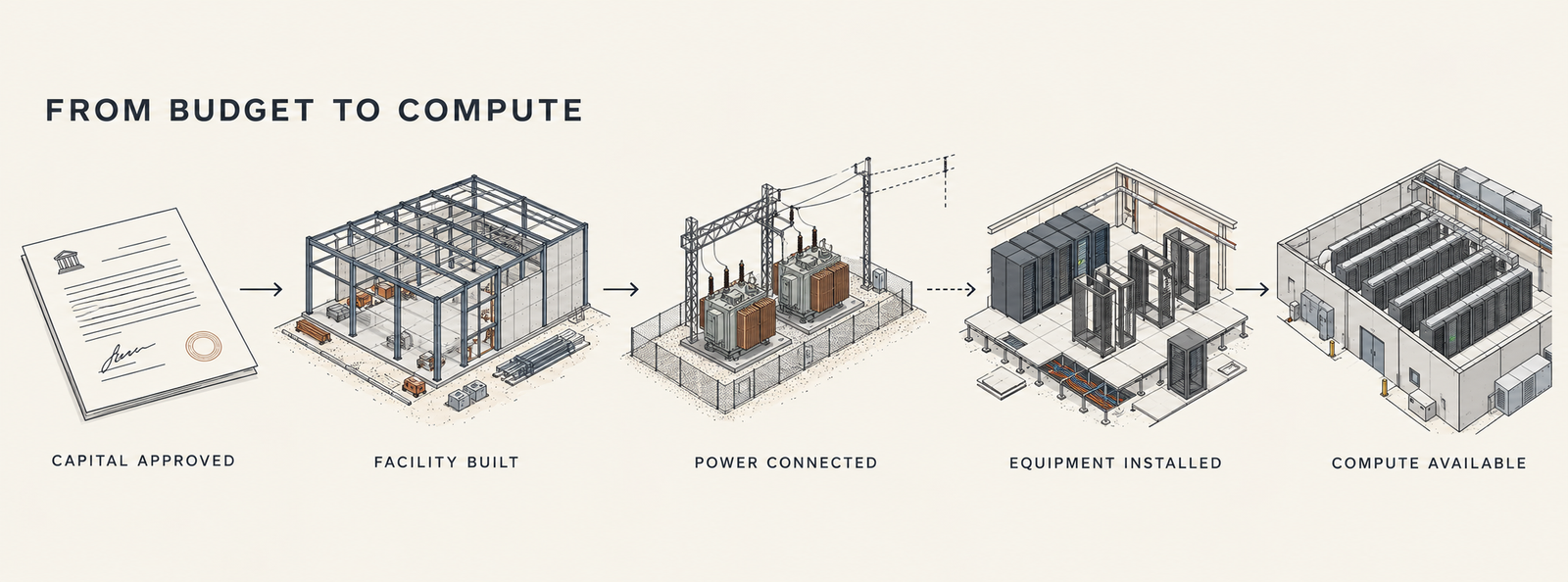
A capex dollar buys assets that come online in a fixed order, and the earliest spending earns nothing.
In his April shareholder letter, Jassy listed what AWS pays for up front: land, power, buildings, chips, servers and networking gear. The cash goes out “typically 6-24 months before we start billing customers,” depending on the component. The same letter puts data-centre lives at 30-plus years and chips, servers and networking at five to six.
That timing suggests a framework for reading any capex announcement. Track the money through six states:
- Committed — approved budget or guidance. Meta’s $135–145 billion sits here.
- Procured — equipment ordered or paid for. TrendForce reports that some component suppliers now want payment in advance, which pulls cash forward.
- Installed — racks in a building. This needs a finished shell and cooling.
- Available — energised, networked and commissioned capacity that can take a workload. This needs a grid connection.
- Contracted — capacity sold under commitment. AWS’s $496 billion backlog lives here, and it can run ahead of state 4.
- Monetised — capacity billing at a price that covers its depreciation and running costs.
Companies disclose the first and fifth states and, in aggregate, the sixth. The states in between are where the time goes.
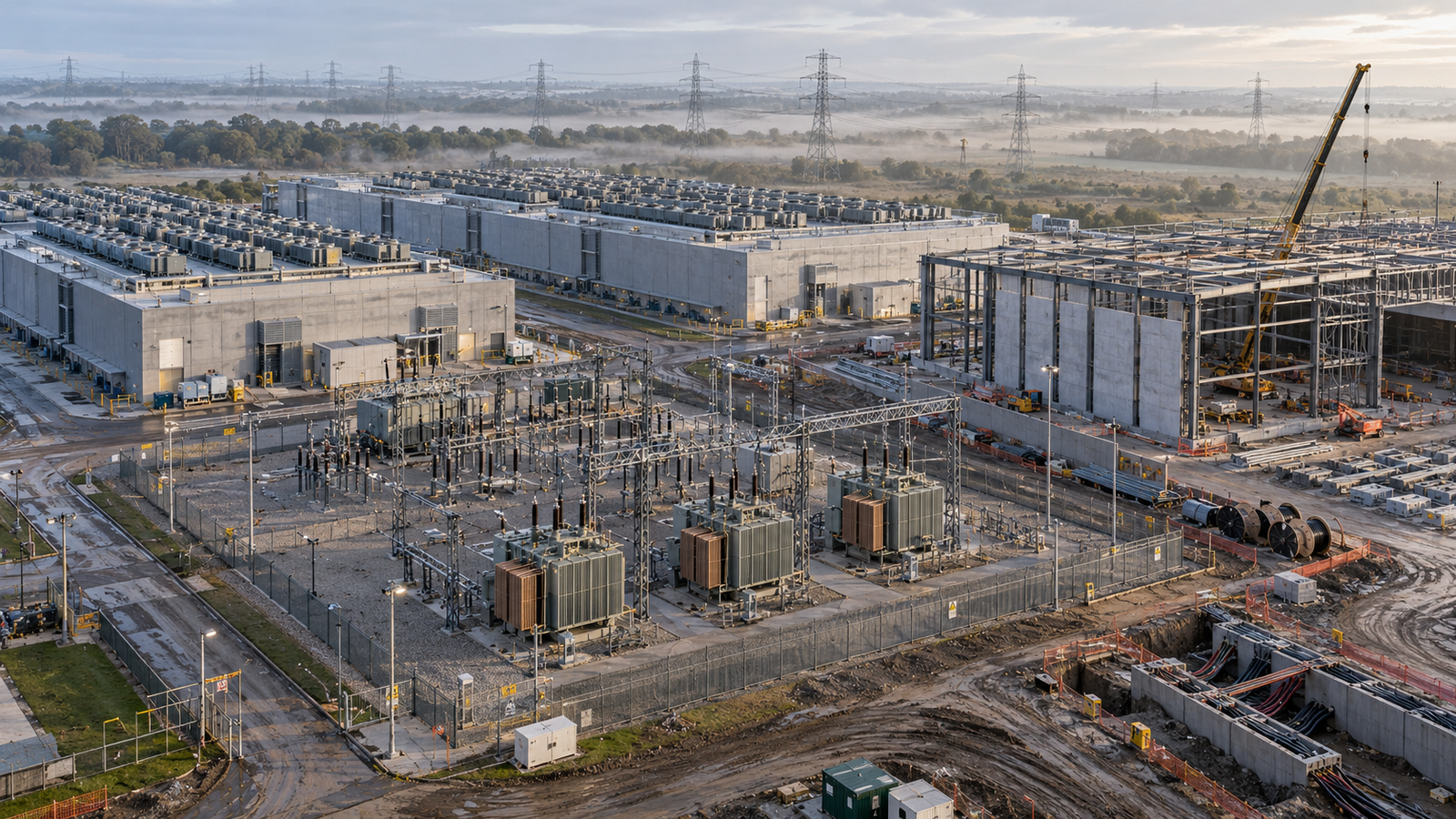
Power is the slowest of them. UniverseBlend’s analysis of transformer lead times and interconnection queues found transformers averaging about 128 weeks and US interconnection waits of three to seven years, longer than the buildings they serve. J.P. Morgan’s 19 October note puts data-centre construction at 18–30 months and names power as the primary bottleneck.
Amazon’s own metric points the same way. AWS added 3.9 gigawatts of power capacity in 2025 and expects to double total power capacity by the end of 2027, according to the shareholder letter. When the constraint is energised megawatts, capex can outrun capacity for a long time without anything having gone wrong.
That is why Meta’s fourth quarter deserves attention. Its guidance implies quarterly spending 41–70% above the third quarter’s $34.91 billion. (Calculation: implied fourth quarter of $49.2–59.2bn divided by the third-quarter actual.) A late-year surge of that size buys assets that will mostly enter service in 2027.
The memory allocation problem
Memory changed the arithmetic more than any other component in 2026, because it raises the price of AI servers and ordinary cloud servers at the same time.
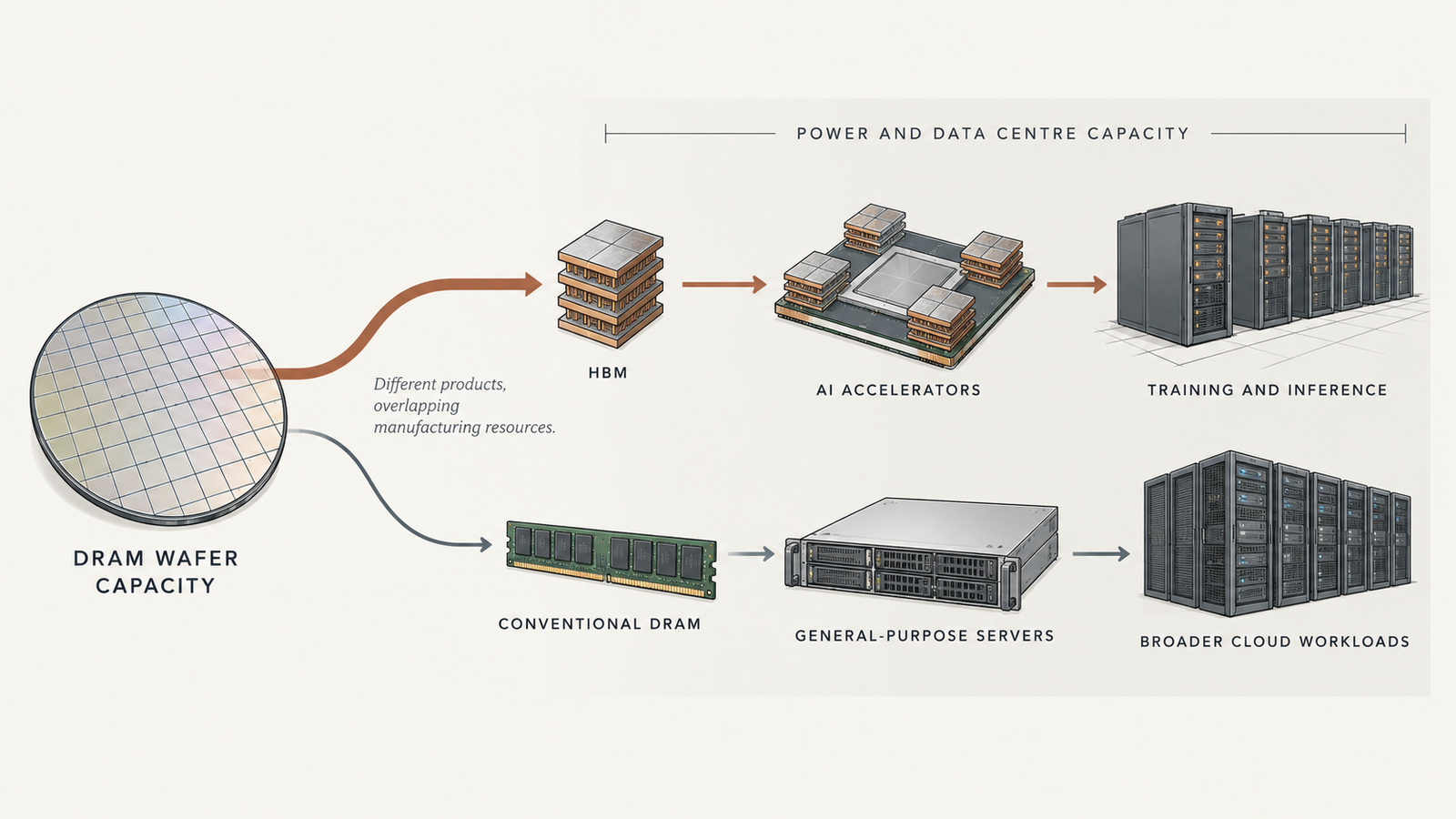
Two products are involved. Conventional server DRAM, sold as DDR5 registered modules (RDIMMs), sits beside CPUs in general-purpose servers. High-bandwidth memory (HBM) is also made from DRAM dies, but they are stacked, linked by through-silicon vias and packaged beside an accelerator to deliver very high bandwidth. An operator cannot plug HBM into a CPU server or fit DDR5 into a GPU package.
They compete upstream, for wafers. Micron chief executive Sanjay Mehrotra has said HBM3E needs about three times the silicon of DDR5 to produce the same number of bits. He expects that ratio to exceed 4-to-1 with HBM4E. Every wafer turned over to HBM yields fewer bits than it would as DDR5. UniverseBlend covered how HBM crowds out conventional DRAM wafers in September.
Amazon has tied this to its budget. On its 30 July earnings call, Jassy attributed most of the increase from about $200 billion to about $220 billion to higher memory costs, which J.P. Morgan’s research also records. He returned to the point on the 23 October podcast. According to several reports of the interview, he described splitting constrained memory between HBM for accelerators and DRAM for AWS’s core, non-AI services, both of which are growing.
The analyst figures show the scale. TrendForce estimates that server DRAM contract prices rose 64% in the second half of 2025 and will rise about 270% over 2026. It expects DRAM and NAND flash together to account for 47% of large cloud providers’ capex in 2026 and 68% in 2027. These are one research firm’s estimates, not company disclosures, but they point the same way as what Amazon and Meta have told investors.
Demand is coming from the CPU side as well. A 22 October TrendForce report expects server CPU shipments to grow 31% in 2026 and more than 40% in 2027, partly because agentic AI workloads need more CPU orchestration. It sees planned CPU-to-accelerator ratios moving from 1:8 toward 1:2 or even 1:1. Those CPUs need memory of their own, mostly DDR5 server modules, so AI demand also lifts conventional DRAM demand directly.
Part of 2026’s capex growth is therefore a price effect: a larger budget buys fewer servers per dollar than it did a year ago. No hyperscaler splits capex into price and volume, so outsiders cannot tell how much extra compute each additional billion buys.
Training and inference compete for the same buildout
Accelerator counts say little on their own, because training and inference ask different things of the same hardware budget.
Training a frontier model needs thousands of accelerators working in lockstep for weeks, high-bandwidth interconnect between them and enough HBM to hold model state. Models are retrained and new ones begun, so a training cluster is a recurring claim on capacity, not a one-off cost.
Inference runs continuously and follows user demand. Generating each token means reading the model’s weights and its key-value (KV) cache from memory. Throughput is therefore usually limited by memory bandwidth, as UniverseBlend explained in why memory bandwidth, not FLOPS, caps inference throughput. The KV cache grows with context length and with the number of concurrent requests, so longer contexts cut how many users one accelerator can serve. Operators batch requests to raise utilisation, and pay for it in latency.
These differences turn into capex decisions. A cluster built for training carries a networking fabric that an inference fleet may not need. Hardware built for fast or cheap inference may be poorly suited to frontier training, and UniverseBlend has argued that specialised inference chips win only a narrow slice of the market. Capacity can move between workloads, though not always efficiently.
Meta and Amazon make this choice from different positions. Meta is its own customer. Its release says current and scheduled capacity gives it “flexibility to allocate resources across model training, core business growth” and new products. Its return arrives mainly through advertising: third-quarter ad revenue rose 26%, with impressions up 10% and price per ad up 14%. That growth cannot be credited wholly to AI infrastructure, although Meta says its AI investments are already delivering substantial incremental ad revenue.
Amazon sells capacity. Jassy said 2027 is “largely sold out all the big chunks,” according to Reuters, with some capacity held back for on-demand EC2 and Bedrock. Large commitments take long blocks; on-demand and managed-inference customers buy in small pieces at different prices. The same gigawatt can earn very different returns depending on who fills it.
Sold-out capacity versus profitable capacity
Sold-out capacity shows that demand at current prices exceeds deliverable supply. It does not show that the next dollar of capex earns an attractive return.
The disclosures establish three things. Customers have signed commitments: AWS’s backlog reached $496 billion at the end of June, up from $364 billion three months earlier. AWS is profitable now, with $16.6 billion of operating income on $42.2 billion of second-quarter revenue, according to Amazon’s second-quarter release. And Jassy wrote in April that Amazon already had commitments for a substantial portion of its 2026 AWS capex.
They do not establish duration, pricing or concentration. The backlog is about 2.9 years of AWS’s $169 billion annualised run rate (calculation: backlog divided by run rate), but Amazon does not say how long the contracts run, what margins they carry or how much comes from a few AI laboratories; OpenAI alone has committed more than $100 billion, according to the shareholder letter. Regional mix and utilisation are also undisclosed.
Costs are rising too. Meta’s depreciation and amortisation rose 44% year on year in the third quarter to $7.15 billion, and its free cash flow was negative $2.12 billion. Meta also announced a non-voting Class C share class, partly to give it a way to raise capital, effective 19 January 2027. J.P. Morgan notes that hyperscalers are increasingly funding the buildout with debt and equity rather than free cash flow.
Useful-life assumptions sit beneath all of this. Amazon depreciates chips and servers over five to six years. J.P. Morgan’s chief US economist, Michael Feroli, has warned that AI hardware may lose economic value faster than conventional equipment as each generation lowers the cost per unit of compute. If he is right, current depreciation schedules could overstate profits.
The strongest counterargument is Amazon’s. Jassy’s letter argues that data centres last 30-plus years and that returns become cumulatively attractive a couple of years after assets enter service. That holds well for buildings and power, the long-lived part. It says less about the five-year assets, which are where memory inflation lands.
What to watch next
Scheduled disclosures:
- 28 October 2026 — Alphabet third-quarter results and Microsoft fiscal first-quarter 2027 results, both after the US close. Watch Alphabet’s $195–205 billion range and Microsoft’s capex including finance leases.
- 29 October 2026 — Amazon third-quarter results, as reported by Reuters. Watch whether the ~$220 billion expectation changes, the AWS backlog and margins, and any memory commentary.
- 19 January 2027 — Meta’s Class C stock takes effect, an indication of how Meta intends to fund 2027.
Not yet scheduled: Meta’s 2027 capex range, which management says it is still developing, and 2027 HBM contract prices, which TrendForce expects to rise 70–140%.
A scorecard for the quarters that follow:
| Indicator | Type | Disclosed? |
|---|---|---|
| Backlog growth versus revenue growth | Leading | Yes (AWS, Google Cloud, Microsoft) |
| Capex growth versus cloud revenue growth | Leading | Yes |
| Price versus volume within capex | Leading | No |
| Utilisation of newly deployed capacity | Leading | No |
| Segment margin after depreciation | Lagging | Partly (AWS yes; Meta’s AI no) |
| Free cash flow and external financing | Lagging | Yes |
| Return on invested capital for AI assets | Lagging | No |
If backlog keeps outpacing revenue while margins hold after depreciation, the spending is converting. If capex keeps rising while margins fall and financing needs grow, it is not, whatever the backlog says.
Conclusion
Treat AI infrastructure spending in 2026 as a measure of intent. Meta’s range tells you how much it is prepared to put in; Amazon’s sold-out remark tells you how far delivery is lagging demand. Neither tells you about returns.
Three questions separate a credible announcement from a merely large one. How much of the increase is price? How long until the spending becomes energised capacity? And who has contracted to use it, at what margin? Today companies answer the third only in aggregate and the first two not at all. Until that changes, a rising capex number is evidence of demand and of component inflation, in proportions that nobody outside these companies can see.
FAQ
What is AI capex in 2026?
It is capital spending on data centres, power, cooling, servers, accelerators, memory and networking intended to run AI and cloud workloads. Estimates for 2026 range from about $794 billion (US hyperscaler consensus, all capex) to about $900 billion (J.P. Morgan, AI capex at five US firms), depending on scope.
Why is Meta spending up to $145 billion on capital expenditure?
Meta guided on 21 October 2026 to $135–145 billion, including finance-lease principal, to support its advertising business and its AI work. When it raised the range in April, it cited higher component prices. Its 2027 plans are not yet set.
Why is Amazon’s AWS capacity sold out through 2027?
Jassy said on 23 October 2026 that customers have committed to most large blocks of 2027 capacity because demand from AI labs and enterprises exceeds what Amazon can build. Some capacity is kept for on-demand EC2 and Bedrock, so not every service or region is unavailable.
How do HBM and conventional DRAM affect AI infrastructure costs?
HBM is stacked memory packaged with accelerators; conventional DRAM serves CPU servers. They are not interchangeable, but both come from DRAM wafers, and HBM uses about three times as much silicon per bit. Rising prices for both have pushed up capex budgets, including Amazon’s.
Does higher AI capex guarantee higher cloud profits?
No. Capex creates depreciation, over five to six years for chips and servers, and returns depend on utilisation and pricing. No company discloses margins on its new AI capacity.
How can businesses tell whether AI infrastructure spending is producing returns?
Compare backlog and revenue growth with capex growth, then check margin after depreciation and free cash flow. For a buyer, the test is utilisation: reserved but idle capacity earns nothing.
Editorial note: Figures are as disclosed or reported up to 25 October 2026. Alphabet and Microsoft report on 28 October and Amazon on 29 October; if those results change any figure here, this article will carry a dated update. Report errors through the contact page.
Keep reading
Here are the latest posts from the blog.
AI Infrastructure Spending: What $145 Billion and a Sold-Out AWS Actually Buy

What Is Agentic AI? How AI Agents Work, What They Cost, and Where They Fail

AI Agent Authorization: Why a Bank Login Isn’t Permission