AI Infrastructure Spending: What $145 Billion and a Sold-Out AWS Actually Buy

AI capex

Published 25 October 2026 · Last verified 25 October 2026 · By the UniverseBlend editorial desk

On 21 October, Meta set the latest marker for AI infrastructure spending, telling investors it expects to spend $135 billion to $145 billion on capital expenditure in 2026, a figure that includes principal payments on finance leases.

Side by side, the two statements describe one problem from opposite ends. Meta shows how much money is going in. Amazon shows how little of that money has yet become compute that a customer can rent.

In this story, AI infrastructure spending means cash spent on long-lived assets — land, buildings, electrical and cooling plant, servers, accelerators, memory and networking — that hyperscalers expect to run AI and cloud workloads.

Key Takeaways
  • Meta’s 21 October guidance narrowed its 2026 range to $135–145 billion; the $145 billion ceiling has stood since April. With $85.8 billion spent by September, the range implies $49–59 billion of fourth-quarter capex, 41–70% above the third quarter.
  • Amazon has not raised its ~$220 billion forecast since 30 July. Jassy’s 23 October remarks described capacity commitments and an appetite to spend more, not a new budget.
  • “Sold out” applies to large, committed blocks of AWS capacity. Jassy said Amazon still keeps capacity back for on-demand EC2 and its Bedrock inference service.
  • Estimates of 2026 hyperscaler spending run from about $794 billion (consensus cited by Goldman Sachs, all capex, US) to about $900 billion (J.P. Morgan, AI capex, five US firms) to $957 billion (TrendForce, nine global cloud providers). They measure different things and cannot be added together.
  • Memory prices are inflating the dollar figures. Jassy attributed most of Amazon’s $20 billion increase to memory costs, and TrendForce estimates DRAM and NAND will take 47% of large cloud providers’ capex this year.
  • AWS’s $496 billion backlog equals roughly 2.9 years of its current revenue run rate. Its duration, pricing and margin are not disclosed.
  • Utilisation of new capacity, contract pricing, and price versus volume inside capex would show whether the spending works. None is disclosed.

Quick Navigation


The AI infrastructure spending ledger

The headline numbers come in three kinds: what companies have spent, what they say they will spend, and what analysts think the sector will spend. They should never share a column without labels.

WhoFigure and periodStatusWhat it does not establish
Meta$135–145bn, 2026, incl. finance-lease principalGuidance, 21 Oct 2026AI share; price inflation within it
Amazon~$220bn cash capex, 2026Management expectation, 30 Jul 2026; unchanged at 25 OctAWS share (includes retail, logistics, satellites)
Alphabet$195–205bn, 2026Guidance, 22 Jul 2026Split between Cloud customers and Google’s own use
Microsoft~$175bn, calendar 2026Guidance as reported, 29 Jul 2026Lower than April’s ~$190bn because of lease accounting, not cuts
Five US hyperscalers incl. Oracle~$900bn AI capex, 2026J.P. Morgan estimate, 19 Oct 2026Company disclosure; uses J.P. Morgan’s AI definition
US hyperscalers~$794bn total capex, 2026Consensus cited by Goldman Sachs, 7 Aug 2026AI share; Goldman says it overstates US AI investment by ~$200bn
Nine global cloud providers$957bn, 2026TrendForce estimate, 14 Oct 2026Includes ByteDance, Tencent, Alibaba, Baidu; not additive to the rows above

The “$700 billion” figure that circulated in July is out of date. Reuters used it on 30 July for Big Tech’s AI investment; by October the narrowest comparable estimate had passed $790 billion.

Meta’s guidance reads like a raise, but only the floor moved, from $130 billion to $135 billion. The $145 billion ceiling dates from 29 April, when Meta cited higher component prices. What the new floor establishes is that Meta expects to spend at least $49 billion in the fourth quarter. (Calculation: $135bn minimum guidance minus $85.82bn spent from January to September, using purchases of property and equipment plus finance-lease principal from Meta’s third-quarter cash-flow statement.)

Microsoft’s row shows why a lower number need not mean a smaller programme. CFO Dive reported that Microsoft extended the estimated useful life of its data centres from 15 to 25 years. Chief financial officer Amy Hood said the change moves some future data-centre leases from finance leases, which count as capex, to operating leases, which do not. The buildings are the same. The reported capex is lower.

The money arrives before the compute

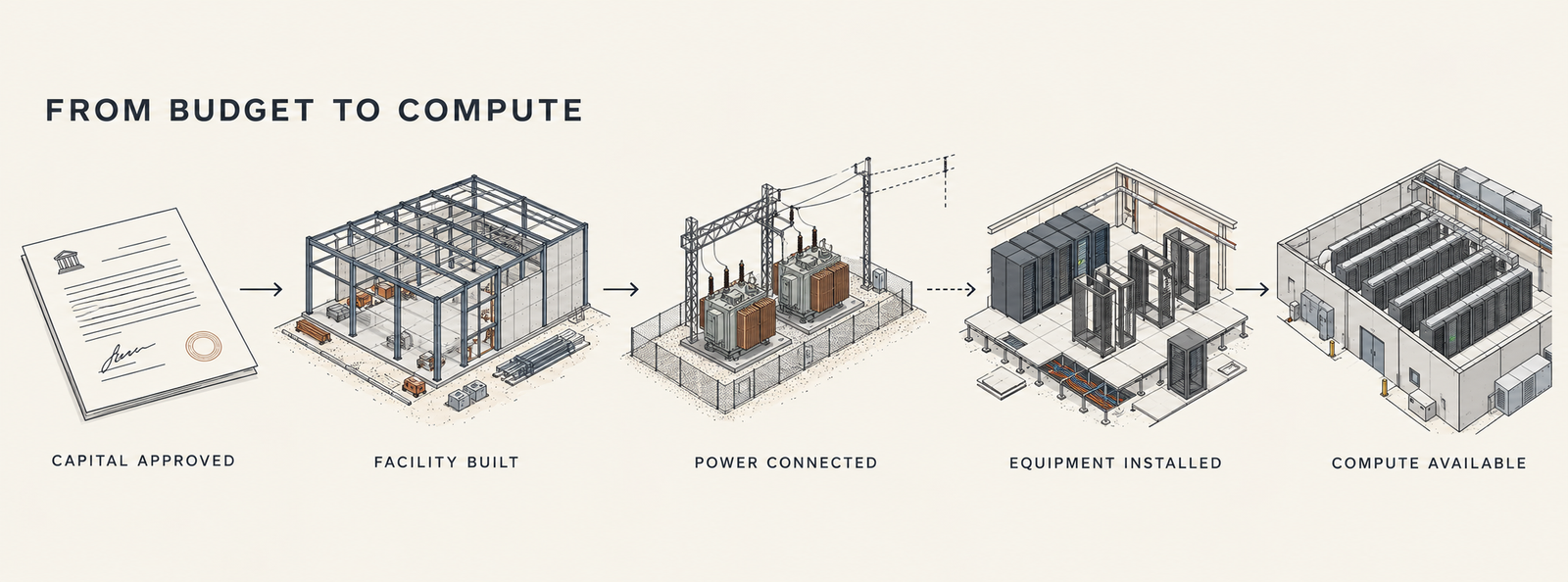
A capex dollar buys assets that come online in a fixed order, and the earliest spending earns nothing.

In his April shareholder letter, Jassy listed what AWS pays for up front: land, power, buildings, chips, servers and networking gear. The cash goes out “typically 6-24 months before we start billing customers,” depending on the component. The same letter puts data-centre lives at 30-plus years and chips, servers and networking at five to six.

That timing suggests a framework for reading any capex announcement. Track the money through six states:

  1. Committed — approved budget or guidance. Meta’s $135–145 billion sits here.
  2. Procured — equipment ordered or paid for. TrendForce reports that some component suppliers now want payment in advance, which pulls cash forward.
  3. Installed — racks in a building. This needs a finished shell and cooling.
  4. Available — energised, networked and commissioned capacity that can take a workload. This needs a grid connection.
  5. Contracted — capacity sold under commitment. AWS’s $496 billion backlog lives here, and it can run ahead of state 4.
  6. Monetised — capacity billing at a price that covers its depreciation and running costs.

Companies disclose the first and fifth states and, in aggregate, the sixth. The states in between are where the time goes.

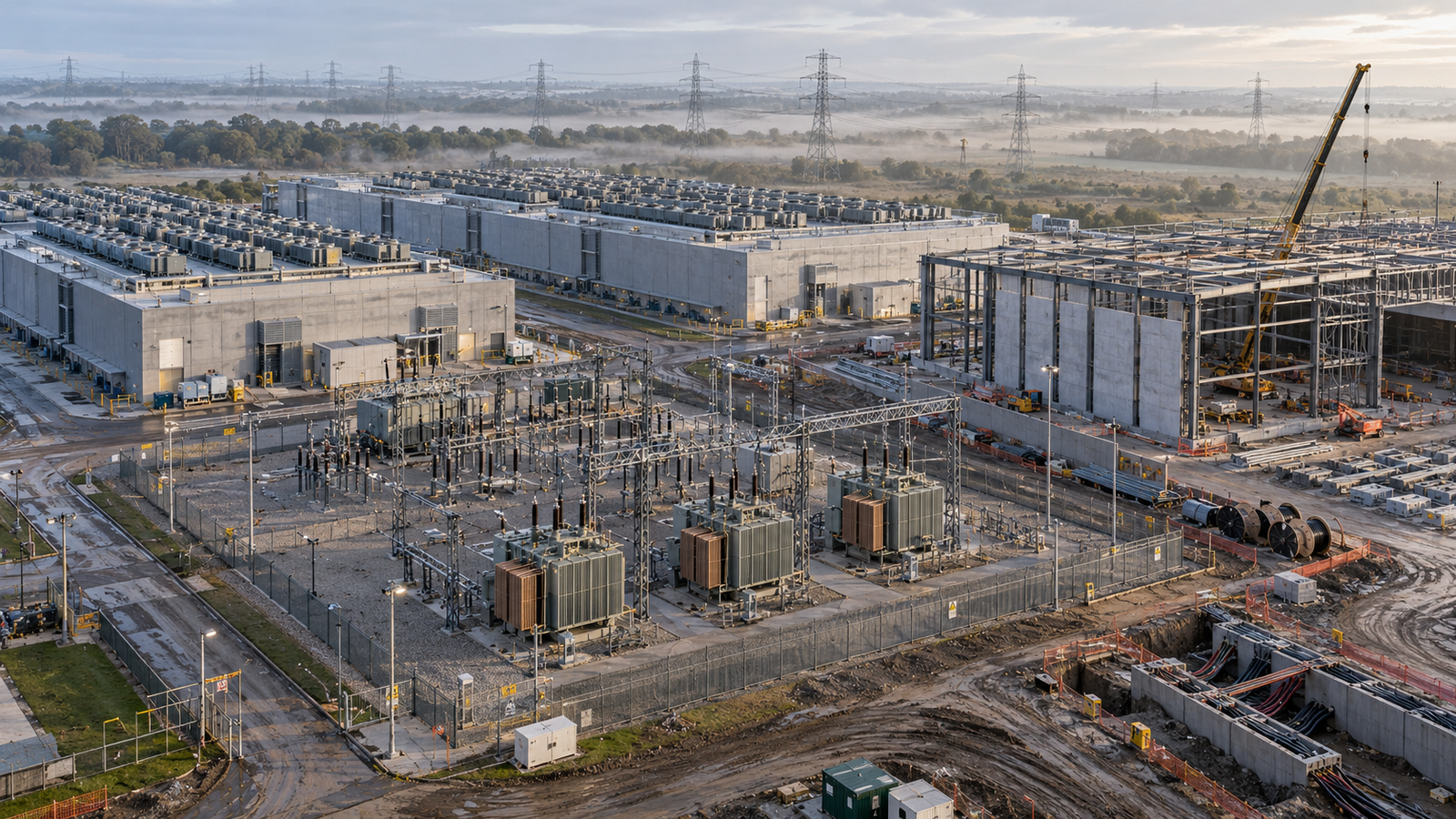
Power is the slowest of them. UniverseBlend’s analysis of transformer lead times and interconnection queues found transformers averaging about 128 weeks and US interconnection waits of three to seven years, longer than the buildings they serve. J.P. Morgan’s 19 October note puts data-centre construction at 18–30 months and names power as the primary bottleneck.

Amazon’s own metric points the same way. AWS added 3.9 gigawatts of power capacity in 2025 and expects to double total power capacity by the end of 2027, according to the shareholder letter. When the constraint is energised megawatts, capex can outrun capacity for a long time without anything having gone wrong.

That is why Meta’s fourth quarter deserves attention. Its guidance implies quarterly spending 41–70% above the third quarter’s $34.91 billion. (Calculation: implied fourth quarter of $49.2–59.2bn divided by the third-quarter actual.) A late-year surge of that size buys assets that will mostly enter service in 2027.
AI capex

The memory allocation problem

Memory changed the arithmetic more than any other component in 2026, because it raises the price of AI servers and ordinary cloud servers at the same time.

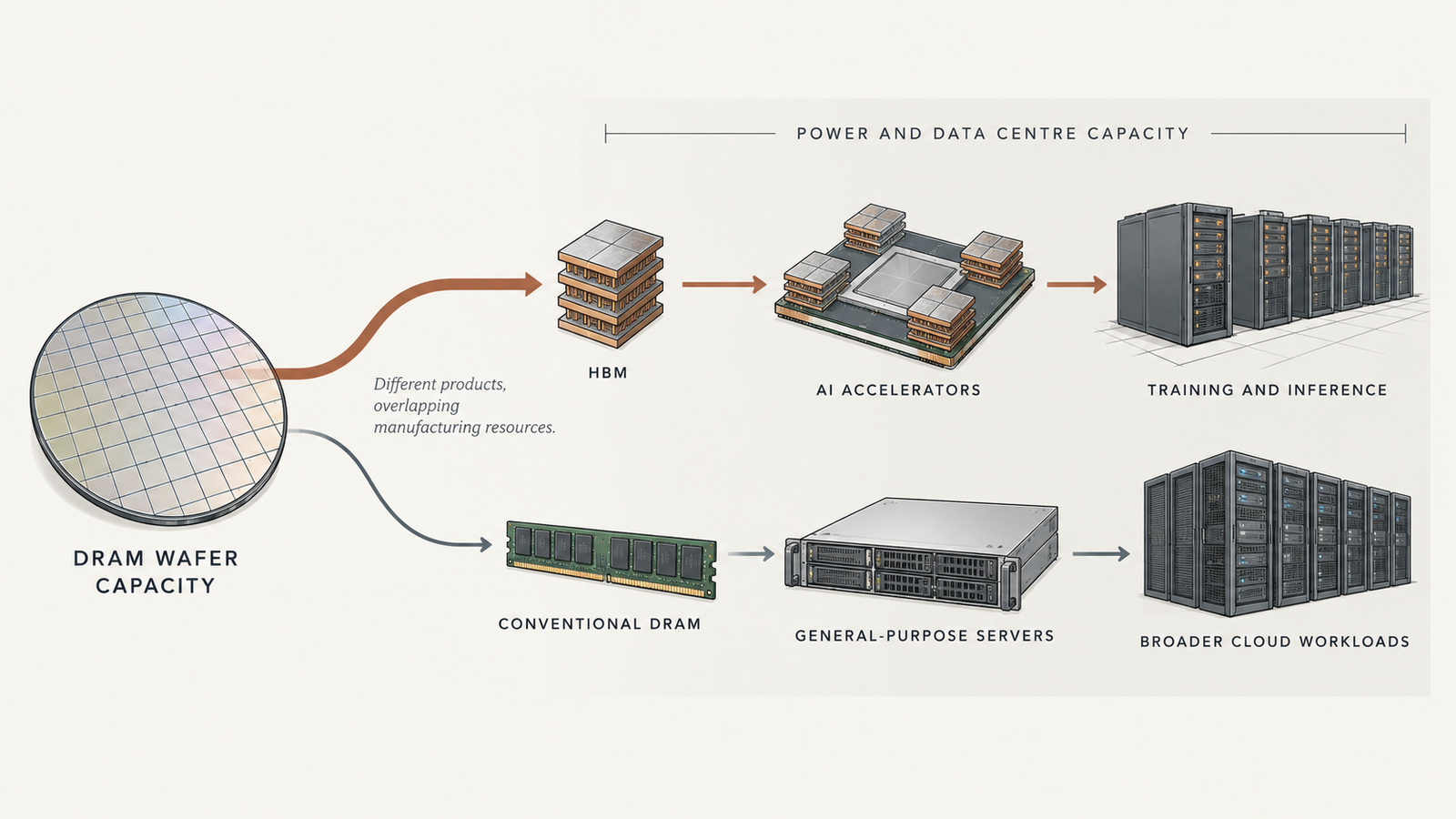
Two products are involved. Conventional server DRAM, sold as DDR5 registered modules (RDIMMs), sits beside CPUs in general-purpose servers. High-bandwidth memory (HBM) is also made from DRAM dies, but they are stacked, linked by through-silicon vias and packaged beside an accelerator to deliver very high bandwidth. An operator cannot plug HBM into a CPU server or fit DDR5 into a GPU package.

They compete upstream, for wafers. Micron chief executive Sanjay Mehrotra has said HBM3E needs about three times the silicon of DDR5 to produce the same number of bits. He expects that ratio to exceed 4-to-1 with HBM4E. Every wafer turned over to HBM yields fewer bits than it would as DDR5. UniverseBlend covered how HBM crowds out conventional DRAM wafers in September.

Amazon has tied this to its budget. On its 30 July earnings call, Jassy attributed most of the increase from about $200 billion to about $220 billion to higher memory costs, which J.P. Morgan’s research also records. He returned to the point on the 23 October podcast. According to several reports of the interview, he described splitting constrained memory between HBM for accelerators and DRAM for AWS’s core, non-AI services, both of which are growing.

The analyst figures show the scale. TrendForce estimates that server DRAM contract prices rose 64% in the second half of 2025 and will rise about 270% over 2026. It expects DRAM and NAND flash together to account for 47% of large cloud providers’ capex in 2026 and 68% in 2027. These are one research firm’s estimates, not company disclosures, but they point the same way as what Amazon and Meta have told investors.

Demand is coming from the CPU side as well. A 22 October TrendForce report expects server CPU shipments to grow 31% in 2026 and more than 40% in 2027, partly because agentic AI workloads need more CPU orchestration. It sees planned CPU-to-accelerator ratios moving from 1:8 toward 1:2 or even 1:1. Those CPUs need memory of their own, mostly DDR5 server modules, so AI demand also lifts conventional DRAM demand directly.

Part of 2026’s capex growth is therefore a price effect: a larger budget buys fewer servers per dollar than it did a year ago. No hyperscaler splits capex into price and volume, so outsiders cannot tell how much extra compute each additional billion buys.
AI capex

Training and inference compete for the same buildout

Accelerator counts say little on their own, because training and inference ask different things of the same hardware budget.

Training a frontier model needs thousands of accelerators working in lockstep for weeks, high-bandwidth interconnect between them and enough HBM to hold model state. Models are retrained and new ones begun, so a training cluster is a recurring claim on capacity, not a one-off cost.

Inference runs continuously and follows user demand. Generating each token means reading the model’s weights and its key-value (KV) cache from memory. Throughput is therefore usually limited by memory bandwidth, as UniverseBlend explained in why memory bandwidth, not FLOPS, caps inference throughput. The KV cache grows with context length and with the number of concurrent requests, so longer contexts cut how many users one accelerator can serve. Operators batch requests to raise utilisation, and pay for it in latency.

These differences turn into capex decisions. A cluster built for training carries a networking fabric that an inference fleet may not need. Hardware built for fast or cheap inference may be poorly suited to frontier training, and UniverseBlend has argued that specialised inference chips win only a narrow slice of the market. Capacity can move between workloads, though not always efficiently.

Meta and Amazon make this choice from different positions. Meta is its own customer. Its release says current and scheduled capacity gives it “flexibility to allocate resources across model training, core business growth” and new products. Its return arrives mainly through advertising: third-quarter ad revenue rose 26%, with impressions up 10% and price per ad up 14%. That growth cannot be credited wholly to AI infrastructure, although Meta says its AI investments are already delivering substantial incremental ad revenue.

Amazon sells capacity. Jassy said 2027 is “largely sold out all the big chunks,” according to Reuters, with some capacity held back for on-demand EC2 and Bedrock. Large commitments take long blocks; on-demand and managed-inference customers buy in small pieces at different prices. The same gigawatt can earn very different returns depending on who fills it.

Sold-out capacity versus profitable capacity

Sold-out capacity shows that demand at current prices exceeds deliverable supply. It does not show that the next dollar of capex earns an attractive return.

The disclosures establish three things. Customers have signed commitments: AWS’s backlog reached $496 billion at the end of June, up from $364 billion three months earlier. AWS is profitable now, with $16.6 billion of operating income on $42.2 billion of second-quarter revenue, according to Amazon’s second-quarter release. And Jassy wrote in April that Amazon already had commitments for a substantial portion of its 2026 AWS capex.

They do not establish duration, pricing or concentration. The backlog is about 2.9 years of AWS’s $169 billion annualised run rate (calculation: backlog divided by run rate), but Amazon does not say how long the contracts run, what margins they carry or how much comes from a few AI laboratories; OpenAI alone has committed more than $100 billion, according to the shareholder letter. Regional mix and utilisation are also undisclosed.

Costs are rising too. Meta’s depreciation and amortisation rose 44% year on year in the third quarter to $7.15 billion, and its free cash flow was negative $2.12 billion. Meta also announced a non-voting Class C share class, partly to give it a way to raise capital, effective 19 January 2027. J.P. Morgan notes that hyperscalers are increasingly funding the buildout with debt and equity rather than free cash flow.

Useful-life assumptions sit beneath all of this. Amazon depreciates chips and servers over five to six years. J.P. Morgan’s chief US economist, Michael Feroli, has warned that AI hardware may lose economic value faster than conventional equipment as each generation lowers the cost per unit of compute. If he is right, current depreciation schedules could overstate profits.

The strongest counterargument is Amazon’s. Jassy’s letter argues that data centres last 30-plus years and that returns become cumulatively attractive a couple of years after assets enter service. That holds well for buildings and power, the long-lived part. It says less about the five-year assets, which are where memory inflation lands.

What to watch next

Scheduled disclosures:

  • 28 October 2026 — Alphabet third-quarter results and Microsoft fiscal first-quarter 2027 results, both after the US close. Watch Alphabet’s $195–205 billion range and Microsoft’s capex including finance leases.
  • 29 October 2026 — Amazon third-quarter results, as reported by Reuters. Watch whether the ~$220 billion expectation changes, the AWS backlog and margins, and any memory commentary.
  • 19 January 2027 — Meta’s Class C stock takes effect, an indication of how Meta intends to fund 2027.

Not yet scheduled: Meta’s 2027 capex range, which management says it is still developing, and 2027 HBM contract prices, which TrendForce expects to rise 70–140%.

A scorecard for the quarters that follow:

IndicatorTypeDisclosed?
Backlog growth versus revenue growthLeadingYes (AWS, Google Cloud, Microsoft)
Capex growth versus cloud revenue growthLeadingYes
Price versus volume within capexLeadingNo
Utilisation of newly deployed capacityLeadingNo
Segment margin after depreciationLaggingPartly (AWS yes; Meta’s AI no)
Free cash flow and external financingLaggingYes
Return on invested capital for AI assetsLaggingNo

If backlog keeps outpacing revenue while margins hold after depreciation, the spending is converting. If capex keeps rising while margins fall and financing needs grow, it is not, whatever the backlog says.

Conclusion

Treat AI infrastructure spending in 2026 as a measure of intent. Meta’s range tells you how much it is prepared to put in; Amazon’s sold-out remark tells you how far delivery is lagging demand. Neither tells you about returns.

Three questions separate a credible announcement from a merely large one. How much of the increase is price? How long until the spending becomes energised capacity? And who has contracted to use it, at what margin? Today companies answer the third only in aggregate and the first two not at all. Until that changes, a rising capex number is evidence of demand and of component inflation, in proportions that nobody outside these companies can see.

FAQ

What is AI capex in 2026?

It is capital spending on data centres, power, cooling, servers, accelerators, memory and networking intended to run AI and cloud workloads. Estimates for 2026 range from about $794 billion (US hyperscaler consensus, all capex) to about $900 billion (J.P. Morgan, AI capex at five US firms), depending on scope.

Why is Meta spending up to $145 billion on capital expenditure?

Meta guided on 21 October 2026 to $135–145 billion, including finance-lease principal, to support its advertising business and its AI work. When it raised the range in April, it cited higher component prices. Its 2027 plans are not yet set.

Why is Amazon’s AWS capacity sold out through 2027?

Jassy said on 23 October 2026 that customers have committed to most large blocks of 2027 capacity because demand from AI labs and enterprises exceeds what Amazon can build. Some capacity is kept for on-demand EC2 and Bedrock, so not every service or region is unavailable.

How do HBM and conventional DRAM affect AI infrastructure costs?

HBM is stacked memory packaged with accelerators; conventional DRAM serves CPU servers. They are not interchangeable, but both come from DRAM wafers, and HBM uses about three times as much silicon per bit. Rising prices for both have pushed up capex budgets, including Amazon’s.

Does higher AI capex guarantee higher cloud profits?

No. Capex creates depreciation, over five to six years for chips and servers, and returns depend on utilisation and pricing. No company discloses margins on its new AI capacity.

How can businesses tell whether AI infrastructure spending is producing returns?

Compare backlog and revenue growth with capex growth, then check margin after depreciation and free cash flow. For a buyer, the test is utilisation: reserved but idle capacity earns nothing.

Editorial note: Figures are as disclosed or reported up to 25 October 2026. Alphabet and Microsoft report on 28 October and Amazon on 29 October; if those results change any figure here, this article will carry a dated update. Report errors through the contact page.


Keep reading

Claude Opus vs Sonnet

Claude Opus vs Sonnet: What the 2026 Price Gap Actually Buys

Last verified: 8 November 2026. All prices are Anthropic’s standard first-party API rates in US dollars per million tokens. They aren’t Claude Pro or Max …
RSA-1024

Did AI Break RSA? What DeepMind Actually Found

Last verified: 8 November 2026. Both papers are unreviewed working papers, and no outside group has reproduced the results yet. No, AI did not break …
Model Distillation

Model Distillation Explained: When AI Learning Becomes Extraction

Last verified: 7 November 2026. Government and company claims are attributed throughout. None has been tested in court. A support team trains a small, cheap …
AI shopping agents

Visa Tested AI Shopping Agents. 42.8% of Runs Failed, and Many Still Bought

Last verified: 7 November 2026. Benchmark figures are from Visa’s announcement. Model rankings are from Fortune. A shopper asks for a TV. The agent finds …

Alibaba’s Zhenwu V900 and the Memory Wall Behind a 500,000-Card Cluster

Zhenwu V900

Alibaba’s T-Head published a spec sheet for the Zhenwu V900 on September 22 with two numbers on it and one conspicuous absence. The numbers are 216 GB of memory per card and 1,200 GB/s of chip-to-chip bandwidth. The absence is any FLOPS figure at all.

That combination tells you what the company thinks the hard problem is. A chip announcement that leads with memory capacity and interconnect bandwidth, rather than peak arithmetic throughput, is an announcement about systems engineering.

CEO Eddie Wu said a single cluster could hold up to 500,000 of these chips. Multiply that by 216 GB and you get roughly 108 petabytes of accelerator memory — a number worth sitting with, because it describes a procurement problem more than a computing one.

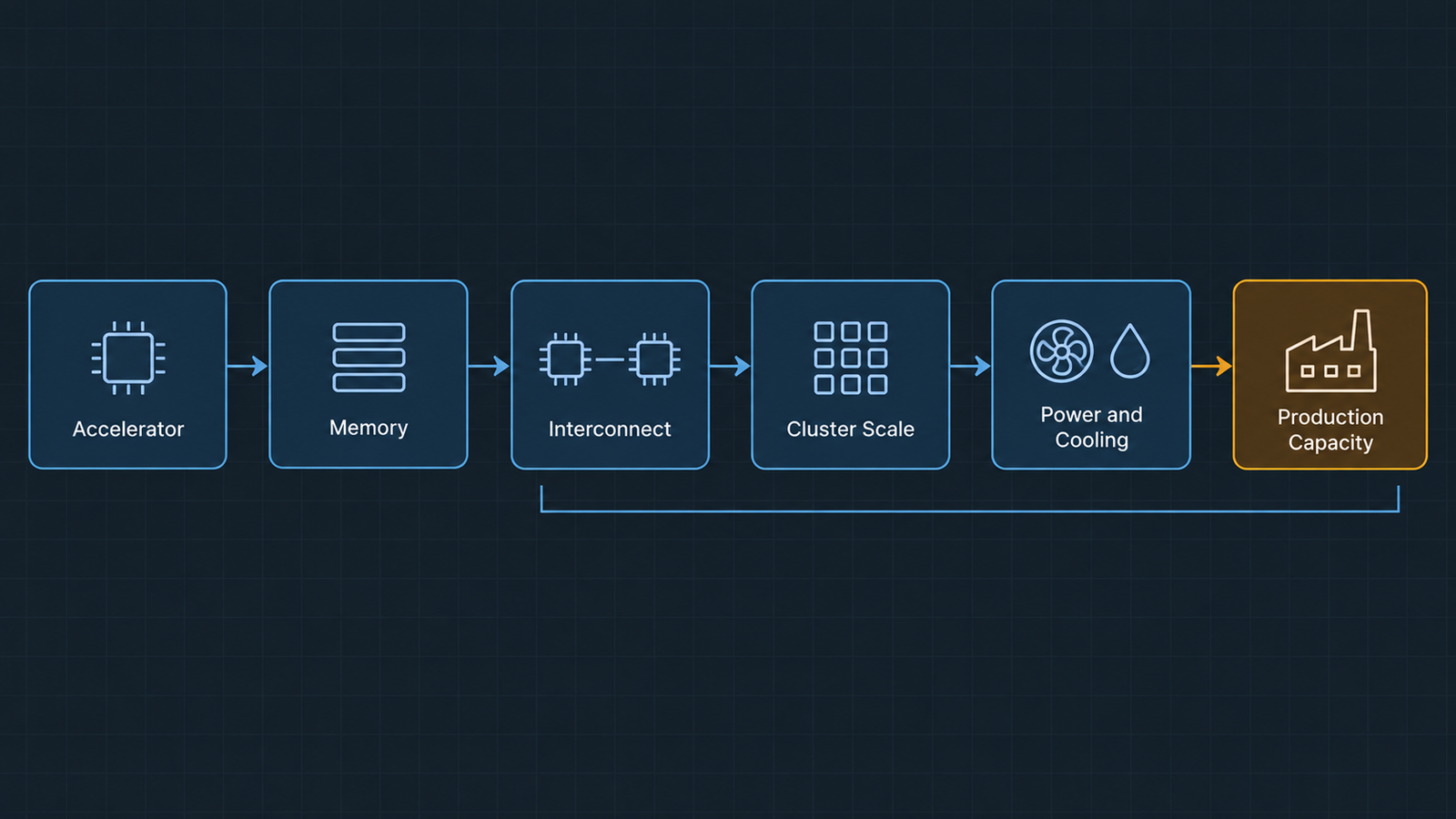
This piece works through the chain from accelerator to memory to interconnect to cluster scale to power to supply, and asks which link actually binds.

Key takeaways
  • The Zhenwu V900 is a training-and-inference accelerator from T-Head, Alibaba’s chip design unit, unveiled at the Apsara Conference in Hangzhou on September 22, 2026, with mass production targeted for Q1 2027.
  • T-Head states 216 GB of memory per card and 1,200 GB/s of inter-chip bandwidth, up from the M890’s 144 GB and 800 GB/s. No FLOPS figure has been published.
  • The claimed 3× performance gain over the M890 is a vendor claim with no disclosed benchmark, workload, precision or power envelope. It cannot be treated as a cross-vendor comparison.
  • Alibaba says clusters can scale to 500,000 cards. At 216 GB each, that would be about 108 PB of aggregate accelerator memory — our calculation, and a design ceiling rather than a deployment.
  • Wu set a target of more than 20 GW of Alibaba Cloud data-centre capacity by 2032, and separately acknowledged that supply shortages currently limit how fast the company can bring compute online.
  • The binding constraint is genuinely unclear from public evidence. Memory supply has the strongest documentary support; power and packaging are close behind.

Quick Navigation


The Zhenwu V900 Announcement Is Bigger Than a Chip Launch

What T-Head presented at Apsara was not a standalone accelerator. It was a stack.

The Zhenwu V900 arrives alongside the ICN Switch interconnect chip, the Panmai smart NIC, the Zhenyue SSD controller and a Panjiu supernode server that packages them together. A later Yitian 750 CPU is designed to speak T-Head’s ICN protocol so the host processor can address the accelerators directly. Alibaba now designs most of the logic silicon in its own AI cluster.

That is the strategically interesting part. Companies build full stacks when the integration between parts is where the performance lives, and when they cannot rely on buying the parts.

The headline specifications, as stated by T-Head:

SpecificationZhenwu M890 (May 2026)Zhenwu V900 (Sep 2026)
Memory per card144 GB216 GB
Inter-chip bandwidth800 GB/s1,200 GB/s
Precision supportFP32 to FP4FP32 to FP4, reworked FP8/FP4 Tensor Core
Supernode scale128 chipsMore than 1,000 chips
Stated cluster ceilingNot stated500,000 cards
Peak throughputNot publishedNot published

Eddie Wu called it the most powerful AI chip in China today and said it delivers about three times the performance of the M890. Take that carefully. Three times what, measured how?

No benchmark has been named. No workload, batch size, precision, software stack, comparison methodology or power envelope has been disclosed. A 3× claim against your own previous generation, using your own harness, is a generational engineering statement, not a standardised result. It cannot be compared against any other vendor’s number, and the absence of a FLOPS figure means there is nothing to normalise against either.

One timing note worth recording: T-Head’s own roadmap from May 2026 placed the V900 in Q3 2027. The chip was unveiled in September 2026 with mass production targeted for Q1 2027. Either the schedule accelerated or the earlier roadmap described a different milestone. Alibaba has not explained the difference.


Start With the 216 GB Number

216 GB per accelerator is the most informative figure on the sheet, and it is worth understanding why capacity earns that position.

For context, NVIDIA’s H200 carries 141 GB of HBM3e. The V900’s 216 GB is more on-package capacity than that part, which several outlets have noted. Capacity is not bandwidth, though, and the comparison stops being useful immediately after that sentence.

Here is what memory capacity per accelerator actually buys during training. Three things compete for it:

  • Parameters. The model weights themselves, plus optimiser state, which for common optimisers runs to several times the parameter memory.
  • Activations. Intermediate results held for the backward pass, scaling with batch size and sequence length.
  • Communication buffers. Space for gradients and shards in flight between devices.

When a model does not fit, you shard it — across tensors, across pipeline stages, across experts. Every shard boundary becomes a communication event. More memory per card means fewer boundaries, which means less traffic on the interconnect, which is why T-Head frames the larger memory as a way to cut model-sharding and data-movement overhead.

Inference has a different profile. Weights sit resident, and the variable cost is the KV cache, which grows linearly with context length and batch size. A card with 216 GB can hold more concurrent long-context sessions before it starts evicting or spilling.

What T-Head has not disclosed is memory bandwidth — the rate at which those 216 GB can be read. For token generation, which is memory-bound, bandwidth governs throughput more directly than capacity does. Several outlets describe the memory as HBM; T-Head’s own sheet says “memory”. Until the generation, stack count and bandwidth are published, the most honest thing to say is that we know how much, not how fast.


What 500,000 Zhenwu V900 Cards Actually Means

The arithmetic first, clearly labelled as ours.

216 GB × 500,000 cards = 108,000,000 GB ≈ 108 PB of aggregate accelerator memory.

That figure is a derived calculation, not a disclosure and not a deployment. Alibaba has not said it has built such a cluster, and nothing in the announcement suggests one exists. The 500,000 number is a stated architectural ceiling for what the ICN Switch fabric is designed to address. Treat 108 PB as what the ceiling would imply if fully populated at the stated per-card capacity.

To make the scale legible: 108 PB is roughly 108,000 terabytes, or about 27 million high-resolution feature films, or enough to hold a few hundred copies of the entire indexed public web in text form. It is a data-centre-scale storage figure, except it is all high-speed memory sitting beside processors.

A second calculation, for the model target Alibaba named. Wu said Alibaba is sizing clusters for future Qwen models in the 5 to 10 trillion parameter range.

10 trillion parameters at FP8 (1 byte each) = about 10 TB just for weights. Optimiser state and activations typically multiply that several times over during training, so call it 30–60 TB of resident memory before any batch data. At 216 GB per card, the weights alone need roughly 46 cards; a realistic training footprint with optimiser state and activations plausibly runs into the high hundreds or low thousands. That is the reason T-Head emphasises supernodes of more than 1,000 chips with unified memory addressing rather than individual card specs.

Third, the honest limit of this kind of arithmetic. Aggregate memory tells you what a cluster could hold. It says nothing about whether the cluster can move data fast enough for that memory to be useful, and nothing about whether 500,000 cards can be manufactured, packaged, powered, cooled and kept running simultaneously.


The Memory Wall

The term describes a simple divergence: arithmetic throughput has improved faster than memory bandwidth for decades, so an increasing share of accelerator time is spent waiting for data rather than computing on it.

Modern AI workloads sit right in that gap. Token generation reads the full weight set for every token produced and is bound by memory bandwidth, not FLOPS. Attention over long contexts reads a KV cache that grows with every token. Training spends much of its time moving gradients and activations rather than multiplying matrices.

Zhenwu V900

This is why more memory per accelerator does not automatically make scaling easier. It changes the shape of the problem rather than removing it:

More memory per card helps withIt does not address
Fewer shards, so fewer communication eventsThe bandwidth to feed the compute units
Longer contexts and larger batches per deviceInterconnect capacity between devices
Fewer devices for a given model sizePower and cooling per rack
Simpler parallelism strategiesWhether the memory can be supplied at volume

The last row is the one that matters most for the V900, and it is where this story stops being about a chip. Every gigabyte of high-bandwidth memory on 500,000 cards has to be manufactured, stacked, bonded and packaged. We looked at the economics of exactly this line in our breakdown of what AI memory actually costs, and the short version is that memory has been the tightest link in the chain through 2026.

One implication is worth naming as analysis rather than fact: a design that leans on large per-card capacity to reduce communication overhead also increases the memory content per unit of compute. That is an elegant engineering trade when memory is available and an expensive one when it is not.


Why 1,200 GB/s Matters

Start with what the number does not tell us.

T-Head states 1,200 GB/s of inter-chip bandwidth. The spec sheet does not clarify whether that is unidirectional or bidirectional aggregate, how many links it is distributed across, or what topology those links form. Those distinctions change the meaning substantially, and nobody outside Alibaba can resolve them from what has been published.

The terms that get conflated, kept separate:

TermWhat it measures
Per-link bandwidthThroughput of a single connection between two devices
Per-chip bandwidthTotal across all of one accelerator’s links, often quoted bidirectionally
Bisection bandwidthThroughput across the worst-case cut that divides the cluster in half
Aggregate cluster bandwidthSum of all links, which almost never reflects achievable performance

The reason to be pedantic: multiplying 1,200 GB/s by 500,000 cards produces a headline figure of 600 PB/s that means essentially nothing. Collective operations are limited by the slowest path through the topology, not by the sum of the links. We are deliberately not performing that multiplication.

What the number does signal is priority. Going from 800 GB/s on the M890 to 1,200 GB/s is a 50% increase in the generation where memory capacity rose 50% as well. The two scaled together, which is consistent with a design aimed at keeping communication from becoming the limiter as supernodes grow from 128 chips to more than 1,000.

Here is why that matters operationally. In distributed training, every step ends with an all-reduce: every device’s gradients must be combined and redistributed. The step cannot finish until the slowest participant finishes. As device counts grow, the time spent in collectives grows relative to the time spent computing, and past a certain point adding accelerators stops adding throughput.

Mixture-of-experts models make this sharper. Expert routing sends each token to a subset of devices, generating all-to-all traffic patterns that are far less forgiving than all-reduce. A model with experts spread across a supernode lives or dies on the fabric.

Agentic inference adds a third pattern: many concurrent long-context sessions, each holding a large KV cache, each needing low latency. That is a memory-and-fabric problem more than a compute one.

So the honest read on 1,200 GB/s is that it is a credible generational improvement in the right dimension, disclosed at a level of detail too coarse to evaluate. A chip that looks strong in isolation can behave very differently when a thousand of them must act as one machine, and the ICN Switch — not the accelerator — is where that behaviour is determined.


Silicon, Memory or Power: Where Is the Real Bottleneck?

The popular answer is memory. It is probably right, but the evidence is more mixed than the confident version suggests, so here is each candidate with what actually supports it.

Silicon

Design capability is no longer the question. T-Head has shipped successive Zhenwu generations and now designs the accelerator, the interconnect switch, the NIC, the SSD controller and the server CPU. That is a full-stack design organisation.

Manufacturing is the open variable. No public information establishes which foundry and process node the V900 uses, what yields look like, or how much advanced packaging capacity is available to stack memory onto it. Advanced packaging is frequently the tighter constraint than the logic wafer itself, and nothing in the announcement addresses it.

Memory

This has the strongest documentary support. US export controls introduced in December 2024 restricted HBM above a specified performance threshold, along with the tooling to produce it, which left Chinese accelerator programmes dependent on domestic supply.

Domestic supply is arriving, slowly. CXMT was reported in September 2026 to have begun limited HBM3E production, with samples in qualification testing at customers including T-Head — a year earlier than most forecasts had projected. Analysts still place CXMT roughly three to five years behind SK hynix, Samsung and Micron on various measures, with low yields and no access to EUV lithography, which reportedly forces about 30% more wafers for the same output.

Two things follow. Domestic HBM exists and is improving faster than expected. It is not yet obviously available at the volume a 500,000-card ambition implies, and “in qualification testing” is not “in supply.”

Power and data centres

The least glamorous and possibly the most binding. Alibaba currently operates an estimated 5–6 GW of capacity by Goldman’s reckoning, adding 1–2 GW a year, against a target of more than 20 GW by 2032. Closing that gap requires more than 2 GW annually, sustained for six years.

Power capacity cannot be iterated annually the way a chip design can. Grid connections, substations, transformers, cooling plant and construction schedules run on multi-year cycles that no amount of engineering talent compresses.

The honest answer

Wu himself provided the most useful data point: he said the industry’s mid-to-long-term demand far outpaces supply capability, and acknowledged that supply shortages are limiting how quickly Alibaba can bring compute online. He did not specify which supply.

Our reading, offered as analysis: memory is the most likely near-term binding constraint through 2027, packaging is a close and under-discussed second, and power becomes the dominant constraint over the 2029–2032 horizon the 20 GW target covers. The evidence supports ranking these as probabilities, not as a settled answer.


What 20 GW Changes

Wu’s exact framing: by 2032, the global data centre capacity operated by Alibaba Cloud will surpass 20 GW.

Precision matters here, because the number is routinely misread. 20 GW of data-centre capacity is not 20 GW of accelerator power draw. Capacity typically describes provisioned electrical capacity for a facility, covering IT load plus cooling, power conversion losses and headroom. Accelerators are a fraction of that, and facilities rarely run at full provisioned load.

What the target actually commits Alibaba to, operationally:

  • Grid connections and generation. 20 GW is utility-scale. Securing interconnection agreements at that magnitude is a regulatory and civil-engineering programme, not a procurement exercise.
  • Construction. Buildings, at a pace of one to two gigawatts of new capacity every year for six years.
  • Cooling. Accelerator racks at current densities increasingly require liquid cooling, which changes building design, not just equipment selection.
  • Power distribution. Substations, transformers, switchgear and busway, all of which have their own multi-year lead times.
  • Utilisation. Provisioned capacity earns nothing until it is filled with hardware that is running jobs.
  • Geographic distribution. “Global” implies capacity outside China, which brings different grids, regulators and equipment supply chains.

The capital implication is substantial. Goldman’s estimate, reported after the conference, puts the required annual capex at roughly RMB 200–300 billion, against a three-year AI and cloud investment plan of RMB 380 billion announced in February 2025 that Alibaba has already indicated it will overshoot. Analysts at Citi and UBS translated the 20 GW target into external cloud revenue of roughly $160–170 billion by the early 2030s.

Treat those as bank models rather than company guidance. Alibaba gave no spending figure alongside the 20 GW target, and Goldman’s starting estimate of 5–6 GW may not measure capacity the same way Alibaba does.

The useful way to read 20 GW is as a statement about sequencing. A company that believes memory or silicon will be its permanent constraint does not commit to a power build-out of that size. Committing to it suggests Alibaba expects the chip supply problem to be solvable on a shorter timescale than the power problem — which is itself a claim about where the bottleneck will sit in five years, not where it sits today.


What Export Controls Change at the Infrastructure Layer

Set the politics aside and look at what restrictions do to an engineering roadmap.

When advanced accelerators and high-bandwidth memory become unavailable through commercial channels, the procurement problem turns into a design problem. Four shifts follow, all visible in what T-Head presented:

  • Vertical integration becomes rational. If you cannot buy the best available parts, integration across parts you control becomes the remaining source of advantage. Designing the accelerator, the switch, the NIC and the CPU to share one protocol is a response to that.
  • Memory efficiency gets prioritised over peak throughput. Native FP8 and FP4 support with reworked Tensor Core arithmetic and MXFP8/MXFP4 scaling formats reduces the bytes per parameter. Lower precision is partly a performance strategy and partly a way to stretch constrained memory.
  • Interconnect substitutes for per-device capability. If individual accelerators cannot match the leading parts, making a thousand of them behave as one machine recovers some of the gap. Unified memory addressing across a supernode is exactly that trade.
  • Software becomes load-bearing. T-Head showcased its SAIL software stack covering training, inference and optimisation. A domestic accelerator without a mature software stack is a paperweight, and this is historically where domestic silicon programmes have struggled most.

The constraint that does not yield to any of this is memory volume. You can design around a bandwidth deficit with better parallelism. You cannot design around not having enough HBM stacks to populate half a million cards, which is why CXMT’s progress matters more to this story than any figure on the V900 spec sheet.

A note on timing, offered without interpretation: the announcement landed days before a scheduled Trump–Xi meeting at which AI and semiconductors were expected to feature. Several outlets made that connection. We have no evidence about intent and are not going to speculate about it.


What We Know About the Zhenwu V900 — and What We Don’t

KnownStatus
Announced September 22, 2026 at Apsara, HangzhouConfirmed
216 GB memory, 1,200 GB/s inter-chip bandwidthVendor-stated
FP32 to FP4 native support, reworked FP8/FP4 Tensor CoreVendor-stated
~3× M890 performanceVendor claim, no methodology
Supernodes of 1,000+ chips, cluster ceiling of 500,000Vendor-stated design capability
Mass production targeted Q1 2027, with Panjiu supernode serverVendor-stated timetable
Not disclosedWhy it matters
Peak throughput at any precisionNo basis for cross-vendor comparison
Memory type, generation and bandwidthBandwidth governs inference throughput
Foundry, process node, die sizeDetermines manufacturable volume
Power consumption per cardSets rack density and the 20 GW arithmetic
Whether 1,200 GB/s is uni- or bidirectionalChanges the figure’s meaning materially
Network topology above the supernodeDetermines behaviour at cluster scale
Memory supplier and secured volumesThe central question for 500,000 cards
Any deployed cluster size to dateThe 500,000 figure is a ceiling, not a build

The Engineering Question Behind the Headline

The Zhenwu V900 is a credible generational step by a design organisation that has shipped several. That is the fair summary of what was announced.

What was not announced is whether the parts Alibaba does not design can be supplied at the scale its ambitions describe. A cluster is not a quantity of chips. It is a system in which memory, fabric, power, cooling, scheduling and fault tolerance all have to hold simultaneously, and the weakest of those determines how much useful compute comes out the other end. At 500,000 devices, component failures become a daily operational routine rather than an exception, and checkpointing strategy starts to matter as much as peak throughput.

The 108 PB figure is a useful way to feel the scale, but read it as a bill of materials rather than a capability. Every one of those gigabytes has to be fabricated, stacked, bonded, mounted, powered and cooled, and export controls have made two of those steps considerably harder for Chinese buyers.

So the question the V900 raises is not whether Alibaba can design a competitive accelerator. It evidently can. The question is whether the memory supply chain, the packaging capacity and the electrical grid can keep pace with a design roadmap that now iterates annually. On current evidence, they cannot all move at that speed — and the V900’s specification sheet, which leads with memory and interconnect and omits FLOPS entirely, reads like a company that already knows it.


Frequently Asked Questions

What is the Zhenwu V900?

A training-and-inference AI accelerator unveiled at Alibaba’s Apsara Conference in Hangzhou on September 22, 2026. It is the successor to the Zhenwu M890 and supports precisions from FP32 down to FP4.

Who developed the Zhenwu V900?

T-Head, Alibaba’s chip design unit, also known as Pingtouge. Alibaba CEO Eddie Wu presented it and described it as the most powerful AI chip in China today.

How much memory does the Zhenwu V900 have?

T-Head states 216 GB per card, up from 144 GB on the M890. The memory generation and bandwidth have not been disclosed, which matters because bandwidth, not capacity, governs token-generation speed.

What is the 1,200 GB/s figure?

T-Head’s stated inter-chip bandwidth, up from 800 GB/s on the M890. The company has not said whether it is unidirectional or bidirectional aggregate, or how it is distributed across links, so it should not be multiplied across devices to estimate cluster performance.

How many V900 cards can an Alibaba cluster support?

Alibaba says a single cluster can scale to 500,000 cards, connected through its in-house ICN Switch. That is a stated design ceiling. No cluster of that size has been announced as deployed.


Keep reading

Claude Opus vs Sonnet

Claude Opus vs Sonnet: What the 2026 Price Gap Actually Buys

Last verified: 8 November 2026. All prices are Anthropic’s standard first-party API rates in US dollars per million tokens. They aren’t Claude Pro or Max …
RSA-1024

Did AI Break RSA? What DeepMind Actually Found

Last verified: 8 November 2026. Both papers are unreviewed working papers, and no outside group has reproduced the results yet. No, AI did not break …
Model Distillation

Model Distillation Explained: When AI Learning Becomes Extraction
Last verified: 7 November 2026. Government and company claims are attributed throughout. None has been tested in court. A support team trains a small, cheap …
AI shopping agents

Visa Tested AI Shopping Agents. 42.8% of Runs Failed, and Many Still Bought

Last verified: 7 November 2026. Benchmark figures are from Visa’s announcement. Model rankings are from Fortune. A shopper asks for a TV. The agent finds …