A lender writing a $42 billion senior secured cheque asks two questions. Can the borrower pay? And if it cannot, what is the security worth?
For most asset-backed lending the second question is the easy one. Property has comparable sales. Aircraft have a global resale market and published values. Vehicles have auction data going back decades. The collateral has a price history that exists independently of the borrower.
AI accelerators do not have that yet. They have a list price, an accounting schedule and a thin secondary market whose depth has never been tested at scale in a downturn. The debt being written against them is real and large; the recovery assumption underneath it is a judgement.
That gap is the subject here. The $60 billion package syndicating this week is a bet on Anthropic’s business and, simultaneously, a bet on what a 2027-generation TPU is worth in 2030.
Key takeaways
- The Financial Times reported on October 6 that Bank of America, Citigroup and Morgan Stanley began syndicating a $60 billion debt package funding Anthropic’s lease of Google-designed chips: roughly $42 billion of senior secured debt backstopped by Broadcom and $18 billion of junior debt, with Blackstone committing about $9 billion of the latter.
- Some syndicated coverage published the same figures inflated tenfold. The correct numbers are $42bn, $18bn and $9bn.
- This $60 billion is separate from Anthropic’s reported $518 billion of total compute commitments. The financing funds part of the commitments; it is not the same number.
- Book value, market value and recovery value are three different things, and only the third matters in a workout. The gap between them widens when a technology generation turns.
- The aircraft analogy is useful for structure and misleading on liquidity. Aircraft have thousands of potential operators worldwide; frontier accelerators have a buyer pool measured in dozens.
- The distinctive risk is correlation: the conditions that stress the borrower are the same conditions that soften demand for the collateral. Borrower risk and collateral value can deteriorate together.
- Credit markets have started pricing this. PGIM anchored a $500 million CLO in late September containing a first-of-its-kind 15% cap on AI-related collateral.
Quick Navigation
- The $60 Billion Transaction, Stripped to Mechanics
- What AI Chip Financing Actually Means
- Three Different Values, Only One of Which Matters in a Workout
- Accounting Depreciation Is Not Economic Depreciation
- Where the Aircraft Analogy Works, and Where It Breaks
- The Correlated-Collateral Problem
- Broadcom Occupies Three Seats at the Table
- What the Credit Market Is Signalling
- The Case for the Collateral Holding Its Value
- What Lenders and Infrastructure Buyers Should Model
- What the Chips Are Worth
- FAQ
The $60 Billion Transaction, Stripped to Mechanics
What the Financial Times reported, and what subsequent coverage corroborates:
| Element | Detail |
|---|---|
| Arrangers | Bank of America, Citigroup, Morgan Stanley |
| Total package | $60 billion |
| Senior tranche | ~$42 billion, secured, backstopped by Broadcom |
| Junior tranche | ~$18 billion, no Broadcom guarantee |
| Junior anchor | Blackstone, committing ~$9 billion and syndicating the rest |
| Purpose | Funding Anthropic’s chip orders through 2027 |
| Payment start | Lease payments commence after chip delivery |
| Status | Syndication letters out; books not closed |
The economic shape is a leasing structure rather than a purchase. A financing vehicle funds the hardware, Anthropic leases it, and the lease payments service the debt. Anthropic does not own the chips, which is precisely why the hardware can serve as security for the senior lenders.
Two features deserve attention before anything else.
- The Broadcom backstop is doing enormous work. The senior tranche is supported by Broadcom’s investment-grade credit, widely reported as A−. That is what makes $42 billion placeable with institutional lenders at a manageable cost. Without it, the senior tranche would be priced against the credit of a company that reported a $42 billion net loss in 2025, most of it non-cash, with revenue of $4.59 billion.
- The junior tranche is the honest price signal. The $18 billion with no guarantee sits directly against Anthropic’s credit and the hardware. Blackstone taking half of it is a meaningful commitment; the terms on which the rest places will tell you more about market appetite than any amount of commentary.
Timing matters too. Payments begin after delivery in 2027. The debt is being raised now against cash flows that start later, which means the underwriting rests on a forecast of Anthropic’s 2027–2032 revenue and on a residual-value assumption for hardware that does not yet exist in the data centre.
What AI Chip Financing Actually Means
AI chip financing is the use of debt to fund the acquisition or lease of AI accelerators, where the hardware and the contracted payments it generates serve as the basis for repayment. It is equipment finance applied to silicon that depreciates faster than almost anything else lenders have taken as security.
The arrangements differ more than the headlines suggest:
| Structure | Who owns the hardware | Who carries the residual risk |
|---|---|---|
| Outright purchase | The buyer | The buyer |
| Operating lease | The lessor | The lessor |
| Finance lease | Effectively the lessee | The lessee |
| Asset-backed debt | A financing vehicle | Lenders, through the security package |
| Vendor financing | Varies | The vendor, partly |
| Credit guarantee | Unchanged | The guarantor, on default |
The Anthropic structure combines several of these at once: a lease to the user, asset-backed debt to fund it, a guarantee from the chip supplier on the senior piece, and a separate convertible facility from that same supplier.
Senior and junior, without oversimplifying
- Senior secured debt holds a first claim on pledged collateral and sits at the top of the repayment waterfall. In this structure it also carries Broadcom’s support, which means a senior lender has two sources of recovery: the guarantee and the security.
- Junior debt ranks behind. It absorbs losses first, prices wider to compensate, and here it carries no guarantee at all.
The simplification worth flagging: priority is set by intercreditor agreements and the specific security package, not by the labels. What assets are actually pledged, whether the pledge is over the hardware or over the equity of the vehicle that owns it, how enforcement works across jurisdictions, and what conditions govern the guarantee all matter more than the words “senior” and “junior.” Those documents are not public.
For a lender, this means the senior position is substantially a Broadcom credit exposure with hardware as backup, while the junior position is a direct bet on Anthropic and on what the chips fetch. Those are very different risks wearing the same deal name.
Three Different Values, Only One of Which Matters in a Workout
Every asset has three values, and conflating them is how collateral analysis goes wrong.
| Value | What it is | Who uses it |
|---|---|---|
| Book value | Original cost less accumulated depreciation, per the schedule chosen | Accountants, auditors, the income statement |
| Market value | What a willing buyer pays a willing seller in an orderly market | Asset managers, insurers, secondary traders |
| Recovery value | What a lender actually realises after default, enforcement, delay, remarketing and costs | Credit analysts, workout desks |
Recovery value is the only one that protects a lender, and it is always the lowest of the three. The discount between market and recovery reflects time, transaction costs, the circumstances of a forced sale, and whether a buyer exists when you need one.
For AI accelerators, several factors widen that discount specifically:
- Integration. A rack of accelerators is not a commodity unit. It needs compatible networking, power delivery, cooling and a software stack. Recovering value may mean selling a system, not a chip.
- Location. The hardware sits in a data centre with its own lease, power contract and operator. Physical recovery is not simply a repossession.
- Operating cost. Unlike an aircraft in storage, idle accelerators in a facility still consume rent and, if kept warm, power.
- Timing. Enforcement takes months. A technology generation can turn in twelve.
Accounting Depreciation Is Not Economic Depreciation
Accounting depreciation allocates cost across a chosen useful life. It is a smooth line, usually straight, and it is an estimate made by management.
Economic depreciation is what the asset is actually worth over time, and it is not smooth at all. It is flat while the hardware remains the current generation, then steps down sharply when a materially better part ships, then flattens again at whatever floor the installed base supports.
The mismatch matters because book value follows the first curve and recovery value follows the second. A chip carried at 60% of cost on a six-year schedule may be worth considerably less in a market where the new generation delivers substantially more performance per watt.
We argued in our analysis of AI accelerator depreciation that these schedules are among the least audited assumptions in AI infrastructure economics, and that memory capacity rather than compute is often what ends an accelerator’s competitive life. That was an accounting and modelling point. The $60 billion package turns it into a credit question, because a residual-value assumption that was previously internal to a company’s financial statements is now embedded in the security package for institutional debt.
The key distinction is this: book value is an assertion, market value is an observation, and recovery value is an outcome. Only the first is visible in advance.
Where the Aircraft Analogy Works, and Where It Breaks
Bankers reach for aircraft finance when explaining these structures, and the comparison deserves better than dismissal. Aviation leasing is a mature, multi-decade, trillion-dollar market that solved several problems this one now faces.
Where the analogy genuinely holds:
- A high-value physical asset with a long nominal life
- Lease structures separating ownership from operation
- Asset-backed debt with residual-value assumptions baked into pricing
- Specialist lessors who understand the equipment better than the lenders do
- Established enforcement mechanics for repossession
- Cash flows contracted in advance from creditworthy operators
That is a real set of similarities, and it explains why the structure was reachable at all.
Where it breaks, and the breaks are substantial:
| Commercial aircraft | AI accelerators | |
|---|---|---|
| Potential buyers | Hundreds of airlines and lessors worldwide | Dozens of hyperscalers, labs and specialist clouds |
| Useful life | 20–30 years | Competitive life measured in years |
| Obsolescence driver | Fuel efficiency, gradual | New generation, stepwise |
| Secondary market | Deep, priced, with published appraisals | Thin, opaque, largely untested in stress |
| Portability | Fly it to the new operator | Decommission, ship, reinstall, reintegrate |
| Software dependence | Minimal | Substantial — ecosystem compatibility matters |
| Operating economics | Older aircraft remain viable on secondary routes | Older accelerators compete directly on performance per watt |
The buyer-pool difference is the one that does most of the damage to the analogy. When a regional carrier fails, its narrowbodies find homes because thousands of operators fly that type and demand for air travel is not correlated with that carrier’s solvency. When a large AI lab’s economics deteriorate, the set of organisations able to absorb tens of thousands of accelerators is small, and they are mostly reading the same market signals.
There is also a specificity problem. The TPUs in this transaction are designed for a particular architecture and ecosystem. The resale question is not “what is a GPU worth” but “who else runs this hardware, at scale, with the networking and software to use it.” That is a narrower question than it sounds.
The Correlated-Collateral Problem
Good collateral is uncorrelated with the borrower. That is the whole point of taking security: when the borrower fails for borrower-specific reasons, the asset retains value because its market has other participants and other drivers.
AI accelerators may not offer that separation.
The mechanism, stated as analysis rather than prediction:
AI demand weakens → borrower revenue and cash flow come under pressure → default risk rises → demand for AI accelerators weakens across the sector → secondary-market prices fall → recovery value declines.
Every arrow in that chain is driven by the same underlying variable. The thing that would cause Anthropic to struggle — a slowdown in enterprise AI spending, a compression in model pricing, a capability plateau — is the same thing that would thin the buyer pool for its hardware.
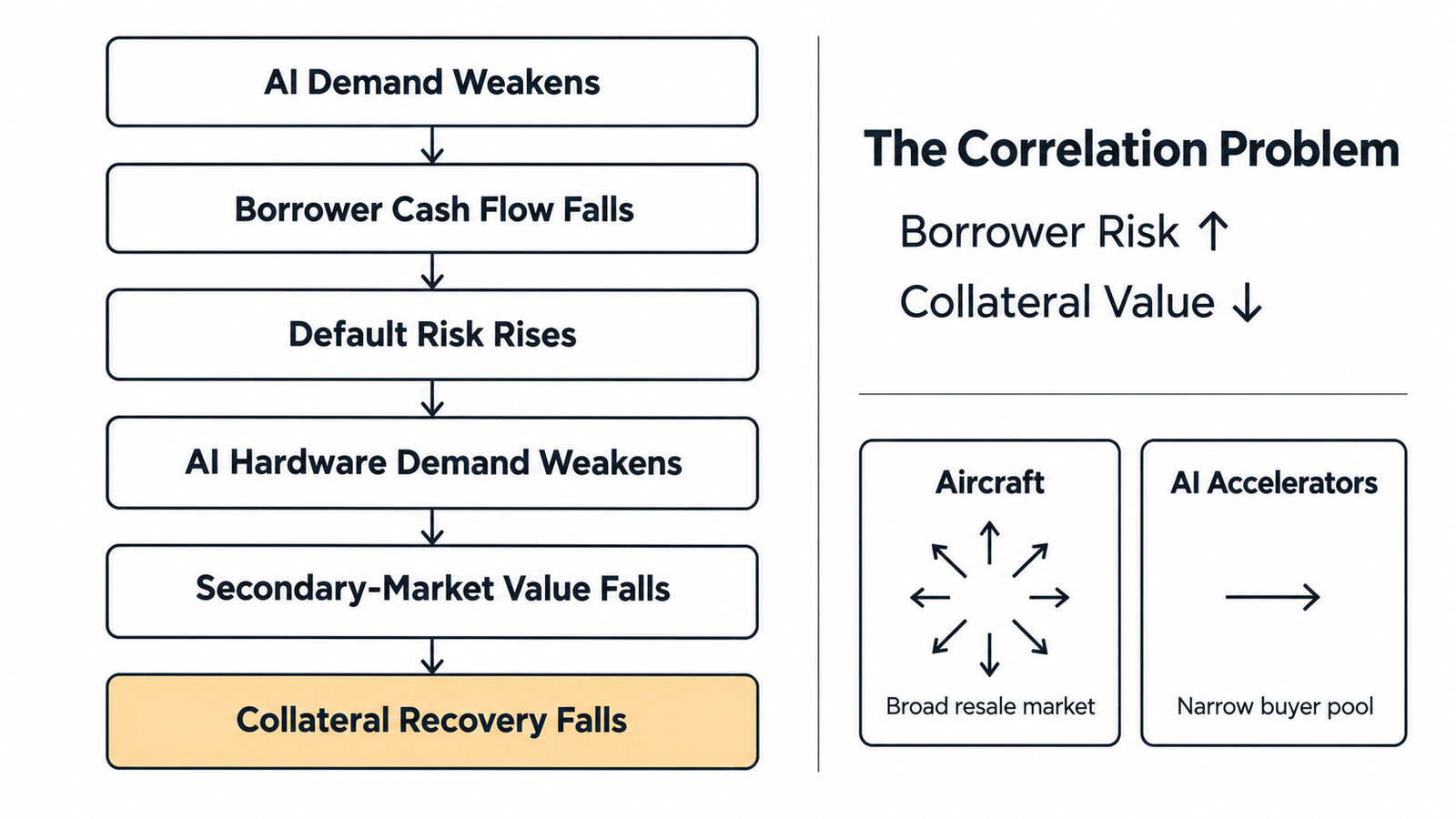
Compare that with the aviation case. An airline fails because of its route network, its balance sheet or a labour dispute; aircraft values barely move, because demand for air travel is intact and other operators are buying. The collateral is insulated from the borrower’s problem.
Here the insulation is weaker. The important risk is not borrower credit alone, and not residual value alone. It is the interaction between them.
Two qualifications keep this honest.
- This is a risk characteristic, not a prediction of crisis. Correlated collateral is common in structured finance — commercial mortgages in a single metro, shipping in one trade lane — and markets price it rather than refuse it. The question is whether it is being priced.
- The correlation is imperfect. A borrower-specific failure, as opposed to a sector downturn, would leave hardware demand intact and recovery would look much better. Anthropic losing share to a competitor is a different scenario from AI spending flattening industry-wide, and only the second produces the full correlation effect.
The practical consequence for a credit analyst: stress-testing this exposure requires modelling borrower default and collateral value as joint outcomes, not as independent variables multiplied together. Treating them as independent will understate loss severity in exactly the scenario that matters.
Broadcom Occupies Three Seats at the Table
State this plainly, because it is unusual and it is disclosed rather than hidden.
| Role | What it means |
|---|---|
| Supplier | Broadcom produces the custom accelerators Anthropic is leasing |
| Guarantor | Its investment-grade credit backstops the ~$42bn senior tranche |
| Lender | Per Broadcom’s quarterly report and a term sheet shown to investors, Anthropic could issue up to $42 billion of convertible notes to Broadcom to cover lease payments |
The economic exposures run in different directions and are worth separating.
As supplier, Broadcom books revenue on hardware it sells into the structure. As guarantor, it takes contingent credit exposure to Anthropic’s performance. As convertible lender, it takes direct credit exposure that could convert into equity. Reporting indicates Anthropic is on track to become Broadcom’s largest custom-silicon customer.
What that combination produces, as analysis: Broadcom’s revenue from this customer is partly financed by Broadcom’s own credit. If the customer performs, the company captures product margin plus the upside on a convertible position. If the customer struggles, it absorbs losses as guarantor and as lender simultaneously, on top of losing the revenue.
This is not a scandal and it is not novel in kind. Vendor financing is as old as capital equipment, and Anthropic’s own prospectus reportedly flags potential conflicts of interest, warning that Broadcom’s decisions on pricing and hardware could affect Anthropic’s ability to procure enough compute. Both parties have disclosed the arrangement.
What it does mean for a senior lender is specific: the guarantee that makes the paper investment-grade comes from a party whose own exposure to the same borrower is large and multi-layered. The guarantee is not independent of the risk it covers. That is a correlation of a different kind, sitting on top of the collateral correlation already described.
What the Credit Market Is Signalling
The interesting response is not commentary. It is documentation.
On September 29, Bloomberg reported that PGIM anchored a $500 million CLO issued by Allstate containing a first-of-its-kind provision capping AI-related collateral at 15% of the pool. PGIM’s co-head of securitized products indicated the firm is exploring similar structures with other managers and is building a framework to assess loans by their AI-sector linkage.
That is a structural response rather than a view. A manager that thought AI credit was simply attractive would buy more of it; a manager that thought it was simply bad would avoid it. Capping it means treating the exposure as acceptable but correlated.
Two further data points, both attributed carefully. Bank of America strategists have been reported as estimating that CLO exposure to chips and data centres could approach $100 billion; I could not locate the underlying note, so treat it as a strategist estimate. Separately, JPMorgan has put up to $150 billion of CLO-held leveraged loans in sectors facing meaningful AI-disruption risk — a different measure of a different thing, and not additive with the first.
For the market, this means AI infrastructure has moved from an equity story to a credit story. The relevant question changes from how much upside a successful build-out produces to how losses are distributed if it disappoints — and that question is answered by security packages and recovery assumptions, not by growth forecasts.
The Case for the Collateral Holding Its Value
The bearish reading is easy to write and may well be wrong. Several arguments point the other way, and lenders taking this paper are not naive.
- Scarcity is the strongest one. Advanced accelerators have been supply-constrained for three years. Memory is the binding input and it is contracted years ahead — Micron said in September that it had committed the vast majority of its calendar 2027 HBM supply at significantly higher prices, which we covered in our analysis of HBM pricing for 2027. Hardware that is hard to obtain new holds its value used.
- Inference workloads extend useful life. The frontier-training use case has the shortest competitive half-life. Serving established models is less demanding, and older accelerators often remain economic for inference long after they stop being the right choice for training. That gives the installed base a floor that pure training economics would not.
- Utilisation, not vintage, determines productivity. A fully utilised previous-generation fleet can produce better economics than an underutilised current-generation one, which is the argument we made in our analysis of accelerator utilisation. A buyer with demand to fill will take older hardware at the right price.
- Demand is broadening. Sovereign programmes, enterprises and specialist clouds have entered the market. The buyer pool is thin compared with aviation, but it is thicker than it was two years ago.
- Power is becoming the constraint. If electrical capacity rather than silicon limits deployment, hardware already installed in a powered facility carries a premium that a spec-sheet comparison misses. Capacity that exists and runs is worth more than capacity that has to be built.
- The structure has layers. Senior lenders sit behind both the Broadcom guarantee and the junior tranche. For the senior position to take a loss, Broadcom’s support would have to fail and $18 billion of junior capital would have to be exhausted first. That is a meaningful cushion.
The honest summary: the collateral question is unresolved rather than settled in either direction. What makes it worth watching is that nobody has observed a large forced sale of frontier accelerators in a weak market. Until someone does, every recovery assumption in this market is a model output, not an observation.
What Lenders and Infrastructure Buyers Should Model
Most readers will never structure a $42 billion tranche. The underwriting questions scale down to any organisation financing accelerators, and they are worth having answers to.
The asset
- Useful life assumed, and whether it matches competitive life or just the accounting schedule
- Residual value assumed at term, and what evidence supports it
- Memory capacity and bandwidth relative to the generation that will exist at term
- Performance per watt against the likely replacement
- Software portability — how much of the value depends on one ecosystem
The market
- Who else runs this hardware at scale, specifically and by name
- Observed secondary-market transactions, if any, rather than quoted prices
- Whether the asset can be sold as a unit or only as an integrated system
- Supply conditions at the likely exit date
The structure
- What is actually pledged, and whether enforcement reaches the hardware or only an equity interest
- Where you sit in the waterfall and how much cushion is beneath you
- Who provides any guarantee, and what their own exposure to the same borrower is
- Conditions that could void or weaken the guarantee
- Jurisdiction and enforcement timeline
The correlation
- What scenario causes borrower default, and what that scenario does to collateral value
- Whether your model treats those as independent variables; it should not
- Loss severity under a joint-stress case rather than a borrower-specific one
The operating reality
- Utilisation assumed, and what the economics look like at 60% of it
- Power, cooling and facility costs that continue after a default
- Maintenance and support obligations attached to the hardware
- Who operates the asset during a workout
The single most useful discipline is the last one in the correlation block. Multiplying an independent default probability by an independent recovery rate produces a comfortable number and the wrong answer.
What the Chips Are Worth
The $60 billion package is a bet on two things at once, and only one of them gets discussed.
The first is Anthropic: whether a company with $4.59 billion of 2025 revenue and a reported run rate above $65 billion by mid-2026 can service lease payments on hardware arriving in 2027. That is a growth question, and the market has a view on it.
The second is quieter. If the first bet fails, the recovery depends on what a 2027-generation TPU fetches in a market that has just been given a reason to doubt AI infrastructure demand. There is no price history for that, no appraisal convention, no established buyer list, and no precedent transaction to anchor against.
Which is why PGIM’s 15% cap is the most informative development of the past fortnight. It is not a prediction that AI credit will sour. It is an institution deciding that the exposure is correlated enough to need a structural limit rather than just a price.
Accelerator depreciation used to be an accounting debate conducted inside quarterly filings. It is now an input to the recovery assumptions behind tens of billions of dollars of institutional debt. The schedules did not become more rigorous on the way.
FAQ
What is AI chip financing?
Debt used to fund the purchase or lease of AI accelerators, where the hardware and the payments it generates underpin repayment. It is equipment finance applied to assets with unusually fast technological turnover.
How does the $60 billion Anthropic financing work?
According to the Financial Times on October 6, Bank of America, Citigroup and Morgan Stanley began syndicating a $60 billion package: about $42 billion of senior secured debt backstopped by Broadcom and about $18 billion of junior debt, with Blackstone committing roughly $9 billion of the junior portion. It funds Anthropic’s 2027 chip orders, with lease payments starting after delivery.
Is this the same as Anthropic’s $518 billion compute commitment?
No. The $518 billion is the reported total of Anthropic’s future compute and infrastructure commitments across six partners over roughly a decade, per a confidential IPO prospectus reviewed by Reuters. The $60 billion is a financing package covering part of that. They should never be added together.
Why are AI chips being used as collateral?
Because the capital requirements exceed what companies can fund from equity and cash flow, and because accelerators are high-value, identifiable assets producing contracted cash flows. That makes them superficially similar to aircraft or other financeable equipment.
How does accelerator depreciation affect AI chip financing?
Directly. Recovery value depends on what the hardware is worth at the point of enforcement. Accounting depreciation follows a smooth schedule; economic value tends to step down when a materially better generation ships. Lenders are exposed to the second curve, not the first.
Why is AI hardware different from aircraft collateral?
Mainly buyer depth and obsolescence. Aircraft have hundreds of potential operators worldwide, 20-to-30-year lives and a mature appraisal market. Frontier accelerators have a buyer pool in the dozens, competitive lives measured in a few years, and a thin secondary market that has not been tested in a downturn.
What is residual value in AI infrastructure?
The estimated worth of hardware at the end of a lease or financing term. It determines how much of a loan is covered by the asset rather than by the borrower’s cash flow, which makes it one of the most consequential assumptions in any chip-backed structure.
Could AI chip financing create credit risk?
It creates exposure, which markets are already responding to. PGIM anchored a $500 million CLO in late September with a 15% cap on AI-related collateral, the first such provision. Whether that exposure becomes a broader problem depends on AI demand, hardware turnover and how the structures are layered — none of which is settled.
Keep reading
Here are the latest posts from the blog.
The $60B AI Chip Financing and Its Residual-Value Problem
AI Chip Leasing Export Controls and the Tencent Deal

Misaligned Agent Activity: Who Pays When an Agent Strays