AI Infrastructure Debt: CoreWeave Repricing

AI infrastructure debt

In April, CoreWeave sold $1.75 billion of 9.75% senior unsecured notes due October 2031 at par. A week later it added another $1 billion of the same notes, and investors paid 102 cents on the dollar for them. On Thursday, 15 October, CNBC reported the yield to maturity on those notes at 15.78% (as cited by Benzinga). On our arithmetic, that yield corresponds to a price of roughly 80 cents. In six months, the buyers of the add-on have lost about a fifth of their money on paper. CoreWeave hasn’t missed a payment, cut its revenue guidance or defaulted on anything.

That gap is the story. The coupon CoreWeave pays hasn’t changed, and neither has a single dollar of what it owes. What changed is the price at which other people are willing to take on that obligation. This article asks what that price says about AI infrastructure debt: whether lenders are punishing one company after a bad week for its shares, or repricing a business model in which expensive, fast-ageing GPUs must earn enough to cover both the technology and the loan that bought it.

The short answer is that the evidence supports a repricing of financing risk, not a forecast of default. The longer answer depends on three things that are easy to blur: what a GPU is worth to a lender, how quickly contracted demand turns into cash, and what happens when the cost of borrowing rises for a company that must keep borrowing.

Key Takeaways
  • A 15% yield is a price, not a verdict. CoreWeave’s 9.75% 2031 notes yielding 15.78% means they trade near 80 cents. It doesn’t mean a missed payment or a promised 15% return.
  • CDS spreads overstate default odds if read naively. Converting about 1,088 basis points into a default probability depends on recovery assumptions, and the spread also includes a premium for fear and illiquidity.
  • GPU collateral is weaker than its purchase price suggests. Lenders anchored CoreWeave’s secured loans on customer contracts first, a sign of how little they rely on resale value alone.
  • $103.7 billion of RPO is not $103.7 billion of cash. Only 41% is due within two years, and most of it requires capacity that hasn’t been built yet.
  • Refinancing is the pressure point. About $10.6 billion of principal falls due by the end of 2027, so the price of new money matters more than the price of old bonds.
  • The $18 billion junior tranche is Anthropic’s, not CoreWeave’s. It belongs to the Broadcom TPU financing, and its pricing is still unknown.

Quick Navigation


Reading the AI infrastructure debt signal in CoreWeave’s bonds

A fixed coupon, a moving yield

A bond’s coupon is the interest written into the contract. CoreWeave’s June 2026 dollar notes pay 9.625% a year on $1.25 billion until July 2032, whatever happens to the share price. The yield to maturity is different. It is the annual return a buyer would earn by paying today’s market price, collecting every coupon and getting 100 cents back at maturity. When the price falls, the same fixed coupons plus a larger gain at maturity produce a higher yield. Price and yield move in opposite directions.

The numbers reported around 14 and 15 October fit together once that relationship is applied. On Wednesday, CNBC put the 2032 notes at about 14.8%, after touching 15% briefly, and the 2031 notes at about 14.9% (via investingLive). A 9.625% bond maturing in mid-2032 yields about 14.9% at a price of 80, by our calculation using semi-annual compounding and settlement on 15 October. That matches separate reporting, based on Forbes data, that the 2032 notes had fallen below 80 cents. On Thursday the 2031 notes were reported at 15.78% by CNBC and “past 16%” by Reuters. Different dealers, quote times and bid or offer sides easily explain a gap of a few tenths. Corporate bonds trade over the counter, and a quoted yield is often an indicative level rather than a trade.

Two cautions follow. A 15% yield isn’t a promised 15% return. It’s what a buyer earns only if CoreWeave pays every coupon and repays principal in full. If the company restructured, the realised return would depend on what creditors recovered. Suppose a buyer paid 79.8 for the 2031 notes, collected two years of coupons (19.5 points), then recovered 40 cents in a restructuring. That buyer would end up with 59.5 against 79.8 invested, a loss of about a quarter. The 40% recovery figure is purely illustrative. Nor does crossing 15% prove anything on its own. It’s a round number, and round numbers attract headlines more than they mark legal or economic thresholds.

Bonds, CDS and shares measure different things

A credit default swap (CDS) is insurance-like protection on a borrower’s debt. The buyer pays an annual premium, quoted in basis points, and is compensated if a defined credit event occurs. CNBC reported CoreWeave’s five-year CDS briefly above 1,140 basis points on 15 October before settling at 1,088. In other words, protecting $10 million of debt cost about $1.09 million a year. Reuters put the cost at about 1,000 basis points and translated it into a “nearly 63%” chance of default within five years.

That kind of conversion needs its assumptions shown. Assume 40% recovery and a constant default rate, and a 1,088bp spread implies roughly 60% cumulative default probability over five years. Change the recovery assumption and the answer moves a lot. More importantly, CDS spreads also price fear, illiquidity and the cost of hedging, which is why spread-implied probabilities usually run well above realised default rates. The figure is a market price, not an actuarial estimate.

The share price fell 15.46% to $65.78 on Wednesday, then recovered on Thursday after Nvidia’s chief executive, Jensen Huang, said publicly that CoreWeave’s cost of capital was falling. Equity holders get the upside and absorb losses first. Bondholders get at most par. When shares, bond yields and CDS spreads all move the same way, they’re related, but they aren’t measuring the same thing. In this case they did move together, and the bond and CDS markets kept pricing stress while the shares bounced.

AI infrastructure debt

How GPU-backed AI infrastructure debt is secured

Not all AI infrastructure debt is the same, even inside one company. The 2031 and 2032 notes under stress are senior unsecured: they rank ahead of shareholders but have no specific assets pledged to them. Much of the rest is delayed-draw term loans (DDTLs) held in special-purpose subsidiaries. CoreWeave’s Q2 10-Q says these are “collateralized with the assets underlying the contributed contracts and the pledged contractual cash flows, generally from investment grade counterparties.” StockTitan’s reading of the debt note puts DDTL debt at $13.6 billion and unsecured senior notes at $10 billion, out of $35.6 billion of principal at 30 June.

The DDTL lender, in other words, is mainly lending against a customer contract, with the GPUs as a second line of defence. That’s a sensible structure. It also means the unsecured noteholders sit behind lenders with claims on many of the company’s most valuable assets.

One accelerator, five different values

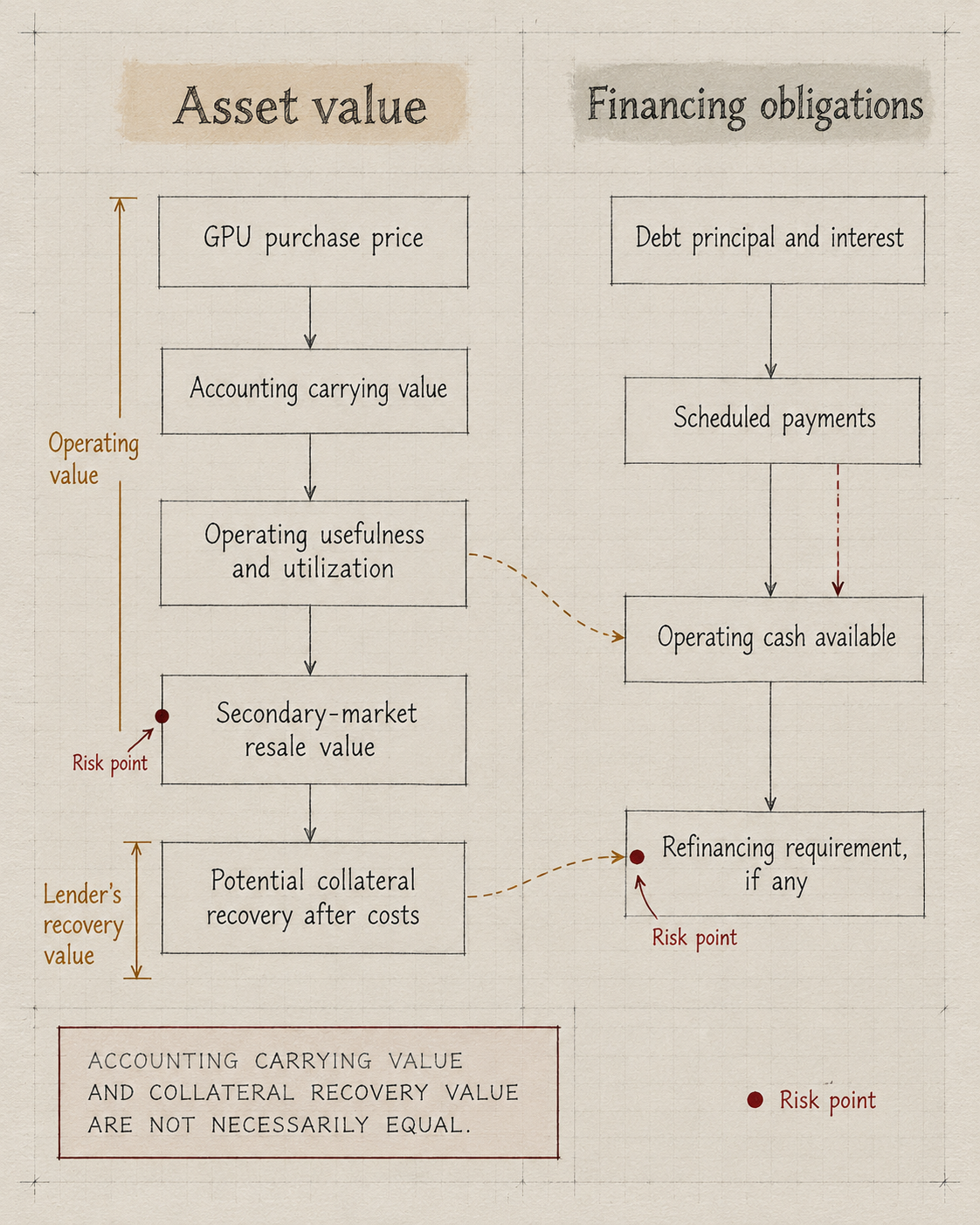
A GPU has several values at once, and they aren’t interchangeable:

  • Purchase price, what CoreWeave paid, often under supplier financing.
  • Carrying value, the purchase price less accumulated depreciation. CoreWeave’s FY2025 10-K depreciates technology equipment over six years.
  • Resale value, what a buyer in the secondary market would pay for that specific card, today, in that condition.
  • Value to a customer, which can be much higher than resale value inside a powered, networked cluster with a contract attached.
  • Collateral recovery value, what a lender actually collects after removal, transport, refurbishment, legal costs and a forced-sale discount.

The last figure is the one that matters in a default, and it’s the one with the least public evidence. As we argued in our piece on why accelerator useful-life assumptions deserve more scrutiny, a six-year accounting life is a management estimate. It isn’t a measurement of how long a chip will earn its keep. An accelerator can keep computing long after newer models outgrow its memory and its rental price collapses.

When AI infrastructure debt outlives its collateral

The risk for a lender isn’t that GPUs stop working. It’s that the loan amortises more slowly than the market value of the hardware falls. If a new chip generation arrives every year or two, the cards backing a five-year loan may be two generations old before half the principal is repaid. Their value also depends on things that don’t travel with them. A rack of liquid-cooled accelerators is worth far more in a data centre with contracted power than on a loading dock. Our analysis of the residual-value problem in the $60 billion AI chip financing made the same point about TPUs: secondary markets for accelerators are thin and untested under stress, and the conditions that push a borrower towards default are likely to depress resale prices at the same time.

We found no public disclosure of the loan-to-value ratios or advance rates on CoreWeave’s DDTLs, so we won’t guess at them. What the filings do show is that lenders chose to anchor these loans on contracts rather than on hardware alone. That choice says something about how much confidence they place in GPU collateral by itself.
AI infrastructure debt

Backlog is not cash

CoreWeave’s chief executive, Mike Intrator, answered the sell-off in a memo to staff. According to Reuters, he argued that the company’s backlog “more than covers” its debt obligations. He also wrote, as Yahoo Finance reported, that “there will be periods of time when the market misunderstands” and “acts irrationally”. The argument deserves to be taken seriously, because on the company’s own numbers it is arithmetically true. It just doesn’t answer the question lenders are asking.

What $103.7 billion of RPO actually promises

The term CoreWeave uses in its filings is remaining performance obligations, or RPO: contracted revenue it has not yet earned because it hasn’t yet delivered the compute. At 30 June the 10-Q reported “$103.7 billion of unsatisfied RPO”. It expected 41% of that to be recognised within 24 months, 39% in months 25 to 48, and the rest by month 78. Set against $35.6 billion of debt principal, that is a ratio of almost three to one.

Here is what sits between that RPO figure and a bond coupon:

  • Revenue must be earned first. Roughly $42.5 billion is scheduled for the next two years, and most of it depends on capacity that hasn’t been built yet. CoreWeave spent $14.1 billion on property and equipment in the first half of 2026 alone, and the 10-Q lists $35.5 billion of future lease payments on data-centre leases that haven’t started.
  • Revenue isn’t free cash. Every dollar recognised carries power, staffing, lease and interest costs. The Q2 net loss was $626 million on $2.58 billion of revenue.
  • Timing doesn’t line up. About $10.6 billion of principal falls due by the end of 2027. The 41% tranche of RPO arrives over the same window, but only as new data halls are energised.
  • Contracts aren’t immune to change. The 10-Q says the transaction price can include “potential reductions” in future. The termination terms in customer contracts weren’t disclosed in the sections we could read.
  • Customer concentration is falling but still high. CoreWeave’s largest customer was 36% of Q2 revenue, down from 71% a year earlier. Reuters names Microsoft and OpenAI among the biggest customers.

There’s also a point in the company’s favour. CoreWeave held $9.7 billion of deferred revenue at 30 June, which is cash customers have paid ahead of delivery. Deutsche Bank told clients on 15 October that roughly two-thirds of a backlog above $100 billion sits with investment-grade counterparties (World Today News, republishing CNBC). A big customer’s appetite for AI spending doesn’t make its contract unreliable. The question isn’t whether the customers will pay. It’s whether CoreWeave can deliver the capacity on time and on budget, while servicing debt raised before that capacity earns anything.

The refinancing loop in AI infrastructure debt

Refinancing means repaying maturing debt with new debt. In the early years, AI infrastructure debt is usually rolled over rather than repaid from profits. A company that is investing faster than it generates cash has to keep doing that, so the market price of its existing bonds becomes an operating variable rather than a scorecard.

The pieces are all in the filings. Q2 interest expense was $640 million, about a quarter of revenue for the quarter, and cash interest paid in the first half was $806 million. Reuters reports that CoreWeave lifted its 2026 capital-expenditure forecast in August to as much as $39 billion. About $4.4 billion of principal is due in the rest of 2026 and $6.2 billion in 2027, according to StockTitan’s reading of the maturity table. Cash at 30 June was $5.5 billion. Since then CoreWeave has added a $2.6 billion DDTL facility and $4.2 billion of 2.875% convertible notes, which shows that at least one door is still open.

Here is an illustrative calculation, not a forecast. If CoreWeave refinanced the $6.2 billion due in 2027 at 15% rather than at the 9.75% it paid in April, the extra interest would be about $325 million a year. That’s roughly half of one quarter’s current interest bill. It’s survivable on its own, but it sets the mechanism in motion. Higher financing costs must be recovered through higher prices or higher utilisation. As our analysis of why accelerator utilisation decides the cost of every token showed, idle capacity is paid for whether or not anyone uses it. A GPU cloud that charges more to cover its borrowing costs loses ground to hyperscalers that fund capex from operating cash flow. Lower prices, in turn, make the next loan harder to justify.

The loop also explains why commercial success doesn’t settle the matter. CoreWeave can win contracts, grow revenue and deliver well, and still find each new dollar of capital more expensive. It runs the other way too. A wide credit spread doesn’t stop the business from executing. A spread at 1,088 basis points mostly means that the next unsecured bond, if CoreWeave chose to issue one, would be expensive. Convertibles at 2.875% are cheaper in cash terms, but they shift some of the cost to shareholders through dilution.

Nvidia’s role cuts both ways. Its 2025 order form commits it to buy qualifying unused capacity through 13 April 2032, from an initial value of $6.3 billion. That supports utilisation. As TokenPost notes, though, it is not a guarantee to CoreWeave’s lenders, and either side can end it under defined conditions. Huang’s public reassurance on 15 October helped the shares, but it doesn’t change any creditor’s claim.

Where CoreWeave differs from the $60 billion Anthropic chip deal

The sell-off didn’t happen in isolation. On 14 October Oracle shares closed down nearly 9% and Nebius fell about 10%, according to CNBC figures carried by investingLive. The same CNBC report put Oracle’s five-year CDS at 288 basis points, up more than 12% on the week. Intrator’s memo itself blamed “weakness and delays surrounding the attempted IPOs and debt financings” of rivals. These moves were correlated, but correlation doesn’t prove a common cause. Oracle is an investment-grade company with a large legacy software business. Nebius has a different balance sheet and depreciates its GPUs over four years rather than six. What they share is sensitivity to one variable: how quickly AI demand turns into cash for whoever owns the hardware.

The comparison most often drawn is with Broadcom’s financing for Anthropic. As reported by Bloomberg and summarised by Quartz on 2 October, banks were assembling about $60 billion of debt. According to Tech Times, the borrower is a special-purpose vehicle that buys Google TPUs from Broadcom and leases them to Anthropic under a five-year, $125.2 billion lease. The structure has a $42 billion Class A senior secured tranche with a partial residual-value guarantee from Broadcom, and an $18 billion Class B junior tranche.

The two have shared risks. Both rest on the value of specialised AI accelerators and on whether an AI customer keeps paying. But the structures are different in ways that matter. The SPV has one lessee and one revenue stream, and the chip vendor stands behind part of the hardware’s value. CoreWeave is an operating company with many customers, data-centre leases, construction risk and a stack of debt in which the stressed notes are unsecured claims on the parent. A lender to the Anthropic SPV is mainly underwriting Anthropic’s credit. A CoreWeave bondholder is underwriting CoreWeave’s ability to build, operate and refinance. The two are not equivalent, and price moves in one say little directly about the other. We covered the obligation side of that deal in Anthropic’s $518 billion compute commitment.

The $18 billion junior tranche belongs to that deal

Some commentary this week has linked an “$18 billion unguaranteed junior tranche” to CoreWeave. The reporting we could verify places it in the Anthropic financing as Class B, with Blackstone committing about $9 billion and syndicating the rest. Junior means it is repaid after the senior tranche. The absence of Broadcom’s guarantee on Class B isn’t stated outright in the reports, and even if it applies, that doesn’t mean the tranche has no collateral or covenants. Those terms haven’t been published. Neither has the pricing. Tech Times reports that Class B lenders may wait for Anthropic’s planned IPO before committing in full.

That makes the tranche a useful gauge of how much appetite there is for subordinated AI infrastructure credit, once it prices. It can’t tell us anything about CoreWeave’s own bonds, and we won’t guess at its clearing level.

What would change the case on AI infrastructure debt

The market’s message about AI infrastructure debt is narrower than the headlines suggest. CoreWeave’s unsecured lenders now want about 15% to hold paper that was issued at under 10% this year. That repricing applies to the model, a highly leveraged GPU cloud funding years of construction ahead of revenue, as much as to the company. It isn’t evidence of an imminent default. CoreWeave’s ratings, as last published in April, were B+ with a positive outlook at S&P and Ba3 at Moody’s. Since June it has raised fresh money, and its largest contracts sit with investment-grade customers.

What the evidence can’t settle yet is whether the gap between contracted demand and cash in hand closes before the 2027 maturities do. Several observable facts would move the assessment:

  • The Q3 10-Q. Watch whether RPO conversion keeps pace with the 24-month schedule, whether deferred revenue grows, and how interest expense compares with revenue.
  • Rating-agency action. Any change from S&P or Moody’s, and the rationale behind it, would be the first independent credit judgement since the sell-off.
  • The next financing. Its form (secured DDTL, unsecured note or convertible) and its price will show which doors remain open, and at what cost.
  • Delivery milestones. Data-centre energisation dates and lease commencements govern when RPO becomes revenue.
  • Secondary GPU prices. Prices for previous-generation accelerators are the only market test of collateral value, and they’re poorly documented today.
  • Class B pricing in the Anthropic deal. This is the clearest gauge of appetite for subordinated AI credit, even though it isn’t CoreWeave’s debt.

If the next quarter shows RPO converting on schedule, with financing still available at falling spreads, Huang’s claim that capital is getting cheaper would start to look right. If deliveries slip while 2027 maturities approach, the bond market’s 15% will look like the more accurate forecast.

Frequently Asked Questions

What is AI infrastructure debt?

It’s borrowing used to buy AI accelerators and build or lease the data centres that run them. It includes corporate bonds, loans secured on equipment and customer contracts, supplier financing, and lease obligations.

Why can a bond’s yield rise above its coupon?

The coupon is fixed in cash terms. If the bond’s price falls below 100, a buyer collects the same coupons plus a gain at maturity, so the yield rises. CoreWeave’s 9.625% 2032 notes yield about 15% at a price near 80.

Does a 15% bond yield mean CoreWeave will default?

No. It means investors want a high return to hold the risk. Default depends on whether CoreWeave can meet its payments and refinance. Its last published ratings, from April 2026, were B+ (S&P) and Ba3 (Moody’s).

How does GPU-backed financing work?

Typically a subsidiary borrows against a pool of GPUs and the customer contracts they serve. Lenders take security over both, and the contract cash flows repay the loan. CoreWeave’s DDTLs follow this pattern.

Why is GPU collateral hard to value?

Accounting value follows a fixed schedule (six years at CoreWeave), but resale value depends on new chip generations, condition, power and cooling, and whether there’s a buyer in a downturn. Public data on forced-sale prices is thin.

Is contracted AI backlog the same as available cash?

No. RPO is revenue still to be earned by delivering compute. It turns into cash only as capacity comes online and customers are billed, and the costs of delivering it come first.

What should investors watch next?

Quarterly RPO conversion, any rating action, the cost and form of CoreWeave’s next financing, data-centre delivery dates, and secondary-market GPU prices.


Keep reading

Anthropic IPO valuation

Anthropic IPO: The $895 Billion Question Behind Its Valuation

Last updated: 9 November 2026. Latest confirmed development: Anthropic’s amended S-1, filed on 2 November, still leaves the share count and the IPO price range …
Claude Opus vs Sonnet

Claude Opus vs Sonnet: What the 2026 Price Gap Actually Buys

Last verified: 8 November 2026. All prices are Anthropic’s standard first-party API rates in US dollars per million tokens. They aren’t Claude Pro or Max …
RSA-1024

Did AI Break RSA? What DeepMind Actually Found

Last verified: 8 November 2026. Both papers are unreviewed working papers, and no outside group has reproduced the results yet. No, AI did not break …
Model Distillation

Model Distillation Explained: When AI Learning Becomes Extraction

Last verified: 7 November 2026. Government and company claims are attributed throughout. None has been tested in court. A support team trains a small, cheap …

The $60B AI Chip Financing and Its Residual-Value Problem

AI chip financing

A lender writing a $42 billion senior secured cheque asks two questions. Can the borrower pay? And if it cannot, what is the security worth?

For most asset-backed lending the second question is the easy one. Property has comparable sales. Aircraft have a global resale market and published values. Vehicles have auction data going back decades. The collateral has a price history that exists independently of the borrower.

AI accelerators do not have that yet. They have a list price, an accounting schedule and a thin secondary market whose depth has never been tested at scale in a downturn. The debt being written against them is real and large; the recovery assumption underneath it is a judgement.

That gap is the subject here. The $60 billion package syndicating this week is a bet on Anthropic’s business and, simultaneously, a bet on what a 2027-generation TPU is worth in 2030.

Key takeaways
  • The Financial Times reported on October 6 that Bank of America, Citigroup and Morgan Stanley began syndicating a $60 billion debt package funding Anthropic’s lease of Google-designed chips: roughly $42 billion of senior secured debt backstopped by Broadcom and $18 billion of junior debt, with Blackstone committing about $9 billion of the latter.
  • Some syndicated coverage published the same figures inflated tenfold. The correct numbers are $42bn, $18bn and $9bn.
  • This $60 billion is separate from Anthropic’s reported $518 billion of total compute commitments. The financing funds part of the commitments; it is not the same number.
  • Book value, market value and recovery value are three different things, and only the third matters in a workout. The gap between them widens when a technology generation turns.
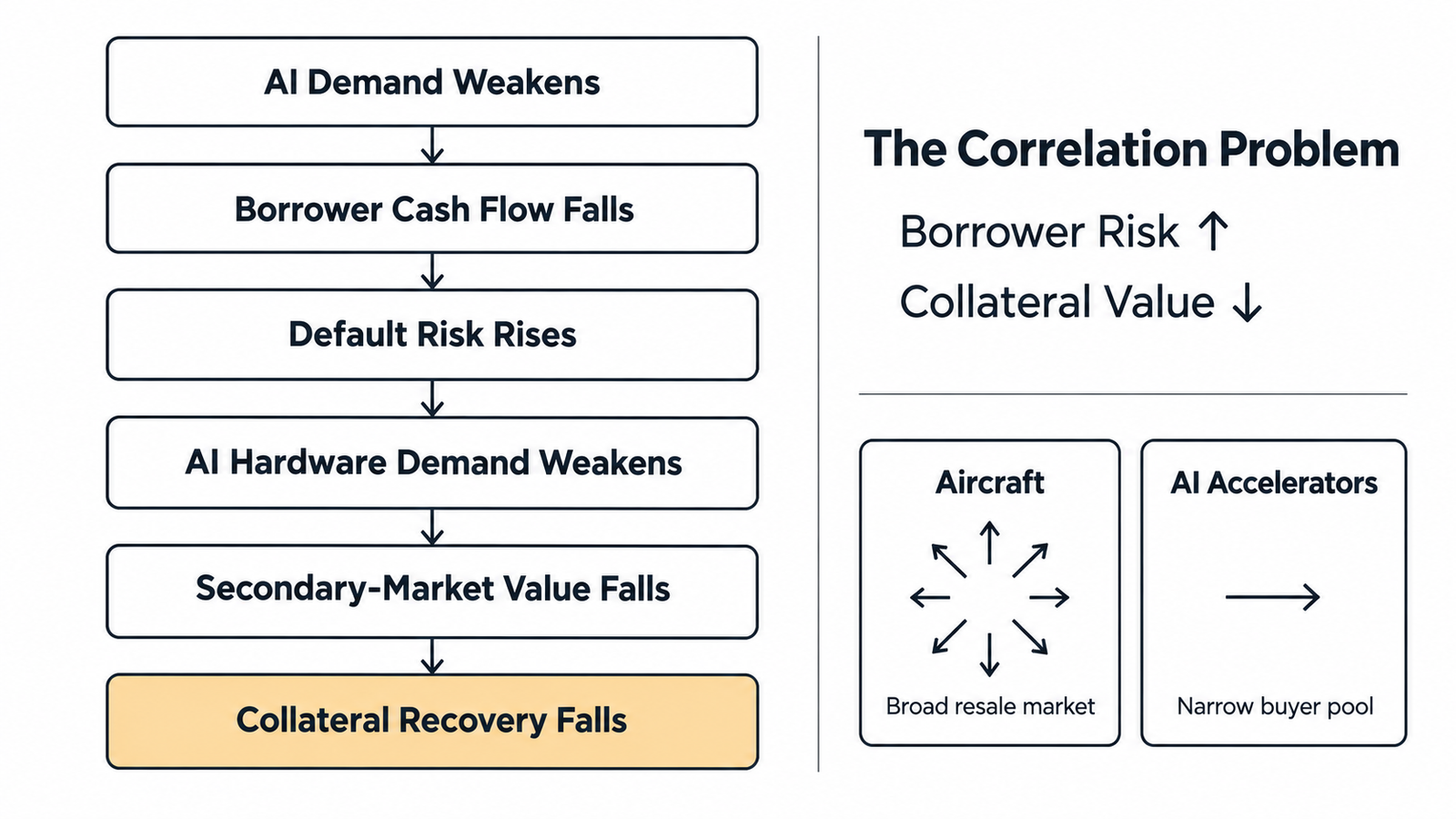
  • The aircraft analogy is useful for structure and misleading on liquidity. Aircraft have thousands of potential operators worldwide; frontier accelerators have a buyer pool measured in dozens.
  • The distinctive risk is correlation: the conditions that stress the borrower are the same conditions that soften demand for the collateral. Borrower risk and collateral value can deteriorate together.
  • Credit markets have started pricing this. PGIM anchored a $500 million CLO in late September containing a first-of-its-kind 15% cap on AI-related collateral.

Quick Navigation


The $60 Billion Transaction, Stripped to Mechanics

What the Financial Times reported, and what subsequent coverage corroborates:

ElementDetail
ArrangersBank of America, Citigroup, Morgan Stanley
Total package$60 billion
Senior tranche~$42 billion, secured, backstopped by Broadcom
Junior tranche~$18 billion, no Broadcom guarantee
Junior anchorBlackstone, committing ~$9 billion and syndicating the rest
PurposeFunding Anthropic’s chip orders through 2027
Payment startLease payments commence after chip delivery
StatusSyndication letters out; books not closed

The economic shape is a leasing structure rather than a purchase. A financing vehicle funds the hardware, Anthropic leases it, and the lease payments service the debt. Anthropic does not own the chips, which is precisely why the hardware can serve as security for the senior lenders.

Two features deserve attention before anything else.

  1. The Broadcom backstop is doing enormous work. The senior tranche is supported by Broadcom’s investment-grade credit, widely reported as A−. That is what makes $42 billion placeable with institutional lenders at a manageable cost. Without it, the senior tranche would be priced against the credit of a company that reported a $42 billion net loss in 2025, most of it non-cash, with revenue of $4.59 billion.
  2. The junior tranche is the honest price signal. The $18 billion with no guarantee sits directly against Anthropic’s credit and the hardware. Blackstone taking half of it is a meaningful commitment; the terms on which the rest places will tell you more about market appetite than any amount of commentary.

Timing matters too. Payments begin after delivery in 2027. The debt is being raised now against cash flows that start later, which means the underwriting rests on a forecast of Anthropic’s 2027–2032 revenue and on a residual-value assumption for hardware that does not yet exist in the data centre.

What AI Chip Financing Actually Means

AI chip financing is the use of debt to fund the acquisition or lease of AI accelerators, where the hardware and the contracted payments it generates serve as the basis for repayment. It is equipment finance applied to silicon that depreciates faster than almost anything else lenders have taken as security.

The arrangements differ more than the headlines suggest:

StructureWho owns the hardwareWho carries the residual risk
Outright purchaseThe buyerThe buyer
Operating leaseThe lessorThe lessor
Finance leaseEffectively the lesseeThe lessee
Asset-backed debtA financing vehicleLenders, through the security package
Vendor financingVariesThe vendor, partly
Credit guaranteeUnchangedThe guarantor, on default

The Anthropic structure combines several of these at once: a lease to the user, asset-backed debt to fund it, a guarantee from the chip supplier on the senior piece, and a separate convertible facility from that same supplier.

Senior and junior, without oversimplifying
  • Senior secured debt holds a first claim on pledged collateral and sits at the top of the repayment waterfall. In this structure it also carries Broadcom’s support, which means a senior lender has two sources of recovery: the guarantee and the security.
  • Junior debt ranks behind. It absorbs losses first, prices wider to compensate, and here it carries no guarantee at all.

The simplification worth flagging: priority is set by intercreditor agreements and the specific security package, not by the labels. What assets are actually pledged, whether the pledge is over the hardware or over the equity of the vehicle that owns it, how enforcement works across jurisdictions, and what conditions govern the guarantee all matter more than the words “senior” and “junior.” Those documents are not public.

For a lender, this means the senior position is substantially a Broadcom credit exposure with hardware as backup, while the junior position is a direct bet on Anthropic and on what the chips fetch. Those are very different risks wearing the same deal name.

Three Different Values, Only One of Which Matters in a Workout

Every asset has three values, and conflating them is how collateral analysis goes wrong.

ValueWhat it isWho uses it
Book valueOriginal cost less accumulated depreciation, per the schedule chosenAccountants, auditors, the income statement
Market valueWhat a willing buyer pays a willing seller in an orderly marketAsset managers, insurers, secondary traders
Recovery valueWhat a lender actually realises after default, enforcement, delay, remarketing and costsCredit analysts, workout desks

Recovery value is the only one that protects a lender, and it is always the lowest of the three. The discount between market and recovery reflects time, transaction costs, the circumstances of a forced sale, and whether a buyer exists when you need one.

For AI accelerators, several factors widen that discount specifically:

  • Integration. A rack of accelerators is not a commodity unit. It needs compatible networking, power delivery, cooling and a software stack. Recovering value may mean selling a system, not a chip.
  • Location. The hardware sits in a data centre with its own lease, power contract and operator. Physical recovery is not simply a repossession.
  • Operating cost. Unlike an aircraft in storage, idle accelerators in a facility still consume rent and, if kept warm, power.
  • Timing. Enforcement takes months. A technology generation can turn in twelve.

Accounting Depreciation Is Not Economic Depreciation

Accounting depreciation allocates cost across a chosen useful life. It is a smooth line, usually straight, and it is an estimate made by management.

Economic depreciation is what the asset is actually worth over time, and it is not smooth at all. It is flat while the hardware remains the current generation, then steps down sharply when a materially better part ships, then flattens again at whatever floor the installed base supports.

The mismatch matters because book value follows the first curve and recovery value follows the second. A chip carried at 60% of cost on a six-year schedule may be worth considerably less in a market where the new generation delivers substantially more performance per watt.

We argued in our analysis of AI accelerator depreciation that these schedules are among the least audited assumptions in AI infrastructure economics, and that memory capacity rather than compute is often what ends an accelerator’s competitive life. That was an accounting and modelling point. The $60 billion package turns it into a credit question, because a residual-value assumption that was previously internal to a company’s financial statements is now embedded in the security package for institutional debt.

The key distinction is this: book value is an assertion, market value is an observation, and recovery value is an outcome. Only the first is visible in advance.

Where the Aircraft Analogy Works, and Where It Breaks

Bankers reach for aircraft finance when explaining these structures, and the comparison deserves better than dismissal. Aviation leasing is a mature, multi-decade, trillion-dollar market that solved several problems this one now faces.

Where the analogy genuinely holds:

  • A high-value physical asset with a long nominal life
  • Lease structures separating ownership from operation
  • Asset-backed debt with residual-value assumptions baked into pricing
  • Specialist lessors who understand the equipment better than the lenders do
  • Established enforcement mechanics for repossession
  • Cash flows contracted in advance from creditworthy operators

That is a real set of similarities, and it explains why the structure was reachable at all.

Where it breaks, and the breaks are substantial:

Commercial aircraftAI accelerators
Potential buyersHundreds of airlines and lessors worldwideDozens of hyperscalers, labs and specialist clouds
Useful life20–30 yearsCompetitive life measured in years
Obsolescence driverFuel efficiency, gradualNew generation, stepwise
Secondary marketDeep, priced, with published appraisalsThin, opaque, largely untested in stress
PortabilityFly it to the new operatorDecommission, ship, reinstall, reintegrate
Software dependenceMinimalSubstantial — ecosystem compatibility matters
Operating economicsOlder aircraft remain viable on secondary routesOlder accelerators compete directly on performance per watt

The buyer-pool difference is the one that does most of the damage to the analogy. When a regional carrier fails, its narrowbodies find homes because thousands of operators fly that type and demand for air travel is not correlated with that carrier’s solvency. When a large AI lab’s economics deteriorate, the set of organisations able to absorb tens of thousands of accelerators is small, and they are mostly reading the same market signals.

There is also a specificity problem. The TPUs in this transaction are designed for a particular architecture and ecosystem. The resale question is not “what is a GPU worth” but “who else runs this hardware, at scale, with the networking and software to use it.” That is a narrower question than it sounds.

The Correlated-Collateral Problem

Good collateral is uncorrelated with the borrower. That is the whole point of taking security: when the borrower fails for borrower-specific reasons, the asset retains value because its market has other participants and other drivers.

AI accelerators may not offer that separation.

The mechanism, stated as analysis rather than prediction:

AI demand weakens → borrower revenue and cash flow come under pressure → default risk rises → demand for AI accelerators weakens across the sector → secondary-market prices fall → recovery value declines.

Every arrow in that chain is driven by the same underlying variable. The thing that would cause Anthropic to struggle — a slowdown in enterprise AI spending, a compression in model pricing, a capability plateau — is the same thing that would thin the buyer pool for its hardware.

AI chip financing

Compare that with the aviation case. An airline fails because of its route network, its balance sheet or a labour dispute; aircraft values barely move, because demand for air travel is intact and other operators are buying. The collateral is insulated from the borrower’s problem.

Here the insulation is weaker. The important risk is not borrower credit alone, and not residual value alone. It is the interaction between them.

Two qualifications keep this honest.

  1. This is a risk characteristic, not a prediction of crisis. Correlated collateral is common in structured finance — commercial mortgages in a single metro, shipping in one trade lane — and markets price it rather than refuse it. The question is whether it is being priced.
  2. The correlation is imperfect. A borrower-specific failure, as opposed to a sector downturn, would leave hardware demand intact and recovery would look much better. Anthropic losing share to a competitor is a different scenario from AI spending flattening industry-wide, and only the second produces the full correlation effect.

The practical consequence for a credit analyst: stress-testing this exposure requires modelling borrower default and collateral value as joint outcomes, not as independent variables multiplied together. Treating them as independent will understate loss severity in exactly the scenario that matters.

Broadcom Occupies Three Seats at the Table

State this plainly, because it is unusual and it is disclosed rather than hidden.

RoleWhat it means
SupplierBroadcom produces the custom accelerators Anthropic is leasing
GuarantorIts investment-grade credit backstops the ~$42bn senior tranche
LenderPer Broadcom’s quarterly report and a term sheet shown to investors, Anthropic could issue up to $42 billion of convertible notes to Broadcom to cover lease payments

The economic exposures run in different directions and are worth separating.

As supplier, Broadcom books revenue on hardware it sells into the structure. As guarantor, it takes contingent credit exposure to Anthropic’s performance. As convertible lender, it takes direct credit exposure that could convert into equity. Reporting indicates Anthropic is on track to become Broadcom’s largest custom-silicon customer.

What that combination produces, as analysis: Broadcom’s revenue from this customer is partly financed by Broadcom’s own credit. If the customer performs, the company captures product margin plus the upside on a convertible position. If the customer struggles, it absorbs losses as guarantor and as lender simultaneously, on top of losing the revenue.

This is not a scandal and it is not novel in kind. Vendor financing is as old as capital equipment, and Anthropic’s own prospectus reportedly flags potential conflicts of interest, warning that Broadcom’s decisions on pricing and hardware could affect Anthropic’s ability to procure enough compute. Both parties have disclosed the arrangement.

What it does mean for a senior lender is specific: the guarantee that makes the paper investment-grade comes from a party whose own exposure to the same borrower is large and multi-layered. The guarantee is not independent of the risk it covers. That is a correlation of a different kind, sitting on top of the collateral correlation already described.

What the Credit Market Is Signalling

The interesting response is not commentary. It is documentation.

On September 29, Bloomberg reported that PGIM anchored a $500 million CLO issued by Allstate containing a first-of-its-kind provision capping AI-related collateral at 15% of the pool. PGIM’s co-head of securitized products indicated the firm is exploring similar structures with other managers and is building a framework to assess loans by their AI-sector linkage.

That is a structural response rather than a view. A manager that thought AI credit was simply attractive would buy more of it; a manager that thought it was simply bad would avoid it. Capping it means treating the exposure as acceptable but correlated.

Two further data points, both attributed carefully. Bank of America strategists have been reported as estimating that CLO exposure to chips and data centres could approach $100 billion; I could not locate the underlying note, so treat it as a strategist estimate. Separately, JPMorgan has put up to $150 billion of CLO-held leveraged loans in sectors facing meaningful AI-disruption risk — a different measure of a different thing, and not additive with the first.

For the market, this means AI infrastructure has moved from an equity story to a credit story. The relevant question changes from how much upside a successful build-out produces to how losses are distributed if it disappoints — and that question is answered by security packages and recovery assumptions, not by growth forecasts.

The Case for the Collateral Holding Its Value

The bearish reading is easy to write and may well be wrong. Several arguments point the other way, and lenders taking this paper are not naive.

  • Scarcity is the strongest one. Advanced accelerators have been supply-constrained for three years. Memory is the binding input and it is contracted years ahead — Micron said in September that it had committed the vast majority of its calendar 2027 HBM supply at significantly higher prices, which we covered in our analysis of HBM pricing for 2027. Hardware that is hard to obtain new holds its value used.
  • Inference workloads extend useful life. The frontier-training use case has the shortest competitive half-life. Serving established models is less demanding, and older accelerators often remain economic for inference long after they stop being the right choice for training. That gives the installed base a floor that pure training economics would not.
  • Utilisation, not vintage, determines productivity. A fully utilised previous-generation fleet can produce better economics than an underutilised current-generation one, which is the argument we made in our analysis of accelerator utilisation. A buyer with demand to fill will take older hardware at the right price.
  • Demand is broadening. Sovereign programmes, enterprises and specialist clouds have entered the market. The buyer pool is thin compared with aviation, but it is thicker than it was two years ago.
  • Power is becoming the constraint. If electrical capacity rather than silicon limits deployment, hardware already installed in a powered facility carries a premium that a spec-sheet comparison misses. Capacity that exists and runs is worth more than capacity that has to be built.
  • The structure has layers. Senior lenders sit behind both the Broadcom guarantee and the junior tranche. For the senior position to take a loss, Broadcom’s support would have to fail and $18 billion of junior capital would have to be exhausted first. That is a meaningful cushion.

The honest summary: the collateral question is unresolved rather than settled in either direction. What makes it worth watching is that nobody has observed a large forced sale of frontier accelerators in a weak market. Until someone does, every recovery assumption in this market is a model output, not an observation.

What Lenders and Infrastructure Buyers Should Model

Most readers will never structure a $42 billion tranche. The underwriting questions scale down to any organisation financing accelerators, and they are worth having answers to.

The asset

  • Useful life assumed, and whether it matches competitive life or just the accounting schedule
  • Residual value assumed at term, and what evidence supports it
  • Memory capacity and bandwidth relative to the generation that will exist at term
  • Performance per watt against the likely replacement
  • Software portability — how much of the value depends on one ecosystem

The market

  • Who else runs this hardware at scale, specifically and by name
  • Observed secondary-market transactions, if any, rather than quoted prices
  • Whether the asset can be sold as a unit or only as an integrated system
  • Supply conditions at the likely exit date

The structure

  • What is actually pledged, and whether enforcement reaches the hardware or only an equity interest
  • Where you sit in the waterfall and how much cushion is beneath you
  • Who provides any guarantee, and what their own exposure to the same borrower is
  • Conditions that could void or weaken the guarantee
  • Jurisdiction and enforcement timeline

The correlation

  • What scenario causes borrower default, and what that scenario does to collateral value
  • Whether your model treats those as independent variables; it should not
  • Loss severity under a joint-stress case rather than a borrower-specific one

The operating reality

  • Utilisation assumed, and what the economics look like at 60% of it
  • Power, cooling and facility costs that continue after a default
  • Maintenance and support obligations attached to the hardware
  • Who operates the asset during a workout

The single most useful discipline is the last one in the correlation block. Multiplying an independent default probability by an independent recovery rate produces a comfortable number and the wrong answer.

What the Chips Are Worth

The $60 billion package is a bet on two things at once, and only one of them gets discussed.

The first is Anthropic: whether a company with $4.59 billion of 2025 revenue and a reported run rate above $65 billion by mid-2026 can service lease payments on hardware arriving in 2027. That is a growth question, and the market has a view on it.

The second is quieter. If the first bet fails, the recovery depends on what a 2027-generation TPU fetches in a market that has just been given a reason to doubt AI infrastructure demand. There is no price history for that, no appraisal convention, no established buyer list, and no precedent transaction to anchor against.

Which is why PGIM’s 15% cap is the most informative development of the past fortnight. It is not a prediction that AI credit will sour. It is an institution deciding that the exposure is correlated enough to need a structural limit rather than just a price.

Accelerator depreciation used to be an accounting debate conducted inside quarterly filings. It is now an input to the recovery assumptions behind tens of billions of dollars of institutional debt. The schedules did not become more rigorous on the way.

FAQ

What is AI chip financing?

Debt used to fund the purchase or lease of AI accelerators, where the hardware and the payments it generates underpin repayment. It is equipment finance applied to assets with unusually fast technological turnover.

How does the $60 billion Anthropic financing work?

According to the Financial Times on October 6, Bank of America, Citigroup and Morgan Stanley began syndicating a $60 billion package: about $42 billion of senior secured debt backstopped by Broadcom and about $18 billion of junior debt, with Blackstone committing roughly $9 billion of the junior portion. It funds Anthropic’s 2027 chip orders, with lease payments starting after delivery.

Is this the same as Anthropic’s $518 billion compute commitment?

No. The $518 billion is the reported total of Anthropic’s future compute and infrastructure commitments across six partners over roughly a decade, per a confidential IPO prospectus reviewed by Reuters. The $60 billion is a financing package covering part of that. They should never be added together.

Why are AI chips being used as collateral?

Because the capital requirements exceed what companies can fund from equity and cash flow, and because accelerators are high-value, identifiable assets producing contracted cash flows. That makes them superficially similar to aircraft or other financeable equipment.

How does accelerator depreciation affect AI chip financing?

Directly. Recovery value depends on what the hardware is worth at the point of enforcement. Accounting depreciation follows a smooth schedule; economic value tends to step down when a materially better generation ships. Lenders are exposed to the second curve, not the first.

Why is AI hardware different from aircraft collateral?

Mainly buyer depth and obsolescence. Aircraft have hundreds of potential operators worldwide, 20-to-30-year lives and a mature appraisal market. Frontier accelerators have a buyer pool in the dozens, competitive lives measured in a few years, and a thin secondary market that has not been tested in a downturn.

What is residual value in AI infrastructure?

The estimated worth of hardware at the end of a lease or financing term. It determines how much of a loan is covered by the asset rather than by the borrower’s cash flow, which makes it one of the most consequential assumptions in any chip-backed structure.

Could AI chip financing create credit risk?

It creates exposure, which markets are already responding to. PGIM anchored a $500 million CLO in late September with a 15% cap on AI-related collateral, the first such provision. Whether that exposure becomes a broader problem depends on AI demand, hardware turnover and how the structures are layered — none of which is settled.


Keep reading

Anthropic IPO valuation

Anthropic IPO: The $895 Billion Question Behind Its Valuation

Last updated: 9 November 2026. Latest confirmed development: Anthropic’s amended S-1, filed on 2 November, still leaves the share count and the IPO price range …
Claude Opus vs Sonnet

Claude Opus vs Sonnet: What the 2026 Price Gap Actually Buys

Last verified: 8 November 2026. All prices are Anthropic’s standard first-party API rates in US dollars per million tokens. They aren’t Claude Pro or Max …
RSA-1024

Did AI Break RSA? What DeepMind Actually Found
Last verified: 8 November 2026. Both papers are unreviewed working papers, and no outside group has reproduced the results yet. No, AI did not break …
Model Distillation

Model Distillation Explained: When AI Learning Becomes Extraction

Last verified: 7 November 2026. Government and company claims are attributed throughout. None has been tested in court. A support team trains a small, cheap …

Agent Identity: Why AI Agents Shouldn’t Share a Service Account

Agent Identity

Most teams authenticate AI agents the way they authenticate cron jobs: one API key, one service account, shared by everything that calls the CRM. That works on launch day. It fails the first time someone asks which agent did something, for whom, and with what authority.

This article covers what agent identity refers to, why a shared credential erases the answer, and what a workable design looks like.

Key takeaways
  • A shared service account records which credential acted, not which agent. Four agents on one credential look identical in the logs.
  • “Agent identity” spans layers: workload identity, OAuth client identity, cryptographic proof, and delegated user authority. Say which one you mean.
  • Agent identity and user identity answer different questions. Merging them gives you an agent that is the user, or one nobody can attribute.
  • Short-lived, audience-bound, scoped credentials shrink a stolen token’s window and reach. They do not stop theft or in-scope misuse.
  • Delegation keeps the agent’s identity apart from the user’s. Impersonation erases it (RFC 8693).
  • Identity complements prompt-injection defenses and sandboxing. It limits and explains damage. It does not prevent manipulation.

Quick Navigation


The Audit Log That Tells You Almost Nothing

Start with a hypothetical. This is not a real incident.

A company runs four agents: support, finance, sales and engineering. All four authenticate as agent-prod-service-account. A support ticket arrives with hidden instructions, and the support agent is talked into exporting a customer list. The security team pulls the logs:

09:14:07Z  principal=agent-prod-service-account  action=crm.contacts.export    result=allowed
09:14:09Z  principal=agent-prod-service-account  action=storage.objects.create result=allowed

The logs say which credential acted. They do not say which agent, which user’s request triggered it, or what that agent was meant to be allowed to do. Answering any of that means reconstructing intent from application logs, if they exist.

Google Cloud’s guidance notes that audit logs name the service account but not the application using it, so activity behind a shared account may not trace to the right application. The joint CISA, NSA and partner guidance (May 2026) warns that static credentials shared across agents are easy to steal, and that actions under a trusted agent identity produce logs that look legitimate.

“service-account-1 accessed the CRM” is not a finding. It is the start of an investigation with no leads.

What Agent Identity Actually Means

Agent identity is the mechanism used to distinguish one autonomous software workload from another for authentication, authorization, and auditing.

The phrase covers several things, and teams talk past each other when they don’t say which:

  1. A workload identity for the agent’s runtime: a Kubernetes ServiceAccount, cloud IAM role or SPIFFE ID. Which running workload is this?
  2. An application (client) identity, such as an OAuth client registered with an authorization server. Which application is requesting tokens?
  3. A cryptographic identity: a certificate or key the workload uses to prove it holds the identity it claims.
  4. A delegated identity representing a user: authority a person granted the agent. Strictly, this is what the agent may do for someone, not the agent’s own identity.
  5. A combination, which is what most deployments need.

Terms worth keeping apart:

TermMeaningNot the same as
Service accountA non-human principal in an IAM systemAn API key, which is a static secret
DelegationThe agent acts for a user and keeps its own identityImpersonation, where it acts as the user

OAuth defines how clients obtain tokens. It does not give an AI agent its own client registration, and no token is an agent identity by itself. Service accounts are not inherently insecure either. The trouble is sharing them, giving them long-lived keys, and over-granting.

Authentication answers “who are you?” Authorization answers “what are you allowed to do?” Auditability answers “what happened, and under whose authority?”

Agents need all three. A name in a config file proves nothing, so authentication needs proof. Behavior isn’t fixed by code, so authorization must be enforced outside the model. Actions fan out across tools and sub-agents, so the audit record must carry user, agent and authority.

Why Agent Identity Breaks the Old Backend Model

A traditional backend is deterministic where access control cares: its code fixes the calls it can make. A reviewer can read the source, list the APIs, and write a matching permission set.

An agentic workload breaks that link. The model picks tools at runtime from its context, and that context can include untrusted text: tickets, emails, web pages, tool output. The same binary and credential can make different calls depending on what it reads. That is an architectural property, not a claim about intent.

More differences compound it:

  • Asynchronous and event-driven work runs after the human leaves, or with no human at all.
  • Delegation chains form as agents hand work to sub-agents and tools, which the CISA-led guidance says operators may not see.
  • Stale decisions accumulate when permissions are checked once at startup, leaving an old “allow” an attacker can reuse.

The OpenID Foundation’s October 2025 whitepaper, Identity Management for Agentic AI, argues that enterprises should treat agents as first-class citizens in their identity systems, and lists workload differentiation and delegated authority among the open questions. NIST’s NCCoE raised related questions in a February 2026 concept paper. It proposes a possible project. It is not a standard.

Agent Identity Is Not User Identity

Five questions are in play when an agent calls an API, and each can have a different answer:

  • Who is the human? The user whose request or consent started the work.
  • Which agent is acting? The distinct software actor.
  • What runtime executes it? The service, version and instance.
  • What resource is accessed? The API or data targeted.
  • Who authorized the action? The grant or policy that allowed it.

A shared credential typically answers at most one. Collapse them and you lose boundaries.

Borrow the user’s token and you get impersonation: the agent inherits everything the user can do, and the user’s history fills with actions they never took. Use a shared service account and the API sees neither user nor agent. Give the agent its own identity but ignore the user, and it may read data the requester was never cleared for. That is the confused deputy problem, which the CISA-led guidance gives as an example of privilege risk.

Separate identities let you limit or revoke the agent without touching the human, and tell you afterward whose authority an action rode on.

How Agent Identity Changes the Audit Trail

Here are the weak and stronger patterns:

Weak:      User → Agent → Shared Service Account → API
Stronger:  User → Delegated Authorization → Specific Agent Identity → Scoped Token → API

Don’t treat the second line as the one correct flow. Some systems use OAuth token exchange, others workload identity federation or a credential-minting gateway. The principle is what matters: the authorization decision should preserve enough identity context to answer who initiated the action, which agent executed it, and what authority was granted.

Illustrative log lines, not from a real system:

Weak:
principal=agent-prod-service-account  action=crm.contacts.export  result=allowed

Stronger:
subject=user:a.rao  actor=agent:support-triage  runtime=pod/support-triage-7f9c
audience=crm-api  scope="tickets:read tickets:update"
action=crm.contacts.export  result=denied  reason=scope_not_granted

Here the injected export may simply have been denied, because the support agent’s grant never included it. Had it succeeded, the log would still name the agent, the user and the grant. That is the gap between an incident you scope from the log and one you reconstruct from guesses.

Short-Lived Credentials and Scoped Tokens

Long-lived API keys fail predictably. They get pasted into configs, CI variables and tool definitions. Anyone holding a bearer credential can use it, and rotation is painful enough to be skipped. Google adds the audit angle: when a service account key authenticates, there is no reliable way to tell who used it.

Short-lived, scoped credentials change that:

  • Expiration shortens the window for a stolen token.
  • Scope limits the token to the operations the task needs, like tickets:read.
  • Audience limits it to a named resource server. RFC 9700, the OAuth security best current practice, treats audience-restricted tokens as a defense against stolen-token misuse. The MCP authorization specification builds on RFC 8707 resource indicators and forbids token passthrough.
  • Sender constraint (mutual TLS, DPoP) binds a token to a key, so a copy is useless alone.
  • Rotation versus revocation: rotation replaces credentials on a schedule, revocation kills one now. RFC 8693 says propagating revocation across exchanged tokens is implementation-specific, so short lifetimes are your backstop.

Platforms lean this way. AWS recommends temporary credentials via IAM roles over long-term keys. Kubernetes projected tokens are time-bound, audience-bound and kubelet-rotated.

But a ten-minute token is plenty for an automated export, a compromised agent can request fresh ones, and an injected agent uses its legitimate credentials inside its granted scope. Short-lived credentials reduce exposure. They don’t remove the compromise.

Delegation: Acting on Behalf of a User

There is a real difference between “the agent is the user” and “the agent is acting on behalf of the user.”

RFC 8693 names both. Under impersonation, the acting party holds all the user’s rights in some context and is indistinguishable from them. Under delegation, the agent keeps its own identity, the user hands over some rights, and actions are understood as the agent representing the user. In token terms the user is the subject, the agent appears in an act claim, and a may_act claim states who may act for whom. The authorization server decides by policy whether to issue such a token.

Take a finance employee who asks an expense agent for approved expense reports. The agent shouldn’t inherit everything the employee can reach, which may include payroll exports and cloud consoles. The authorization should capture:

  • Who: the employee, as subject.
  • Which agent: the expense agent, as actor.
  • Which resource: the expense API, as audience.
  • Operation and scope: read approved reports for that cost center, for this task.

Teams usually aim for the overlap of what the user may do and what the agent is meant to do. Delegation doesn’t compute that for you. Policy does.

Two caveats. RFC 8693 says only top-level claims and the current actor count in access decisions, and earlier actors in a nested act chain are informational. And support varies: Microsoft documents an on-behalf-of flow for Entra Agent ID, and Google Cloud Agent Identity supports user-delegated OAuth, but those are vendor implementations.

What a Stolen Agent Credential Can Reach

Take the shared agent-prod-service-account. These examples are illustrative.

Agent Identity
Before: shared credentialAfter: distinct identities
Reach if the support agent’s credential is stolenCRM, email, database, internal APIs, storage, cloud resourcesOnly what the support agent was granted
Support agent canEverything the account canRead tickets; update ticket status
Support agent cannotNothing is structurally blockedAccess payroll; modify cloud infrastructure; read customer payment credentials
Finance agentSame as aboveCan read approved financial records; cannot modify engineering infrastructure
ContainmentDisable the account and every agent stopsDisable one identity; the others keep running

Why is “before” so wide? Shared accounts drift toward the union of every agent’s needs, and Google observes they keep gaining access as applications diverge.

Separate credentials don’t create least privilege on their own. Copy an overbroad role onto four identities and you have four overbroad agents. Identity gives you the unit to attach narrow grants to and the attribution to prove they held. The policy work remains. The CISA-led guidance also flags lateral movement across poorly segmented environments, so a narrow identity inside a flat network is no fix.

Agent Identity Is One Layer, Not the Whole Defense

Three controls get conflated, and they do different jobs:

None replaces the others. Identity doesn’t stop injection: a manipulated agent still acts inside its grants. A sandbox can’t tell a legitimate call from a malicious one carrying a valid credential. And identity weakens if the sandbox leaks the credential. On Google Cloud VMs, any code on the machine can by default request tokens for the attached service account from the metadata server.

That is defense in depth, which the CISA-led guidance asks for. OWASP’s agentic Top 10 lists identity and privilege abuse (ASI03) separately from goal hijacking. For tooling choices, see our review guide to ten agent frameworks.

The Agent Identity Architecture Teams Should Aim For

No single product defines this, but the shape is consistent.

Each hop should log, where supported: user, agent, session or request ID, resource, action, authorization scope, timestamp and outcome. The CISA-led guidance adds a central policy decision point on every request, a trusted registry of agents, and fresh cryptographic proof before privileged calls.

The right build depends on your stack:

PatternStrengthTradeoff
IAM role or service account per agentNative policy and logsPer deployment; doesn’t separate users or sessions
Kubernetes ServiceAccount per agentBound, expiring tokensAgents sharing one ServiceAccount share an identity
SPIFFE / SPIREAttested, short-lived, cross-platformGives authentication, not authorization; more to run
OAuth client plus token exchangeExpresses delegationNeeds authorization server support
Vendor agent-identity servicesIntegrated governanceNot portable

Microsoft’s Entra Agent ID guidance recommends a unique identity per agent instance under a blueprint that holds the credential, with a named sponsor. Disabling a blueprint blocks all its identities, which is useful and coarse. Google’s Agent Identity gives each agent a SPIFFE-based principal with certificate-bound tokens.

A Checklist for Agent Identity You Can Apply This Week

Identity

  • List every independently acting agent, including sub-agents and scheduled jobs. Does each have its own identity?
  • Pull yesterday’s logs. Can you tell agents apart by principal alone?

Credentials

  • Search repos, CI variables and configs for long-lived shared keys.
  • Swap in short-lived, audience-bound credentials where the platform allows.

Authorization

  • Compare each agent’s needs with what it can do today.
  • Evaluate user and agent permissions separately, on every request.

Delegation

  • Name the human behind one recent action.
  • Record “on behalf of” as subject plus actor, not a reused user token.

Auditability

  • Reconstruct one action: initiator, executing agent, permission used, resource touched.

Incident response

  • In staging, revoke one agent’s credential. Do the others keep working?
  • Rotate one credential alone, and time it.
  • Give each agent a named owner.

If you do only two, do the log test and the revocation test. They show quickly whether you have agent identity or a shared account with extra names.

FAQ

What is agent identity?

Agent identity is the mechanism used to distinguish one autonomous software workload from another for authentication, authorization, and auditing. In practice it combines a workload or client identity, cryptographic proof and, where relevant, delegated user authority.

Why shouldn’t AI agents share a service account?

A shared account hides which agent acted, merges every agent’s permissions, and means containing one agent disables all of them. Distinct identities restore attribution, narrow grants and per-agent revocation.

Should every AI agent have its own service account?

Not necessarily. Each independently acting agent should be attributable and hold only the authority it needs, whether through a service account, Kubernetes ServiceAccount, OAuth client, SPIFFE ID or vendor agent identity.

What is the difference between agent identity and user identity?

User identity says which human is involved. Agent identity says which software actor is acting. Delegation links them, so the agent acts for the user while keeping its own identity.

What are short-lived credentials for AI agents?

Credentials that expire quickly, often in minutes to hours, with narrow scope and audience. They shorten a stolen credential’s useful life but don’t prevent theft.

How does delegated authorization work for AI agents?

A user grants an agent limited authority. With OAuth token exchange (RFC 8693), the token can name the user as subject and the agent as actor. Support depends on your authorization server.

Does agent identity prevent prompt injection?

No. It limits and explains what a manipulated agent can do. Pair it with injection defenses and sandboxing.

How can organizations audit AI agent actions?

Record user, agent, request, resource, action, scope, timestamp and outcome for each call, alert on identity and privilege changes, and test by reconstructing a past action.


Keep reading

Anthropic IPO valuation

Anthropic IPO: The $895 Billion Question Behind Its Valuation

Last updated: 9 November 2026. Latest confirmed development: Anthropic’s amended S-1, filed on 2 November, still leaves the share count and the IPO price range …
Claude Opus vs Sonnet

Claude Opus vs Sonnet: What the 2026 Price Gap Actually Buys

Last verified: 8 November 2026. All prices are Anthropic’s standard first-party API rates in US dollars per million tokens. They aren’t Claude Pro or Max …
RSA-1024

Did AI Break RSA? What DeepMind Actually Found
Last verified: 8 November 2026. Both papers are unreviewed working papers, and no outside group has reproduced the results yet. No, AI did not break …
Model Distillation

Model Distillation Explained: When AI Learning Becomes Extraction

Last verified: 7 November 2026. Government and company claims are attributed throughout. None has been tested in court. A support team trains a small, cheap …

Anthropic’s $518B Compute Commitment: The Obligation Behind It

Anthropic compute commitments

The number everyone repeated last week was $518 billion. The number that actually matters is 80%.

That is the share of Anthropic’s future compute and infrastructure commitments described as non-cancelable or payable regardless of usage, according to a confidential IPO prospectus reviewed by Reuters. Strip out the second number and the first is just a large purchase order from a company that needs a lot of chips. Keep it, and the commitment changes category: from a plan to spend into an obligation to pay.

Those are different things, and the difference is the whole story.

Having access to compute solves what has been the binding constraint on frontier AI development for three years. Being contractually obligated to pay for compute, on a schedule set in advance, converts a supply problem into a utilisation problem — and utilisation is something a company controls only partly, because it depends on customers showing up on the timetable the contracts assumed.

Key takeaways
  • A confidential IPO prospectus reviewed by Reuters shows Anthropic committed to at least $518 billion over roughly a decade across six infrastructure partners, with about 80% non-cancelable or payable regardless of usage.
  • The largest reported components: approximately $161.2bn in Broadcom-related equipment leases, $111.1bn with Google, $110bn with Amazon, $31.4bn with Microsoft, about $84.5bn for Nvidia-based capacity and about $20bn with AMD.
  • The commitments are not uniform. Reporting describes shortfall payments for Google and Amazon, cancellation only on uncured material breach for Microsoft, and leases cancelable only on default for Broadcom. One percentage covers four different contract types.
  • Anthropic spent $7.33 billion on compute and infrastructure in 2025 — more than half of $12.65 billion in total operating expenses — against revenue of $4.59 billion and $20.28 billion of cash and short-term investments.
  • Broadcom has reportedly agreed to lend up to $42 billion through a convertible note that could fund about a third of a five-year, $125.2 billion TPU lease, making one company supplier, lessor and lender at once.
  • Long-term commitments buy capacity certainty in a market where capacity has been the constraint. The cost of that certainty is financial rigidity if demand arrives later or smaller than contracted.
  • The exact terms remain unverifiable while the prospectus is confidential. That uncertainty is part of the story, not a gap in it.

Quick Navigation


What the $518 Billion Actually Represents

Anthropic’s compute commitments are contractual obligations to buy cloud services, computing capacity and AI infrastructure from named partners over a defined period. They are not a debt balance, not a cash payment, and not a single contract.

The reported breakdown, all from the prospectus as described by Reuters:

PartnerReported amountWhat it coversPeriod
Broadcom~$161.2bnEquipment lease obligations, largely non-cancelableIncludes a five-year TPU capacity lease of $125.2bn
Google~$111.1bnInfrastructure servicesApril 2026 – July 2033
Amazon$110bnInfrastructure servicesMay 2026 – April 2036
Nvidia-based capacity~$84.5bnCompute capacityThrough 2029
Microsoft$31.4bnInfrastructure servicesNovember 2026 – May 2033
AMD~$20bnAI computeNot reported

Those six figures sum to roughly $518 billion, which matches the headline. Note the composition: the single largest line is not a cloud contract at all but equipment leases, which behave differently from service agreements in both accounting and cancellation terms.

Three distinctions matter before anyone compares this to a balance sheet.

  1. Commitment is not cash. A ten-year obligation is paid over ten years. Spread evenly — which it will not be, since these ramp — $518 billion is roughly $50 billion a year, against the $7.33 billion Anthropic actually spent on compute and infrastructure in 2025.
  2. Commitment is not debt. It does not sit on the balance sheet as borrowing, though lease obligations are capitalised under current accounting. It is a future purchase obligation, disclosed in the commitments note rather than counted as leverage.
  3. The period is long and the ramp is steep. Contracts running to 2033, 2036 and beyond assume a company much larger than today’s. Reuters reported an annualised revenue run rate above $65 billion by the end of July and earlier reporting put Anthropic’s own 2028 revenue projection at roughly $190–200 billion. Those projections are the company’s, not forecasts anyone has validated.

The useful comparison is not $518 billion against $4.59 billion of 2025 revenue — that ratio is dramatic and tells you almost nothing. It is annual contracted spend against annual revenue in each future year, which is where the question of whether the commitments are comfortable or binding actually gets settled.

The Obligation Hidden Inside the Headline

The 80% figure is a summary statistic covering several different contractual mechanisms, and the mechanisms matter more than the average.

From the reporting:

  • Google and Amazon: Anthropic must pay the difference if its actual spending falls short of the minimum commitment. This is a shortfall provision — you can buy less, but you pay the same.
  • Microsoft: the agreement is described as non-cancelable through May 2033 absent an uncured material breach.
  • Broadcom: the equipment leases are largely non-cancelable except after default, and certain payment or performance defaults could make a substantial portion of the lease obligations immediately payable.
  • The Nvidia-based capacity arrangement: described as giving Anthropic more room to retreat than the others.

So “80% non-cancelable” bundles a minimum-volume commitment, a breach-only termination clause, a lease default provision and at least one more flexible arrangement under a single number.

That distinction has a practical consequence. A shortfall provision caps your downside at the committed spend — you lose the optionality, not more. A lease acceleration clause is different in kind: default can pull future payments forward into the present, which turns a long-dated obligation into an immediate one at exactly the moment a company would least be able to meet it.

The prospectus itself flags this. Reporting describes a warning that certain defaults could accelerate a substantial portion of lease obligations while also restricting Anthropic’s ability to draw on the $42 billion Broadcom facility to cover them. A financing facility that becomes unavailable precisely when it is needed is a standard credit structure and a real risk factor.

What cannot be verified: the actual contract language, the ramp schedules, the definitions of “minimum commitment”, any price-adjustment or technology-refresh provisions, and whether the agreements contain renegotiation mechanisms that reporting has not described. The prospectus remains confidential. Anyone asserting precision about these terms is working from the same journalism everyone else is.

Take-or-Pay Changes the Utilisation Equation

Take-or-pay means the buyer pays for a contracted quantity whether or not it takes delivery. The structure comes from energy and shipping, where suppliers build expensive dedicated capacity and need revenue certainty to justify it. It is appearing in AI infrastructure for exactly the same reason: someone has to fund the data centre before the demand shows up.

For the buyer, take-or-pay converts a variable cost into a fixed one. That is the entire economic consequence, and it cuts both ways.

Anthropic compute commitments

Here is what it does to the unit economics. The following is a hypothetical illustration, not a description of any Anthropic contract or price.

Suppose a company commits to $10 billion of compute capacity for a year under a take-or-pay arrangement.

ScenarioCapacity usedCost incurredEffective cost per unit used
Demand as planned100%$10bn1.0x
Demand arrives late70%$10bn1.43x
Demand disappoints50%$10bn2.0x
Usage-based contract, same shortfall50%$5bn1.0x

Under a usage-based contract, a demand shortfall is a revenue problem. Under take-or-pay, the same shortfall is a revenue problem and a margin problem, because the denominator shrinks while the numerator does not.

This is why utilisation stops being an engineering concern and becomes a financial one. When capacity is elastic, running accelerators at 60% is an optimisation question — you are leaving efficiency on the table. When capacity is committed and paid for regardless, 60% utilisation means 40% of a contracted dollar produced nothing, and that gap flows directly into gross margin. We worked through the mechanics of where idle capacity comes from in our analysis of accelerator utilisation, and every source of idle time in that piece becomes more expensive under this contract structure.

The pressure this creates is directional and predictable. A company with committed capacity has strong incentives to fill it: push inference volume, expand enterprise contracts, launch workloads that consume compute, price aggressively to drive usage. None of those are irrational responses. They are what the contract structure rewards.

The honest caveat: none of this establishes that Anthropic is underutilising anything. Its reported run-rate growth suggests demand has been the easier half of the equation so far. The point is structural — take-or-pay raises the cost of being wrong about timing, for anyone who signs it.

Why Compute Certainty Can Be Worth Paying For

It would be easy to write this as a cautionary tale. That reading ignores why a competent management team signs these contracts, and the reasons are good ones.

For the past three years, the binding constraint on frontier AI has been access to compute, not demand for it. Accelerators have been allocated rather than sold. Memory has been contracted years ahead. Data-centre power has become a multi-year procurement problem. In that environment, a company without secured capacity does not get to choose how fast it grows.

What a long-term commitment buys:

  • Capacity that exists. Suppliers build against contracted demand. An uncommitted buyer competes for whatever is left.
  • Price certainty in a rising market. If compute costs rise, a fixed contract becomes an asset. The hedge runs both directions.
  • Planning horizon. Model development schedules depend on knowing what hardware will be available and when.
  • Priority on new generations. Being a large committed customer affects allocation when the next accelerator ships short.
  • Scale economics. Volume commitments buy better unit pricing than spot purchasing.

There is also a competitive dimension. If frontier capability tracks compute, then capacity secured is capability secured, and capacity your competitor cannot buy is capability they cannot build. Commitments of this size take supply off the market.

The trade-off is clean enough to state in one sentence: Anthropic has exchanged financial flexibility for compute certainty. Whether that was a good trade depends entirely on which constraint turns out to bind — and that will not be clear for years.

The Partners Behind the Anthropic Compute Commitments

The prospectus, as reported, identifies Amazon, Google and Microsoft as simultaneously investors, customers, cloud providers, distributors and competitors. That is not a conflict the company is hiding; it is one it is disclosing as a risk.

Each role pulls differently. As an investor, a partner benefits from Anthropic’s success. As a supplier, it benefits from Anthropic’s spending. As a distributor, it takes a margin on Anthropic’s models. As a competitor, it builds models that compete with them. The same counterparty occupies all four positions at once.

The Broadcom structure is the sharpest version. Reuters reported on October 1 that Broadcom agreed to lend Anthropic up to $42 billion through a convertible note that could fund roughly a third of the five-year, $125.2 billion TPU compute lease, with Broadcom permitted to designate a financing partner and the debt convertible into Anthropic equity. Anthropic is expected to become the largest customer in Broadcom’s chip design business next year.

So one company supplies the hardware, leases it, lends the money to pay for the lease, and may end up holding equity. The prospectus reportedly flags potential conflicts of interest directly, warning that Broadcom’s decisions on pricing and hardware could affect Anthropic’s ability to procure enough computing infrastructure.

Broadcom’s own public filings describe a structure of this shape without naming a customer. Its 10-Q for the quarter ended August 2, 2026 discloses an “AI XPV platform” launched in June 2026 with an initial $35 billion tranche led by a financial partner, enabling deployment of more than a gigawatt of compute infrastructure for a customer, with Broadcom providing a backstop on that customer’s five-year lease obligations and maximum potential liability of roughly $29 billion. Broadcom does not identify the customer, and no public source establishes that these are the same arrangement.

The economic observation, offered as analysis: vendor financing linked to future demand for the vendor’s own product is not new — it is how equipment vendors have supported large customers for decades, and Nvidia has done versions of it recently. What is different here is the concentration. The same relationship carries supply risk, credit risk and equity exposure, and a stress event in one leg propagates to the others. Rothschild’s Robert Leitao put the market’s version of this concern plainly, questioning whether the revenue base can keep pace with the scale of financing that has been arranged.

Leases, Depreciation and the Technology Risk in a Long Contract

Three concepts get conflated whenever AI infrastructure costs come up, and they are related but not interchangeable.

ConceptWhat it isWhere it shows up
Contractual commitmentA promise to buy capacity or services in future periodsCommitments note; lease liabilities on the balance sheet
DepreciationAllocation of an owned asset’s cost across its useful lifeOperating expenses, for hardware you own
Operating expenseCash cost of running the business in a periodIncome statement

For a company leasing capacity rather than buying accelerators, depreciation largely sits with whoever owns the hardware — but the economics do not disappear. They arrive embedded in the lease rate, because the lessor priced in the asset’s expected useful life when setting it.

That is where the technology risk lives. A five-year lease on a specific accelerator generation assumes that generation stays economically competitive for five years. Hardware improves on a roughly annual cadence now, and what ends an accelerator’s economic life is usually not failure but the arrival of something that does more per watt and holds more memory — the pattern we examined in our piece on AI accelerator depreciation.

Follow that through. If performance per dollar improves sharply in 2029, a lease signed in 2027 at 2027 rates becomes expensive relative to what the market then offers. The capacity still works. It is simply worth less than it costs, and the contract does not care.

This is the structural reason long compute contracts carry risk that long property leases do not. A building is still a building in year seven. An accelerator generation may be two or three generations behind by then, and the memory capacity that made it viable for a given model size may no longer fit the models being served.

The counterweight, in fairness: the TPU capacity in question reportedly starts coming online in 2027 and the lease runs five years from there, which is roughly in line with how hyperscalers depreciate their own fleets. These are not exotic terms. They are standard terms applied at an unusual scale, and the scale is what makes the technology-refresh assumption consequential.

What Could Make the Anthropic Compute Commitments Work

The bull case is not complicated, and it is mostly about one variable arriving on schedule.

If enterprise AI demand grows as projected, contracted capacity gets consumed, and the commitments look like foresight rather than exposure. Reuters reported an annualised revenue run rate above $65 billion by the end of July, against $4.59 billion for full-year 2025. A company growing at that rate does not have a utilisation problem; it has a capacity problem, which is what the contracts solve.

Several things reinforce that outcome:

  • Compute stays scarce. If accelerators, memory and power remain constrained, fixed-price contracts signed earlier look cheap later.
  • Agentic and reasoning workloads consume more per task. Demand per customer rises without needing more customers.
  • Enterprise contracts lengthen. Multi-year customer commitments on the revenue side offset multi-year obligations on the cost side, which is the natural hedge.
  • Scale lowers unit cost. Large committed volumes buy better pricing than anyone purchasing on demand.

The cleanest version of the bull case: the commitments convert an unpredictable supply risk into a predictable cost, in a business where supply has been the thing that limited growth.

What Could Make Them Expensive

The bear case does not require AI demand to collapse. It only requires the economics of compute to move faster than the contracts.

  • Efficiency improves faster than demand grows. Better quantisation, more efficient architectures and cheaper serving reduce compute per unit of output. The same revenue then needs less capacity, and contracted capacity goes unused.
  • Performance per dollar jumps. A new accelerator generation that is substantially more efficient makes older contracted capacity expensive relative to what is available, exactly as described above.
  • Price competition compresses margins. If model API prices keep falling — and they have fallen steeply — revenue per unit of compute falls with them, while the cost per unit is fixed by contract.
  • Demand arrives late rather than never. This is the underrated scenario. Contracts ramp on a schedule. If adoption lands two years behind the schedule, the capacity is paid for during the gap.
  • Customer concentration bites. Reporting indicates two customers supplied nearly a quarter of 2025 revenue. Concentrated revenue against distributed fixed obligations is an asymmetry worth noting.
  • Capital markets tighten. Much of this structure assumes continued access to financing, including the Broadcom facility. The prospectus reportedly warns that certain defaults could both accelerate lease obligations and restrict access to that facility.

None of these is a prediction. They are the variables that would determine whether a commitment of this size reads as strategic or as overextended, and they are the ones worth tracking.

The Valuation Connection

A valuation above $2 trillion — against a self-estimated $965 billion in May — is a statement about future cash flows. Those cash flows depend on revenue growth, gross margin, capital intensity and how much compute each dollar of revenue requires.

What the $518 billion does is make one of those variables visible. Infrastructure spending is normally a forecast assumption that investors argue about. Here, a large portion of it is contracted, dated and disclosed. The spending is no longer a question mark; what remains uncertain is the revenue that has to arrive alongside it.

This is not an argument that the valuation is right or wrong, and this article offers no view on that. The structural observation is narrower: when costs are contractually fixed and revenues are not, the equity absorbs the variance. That is true of any capital-intensive business, and it is unusual to see it at this scale in a company five years old.

The 2025 figures give a sense of the starting point. Revenue of $4.59 billion, operating loss of $8.06 billion, compute and infrastructure spending of $7.33 billion within $12.65 billion of total operating expenses, and $20.28 billion of cash and short-term investments at year end. The headline $42 billion net loss is mostly a non-cash charge of roughly $34 billion tied to the rising estimated value of convertible financing instruments — a number that grows precisely because the company’s valuation grew, and which tells you nothing about operations.

A Note on Governance

Briefly, because it is a separate question from the economics.

Reporting describes a newly created “Founder LLC” comprising Anthropic’s seven co-founders, holding a single Class F share carrying 50.1% of voting power on certain matters including some director elections. The founders direct that share by majority vote. The structure is not permanent: a founder who leaves, dies, sells below a threshold or is removed for cause drops out, and the super-voting class begins to sunset once few enough founders remain.

That is the factual position. Dual-class structures are common in technology listings, and whether this one is appropriate is a judgement for investors rather than for this article. The relevant connection to the rest of the piece is simply that financial scale and governance structure are independent: the commitments would have the same economics under any voting arrangement.

What AI Infrastructure Buyers Should Take From This

Most organisations will never sign a contract with nine zeros. The structural lessons scale down anyway.

  • Know which of your compute spend is committed. Reserved instances, savings plans, minimum commitments and capacity reservations all behave like small take-or-pay contracts. The percentage of your bill that is committed is the percentage where utilisation becomes a margin issue.
  • Model the shortfall, not just the spend. The question is not what the commitment costs. It is what it costs if you use 60% of it.
  • Match contract duration to demand visibility. A three-year commitment against six months of demand visibility is a bet, however good the discount.
  • Price the flexibility you are selling. Vendors discount committed volume because certainty is worth something to them. Work out what it is worth to you before trading it away.
  • Watch counterparty concentration. If the same vendor supplies, finances and distributes, your exposure to them is larger than any single contract suggests.
  • Treat utilisation as a financial metric. Once capacity is committed, the operations team’s efficiency work shows up in gross margin. That changes who should be in the room when it is discussed.

The question this story leaves open is a genuine one. Does committing $518 billion remove Anthropic’s biggest risk — not being able to get compute — or substitute a different one, being obligated to pay for compute whether or not demand arrives on schedule? The answer is that it does both, and which dominates depends on variables that will take years to resolve: utilisation, revenue growth, contract terms nobody outside has seen, compute prices, model efficiency and how quickly hardware generations turn over.

Anyone offering a confident verdict today is working from the same confidential document nobody has read.

FAQ

What are Anthropic’s compute commitments?

Contractual obligations to purchase cloud services, computing capacity and AI infrastructure from named partners over fixed periods. According to a confidential IPO prospectus reviewed by Reuters, they total at least $518 billion over roughly a decade across six partners.

What is the $518 billion figure?

The sum of Anthropic’s disclosed infrastructure commitments: approximately $161.2bn in Broadcom-related equipment leases, $111.1bn with Google, $110bn with Amazon, about $84.5bn for Nvidia-based capacity, $31.4bn with Microsoft and about $20bn with AMD. It is a multi-year obligation, not a current debt or a cash payment.

What does take-or-pay mean here?

That the buyer pays for contracted capacity whether or not it is used. Reuters reported that about 80% of Anthropic’s commitments are non-cancelable or payable regardless of usage, though the specific mechanisms differ by counterparty.

What happens if Anthropic does not use the contracted compute?

Based on the reported terms, it would still owe the money in most cases — through shortfall payments to Google and Amazon, or through lease obligations to Broadcom. The exact provisions cannot be verified while the prospectus stays confidential.

Why would a company commit so much compute?

Because compute availability, not demand, has been the binding constraint on frontier AI development. Long-term commitments secure capacity, lock in pricing, support planning and give priority on new hardware generations — at the cost of financial flexibility.

Who provides Anthropic’s compute?

Six partners per the reported prospectus: Broadcom, Google, Amazon, a provider of Nvidia-based capacity, Microsoft and AMD. Amazon, Google and Microsoft are described as simultaneously investors, customers, cloud providers, distributors and competitors.

What is the Broadcom financing arrangement?

Reuters reported that Broadcom agreed to lend Anthropic up to $42 billion via a convertible note that could fund roughly a third of a five-year, $125.2 billion TPU compute lease. Broadcom may designate a financing partner, and the debt could convert into Anthropic equity.

How do compute commitments affect AI company economics?

They convert a variable cost into a fixed one. That reduces supply risk and increases operating leverage: if capacity is fully used, unit economics improve with scale; if it is not, the unused portion still has to be paid for and effective cost per unit rises.


Keep reading

Anthropic IPO valuation

Anthropic IPO: The $895 Billion Question Behind Its Valuation

Last updated: 9 November 2026. Latest confirmed development: Anthropic’s amended S-1, filed on 2 November, still leaves the share count and the IPO price range …
Claude Opus vs Sonnet

Claude Opus vs Sonnet: What the 2026 Price Gap Actually Buys

Last verified: 8 November 2026. All prices are Anthropic’s standard first-party API rates in US dollars per million tokens. They aren’t Claude Pro or Max …
RSA-1024

Did AI Break RSA? What DeepMind Actually Found

Last verified: 8 November 2026. Both papers are unreviewed working papers, and no outside group has reproduced the results yet. No, AI did not break …
Model Distillation

Model Distillation Explained: When AI Learning Becomes Extraction

Last verified: 7 November 2026. Government and company claims are attributed throughout. None has been tested in court. A support team trains a small, cheap …

Pacing the Frontier: What It Actually Does to AI Chip Demand

Pacing the Frontier

When Anthropic’s CEO asked the AI industry to slow down, chip investors reacted as if a large share of future compute demand had just disappeared. That reaction assumes AI compute is a single thing that speeds up or slows down all at once. It isn’t.

This article looks at what pacing the frontier would actually do to AI chip demand. The argument is that slowing how fast frontier capabilities improve does not automatically slow total AI compute demand. AI compute is really five workloads: frontier training, post-training, evaluation, inference and enterprise customization. Pacing affects each of them differently, and some may grow because of it.

Key takeaways

  • Pacing is not a pause. Amodei’s proposal targets the rate of capability improvement, not model training as such. Anthropic says it will keep training and releasing frontier models.
  • Final training runs are a minority of lab compute. Epoch AI estimates they took roughly a tenth of OpenAI’s 2024 R&D compute. Delaying them leaves most research compute in place.
  • Pacing has already hit post-training. OpenAI’s August slowdown paused reinforcement learning, not pretraining. Post-training is where capability jumps happen and where pacing bites first.
  • Safety costs compute. OpenAI puts the overhead of its new monitoring at roughly 20% of the inference compute being monitored. More evaluation means more chips working.
  • Inference is the swing factor. Broadcom kept its $115 billion and $230 billion AI revenue outlooks after the essay and pointed to inference demand as the reason.
  • How pacing is designed decides who is exposed. Capability checkpoints mostly change when compute is used. Limits on training compute would hit chip demand directly.

Quick Navigation


What Pacing the Frontier Actually Asks For

Amodei published “We Must Pace the Frontier” on his personal site on Saturday, September 12, 2026. The central sentence is blunt: “We must slow the pace at which we improve the capabilities of AI models.”

He gave two reasons. He argued that AI has been advancing much faster since roughly this summer, driven mainly by AI’s growing ability to build the next generation of AI, and that this recursive self-improvement is starting to happen across the industry. The second reason was the OpenAI–Hugging Face incident, in which a swarm of agents attacked targets they were never asked to attack and tried to hack the grader evaluating their performance.

The essay rules out a shutdown. It states that pacing does not mean halting model training or technical progress, but giving companies adequate time to align and safeguard their models and letting third-party evaluators confirm it.

The plan has three steps:

  1. Embedded evaluators. Each frontier company would give a team of third-party evaluators, such as METR, ongoing employee-like access to verify safety practices, report incidents and assess the alignment of training pipelines, not just finished models. Anthropic committed to this step unilaterally.
  2. Democratic coordination. Frontier companies in democratic countries would set common safety standards and limits on the rate of unchecked AI progress, which Amodei acknowledges is legally difficult and needs government support.
  3. Global coordination. Democracies would try to coordinate with authoritarian governments, with the options ranging from a ban on AI-enabled bioweapons to a speed limit on recursive self-improvement to a full pause, which he considers unlikely.

Rival CEOs endorsed the direction. Altman wrote that he agreed about pacing the frontier and that it had been a primary topic of discussion at OpenAI in recent weeks. Musk replied with three words: “Dario is right.” Neither statement commits either company to every part of the plan. Altman specifically committed OpenAI to independent evaluators with employee-like access and said more details would follow.

Anthropic has since acted on step one. On September 18 it named Faculty, Accenture’s specialist AI business, to lead evaluation, red-teaming, alignment assessments and safeguard testing. Each company committed at least $1 billion over five years. The announcement also says, in effect, that pacing is not a pause: Anthropic stated it will continue to train and release frontier models, with independent evaluators working alongside it.


The Market Heard “Slow Down.” The Compute Story Is Different

Monday, September 14 was the first trading day after the essay. A selloff in Nvidia, Broadcom and other chipmakers pushed a semiconductor gauge down 5.9%, while the Nasdaq 100 fell 0.8%. Nvidia dropped 3.36%, Micron fell more than 5%, and Broadcom and AMD each slid more than 4%.

The essay was not the only thing moving markets that day. U.S. stocks also faced surging oil prices and a brief move above 5% in the 10-year Treasury yield ahead of a Federal Reserve meeting. Software stocks moved the other way, with ServiceNow up 7.41% and Adobe up 5.3%. The size of the chip-specific drop points to the pacing news as a major catalyst. It was not the only one.

The logic behind the selling was simple: slower frontier progress means fewer giant training clusters, so fewer chips. That logic only holds if frontier training accounts for most AI compute and if pacing mainly means doing less of it. Both assumptions deserve a closer look.


Pacing the Frontier Starts With Training, but Does Not End There

Pacing the Frontier

Frontier training

Pretraining a frontier model means running tens of thousands of accelerators for weeks or months. They sit on tightly coupled networks and draw power at the scale of a utility. Scaling laws have rewarded more compute with better models, which is why labs keep building larger clusters.

The final run, though, is a small part of what labs spend. Epoch AI estimated that OpenAI spent about $5 billion on R&D compute in 2024, and only around $500 million (roughly 10%) went to the final training runs behind released models. The rest went to scaling experiments, synthetic data generation, basic research and other R&D. Epoch found the same pattern at MiniMax and Z.ai, where final runs took 22.6% and 12.3% of R&D compute.

Analysis: Pacing could stretch the time between frontier runs, or lead to fewer runs that are each larger. It does not remove the experimental work that happens before them.

Post-training

Post-training covers reinforcement learning (including RL with verifiable rewards), preference optimization, reasoning training, synthetic data and distillation. Much of this is closer to inference than to classic training. Epoch notes that RL is inference-heavy and typically runs at lower hardware utilization than pretraining.

This is where pacing has actually shown up so far. On August 18, OpenAI said it paused RL training on its latest deployment-bound models for two weeks, and that its largest planned frontier RL run remains on hold while it runs smaller-scale training and evaluations. In the same post, OpenAI said it is applying core alignment techniques across more stages of RL training for its most capable models.

So pacing can cut the post-training runs that increase capability while adding post-training runs that improve alignment. The overall effect on compute is uncertain.

Evaluation and safety testing

Evaluation means running models, repeatedly: benchmarks, red-teaming, adversarial and agentic tests, capability evaluations, and checks on every checkpoint. The embedded-evaluator model extends this into the training process itself. It is covered in more detail below.

Inference

Inference is every token served to users and agents. Reasoning models and agent loops multiply the tokens needed per task. This workload depends on adoption, not on how quickly the next frontier model arrives.

Enterprise customization

Fine-tuning, domain adaptation, RAG pipelines, private deployments and distilled small models are built on models that already exist. Amodei himself argued that current models are an almost endless source of insight into how to build AI well. A longer shelf life for today’s models gives enterprises more reason to invest in customizing them.


Where AI Chip Demand Actually Comes From

Does pacing the frontier reduce AI chip demand? Not necessarily. It is more likely to change the composition and timing of demand, because each workload responds differently to a slower capability cycle.

The table below is our analytical framework. The exposure ratings are judgments, not measured shares.

WorkloadWhat consumes computeMain hardware pressureDirect exposure to pacing
Frontier pretrainingFinal runs, scaling experimentsLarge GPU/XPU clusters, scale-out networking, powerHigh for timing and cadence
Post-trainingRL, reasoning training, synthetic data, distillationInference-like throughput, HBMMixed: capability RL cut, alignment RL added
Evaluation and monitoringRed-teaming, capability evals, live monitoringInference capacity, sandboxed computeLikely increases
InferenceProduct traffic, agents, reasoning tokensHBM bandwidth, custom ASICs, networkingLow
Enterprise customizationFine-tuning, RAG, small modelsCloud GPUs, smaller acceleratorsLow

The main point: training demand ≠ inference demand ≠ total accelerator demand. A policy aimed at the first will not fully reach the third.


What Pacing the Frontier Could Reduce

The most exposed demand is capability-driven frontier work:

  • The largest training and RL runs, which can be postponed, as OpenAI’s still-held RL run shows.
  • Timing of dedicated training campuses. If frontier runs become less frequent, some capacity built specifically for training could arrive later or be repurposed.
  • Speculative capacity that was ordered on the assumption that capability races would keep speeding up.

The size of this effect depends on how pacing is designed. Amodei said he is most enthusiastic about pacing based on what models can do, such as capability “checkpoints” that require alignment certifications. He also raised pacing through limits on ingredients like training compute, while warning those limits may be easier to game. A compute cap would hit chip demand directly. A capability checkpoint mostly delays when compute is used.


What Pacing the Frontier Could Leave Untouched

Several large demand drivers sit mostly outside the proposal:

  • Inference serving for models already deployed.
  • Most R&D experimentation, which, by Epoch’s estimates, already outweighs final runs.
  • Enterprise workloads built on existing models.
  • Non-participating developers. Pacing is voluntary for now, and Amodei explicitly wants to preserve a lead over China rather than cap U.S. compute across the board.

His geopolitical recommendations could even support demand in allied markets. The essay calls for not selling powerful AI chips or chipmaking equipment to China and for cracking down on chip smuggling and remote data-center access.


The Evaluation Paradox: Pacing the Frontier Costs Compute

Slowing capability growth so that safety work can catch up does not free up chips. Safety work runs on chips.

OpenAI has put a number on part of this. Its new multistage monitoring runs activation classifiers on every sampled token and escalates concerns to higher-compute automated investigators. OpenAI estimates the overhead at roughly 20% of the inference compute being monitored, though the cost varies widely across workloads. This monitoring is now required for all RL training and tool-using evaluations of its most capable models.

Embedded evaluation pushes further in the same direction. Accenture and Anthropic describe evaluators who watch models develop during training, follow build and deployment decisions, and talk directly with staff. Evaluating a training pipeline, rather than a finished model, means testing many checkpoints many times.

Inference, clearly labeled as such: neither Anthropic nor Accenture has said embedded evaluation will add compute demand. Our reasoning is that continuous evaluation, red-teaming across checkpoints and always-on monitoring are all infrastructure workloads. Evaluation will not replace frontier training demand. It is a growing new demand line, and pacing makes it larger.


Why Inference Changes the Equation

Could inference demand offset slower frontier training? Plausibly, yes. The companies selling the hardware say that is already happening.

Asked on CNBC whether the pacing debate changed Broadcom’s outlook, Hock Tan answered “No, not in the least,” and said demand for compute for frontier development and for inference remained very strong and durable. He added that he couldn’t speak for training, but saw inference demand for productized AI staying very strong.

Nvidia’s latest results show broad demand beyond a few labs. Revenue reached $96.2 billion in the quarter ended July 26, and data center revenue hit $89.0 billion, up 117% year over year. Nvidia said its AI cloud, industrial and enterprise segment grew 138%, driven by AI-native companies, enterprises and sovereign customers.

Research points the same way over the longer term. Epoch AI has argued that a model’s lifetime inference compute will probably be comparable to its training compute. Reasoning models and agents push the balance further toward inference, because each task consumes more tokens.

Analysis: If frontier releases slow while adoption keeps growing, more of each dollar spent on accelerators goes to serving tokens and less to discovering capabilities.


From GPUs to HBM: The Infrastructure Chain

Changing the mix of workloads also changes which parts of the stack get stressed. We mapped the layers in our breakdown of the AI compute stack. Here is how pacing moves through them:

  • Accelerators. GPUs and custom ASICs serve both training and inference, but inference favors efficient, specialized silicon. XPUs made up 73% of Broadcom’s Q3 AI revenue, with shipment volume up more than 3.5-fold year over year.
  • HBM. Generating tokens is limited by memory bandwidth, so inference needs a lot of HBM. Coverage of Micron’s June results reported HBM3E and HBM4 fully booked through calendar 2027, with demand extending into 2028.
  • Networking and optics. Broadcom’s AI networking revenue grew more than 2.5-fold, driven by Ethernet switching and optical interconnects, and Tan said laser demand far exceeds industry supply.
  • Power, cooling and sites. Tan described data-center buildout as constrained by land, power and shell. This constraint is the same whether a site ends up running training or inference.

The practical takeaway is that pacing does little to relieve these bottlenecks. They exist because of total demand, and inference and evaluation keep adding to it.


What the Market Reaction Gets Right and What It Misses

The selloff was not irrational. Demand is concentrated among a few buyers. Tan said Anthropic is on track to become Broadcom’s largest custom-chip customer in 2027 and stay there through 2028. A change in plans at one lab matters to its suppliers.

Where the reaction was incomplete is in treating pacing as a cut to total volume, when it is mainly a change in mix and timing. Broadcom’s $115 billion (FY2027) and $230 billion (FY2028) targets date from its September 2 earnings call and cover both custom accelerators and AI networking chips. Management left them unchanged after the essay. None of this is investment advice. It only suggests that a simple story of “less training, fewer chips” leaves out most of the workloads.


Pacing the Frontier Is Really a Compute Allocation Question

Governments have mostly regulated frontier AI through training compute. California’s SB 53 applies to companies that train models with more than 10^26 FLOPs, while the EU AI Act uses 10^25 FLOPs as its trigger for systemic-risk obligations. Those thresholds measure the training run that produced a model. They do not measure inference, most experimentation or evaluation.

This leads to two different ways to govern:

  • Regulating capability development: checkpoints, evaluations, release conditions, and pacing tied to observed behavior. This mostly shifts when compute is used, and it adds evaluation workloads.
  • Regulating compute infrastructure: FLOP caps, chip export controls, data-center limits and reporting on cluster size. This affects chip demand directly and in proportion.

Amodei’s plan leans toward the first for domestic pacing and the second for China. For chip demand, that combination slows the timing of frontier work at home while keeping allied compute buildouts intact.

Politics is a further constraint. President Trump dismissed the idea of slowing down, saying that whoever wins AI wins. Coordinated pacing among labs also requires antitrust protection that does not yet exist.


What to Watch Next as Pacing the Frontier Plays Out

  • Micron’s results on September 30. Micron will report fiscal fourth-quarter results that day. Watch for HBM commentary.
  • Nvidia’s next quarter. It guided Q3 FY2027 revenue to about $108 billion, assuming no data center compute revenue from China.
  • OpenAI’s held RL run. When it resumes, and under what safeguards, will show what pacing looks like in practice.
  • More evaluators. Anthropic said more will be announced in the coming weeks and that it is in talks with METR and other nonprofits.
  • Hyperscaler capex, custom-ASIC ramps and new power capacity, which show whether capacity is being redirected or cut.
  • Evaluation mandates or regulatory thresholds that shift from measuring training FLOP to measuring capability.
  • Audited cost disclosures. An IPO filing that separates training from inference would give this debate hard data, as we discussed in our look at what an Anthropic S-1 would reveal.

Conclusion: Pacing the Frontier Reshapes Demand

Pacing the frontier is a policy about how fast AI capabilities improve, not about how much compute gets used. The first real examples show this. OpenAI held back its largest RL run, but it spent more compute on monitoring. Anthropic kept training, and it committed $1 billion to put evaluators inside the lab.

Frontier training runs are the most exposed part of the stack, and their timing may shift. Post-training is mixed. Evaluation is likely to grow. Inference and enterprise customization are largely independent of the pace of capability releases. Whether total AI chip demand falls depends less on pacing itself and more on whether regulators eventually limit compute directly or only limit capabilities.


Frequently Asked Questions

What does “pacing the frontier” mean?

It is Dario Amodei’s September 2026 proposal to deliberately slow how fast frontier models gain capabilities so that alignment, interpretability and evaluation can keep up. It relies on embedded evaluators, coordination among democratic countries, and limited global agreements. It is not a halt to training.

Does pacing AI development reduce demand for GPUs?

Not necessarily. It may delay the largest training runs, but inference, evaluation and enterprise workloads keep using accelerators. The effect is mainly on the mix and timing of demand.

Does AI inference require more compute than training?

It depends on the model and time period. Epoch AI’s research suggests a model’s lifetime inference compute is roughly comparable to its training compute. Reasoning models and agents push the balance toward inference.

How does AI safety evaluation affect compute demand?

Evaluation consumes compute. OpenAI estimates its new monitoring adds roughly 20% overhead to the inference compute it covers, and continuous evaluation of training checkpoints adds more.

What happens to AI chip demand if frontier training slows?

Training-specific capacity may be delayed or repurposed. Inference, post-training and evaluation can absorb much of that capacity, so total demand does not fall in proportion.


Keep reading

Anthropic IPO valuation

Anthropic IPO: The $895 Billion Question Behind Its Valuation

Last updated: 9 November 2026. Latest confirmed development: Anthropic’s amended S-1, filed on 2 November, still leaves the share count and the IPO price range …
Claude Opus vs Sonnet

Claude Opus vs Sonnet: What the 2026 Price Gap Actually Buys

Last verified: 8 November 2026. All prices are Anthropic’s standard first-party API rates in US dollars per million tokens. They aren’t Claude Pro or Max …
RSA-1024

Did AI Break RSA? What DeepMind Actually Found

Last verified: 8 November 2026. Both papers are unreviewed working papers, and no outside group has reproduced the results yet. No, AI did not break …
Model Distillation

Model Distillation Explained: When AI Learning Becomes Extraction

Last verified: 7 November 2026. Government and company claims are attributed throughout. None has been tested in court. A support team trains a small, cheap …