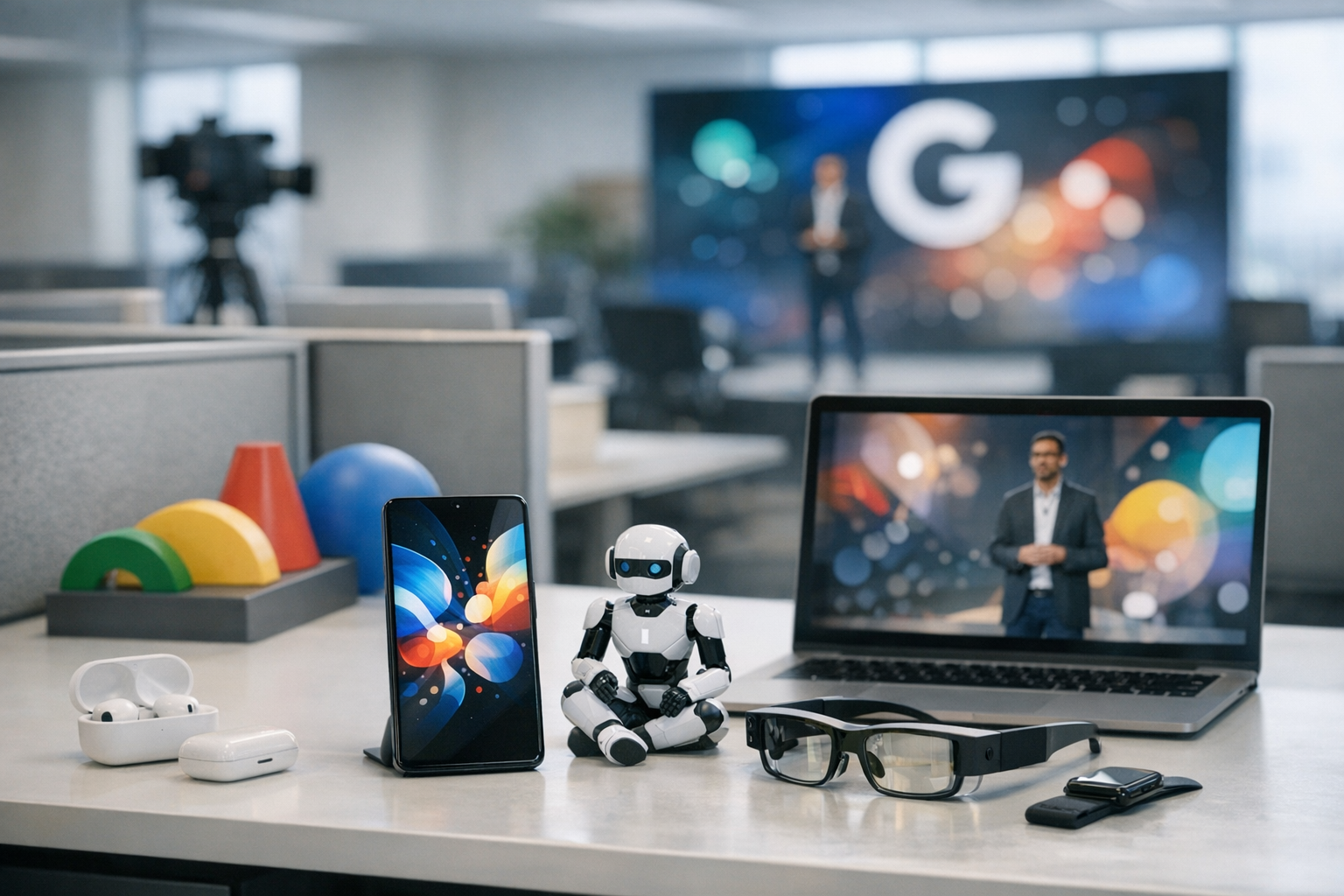
The AI models and Gemini improvements announced at the Google IO 2026 keynote hit the developer community like a goods train. Sundar Pichai took to the stage at Shoreline Amphitheatre May 20, 2026 and gave what I would honestly describe Google’s most ambitious keynotes in years. Every announcement was centred around one core theme: AI everywhere, for everyone.
Pichai outlined a strategy that ranges from next-gen Gemini models to sweeping corporate solutions, and that directly targets OpenAI and Anthropic. And the huge number of product launches indicates Google isn’t simply competing, it’s aiming to change the entire playing field. I’ve been to many of these events and this one was different. This is what you should know.
Gemini 2.5 Ultra: The Flagship Model Steals the Show
Enterprise AI Capabilities and Google Cloud Integration
Competitive Positioning: Google vs. OpenAI vs. Anthropic
Developer Tools, Android AI, and the Gemini Ecosystem
Strategic Direction: Pichai’s Vision for AI-First Google
Gemini 2.5 Ultra: The Flagship Model Steals the Show
The biggest reveal during the Google IO 2026 keynote presentations was definitely Gemini 2.5 Ultra. “It’s our most capable model we’ve ever built,” said Pichai. Big statement. But the live demos actually proved this, though.
What’s new in Gemini 2.5 Ultra:
- 2 million token context window – quadruple the previous generation
- Native multimodal thinking across text, images, video, audio and code
- Real-time agentic capabilities chaining activities without human intervention
- Mathematical and scientific reasoning greatly enhanced
- Built-in citation and source checking to reduce hallucinations
Notably, Pichai demoed Gemini 2.5 Ultra analyzing a complete 90-minute tape of an engineering discussion. In under eight seconds, the algorithm generated a structured summary, identified action items, and prepared follow-up emails. The crowd was going crazy. (I’m not going to lie, I rewatched that demo clip three times.)
To put the 2 million token context window in perspective: that’s almost 1,500 pages of thick technical documentation, or a year’s worth of Slack chats for a mid-sized engineering team, all at once. For legal teams, that means putting a complete contract history into one query. For academics this means consuming a full clinical trial dataset and the associated literature without chunking or summarizing hacks. What makes this context window upgrade actually meaningful rather than a spec-sheet talking point is that transition from “useful in demos” to “useful in production.”
Gemini 2.5 Flash also received a big improvement. It’s now three times faster than its predecessor with comparable precision – that’s not marketing fluff, that’s a significant engineering advance. Google chose Flash as the workhorse for high volume API calls. So consumer app developers will probably flock first to this lighter, cheaper approach. To put this in practice, a customer support platform that processes 50,000 tickets a day may feasibly migrate from a heavier model to Flash and save more than half the cost of inference with no perceptible dip in response quality – the kind of arithmetic that gets engineering managers happy.
Google announced Gemini 2.5 Nano, which is meant to operate solely on-device. This is of great importance for privacy-sensitive applications. The model will be baked into Pixel devices and Chrome OS starting this summer. It also doesn’t need an internet connection, so all the summarization and translation work is done entirely offline. That was surprising to me when I first saw the spec sheet – actually helpful, not just a checkbox feature. Imagine a healthcare worker at a remote clinic with intermittent internet using a Pixel tablet: Nano can transcribe and summarize patient notes locally, with no data ever leaving the device. Not hypothetical. That’s the exact example the Google product team used in the IO sessions.
One tradeoff to call out: Nano’s on-device performance comes with genuine limits. The model is much smaller than Flash or Ultra, so it performs well on simple tasks but fails on intricate multi-step reasoning. Nano is the appropriate tool for targeted, scoped operations, and not a general-purpose substitute for inference in the cloud,” said the developers.
For technical specs and API access details, check out the full Gemini model documentation.
Enterprise AI Capabilities and Google Cloud Integration
Enterprise clients got some major love during the AI models Gemini upgrades part of the talk. Pichai launched Gemini for Google Cloud, a single, unified enterprise AI platform that connects directly to BigQuery, Vertex AI and Google Workspace.
Corporate news:
- Gemini Code Assist 2.0 Delivers Full Repository – Level Understanding for 30+ Programming Languages
- Gemini for Security – a fine-tuned model trained on threat intelligence data from Google’s Threat Analysis Group
- Gemini Data Agent – an autonomous agent that writes, optimizes, and debugs SQL queries in BigQuery
- Workspace AI Companion – Gemini deeply integrated into Gmail, Docs, Sheets, and Meet with persistent memory across sessions
Most users will actually feel the change in their day-to-day with the Workspace AI Companion upgrade. Gemini in Workspace had previously seemed slapped on — like someone stapled an ai widget to the sidebar and called it good. It now remembers your preferences, your writing style and your past interactions. So suggestions really get better over time, rather than beginning from scratch each session. Imagine this: You open a Google Doc on a Monday morning and the AI Companion already knows you favor bullet-point executive summaries, your team utilizes British English, and the past three papers in this project finished with a risks-and-mitigations section. That’s the sort of continuity that elevates an AI feature from novelty into true productivity tool. Pichai also emphasized that all enterprise data remains within the customer’s cloud perimeter, which is critical for regulated industries.
Google also announced severe price adjustments. Gemini 2.5 Flash API calls are $0.15 per million input tokens, almost 60% less expensive than similar models from competitors. Enterprise clients that already have Google Cloud commitments can obtain even more volume reductions on top of that. The kicker ? That pricing is actually making it possible for smaller teams to explore at scale. For instance, a firm making 10 million API calls a month is suddenly facing $1,500 in inference expenses instead of the $5,000 or more it would spend with a comparable competitor strategy. That’s a big difference when you’re looking at burn rate.”
And compliance and governance got a look in too. Google announced AI Audit Logs, a new product that logs every Gemini interaction in an enterprise. This is a direct response to regulatory needs coming from frameworks such as the EU AI Act. Importantly, these logs interact with existing SIEM solutions security teams are already using – so it’s not just another dashboard no one looks at. This capability alone could be a reason for firms in financial services or healthcare, where proving AI decision traceability to auditors is becoming non-negotiable, to consider Google Cloud.
Competitive Positioning: Google vs. OpenAI vs. Anthropic
Pichai didn’t identify rivals. He didn’t have to.
The Google IO 2026 keynote announcements AI models Gemini upgrades were obviously built to meet specific competitive challenges. But if you read the subtext, you can very plainly see Google’s strategic thinking—and it’s smart.
This is how the big players are positioned following this keynote:
| Feature | Gemini 2.5 Ultra | GPT-5 (OpenAI) | Claude 4 (Anthropic) |
|---|---|---|---|
| Max context window | 2M tokens | 1M tokens | 500K tokens |
| Native multimodality | Text, image, video, audio, code | Text, image, audio, code | Text, image, code |
| On-device model | Gemini 2.5 Nano | Not available | Not available |
| Enterprise integration | Google Cloud native | Azure-dependent | AWS partnership |
| Agentic capabilities | Built-in, multi-step | Available via API | Available via API |
| Pricing (Flash/lite tier) | $0.15/M input tokens | $0.50/M input tokens | $0.25/M input tokens |
There are three distinct benefits of Google. The lead in context window is significant — 1M for GPT-5 vs. 2M isn’t a rounding mistake. Neither OpenAI nor Anthropic presently have any on-device AI powered by Gemini Nano. And Google’s vertical integration with Cloud, Search, Android and Workspace creates an ecosystem moat that’s really hard to recreate rapidly.
Competitors have significant strengths too – don’t sleep on them. In my own testing, I’ve observed it remain true, and Anthropic’s Claude models are generally considered better for nuanced, safety-aware interactions. Thanks to the company, OpenAI, it has years of customer loyalty and brand familiarity behind it. Similarly, OpenAI’s relationship with Microsoft affords it enterprise distribution benefits through Azure that Google can’t simply wish away. It’s also worth mentioning that many enterprise teams have already established internal infrastructure, fine-tuned models, and institutional knowledge around OpenAI’s API surface — switching costs are real, and don’t show up in any comparison table.
Google had some excellent demos but performance in the wild can be a different thing than what happens on stage. Fair warning: hold off on any migration choices till we get impartial benchmark. I’d recommend starting there, as the LMSYS Chatbot Arena often posts community-driven comparisons within weeks of new model releases.
Developer Tools, Android AI, and the Gemini Ecosystem
Google IO 2026 developer-centric Gemini updates were massive. I’ve sat in on countless IO developer sessions over the years, and this one genuinely delivered.
Project Astra 2.0 seized the developer limelight. This is Google’s global AI assistant architecture, and now it has persistent visual memory. This enables it to remember objects, positions and context from past camera encounters. For example, Astra 2.0 may help a technician fix complex gear by remembering what parts they’ve already worked on. That’s not a demo trick, that’s a very helpful workflow. Imagine a field engineer in a factory pointing his phone to a control panel: Astra 2.0 recognizes the particular unit from a prior visit, notes that the left relay was marked marginal last time, and brings up the appropriate maintenance procedure—all without the engineer typing a single word. That is the sort of ambient intelligence Pichai kept talking about during the lecture.
Android 17 AI capabilities, too, got a huge round of applause:
- Gemini Nano smart reply, photo editing and real time translation on-device
- Gemini can control third-party apps using AI-powered app actions using natural language
- Gemini detects scams in real-time using on-device analysis of phone conversations
- Circle to Search adds video content, not just static photos
Google unveiled Gemini for web developers in Chrome Developer Tools. It debugs JavaScript issues, offers performance suggestions and explains complicated code blocks inline. Plus it links into Lighthouse to bring up AI-powered accessibility recommendations — which, to be honest, is the kind of unglamorous tooling that really saves you hours.
If you’re working on AI-powered apps, then Firebase Genkit 2.0 is worth a look, as it has been completely overhauled. This open-source framework now natively supports multi-agent orchestration. Developers can design agent workflows via simple configuration files, instead than writing bespoke glue code. This makes it much easier for teams without strong machine learning skills to construct complicated AI applications and that’s a major thing for most product teams. To give a concrete example, imagine a small team building a document processing pipeline. They could use Genkit 2.0 to wire together an extraction agent, a validation agent, and a formatting agent in a single YAML-style config file, and then deploy the whole thing to Cloud Run without writing any orchestration logic from scratch. That’s hours of boilerplate cut out.
Google also revealed a one-click fine-tuning capability for Gemini models on your own datasets, as well as the expansion of its AI Studio platform. The interface is shockingly easy – upload data, set parameters and the platform does the rest. In addition, fine-tuned models are deployed directly to Vertex AI or via the normal Gemini API. I was suspicious about the “one-click fine-tuning” until I saw the demo. It’s not magic, but it is very accessible. One practical tip: bring clean, neatly labeled training data. The tooling is simple yet garbage in is still garbage out , that hasn’t changed .
Google AI Studio is accessible today, with additional features revealed at IO 2026 rolling out progressively over Q3.
Strategic Direction: Pichai’s Vision for AI-First Google
The Google IO 2026 keynote was about more than just new releases – it was about a real strategic shift. Pichai discussed what he calls “the ambient AI age.” His concept is simple: AI should be invisible, helpful and ubiquitous.
A large part of the keynote was about search change. Google’s AI Overviews are now showing up on more than 70% of search searches in the US. It’s no longer a trial program, it’s the product. Pichai presented a new Search experience with Gemini as a conversational research partner. Users can ask follow-up questions, ask for more in-depth analysis, and receive individualized results. This is Google’s clear response to ChatGPT’s encroachment on their search market share and it’s more believable than anything they’ve ever done before.
Pichai, as expected, discussed the elephant in the room—concerns of publishers. He announced a Publisher Revenue Sharing Program for AI Overviews. When Gemini serves content from a publisher, that publisher gets a part of the ad income from the page. Not much detail, and I’d save the partying till we have the real numbers. But it’s the first real move towards paying content creators in AI search, and that counts.
AI safety and responsibility garnered more airtime than any other IO. Google has announced an external advisory body, called the Responsible AI Council, comprising representatives from academia, civic society and government. The corporation also announced updated AI Principles that specifically tackle agentic AI threats. This is not just a blog article but importantly it is linked to real product governance. There’s also a clear function for the council to examine the launch of high-risk agentic features, which is a structural commitment, not a PR gesture. At least that mechanism is there. Whether that will hold up under competitive pressure to ship fast is a genuine question.
I recalled Pichai’s words of farewell. “We are not building AI to replace human intelligence,” he stated. “We’re building it to augment human potential.” That’s corporate-speak, but the product announcements back up the assertion. Most new features are added to, not replacements for, human workflows. That’s a crucial distinction, and one to observe over the next few product cycles.
This has huge strategic ramifications for companies. Google is wagering that tightly integrating the ecosystem beats finding the best vendor for each job. Importantly, enterprises who are already committed in Google Cloud do have less obstacles to deploying Gemini across their operations – and that’s a significant competitive advantage.
What This Means for Developers and Businesses
So what do you actually do with all these AI models Gemini upgrades from the Google IO 2026 keynote announcements? These are solid, actionable takeaways – no fluff.
For developers:
- Go ahead and give Gemini 2.5 Flash a spin. It is a good contender for production applications today based on price to performance.
- Use Firebase Genkit 2.0 for multi-agent workflows instead of building your own orchestration layer
- Use on-device Gemini Nano while developing Android apps with sensitive user data
- Move to the new Gemini API – Google is sunsetting previous model versions by Q4 2026, so don’t procrastinate on this one
- Join the Google Developer Program and get early access to things still in preview
For enterprise decision makers:
- Audit your existing AI vendor stack – Google’s pricing changes could dramatically affect your cost analysis, especially at scale
- For existing Chronicle or Mandiant customers on Google Cloud, pilot Gemini for Security
- Review AI governance requirements – the new Audit Logs capability may fulfill compliance needs you’re presently patching using third-party technologies
- Don’t bet the farm on one vendor – even with Google’s impressive announcements, a multi-model strategy is still sensible, and I’d argue vital
- Budget for AI training – To make these capabilities work, your workers will need actual upskilling, and that’s not optional
On that last point: The organizations I’ve seen derive the most benefit from new AI tooling aren’t the ones with the biggest funds — they’re the ones who did organized pilots, documented what worked, and established internal champions before pushing anything out globally. If you can do a two week proof of concept on a genuine business problem, take that over a six month committee evaluation any day.
The competition is changing quickly. In the same vein, the gap between AI frontrunners and laggards in industries is expanding at a pace that most CEOs don’t appreciate. others organizations that experiment now will have a huge leg up on others that wait for the “right moment” – which, heads up, never comes.
Conclusion
Gemini upgrades, the Google IO 2026 keynote announcements AI models, are a crucial milestone for Google’s AI strategy. I do not say that lightly after covering a decade of these events. Pichai’s presentation was full of substance — not just vision slides and lofty verbiage. With Gemini 2.5 Ultra, aggressive enterprise pricing, and strong ecosystem integration, Google is a truly serious competitor in the AI competition.
But announcements are only announcements. Real impact relies on execution, stability and developer uptake, all of which require time to prove out. So it’s wise to start evaluating these new models and tools today, rather than waiting for the dust to settle. Get API access via Google AI Studio, run your own benchmarks and compare results with your existing solutions using your real workloads.
The AI models that Gemini updates from this speech will drive enterprise AI adoption for the next 12 to 18 months. Know what you’re doing, experiment and, above all, don’t commit to a single vendor until you’ve proven performance against your use cases. The field is too fast to put everything on one demo.
FAQ
What were the biggest announcements at Google IO 2026?
The headline Google IO 2026 keynote announcements included Gemini 2.5 Ultra with a 2 million token context window, Gemini 2.5 Flash with dramatically lower pricing, and Gemini 2.5 Nano for on-device AI. Additionally, Google announced major enterprise integrations, Android 17 AI features, and Project Astra 2.0. The Publisher Revenue Sharing Program for AI Overviews also made significant waves in the publishing and SEO community.
When will Gemini 2.5 Ultra be available to developers?
Google announced that Gemini 2.5 Ultra enters public preview in June 2026. Developers can request early access through Google AI Studio. Gemini 2.5 Flash is available immediately through the standard API. Meanwhile, Gemini 2.5 Nano ships with Pixel devices and Chrome OS updates this summer.
How does Gemini 2.5 compare to GPT-5 and Claude 4?
Based on the Google IO 2026 keynote announcements AI models Gemini updates, Gemini 2.5 Ultra leads in context window size (2M tokens) and native multimodality. It also offers the most aggressive pricing through Gemini Flash. Nevertheless, independent benchmarks haven’t been published yet. Developers should wait for community evaluations on platforms like LMSYS Chatbot Arena before drawing firm conclusions — stage demos and real-world performance don’t always match.
Keep reading
Here are the latest posts from the blog.

Wiz cloud security compliance automation Anthropic API 2026 is one of those convergences that actually deserves the hype. Two serious players, one genuinely painful problem —…

IBM quantum computing AI model training enterprise applications 2026 might be the most consequential shift in enterprise AI since the GPU cluster became standard infrastructu…

OpenClaw for sales using local first AI agents represents a fundamental shift in how sales teams deploy artificial intelligence. Instead of routing every interaction through…