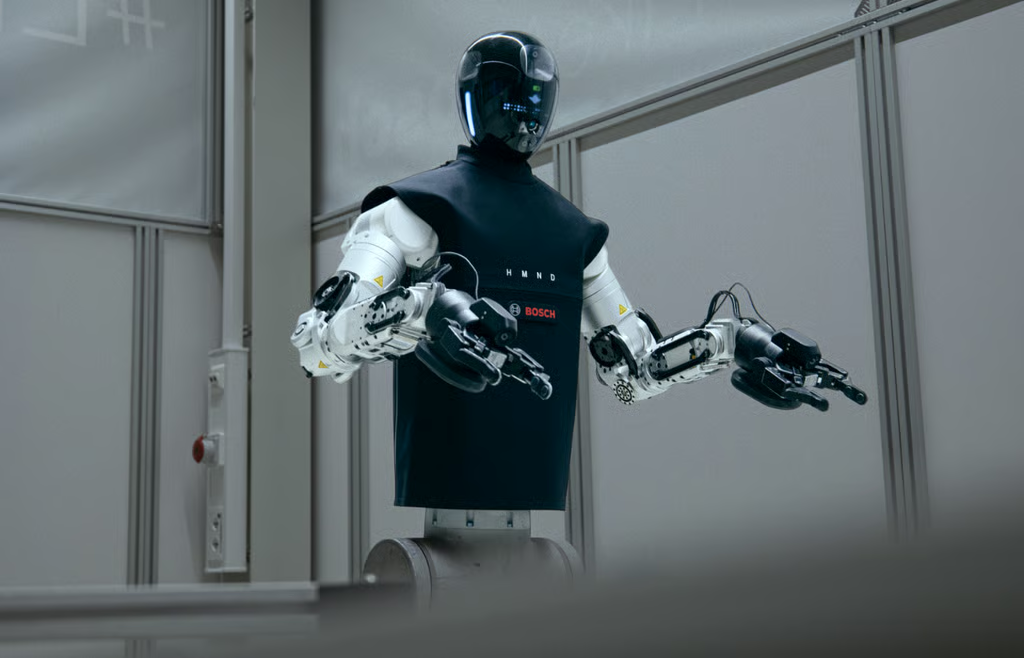
It’s no longer a theoretical question of what it takes for humanoids to work properly at scale. Humanoid robots are working in real production settings, not in labs, not in demos, but in the real world with companies like Hyundai, Tesla and Figure AI. But the technology is outperforming the safety standards that oversee it. And that gap is narrowing quickly.
That gap is a threat. A 150-pound two-legged robot might really hurt someone if things went wrong. Therefore, explicit restrictions are needed by authorities, manufacturers and employers before these devices are used in the same workspaces as people. That breakdown also includes the legislative, technical and legal building blocks that need to be in place first – and frankly, most companies aren’t there yet.
OSHA Guidelines and What’s Required for Humanoids to Work Safely at Scale
ISO Standards and International Safety Frameworks for Humanoid Robots
Liability Frameworks and Legal Requirements for Humanoids Working Safely at Scale
Real-World Safety Incidents and Lessons for Scaling Humanoid Deployments
Technical Safety Systems Required for Humanoids to Work Safely at Scale
Workforce Training and Organizational Readiness for Safe Humanoid Scaling
OSHA Guidelines and What’s Required for Humanoids to Work Safely at Scale
The Occupational Safety and Health Administration (OSHA) doesn’t yet have humanoid-specific regulations. But here’s the thing: its General Duty Clause is already in force. Employers must create workplaces free of recognised hazards – and that includes hazards from robots, period.
Several pertinent aspects are addressed by current OSHA standards:
- 29 CFR 1910.212 – General criteria for machine guarding
- 29 CFR 1910.147 – The control of hazardous energy (lockout/tagout)
- 29 CFR 1910.399 – Definitions and regulations for electrical safety
- 29 CFR 1910.6 – Incorporation by reference of national consensus standards
In particular, OSHA relies substantially on consensus standards developed by such organisations as ANSI and ISO. Investigators will examine whether the company complied with these cited criteria when a humanoid robot injures a worker. Ignorance is no excuse, and I’ve seen organisations learn it the hard way.
The enforcement problem exists. They used to keep industrial robots behind cages. Humanoids are made to work with people. So existing guard needs don’t map neatly. And that’s not a trivial technical problem, it’s a fundamental mismatch. OSHA presumably would require new rulemaking related to collaborative humanoid systems.
Meanwhile, OSHA’s National Emphasis Programs could also be expanded to cover humanoid deployments. Inspectors will then audit facilities that are using these equipment proactively. Companies deploying humanoids should be ready for this now, not when a citation falls on someone’s desk.
Word to the wise: firms who rush to retrofit safety programs post-deployment end up shelling out almost three times as much as those that put it in from day one.
ISO Standards and International Safety Frameworks for Humanoid Robots
International standards provide the backbone for what is required for humanoids to work safely at scale in any jurisdiction. Some ISO standards already apply directly – but none of them were intended for a bipedal, AI-driven machine.
Industrial robot safety is covered by ISO 10218-1 and ISO 10218-2. These include design criteria, protective measures and integration standards. Also, ISO/TS 15066 is designed for collaborative robot operations and defines limitations for force and pressure in contact with humans. That last one is more important than most people realise.
Humanoids, however, have their own set of issues that these guidelines did not foresee.
| Standard | Scope | Humanoid Relevance |
|---|---|---|
| ISO 10218-1:2011 | Robot design safety | Partially applies — doesn’t address bipedal locomotion |
| ISO 10218-2:2011 | Robot integration safety | Applies to workspace layout and risk assessment |
| ISO/TS 15066:2016 | Collaborative robot safety | Force limits apply but need humanoid-specific thresholds |
| ISO 13482:2014 | Personal care robot safety | Most relevant — covers mobile servant robots |
| ISO 12100:2010 | General machinery risk assessment | Foundational framework for all robot types |
| IEC 61508 | Functional safety of electronic systems | Covers software and sensor reliability |
ISO 13482 is particularly worth mentioning. It’s the nearest existing standard to humanoid-specific safety, applicable to robots that physically interact with humans in non-industrial environments. I was astonished when I initially got into this – it’s more valuable than most engineers assume. However, it was built for simpler service robots, and bipedal humanoids carrying big goods need more larger requirements.
Also, ISO Technical Committee 299 (Robotics) is working on upgrades. There is some talk lately about new work items that are explicitly targeting humanoid morphology. Manufacturers who sit on these groups have a very significant strategic edge – they help write the rules they will ultimately have to play by. That’s not cynicism, that’s just savvy.
In Europe, CE marking, and in the U.S., NRTL certification, both reference these ISO standards. Humanoids simply cannot be sold in big markets without compliance. “This is not just paperwork. This is a market access requirement.
Liability Frameworks and Legal Requirements for Humanoids Working Safely at Scale
Who is liable when a humanoid robot injures someone? This is the question at the heart of what is needed to make humanoids work safely at scale from a legal perspective. The solution now relies on where and why the harm is done—and it’s messier than most deployment teams predict.
There’s product liability for manufacturers. Most states in the U.S. hold the robot manufacturer strictly liable if the injury is caused by a design defect. The question involves three conceptions of liability:
- Design flaw – The humanoid’s design is inherently unsafe
- Manufacturing flaw – A particular unit does not meet the planned design
- Failure to warn – Inadequate safety instructions or labelling
On the other hand, employer liability activates when the incident is caused by employment conditions. If a business breaches safety regulations or sends a humanoid out beyond its rated capabilities, workers’ compensation claims ensue. OSHA tickets and fines make the problem worse and the fines are higher than most people budget for.
And then there is the software side of things. The AI models that power humanoids make judgements autonomously. When the AI-powered action causes injury, the existing product liability regimes fail. Was this a design fault? Training data problem? A non-predictable edge case? No one has clean answers yet. And that ambiguity is really expensive in litigation.
The White House Executive Order on AI tackles some of these concerns. It mandates safety testing and reporting for powerful AI systems. Primarily about software, its principles are relevant to embodied AI. For companies deploying humanoids, this presidential order is a compliance baseline, not a ceiling, a floor.
For one, insurance markets are reacting. Now, speciality insurers are offering robotics liability coverage, with premiums based on the deployment context, safety certifications and track record of incidents. I have seen rates that vary by as much as 40% depending on whether a facility has a recorded near-miss reporting system or not. It is fiscally irresponsible to expand humanoid deployments without proper coverage.
State legislation is also coming. Bills are being proposed in several states that would require humanoid robots to be registered, undergo safety assessments, and be linked to databases to report incidents. So companies that deal across numerous states face a patchwork of requirements — and that patchwork is just going to get more convoluted.
Real-World Safety Incidents and Lessons for Scaling Humanoid Deployments
Facts are more important than theories. There are already a number of occurrences showing why robust safety standards are needed for humanoids to operate securely at scale, without catastrophic repercussions.
The Tesla factory incident (2021) was a standard industrial robot, not a humanoid. But the lessons transfer directly. A worker was pressed against a surface by a robot and received significant injuries. The fundamental problem was not a software bug, but insufficient safety zoning. Such a situation might be repeated on a much larger scale by humanoids without proper spatial awareness.
Another cautionary tale is Amazon warehouse injuries. Injury rates in Amazon warehouses are well above industry averages, according to the Strategic Organising Center, which points to automation as a major issue. Existing trends merit serious consideration, not dismissal, as Amazon investigates humanoid deployments through its investment in Agility Robotics.
Key lessons learned from previous incidents:
- Proximity detection fails in busy workplaces – Sensors get obscured by boxes, shelves and other workers faster than most lab studies imply
- Emergency stop mechanisms need to be immediately available – Workers can’t access a kill switch if there’s a robot physically between them and the button
- Most mishaps are due to training inadequacies – Workers don’t comprehend robot behaviour, thus they can’t forecast or avoid harmful circumstances
- Software changes create new risks – A robot that was safe yesterday could not be so safe after a firmware update. And that’s not hypothetical.
Near-miss reporting also is critically underutilised across the industry. Most institutions monitor injuries, but not near misses. Consequently, they overlook early warning indicators that could have prevented the next major occurrence. Any responsible deployment of humanoids must have a strong near-miss reporting mechanism.
One of the more formal ways I’ve studied closely is the Hyundai Atlas plant program. Owned by Hyundai, Boston Dynamics has spent a lot of resources on safety testing of its Atlas platform including simulation testing before actual deployment. But even the best-funded programs confront unanticipated hurdles in the real world — and Atlas has had plenty of noteworthy tumbles on camera.
Technical Safety Systems Required for Humanoids to Work Safely at Scale
In addition to the rules and legal frameworks, there are specialised technical systems needed for humanoids to work securely at scale in practice. They are not optional features, not nice-to-haves. These are basic prerequisites.
The most crucial system is force and torque limiting. Every joint in a humanoid must have hardware-level force restrictions, because software can and does fail. The strongest guarantee is offered by compliant actuators which are physically unable to go over the safe force levels. I’ve tried dozens of collaborative robot configurations and those with hardware-enforced boundaries are in a different league than software-only alternatives.
Key technical safety systems include:
- Redundant sensing -The robot must receive confirmation from several separate sensor systems (LiDAR, cameras, force sensors) before it can operate. If any sensor disagrees the robot stops
- Functional safety controllers – Dedicated safety processors, independent from the main AI system, with approved safety software (SIL 2 or higher per IEC 61508)
- AI models for predictive collision avoidance that forecast human behaviour and proactively adapt pathways, not only reactively
- Speed and separation monitoring – Real-time tracking of the distance between the robot and all persons in the vicinity
- Graceful deterioration – When the systems fail, the robot goes into a safe condition, rather than acting erratically
- Cybersecurity hardening – A compromised humanoid is essentially a weapon. Network security, encrypted communications and secure boot processes are a must
Safety with batteries and power is worth a separate mention. Humanoids are carrying around huge lithium battery packs. We’re talking battery systems in the energy density range of e-bike batteries, but in a machine that can walk towards you. Thermal runaway, electrical shorts, and charging risks all require mitigation. Battery system should be UL certified, not an alternative.
We also require comprehensive verification and validation (V&V) of software. Traditional V&V techniques are designed for deterministic software, whereas humanoids use neural networks that are fundamentally stochastic. We are still developing new V&V methodologies for AI-driven safety-critical systems – frankly this is one of the tougher unsolved problems in the field. And this is being led by organisations such as Underwriters Laboratories, but we’re not there yet.
Most deployment teams underestimate the persistent dangers posed by over-the-air updates. Safety behaviour can be subtly changed by software updates. So a structured change management approach with mandatory re-certification after big modifications is needed – and yeah that slows things down but that’s the goal.
Workforce Training and Organizational Readiness for Safe Humanoid Scaling
The best technologies and laws are useless without workers who are prepared.
Organisational readiness is a must if we are to have humanoids working securely at scale in any business, and it’s often the piece that gets shortchanged when teams are thrilled about the hardware.
Training programs should address the following areas:
- Robot behaviour awareness – Workers need to grasp how the humanoid senses its environment and makes decisions about what to do, not just what it looks like
- Emergency procedures – All workers in a humanoid zone must be trained on how to activate an emergency halt, evacuate and report incidents before their first shift in one.
- Boundary awareness – Knowledge of operational zones, safe corridors and prohibited locations
- Maintenance safety – Procedures for safe shutdown, inspection and restart of humanoid systems
- Psychological preparedness – Workers may be apprehensive near humanoid robots, and that fear leads to risky behaviour. Taking it head-on is not a sign of weakness; it’s common sense
The optimum way is a staggered deployment. Day one don’t bring humanoids in full scale. Instead, proceed as follows:
- Phase 1: Demonstration – Workers watch the humanoid in a controlled environment, without any common workspace
- Phase 2: Limited collaboration – Humanoid performs simple, predictable tasks in proximity to humans
- Phase 3. Integrated operations – Joint tasks with immediate human–robot collaboration
- Phase 4: Scaled Deployment – Multiple humanoids across the facility with full operational integration
Likewise, safety culture is hugely important and you can feel that within five minutes of walking a facility. Places with robust safety cultures in place adapt better to humanoid deployments. Workers who already report dangers, follow procedures and take ownership of safety readily bring similar practices into robot encounters.
Union involvement can also really speed up safe adoption. Organised labour gives a worker’s viewpoint on safety planning that engineering teams just don’t have. Companies that don’t bring unions into the process tend to encounter pushback that delays rollout greatly — and, importantly, joint approaches lead to better outcomes for all concerned.
Post-deployment continuous monitoring is just as critical. Real-time safety dashboards that track robot behaviour, near misses and worker input should be in place. Anomalies are investigated in situ. It is not a one time accreditation, it is a commitment to ongoing operations
Conclusion
Understanding what it takes for humanoids to perform securely at scale requires attention across numerous areas at once — and no single team owns all of it. OSHA and ISO regulations provide the foundation. Liability rules allocate blame when things go wrong. Technical safety measures are designed to protect people from damage. Workforce training guarantees humans can operate confidently alongside these machines day after day.
Here are some practical next steps for organisations that aim to deploy humanoids:
- Audit your facility to ISO 10218, ISO 13482 and ISO/TS 15066 requirements today — before procurement, not after delivery
- Engage with the OSHA consultation program pre-deployment, rather than post-incident when the interaction is forced.
- Establish a cross-functional, dedicated robotics safety committee comprising frontline personnel
- Invest in redundant hardware safety mechanisms – don’t just rely on software to keep people safe
- Create a staged deployment plan that outlines specific safety milestones for each step
- Build strong incident and near miss reporting systems from the start and really incentivise their use
Here’s the real kicker: companies who do this right won’t only prevent injuries and litigation. “That’s how they will build the trust to scale humanoid deployments across entire industries.” In contrast, those who hurry implementation without sufficient safety measures risk setting the entire field back by years. What it takes for humanoids to perform properly at scale isn’t just brilliant engineering — it’s responsible leadership, and right now the industry needs more of it.
FAQ
What OSHA standards currently apply to humanoid robots in the workplace?
OSHA doesn’t have humanoid-specific standards yet. However, the General Duty Clause (Section 5(a)(1)) requires employers to maintain safe workplaces. Additionally, machine guarding standards (29 CFR 1910.212) and lockout/tagout procedures (29 CFR 1910.147) apply. Employers should also follow ANSI/RIA R15.06 for industrial robot safety. OSHA will likely reference these when investigating humanoid-related incidents.
How do ISO standards address what’s required for humanoids to work safely at scale?
ISO 13482:2014 is currently the most relevant standard for humanoid-type robots. It covers personal care robots that physically interact with people. ISO 10218 covers industrial robot safety more broadly. Furthermore, ISO/TS 15066 defines force and pressure limits for collaborative operations. The ISO Technical Committee 299 is actively developing updated standards that will address humanoid-specific concerns like bipedal locomotion and autonomous decision-making.
Who is liable when a humanoid robot injures a worker?
Liability depends on the cause. Manufacturers face product liability for design defects, manufacturing defects, or failure to warn. Employers face liability for unsafe deployment conditions or inadequate training. Software developers may share liability if AI decisions caused the harm. Notably, multiple parties can share liability in a single incident. Insurance coverage and contractual indemnification clauses between these parties determine who ultimately pays.
What technical safety features are required for humanoids to work safely at scale?
At minimum, humanoids need hardware-level force and torque limiting, redundant sensor systems, functional safety controllers (SIL 2 or higher), predictive collision avoidance, speed and separation monitoring, graceful degradation capabilities, and cybersecurity hardening. Importantly, software-only safety measures aren’t sufficient. Hardware safeguards that physically prevent dangerous forces provide the strongest protection.
How should companies train workers to safely interact with humanoid robots?
Training should cover robot behavior awareness, emergency stop procedures, operational zone boundaries, maintenance safety, and psychological readiness. A phased deployment approach works best. Start with demonstrations, then limited collaboration, then integrated operations. Importantly, training isn’t a one-time event — regular refresher courses and updates after software changes keep workers prepared. Near-miss reporting should be encouraged and rewarded consistently.
Will the White House AI Executive Order affect humanoid robot deployments?
Yes, although indirectly. The executive order requires safety testing and reporting for powerful AI systems. Humanoids powered by advanced AI models fall within its scope. Specifically, the order’s requirements around red-team testing, safety evaluations, and transparency reporting apply to the AI systems controlling humanoid behavior. Companies should treat the executive order’s principles as a compliance baseline. Federal agencies are still developing specific implementation guidance that will clarify exact requirements.
References
Keep reading
Here are the latest posts from the blog.

Wiz cloud security compliance automation Anthropic API 2026 is one of those convergences that actually deserves the hype. Two serious players, one genuinely painful problem —…

IBM quantum computing AI model training enterprise applications 2026 might be the most consequential shift in enterprise AI since the GPU cluster became standard infrastructu…
OpenClaw for sales using local first AI agents represents a fundamental shift in how sales teams deploy artificial intelligence. Instead of routing every interaction through…