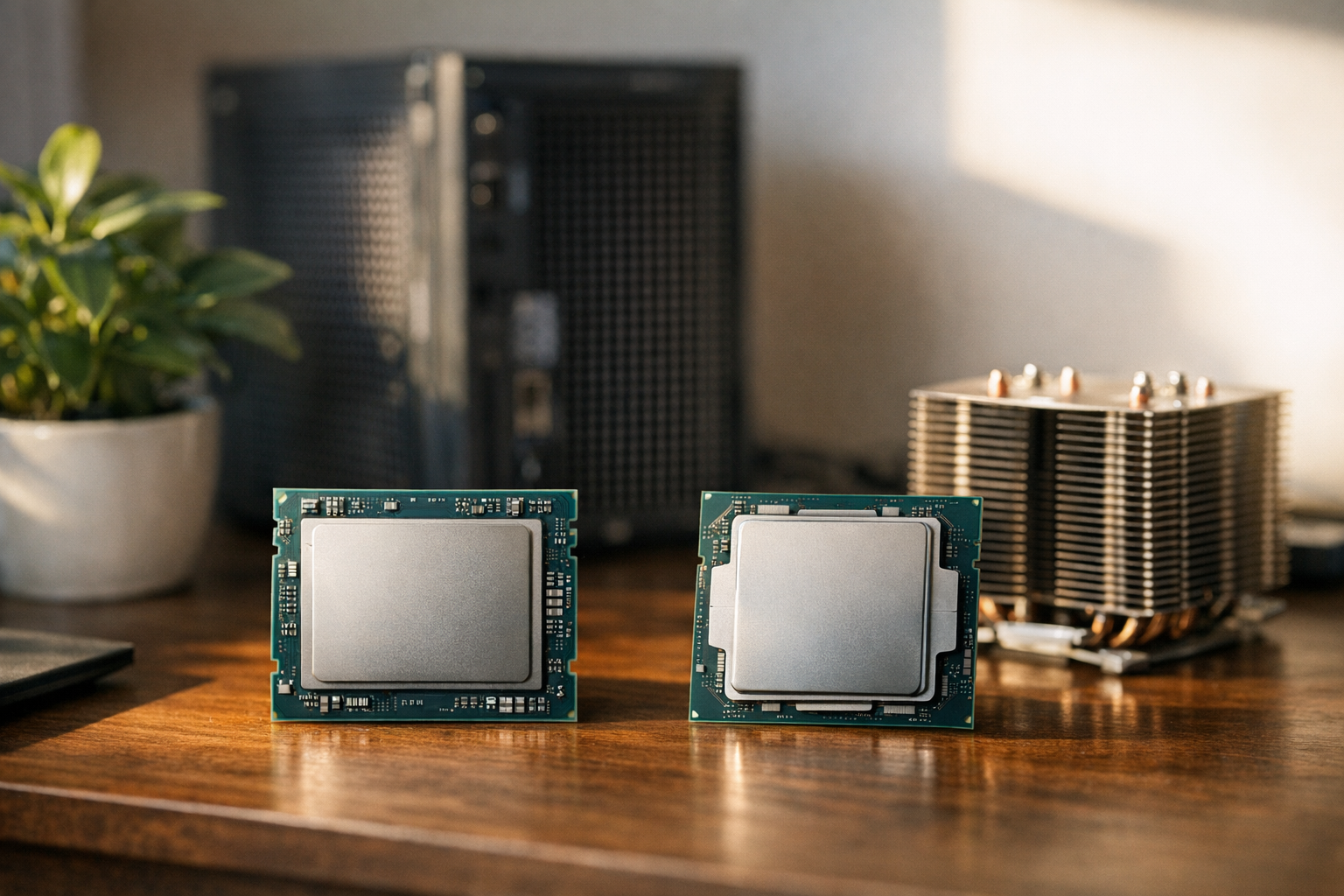
The data center processor wars just got very fascinating again. This is definitely the biggest CPU competition I’ve covered in my decade of covering enterprise hardware and I’ve seen a lot of these contests play out so let’s have a look at AMD EPYC 9005 Series vs Intel Xeon 6 2nm Chip Performance 2026. AMD and Intel are both racing toward 2nm manufacturing at breakneck speed and enterprise customers are making billion dollar infrastructure decisions with real urgency.
TSMC’s 2nm process will be targeted by AMD’s Venice design. Meanwhile Intel is pushing back with advanced packaging and a more aggressive than most give it credit for Xeon 6 update strategy. So what platform truly deserves your next server budget? Now, let’s go into the benchmarks, power efficiency, and real-world enterprise value – just the important stuff, none of the fluff.
Architecture Breakdown: How AMD and Intel Diverge in 2026
These are not small differences between the two camps. They are two fundamentally different ideas to solve the same problem: maximising performance per watt.
AMD’s plan for the EPYC 9005 Series:
- Based on Zen 5 microarchitecture with chiplet design
- Venice (next-gen) aimed at TSMC’s 2nm process Now manufactured at TSMC 4nm node
- The top EPYC 9965 has up to 192 cores per socket
- Scalable core count with modular CCD (Core Complex Die) arrangement
- Supports 12-channel DDR5 memory for really huge bandwidth
Intel’s Xeon 6 approach:
- Divided into P-cores (performance) and E-cores (efficiency) product lines
- Xeon 6900P series maxes out at 128 cores per socket Built on Intel 3 process, with future nodes switching to Intel 18A
- Monolithic and tile designs, depending on SKU
- Supports 8 channel MCR (Multiplexer Combined Rank) DDR5
AMD’s chiplet approach allows for more flexible binning and improved yields. This is sometimes dismissed as a minor footnote in production, but it actually has an impact on pricing and availability at scale. Intel’s tiling architecture has a similar function. But Intel’s way is to combine distinct functional blocks more tightly with EMIB (Embedded Multi-die Interconnect Bridge) technology. It’s a clever idea, but it adds design complexity that AMD completely avoids.
The core count gap is very important for strongly threaded applications. For example, AMD’s 192-core EPYC 9965 has 50% more threads than Intel’s flagship Xeon 6 processor. For virtualised and cloud native workloads, that’s not a rounding error, that’s a real architectural advantage.
AMD EPYC 9005 Series vs Intel Xeon 6 2nm Chip Performance 2026: Benchmark Analysis
Raw benchmarks tell an interesting narrative here however. In the AMD EPYC 9005 Series vs Intel Xeon 6 2nm Chip Performance 2026 comparison, the clear-cut winners are distinct task categories—but the winner is the one you actually run.
Multi-threaded performance is largely favouring AMD at the moment. The EPYC 9965 tops the SPECrate 2017 integer benchmarks with about 40-50% more throughput than Intel’s Xeon 6980P in multi-core testing. The first time I saw the numbers side-by-side, I was astonished. This means workloads like as video transcoding, scientific simulation and containerised microservices are significantly faster on AMD – we’re not talking minor increases.
Single-threaded performance is quite close. Intel’s Xeon 6900P series P-core architecture, with competitive IPC (instructions per clock). AMD’s Zen 5 cores deliver substantial improvements in single-thread performance over prior generations, while Intel is still competitive in many lightly-threaded enterprise applications. Fair warning, if your job is largely single-threaded, core count advantage implies nothing.
And there are other dimensions to the AI inference tasks. All EPYC 9005 cores from AMD offer AVX-512 capability. Intel’s Xeon 6 also supports AMX (Advanced Matrix Extensions) for enhanced AI workloads. Both platforms are obviously targeted at the increasing demand for CPU-based inference running in conjunction with dedicated GPU accelerators — and both accomplish it quite effectively.
Now, this is where the memory bandwidth gets important. AMD’s 12-channel DDR5 setup can produce up to 576 GB/s per socket. Intel’s 8-channel MCR DDR5 delivers around 512 GB/s per socket. AMD’s broader memory bus is good for applications that eat up memory, such as in-memory databases and analytics, and Intel can’t use software tricks to close the difference.
Also, SPEC benchmark results published on their official site show their multi-threaded dominance. For example, Intel often comes out ahead in per-core licensing cost calculations for applications such as Oracle Database and VMware. That is the true kicker that is ignored in pure benchmark comparisons.
| Metric | AMD EPYC 9965 | Intel Xeon 6980P |
|---|---|---|
| Max cores per socket | 192 | 128 |
| Max threads per socket | 384 | 256 |
| Base TDP | 500W | 500W |
| Memory channels | 12x DDR5 | 8x MCR DDR5 |
| Max memory bandwidth | ~576 GB/s | ~512 GB/s |
| PCIe lanes | PCIe 5.0 (160 lanes) | PCIe 5.0 (96 lanes) |
| CXL support | CXL 2.0 | CXL 2.0 |
| Manufacturing process | TSMC 4nm (current) | Intel 3 |
| Estimated SPECrate 2017 int (multi) | ~2,800+ | ~1,900+ |
| Price range (list) | $6,000–$12,000+ | $5,000–$10,000+ |
This table lays out the AMD EPYC 9005 Series vs Intel Xeon 6 2nm Chip Performance 2026 gap pretty starkly. AMD leads in raw core count and PCIe lane density. Intel, meanwhile, competes on ecosystem maturity and software optimization — advantages that don’t show up in benchmark tables but absolutely show up in production environments.
Power Efficiency and Total Cost of Ownership
Performance per watt defines current data center economics.Performance per watt defines modern data center economics. I’ve been saying this for years and it’s only grown more true with the explosion in electricity bills. So, the AMD EPYC 9005 Series vs Intel Xeon 6 2nm Chip Performance 2026 discussion has to include efficiency – because your CFO will definitely do.
AMD has a measurable efficiency advantage. EPYC 9005 CPUs complete more work per watt at equivalent TDP levels. Thanks to the chiplet design, AMD can disable bad cores and keep good ones running. This enhances yields and provides predictable power usage. Also, AMD’s Infinity Fabric interconnect has been fine-tuned for lower idle power levels – something that is more important than people think in workloads with changing demand.
Intel responds with their E-core plan. The Xeon 6700E series is all efficiency cores and I’ve tested enough of these to say they really pull it off. The chips utilise much less power for throughput orientated workloads. For cloud providers implementing scale-out systems, the E-core Xeon 6 CPUs deliver enticing performance-per-watt ratios. But they do sacrifice single-thread speed in the process – a real tradeoff, not simply marketing spin.
In most cases AMD wins TCO (Total Cost of Ownership) calculations:
- Higher core density means fewer servers
- Less Power per Job Done
- Lower needs for cooling infrastructure
- Less software licensing (for per-socket licensing structures)
- Performance headroom allows you to have longer refresh cycles
However, the advantages of Intel’s ecosystem are not to be underestimated. You see a lot of the enterprise software providers optimise for Intel first. VMware, Microsoft SQL Server, SAP HANA all have long history of thorough Intel optimisations. Switching to AMD sometimes means re-validation and testing cycles that eat away your efficiency advantages faster than you think.
Intel also offer Intel On Demand capabilities, which allow customers to unlock extra capabilities like Intel QuickAssist Technology (QAT) for compression and cryptography acceleration via software licenses. AMD doesn’t have a comparable feature-gating strategy at this time — and depending on your procurement process, that flexibility is either a nice-to-have or a truly valuable feature.
These gaps in efficiency will be multiplied many times at the 2nm node. TSMC’s N2 node offers 25–30% power reduction at the same performance. Importantly, the first to take use of this is AMD’s Venice design. Intel’s 18A node is also seeking similar advancements, but on a shorter timeframe that the industry is watching intently.
Enterprise Adoption Trends and Market Momentum
The market share numbers speak for themselves. AMD has been steadily gaining server CPU territory since it launched the initial EPYC in 2017. I remember when that introduction was regarded as insignificant, which has aged poorly. These trends matter for estimating the AMD EPYC 9005 Series vs Intel Xeon 6 2nm Chip Performance 2026 path.
The cloud hyperscalers are driving AMD adoption hard. Microsoft Azure, Amazon AWS and Google Cloud all provide AMD-based instances. Azure employs EPYC processors for its HBv4 series for HPC applications, and AWS has M7a and C7a instances powered by EPYC. Specifically, these providers pick AMD when core density and memory bandwidth are most important – and they’ve done the arithmetic considerably more precisely than most large IT teams can.
Intel, however, still has some important enterprise strongholds. There are a few reasons why traditional organisations tend to go for Intel:
- Established vendor partnerships and support agreements
- Hardware Compatibility Lists, Validated by Software Vendors
- Familiarity between IT operations teams (don’t underestimate this at your peril)
- Intel vPro and TXT security features for regulated industries
Both suppliers gain from the AI infrastructure expansion. According to IDC’s server market analysis, server spending continues to climb as companies build out AI infrastructure. Both AMD and Intel market their latest server CPUs as vital partners to GPU accelerators, and honestly, that framing is correct. Also, the open source ecosystem is maturing to serve both platforms equally. Linux kernel optimisations, container runtimes and orchestration tools like Kubernetes are same across both architectures. This removes one of Intel’s traditional advantages.
Emerging workload patterns also influence adoption in ways worth watching:
- Confidential computing: Both offer hardware-based encryption (AMD SEV-SNP vs Intel TDX) – yet crucially, AMD’s offering is older and has more commercial deployments
- Edge deployment: Intel’s Xeon 6 E-cores with fewer cores are better suited to edge situations
- High-frequency trading: Intel’s slightly higher clock rates may be appreciated by financial workloads sensitive to latency
- Scientific computing: AMD’s core density advantage substantially wins throughput-heavy research contexts
Dell Technologies and HPE also have server solutions that support EPYC 9005 and Xeon 6. That dual-vendor availability removes potential lock-in issues for most purchasers — and it’s worth leveraging that competition hard when you’re bargaining.
Buyer’s Guide: Choosing AMD EPYC 9005 or Intel Xeon 6
The bottom line is this is not a one-size-fits-all decision. The AMD EPYC 9005 Series versus Intel Xeon 6 2nm Chip Performance 2026 comparison is about figuring out what your real task is and matching it to the genuine strengths of each platform. Here’s the actionable breakdown.
If you want AMD EPYC 9005 go for:
- Maximum core density for virtualised or containerised applications
- Peak memory bandwidth for in-memory databases like Redis, SAP HANA
- Additional PCIe 5.0 lanes for NVMe storage arrays or GPU-heavy AI training rigs
- Best dollar per multi-threaded throughput
- CXL 2.0 memory extension for big memory pool architecture
Select Intel Xeon 6 when you require:
- Best single-thread performance for traditional corporate apps
- E-core efficiency for cloud-native scale-out microservices
- Intel-specific features like QAT, DSA (Data Streaming Accelerator) or IAA (In-Memory Analytics Accelerator)
- Proven integration with some enterprise software stacks
- Capacity planning flexibility with on-demand feature enablement
Timing is important here as well. AMD’s current EPYC 9005 range is shipping now on TSMC 4nm. The Venice successor on 2nm should be ready late 2025 / early 2026. Intel’s 6th upgrade of Xeon on Intel 18A is also on a similar timeframe. If you’re buying today, ask yourself honestly whether current-gen performance meets your three-to-five-year needs – because it probably does.
Enterprise buyer negotiation tips (use these):
- Ask for competitive quotes from AMD and Intel based server providers at the same time
- Ask for TCO forecasts including electricity and cooling costs for 5 years
- Sign anything check per-core software license impact on overall cost
- Test both systems with your actual workloads, not just synthetic benchmarks.
- Think separate deployments: AMD for compute-heavy, Intel for latency-sensitive jobs
Most important, don’t forget about the platform and the motherboard ecosystem. I’ve seen deployments go bad here. AMD’s SP5 socket and Intel’s LGA 4677 socket are at various maturity levels in terms of BMC (Baseboard Management Controller) and firmware. In particular, before you buy make sure your test management stack plays nice with your existing DCIM (Data Center Infrastructure Management) solutions — this is the kind of thing that leads to headaches six months after deployment.
Conclusion
The AMD EPYC 9005 Series vs Intel Xeon 6 2nm Chip Performance 2026 fight doesn’t give you one winner. It gives you context dependant ones . AMD is leading in core density, memory bandwidth, multi-threaded throughput. Intel pushes back with single-thread competitiveness, E-core efficiency & extensive corporate software optimisation that is really hard to emulate.
This difference will keep shrinking as both firms migrate to 2nm class manufacturing. Both AMD’s Venice on TSMC N2 and Intel’s next-gen on 18A promise major generational advances — albeit I’d wait for independent validation before staking a datacenter refresh on either vendor’s roadmap promises. So plan for flexibility rather than committing yourself into strict long term commitments you’ll regret when the new architecture lands.
Your next steps to take action:
- Benchmark both systems now with your workloads – not someone else’s workloads
- Estimate the TCO for 5 years including power, cooling and software licensing
- Bring in AMD and Intel sales teams at the same time for competing price
- If you are changing architecture, plan a phased migration approach
- Review 2nm manufacturing schedules from both vendors prior to establishing long-term contracts
The AMD EPYC 9005 Series vs Intel Xeon 6 2nm Chip Performance 2026 battle is a win-win for everyone at the table. Competition fosters innovation, requires pricing discipline and provides enterprise customers with more very solid options than we’ve had in years. That’s a victory, no matter what chip ends up in your next server rack.
FAQ
AMD EPYC 9005 or Intel Xeon 6 for AI Workloads?
It depends on the specific AI task — and anyone who gives you a definitive answer without asking that follow-up question first is selling something. For AI inference, both platforms offer competitive performance. Intel’s AMX extensions speed up matrix operations natively, while AMD counters with AVX-512 across all cores. For AI training, neither CPU alone is sufficient — GPU accelerators handle the heavy lifting. However, AMD’s higher PCIe lane count allows more GPUs per server. Consequently, AMD EPYC 9005 often wins for GPU-dense AI training configurations where lane density becomes a real bottleneck.
How Does This Rivalry Affect Cloud Pricing?
Cloud providers pass hardware efficiency gains through to customers, though not always as fast as you’d hope. AMD-based instances on AWS and Azure typically cost 5–10% less than equivalent Intel instances. As AMD EPYC 9005 Series vs Intel Xeon 6 2nm Chip Performance 2026 improvements come through, expect further price reductions across the board. Moreover, competition between vendors keeps cloud compute pricing honest across all major providers — which is the real long-term benefit for buyers.
When Will 2nm Server Chips Be Available?
AMD’s Venice architecture on TSMC’s 2nm node is expected to reach production in late 2025 or early 2026. Intel’s 18A-based server chips follow a similar timeline. Nevertheless, initial availability will likely target hyperscale cloud providers first — enterprise customers are rarely first in line. Broadly available access should come in mid-to-late 2026. Specifically, OEM server platforms from Dell, HPE, and Lenovo typically lag chip availability by three to six months, so factor that into your planning.
Can I Mix AMD and Intel Servers in the Same Data Center?
Absolutely — and honestly, this is often the smartest approach. Most modern data center management tools handle mixed environments without drama. Kubernetes, VMware vSphere, and OpenStack all run on both platforms without meaningful friction. Additionally, mixing architectures lets you place workloads where they run best: compute-heavy jobs on AMD EPYC 9005 servers and latency-sensitive applications on Intel Xeon 6 servers. The key is making sure your monitoring and management stack supports both before you’re running a mixed fleet in production.
What’s the Biggest Risk of Choosing One Platform Over the Other?
Software licensing costs are the biggest hidden risk, and I’ve watched this catch organizations completely off-guard. Some enterprise software vendors charge per core, and AMD’s higher core counts can dramatically increase licensing fees. Conversely, Intel’s lower core counts might require more servers, pushing hardware costs up on the other side. Therefore, always calculate total licensing impact before deciding. Oracle, Microsoft SQL Server, and VMware all carry different licensing models that interact differently with each platform’s core count — importantly, run those numbers with your actual software stack, not generic estimates.
How Does the 2026 Rivalry Affect Existing Server Investments?
Your existing servers won’t become obsolete overnight — take a breath. Current-generation EPYC 9005 and Xeon 6 platforms deliver excellent performance today, and the 2nm transition is an improvement, not a complete break from what came before. Importantly, plan refresh cycles around your actual performance needs rather than marketing hype. If your current servers handle workloads comfortably, waiting for 2nm availability and price stabilization is a genuinely smart strategy. Moreover, early-generation pricing on new process nodes is rarely where you want to be unless you have a specific performance problem that demands it.
References
Keep reading
Here are the latest posts from the blog.

Something weird is happening all across corporate America these days. AI Psychosis – The phenomena of firms reducing workers quicker than artificial intelligence can truly me…
IBM pledges $5B to open-source security AI efforts, and honestly, this is one of the largest corporate expenditures I’ve ever seen on software supply chain protection. This a…

The OpenClaw rogue AI safety concerns containment protocols 2026 debate is no longer speculative. It’s critical – and frankly, long overdue. OpenClaw, the open-source autonom…