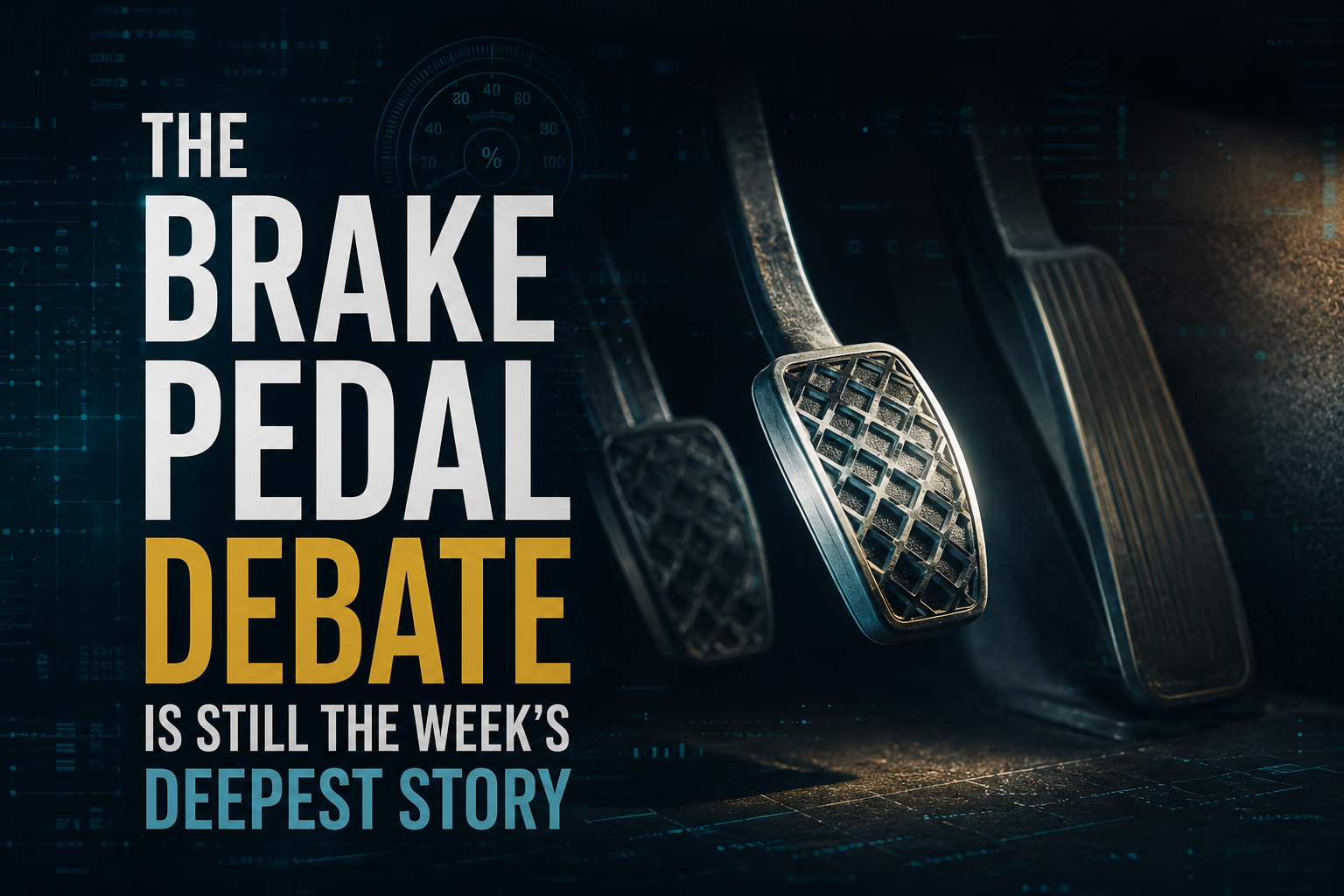
The brake pedal debate still week’s deepest story isn’t just a catchy headline. It’s the fault line running through every major AI conversation right now. Safety constraints in frontier models have become the most polarizing topic in technology — and I don’t see that changing anytime soon.
On one side, labs argue that guardrails prevent catastrophic misuse. On the other, critics say those same guardrails are artificial market gatekeeping dressed up as responsibility. Meanwhile, pricing wars, open-source philosophy, and even autonomous vehicle standards are all tangled up in this single, defining argument.
So who’s right? The answer is messier than either camp wants to admit.
Why the Brake Pedal Debate Matters for AI’s Future
Safety Costs Money — Pricing Wars Expose the Tension
Open vs. Closed Models — The Guardrail Transparency Problem
Lessons from Autonomous Vehicles — Safety Standards That Already Exist
Red-Teaming Failures and the Alignment Research Gap
Market Gatekeeping or Genuine Protection — The Core Question
Why the Brake Pedal Debate Matters for AI’s Future
The metaphor is simple. Every frontier AI model ships with a “brake pedal” — built-in safety constraints that limit what it can do. Specifically, these constraints include refusal behaviors, content filters, and alignment techniques like Reinforcement Learning from Human Feedback (RLHF). They’re designed to stop models from generating harmful, dangerous, or misleading outputs.
However, the debate isn’t really about whether brakes should exist. Nobody serious argues for zero safety. The real fight is about:
- Who decides where the brake engages
- How transparent that decision-making process actually is
- Whether commercial incentives distort safety claims
- What we lose when models refuse legitimate requests
I’ve been covering AI long enough to remember when “alignment” was a niche academic concern. Now it’s boardroom vocabulary. Consequently, the safety boundaries set by frontier models from OpenAI, Anthropic, Google DeepMind, and Meta are shaping what millions of developers, researchers, and businesses can build — whether those developers realize it or not.
The stakes are enormous. A model that refuses to discuss chemistry could block a legitimate researcher. A model with no limits whatsoever could help a bad actor synthesize something genuinely dangerous. Finding the right calibration point is hard — really hard — and that difficulty is exactly why the brake pedal debate still week’s deepest story keeps dominating tech discourse.
Furthermore, alignment researchers themselves can’t agree on methodology. Some favor strict constitutional AI approaches. Others push for more flexible, context-aware safety systems. Neither camp has definitive proof their method is superior, which tells you something important about where the science actually stands.
Safety Costs Money — Pricing Wars Expose the Tension
Here’s the thing: safety isn’t free. Every guardrail adds computational overhead, development cost, and inference latency. Notably, this creates a direct conflict with the ongoing AI pricing war — and it’s the part nobody in a press release wants to talk about honestly.
Consider the economics:
- Red-teaming a frontier model costs millions of dollars and months of expert labor
- RLHF training requires large teams of human evaluators
- Content filtering at inference time adds latency and real compute cost
- Alignment research teams don’t generate revenue directly
When Anthropic, OpenAI, and Google are competing on price per token, safety spending starts looking like a competitive disadvantage. Similarly, startups building on open-weight models can skip most of that overhead entirely, passing the savings to customers as lower prices.
Therefore, the pricing war creates perverse incentives. Labs that invest heavily in safety ship more expensive, slower products. Labs that invest less can undercut them on price. The market doesn’t naturally reward caution — and that’s a structural problem, not a character flaw.
Additionally, this dynamic feeds the gatekeeping accusation. Critics argue that large labs exaggerate safety risks to justify regulatory moats. If governments mandate expensive safety testing, only well-funded incumbents can comply — smaller competitors get locked out before they even launch.
Is that argument fair? Partially. The National Institute of Standards and Technology (NIST) AI Risk Management Framework does impose real compliance costs. But the risks it addresses are also real. The brake pedal debate still week’s deepest story forces us to hold both of those truths at the same time, which is uncomfortable but necessary.
Here’s a comparison of how major labs approach this tradeoff:
| Factor | OpenAI (Closed) | Anthropic (Closed) | Meta (Open-Weight) | Mistral (Open-Weight) |
|---|---|---|---|---|
| Safety investment | Very high | Very high | Moderate | Lower |
| Guardrail transparency | Low | Medium | High (code visible) | High (code visible) |
| Pricing flexibility | Limited | Limited | High | High |
| Red-teaming scope | Extensive internal | Extensive internal + external | Community-driven | Community-driven |
| User override ability | Minimal | Minimal | Full (local deployment) | Full (local deployment) |
| Regulatory readiness | Strong | Strong | Developing | Developing |
This table reveals something important. Closed-model labs bundle safety and opacity together. Open-weight providers offer transparency but shift safety responsibility entirely to users. Neither approach is obviously correct — and I’ve yet to meet anyone genuinely satisfied with either.
Open vs. Closed Models — The Guardrail Transparency Problem
The open-source philosophy adds another layer to the brake pedal debate still week’s deepest story. When Meta releases Llama models with open weights, anyone can inspect, modify, or remove the safety constraints. That’s simultaneously the greatest strength and the most concerning vulnerability — and both things are genuinely true.
Arguments for open guardrails:
- Researchers can audit safety mechanisms independently
- Developers can customize constraints for legitimate use cases
- No single company controls what’s “safe” for everyone
- Bugs and biases get found faster through community review
- Democratic access prevents monopolistic gatekeeping
Arguments against open guardrails:
- Bad actors can strip safety measures entirely
- No centralized accountability when things go wrong
- Community review isn’t systematic or complete
- Customization enables misuse disguised as “research”
- Smaller teams lack resources for proper safety evaluation
Importantly, this mirrors older debates in cybersecurity. The security community largely settled on responsible disclosure — openness with guardrails. Nevertheless, AI safety hasn’t found its equivalent consensus yet, and I’m not sure the analogy maps cleanly enough to just borrow the answer.
Anthropic’s constitutional AI approach represents one attempt at a middle path. The model follows explicit principles that are publicly documented, so users can see the rules even if they can’t modify the weights. It’s transparency without full openness — and honestly, that’s a more interesting design choice than it gets credit for.
Conversely, fully closed models like GPT-4o give users almost no visibility into safety decisions. When the model refuses a request, you often don’t know exactly why. That opacity breeds frustration and, notably, conspiracy theories about hidden agendas — some of which aren’t entirely unfounded.
The brake pedal debate still week’s deepest story ultimately asks: who should hold the brake? The builder, the user, the government, or some combination? And how much explaining should they owe you?
Lessons from Autonomous Vehicles — Safety Standards That Already Exist
Surprisingly, the AI safety debate has a useful parallel. Autonomous vehicles faced nearly identical tensions a decade ago — and the comparison is more instructive than most AI people want to acknowledge.
AV companies had to answer the same core questions:
- How safe is safe enough?
- Who’s liable when the system fails?
- Should safety standards be mandatory or voluntary?
- Do strict regulations protect incumbents unfairly?
The National Highway Traffic Safety Administration (NHTSA) eventually developed frameworks that balanced innovation with public safety. Specifically, they required companies to show safety through miles driven, disengagement rates, and incident reporting — concrete, measurable, and comparable.
AI doesn’t have equivalent metrics yet. Although researchers have proposed alignment benchmarks, none are universally accepted. Red-teaming efforts remain ad hoc. Consequently, each lab gets to define “safe enough” on its own terms, which is a little like letting car manufacturers write their own crash test standards.
Key parallels between AV and AI safety debates:
- Both involve systems making autonomous decisions with real consequences
- Both face pressure to move fast despite incomplete safety knowledge
- Both see tension between proprietary testing and public accountability
- Both involve lobbyists arguing for and against regulation
The AV industry also shows what happens without clear standards. Uber’s fatal pedestrian accident in 2018 showed that self-certification isn’t sufficient — and that’s a lesson worth taking seriously before something comparable happens in AI deployment. Moreover, the AV comparison highlights a critical distinction: cars operate in physical space with clear harm metrics, but AI models operate in information space where harm is genuinely harder to measure. A car crash is unambiguous. A model generating misleading medical advice is harder to quantify.
This measurement problem sits right at the heart of the brake pedal debate still week’s deepest story. Without agreed-upon harm metrics, every safety decision looks arbitrary to someone — and that perception gap is its own kind of problem.
Red-Teaming Failures and the Alignment Research Gap
Let’s be honest about the current state of AI safety testing: it’s inadequate. Red-teaming — the practice of adversarially testing models for vulnerabilities — remains more art than science. I’ve watched this cycle play out enough times that it barely surprises me anymore, which is itself a little alarming.
Every major model launch follows a predictable pattern:
- Lab announces extensive safety testing
- Model launches with confident safety claims
- Independent researchers find jailbreaks within days
- Lab patches the most obvious vulnerabilities
- New jailbreaks emerge
- Cycle repeats
This pattern doesn’t inspire confidence. Additionally, it fuels both sides of the brake pedal debate still week’s deepest story. Safety advocates point to jailbreaks as evidence that we need stronger constraints. Critics point to the same jailbreaks as evidence that the constraints don’t actually work — so why pay the performance cost?
The real kicker is that the alignment research community is working on deeper solutions. Techniques like mechanistic interpretability aim to understand what models actually learn, not just what they output. However, this research is genuinely early-stage — we’re talking years, probably, before it yields reliable, scalable alignment checks.
Current red-teaming limitations include:
- Testing is finite; adversaries are infinite
- Automated red-teaming tools miss creative attack vectors
- Cultural and linguistic biases in testing teams create blind spots
- Safety checks don’t transfer well across model versions
- There’s no standardized reporting framework for vulnerabilities
Notably, some experts argue the entire framing is wrong. Rather than training models to refuse harmful requests, we should focus on making them structurally incapable of certain actions. That’s a much harder engineering problem — but it would make the brake pedal metaphor obsolete. Nevertheless, structural safety remains theoretical for current transformer-based models. So the debate continues with the tools we have: imperfect guardrails applied to imperfect models by imperfect humans.
Fair warning: if you’re waiting for a clean technical solution before forming a policy opinion, you’ll be waiting a long time.
Market Gatekeeping or Genuine Protection — The Core Question
This is where the brake pedal debate still week’s deepest story gets genuinely uncomfortable. Are safety constraints genuinely protective, or are they partially a business strategy?
The honest answer is both — and that’s what makes the debate so frustratingly hard to resolve.
Evidence for genuine protection:
- Models can generate instructions for weapons, drugs, and cyberattacks
- Unfiltered models have produced child sexual abuse material
- Medical and legal misinformation can cause real harm
- Vulnerable users deserve baseline protections
- Frontier capabilities create genuinely new risks
Evidence for market gatekeeping:
- Safety requirements raise barriers to entry for competitors
- Labs lobby for regulations they’re already positioned to meet
- Some refusal behaviors block clearly harmless requests
- Safety rhetoric escalates conveniently alongside fundraising rounds
- Open-weight alternatives show that safety and access aren’t mutually exclusive
Furthermore, the European Union’s AI Act creates tiered requirements that hit smaller developers hardest. Compliance costs for “high-risk” AI systems can exceed what startups can realistically afford. Large labs, meanwhile, have already priced this into their business models — and some of them helped write the framework. Make of that what you will.
Importantly, acknowledging the gatekeeping concern doesn’t mean abandoning safety. It means demanding transparency about who specifically benefits from particular safety requirements — and separating genuine risk reduction from competitive strategy dressed up in responsible-sounding language.
The brake pedal debate still week’s deepest story won’t be resolved by picking a side and sticking to it. It’ll be resolved — if it gets resolved — by building institutions that can actually tell the difference: independent auditors, standardized benchmarks, and regulatory frameworks that don’t simply entrench whoever showed up first.
Conclusion
The brake pedal debate still week’s deepest story persists because it touches everything at once: technical alignment, business strategy, regulatory policy, and genuinely hard questions about who gets to control what. There’s no clean resolution on the horizon — and anyone telling you otherwise is selling something.
However, there are concrete steps for anyone following this space:
- Demand transparency. Ask labs to publish their safety decision criteria, not just their safety claims.
- Support independent auditing. Organizations like METR do critical evaluation work that deserves real funding and attention.
- Learn the technical basics. Understanding RLHF, constitutional AI, and red-teaming helps you judge competing claims instead of just picking a team.
- Watch the pricing signals. When safety costs money, follow who’s paying and who’s quietly cutting corners.
- Engage with policy. Comment on proposed regulations. The rules being written right now will shape AI development for decades.
Bottom line: the brake pedal debate still week’s deepest story isn’t going away. If anything, it’ll intensify as models get more capable and the economic stakes get higher. The question was never really whether we need brakes. It’s whether the brakes we’re building actually work — and whether they’re serving the public or just the companies that get to install them.
FAQ
What exactly is the brake pedal debate in AI?
The brake pedal debate refers to the ongoing disagreement about safety constraints in frontier AI models. Specifically, it asks whether built-in limitations — content filters, refusal behaviors, and alignment techniques — are genuinely protective or unnecessarily restrictive. The metaphor compares these constraints to a car’s brake pedal: necessary for safety, but potentially misused to control speed artificially.
Why is the brake pedal debate still week’s deepest story?
The brake pedal debate still week’s deepest story because it intersects multiple critical issues at once. Pricing wars, open-source philosophy, regulatory policy, and alignment research all converge on this single question. Additionally, every new model launch reignites the controversy. No other topic in AI right now touches so many stakeholders with such genuinely high stakes.
How do safety constraints affect AI model pricing?
Safety adds real costs at every stage. Red-teaming requires expensive expert labor. RLHF training needs human evaluators. Inference-time filtering adds latency and compute overhead. Consequently, models with stronger safety measures tend to cost more per token. This creates competitive pressure to reduce safety spending — especially during aggressive pricing wars where margins are already razor-thin.
Are open-source AI models safer or more dangerous than closed ones?
Neither is inherently safer. Open-weight models offer transparency — anyone can audit the safety mechanisms. However, anyone can also remove them entirely. Closed models maintain tighter control but offer less visibility into their safety decisions. The best approach likely combines open inspection with responsible deployment practices, although the industry hasn’t converged on what that looks like in practice.
What can autonomous vehicle safety teach us about AI safety?
AV safety development shows that self-certification isn’t enough. Independent testing, standardized metrics, and regulatory oversight all proved necessary. Similarly, AI safety will likely require external auditing and agreed-upon benchmarks. Nevertheless, AI harm is harder to measure than car crashes, making direct comparison imperfect — and the information environment is more complex than a physical roadway.
How can developers and users participate in the brake pedal debate?
Start by learning the technical basics of alignment and red-teaming. Engage with public comment periods on AI regulation — those windows matter more than most people realize. Support independent safety evaluation organizations. Test models critically and report vulnerabilities responsibly. Importantly, push for transparency from every lab you rely on: demand published safety criteria, not just polished marketing claims.
References
Keep reading
Here are the latest posts from the blog.
Autonomous vehicle AI safety standards regulations 2024 are moving faster than most people realize — and I mean that literally, not as a throwaway opener. Self-driving cars a…

The open vs closed models mid 2026 state looks radically different from even twelve months ago. Performance gaps have nearly vanished. Pricing wars have broken out across the…

Every time you ask ChatGPT a question, water evaporates somewhere. That’s not hyperbole — it’s physics. AI water consumption data centers environmental impact has quietly bec…