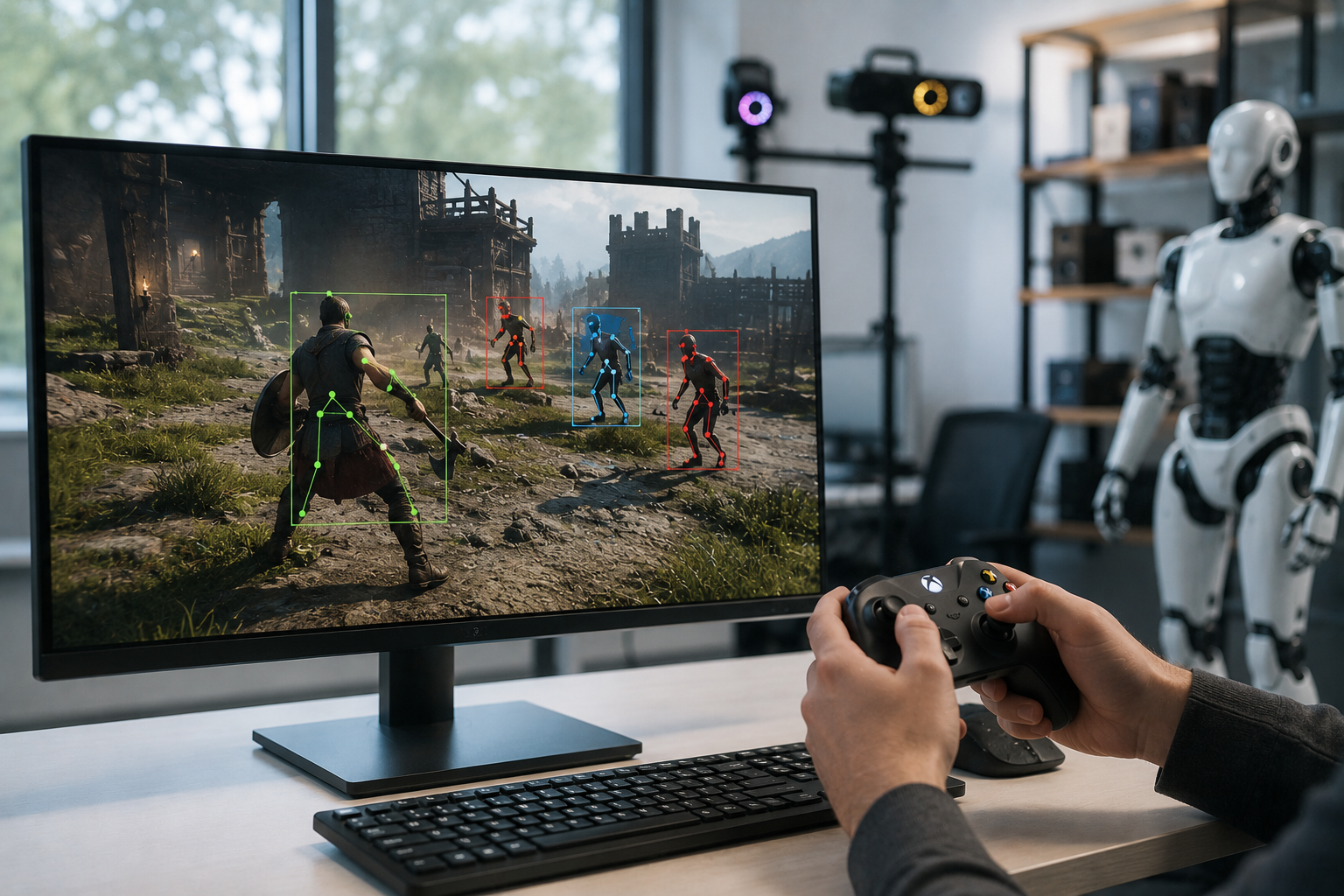
Every robotics team hits the same wall eventually. They need massive amounts of training data, and collecting it the traditional way is brutally expensive — in time, money, and human attention.
That cost is driving a genuinely interesting shift: teams are increasingly turning to video games to solve the problem. Not as a gimmick, but as a serious engineering decision that’s changing how robots learn.
Modern game engines simulate physics, render photorealistic environments, and track every object’s position frame by frame. That’s essentially a robot training data factory running continuously, for almost nothing. Every action a game character takes comes pre-labelled with intent, force vectors, and environmental context — automatically, without a single human annotator. Instead of spending months manually tagging real-world footage, researchers can pull rich, structured action-labelled data from game environments in hours.
This isn’t theoretical. It’s happening at leading AI labs right now, and the results are hard to argue with.
Why Game Engines Are Surprisingly Good at This
Unreal Engine and Unity weren’t built for robotics. Nobody at Epic or Unity Technologies
was thinking about gripper trajectories when they shipped those tools. And yet they’ve become two of the most powerful platforms for generating action-labelled data — because they already solve the hardest parts of creating valuable robot training datasets.
Physics simulation. Game engines model gravity, friction, collision, and rigid-body dynamics with remarkable accuracy. When a virtual hand picks up a cup in Unity, the engine records every force applied at every millisecond. That’s exactly the data a robotic gripper needs to learn from.
Automatic annotation. In the real world, labelling a single grasping action might take a human annotator 5–10 minutes. A game engine generates perfect labels instantly — object IDs, bounding boxes, segmentation masks, joint angles, all available through built-in APIs. Teams can go from zero to 50,000 labelled grasping examples in a single afternoon. That simply doesn’t happen with physical robots.
Scale on demand. Need 10 million grasping examples across 500 object shapes? A game engine can produce that dataset over a weekend on a GPU cluster. Procedural generation tools let teams randomize object textures, shapes, and masses; lighting conditions and camera angles; surface materials and friction coefficients; background clutter and occlusion patterns. This randomization technique — called domain randomization — is critical for training robots that generalize to real-world conditions rather than memorizing simulation quirks.
NVIDIA’s research teams have demonstrated this approach extensively with Isaac Sim, which builds directly on game engine technology. The data quality is genuinely surprising. Modern engines render at near-photorealistic levels and provide ground-truth depth maps that no real camera can match in accuracy. Game-engine action-labelled data isn’t just cheaper — it’s often more precise than manually collected alternatives.
What Makes Action-Labelled Data From Games Different
Manual annotation is slow, expensive, inconsistent, and demoralizing for the people doing it. But understanding why action-labelled data from game engines is so valuable requires getting specific about what “action labels” actually contain — because there’s a significant difference between shallow and deep labelling.
A traditional labelled dataset might tag a video frame with “robot picks up block.” Useful, but shallow. Game-engine action-labelled data captures the full action signature:
- Temporal sequence: exact start and end timestamps
- Force profiles: how much pressure was applied at each joint
- Spatial trajectories: the 3D path of every moving component
- Object state changes: position, rotation, and velocity before and after
- Contact points: precisely where gripper met object
- Success/failure flags: did the grasp hold or slip?
Robots don’t just need to know what happened — they need to know how it happened. Game engines provide that “how” automatically, every time, with zero human error. The label richness alone justifies the switch, even before you look at the cost numbers.
And the cost comparison is genuinely striking:
| Factor | Real-World Collection | Game-Engine Synthetic Data |
|---|---|---|
| Cost per 1,000 labeled actions | $500–$2,000 | $5–$20 |
| Annotation accuracy | 85–95% (human error) | 99.9%+ (ground truth) |
| Time to generate 1M samples | 6–12 months | 1–3 days |
| Edge case coverage | Limited by physical setup | Virtually unlimited |
| Label richness | 2–5 attributes per action | 20–50+ attributes per action |
| Reproducibility | Low (environment varies) | Perfect (deterministic seeds) |
Synthetic action-labelled data isn’t a complete replacement for real-world data — worth being clear about that — but it dramatically reduces how much expensive real-world data you need to collect. For most teams, that’s the point.
Closing the Sim-to-Real Gap
Here’s the honest complication: action-labelled data generated in a game engine isn’t automatically useful for real robots. The gap between simulation and reality — the sim-to-real gap — has historically been a dealbreaker for many teams.
Recent breakthroughs have made that gap surprisingly narrow.
Domain randomization remains the most proven technique. By training on wildly varied synthetic environments, robots learn to ignore visual details that don’t actually matter for the task. They focus on the underlying physics and geometry that do transfer to reality. OpenAI’s Dactyl project is still one of the best demonstrations of this. The team trained a robotic hand entirely in simulation to manipulate a Rubik’s Cube — and the robot succeeded in the real world despite never touching a physical cube during training. The key was massive randomization of action-labelled data across thousands of environmental variations.
Progressive fidelity training works well in practice. Teams start with low-fidelity, fast simulations to explore the solution space broadly, then refine promising policies in higher-fidelity environments, then fine-tune with a small amount of real-world data. The pipeline looks like this:
- Coarse simulation — millions of episodes in a simplified physics engine
- High-fidelity simulation — thousands of episodes in Unreal or Unity with realistic rendering
- Real-world fine-tuning — dozens to hundreds of episodes on physical hardware
The expensive real-world step shrinks from the primary data source to a small calibration step. Some teams report needing 100x less real-world data when pre-training on synthetic game-engine data. That’s not a rounding error — that’s a fundamentally different economics for robotics research.
Physics engine accuracy has also improved dramatically. MuJoCo, now open-source under DeepMind, simulates contact dynamics with remarkable precision. NVIDIA’s PhysX engine — the same engine powering countless video games — handles soft-body physics and fluid dynamics that matter for robotic manipulation. Getting the physics parameters tuned correctly takes real effort, though. The learning curve is genuine, and teams that skip this step tend to wonder why their sim-to-real transfer is poor.
The Untapped Asset Libraries Nobody Is Talking About
Most discussions about synthetic data focus on purpose-built simulations. There’s something even more interesting hiding in plain sight: existing game content that’s already sitting on servers, largely untapped, representing billions of dollars in development investment.
Consider what’s already in game studios’ asset libraries. Thousands of 3D object models with accurate physical properties. Detailed indoor environments with realistic furniture layouts. Character animation data encoding human-like manipulation strategies. Interaction logs from millions of players performing goal-directed actions.
These assets are already optimized for real-time rendering and physics simulation. Reusing them for action-labelled data generation is dramatically cheaper than building equivalent assets from scratch — and the quality is often better than what a research team would build in-house.
Concrete examples make this tangible. Games like The Sims contain detailed kitchen environments where characters interact with hundreds of household objects. Every cooking action — opening a fridge, stirring a pot, placing a plate — is essentially labelled training data for a household robot. Nobody designed it that way, but that’s what it is functionally. The action-labelled data is already there; it just needs to be extracted.
Warehouse simulation games model logistics environments nearly identical to real fulfillment centers. The picking, placing, and sorting actions in these games mirror exactly what warehouse robots need to learn. The content exists, it’s detailed, and most of it has never been touched by a robotics team.
Epic Games’ MetaHuman framework generates photorealistic human models with full skeletal rigs. These models can demonstrate manipulation tasks in simulation, creating action-labelled data that captures human-like movement patterns — particularly valuable for robots that need to operate alongside people in shared spaces, where human-like motion matters for safety and predictability.
The licensing landscape is evolving quickly. Several game studios have begun licensing their 3D asset libraries specifically for AI training. Open-source game assets on platforms like Sketchfab and TurboSquid provide free alternatives for research teams with smaller budgets. This space is worth monitoring closely — deals that would have been impossible three years ago are now routine.
Building a Pipeline That Actually Works
Knowing that game engines produce valuable action-labelled data is one thing. Building a pipeline that works in practice is another. Teams stumble here not because the technology fails them, but because they skip foundational steps. Here’s a practical breakdown.
Step 1: Define your action vocabulary. Before generating any data, clearly specify what actions your robot needs to learn. Common categories include pick-and-place (grasping, lifting, positioning), navigation (path planning, obstacle avoidance), tool use (pushing, pulling, rotating with implements), and assembly (aligning, inserting, fastening). Vague action vocabularies produce vague datasets.
Step 2: Select your engine. Unity offers better scripting access and a larger asset store. Unreal provides superior rendering quality. For physics-critical tasks, consider pairing either engine with MuJoCo or PyBullet as a backend physics solver. Don’t spend three weeks debating this — pick one and start generating data. Paralysis by analysis is real, and both engines are free for research use.
Step 3: Instrument the environment. Add data collection hooks to your simulation. You’ll want RGB images and depth maps at 30–60 fps, full joint state vectors for all articulated objects, contact force readings at collision points, semantic segmentation masks for every visible object, and action labels with start and end timestamps. The richness of your action-labelled data depends entirely on how well you instrument this step.
Step 4: Set up domain randomization. Randomize everything that shouldn’t matter to the robot’s policy — textures, lighting, camera positions, object colors. The trained model learns to focus on geometry and physics rather than surface visual features that won’t look the same in the real world. This step is not optional if you care about transfer performance.
Step 5: Validate against real-world baselines. Generate a small real-world dataset for the same tasks. Compare model performance when trained on synthetic versus real data. Track the sim-to-real transfer ratio — how much synthetic action-labelled data equals one real-world sample in training value. This number tells you everything about whether your simulation is properly calibrated.
Step 6: Iterate on physics accuracy. If transfer performance is low, the physics simulation needs tuning. Adjust friction coefficients, damping parameters, and sensor noise models. Add simulated sensor imperfections like motion blur and depth noise to match real camera behavior. This step is tedious. It’s also where the real performance gains hide.
Teams following this pipeline typically achieve 70–90% of fully real-world-trained performance using only synthetic data. The remaining gap closes with minimal real-world fine-tuning. That makes action-labelled data generation through game engines not just theoretically interesting but practically essential for robotics programs running on realistic budgets.
The Economics Are Getting Better Every Year
The financial case for game-engine-generated action-labelled data is compelling, and it strengthens with each passing year.
Hardware costs are falling fast. A single NVIDIA RTX 4090 can render thousands of training episodes per hour. A cloud GPU cluster costing $500 per day can generate datasets that would take a physical robot lab months to collect. The cost-per-labelled-action keeps dropping while real-world collection costs remain stubbornly flat.
Open-source tools are maturing rapidly. Google DeepMind’s open-sourcing of MuJoCo removed a major cost barrier that used to price out smaller teams entirely. NVIDIA’s Isaac Sim offers free licenses for individual researchers. These tools make action-labelled data generation accessible to teams without massive budgets, which is why university research groups are doing impressive work on essentially zero hardware spend. The democratization is real.
Looking ahead, a few trends are worth watching.
Foundation models for robotics will demand even larger labelled datasets. Game engines are the only practical way to generate action-labelled data at the required scale — nothing else comes close. Multi-modal action labels combining vision, force, and language descriptions will become standard, and game engines can generate all three simultaneously. Collaborative asset libraries where robotics teams share and reuse simulation environments will cut per-team costs further — essentially an open-source movement for robot training environments. Real-time adaptive training, where robots train in simulation during operational downtime using environments that mirror their physical workspace, is already being explored.
The challenges that remain are real. Deformable object simulation — fabric, food, soft materials — is still genuinely hard. Complex contact dynamics at the edges of what current physics engines handle remain problematic. But the direction is clear, and the pace of improvement in both areas has accelerated.
Synthetic action-labelled data from game engines is becoming the primary data source for robot learning. The question for most teams is no longer whether to use it. It’s how to use it most effectively — and how quickly they can build the infrastructure to do so at scale.
Conclusion
Action-labelled data from game engines has moved from an interesting research direction to a practical necessity for teams building robots at scale. The cost advantages are real — 50 to 100x cheaper per labelled action than real-world collection. The label richness is unmatched — 20 to 50 attributes per action versus 2 to 5 from human annotators. The scale is incomparable — a weekend GPU run versus months of physical data collection.
The sim-to-real gap that once made this impractical has narrowed dramatically. Domain randomization and progressive fidelity training have transformed synthetic data from a curiosity into a core component of serious robotics pipelines. Teams like OpenAI’s Dactyl group proved that robots trained entirely on synthetic action-labelled data can succeed in the real world. The field has built on that proof extensively since.
If you’re building robots and haven’t started exploring game-engine-based action-labelled data generation, a practical starting point: pick Unity or Unreal, build a single-task simulation environment, generate 10,000 labelled episodes, and benchmark the resulting model against one trained on real-world data. That benchmark will tell you your sim-to-real transfer ratio — the number that determines how aggressively you should invest in expanding the pipeline.
The most valuable robot training data doesn’t require expensive physical setups or armies of human annotators. It requires smart use of tools the gaming industry has spent decades perfecting. That realization is spreading through the robotics community, and the teams that internalize it earliest will have a meaningful head start on those that figure it out later.
FAQ
What exactly is action-labelled data in robot training?
Action-labelled data refers to training datasets where each recorded action includes detailed annotations — force profiles, spatial trajectories, object states, and timing information. Unlike simple image labels that identify what’s in a frame, action labels describe how a robot interacted with objects: the grip force applied, the approach angle used, the resulting movement produced. That richness is what makes action-labelled data so valuable compared to traditional image-based datasets, which capture what happened but not the mechanical details of how.
How much cheaper is synthetic data from game engines than real-world collection?
Typically 50 to 100 times cheaper per labelled action. Generating 1,000 labelled actions in a game engine costs roughly $5–$20, while real-world collection runs $500–$2,000 for equivalent quantity. Synthetic generation also scales linearly with compute — doubling GPU budget doubles output. Real-world collection doesn’t scale that way, because physical constraints and human annotator availability create hard ceilings that compute spending can’t overcome.
Can robots trained on game-engine data actually work in the real world?
Yes, with caveats. Robots trained purely on synthetic action-labelled data typically achieve 70–90% of the performance of those trained on real-world data. Adding a small amount of real-world fine-tuning — often just 1–5% of total training data — closes most of the remaining gap. The key technique is domain randomization: heavily varying synthetic training environments so the robot learns physics and geometry rather than simulation-specific visual details that won’t appear the same way in the real world.
Which game engine is best for generating robot training data?
It depends on priorities. Unity offers easier Python integration and a larger asset marketplace. Unreal provides superior visual accuracy and more realistic material rendering. For physics-critical applications, many teams pair either engine with specialized solvers like MuJoCo or PyBullet. Both are free for research use, so the barrier to entry is low regardless of choice. The more important decision is starting — the difference between engines matters far less than actually building the pipeline.
What types of robot tasks benefit most from game-engine data?
Manipulation tasks — picking, placing, assembling — benefit enormously, and navigation transfers well from simulation. Tasks involving highly deformable materials like fabric or food preparation remain harder to simulate accurately, though physics engines are improving in these areas. Warehouse logistics, household robotics, and industrial assembly are currently seeing the strongest results from synthetic action-labelled data, which is why these sectors have adopted the approach most aggressively.
How do I validate that synthetic action-labelled data actually transfers to real robots?
Create a small real-world benchmark dataset covering your target tasks. Train identical model architectures on synthetic-only, real-only, and mixed datasets. Compare success rate, completion time, and error frequency across all three. Track the transfer ratio — how many synthetic samples equal one real sample in training value. A healthy ratio runs 10:1 to 100:1. If your ratio exceeds 1000:1, your simulation likely needs physics accuracy improvements. That ratio is your primary signal for whether the pipeline is working correctly.
Keep reading
Here are the latest posts from the blog.
Onsemi acquires Synaptics in a $7B bet on physical AI edge computing, and honestly, the implications are bigger than most people realize. This isn’t just another semiconducto…

The world of edge AI vision sensors hardware acceleration inference is evolving fast. Cameras aren’t just capturing images anymore. They’re thinking, deciding, and acting — a…
NVIDIA NemoClaw Isaac Sim lets developers talk to robots using plain English instead of wrestling with complex code. That single shift changes everything. Forget joysticks, f…