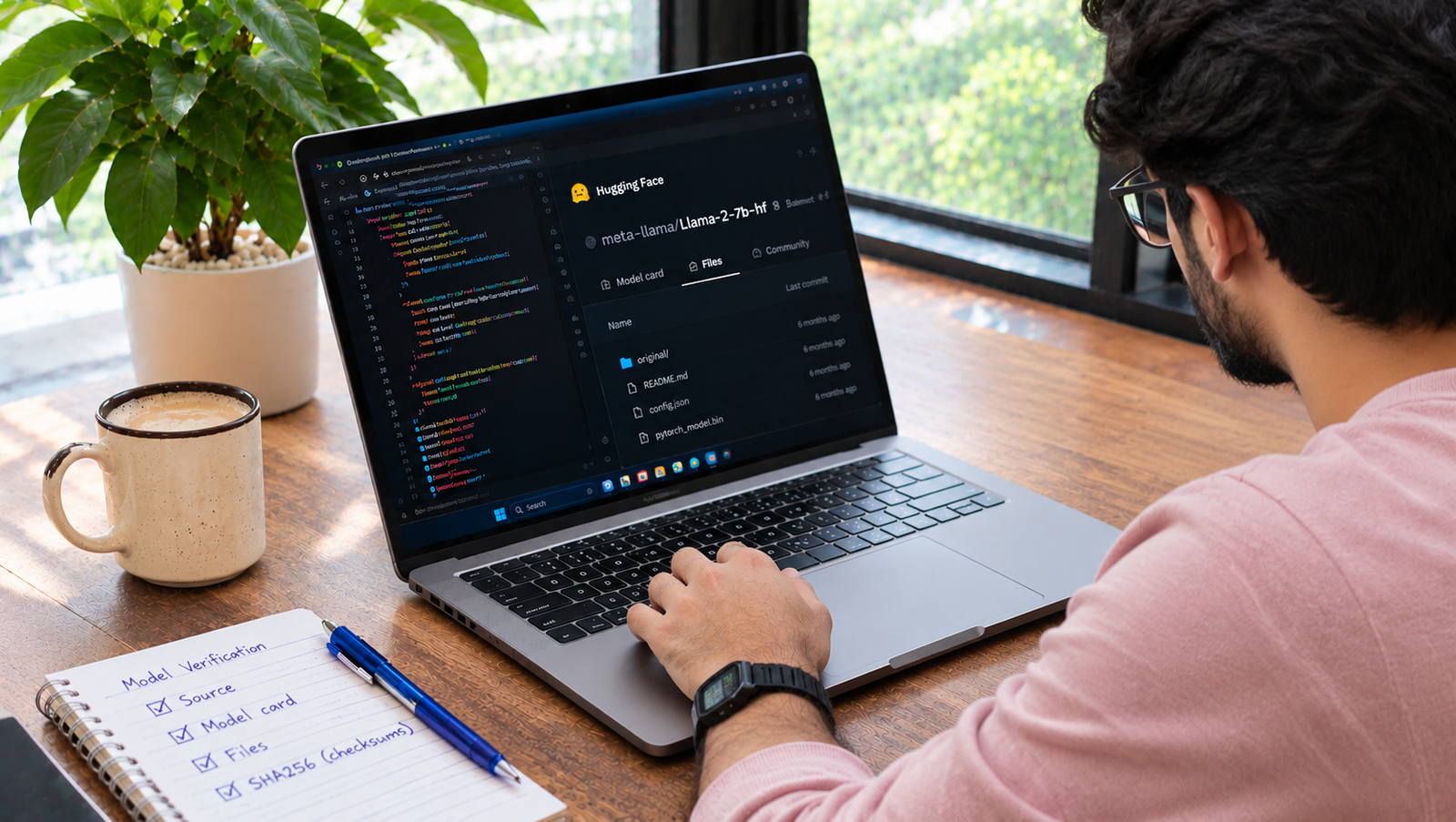
Figures checked against Menlo Ventures’ 2026 State of Enterprise AI report on 4 November 2026. Market sizes are Menlo estimates, shown as annualised run rates.
The price of AI keeps falling. Menlo Ventures says the average open-source model token now costs about $0.13 per million, down 3.3x in a year, and closed models fell 24% to a blended $0.70. Yet enterprise AI spending, by Menlo’s estimate, rose 5.4x to $176.8 billion.
Cheaper inputs and much bigger bills sound contradictory. They aren’t. Menlo’s 2026 State of Enterprise AI report, published on 3 November, shows companies moving from paying for people to use AI towards paying for AI to do work. Work done by agents is measured in tokens, and agents use a lot of them.
Key Takeaways
- Menlo estimates enterprise AI deployment spending at $176.8 billion by September 2026, separate from $102.5 billion in development spending.
- Adoption rose 10 points; average spend per company rose 4.7x. Intensity, not new adopters, drove the growth.
- On OpenRouter, agents now generate about 80% of tokens, a signal from a developer-heavy gateway, not an enterprise census.
- Open-source models took 19% of tokens but 4% of spending, a gap almost entirely explained by Menlo’s average price difference.
- Frontier labs hold 69% of deployment spending. Cost per finished task, not per token, may explain why buyers pay more.
- Coding and assistants make up 76% of application spending, because coding gives agents clear, testable work.
- Budgets need to become consumption budgets, with per-task tracking and limits.
- Read the report with its methodology in mind: a US survey, a restated baseline and investment ties to Anthropic and OpenRouter.
Quick Navigation
- Enterprise AI spending grew far faster than adoption
- How agents change enterprise AI spending
- Enterprise AI spending is becoming a token-consumption problem
- Open-source models take the volume. Frontier labs take the money
- Where the $177B of enterprise AI spending goes
- Budgets fell behind enterprise AI spending
- What the Menlo report gets right, and what to question
- How to budget enterprise AI spending for 2027
- Frequently asked questions
- How much is enterprise AI spending in 2026?
- Why has enterprise AI spending increased so quickly?
- How much enterprise AI spending is driven by agents?
- Why do AI agents consume more tokens than chatbots?
- How much enterprise AI usage comes from open-source models?
- Why do frontier AI companies capture most enterprise AI spending?
- What is the difference between AI deployment and development spending?
- How should companies budget for AI agents?
- Are open-weight models cheaper for enterprise use?
- Will enterprise AI spending keep growing?
Enterprise AI spending grew far faster than adoption
Menlo’s $176.8 billion is deployment spending: money companies spend using and running AI, split between $99.5 billion of infrastructure and $77.3 billion of applications. It’s separate from the $102.5 billion Menlo estimates for development, mostly training compute, which is money spent building models. The two shouldn’t be added together casually, and neither is the total global AI market.
Table: scroll sideways to view all columns when needed.
| Measure (Menlo estimates) | Prior year | 2026 | Change |
|---|---|---|---|
| Enterprise AI deployment spending | $33B | $176.8B | 5.4x |
| AI development spending | Not stated here | $102.5B | 5.3x |
| Enterprise AI adoption | 55% | 65% | +10 points |
| Average spend per enterprise | 1x | 4.7x | 4.7x |
The adoption line is the interesting one. Ten more percentage points of enterprises used AI, roughly 18% more adopters. Average spend per enterprise rose 4.7x. Almost all of the growth in enterprise AI spending came from companies that were already using AI and started using much more of it.
A rough check, as UniverseBlend analysis: 1.18 times more adopters, each spending 4.7 times as much on average, gives about 5.5x. That’s close to Menlo’s 5.4x market figure. The survey average and the market estimate are different measures, so this is a sanity check, not a decomposition. But it points the same way: intensity, not reach, is driving enterprise AI spending.
How agents change enterprise AI spending
A seat licence prices access. One employee, one monthly fee, whatever they do with it. An agent prices work. It takes a task, calls a model many times, reads files and tool outputs, and keeps going until it finishes or fails.
Menlo’s evidence for the shift comes from OpenRouter, a service that routes requests to many model providers through one API. According to the report, agent traffic overtook human traffic there in early February 2026. Since then, agent token traffic grew 37x while human-driven traffic grew 5x. Agents now account for about 80% of OpenRouter tokens, about 130.9 trillion a week. On those shares, agents generate roughly four times as many tokens as people do.
Those figures need context. OpenRouter is one gateway, and the report itself notes that its users skew towards individual developers and startups rather than enterprise buyers. Large companies often go directly to Anthropic, OpenAI, Google or their cloud provider, and OpenRouter’s own rankings page notes that it measures traffic routed through the service, not users or spend. The OpenRouter data shows the direction of travel, not a census of enterprise AI usage, and it comes from a different population than Menlo’s enterprise survey.
Enterprise AI spending is becoming a token-consumption problem
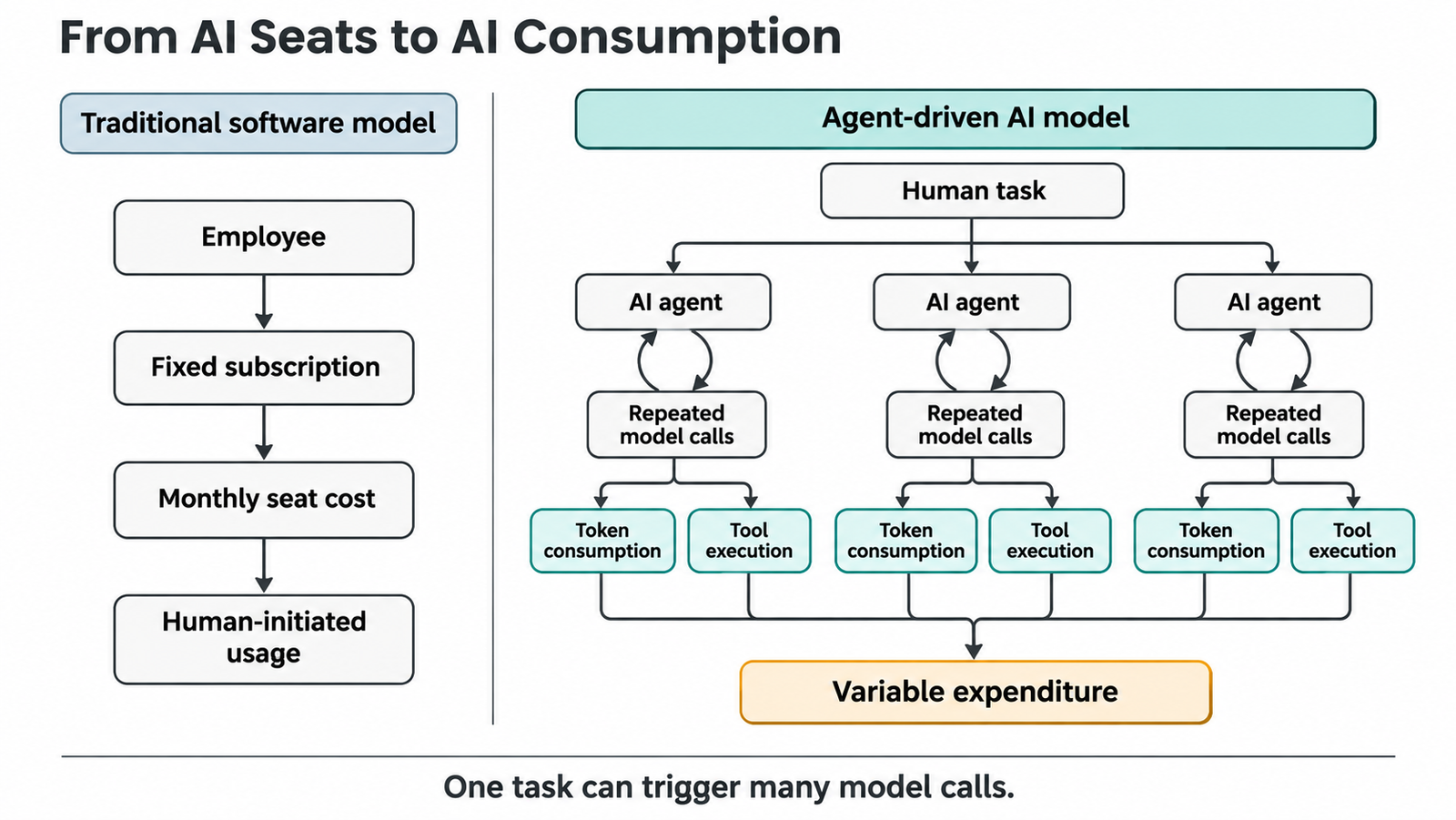
Agents multiply tokens for mechanical reasons. Each step usually resends the conversation so far, so a 20-step task pays for its early context many times over. Tool results, such as search pages, file contents and test logs, land back in the context. Planning and self-checking add calls. Failed steps are retried. Parallel agents each carry their own copy of shared context.
Anthropic measured this on its own system in 2025. In its write-up of a multi-agent research system, it found that agents “typically use about 4× more tokens than chat interactions,” and multi-agent systems “about 15× more tokens than chats.” As UniverseBlend’s analysis of when adding an agent stops paying for itself put it, the unit of cost isn’t the agent but the model call, and “every call pays for its whole input again.”
That’s how prices and bills move in opposite directions. If a token costs a third as much but a task uses ten times as many tokens, the task costs more than three times as much. Enterprise AI spending stops tracking headcount and starts tracking how much work agents are given.
Open-source models take the volume. Frontier labs take the money
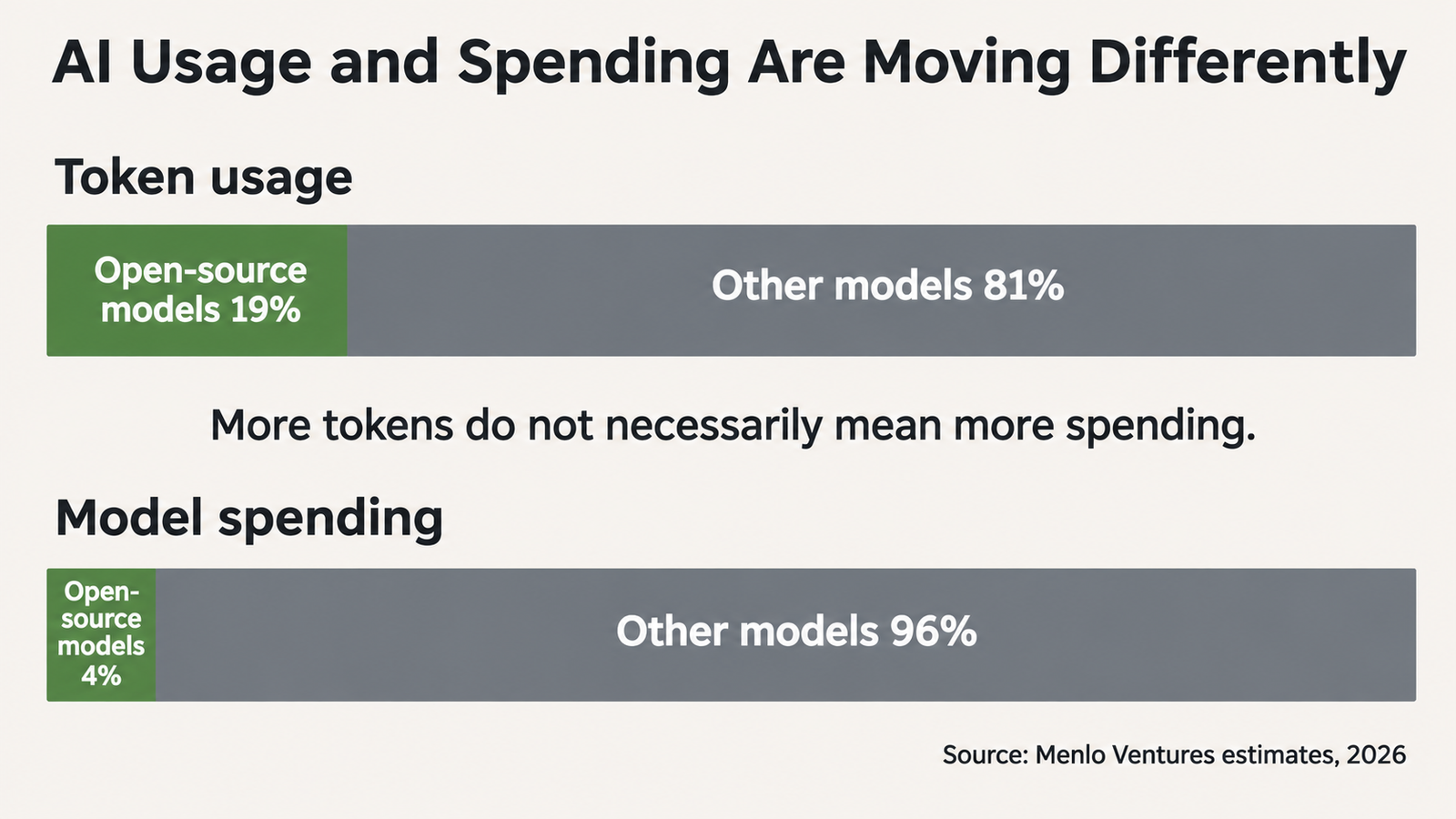
Menlo reports that open-source models handled about 19% of tokens but captured only 4% of model spending. Its words: “Open-source is gaining ground in usage, but losing spending share.”
Token economics: 19% of tokens, 4% of enterprise AI spending
Table: scroll sideways to view all columns when needed.
| Menlo estimate | Open-source models | All other models |
|---|---|---|
| Share of tokens | 19% | 81% |
| Share of model spending | 4% | 96% |
| Average price per million tokens | ~$0.13 (open-source average) | ~$0.70 (closed-model blended) |
The arithmetic is worth doing (UniverseBlend analysis). Open-source models earn 4 points of spending for 19 points of tokens, about 0.21 per point. Other models earn 96 for 81, about 1.19 per point. That’s a gap of about 5.6x per token. Menlo’s average prices differ by about 5.4x, $0.70 against $0.13. If both shares describe the same traffic, the spending gap is almost entirely a price gap. Open-source models are doing a growing share of the work. They’re just much cheaper per unit.
A terminology note. Menlo says “open-source”, but most of these models are open-weight: the trained weights can be downloaded, while training data and code often aren’t released. The Open Source Initiative’s Open Source AI Definition requires data information and complete training code as well. And $0.13 is Menlo’s estimated average, not a price every provider charges.
Self-hosting changes the economics again. A company running an open-weight model on its own GPUs pays nothing per token to a model vendor, but it pays for hardware, power, engineering time and idle capacity. Some of that spending shows up as infrastructure rather than model spend. Our comparison of Chinese open-weight models shows how hardware needs vary across popular options.
Why frontier labs keep 69% of enterprise AI spending
Anthropic, OpenAI and Google together hold 69% of enterprise AI deployment spending, about $122.7 billion, up from 50%. On a narrower measure, enterprise LLM API spending, Menlo puts Anthropic at 55% (from 40%), OpenAI at 31% (from 27%) and Google at 9% (from 21%). These are different denominators. Deployment spending includes infrastructure and applications. API spending covers only model calls. Neither is a share of tokens.
A qualification belongs here. Menlo Ventures is an investor in Anthropic and OpenRouter, both central to the report, and it marks portfolio companies with asterisks. The research is valuable primary data. But its authors’ commercial position is relevant to how readers weigh its market-share findings, especially Anthropic’s rise. OpenRouter’s ownership is also changing: Stripe agreed to acquire it in August.
Why pay five times more per token? The report doesn’t measure this directly, so what follows is interpretation. For agentic work, the cost that matters is cost per completed task, not cost per token. A model that finishes a coding task in fewer steps, or without a failed run, can be cheaper overall. Enterprises also pay for reliability, security reviews, existing contracts and integration with tools they already use. The data shows the premium persisting. It doesn’t prove why.
Where the $177B of enterprise AI spending goes
Table: scroll sideways to view all columns when needed.
| Category (Menlo estimates) | Amount |
|---|---|
| Deployment total | $176.8B |
| Infrastructure | $99.5B |
| Applications | $77.3B |
| of which coding | $34.0B |
| of which assistants and chatbots | $25.0B |
| of which healthcare | $3.7B |
| Development (separate) | $102.5B |
Infrastructure, the stack that runs models and agents, is the larger half. Within applications, coding and assistants take 76%. Healthcare, in third place at $3.7 billion, is a long way behind.
Why coding leads enterprise AI spending
Coding suits agents better than almost any other job, which is why it dominates enterprise AI spending on applications. The work lives in a repository. Tools are scriptable. Compilers and test suites give fast, objective feedback, so an agent can try, fail, check and retry without a human. Success is easier to define than in a sales forecast or a legal review.
That’s also why coding is expensive. Every test run and retry is more tokens. UniverseBlend’s look at who’s paying for coding agents’ tokens found that the larger cost often comes after generation, in review and rework. Functions with subjective decisions, scattered data or unclear success criteria will adopt agents more slowly, and their spending will grow more slowly too.
Budgets fell behind enterprise AI spending
The budget figures show how badly forecasts missed. Menlo’s survey found:
Table: scroll sideways to view all columns when needed.
| Survey respondents | Planned | Actual |
|---|---|---|
| Average spend vs prior year | 1.9x | 4.7x |
| Median spend vs prior year | 1.8x | 2.2x |
On average, companies spent about 2.5 times what they had planned to grow by. The median company overshot only modestly, about 1.2 times its plan. The gap between average and median means a minority of heavy users is pulling the average up: companies where agents went from pilot to production and consumption took off. It does not mean every company spent 2.5 times its budget.
Most of the growth in enterprise AI spending is new money rather than reallocated budget. Menlo says 55% of incremental AI spending came from new budgets and 22% from existing software budgets. Another 13% came from incumbents converting SaaS licences to AI, and 9%, about $12.6 billion, shifted to AI-native vendors. The report found “limited evidence” of enterprises replacing core systems such as Salesforce’s CRM, Workday or NetSuite. AI is adding to the software bill, not yet replacing it.
What the Menlo report gets right, and what to question
The survey covered nearly 400 US enterprise decision-makers responsible for more than $4 billion in AI spending. Morning Consult fielded it from 8 to 26 September 2026. Market sizes are Menlo estimates built from that survey, public filings and third-party reports, expressed as annualised run rates. That’s a strong dataset for direction and proportion. It isn’t an audited sum of invoices, and it’s US-only.
Three cautions:
- The baseline was restated. Menlo’s December 2025 report put 2025 enterprise generative AI spending at $37 billion. The new report uses $33 billion for the prior year, after reclassifying data-labelling vendors such as Mercor from deployment to development. On the old base, growth would be about 4.8x.
- Two datasets are in play. Agent and token findings come from OpenRouter, while budget findings come from the enterprise survey. They shouldn’t be blended.
- Portfolio relationships run through the market-share findings, as noted above.
None of this makes the report unreliable, and it remains one of the few detailed public estimates of enterprise AI spending. It makes it a well-sourced estimate from an interested party, which is how readers should treat it.
How to budget enterprise AI spending for 2027
The lesson for budget owners is that AI is turning into a consumption line, more like cloud than SaaS. A fixed seat budget can’t predict what agents will cost, because their cost depends on how many tasks they run, how many tokens each task takes and which model does the work.
An illustrative agent budget
Every number here is an assumption, chosen only to show the mechanics. None is a quote from a provider.
Table: scroll sideways to view all columns when needed.
| Cost line | Assumption | Annual cost |
|---|---|---|
| Employee assistant seats | 500 seats × $40 a month | $240,000 |
| Agent model usage | 2,000 tasks a day × 1.5M tokens × $1 per million, 250 working days | $750,000 |
| Tools and infrastructure | 20% of model usage (sandboxes, search, vector stores) | $150,000 |
| Monitoring and evaluation | 10% of model usage | $75,000 |
| Human review | Not priced here; often the largest hidden cost | Varies |
The seats are fixed. Everything else moves with volume. If tasks double, or each task takes twice the tokens because agents retry more, model usage rises to $1.5 million. Switch some work to an open-weight model at a fraction of the price and it falls sharply, if quality holds. At Menlo’s $0.70 closed-model average, the same agent line would be $525,000. At a frontier model priced several times higher, it could be millions.
Practical steps follow from that:
- Budget agents per task, not per user.
- Track cost per completed task, not per token.
- Set spending limits per agent.
- Route routine work to cheaper models.
- Review forecasts quarterly rather than annually.
The $177 billion headline will be quoted for months. The more useful finding sits underneath it: enterprise AI spending now follows the work AI does, not the number of people who can use it. Tokens will probably keep getting cheaper. Whether bills shrink depends on how many tasks companies hand to agents, how efficiently those agents finish them and which models they run on. Finance teams that still treat AI as a seat count will keep being surprised.
Frequently asked questions
How much is enterprise AI spending in 2026?
Menlo Ventures estimates enterprise AI deployment spending reached $176.8 billion by September 2026, as an annualised run rate. That’s up from a restated $33 billion the year before.
Why has enterprise AI spending increased so quickly?
Existing adopters are using far more AI, largely through agents that consume many tokens per task. Adoption itself rose only from 55% to 65%.
How much enterprise AI spending is driven by agents?
Menlo doesn’t give a dollar figure. On OpenRouter, agents generate about 80% of tokens, but that platform skews towards developers and startups.
Why do AI agents consume more tokens than chatbots?
They work in many steps, resend context each time, read tool outputs, plan, verify and retry. Anthropic measured agents using about four times the tokens of chats.
How much enterprise AI usage comes from open-source models?
About 19% of tokens, according to Menlo, but only 4% of model spending, because their average price is much lower.
Why do frontier AI companies capture most enterprise AI spending?
They hold 69% of deployment spending in Menlo’s estimate. Likely reasons include capability, reliability and integration, though the report doesn’t prove the cause.
What is the difference between AI deployment and development spending?
Deployment spending is money spent using and running AI. Development spending is money spent building models, mainly training compute and data.
How should companies budget for AI agents?
Budget per task, track cost per completed task, set usage limits and review forecasts quarterly, since agent costs vary with volume and model choice.
Are open-weight models cheaper for enterprise use?
Usually per token, yes. Total cost depends on quality, how many retries tasks need, and whether you pay a provider or run your own hardware.
Will enterprise AI spending keep growing?
The report doesn’t forecast 2027. Agent adoption and falling prices push in opposite directions, so the outcome depends on how much work companies hand to agents.
Keep reading
Here are the latest posts from the blog.

Enterprise AI Spending Hit $177B. Agents Are Driving the Bill

Machine Unlearning: Can We Really Trust an Edited AI Model?
Your Robot May Pass Every Test. Its Simulator Could Still Be Lying