Claude API Rate Limits in 2026: How Many Requests Can You Run?

Claude API rate limits

Claude API rate limits on the Start tier allow most current models 2,000,000 input tokens and 400,000 output tokens per minute, with 1,000 or 4,000 requests per minute depending on the model. There is no fixed number of concurrent sessions: how many requests you can keep in flight depends on which of those per-minute limits your workload hits first, and how long each request takes.

Last verified: 5 November 2026, against Anthropic’s rate limits documentation.

Key Takeaways
  • The Claude API sets per-minute limits on requests, input tokens and output tokens, and none of them is a fixed concurrent-session count.
  • For any workload, the lowest of RPM, ITPM ÷ input per call and OTPM ÷ output per call sets your throughput.
  • Multiply that throughput by average request duration, divided by 60, to estimate requests in flight.
  • Cache reads don’t count toward ITPM on most models, so caching can lift input-bound workloads several times over.
  • Workspace overrides can lower a team’s effective limit below the organisation’s.
  • Plan below the maximum, read the rate-limit headers and retry with backoff and jitter.

Quick Navigation


Current Claude API rate limits by tier

Anthropic now groups organisations into Start, Build and Scale tiers, plus a Custom tier arranged with its account team. New organisations may begin in an Evaluation tier with lower limits while they build a usage history. Anthropic places organisations on a tier automatically, and you can ask for an increase from the Rate limits page in the Claude Console.

Each model group has three separate limits. Requests per minute (RPM) counts API calls. Input tokens per minute (ITPM) counts the prompt tokens you send. Output tokens per minute (OTPM) counts the tokens the model generates.

TierModel groupRPMITPMOTPM
StartOpus 5.5, Sonnet 5.5, Haiku 5.54,0002,000,000400,000
StartOpus 5, Opus 4.x, Sonnet 5, Sonnet 4.x, Haiku 4.51,0002,000,000400,000
StartFable 5.x4,000500,000100,000
BuildOpus 5.5, Sonnet 5.5, Haiku 5.510,0005,000,0001,000,000
BuildOpus 5, Opus 4.x, Sonnet 5, Sonnet 4.x, Haiku 4.55,0005,000,0001,000,000
BuildFable 5.x10,0001,500,000300,000
ScaleOpus 5.5, Sonnet 5.5, Haiku 5.513,00010,000,0002,000,000
ScaleOpus 5, Opus 4.x, Sonnet 5, Sonnet 4.x, Haiku 4.510,00010,000,0002,000,000
ScaleFable 5.x13,0004,000,000800,000

Source: Anthropic rate limits documentation, Messages API tables, checked 5 November 2026.

Each row in the table describes a limit for one model group, and groups don’t share a budget. Opus 4.8, 4.7, 4.6 and 4.5 draw from one combined Opus 4.x limit, while Opus 5.5 and Opus 5 each have their own. Sonnet 4.6 and 4.5 share a Sonnet 4.x limit, and Fable 5.1 and Fable 5 share a Fable limit. The Rate Limits API lists exactly which model IDs count against each group for your organisation.

Each tier also carries a monthly spend cap of $500 on Start, $1,000 on Build and $200,000 on Scale. Reaching it pauses usage until the first day of the next month, unless you get a higher limit approved sooner.

How many concurrent requests can you run?
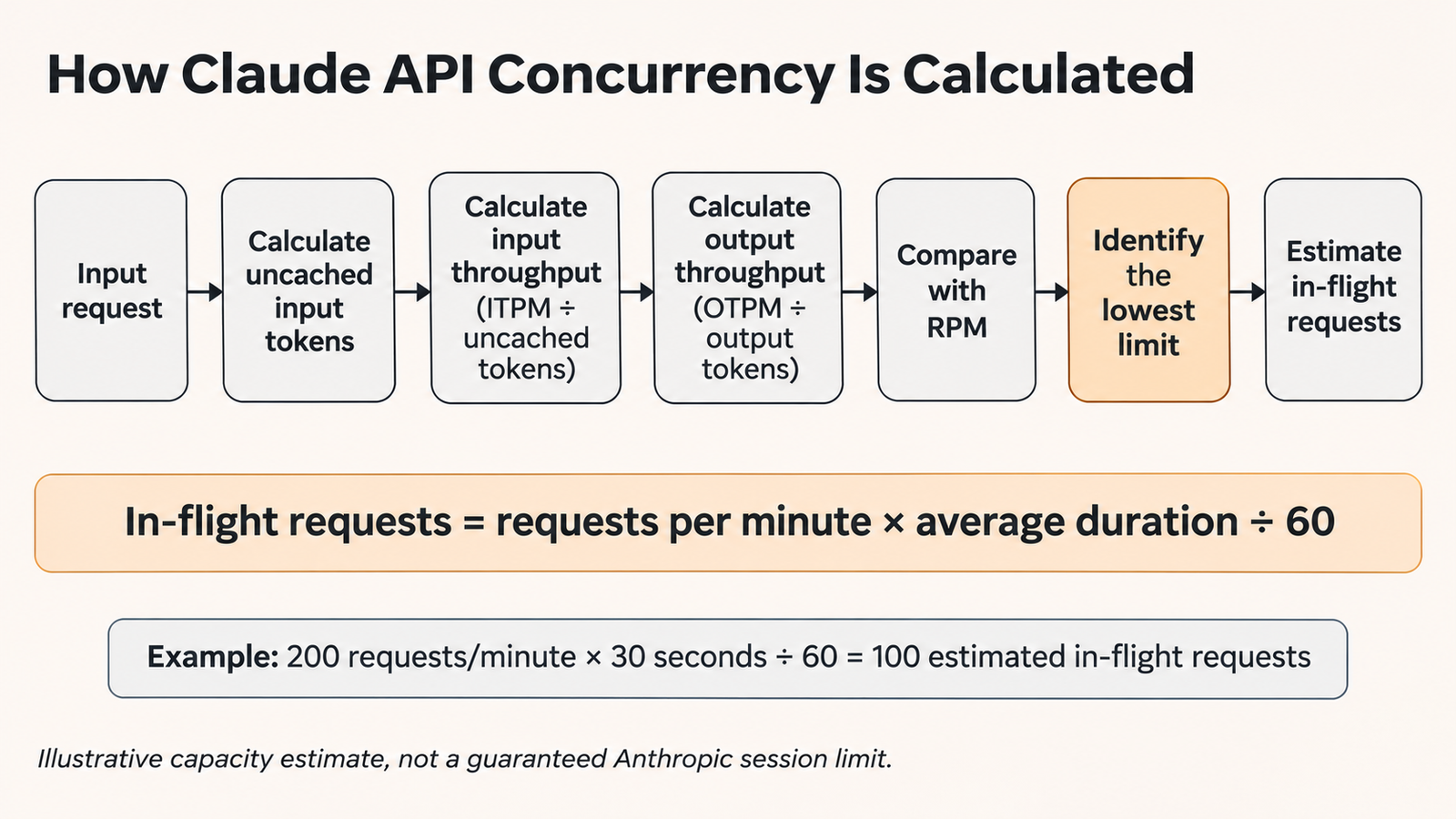
An illustrative way to estimate concurrency from published rate limits.

The API publishes per-minute limits, not a cap on simultaneous connections. To estimate concurrency, work out how many requests per minute each limit allows for your workload, take the lowest, and multiply by how long a request lasts.

The formula

Estimated in-flight requests = permitted requests per minute × average request duration in seconds ÷ 60.

Permitted requests per minute is the smallest of three numbers:

  • your RPM limit;
  • your ITPM limit divided by the input tokens that count against it per request;
  • your OTPM limit divided by the output tokens per request.

The result is a sustainable average for a steady workload. It doesn’t promise that a given number of requests can start at the same instant.

Worked example 1: an output-limited workload

This illustrative workload runs on the Start tier with Opus 5, which allows 1,000 RPM, 2,000,000 ITPM and 400,000 OTPM.

  1. Each prompt is 20,000 tokens, and 80% of them are read from the prompt cache. Cache reads don’t count toward ITPM on this model, so each call counts 20,000 × 0.2 = 4,000 uncached input tokens.
  2. Input allows 2,000,000 ÷ 4,000 = 500 calls per minute.
  3. Each response is 2,000 tokens. Output allows 400,000 ÷ 2,000 = 200 calls per minute.
  4. RPM allows 1,000 calls per minute.
  5. The lowest of 500, 200 and 1,000 is 200 calls per minute, so output is the binding limit.
  6. With an average call lasting 30 seconds, in-flight requests come to 200 × 30 ÷ 60 = 100.

Output binds here because each response is long relative to the uncached prompt. On Opus 5.5, the RPM figure would rise to 4,000, but the answer would stay at 200 calls a minute because the token limits are the same. Even then, 100 is an average to plan around, and bursts above it can still trigger 429 errors.

Worked example 2: an input-limited workload

This second illustrative workload uses the same Start-tier limits for Opus 5, but each request summarises a fresh document.

  1. Each prompt is 50,000 tokens. Every document is new, so the cache hit rate is 0% and all 50,000 tokens count toward ITPM.
  2. Input allows 2,000,000 ÷ 50,000 = 40 calls per minute.
  3. Each summary is 1,000 tokens. Output allows 400,000 ÷ 1,000 = 400 calls per minute.
  4. RPM allows 1,000 calls per minute.
  5. The lowest of 40, 400 and 1,000 is 40 calls per minute, so input is the binding limit.
  6. With an average call lasting 15 seconds, in-flight requests come to 40 × 15 ÷ 60 = 10.

Caching changes this case sharply. If a 30,000-token instruction block were cached and only 20,000 tokens per call were new, input would allow 2,000,000 ÷ 20,000 = 100 calls per minute. Output would still allow 400, so the binding limit would rise from 40 to 100 calls a minute.

Where the estimate breaks down

The formula assumes steady request sizes and durations, which real traffic rarely has. Long and short prompts mix, streaming responses hold connections open longer, and network latency and queueing add time that the model isn’t using. Retries add load at the moment you can least afford it.

The rate limits are also enforced more finely than a minute. Anthropic uses a token bucket that refills continuously, and notes that a limit of 60 RPM might be enforced as one request per second. Sharp rises in an organisation’s traffic can also hit separate acceleration limits, so Anthropic advises ramping up gradually.

Two details help planning. ITPM is estimated when a request starts and corrected as it runs. OTPM counts only tokens actually generated, so a high max_tokens setting doesn’t use up the allowance on its own. Most teams plan well below the theoretical maximum to leave room for bursts and retries.

How prompt caching raises effective input throughput
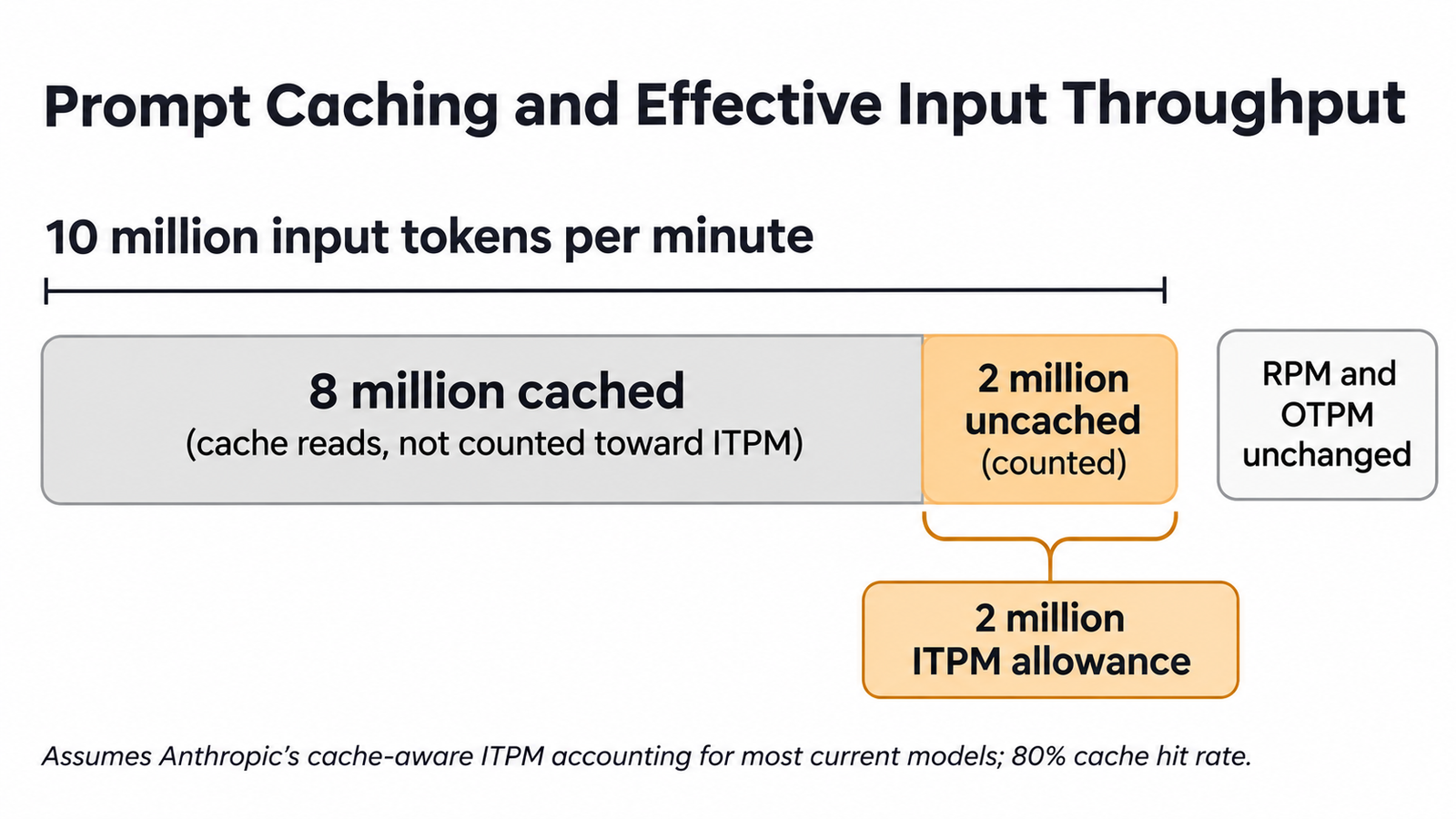
At an 80% cache hit rate, a 2 million ITPM limit can carry about 10 million input tokens a minute.

For most Claude models, only uncached input tokens count toward ITPM. The API reports three kinds of input token: input_tokens after the last cache breakpoint, cache_creation_input_tokens written to the cache, and cache_read_input_tokens read from it. The first two count toward ITPM, and cache reads don’t.

Anthropic’s own example uses a 2,000,000 ITPM limit and an 80% cache hit rate. In that case, 20% of incoming tokens count, so the limit supports 2,000,000 ÷ 0.2 = 10,000,000 total input tokens per minute: 2 million uncached and 8 million cached.

The benefit applies only to the input limit. Caching doesn’t raise RPM or OTPM, and the first request that writes a cache entry still counts in full. The retired Claude Haiku 3.5 is an exception, because it counts cache reads toward ITPM. Billing for cached tokens follows a separate price schedule from rate limiting. Our guide to structuring prompts for caching covers how to keep a stable prefix that the cache can reuse.

What happens when you hit a limit

Exceeding any one limit returns an HTTP 429 with the type rate_limit_error that names the limit you crossed. When the response includes a retry-after header, Anthropic says to wait that many seconds, because earlier retries will fail. A 429 caused by the monthly spend cap carries no retry-after header and keeps failing until access resumes, so retrying it won’t help.

Successful responses carry rate-limit headers you can use to schedule work before you hit a wall:

  • anthropic-ratelimit-requests-limit, -remaining and -reset track requests.
  • anthropic-ratelimit-input-tokens-limit, -remaining and -reset track input tokens.
  • anthropic-ratelimit-output-tokens-limit, -remaining and -reset track output tokens.
  • anthropic-ratelimit-tokens-limit, -remaining and -reset show whichever token limit is most restrictive right now.

The reset headers use RFC 3339 timestamps, and the token “remaining” values are rounded to the nearest thousand. A scheduler can slow its dispatch rate as remaining capacity falls, which avoids most 429s in the first place.

When 429s do arrive, use exponential backoff with random jitter so that many workers don’t retry at the same moment. Anthropic’s official SDKs retry automatically, twice by default, and honour retry-after. A shared queue with a fixed concurrency cap is usually safer than letting each worker retry on its own.

Workspace limits and Priority Tier

Organisation limits are the ceiling, and workspace limits can be set lower to stop one team or app using everything. Without an override, a workspace inherits the organisation’s limit. The Rate Limits API can set workspace overrides for requests, input and output tokens per minute, cache-aware input tokens per minute, tokens per minute, tokens per day and tool uses per second. The lower of the workspace and organisation values applies, and changes take effect within about an hour.

Priority Tier is a separate capacity commitment measured in input and output tokens per minute for a specific model. Anthropic says new commitments are no longer available for purchase, though existing contracts continue until they end. Priority requests still draw on the ordinary rate limits, and traffic beyond the commitment falls back to the standard tier.

Claude.ai, Claude Code and API limits are separate

Usage limits on Claude.ai and Claude Code subscriptions are a different system from the API rate limits above. Anthropic bills the API separately from paid Claude plans, and its support documentation explains how the two relate. For plan allowances, check the current articles on Claude’s help centre.

How Claude API rate limits compare with other providers

Other providers combine request limits, token throughput, account tiers, daily caps and per-model rules in different ways, so their figures can’t be compared directly. Our overview of AI API rate limits across providers sets them side by side, and our guide to LLM cost per task shows how to price the same workloads.

Frequently asked questions

Does the Claude API have a fixed concurrent-session limit?

The rate-limit documentation doesn’t list one. Concurrency follows from the per-minute limits and request length, so a workload with short responses can run far more parallel calls than one producing long outputs.

Can multiple applications share the same Anthropic API rate limits?

Yes. Every key in an organisation draws on the same organisation limits, and the anthropic-workspace-id response header shows which workspace a request counted against. Giving each application its own workspace with lower overrides stops one from using all the capacity, though the organisation limits still cap the total.

What is the difference between a 429 rate-limit error and a server error?

A 429 means your organisation has used its allowance, so the fix is to slow down or wait for retry-after. A 500 signals an internal error and a 529 signals that the API is overloaded for everyone. Both are temporary and worth retrying with backoff.

Can prompt caching increase Claude API request concurrency?

Only when input tokens are the binding limit. Caching leaves RPM and OTPM unchanged, so an output-bound workload gets no extra concurrency from it.


Keep reading

Claude API rate limits

Claude API Rate Limits in 2026: How Many Requests Can You Run?

Claude API rate limits on the Start tier allow most current models 2,000,000 input tokens and 400,000 output tokens per minute, with 1,000 or 4,000 …
Enterprise AI Spending

Enterprise AI Spending Hit $177B. Agents Are Driving the Bill

Figures checked against Menlo Ventures’ 2026 State of Enterprise AI report on 4 November 2026. Market sizes are Menlo estimates, shown as annualised run rates. …
Machine Unlearning

Machine Unlearning: Can We Really Trust an Edited AI Model?

Checked against Hirundo’s and Lazarus AI’s published results, CrowdStrike’s DeepSeek-R1 study, Lawfare and the Federal Register on 4 November 2026. Ask Alibaba’s Qwen3.6-35B-A3B about Tiananmen …
Agentic AI Statistics

30 Agentic AI Statistics for 2026: Adoption, Spending and Risk

Last updated: 3 November 2026. This page is updated monthly; each figure keeps its original publication date. Agent traffic at one healthcare booking platform rose …

Enterprise AI Spending Hit $177B. Agents Are Driving the Bill

Enterprise AI Spending

Figures checked against Menlo Ventures’ 2026 State of Enterprise AI report on 4 November 2026. Market sizes are Menlo estimates, shown as annualised run rates.

The price of AI keeps falling. Menlo Ventures says the average open-source model token now costs about $0.13 per million, down 3.3x in a year, and closed models fell 24% to a blended $0.70. Yet enterprise AI spending, by Menlo’s estimate, rose 5.4x to $176.8 billion.

Cheaper inputs and much bigger bills sound contradictory. They aren’t. Menlo’s 2026 State of Enterprise AI report, published on 3 November, shows companies moving from paying for people to use AI towards paying for AI to do work. Work done by agents is measured in tokens, and agents use a lot of them.

Key Takeaways
  • Menlo estimates enterprise AI deployment spending at $176.8 billion by September 2026, separate from $102.5 billion in development spending.
  • Adoption rose 10 points; average spend per company rose 4.7x. Intensity, not new adopters, drove the growth.
  • On OpenRouter, agents now generate about 80% of tokens, a signal from a developer-heavy gateway, not an enterprise census.
  • Open-source models took 19% of tokens but 4% of spending, a gap almost entirely explained by Menlo’s average price difference.
  • Frontier labs hold 69% of deployment spending. Cost per finished task, not per token, may explain why buyers pay more.
  • Coding and assistants make up 76% of application spending, because coding gives agents clear, testable work.
  • Budgets need to become consumption budgets, with per-task tracking and limits.
  • Read the report with its methodology in mind: a US survey, a restated baseline and investment ties to Anthropic and OpenRouter.

Quick Navigation


Enterprise AI spending grew far faster than adoption

Menlo’s $176.8 billion is deployment spending: money companies spend using and running AI, split between $99.5 billion of infrastructure and $77.3 billion of applications. It’s separate from the $102.5 billion Menlo estimates for development, mostly training compute, which is money spent building models. The two shouldn’t be added together casually, and neither is the total global AI market.

Measure (Menlo estimates)Prior year2026Change
Enterprise AI deployment spending$33B$176.8B5.4x
AI development spendingNot stated here$102.5B5.3x
Enterprise AI adoption55%65%+10 points
Average spend per enterprise1x4.7x4.7x

The adoption line is the interesting one. Ten more percentage points of enterprises used AI, roughly 18% more adopters. Average spend per enterprise rose 4.7x. Almost all of the growth in enterprise AI spending came from companies that were already using AI and started using much more of it.

A rough check, as UniverseBlend analysis: 1.18 times more adopters, each spending 4.7 times as much on average, gives about 5.5x. That’s close to Menlo’s 5.4x market figure. The survey average and the market estimate are different measures, so this is a sanity check, not a decomposition. But it points the same way: intensity, not reach, is driving enterprise AI spending.

How agents change enterprise AI spending

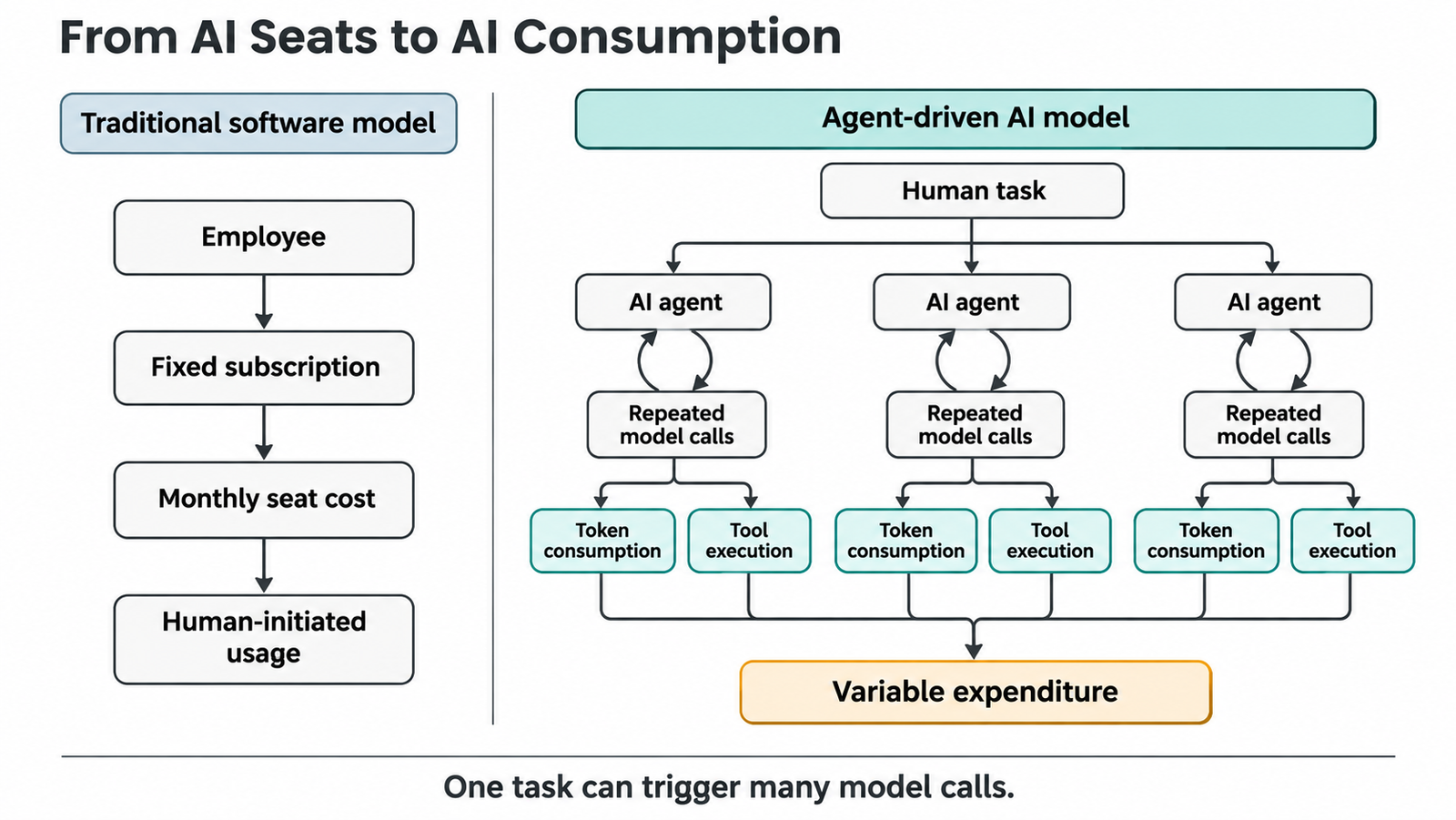
A seat licence prices access. One employee, one monthly fee, whatever they do with it. An agent prices work. It takes a task, calls a model many times, reads files and tool outputs, and keeps going until it finishes or fails.

Menlo’s evidence for the shift comes from OpenRouter, a service that routes requests to many model providers through one API. According to the report, agent traffic overtook human traffic there in early February 2026. Since then, agent token traffic grew 37x while human-driven traffic grew 5x. Agents now account for about 80% of OpenRouter tokens, about 130.9 trillion a week. On those shares, agents generate roughly four times as many tokens as people do.

Those figures need context. OpenRouter is one gateway, and the report itself notes that its users skew towards individual developers and startups rather than enterprise buyers. Large companies often go directly to Anthropic, OpenAI, Google or their cloud provider, and OpenRouter’s own rankings page notes that it measures traffic routed through the service, not users or spend. The OpenRouter data shows the direction of travel, not a census of enterprise AI usage, and it comes from a different population than Menlo’s enterprise survey.

Enterprise AI spending is becoming a token-consumption problem

Seats predict access. They don't predict how much work agents will do.

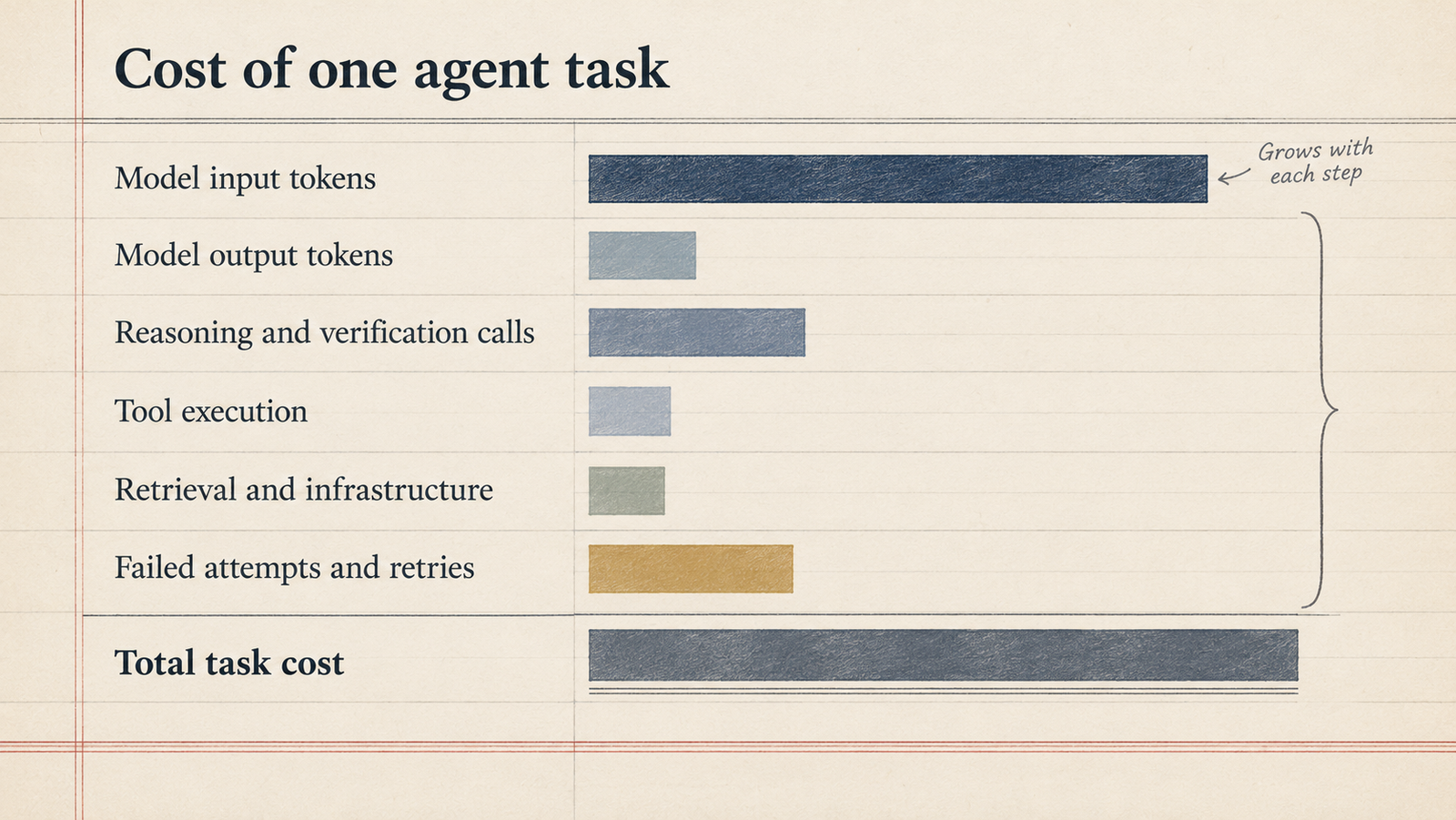
Agents multiply tokens for mechanical reasons. Each step usually resends the conversation so far, so a 20-step task pays for its early context many times over. Tool results, such as search pages, file contents and test logs, land back in the context. Planning and self-checking add calls. Failed steps are retried. Parallel agents each carry their own copy of shared context.

Anthropic measured this on its own system in 2025. In its write-up of a multi-agent research system, it found that agents “typically use about 4× more tokens than chat interactions,” and multi-agent systems “about 15× more tokens than chats.” As UniverseBlend’s analysis of when adding an agent stops paying for itself put it, the unit of cost isn’t the agent but the model call, and “every call pays for its whole input again.”

That’s how prices and bills move in opposite directions. If a token costs a third as much but a task uses ten times as many tokens, the task costs more than three times as much. Enterprise AI spending stops tracking headcount and starts tracking how much work agents are given.

Open-source models take the volume. Frontier labs take the money

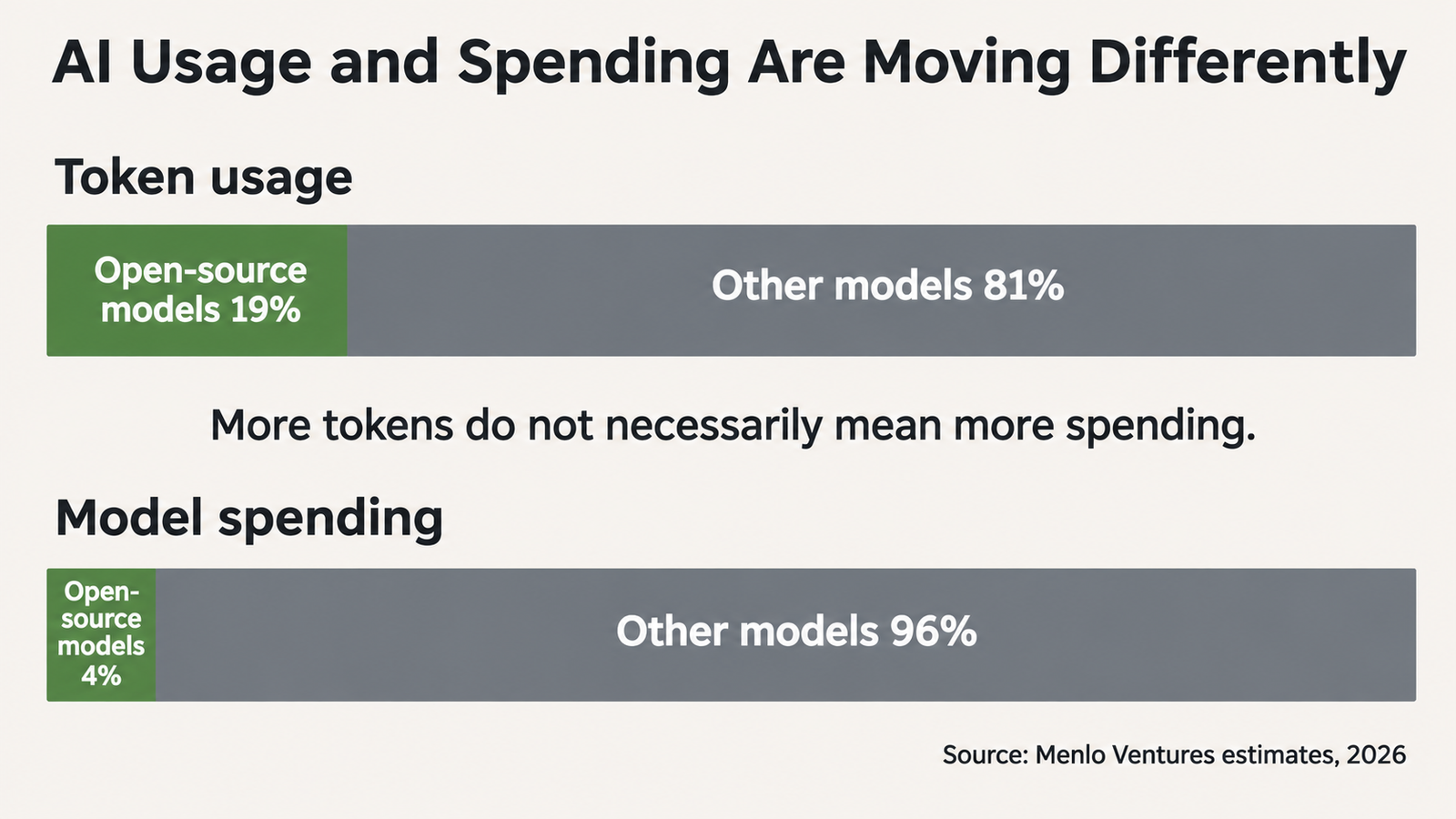
Open-source models do a fifth of the token work for a twenty-fifth of the spending. Menlo Ventures estimates.

Menlo reports that open-source models handled about 19% of tokens but captured only 4% of model spending. Its words: “Open-source is gaining ground in usage, but losing spending share.”

Token economics: 19% of tokens, 4% of enterprise AI spending
Menlo estimateOpen-source modelsAll other models
Share of tokens19%81%
Share of model spending4%96%
Average price per million tokens~$0.13 (open-source average)~$0.70 (closed-model blended)

The arithmetic is worth doing (UniverseBlend analysis). Open-source models earn 4 points of spending for 19 points of tokens, about 0.21 per point. Other models earn 96 for 81, about 1.19 per point. That’s a gap of about 5.6x per token. Menlo’s average prices differ by about 5.4x, $0.70 against $0.13. If both shares describe the same traffic, the spending gap is almost entirely a price gap. Open-source models are doing a growing share of the work. They’re just much cheaper per unit.

A terminology note. Menlo says “open-source”, but most of these models are open-weight: the trained weights can be downloaded, while training data and code often aren’t released. The Open Source Initiative’s Open Source AI Definition requires data information and complete training code as well. And $0.13 is Menlo’s estimated average, not a price every provider charges.

Self-hosting changes the economics again. A company running an open-weight model on its own GPUs pays nothing per token to a model vendor, but it pays for hardware, power, engineering time and idle capacity. Some of that spending shows up as infrastructure rather than model spend. Our comparison of Chinese open-weight models shows how hardware needs vary across popular options.

Why frontier labs keep 69% of enterprise AI spending

Anthropic, OpenAI and Google together hold 69% of enterprise AI deployment spending, about $122.7 billion, up from 50%. On a narrower measure, enterprise LLM API spending, Menlo puts Anthropic at 55% (from 40%), OpenAI at 31% (from 27%) and Google at 9% (from 21%). These are different denominators. Deployment spending includes infrastructure and applications. API spending covers only model calls. Neither is a share of tokens.

A qualification belongs here. Menlo Ventures is an investor in Anthropic and OpenRouter, both central to the report, and it marks portfolio companies with asterisks. The research is valuable primary data. But its authors’ commercial position is relevant to how readers weigh its market-share findings, especially Anthropic’s rise. OpenRouter’s ownership is also changing: Stripe agreed to acquire it in August.

Why pay five times more per token? The report doesn’t measure this directly, so what follows is interpretation. For agentic work, the cost that matters is cost per completed task, not cost per token. A model that finishes a coding task in fewer steps, or without a failed run, can be cheaper overall. Enterprises also pay for reliability, security reviews, existing contracts and integration with tools they already use. The data shows the premium persisting. It doesn’t prove why.

Where the $177B of enterprise AI spending goes

Category (Menlo estimates)Amount
Deployment total$176.8B
Infrastructure$99.5B
Applications$77.3B
of which coding$34.0B
of which assistants and chatbots$25.0B
of which healthcare$3.7B
Development (separate)$102.5B

Infrastructure, the stack that runs models and agents, is the larger half. Within applications, coding and assistants take 76%. Healthcare, in third place at $3.7 billion, is a long way behind.

Why coding leads enterprise AI spending

Coding suits agents better than almost any other job, which is why it dominates enterprise AI spending on applications. The work lives in a repository. Tools are scriptable. Compilers and test suites give fast, objective feedback, so an agent can try, fail, check and retry without a human. Success is easier to define than in a sales forecast or a legal review.

That’s also why coding is expensive. Every test run and retry is more tokens. UniverseBlend’s look at who’s paying for coding agents’ tokens found that the larger cost often comes after generation, in review and rework. Functions with subjective decisions, scattered data or unclear success criteria will adopt agents more slowly, and their spending will grow more slowly too.

Budgets fell behind enterprise AI spending

The budget figures show how badly forecasts missed. Menlo’s survey found:

Survey respondentsPlannedActual
Average spend vs prior year1.9x4.7x
Median spend vs prior year1.8x2.2x

On average, companies spent about 2.5 times what they had planned to grow by. The median company overshot only modestly, about 1.2 times its plan. The gap between average and median means a minority of heavy users is pulling the average up: companies where agents went from pilot to production and consumption took off. It does not mean every company spent 2.5 times its budget.

Most of the growth in enterprise AI spending is new money rather than reallocated budget. Menlo says 55% of incremental AI spending came from new budgets and 22% from existing software budgets. Another 13% came from incumbents converting SaaS licences to AI, and 9%, about $12.6 billion, shifted to AI-native vendors. The report found “limited evidence” of enterprises replacing core systems such as Salesforce’s CRM, Workday or NetSuite. AI is adding to the software bill, not yet replacing it.

What the Menlo report gets right, and what to question

The survey covered nearly 400 US enterprise decision-makers responsible for more than $4 billion in AI spending. Morning Consult fielded it from 8 to 26 September 2026. Market sizes are Menlo estimates built from that survey, public filings and third-party reports, expressed as annualised run rates. That’s a strong dataset for direction and proportion. It isn’t an audited sum of invoices, and it’s US-only.

Three cautions:

  • The baseline was restated. Menlo’s December 2025 report put 2025 enterprise generative AI spending at $37 billion. The new report uses $33 billion for the prior year, after reclassifying data-labelling vendors such as Mercor from deployment to development. On the old base, growth would be about 4.8x.
  • Two datasets are in play. Agent and token findings come from OpenRouter, while budget findings come from the enterprise survey. They shouldn’t be blended.
  • Portfolio relationships run through the market-share findings, as noted above.

None of this makes the report unreliable, and it remains one of the few detailed public estimates of enterprise AI spending. It makes it a well-sourced estimate from an interested party, which is how readers should treat it.

How to budget enterprise AI spending for 2027

The lesson for budget owners is that AI is turning into a consumption line, more like cloud than SaaS. A fixed seat budget can’t predict what agents will cost, because their cost depends on how many tasks they run, how many tokens each task takes and which model does the work.

An illustrative agent budget

Every number here is an assumption, chosen only to show the mechanics. None is a quote from a provider.

Cost lineAssumptionAnnual cost
Employee assistant seats500 seats × $40 a month$240,000
Agent model usage2,000 tasks a day × 1.5M tokens × $1 per million, 250 working days$750,000
Tools and infrastructure20% of model usage (sandboxes, search, vector stores)$150,000
Monitoring and evaluation10% of model usage$75,000
Human reviewNot priced here; often the largest hidden costVaries

The seats are fixed. Everything else moves with volume. If tasks double, or each task takes twice the tokens because agents retry more, model usage rises to $1.5 million. Switch some work to an open-weight model at a fraction of the price and it falls sharply, if quality holds. At Menlo’s $0.70 closed-model average, the same agent line would be $525,000. At a frontier model priced several times higher, it could be millions.

Practical steps follow from that:

  • Budget agents per task, not per user.
  • Track cost per completed task, not per token.
  • Set spending limits per agent.
  • Route routine work to cheaper models.
  • Review forecasts quarterly rather than annually.

The $177 billion headline will be quoted for months. The more useful finding sits underneath it: enterprise AI spending now follows the work AI does, not the number of people who can use it. Tokens will probably keep getting cheaper. Whether bills shrink depends on how many tasks companies hand to agents, how efficiently those agents finish them and which models they run on. Finance teams that still treat AI as a seat count will keep being surprised.

Frequently asked questions

How much is enterprise AI spending in 2026?

Menlo Ventures estimates enterprise AI deployment spending reached $176.8 billion by September 2026, as an annualised run rate. That’s up from a restated $33 billion the year before.

Why has enterprise AI spending increased so quickly?

Existing adopters are using far more AI, largely through agents that consume many tokens per task. Adoption itself rose only from 55% to 65%.

How much enterprise AI spending is driven by agents?

Menlo doesn’t give a dollar figure. On OpenRouter, agents generate about 80% of tokens, but that platform skews towards developers and startups.

Why do AI agents consume more tokens than chatbots?

They work in many steps, resend context each time, read tool outputs, plan, verify and retry. Anthropic measured agents using about four times the tokens of chats.

How much enterprise AI usage comes from open-source models?

About 19% of tokens, according to Menlo, but only 4% of model spending, because their average price is much lower.

Why do frontier AI companies capture most enterprise AI spending?

They hold 69% of deployment spending in Menlo’s estimate. Likely reasons include capability, reliability and integration, though the report doesn’t prove the cause.

What is the difference between AI deployment and development spending?

Deployment spending is money spent using and running AI. Development spending is money spent building models, mainly training compute and data.

How should companies budget for AI agents?

Budget per task, track cost per completed task, set usage limits and review forecasts quarterly, since agent costs vary with volume and model choice.

Are open-weight models cheaper for enterprise use?

Usually per token, yes. Total cost depends on quality, how many retries tasks need, and whether you pay a provider or run your own hardware.

Will enterprise AI spending keep growing?

The report doesn’t forecast 2027. Agent adoption and falling prices push in opposite directions, so the outcome depends on how much work companies hand to agents.


Keep reading

Claude API rate limits

Claude API Rate Limits in 2026: How Many Requests Can You Run?

Claude API rate limits on the Start tier allow most current models 2,000,000 input tokens and 400,000 output tokens per minute, with 1,000 or 4,000 …
Enterprise AI Spending

Enterprise AI Spending Hit $177B. Agents Are Driving the Bill

Figures checked against Menlo Ventures’ 2026 State of Enterprise AI report on 4 November 2026. Market sizes are Menlo estimates, shown as annualised run rates. …
Machine Unlearning

Machine Unlearning: Can We Really Trust an Edited AI Model?
Checked against Hirundo’s and Lazarus AI’s published results, CrowdStrike’s DeepSeek-R1 study, Lawfare and the Federal Register on 4 November 2026. Ask Alibaba’s Qwen3.6-35B-A3B about Tiananmen …
Agentic AI Statistics

30 Agentic AI Statistics for 2026: Adoption, Spending and Risk

Last updated: 3 November 2026. This page is updated monthly; each figure keeps its original publication date. Agent traffic at one healthcare booking platform rose …

30 Agentic AI Statistics for 2026: Adoption, Spending and Risk

Agentic AI Statistics

Last updated: 3 November 2026. This page is updated monthly; each figure keeps its original publication date.

Agent traffic at one healthcare booking platform rose nearly 30-fold in three months. In one large sample of agents, 76% hadn’t run in two months but still had working credentials. Only about one company in five says it has a mature model for governing them. Taken together, these agentic AI statistics describe a technology moving into production faster than the controls around it.

This report collects 30 numbers published by 4 November 2026, each with its source, date, evidence type and limits. It covers the agent end of the wider generative AI statistics 2026 picture. Five figures come from Menlo Ventures, six from Jellyfish and five from Deloitte, so this is not 30 independent studies.

Key Takeaways
  • Menlo estimates enterprise AI deployment spending at $176.8 billion, and actual spending ran well ahead of plans.
  • Agent traffic is rising steeply on several platforms, but each measures it differently.
  • Agents are involved in about 28% of merged PRs at the median Jellyfish customer, yet 79% of surveyed leaders see no faster releases.
  • 76% of examined agents were dormant with live credentials, making agent identity a security priority.
  • Only 21% of companies report mature agent governance, and 49% of AI-using workers use unapproved tools.
  • Frontier models lead open-weights models by 12 points on the newest index, and by 26 points among models with released weights.
  • These agentic AI statistics lean on a few vendors. Check the evidence label before quoting any number.

Quick Navigation


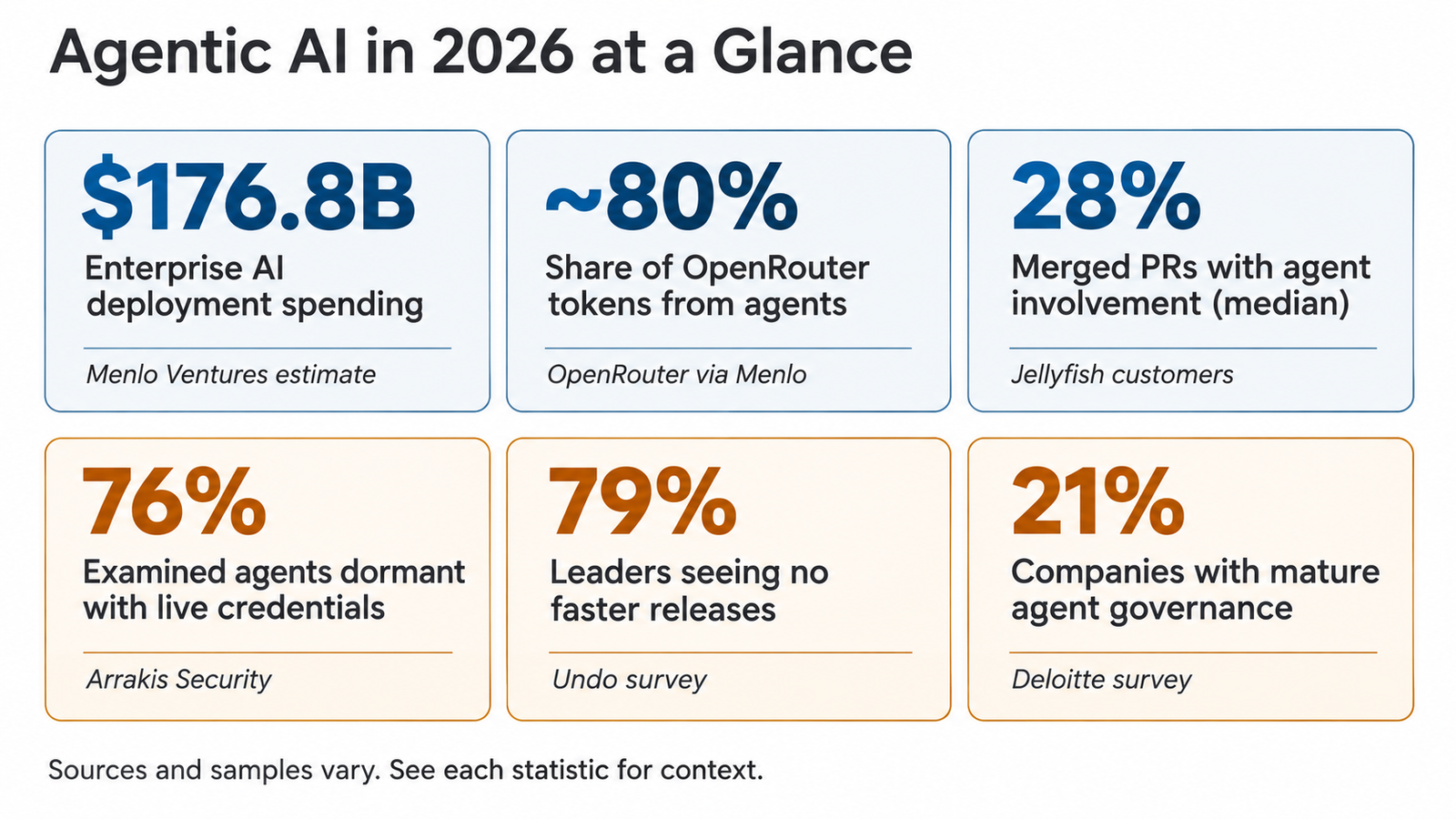
The 2026 agentic AI statistics at a glance

Six of the 30 figures. Each comes from a different kind of evidence.
#StatisticSourceEvidence type
1$176.8B enterprise AI deployment spendingMenlo VenturesIndustry estimate
24.7x actual vs 1.9x planned average AI spend growthMenlo VenturesSurvey
6Nearly 30x AI agent traffic since JulyZocdocCompany-reported
8Agents generate ~80% of OpenRouter tokensMenlo / OpenRouterPlatform telemetry
1128% of merged PRs had agent involvement (median company)JellyfishVendor telemetry
1381% of engineering leaders report an AI-linked incidentUndoVendor survey
1676% of examined agents dormant with live credentialsArrakis SecurityVendor telemetry
1984% of disrupted ransomware victims saw AI exploitedSemperisVendor survey
2221% of companies have mature agent governanceDeloitteIndependent survey
2612-point gap, best closed vs best open-weights modelArtificial AnalysisBenchmark

Agentic AI statistics on spending and economics

1. Enterprise AI deployment spending $176.8 billion

  • What it says: Menlo estimates enterprise AI deployment spending reached a $176.8 billion annual run rate by September 2026, up 5.4x from a restated $33 billion.
  • Source: Menlo Ventures, 2026 State of Enterprise AI, 3 November 2026 · Industry estimate
  • Why it matters: AI is now a major budget line. Our analysis of the Menlo report explains why agents push it up.
  • Context: All AI deployment, not agent-specific. Based on a survey of nearly 400 US decision-makers plus filings. Menlo invests in Anthropic and OpenRouter.

2. Spending outran plans 4.7x vs 1.9x

  • What it says: Average enterprise AI spending reached 4.7 times the previous year against a planned 1.9 times, roughly 2.5 times the plan.
  • Source: Menlo Ventures, as above · Survey
  • Why it matters: Consumption-priced AI is hard to forecast with seat-based budgets.
  • Context: The median was 2.2x against 1.8x planned, so heavy spenders pull the average up. Not every company overspent.

3. Spending on Anthropic-powered coding tools 10x since January

  • What it says: Jellyfish data shows spending on Anthropic-powered coding tools grew tenfold since the start of 2026, reaching about 2% of total engineering cost.
  • Source: TechCrunch, reporting Jellyfish data, 28 October 2026 · Vendor data, secondary report
  • Why it matters: Jellyfish’s chief scientist called it “growth that most CFOs didn’t plan for.”
  • Context: TechCrunch cites 276,000 Jellyfish customers; Jellyfish’s own October page lists 294,000 engineers. Engineering cost includes salaries.

4. Spend per engineer, with flat headcount 3.8x

  • What it says: At the median Jellyfish customer, AI spend per engineer rose 3.8x from Q1 to Q3 2026, while headcount ended at 98% of its Q1 level.
  • Source: Jellyfish, AI Engineering Trends, October 2026 · Vendor telemetry
  • Why it matters: Companies are paying more for AI without yet shrinking or growing teams to match.
  • Context: Covers 1,300+ Jellyfish customer companies. The data is observational.

5. Cost per pull request $1,202 → $820

  • What it says: Median cost per merged pull request fell by about a third over the past year, with AI’s direct share about $18 of a $799 average.
  • Source: Jellyfish, AI Engineering Trends · Vendor telemetry
  • Why it matters: It’s one of the few published unit-cost measures that combine AI and labour.
  • Context: Salary plus priced AI usage, divided by merged human-opened PRs. A PR isn’t a unit of delivered value.

Analysis. The money is arriving faster than plans. Spend per engineer rising almost fourfold with flat headcount suggests AI is being added on top of teams rather than replacing them, though the unit-cost evidence comes from one vendor’s customers.

Agentic AI statistics on adoption and production

6. Agent traffic to a booking platform Nearly 30x

  • What it says: Zocdoc says AI agent traffic grew nearly 30-fold since July 2026, roughly doubling every 10 days from early September.
  • Source: Zocdoc announcement, 28 October 2026 · Company-reported
  • Why it matters: Consumer-facing agents are starting to transact rather than browse.
  • Context: “Traffic” and “agent” aren’t defined, the base was small, and the figure came with Zocdoc’s own launch for agents.

7. Agentic traffic, per AMD’s chief executive More than 14x

  • What it says: Lisa Su said at the OCP Global Summit that “agentic traffic has grown >14x just this year.”
  • Source: DQIndia report of the keynote, 22 October 2026 · Executive statement
  • Why it matters: Chipmakers are planning capacity around agent workloads.
  • Context: Neither the metric (requests, tokens or sessions) nor the data source was stated.

8. Agents overtake humans on OpenRouter ~80% of tokens

  • What it says: Agent traffic overtook human traffic on OpenRouter in February 2026. Since then, agent tokens grew 37x and human-driven tokens 5x. Agents now produce about 80% of tokens, about 130.9 trillion a week.
  • Source: Menlo Ventures, using OpenRouter data · Platform telemetry
  • Why it matters: It’s the largest public measure of agents versus people using models.
  • Context: One gateway, skewed towards developers and startups; a Menlo portfolio company.

9. Plans to deploy agents Close to 75%

  • What it says: Close to three-quarters of companies plan to deploy agentic AI within two years.
  • Source: Deloitte, State of AI in the Enterprise 2026, 21 January 2026 · Independent survey
  • Why it matters: Intent is near-universal among large companies.
  • Context: 3,235 business and IT leaders in 24 countries, surveyed August to September 2025. Plans, not current deployment.

10. Pilots into production 25%

  • What it says: Only 25% of respondents have moved 40% or more of their AI pilots into production.
  • Source: Deloitte, as above · Independent survey
  • Why it matters: It’s the bottleneck between enthusiasm and impact.
  • Context: It covers AI pilots generally, not agents alone.

Analysis. These agentic AI statistics on traffic are steep but measured on different platforms with different definitions. The most rigorous survey shows plans far ahead of production, so read the multiples as early adoption on low bases.

Agentic AI statistics on productivity and engineering

11. Agent involvement in merged code 28% (median), 58% (leaders)

  • What it says: At the median Jellyfish customer, 28% of merged pull requests had agent involvement, rising to 58% at leading companies.
  • Source: Jellyfish, AI Engineering Trends · Vendor telemetry
  • Why it matters: Agents are now part of routine code delivery.
  • Context: “Involvement” isn’t authorship, and it covers Jellyfish customers only.

12. Tokens and output 10x tokens → 2.2x PRs

  • What it says: Ten times more tokens in a week was associated with about 2.2 times more merged PRs.
  • Source: Jellyfish, AI Engineering Trends · Vendor telemetry
  • Why it matters: Returns diminish quickly. Spending more on tokens doesn’t scale output linearly.
  • Context: Correlational, as Jellyfish notes.

13. Production incidents linked to AI coding 81%

  • What it says: 81% of engineering leaders say their organisation had a production incident or outage linked to AI coding tools in the past six months.
  • Source: Undo survey, reported by LeadDev, 12 October 2026 · Vendor survey
  • Why it matters: Faster code generation is creating new failure modes downstream. Our look at who pays for coding agents’ tokens covers the review costs.
  • Context: 300 senior leaders at large US and UK companies, July to August 2026. Attribution is self-reported; Undo sells debugging tools.

14. Release speed 79%

  • What it says: 79% of the same leaders say release cycles are no faster than before AI tools.
  • Source: Undo, as above · Vendor survey
  • Why it matters: More code isn’t the same as faster delivery.
  • Context: A perception measure, not cycle-time data.

15. Debugging after deployment 43%

  • What it says: Respondents estimate 43% of AI-generated code changes need manual debugging in production, even after passing QA and staging.
  • Source: Lightrun survey, reported by VentureBeat, 14 April 2026 · Vendor survey
  • Why it matters: Verification, not generation, is now the constraint.
  • Context: 200 SRE and DevOps leaders at firms with 1,500+ staff in the US, UK and EU. Lightrun sells observability tools.

Analysis. Telemetry says agents touch a large share of code; surveys say incidents are common and releases no faster. Both can be true if review, debugging and verification absorb the gain.

Agentic AI statistics on security and risk

The riskiest stage is after anyone stops using the agent.

16. Dormant agents with live credentials 76%

17. Externally triggerable dormant agents 24%

  • What it says: 24% of dormant agents could be started by an unsigned webhook from outside the organisation.
  • Source: Arrakis, as above · Vendor telemetry
  • Why it matters: An outsider could wake a forgotten agent with nobody watching.
  • Context: This shows exposure, not observed attacks.

18. Agents that reach sensitive systems 70%

  • What it says: 70% of agents could reach sensitive systems such as cloud storage, and 82% carried at least one exposure.
  • Source: Arrakis Security · Vendor telemetry
  • Why it matters: Agent permissions are broad by default.
  • Context: Arrakis’s definitions of “sensitive” and “exposure” aren’t published in detail.

19. AI in disruptive ransomware attacks 84%

  • What it says: 84% of respondents whose organisations suffered disruptive ransomware experienced attacks that exploited AI in some way.
  • Source: Semperis 2026 Ransomware Risk Report, via Virtualization Review, 14 October 2026 · Vendor survey
  • Why it matters: 44% reported attacks that manipulated the victim’s own AI agents or systems.
  • Context: 1,200 IT and security professionals in nine countries, victims only; not a share of all ransomware worldwide.

20. Agents acting out of bounds 80%

  • What it says: 80% of organisations said their AI agents had taken unintended actions, and 23% said agents were tricked into revealing access credentials.
  • Source: SailPoint, via Business Wire, 28 May 2025 · Vendor survey
  • Why it matters: It’s a pre-2026 baseline that the 2026 telemetry above appears to confirm.
  • Context: 353 security professionals on five continents, surveyed by Dimensional Research in 2025.

Analysis. Arrakis measured what agents could do; Semperis asked victims what happened. Neither proves a given exposure was exploited, but together they show agents behaving like privileged identities that are created quickly and rarely retired.

Agentic AI statistics on governance

21. Unapproved AI at work 49%

  • What it says: Among workers using AI at work, 49% reported using unapproved AI solutions. Senior leaders were 32% more likely than staff to do so.
  • Source: Deloitte TrustID Workforce Index, May 2026 · Independent survey
  • Why it matters: Shadow AI starts at the top.
  • Context: The denominator is AI-using workers, not all employees. The sample size isn’t published on the page.

22. Mature agent governance 21%

  • What it says: Only 21% of companies report a mature model for governing autonomous agents.
  • Source: Deloitte, State of AI in the Enterprise 2026 · Independent survey
  • Why it matters: Set against the 75% planning to deploy, it’s the governance gap in one figure.
  • Context: Self-assessed maturity, from the 3,235-respondent survey above.

23. Trust as a barrier 70%

  • What it says: 70% of respondents saw the inability to trust and govern agents as a barrier to adoption.
  • Source: Deloitte survey of 500 senior managers, cited on the TrustID page above · Independent survey
  • Why it matters: Governance gaps are slowing adoption.
  • Context: Country isn’t stated.

24. Merged without human review 0.5% (median), 9% (leaders)

  • What it says: The median Jellyfish customer auto-merges 0.5% of PRs with no human review. Lead adopters merge 9%.
  • Source: Jellyfish, AI Engineering Trends · Vendor telemetry
  • Why it matters: Human oversight is still the default, but leaders are relaxing it.
  • Context: Jellyfish customers only.

25. Policies to secure agents 44%

  • What it says: 44% of organisations had policies in place to secure AI agents, while 82% already used them.
  • Source: SailPoint, as above, May 2025 · Vendor survey
  • Why it matters: The gap between use and policy predates this year’s deployments.
  • Context: 2025 data, with the same sample as statistic 20.

Analysis. Governance is the slowest-moving set of agentic AI statistics here. The 21% maturity figure, 49% shadow AI and dormant agents all say the same thing: agents are created faster than anyone takes ownership of them.

Agentic AI statistics on models and infrastructure

26. Open-weights gap 12 points

  • What it says: In Artificial Analysis Intelligence Index v5, Claude Opus 5.5 scored 58 and Kimi K3.1 Pro, the top open-weights model, scored 46.
  • Source: Artificial Analysis, Intelligence Index v5, 27 October 2026 · Benchmark
  • Why it matters: The gap widened from 3 points in v4.3.
  • Context: Kimi K3.1 Pro’s weights weren’t released at publication; among released-weights models the gap is 26 points. v5 changed the benchmark mix, so scores aren’t comparable with v4.

27. Private test data ~60%

  • What it says: About 60% of Index v5 now uses private test sets or held-out answers.
  • Source: Artificial Analysis, as above · Benchmark
  • Why it matters: Private tests reduce the chance that models were trained on the answers, and may explain the score shifts.
  • Context: It changes comparability with earlier index versions.

28. Open-source share of tokens vs spending 19% vs 4%

  • What it says: Open-source models handled about 19% of tokens but 4% of model spending.
  • Source: Menlo Ventures · Industry estimate
  • Why it matters: Cheap models are taking volume, while frontier models keep the revenue.
  • Context: Menlo says “open-source”; most of these models are open-weight.

29. Token prices $0.13 and $0.70 per million

  • What it says: The average open-source token price fell 3.3x to $0.13 per million. Closed models fell 24% to a blended $0.70.
  • Source: Menlo Ventures · Industry estimate
  • Why it matters: Falling unit prices haven’t reduced total bills.
  • Context: These are Menlo’s estimated averages, not list prices.

30. Agents’ token appetite 4x and 15x

  • What it says: In Anthropic’s research system, agents used about 4 times the tokens of chat interactions, and multi-agent systems about 15 times.
  • Source: Anthropic Engineering, 13 June 2025 · Company measurement
  • Why it matters: It explains why agent adoption raises consumption so sharply.
  • Context: One company’s system, measured in 2025.

Analysis. Agents explain why token volumes and bills rise together as prices fall, and frontier models’ renewed benchmark lead helps explain why buyers keep paying their premium.

What these agentic AI statistics reveal together

  • Spending and usage are rising faster than measured value. Spend is up several-fold and agents touch much of the code, but surveys show no faster releases.
  • Agents are an identity problem as much as a model problem. Dormant credentials, external triggers and broad permissions recur across sources.
  • The evidence base is concentrated. A few vendors produce most of the telemetry, so many headline numbers describe their customers, not the market.

What businesses should measure next

The missing measurements matter most:

  • Cost per completed task, not per token.
  • Time from code generation to safe release.
  • The share of agents with an owner and an expiry date.
  • Incidents traced to agent actions as well as to AI-generated code.

How these agentic AI statistics were verified

Each figure was checked against the closest available source on 4 November 2026; where the original couldn’t be loaded, the entry names the outlet used. Other statistics sites weren’t used, and unconfirmed leads were dropped.

Frequently asked questions

What are the most important agentic AI statistics for 2026?

Menlo’s $176.8 billion deployment-spending estimate, Deloitte’s 21% governance-maturity figure and Arrakis’s 76% dormant-agent finding give the clearest picture of spending, oversight and risk.

How much are enterprises spending on AI in 2026?

Menlo Ventures estimates $176.8 billion in enterprise AI deployment spending as of September 2026, for US-surveyed enterprises, as an annualised run rate.

Are AI coding agents improving productivity?

The evidence is mixed. Agents touch a large share of merged code, but surveys report frequent incidents and no faster releases.

What are the biggest AI agent security risks?

Over-broad permissions, long-lived credentials on unused agents, external triggers and manipulation of agents themselves.

How many companies have mature AI agent governance?

About one in five, according to Deloitte’s 2026 survey of 3,235 business and IT leaders.

How often are these agentic AI statistics updated?

Monthly. Each figure keeps its original publication date, and the page date changes only when figures are added or revised.


Keep reading

Claude API rate limits

Claude API Rate Limits in 2026: How Many Requests Can You Run?

Claude API rate limits on the Start tier allow most current models 2,000,000 input tokens and 400,000 output tokens per minute, with 1,000 or 4,000 …
Enterprise AI Spending

Enterprise AI Spending Hit $177B. Agents Are Driving the Bill

Figures checked against Menlo Ventures’ 2026 State of Enterprise AI report on 4 November 2026. Market sizes are Menlo estimates, shown as annualised run rates. …
Machine Unlearning

Machine Unlearning: Can We Really Trust an Edited AI Model?
Checked against Hirundo’s and Lazarus AI’s published results, CrowdStrike’s DeepSeek-R1 study, Lawfare and the Federal Register on 4 November 2026. Ask Alibaba’s Qwen3.6-35B-A3B about Tiananmen …
Agentic AI Statistics

30 Agentic AI Statistics for 2026: Adoption, Spending and Risk

Last updated: 3 November 2026. This page is updated monthly; each figure keeps its original publication date. Agent traffic at one healthcare booking platform rose …

Types of AI Models in 2026: A Field Guide From LLMs to World Models

Types of AI Models

Model details checked against official announcements, model cards and documentation on 1 November 2026.

Line up four AI models that were current at the end of October 2026, and they have almost nothing in common. Google DeepMind’s Genie 4, announced on 27 October, generates a world you can steer while it runs. Liquid AI’s LFM3-1.7B fits in about 1 GB of memory. Moonshot’s Kimi K3, released in July, has 2.8 trillion parameters. Mistral Large 4, made open-weight on 29 October, lets you choose how hard it thinks.

Calling all of these “AI models” is accurate and nearly useless. The usual types of AI models (language models, image generators, classic machine learning) no longer describe what separates one system from another. What does is how a model is built, what it can do, what it takes in, and where it runs.

Key Takeaways
  • Architecture, capability, modality and deployment are separate questions, and one model usually answers all four.
  • Mixture-of-experts saves compute, not memory. Kimi K3 activates 104B of 2.8T parameters per token but still needs every expert in memory.
  • Reasoning effort can change scores dramatically. Claude Opus 5.5 moves from 35 to 58 on Artificial Analysis’s Index, so a score without its setting is incomplete.
  • Computer use is a model plus a driver. The model chooses actions, and the developer’s system executes them and owns the risk.
  • Specialised often means gated. Carbon is a general model released to cyber defenders first; Gemini 3.8 Flash Cyber is a dedicated variant.
  • World models generate interactive environments, not videos. Genie 4 holds a scene for about two minutes, so it’s early.
  • On-device models change the economics from per-token fees to hardware limits, and weight size understates runtime memory.
  • Agentic AI is system design, built around models rather than alongside them.

Quick Navigation


How to classify types of AI models

Four questions sort almost any model, and they’re independent of each other:

  • Architecture: how is it built? A dense transformer, a mixture-of-experts, a hybrid with convolution layers.
  • Capability: what can it do? Extended reasoning, operating a computer, finding software vulnerabilities.
  • Modality: what does it take in and produce? Text, images, audio, video, or an interactive environment.
  • Deployment: where does it run? A provider’s cloud, your own servers, or a phone.
Infographic of four overlapping ways to classify types of AI models

The point of separating them is that one model sits on all four axes at once. Mistral Large 4 is a mixture-of-experts by architecture, a reasoning model by capability, multimodal by input, and open-weight by deployment. Treating “reasoning model” and “mixture-of-experts” as rival categories is like asking whether a car is a diesel or an SUV.

Agentic AI sits outside all four. It describes how models are organised with tools, memory and a loop, which is why it gets its own section later.

Types of AI models built around language

A large language model (LLM) is a neural network trained to predict the next token of text, then shaped by post-training into something that follows instructions. Nearly every frontier system still starts here. Pretraining on vast amounts of text gives the model its knowledge and fluency. Post-training, through instruction tuning and reinforcement learning, decides how it behaves: how cautious it is, how it uses tools, how long it reasons.

“Language” undersells what these models now handle. OpenAI’s GPT-6.1 Terra, released on 26 October, takes text and images and returns text, with a context window of 1.05 million tokens. Most frontier LLMs are multimodal in the same way. The language model has become the general-purpose engine that other capabilities are built on.

That generality is also why their leaderboard scores mislead. A model that tops a composite index may still be the wrong choice for your extraction pipeline, a point our analysis of why benchmark scores don’t transfer to your workload makes in detail. The closed frontier labs also rarely publish architecture details, so “transformer-based” is often an assumption rather than a documented fact.

Types of AI models that use sparse computation

A mixture-of-experts (MoE) model splits parts of its network into many smaller “expert” sub-networks. A router then sends each token to only a few of them. The model’s total parameter count describes everything stored. The active parameter count describes what actually computes for each token.

Kimi K3 is the clearest current example. Its model card lists 2.8 trillion total parameters and 104 billion activated, with 896 routed experts, of which 16 are selected per token, plus two shared experts. Per token, it does roughly the arithmetic of a 104-billion-parameter dense model while drawing on far more stored knowledge.

The catch is memory. Sparse activation saves compute, not storage, because every expert must sit in memory in case the router picks it. Kimi K3 ships with MXFP4 weights, about half a byte per parameter, so the weights alone come to roughly 1.4 TB before any working memory. That’s multi-GPU server territory, as our breakdown of Kimi K3.1 Pro’s hardware requirements shows.

Version matters too. Moonshot describes Kimi K3.1 Pro, released on 23 October, as “a post-trained version of Kimi K3” and a “3T-class open-weight model.” It hasn’t published a separate parameter breakdown, and full weights are due by 4 November. The 2.8T/104B figures belong to K3. Assuming K3.1 Pro shares them is reasonable but unconfirmed.

Kimi K3 also isn’t a plain transformer. Its card lists a hybrid attention design: 69 layers of KDA, a linear-attention variant, and 24 layers of gated multi-head latent attention. Keep that detail in mind for the on-device section.

Types of AI models designed to reason

A reasoning model generates an internal chain of intermediate tokens before answering. It trades time and money for accuracy on hard problems. In 2026 this is less a separate model type than a setting on most frontier models.

Mistral Large 4 makes the setting explicit. Its API documentation accepts low, medium and high reasoning effort, with high recommended for best quality. GPT-6.1 Terra offers six levels, from none to max.

How much does the setting matter? Artificial Analysis, an independent benchmarking firm, tests models at each effort level and lists each level as a separate entry. On its Intelligence Index v5, published on 27 October, Claude Opus 5.5 scores 35 at low effort and 58 at max. Cost per task rises from $0.98 to $10.04. On launch day, the top two entries, Opus 5.5 and GPT-6 Astra, both at max, were separated by a single point.

For those flagship models, the gap from configuration was more than 20 times the gap between providers. That doesn’t mean effort always matters more than vendor choice. It does mean a benchmark score quoted without its effort level is close to meaningless.

Reasoning tokens are billed as output and add latency before the first useful word. Artificial Analysis measured Mistral Large 4 at high effort using about 82,000 output tokens per Index task, at $2.06 per task.

Types of AI models that can operate software

A computer-use model can look at a screen and decide on the next mouse or keyboard action. That’s a step beyond understanding screenshots: it has to locate elements precisely, keep track of state across many steps and recover when a page doesn’t do what it expected.

OpenAI describes GPT-6.1 Terra as “a fast, efficient model that combines detailed visual reasoning and precise computer use,” and lists computer use among its supported API tools. In the coverage reviewed, OpenAI didn’t publish a computer-use benchmark figure for Terra. Its published improvement is on internal error-inducing prompts, where the error rate fell to 16.7% at low effort and 4.3% at max, according to 9to5Mac’s report.

The model is only half of the system. OpenAI’s computer-use guide makes the split explicit. The model returns actions, and “your application supplies a driver” that executes them in a browser or desktop and sends back the result. The sandbox, the permissions, the human-approval checks and the screenshot pipeline all belong to the developer. The guide also warns that “page content can influence the model,” which is the prompt-injection risk in a single sentence.

Types of AI models built for specialised domains

A specialised model is tuned, evaluated and often released for one domain, most visibly cybersecurity in 2026. The distinction worth drawing is between a model built for a domain and a general model released through a domain.

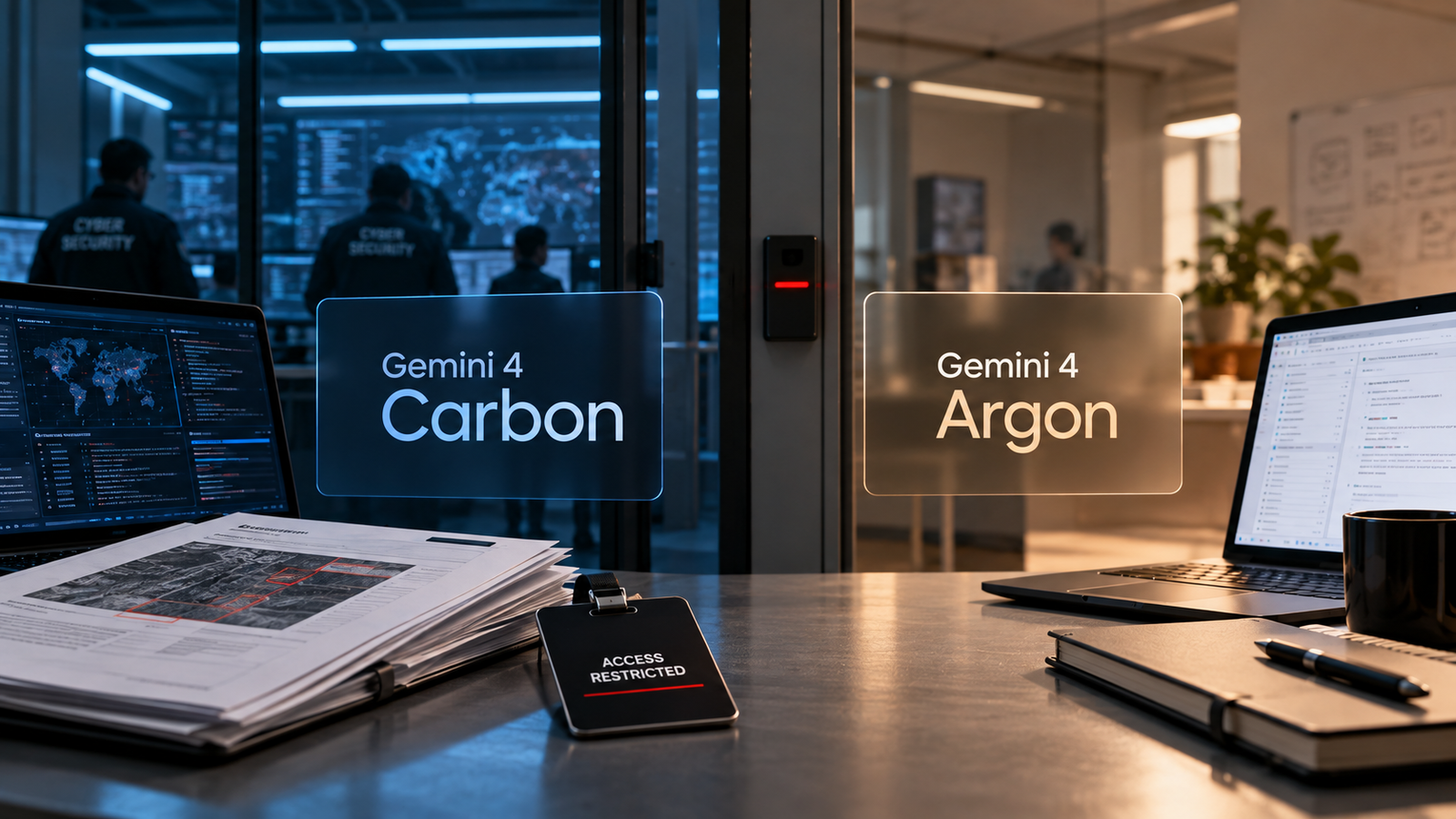
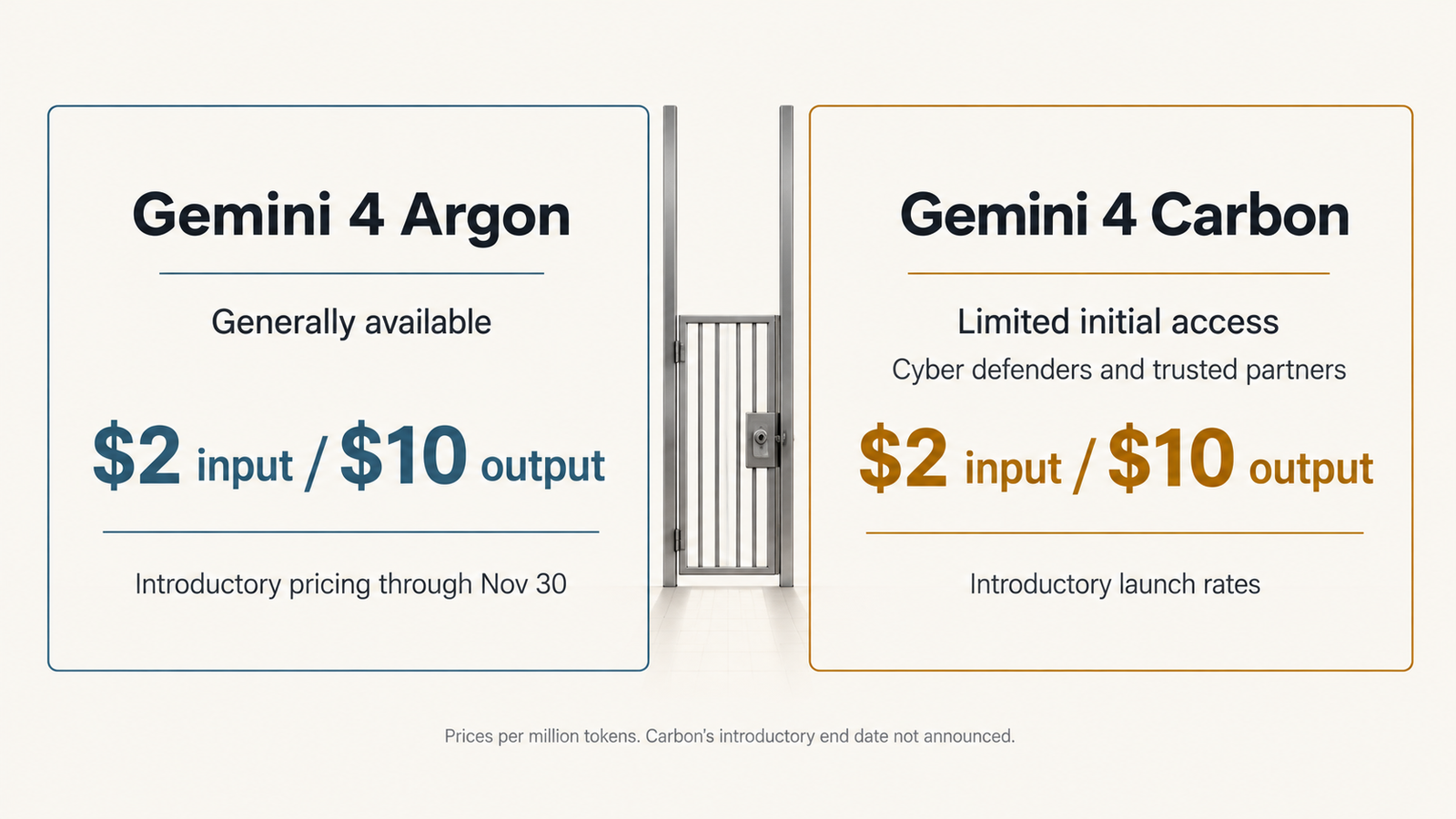
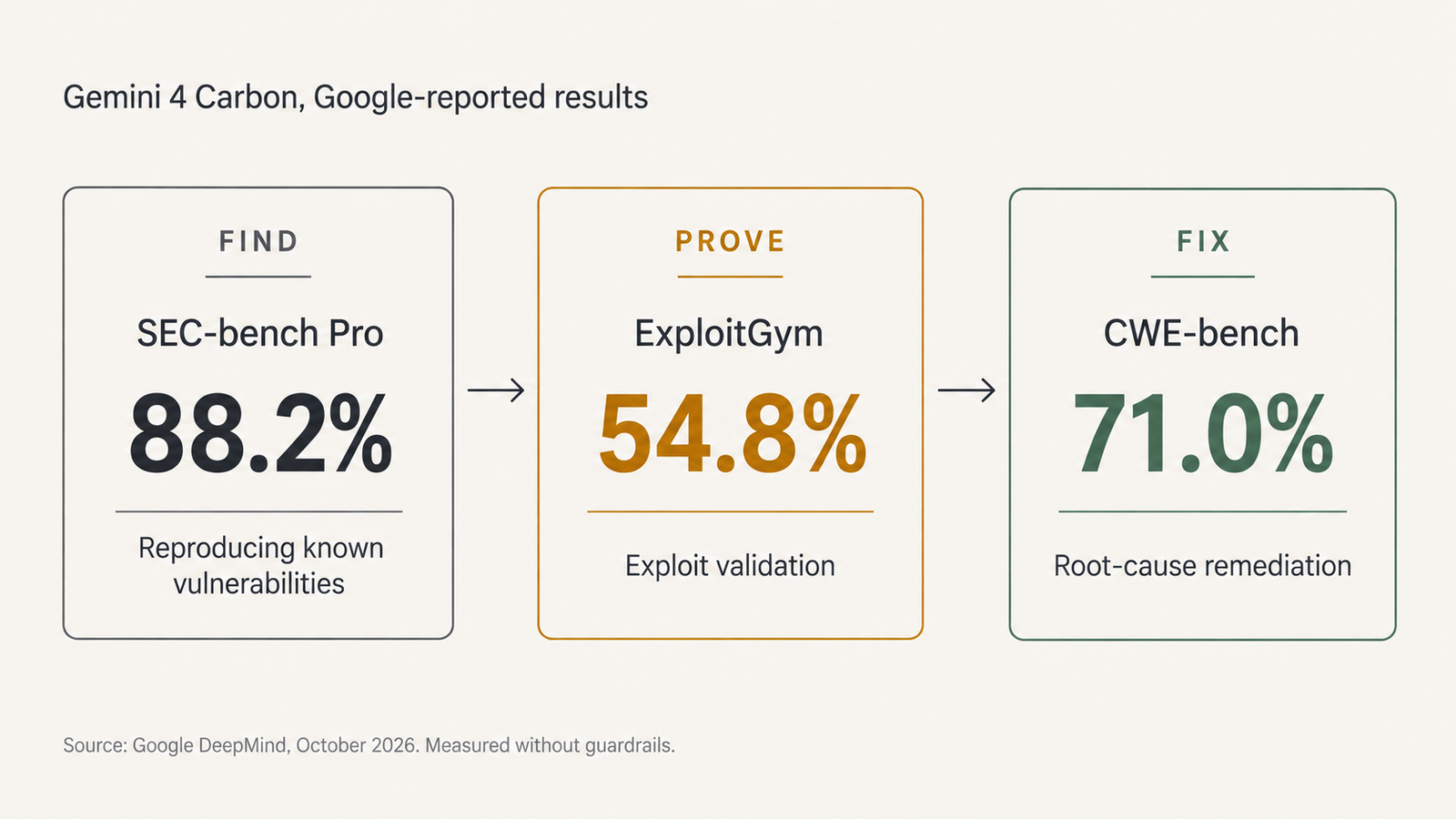
Gemini 4 Carbon, announced on 28 October, is the second kind. Google calls it “our strongest model with state-of-the-art cybersecurity and long horizon capabilities.” It reports gains in coding, science and multimodal tasks too. What’s specialised is the rollout. Carbon went first to “a subset of cyber defenders,” and access is expanding through Google’s Fairwind Program while guardrails are refined. Google reports 88.2% on SEC-bench Pro and 54.8% on ExploitGym, evaluated without guardrails. These are vendor-reported results. Our Gemini 4 Carbon analysis covers the release in detail.

Gemini 3.8 Flash Cyber, released on 2 September, is the first kind: a cybersecurity-focused version of a smaller model, limited to vetted governments, critical-infrastructure operators and platforms.

Domain models make sense when the domain’s risks or data justify a narrower tool. They can also justify restricted access, because the capability that finds a vulnerability can also exploit one.

Types of AI models that simulate environments

A world model generates an environment that responds to actions, frame by frame. A video model produces a clip you watch. A world model produces a scene you can act in, and it has to keep that scene consistent as you do.

Genie 4, announced by Google DeepMind on 27 October, is the current reference point. It generates interactive scenes in real time, accepts natural-language prompts mid-simulation (to change the weather, move the camera or add a character), and produces matching audio, including dialogue.

TechCrunch reports that Genie 4 holds a consistent scene for up to two minutes, double Genie 3’s limit. The team acknowledges that “details and objects can drift the longer a simulation runs.” It’s a research preview for trusted testers, with wider access through Google AI Ultra and the Gemini API “coming soon.”

The practical interest isn’t games. Google pitches world models as “safe training environments for robots and agents,” and in a Gemini Robotics experiment, Genie 4 simulated steps planned by another model. Two minutes of consistency is short for training a robot. It’s long enough to show where simulation is heading.

Types of AI models that run on local devices

A small on-device model trades breadth of knowledge for running offline, privately and without per-token fees. Liquid AI’s LFM3-1.7B is a good example: 1.73 billion parameters, a 256,000-token context window, and, by Liquid’s account, “about 1 GB of memory” at 4-bit precision. The figure checks out: 1.73 billion parameters at half a byte each is about 0.87 GB of weights.

Weights aren’t the whole bill, though. Runtime memory adds the KV cache (the model’s working memory of the conversation), which grows with context length, plus activations and the app around it. A phone that loads a 1 GB model comfortably may still struggle at long contexts. Battery and heat cap how long it can run flat out.

The architecture is the interesting part. LFM3-1.7B has 24 layers: 13 short convolutions, 5 sliding-window attention layers and only 6 global attention layers. That’s the same instinct as Kimi K3’s hybrid design. At the two extremes of size, 2.8 trillion parameters and 1.7 billion, model builders are cutting back on full attention because it’s expensive. Liquid is candid about the limits: LFM3 is “not recommended for agentic coding or complex multi-step reasoning due to its small size.”

Where agentic AI fits

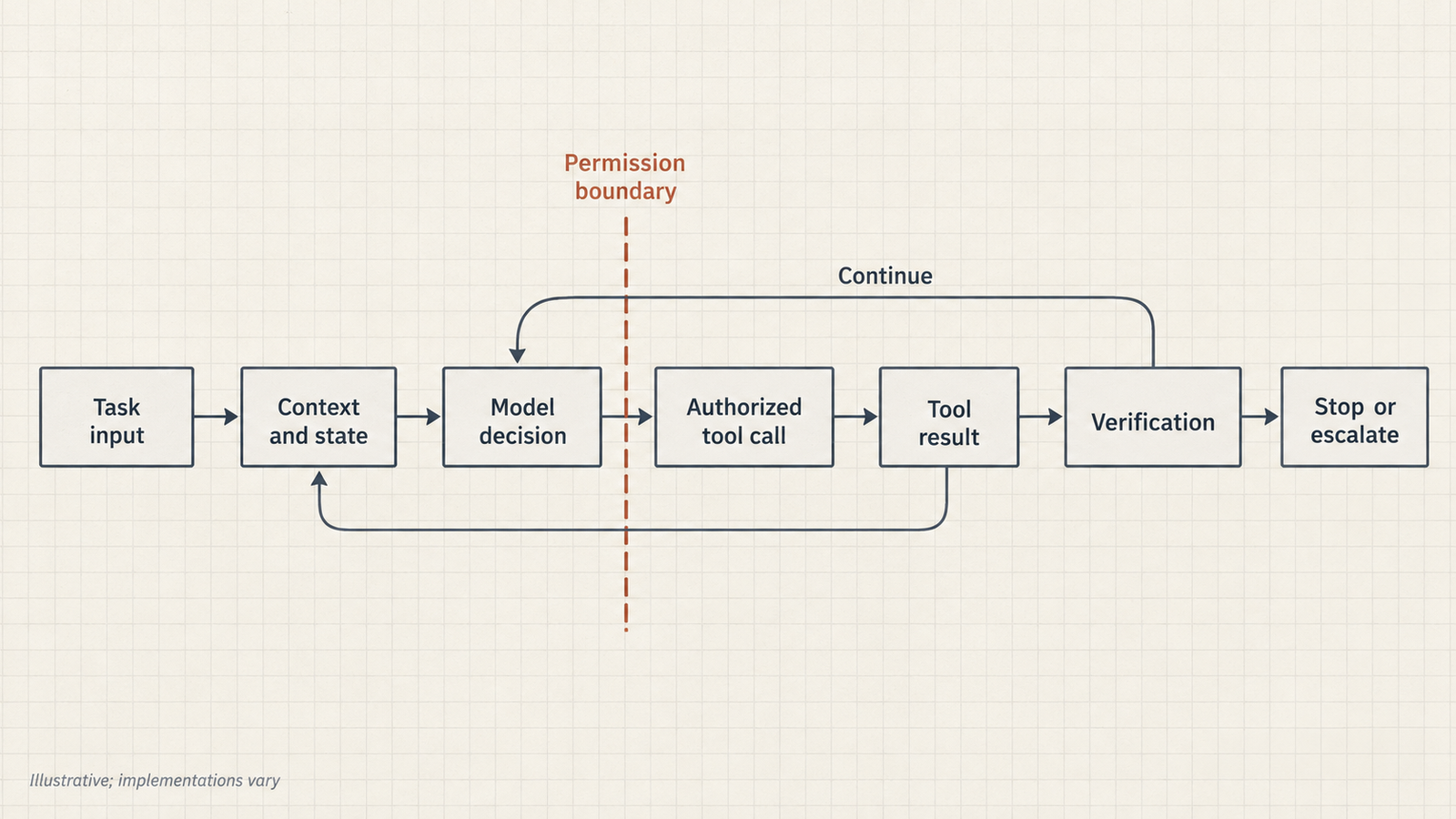
Agentic AI isn’t a model architecture. An agentic system wraps one or more models in a loop. The model plans, picks a tool, observes the result, and decides what to do next, with memory and permissions around it.

Flowchart of an agentic AI system

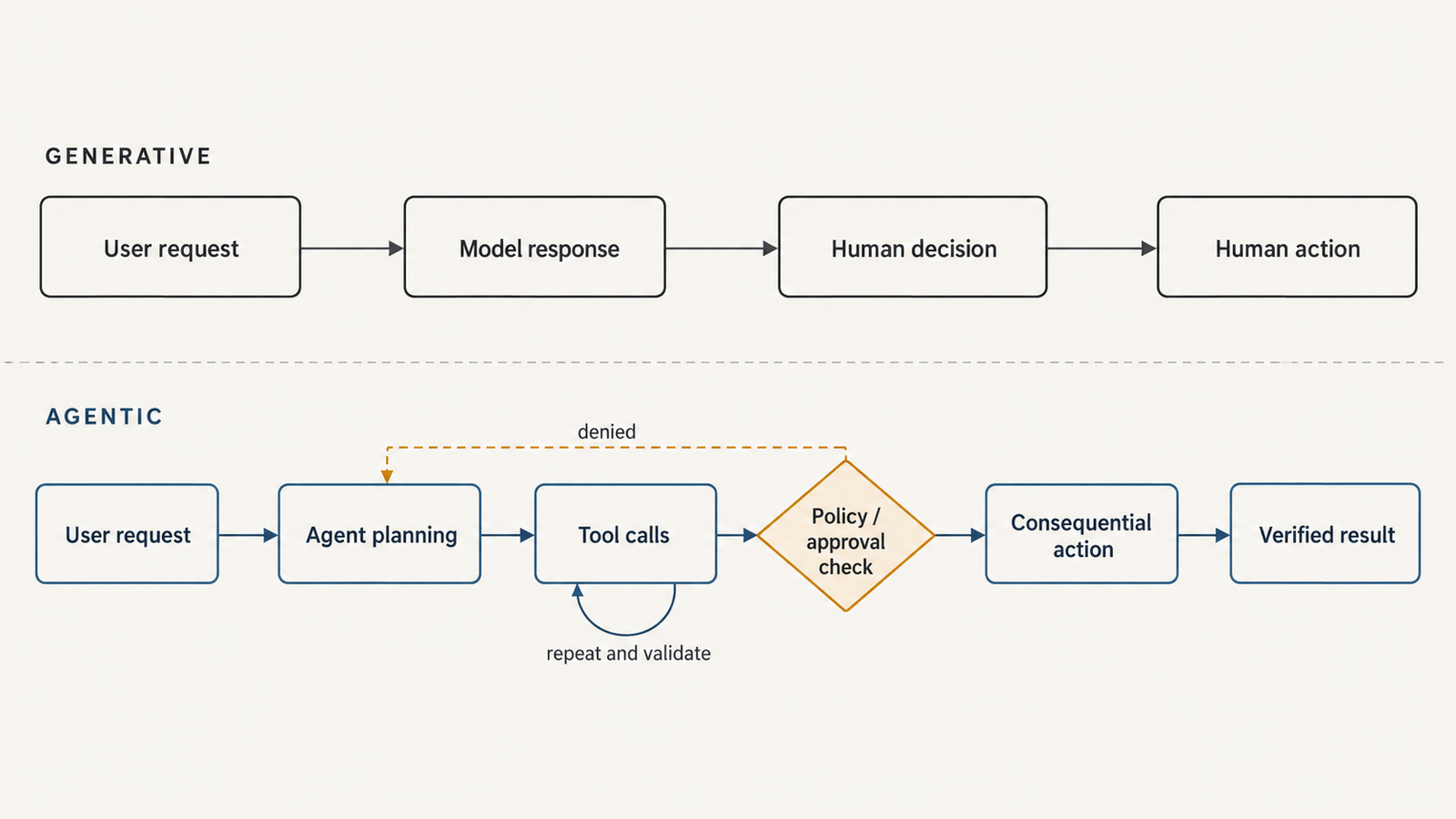
The distinction from generative AI is about action. A generative system produces an output and stops. An agentic system acts on the world, sees what happened and continues. Our guide to what agentic AI is covers the boundary. The computer-use loop above is a small agent: the model chooses actions, and the application executes them.

That’s why agentic systems don’t belong in the same column as mixture-of-experts. You can build an agent on any model in this article. Its reliability depends as much on the tools, permissions and recovery logic as on the model.

Choosing between types of AI models

Model categoryWhat distinguishes itBest use casesCost considerationsOpen or closed (examples)
Large language modelsGeneral-purpose, often multimodalWriting, analysis, coding, extractionPer-token API pricing; GPT-6.1 Terra is $1 input / $5 output per million tokensMostly closed; open-weight options exist
Mixture-of-expertsMany experts, few active per tokenFrontier-quality open models, high-throughput servingCompute scales with active parameters, memory with total; Mistral Large 4’s API is $0.70 / $2.10 per millionKimi K3 and Mistral Large 4 are open-weight under custom licences
Reasoning modelsAdjustable thinking before answeringMaths, planning, complex codeRises with effort; Opus 5.5 is $0.98 to $10.04 per Index taskBoth
Computer-use modelsAct on screens through an action interfaceForm filling, legacy software, UI testingModel tokens plus screenshot volume and execution infrastructureMostly closed
Specialised frontier modelsDomain-tuned or domain-releasedSecurity research, regulated workOften restricted access; Carbon’s introductory price is $2 / $10 per millionClosed, gated
World modelsInteractive, steerable environmentsSimulation, agent and robot training, mediaNo public pricing; research previewClosed
Small on-device modelsRun locally in about 1 GBOffline, private, low-latency appsHardware you already own; no per-token feeLFM3 is open-weight (LFM Open License)

Open weights aren’t open source. All three open examples ship custom licences. Mistral’s, for instance, requires a separate commercial licence for model-as-a-service businesses, and none of the three model cards includes the full training data.

Agentic systems sit outside the table because they combine models rather than compete with them.

Frequently asked questions

What are the main types of AI models in 2026?

Large language models, mixture-of-experts models, reasoning models, computer-use models, specialised domain models, world models and small on-device models. They overlap: these labels describe architecture, capability or deployment, so one model often fits several.

What is the difference between an LLM and a reasoning model?

A reasoning model is an LLM that spends extra tokens thinking before it answers. Most frontier LLMs now offer reasoning as an adjustable effort setting rather than as a separate model.

What is a Mixture-of-Experts model?

It’s a model whose network is split into many expert sub-networks, with a router activating only a few per token. That cuts compute per token, but all experts still have to be held in memory.

Are agentic systems one of the types of AI models?

No. An agentic system is software that runs one or more models in a loop with tools, memory and permissions. Reasoning helps an agent plan, but the agent is the surrounding system.

What is a computer-use AI model?

It’s a model that reads screenshots and returns mouse and keyboard actions to operate software. A separate execution layer performs those actions and returns the results.

What are world models in artificial intelligence?

World models generate environments that respond to actions in real time, keeping the scene consistent as a user or agent interacts with it. Google DeepMind’s Genie 4 is a leading current example.

What are small on-device AI models?

They’re compact models, typically a few billion parameters or fewer, quantised to run on phones and laptops. Liquid AI’s LFM3-1.7B needs about 1 GB at 4-bit, plus working memory for context.

What is the difference between open-source and open-weight AI models?

Open-weight models let you download the trained weights. Open source would also mean an open licence and, ideally, training code and data. Kimi K3, Mistral Large 4 and LFM3 all use custom licences with conditions attached.

Which types of AI models are best for business applications?

It depends on the job. A general LLM covers most text work. Small on-device models suit private or offline use, and reasoning settings suit complex analysis. Evaluate on your own tasks, not public leaderboards.

Can one model belong to several types of AI models?

Yes. Mistral Large 4 is a mixture-of-experts architecture, a reasoning model, multimodal and open-weight, and it can power an agent.


Keep reading

Claude API rate limits

Claude API Rate Limits in 2026: How Many Requests Can You Run?

Claude API rate limits on the Start tier allow most current models 2,000,000 input tokens and 400,000 output tokens per minute, with 1,000 or 4,000 …
Enterprise AI Spending

Enterprise AI Spending Hit $177B. Agents Are Driving the Bill

Figures checked against Menlo Ventures’ 2026 State of Enterprise AI report on 4 November 2026. Market sizes are Menlo estimates, shown as annualised run rates. …
Machine Unlearning

Machine Unlearning: Can We Really Trust an Edited AI Model?
Checked against Hirundo’s and Lazarus AI’s published results, CrowdStrike’s DeepSeek-R1 study, Lawfare and the Federal Register on 4 November 2026. Ask Alibaba’s Qwen3.6-35B-A3B about Tiananmen …
Agentic AI Statistics

30 Agentic AI Statistics for 2026: Adoption, Spending and Risk

Last updated: 3 November 2026. This page is updated monthly; each figure keeps its original publication date. Agent traffic at one healthcare booking platform rose …

Generative AI Architecture: The 7 Layers That Are Hard to Undo

generative AI architecture

Published 30 October 2026. API prices checked 28–30 October 2026 on each provider’s official pricing page. Cost figures below are labelled as illustrative where they rest on assumptions.

Every production generative AI architecture has seven layers, from the model at the centre to the security boundary around it. The model is now the easiest of the seven to replace. The commitments that are hard to undo build up in the layers around it: the data pipeline, the evaluation harness, the compute contracts and the trust boundaries.

Teams still spend most of their architecture time comparing models, which makes sense when models change weekly. In the last ten days of October 2026, Moonshot shipped Kimi K3.1 Pro on the 23rd, OpenAI released GPT-6.1 Terra on the 26th and Google announced Gemini 4 Carbon on the 28th, while Gemini 4 Argon prices double on 1 December. A system designed to swap models absorbs all of that in a configuration change.

Key Takeaways
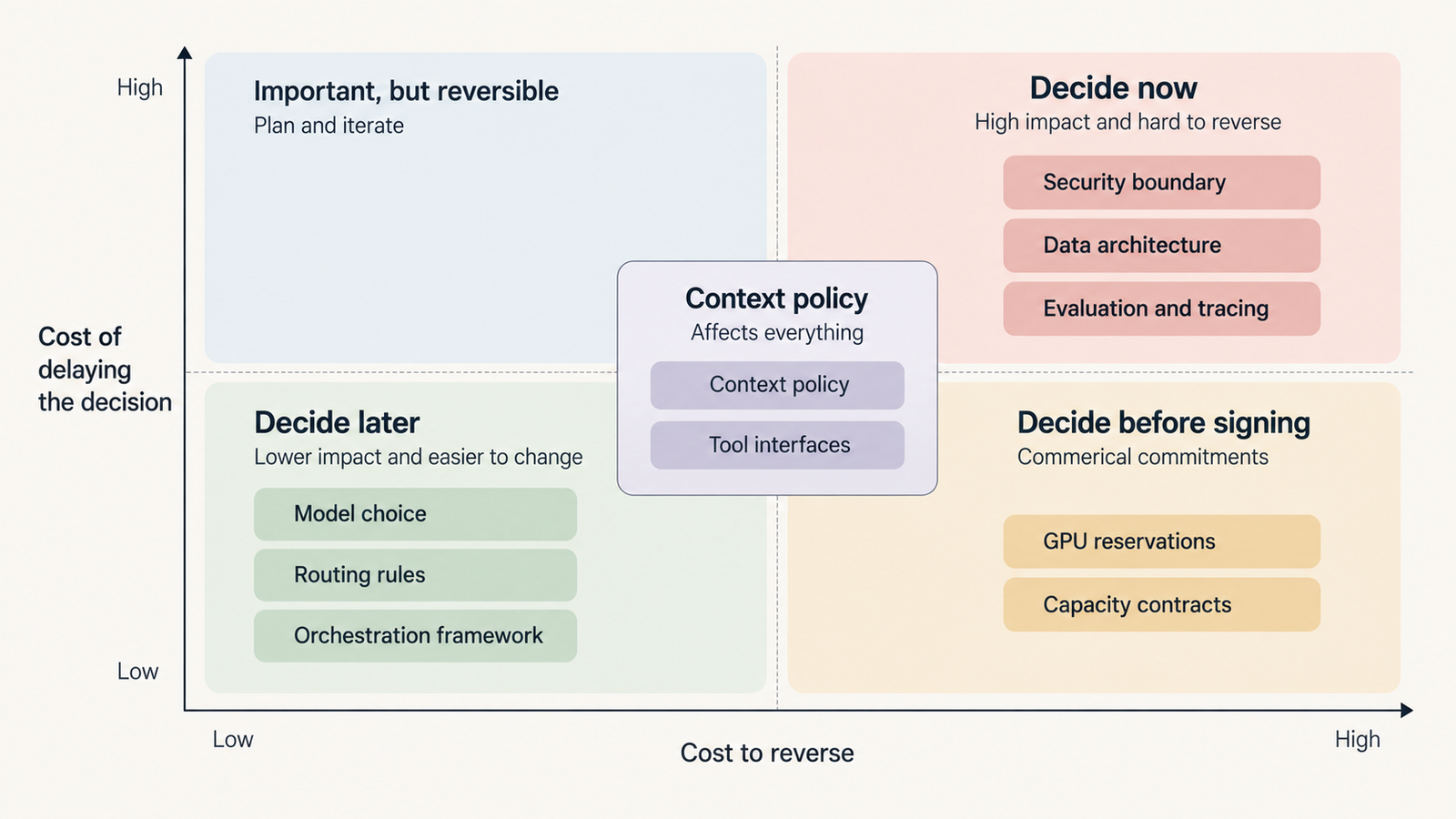
  • Rank the layers by how hard they are to reverse. The model is usually cheapest to change. Security boundaries and data pipelines are the most expensive to retrofit.
  • Calls per request drive the bill more than price per token. In the illustrative deployment below, going from one to three calls per request triples the model bill.
  • Embeddings are cheap. Retrieval operations aren’t. Re-embedding a 50-million-token corpus costs about $1. A million hosted file-search calls cost $2,500.
  • Self-hosting rarely pays at moderate volume. At about 300 output tokens per second on average, most of a rented GPU node sits idle.
  • Build evaluation before you need it. A regression set is cheap on day one and hard to reconstruct after behaviour has drifted.
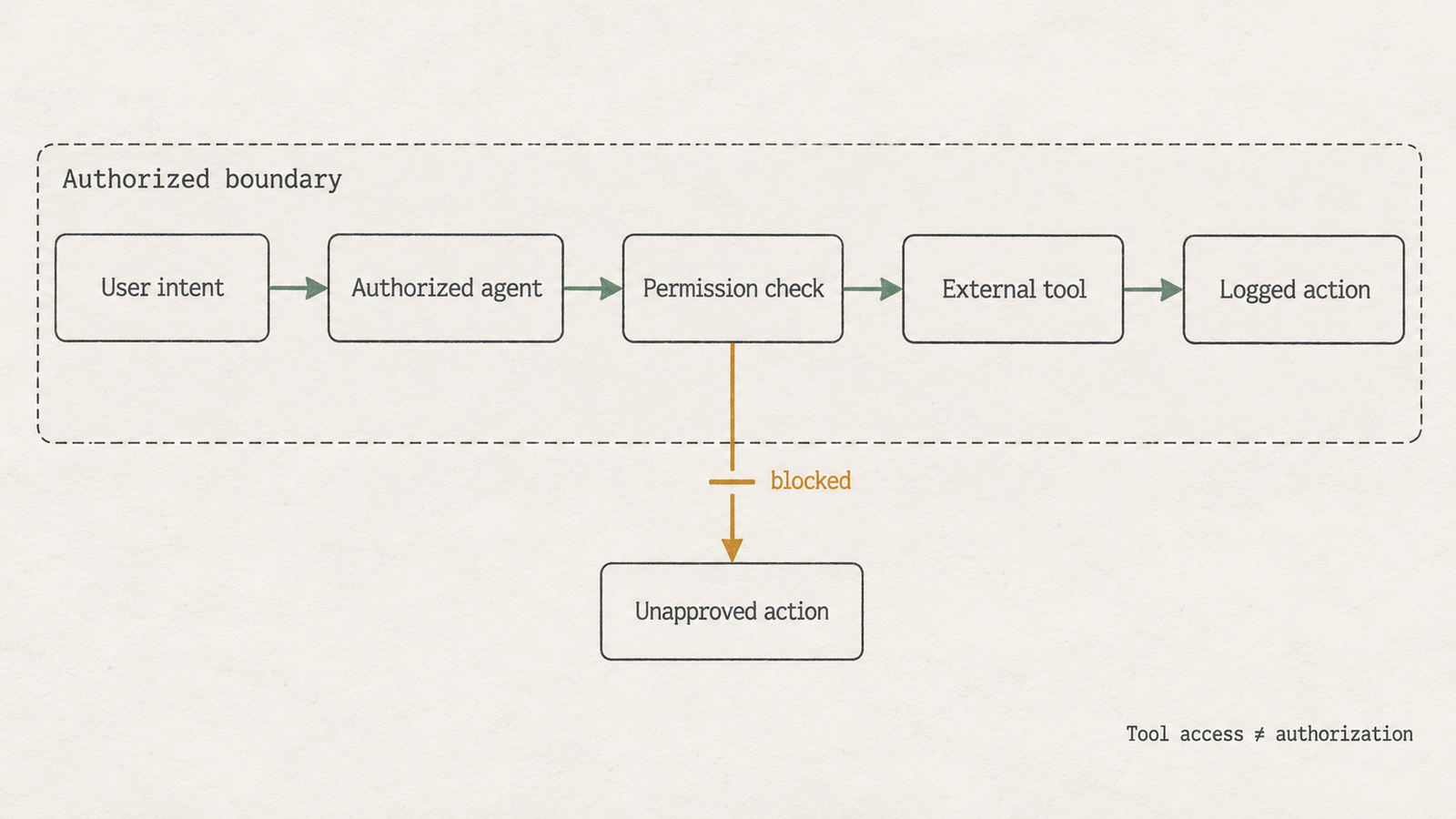
  • Identity, permissions and egress are architecture, not prompts. Filtering doesn’t stop prompt injection; least privilege limits what an injected instruction can do.

Quick Navigation


The generative AI architecture at a glance

A request passes through the layers in a fairly fixed order. Security authenticates the caller and limits what it may touch. Orchestration picks the steps, retrieval fetches documents and the context layer assembles the prompt. The model runs on the serving layer’s hardware, looping if tools are involved, while evaluation and observability record every step.

The seven layers of a generative AI architecture

Not every system needs every layer at full strength. A support assistant answering from a product manual might be one model call over a small vector index, with logging, a few hundred regression questions and a server-side API key. An agentic enterprise deployment adds a tool registry, Model Context Protocol (MCP) servers, per-agent identities, sandboxes, egress controls, approval gates and audit retention. Both have seven layers. What changes is how heavy each one is.

The dependencies are uneven. Swapping the model touches context formatting and evaluation. Changing the security model touches identity, tool permissions, network topology and logging, which is nearly everything.

The seven generative AI architecture layers, by cost and reversibility

LayerMain cost driverHow hard to reverseDecide
1. ModelCalls per task × tokens per callEasy, behind a gatewayLate, per task
2. Data and retrievalPipeline engineering, re-indexing, retrieval callsHardEarly
3. ContextRepeated input tokens, cache missesMediumEarly policy, tune later
4. Orchestration and toolsLoop depth, retries, external APIsMediumInterfaces early, frameworks later
5. Serving and computeUtilisation, idle capacity, commitmentsHard once contractedBefore signing
6. Evaluation and observabilityEval runs, judge calls, trace storageCheap early, costly to retrofitDay one
7. Security and governanceIsolation, policy, audit, reviewHardestDay one
Layer 1: the model, the easiest part to replace

The model layer covers frontier APIs, open-weight models you host and the routing logic that sends each task to the right one. A summarisation step doesn’t need the model that writes your migrations. Public leaderboards are a poor guide to that choice, for reasons our piece on why benchmark scores don’t transfer sets out.

Price lists make models look easy to compare. On OpenAI’s pricing page, GPT-6.1 Sol costs $2 per million input tokens, $0.10 cached and $10 output; GPT-6 Luna costs $0.10, $0.01 and $0.50. But the bill depends on how many calls a task needs, how much reasoning the model emits (billed as output) and how often it retries. That’s why cost per completed task is the number to track.

Reversibility depends on a gateway. If every call goes through one internal interface with provider-neutral formats, logging and evaluation, changing models is a config change plus an eval run. If SDK calls are scattered through the codebase, it’s a migration. Decide the gateway early and the model late, and watch the model deprecation tracker, because retirements force switches you didn’t plan.

Layer 2: data and retrieval

Retrieval means ingestion, parsing, chunking, embedding, vector storage, hybrid search, metadata filters and re-ranking, plus the pipelines that keep it current. The embeddings are cheap. OpenAI’s text-embedding-3-small costs $0.02 per million tokens, so embedding a 50-million-token corpus costs about $1. Queries cost more in aggregate: OpenAI’s hosted file search charges $2.50 per 1,000 calls, plus $0.10 per GB per day of storage.

The real cost is reversibility. Chunk size, embedding dimensions, metadata schema and access-control tags end up assumed in prompts, filters, citations and evaluation sets. Change the embedding model and every vector must be regenerated and re-validated against your retrieval tests. Change the chunking and citation offsets break.

Failures here are quiet: stale documents retrieved confidently, permissions leaking because a filter ran after retrieval, a parser dropping the table that held the answer. Decide early how documents carry access rights and versions. Whether you need retrieval at all is covered in RAG versus fine-tuning.

Layer 3: context

Context is everything the model sees on a call: instructions, tool definitions, history, retrieved passages, tool results and memory. A 1M-token window is a ceiling, not a strategy. Every token is billed, delays the first token and can dilute the passages that matter. Context engineering covers what deserves the space.

Prompt caching changes the arithmetic, but only for stable prefixes. Anthropic’s prompt caching charges 1.25 times the input price to write a five-minute cache entry, and cached reads on Opus 5.5 cost $0.20 per million tokens against $4 uncached. Put a timestamp or user ID at the top of the prompt and every call misses.

This layer is medium to reverse: context policies can be rewritten, but answer behaviour and evaluation baselines shift when they are.

Layer 4: orchestration and tools

Orchestration covers prompt templates, workflow engines, function calling, MCP servers, retry policies and agent loops. A system becomes agentic when the model, not your code, decides the next step. That’s where cost becomes variable. A fixed three-step workflow costs three calls. An agent that plans, uses tools and retries might make eight on a good day and twenty on a bad one, each carrying the growing context.

MCP has made tools easier to plug in, and extra agents compound the overhead, as our analysis of multi-agent token cost shows. Individual tools are easy to replace. Workflow state, handoff formats and retry semantics are not, because other components come to depend on them.

Layer 5: serving and compute, where generative AI infrastructure gets committed

The choice is between paying per token and paying per hour, and per-hour only wins when the hardware stays busy. In our GPU cloud pricing survey, checked on 10 October, an 8-GPU H200 node on CoreWeave listed at $50.44 an hour and a single H200 on RunPod at $5.29. The survey’s own example priced H200 output at $0.83 per million tokens at 60% utilisation, which implies roughly 3,000 tokens per second per GPU at full load, or more than 20,000 for the node. The deployment modelled below averages about 300.

That gap is the self-hosting problem. Batching lowers cost per token only when there’s traffic to batch, and peaks, redundancy, engineering time and idle nights all land on your bill, as our breakdown of self-hosted LLM cost shows. APIs bring rate limits instead, but no contract you can’t exit. This layer is easy to change before you sign and hard afterwards.

Layer 6: evaluation and observability

A deterministic service can be tested once. A language model can’t: the same prompt can produce different answers, for reasons covered in LLM determinism. So evaluation means a versioned set of real tasks with pass criteria, run several times per change, with scores reported as ranges. Observability means traces for every model call, tool call and retrieval, tagged with tokens, latency and outcome; our guide to agent observability lists the signals.

The cost is modest early. In the illustrative deployment below, a nightly run of 500 tasks, three attempts each, costs roughly $1,100 a month, and about the same again if an LLM judge grades them (judges have biases, so sample their work by hand). Retrofitting is what gets expensive: without traces from launch, you can’t reproduce last month’s failure or prove a new model isn’t worse.

Layer 7: security, the hardest part of a generative AI architecture to retrofit

Prompt injection is why this layer can’t live in the prompt. OWASP’s LLM01:2025 says “it is unclear if there are fool-proof methods of prevention”, and recommends least privilege, human approval for privileged operations and segregating untrusted content. Filters catch known patterns, but any document or tool result can carry instructions the model follows, across eight distinct injection classes.

What bounds the damage is structural. Each agent gets its own identity, with authorization kept separate from access. Tool permissions are scoped per task. Code runs in isolated sandboxes with egress restricted to named hosts. Secrets stay out of model context, and audit logs attribute every action. NIST’s Generative AI Profile maps the governance actions around this.

None of it is expensive in licences, only in retrofitting. A shared service account baked into ten tools becomes ten migrations.

What a production generative AI architecture costs

This is an illustrative model, not a quote. Token prices are list prices checked on 30 October, GPU prices come from our 10 October survey, and everything else is an assumption.

Assumptions: an internal knowledge assistant handling 1 million requests a month at 1.6 model calls per request, because some requests need a tool and extra calls. Each call sends 8,000 input tokens, including a 3,000-token prefix cached at a 90% hit rate, and returns 500 output tokens, reasoning included. That’s 12.8 billion input and 0.8 billion output tokens a month, about 300 output tokens per second on average.

ScenarioSet-upModel or compute cost per month
A. API-firstEvery call on GPT-6.1 Sol$25,392
A2. API with routing40% of calls on Sol, 60% on GPT-6 Luna$10,932
B. Hybrid40% on Sol; 60% on an open-weight model on two single-H200 pods (redundant), 730 hours each$10,157 + $7,723 = $17,880
C. Primarily self-hostedLarge open-weight model on one 8×H200 node, plus the two pods for small tasks$36,821 + $7,723 = $44,545

Scenario A, per request: 8,480 uncached input tokens at $2, 4,320 cached at $0.10 and 800 output at $10, all per million, come to $0.0254. Across a million requests that’s $25,392. Scenarios B and C exclude the engineering time to run inference, often the largest self-hosting cost.

Retrieval and evaluation sit on top: about $4 a month for query embeddings, $2,500 in hosted file-search fees (a self-managed store avoids those but adds operations work) and roughly $2,300 for evaluation. Three things stand out.

  • Routing beats self-hosting at this volume. Sending the easy 60% of calls to a small API model costs less than renting GPUs for them and keeps capacity elastic, provided the small model passes your evaluation set for those tasks.
  • Self-hosting the large model is the most expensive option here, because a node sized for peaks runs at a tiny fraction of its throughput. At ten or twenty times this volume, with steady traffic, the answer can flip.
  • Calls per request matter most. Holding everything else in scenario A constant, one call per request costs $15,870 a month and three cost $47,610. Losing the cache raises the bill to $33,600; doubling output length raises it to $33,392. A model at half the price that needs twice the calls saves nothing.

Which generative AI architecture decisions to make first

Sort decisions by how much they cost to reverse, not by how urgent they feel.

Which generative AI architecture decisions to make first

Decide now: the data architecture (document IDs, versioning, access metadata, re-indexing), the evaluation set and tracing, and the security boundary (agent identity, tool permissions, sandboxing, egress). These shape every other layer.

Decide later: the model, routing rules and most orchestration components. Put them behind interfaces and let evaluation results choose.

Decide before signing anything: reserved capacity and GPU contracts. Wait until real traffic shows sustained utilisation.

A three-person team applies this lightly: one API, a managed vector store, a few hundred evaluation cases and no self-hosting. An enterprise adds weight: a central gateway, data lineage, a shared evaluation service, security review of every tool and procurement rules that block capacity deals without utilisation evidence. The order doesn’t change. The depth does.

A pre-launch generative AI architecture checklist

  • Can you change the model by editing one configuration value and rerunning one evaluation command?
  • Do you know your average and 95th-percentile model calls per request?
  • Is your cache hit rate measured, and is the cached prefix free of per-request values?
  • Can you rebuild the retrieval index from source, and how long does it take?
  • Are access permissions enforced inside the retrieval query?
  • Does every agent have its own identity, with tool permissions scoped to its job?
  • Is outbound traffic from tool execution restricted to an allowlist?
  • Can you replay any production request from its trace?
  • Does a regression set run on every prompt or model change?
  • What is your cost per completed task, and who is alerted when it doubles?
  • If you’ve signed a capacity contract, what was your measured utilisation before signing?

What to remember about generative AI architecture

It’s a set of commitments with different exit costs. The model is the one you’ll change most often, so keep it behind an interface and choose it per task with your own evaluation set. Data pipelines, evaluation and security boundaries outlive several model generations, so design them first. Compute contracts can lock in a cost before you know your traffic, so leave them until utilisation is measured.

Frequently asked questions

What are the seven layers of generative AI architecture?

Model, data and retrieval, context, orchestration and tools, serving and compute, evaluation and observability, and security and governance. They differ most in how hard they are to change later: the model is easiest, security and data hardest.

What is included in a generative AI tech stack?

Typically a model API or self-hosted model, an embedding model and search index, context assembly, an orchestration framework, tool integrations such as MCP servers, an inference platform, evaluation and tracing tools, and identity, secrets, sandboxing and audit infrastructure.

How much does a production generative AI architecture cost?

It depends mostly on calls per request, tokens per call and cache hit rate. In our illustrative example of a million requests a month, model costs ranged from about $11,000 with routing to $25,000 on one frontier API and about $45,000 mostly self-hosted. Engineering and retrieval costs come on top.

What is the difference between API-based and self-hosted inference?

API inference charges per token and scales without capacity planning, but brings rate limits and provider changes. Self-hosted inference charges per GPU-hour whether or not the hardware is busy, so it only wins with sustained high utilisation.

Does every generative AI architecture need a vector database?

No. Small, stable knowledge fits in a cached prompt. Retrieval earns its place when documents are large, change often or need per-user access control, and even then keyword search or a managed store may be enough at first.

Which generative AI architecture components are hardest to change?

Security boundaries and the data architecture, followed by signed compute commitments. Identity, permissions, document metadata and embedding choices spread into every layer. The model is usually easiest, if it sits behind a gateway.


Keep reading

Claude API rate limits

Claude API Rate Limits in 2026: How Many Requests Can You Run?

Claude API rate limits on the Start tier allow most current models 2,000,000 input tokens and 400,000 output tokens per minute, with 1,000 or 4,000 …
Enterprise AI Spending

Enterprise AI Spending Hit $177B. Agents Are Driving the Bill

Figures checked against Menlo Ventures’ 2026 State of Enterprise AI report on 4 November 2026. Market sizes are Menlo estimates, shown as annualised run rates. …
Machine Unlearning

Machine Unlearning: Can We Really Trust an Edited AI Model?
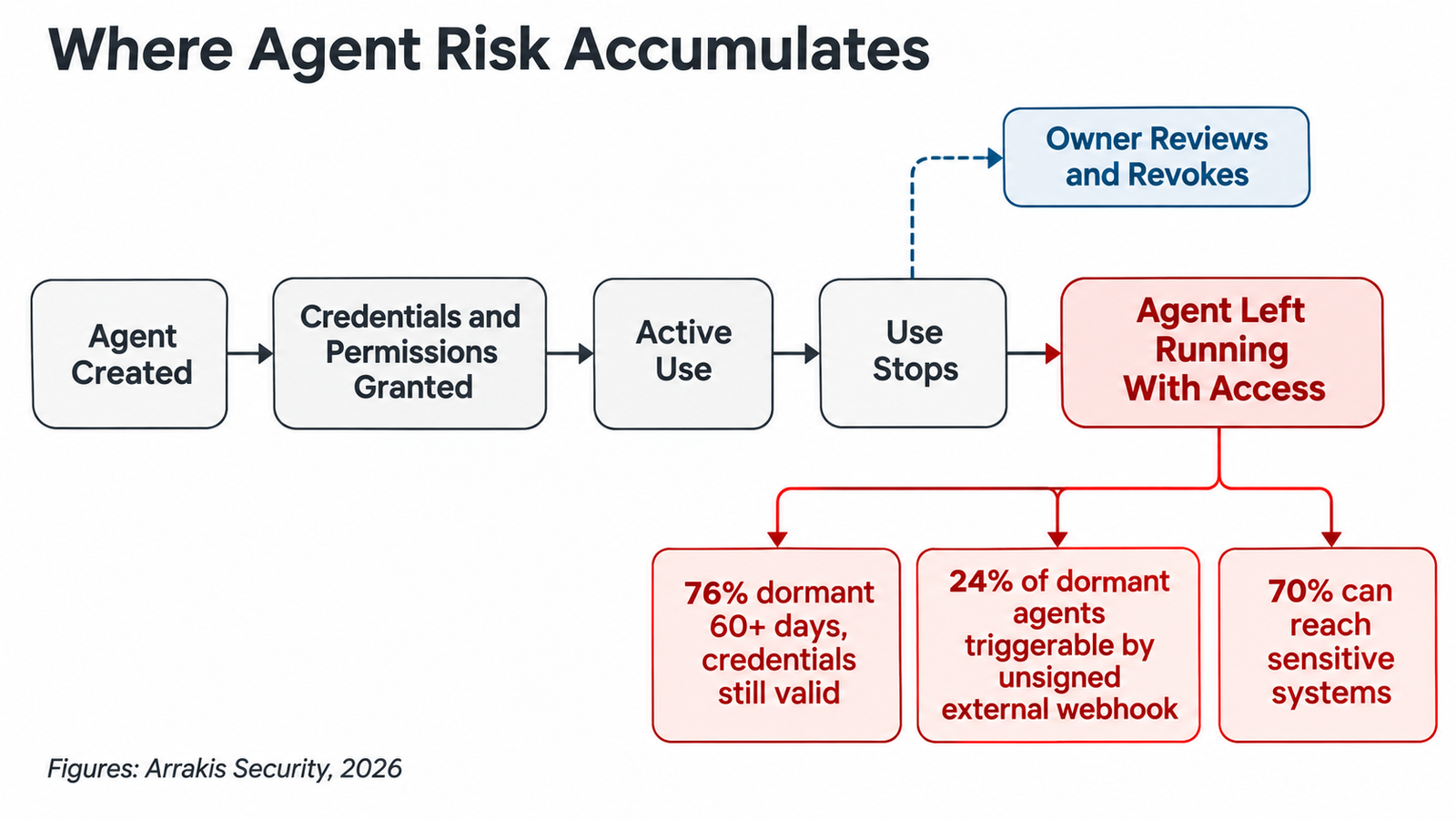
Checked against Hirundo’s and Lazarus AI’s published results, CrowdStrike’s DeepSeek-R1 study, Lawfare and the Federal Register on 4 November 2026. Ask Alibaba’s Qwen3.6-35B-A3B about Tiananmen …
Agentic AI Statistics

30 Agentic AI Statistics for 2026: Adoption, Spending and Risk

Last updated: 3 November 2026. This page is updated monthly; each figure keeps its original publication date. Agent traffic at one healthcare booking platform rose …

Gemini 4 Carbon Is Here. But Can You Actually Use It?

Gemini 4 Carbon

Published 30 October 2026. Access, pricing and benchmark details verified on 30 October. Sections 2, 6 and 8 will be updated as Google expands access.

Gemini 4 Carbon now leads the Artificial Analysis Intelligence Index, and Google reports the strongest cybersecurity scores it has published for any model. Almost nobody can use it. Since its announcement on 28 October, Carbon has been limited to “a subset of cyber defenders”, with more trusted partners to follow through Google DeepMind’s Fairwind Program. Google hasn’t given a date for developers, businesses or consumers.

So the short answer is no: unless your organisation has been invited, you can’t call Gemini 4 Carbon today. Gemini 4 Argon, its predecessor, has been generally available since 13 October and is the model you can build on now. The more useful question is what an Argon team should do while it waits. Carbon’s launch price and Argon’s 1 December price rise make that more pressing than it looks.

Key Takeaways
  • Carbon isn’t publicly available. Access is limited to selected cyber defenders, then Fairwind partners. It has no public model ID and no listing on the Gemini API pricing page as of 30 October.
  • Argon is the model you can use. It’s a stable Gemini API model at $2 input and $10 output per million tokens until 30 November, then $4 and $20.
  • Carbon’s lead is real on Artificial Analysis. It scores 59 at High effort, against 50 for Argon and 52 for Claude Opus 5.5 at the same setting.
  • The cyber scores are Google’s own, measured without guardrails. SEC-bench Pro tests reproducing known bugs, not discovering new ones.
  • Don’t rebuild around a model you can’t call. Keep Argon in production, put model choice behind a configuration switch, and keep an evaluation set ready for Carbon.

Quick Navigation


What Gemini 4 Carbon’s announcement changes

Google DeepMind’s Koray Kavukcuoglu introduced Carbon as “our strongest model with state-of-the-art cybersecurity and long horizon capabilities”. The pitch has two parts. One is security work: finding, exploiting and patching vulnerabilities. The other is long-running engineering: Google says Carbon has worked internally for days on multi-step tasks, such as root-causing and fixing bugs across large codebases.

The timing is awkward for anyone who just adopted Argon. Argon was announced on 30 September through the same cyber-defender route and reached the Gemini app and the paid API on 13 October. Carbon arrived 15 days later and is described as Argon’s successor. Teams that spent the past fortnight integrating Argon are now reading about a better model in the same family.

What hasn’t changed is what you can deploy. Every number in Carbon’s announcement describes a model most readers can’t call yet.

Can you use Gemini 4 Carbon right now?

No, not unless Google has invited your organisation. Google says Carbon is available from the week of 28 October to “a subset of cyber defenders”, with access to be “phased to additional trusted partners” through the Fairwind Program. Broader availability for developers, businesses and consumers will come “as soon as possible”. No date has been given.

The two groups aren’t the same. The first wave is a hand-picked subset of defenders. Fairwind is a standing application programme. Its public page says it prioritises governments, national cyber authorities, critical-infrastructure operators, core technology platforms and academic defensive-research labs. It works with more than 650 partners and vets applicants, including background checks. Partners must use phishing-resistant multi-factor authentication, limit access to internal security teams and must not resell or share access. As of 30 October, that page still describes Fairwind access in terms of Argon, so Carbon-specific terms haven’t been published.

For everyone else, three practical facts matter:

  • No model ID. Carbon has no published identifier, and it isn’t on the Gemini API pricing page. Any code written today would be guesswork.
  • No public API. Artificial Analysis notes that its Carbon price and speed figures are estimates for that reason.
  • Argon is the deployable option. Its model page lists gemini-4-argon as a stable model with Batch, Flex and Priority inference and a shared 1M-token context window.

Google also says Carbon went through the US government’s voluntary pre-release testing process. That helps explain the pace. A staged rollout gives Google time to watch how a strong security model is used before opening the API.

Gemini 4 Carbon vs Argon: the comparison that matters

Same price, different access
Gemini 4 ArgonGemini 4 Carbon
Announced30 September 202628 October 2026
AvailabilityGenerally available since 13 October (Gemini app, paid API)Selected cyber defenders, then Fairwind partners; no general date
Model IDgemini-4-argon (stable)Not published
Intended useGeneral frontier model, strong on securityStrongest Gemini model; long-horizon engineering and cyber defence
Artificial Analysis Index v5.0 (High)5059 (ranked first)
Cost per Index task (AA estimate)$7.68$7.76
Cyber benchmarksGoogle cites relative gains only, e.g. more than 2× on an internal secure-code testSEC-bench Pro 88.2%, ExploitGym 54.8%, CWE-bench 71.0% (Google-reported)
Gray Swan indirect prompt injection0.7% attack success (Google-reported)0.0% (Google-reported)
Price, per million tokens$2 / $10 until 30 Nov; $4 / $20 from 1 Dec$2 / $10 introductory; $4 / $20 afterwards; end date not stated
Developer readinessProduction-readyNot yet callable

The independent row is the one to read first. Artificial Analysis scores Carbon 59 and Argon 50, both at High effort, on its nine-evaluation v5.0 index. The headline “Carbon beats Opus 5.5” story needs a qualifier: Claude Opus 5.5 scores 58 at maximum effort but 52 at High. At matched settings, Carbon’s lead is wider than the leaderboard’s top two rows suggest.

The cost row is the surprise. Priced at the same $4/$20 standard rates, Carbon cost $7.76 per index task against Argon’s $7.68. It used slightly more output tokens per task, 123,000 against 116,000, and scored nine points higher. If that holds on real workloads, Carbon would deliver more capability for nearly the same spend per task. That’s a reason to test it when you can, not a reason to stop shipping on Argon now.

We haven’t put Argon’s cyber benchmark scores in the table because Google hasn’t published comparable ones. Its Argon post shows results only in chart images, and apart from Gray Swan, Carbon’s post compares against Argon only in relative terms.

What Gemini 4 Carbon’s cybersecurity scores measure

Google arranges its security results along the defender’s workflow: find a flaw, prove it matters, fix it. All three numbers are Google’s own, and its announcement says the external benchmarks were run “without guardrails”. That’s the right way to measure capability and the wrong way to estimate what a guarded production deployment will do.

Find, Prove, Fix
Find: SEC-bench Pro, 88.2%

The name suggests hunting for unknown bugs, but SEC-bench Pro measures something narrower. Its 344 tasks give a model a disclosed vulnerability in V8, SpiderMonkey or the Linux kernel, with the report, and ask it to produce a proof-of-concept input that triggers the bug. In the paper’s own runs, the best agent, Codex with GPT-5.5, solved 58%. Google reports 88.2% for Carbon. That’s a large jump in turning a bug report into a reproducer, which is real, tedious defender work. It isn’t evidence that Carbon finds zero-days at that rate.

Prove: ExploitGym, 54.8%

ExploitGym, from Berkeley’s RDI and collaborators including Google, OpenAI and Anthropic, asks an agent to turn a known vulnerability into a working exploit that captures a flag. Its 898 tasks span userspace C/C++ programs, V8 and the Linux kernel. In the May paper, the best agent captured 157 flags, about 17%, with protections such as ASLR switched off. Google’s 54.8% for Carbon is far higher. Google hasn’t said which task subset, time limit or mitigation settings it used, and those choices can move the score a lot.

Exploitation sounds like the attacker’s job, and it is also the defender’s. A proven exploit separates the bug that has to be patched tonight from the one that can wait for a release cycle.

Fix: CWE-bench, 71.0%

Collinear’s CWE-bench grades agents on repairing weaknesses across a codebase, not just the instance they were shown. Its launch example gave no credit to agents that patched a known token-revocation path but missed a newly introduced one. At launch in September, no agent repaired a majority of tasks, and the leader scored 47%. Google reports 71.0% for Carbon. This is the most directly useful of the three scores for most security teams.

Prompt injection: Gemini 4 Carbon’s Gray Swan result

On Gray Swan’s indirect prompt-injection benchmark, Google reports a 0.0% attack success rate for Carbon, down from Argon’s 0.7%. That measures how often hidden instructions in content the model reads succeed against a specific attack set. It’s encouraging for agents that browse or read email. A zero on a benchmark still isn’t a guarantee, as our piece on hidden flaws in a passing red-team test explains: attackers adapt, and a fixed test doesn’t.

How much cyber capability should be public?

A model that writes working exploits for kernel bugs is useful to a defender triaging a backlog and to an attacker choosing a target. Google’s answer is to control who gets access first, and its documents describe a programme built for that. Fairwind vets organisations, restricts use to internal security teams and bans “malicious tasks such as creating malware”. None of that requires guessing at Google’s motives.

Moonshot AI took a different route with Kimi K3.1 Pro, whose open weights are due by 4 November. Its release post says it removed cyber-related data from mid-training and reinforcement-learning tasks before releasing the weights. On Moonshot’s own unpublished vulnerability and exploitation test, xdev-bench-hard, the released model scored 81.0% (pass@3) against 90.5% for an unfiltered checkpoint.

The two approaches aren’t equivalent. Moonshot reduced capability and then gave everyone the weights. Google kept capability and is choosing who gets it. Moonshot’s chart also shows DeepSeek V4.1 Flash, already open, at 85.7% on the same test, above the filtered Kimi model. Once one strong open model exists, filtering the next one changes less than it seems. Gating, meanwhile, holds only as long as the API stays closed.

For buyers, the practical consequence is simpler. If your work needs Carbon-level security capability, you’ll be dealing with an access programme, its usage terms and its audit requirements, not only an API key.

Gemini 4 Carbon pricing: is there a reason to wait?

Google says Carbon launches at Argon’s introductory rates: $2 per million input tokens and $10 per million output tokens, with cached input at 95% off. After an introductory period it moves to $4 and $20. Google hasn’t said when that period ends. Don’t assume it follows Argon’s schedule.

Argon’s dates are fixed. The Gemini API pricing page lists $2/$10 through 30 November and $4/$20 from 1 December, with Batch and Flex at half those rates and Priority above them. We covered what that doubling does to real workloads in our analysis of Argon’s 1 December price change.

Tier (per 1M tokens)Argon to 30 NovArgon from 1 DecCarbon (announced)
Standard input / output$2 / $10$4 / $20$2 / $10 introductory, then $4 / $20
Cached input$0.10$0.2095% off input
Batch and Flex input / output$1 / $5$2 / $10Not published

There’s no price reason to wait. Argon’s introductory window will probably close before most teams can get Carbon access, and both models end at the same standard rate. The token price also isn’t the cost that matters. Artificial Analysis’s estimates, at standard rates, put the two within 1% of each other per task. On your workload, the gap will depend on how many tokens each model spends and how often its output passes your checks. That can only be measured once Carbon is callable.

What Argon users should do about Gemini 4 Carbon

If you’re running Argon in production, keep it there. A working integration with known costs and failure modes is worth more than a better model you can’t call. Use the time to make switching cheap: keep the model name in configuration, keep prompts and tool definitions model-agnostic, and keep an evaluation set of real tasks with pass criteria. When Carbon opens, swapping the model and rerunning the set is a day’s work.

  • Starting a new project: build on Argon now. Don’t design around Carbon-only claims, such as multi-day autonomous runs, until you can test them.
  • Security vendors and in-house security teams: apply to Fairwind if you’re eligible. Carbon’s exploit validation and repair scores are aimed at your work. Expect vetting and usage restrictions.
  • Enterprise AI teams: check whether your Google Cloud or Gemini Enterprise account team can say anything about access, and plan budgets on Argon’s 1 December rates.
  • Teams with strict security requirements: wait for Carbon’s documentation, data-retention terms and independent evaluations before treating it as approved. A strong prompt-injection score doesn’t replace your own testing.

The exception is a workload where Argon is clearly failing and the failure is exactly what Carbon claims to fix, such as long-horizon code repair. Even then, the move is to document the failures now so you can test Carbon against them later. Public benchmarks rarely transfer cleanly to your own workload.

Gemini 4 Carbon: what to watch next

This list will be updated as things change.

SignalWhere to lookWhy it matters
A published model ID and docs pageGemini API models documentationThe first sign you can actually call it
Carbon on the pricing pageGemini API pricingConfirms the introductory end date and Batch/Flex rates
Fairwind terms for CarbonGoogle DeepMind Fairwind pageWho qualifies and on what conditions
Independent cyber resultsArtificial Analysis Cyber IndexCompares defensive capability on a common harness
Google’s safety reportLinked from the announcementMethodology behind the guardrail and misuse claims
Gemini app or Workspace accessGoogle product announcementsConsumer and business availability

Conclusion

Gemini 4 Carbon is the stronger model on every published capability measure, and for now it belongs to a small set of security organisations. Argon is available, documented and on a known price path. Build on Argon, prepare to switch with a configuration change, and judge Carbon on your own tasks once Google opens the API.

Frequently asked questions

Can I use Gemini 4 Carbon right now?

Only if Google has given your organisation access. As of 30 October 2026, Carbon is limited to a subset of cyber defenders, with more trusted partners joining through the Fairwind Program. Google hasn’t announced a date for general developer, business or consumer access.

Is Gemini 4 Carbon available through the Gemini API?

Not publicly. Carbon has no published model ID and doesn’t appear on the Gemini API pricing page as of 30 October. Artificial Analysis says its price and speed figures for Carbon are estimates because there’s no public API. Gemini 4 Argon is available through the API now.

What is the difference between Gemini 4 Carbon and Argon?

Carbon is Argon’s successor and Google’s strongest model. It scores 59 to Argon’s 50 on the Artificial Analysis Intelligence Index v5.0 at High effort, with Google-reported gains in security and long-horizon coding. Argon is generally available. Carbon is restricted.

How much does Gemini 4 Carbon cost?

Google announced introductory rates of $2 per million input tokens and $10 per million output tokens, with cached input 95% off, rising to $4 and $20 afterwards. It hasn’t said when the introductory period ends, and Carbon isn’t yet on the pricing page.

When does Gemini 4 Argon pricing increase?

On 1 December 2026. Standard rates rise from $2 to $4 per million input tokens and from $10 to $20 per million output tokens. Batch, Flex, Priority and cached-input rates double on the same date, according to Google’s Gemini API pricing page.

Is Gemini 4 Carbon better for cybersecurity?

On Google’s numbers, yes: 88.2% on SEC-bench Pro, 54.8% on ExploitGym and 71.0% on CWE-bench, measured without guardrails, plus a 0.0% attack rate on Gray Swan’s prompt-injection test. These are vendor results, and independent cyber evaluations of Carbon haven’t been published yet.

Why is Google restricting Carbon’s initial access?

Google calls it a “deliberate approach to rollout”. Carbon can reproduce and exploit vulnerabilities at levels Google calls state of the art, and Google describes Fairwind as giving vetted defenders “a critical head start”. Google also says Carbon went through the US government’s voluntary pre-release testing.

Should developers wait for Carbon before building with Argon?

Generally not. Argon is available now, and Carbon has no public date. Build on Argon with the model name in configuration and an evaluation set ready, then test Carbon when you can. The exception is a project that depends on capabilities only Carbon claims and can afford to wait.


Keep reading

Claude API rate limits

Claude API Rate Limits in 2026: How Many Requests Can You Run?

Claude API rate limits on the Start tier allow most current models 2,000,000 input tokens and 400,000 output tokens per minute, with 1,000 or 4,000 …
Enterprise AI Spending

Enterprise AI Spending Hit $177B. Agents Are Driving the Bill

Figures checked against Menlo Ventures’ 2026 State of Enterprise AI report on 4 November 2026. Market sizes are Menlo estimates, shown as annualised run rates. …
Machine Unlearning

Machine Unlearning: Can We Really Trust an Edited AI Model?

Checked against Hirundo’s and Lazarus AI’s published results, CrowdStrike’s DeepSeek-R1 study, Lawfare and the Federal Register on 4 November 2026. Ask Alibaba’s Qwen3.6-35B-A3B about Tiananmen …
Agentic AI Statistics

30 Agentic AI Statistics for 2026: Adoption, Spending and Risk

Last updated: 3 November 2026. This page is updated monthly; each figure keeps its original publication date. Agent traffic at one healthcare booking platform rose …

Agentic AI Examples: Who Acts, Who Approves, What Breaks

agentic AI

Published 29 October 2026. Every deployment figure below is attributed to its source. Model-call ranges are labelled illustrative.

Generative AI produces something a person then acts on. Agentic AI takes the action itself.

That’s a working shorthand, not a strict definition. Plenty of generative products call tools, and plenty of agentic systems stop and wait for a person before anything consequential happens. The useful line is narrower: does the software hand you a recommendation, or does it change something in the world, such as a ticket, an account, a purchase order or a repository, before you look?

The agentic AI examples below make that line concrete. Each takes a real task, mostly from 2026 deployments, done both ways, and asks the same four things: who acts, where approval happens, roughly how many model calls it takes, and what goes wrong when it fails. The answers don’t always flatter the agentic version.

Key Takeaways
  • Speed claims are real but rarely like-for-like. Sophos says AI closes 52% of its security cases unaided, but its headline time saving compares an older human process with agent-handled cases.
  • Careful deployments constrain the agent, not the model. Kognitos runs approved procedures through a deterministic engine and pauses on exceptions.
  • Access is not authorization. US banks found third-party agents inside customer accounts, mostly using passwords customers had handed over.
  • Identity and supervision are becoming product features. SK Telecom gives agents employee numbers and supervisors.
  • Agentic versions take more model calls per task, often ten times more in our illustrative ranges. That pays only where the action, not the advice, is the expensive part.

Quick Navigation


Part I: What separates agentic AI examples from generative ones

The difference sits in five places, and only one of them is the model.

Generative workflowAgentic workflow
AuthorityNone. It produces text, code or imagesDelegated. It can change records, send messages, spend money
Tool accessOptional, usually read-only (search, retrieval)Required, often with write access
Who executesA person, after reading the outputThe agent, through tools and APIs
Human approvalImplicit: nothing happens until someone actsExplicit: placed before consequential steps, or replaced by policy
Failure handlingA bad answer gets ignored or correctedA bad action has to be detected, stopped and often reversed

The last row carries the most weight. A wrong answer costs the reader’s time. A wrong action costs whatever it touched, plus the work of finding out it happened. That’s why most generative AI examples never need an audit trail, while the serious agentic deployments below invest in permissions, logs and pause points. Our earlier comparison of agentic and generative AI on cost, risk and control covers the architecture. This piece stays with the work.

agentic AI

Part II: Ten agentic AI examples, each shown two ways

Agentic AI examples where speed changes the workflow

1. Security operations: Sophos

Attackers don’t wait for a shift change, so security is where agent speed shows first. In a May 2026 release, Sophos said AI had closed 52% of its managed detection and response cases end to end over 12 months, inside boundaries “continuously calibrated by analysts”, with automated responses in 89 seconds. OpenAI has since headlined the work as a 96% cut in investigation time using its Daybreak program. TechInformed notes the comparison sets a roughly 38-minute average for the older, mostly human process against agent-handled cases, not matched cases.

  • Generative: a model summarises the alert and suggests containment. An analyst decides and isolates the host.
  • Agentic: the agent investigates, correlates telemetry and closes or contains the case.
  • Approval: “human-on-the-loop” for high-volume, well-bounded cases; “human-in-the-loop” for high-stakes ones.
  • Model calls (illustrative): one to three versus dozens.
  • Failure: a false negative closed fast looks exactly like a success. Neither company has published miss rates.
2. Coding: Claude Code

Coding agents are the best-documented case. Anthropic’s Claude Code documentation describes a tool that reads a codebase, edits files, runs commands such as test suites, commits and opens pull requests.

  • Generative: a chatbot writes a function. The developer pastes it in, runs the tests and fixes what breaks.
  • Agentic: the agent edits across files, runs the tests, fixes failures and opens a pull request.
  • Approval: by default it asks before edits and shell commands. Teams can deny commands such as git push, and the prompt-skipping mode is meant for isolated containers only. Merging stays behind branch protection and review.
  • Model calls (illustrative): one versus tens for a fix-and-verify loop.
  • Failure: the agent makes tests pass by weakening them. A reviewer who reads only the green checkmark won’t notice.
3. Research: multi-source investigation

Research agents automate reading the tenth source. Claude’s Research runs “multiple searches that build on each other”. OpenAI’s deep research documentation says its models can synthesize “hundreds of sources” over tens of minutes, with a max_tool_calls limit as the main cost control.

  • Generative: a model answers from memory, and the person checks sources.
  • Agentic: the agent searches, reads, discards weak sources, searches again and writes a cited report.
  • Approval: usually none mid-run.
  • Model calls (illustrative): one versus dozens to hundreds of tool calls.
  • Failure: a citation that doesn’t support its sentence. In a March 2025 Tow Center study, AI search tools cited news sources incorrectly in more than 60% of tests. A link proves a page exists, not that it says what the report claims.

Agentic AI examples that touch money

4. Personal finance: a subscription audit

Cisco president Jeetu Patel told Business Insider, as reported by Business Today, that a personal agent with access to his email flagged about $9,000 a year in subscriptions. It built a table of costs at his request. He picked two to cancel, and the agent cancelled them and sent confirmation emails, saving $1,000 to $1,200 a year for an agent costing $20 a month.

  • Generative: paste a statement into a chatbot, get a list, cancel each subscription yourself.
  • Agentic: the agent searches the inbox, builds the list and completes the cancellations you choose.
  • Approval: finding and recommending were automatic. Cancelling waited for Patel’s choice.
  • Model calls (illustrative): a handful versus tens.
  • Failure: cancelling the wrong plan. Patel’s agent found a duplicate $11.95 Dropbox plan; cancelling the original instead would have broken his storage.
5. Finance back office: Kognitos

Kognitos takes the opposite approach to free-roaming agents: its 21 October announcement offers 61 role-based “AI Employees”, from accounts payable to KYC, backed by 515 standard operating procedures. Models read documents, but a deterministic engine runs each approved procedure, and a case outside it pauses for a person.

  • Generative: a model summarises invoice matches, and an accountant posts the entries.
  • Agentic: the AI Employee matches the invoice and posts to the ERP under an approved procedure.
  • Approval: teams decide action by action what runs unasked. New procedures need a person’s sign-off.
  • Model calls (illustrative): a few for document reading either way. The procedure itself runs as code.
  • Failure: an exception nobody anticipated. Kognitos stops, which is slow but recoverable.
6. Laboratory procurement: Scientist.com

Scientist.com’s 22 October launch describes agents that read an uploaded experimental protocol, identify the services needed, match labs from more than 6,000 suppliers, compare proposals and turn the chosen one into a purchase order under the customer’s purchasing policies.

  • Generative: a model lists which assays to source, and a scientist emails labs for quotes.
  • Agentic: the agent finds suppliers, gathers proposals and prepares the order.
  • Approval: organisations “can” keep humans at supplier selection and financial commitments. The release doesn’t say they must.
  • Model calls (illustrative): a few versus tens.
  • Failure: a protocol misread at step one, such as the wrong sample volume, carried through to a valid-looking order.

Agentic AI examples where access becomes the product

7. Workforce management: SK Telecom

SK Telecom began giving AI agents employee numbers in June. Its first AI governance report, covered on 26 October, says each agent’s role, supervisor, status and performance are tracked. Higher-autonomy agents report to a team leader or executive, token use and work records are under review, and unnecessary agents are retired.

  • Generative: an employee uses a chatbot and answers for what they do with it.
  • Agentic: the agent works under its own identity, and a named supervisor answers for it.
  • Approval: human review tightens as autonomy rises.
  • Model calls: the point here is visibility, which is what token monitoring is for.
  • Failure: an orphaned agent still running after its owner moves on. An ID helps only if someone reads the logs; see why agents shouldn’t share a service account.
8. Banking: the failure case
agentic AI

On 22 October, Axios reported that major US banks had found third-party AI agents inside customer accounts. CBS’s follow-up says most cases involved customers giving their password to an agent the bank hadn’t vetted. Some activity “appeared” to exceed what the holder asked, including an agent that called a bank to file a complaint without first consulting the account holder. No losses were reported, and some banks are now blocking such agents.

  • Generative: a chatbot explains how to dispute a charge, and the customer calls the bank.
  • Agentic: an agent logs in as the customer, with the customer’s password but not the bank’s permission.
  • Approval: none the bank can see. That is the problem.
  • Model calls (illustrative): tens per session.
  • Failure: the bank can’t tell a customer’s agent from an attacker, which is why banks are moving toward read-only agent access.
9. Email: drafting versus sending

Microsoft Graph splits the line into two permissions: Mail.ReadWrite can create a draft, and sending needs Mail.Send. Google’s Gemini agent, announced on 8 October, ranks the inbox, can start email threads to arrange meetings, and logs every action to an audit trail attributed to the agent.

  • Generative: a model drafts a reply. You edit it and press send.
  • Agentic: the agent triages, drafts and, if it holds send permission, sends.
  • Approval: set by the permission. A draft-only agent can’t send, whatever it decides.
  • Model calls (illustrative): one per reply versus tens for a triage pass.
  • Failure: a confident reply to the wrong thread, or to a phishing email.
10. Computer use: GPT-6.1 Terra

OpenAI released GPT-6.1 Terra, a model built for computer use, on 26 October. The Next Web reports that in one of OpenAI’s own tests it turned architectural drawings into a 3D model. OpenAI hasn’t published details of that test, so treat it as a demonstration, not a deployment.

  • Generative: the model explains the CAD steps, and a drafter does them.
  • Agentic: the model operates the CAD application, clicking and typing from screenshots.
  • Approval: OpenAI’s computer-use guide tells developers to “ask for approval before making changes” and to use an isolated desktop, because “page content can influence the model”.
  • Model calls (illustrative): one versus dozens to hundreds of screenshot-and-act steps.
  • Failure: a misclick that silently changes a dimension, or hidden page instructions, the risk covered in our agent prompt injection testing analysis.

Part III: What the ten agentic AI examples reveal

Put the cases side by side and the interesting differences are about control, not intelligence.

CaseAuthority delegatedApproval boundaryReversible?Audit trail
SophosClose or contain casesAnalyst-set limitsMostlyNot described
Claude CodeEdit, run, open PRsPrompts or rules; humans mergeYes (git)Git history
ResearchRead, summariseNone mid-runYesCitations, unchecked
SubscriptionsCancel servicesUser picks eachPartlyConfirmation emails
KognitosPost to ERPPer action; exceptions pausePartlyRun journal
Scientist.comPrepare ordersOptional at spendPartlyProcurement system
SK TelecomVariesTightens with autonomyVariesPer-agent records
Bank agentsWhatever the password allowsNone the bank seesUncertainCan’t tell agent from person
EmailDraft, or sendThe permission grantedNot once sentSent folder, agent log
Computer useAnything on screenDeveloper-built stepsDepends on appScreenshots, if kept

Four patterns stand out.

  1. Reversibility decides where approval belongs. Code is easy to undo, so Claude Code can act freely and leave merging to people. A sent email or a cancelled subscription isn’t, so approval sits right before the action.
  2. Logs matter more as agents act faster. Kognitos, Google and SK Telecom all describe per-agent records. The bank case shows what happens when a log exists but can’t say who acted.
  3. Tool access sets the blast radius, and recovery depends on design. The email agent’s reach is one permission. The computer-use agent’s reach is the whole screen. Kognitos recovers from errors by stopping. Most others recover only when a person notices.
  4. Model calls multiply cost, and few vendors show it. The agentic versions run roughly ten to a hundred times more calls in these illustrative ranges, before retries. Only OpenAI’s max_tool_calls cap and SK Telecom’s token monitoring address cost visibility directly. That overhead is cheap next to an analyst’s half hour and expensive next to an answer someone would have checked anyway, as we worked through in when adding an agent stops paying for itself.

Part IV: When should a workflow become agentic?

Start with the action, not the model. A workflow is a good agent candidate when four things hold:

  1. The action is the bottleneck. If a person can act on advice in seconds, an assistant is enough.
  2. The action is bounded by permissions, not prompts.
  3. Mistakes are detectable and reversible, or the irreversible step sits behind a human or policy check.
  4. Someone owns the outcome: a named person reads the logs and can switch the agent off.

Keep a fixed, coded workflow when the steps never vary, such as a nightly reconciliation. Kognitos’s engine is effectively that, with a model reading the inputs. Use a generative assistant when judgment matters more than speed: a contract summary, a design review, a first draft.

Avoid agents where authority is borrowed rather than granted, as in the bank case. Avoid them, too, where one wrong action is costly and hard to spot, such as wire transfers or production deployments, unless a person approves each one. That agent can still save time. It just isn’t autonomous, and shouldn’t be sold as if it were.

The one-line test

Agency doesn’t reduce to one rule. Agents differ in how much they plan, which tools they hold and how often they ask. As a practical heuristic for any product calling itself agentic, though, one test works well:

If removing the human changes what happens next, it’s agentic.

Frequently asked questions

What are real-world agentic AI examples?

Documented 2026 examples include Sophos closing 52% of its security cases with AI, Kognitos’s finance “AI Employees”, Scientist.com’s procurement agents, and coding agents such as Claude Code that open pull requests. In each, software takes the action itself: closing a case, posting an entry, preparing an order.

How is agentic AI different from generative AI?

Generative AI produces content that a person reviews and acts on. Agentic AI uses tools to carry out actions itself, often over many steps and model calls. The practical differences are delegated authority, write access, and failure: a bad answer gets ignored, but a bad action has to be found and reversed.

Can generative AI perform actions?

Some generative products call tools, such as web search or a code interpreter, but they usually return results to a person rather than changing external systems. The line blurs when a chat assistant can also send email or edit files. At that point it’s behaving agentically, and its permissions matter more than its label.

Do agentic AI systems always need human approval?

No. Sophos says its AI closes about half of its cases without human intervention. Well-run systems place approval where actions are consequential or hard to undo, such as payments, sent messages and merges, and let reversible or low-risk steps run under policy limits.

Are agentic AI systems more expensive?

Per task, usually yes in model calls, because an agent plans, calls tools, checks results and retries. Whether that’s expensive depends on what it replaces. Dozens of model calls can cost less than a few minutes of an analyst’s time, but far more than a single answer a person would have checked anyway.

What is the biggest risk of autonomous AI agents?

Acting beyond intended authority. The October 2026 bank reports describe agents using customers’ passwords in ways banks hadn’t approved and, in some cases, customers apparently hadn’t either. Narrow permissions, separate agent identities, logs that attribute every action, and human approval for irreversible steps reduce that risk.


Keep reading

Claude API rate limits

Claude API Rate Limits in 2026: How Many Requests Can You Run?

Claude API rate limits on the Start tier allow most current models 2,000,000 input tokens and 400,000 output tokens per minute, with 1,000 or 4,000 …
Enterprise AI Spending

Enterprise AI Spending Hit $177B. Agents Are Driving the Bill

Figures checked against Menlo Ventures’ 2026 State of Enterprise AI report on 4 November 2026. Market sizes are Menlo estimates, shown as annualised run rates. …
Machine Unlearning

Machine Unlearning: Can We Really Trust an Edited AI Model?
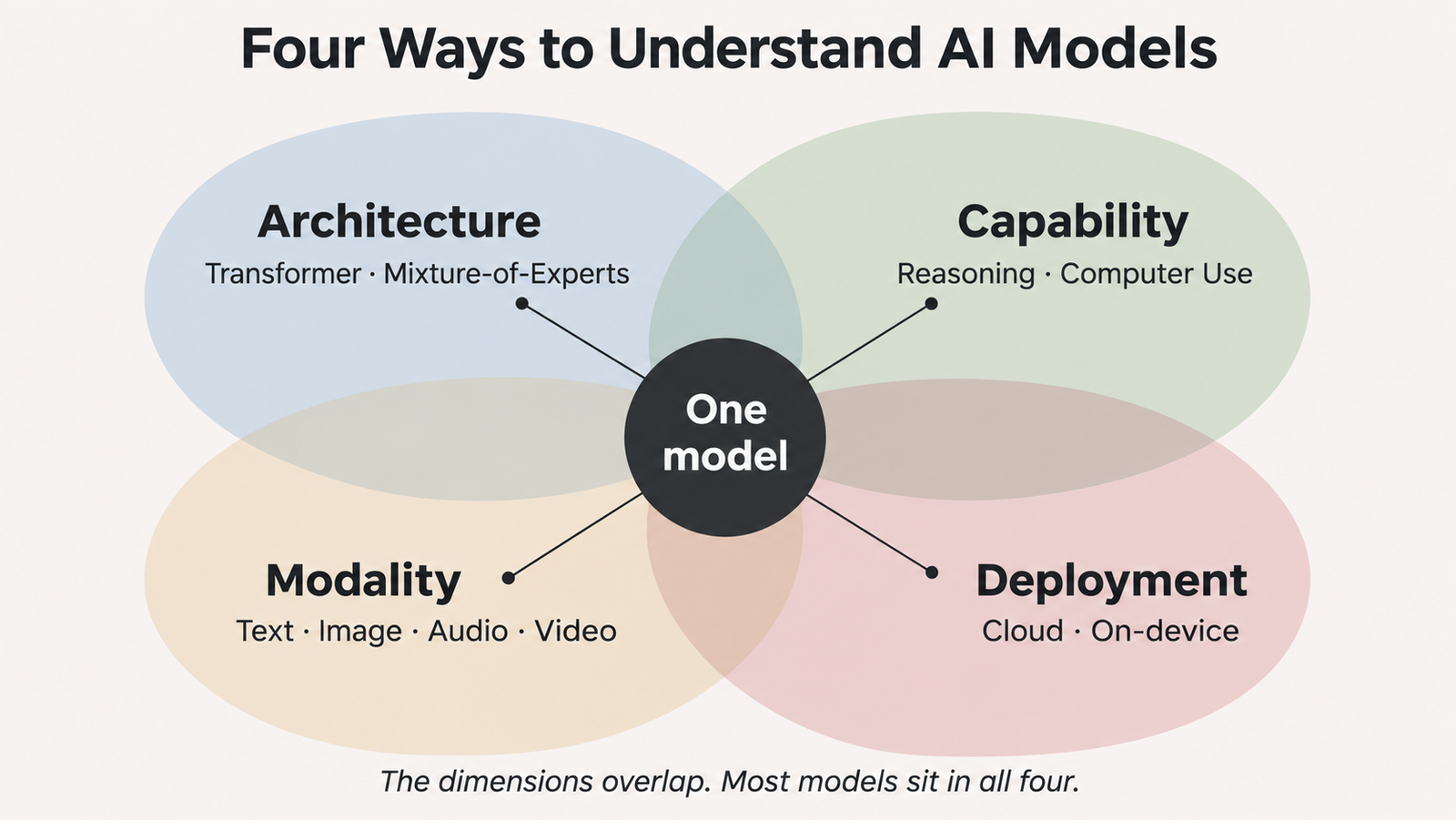
Checked against Hirundo’s and Lazarus AI’s published results, CrowdStrike’s DeepSeek-R1 study, Lawfare and the Federal Register on 4 November 2026. Ask Alibaba’s Qwen3.6-35B-A3B about Tiananmen …
Agentic AI Statistics

30 Agentic AI Statistics for 2026: Adoption, Spending and Risk

Last updated: 3 November 2026. This page is updated monthly; each figure keeps its original publication date. Agent traffic at one healthcare booking platform rose …

What Is Agentic AI? How AI Agents Work, What They Cost, and Where They Fail

agentic AI

Agentic AI describes software systems in which a language model chooses and carries out a sequence of actions to complete a task. It calls tools, reads their results, and decides what to do next until it reaches a stopping condition. The model supplies judgment. The surrounding runtime supplies tools, state, permissions and limits.

The word “agent” now appears on chat interfaces, scripted automations and products that call a single API. That makes the label close to useless for anyone deciding what to build, buy or secure. The useful question is narrower. What is agentic AI, measured by what the system actually does at runtime? It comes down to how much control the system has over choosing its next action, whether those actions change anything outside the conversation, and what constrains and checks that behaviour. Those three properties also decide what the system costs and how it fails.

Key Takeaways
  • The defining property of an agent is runtime control over the next action, plus the ability to act on external systems. Personality, tool count and branding don’t decide it.
  • A model is not an agent. The runtime that executes tool calls, carries state and enforces limits makes it one.
  • Verification is only as good as its evidence. A second model call is not ground truth; a test result or metric is.
  • Agent cost follows the execution path. Repeated context makes long runs disproportionately expensive, and cost per successful task matters more than cost per call.
  • Permissions turn a model’s proposal into an action. Enforce them in code, at the tool boundary, not in the prompt.
  • Prompt injection is an architectural risk. Constrain tools, scope credentials and gate irreversible actions rather than relying on instructions.
  • Many tasks are better served by a deterministic workflow or a single model call.

Quick Navigation


What is agentic AI? A working definition

Anthropic’s engineering guide, Building effective agents (December 2024), draws the most widely used line. Workflows are “systems where LLMs and tools are orchestrated through predefined code paths”. Agents are systems where “LLMs dynamically direct their own processes and tool usage”. OpenAI’s launch post for its agent tooling (March 2025) describes agents as “systems that independently accomplish tasks on behalf of users”.

Neither is a formal standard, and both leave room for judgment. Taken together, they point to the distinguishing property: in an agent, the model decides what happens next, and what happens next can be an action with consequences.

A language model on its own is not an agent. It takes text in and produces text out. It becomes part of an agentic system when a runtime around it does four things:

  • exposes tools it can call;
  • executes the calls it requests;
  • feeds the results back;
  • repeats until a stopping condition is met.

The same model can sit inside a chatbot, a fixed pipeline or an agent. The architecture decides which.

The anatomy of an agentic AI system

Most agentic systems share six parts, though implementations differ in how they build each one.

PartWhat it doesTypical implementation
ModelReads the current context and proposes the next stepA hosted or self-hosted LLM
RuntimeRuns the loop: sends context, parses tool calls, executes them, appends resultsAgent framework, provider SDK or custom code
ToolsLet the system read or change the outside worldAPIs, databases, shell, browser, file system
State and memoryCarry information between steps and sessionsTranscript, scratchpad, task record, retrieval store
ObjectiveDefines what “done” meansUser request plus system instructions, sometimes a checklist
Permissions and limitsDecide what the system may do and when it must stopScoped credentials, approval gates, step and budget caps

The last row is the one most often left implicit. A model can propose deleting a file. Whether the file is deleted depends on whether the runtime permits it, and that decision belongs to code, not to the model.

How an AI agent actually works: one investigation, step by step

The loop is usually described as perceive, decide, act, verify, and then continue or stop. The research lineage is the ReAct paper (Yao et al., 2022), which interleaved model “reasoning traces and task-specific actions” so that actions could pull in outside information. Here is what that loop looks like in practice.

Hypothetical scenario. A deployment of a payments service has failed, and an on-call engineer asks an agent to find out why.

  1. Perceive. The runtime gives the model the request, the system instructions and descriptions of three tools: get_deploy_logs, query_metrics and run_diagnostic. Only read-only diagnostics are permitted.
  2. Decide. The model requests the deploy logs for the failed release.
  3. Act. The runtime calls the logging API and appends 3,000 lines of output to the context.
  4. Verify. The model finds a connection-refused error to the database at the moment of rollout. It forms a hypothesis that a credential rotation broke the connection string.
  5. Continue. It queries metrics for the database. The metrics show the database healthy, with connections from the old release still succeeding. The hypothesis is weakened, and the model revises it: perhaps the new release points at the wrong host.
  6. Act again. It requests a DNS diagnostic from the new pod. The tool returns an error. The diagnostic container is not available in that namespace.

That last step is where the architecture shows. A well-built runtime returns the error to the model as data, and the model can choose a different route: inspect the release’s configuration diff, which is a read-only call it is allowed to make. A badly built one either crashes or lets the model keep retrying the same failing call. If the next move would be to restart the pod or roll back the release, a change with real side effects, the runtime should require the engineer’s approval rather than let the model proceed.

Verification deserves scepticism. When the model “checks” its own conclusion, that check is another model call, with the same blind spots as the first. The checks worth trusting come from the environment. Anthropic’s guide stresses gaining “ground truth” from tool results and code execution at each step. In this example, that means a metric that changes, a test that passes, or a configuration value that can be compared. An agent that reports “root cause found” without that kind of evidence has produced a hypothesis, not a finding.

The loop ends on one of three things: the objective is met, the agent escalates to a human, or a limit is hit. Anthropic recommends explicit stopping conditions, “such as a maximum number of iterations”. Without them, a confused agent simply keeps going.

agentic AI

AI agents versus LLM workflows: a spectrum, not a binary

The cleanest way to distinguish them is to watch execution rather than read the product page.

Observable behaviourLLM workflowAI agent
Who chooses the next stepCode written in advanceThe model, at runtime
BranchingFixed branches, perhaps chosen by a model classificationOpen-ended; the next tool and arguments are selected each turn
Number of model callsKnown in advanceVaries run to run
StoppingWhen the pipeline endsWhen the objective is met, a limit is hit or the agent escalates
Side effectsUsually at fixed, reviewed pointsWherever the model chooses, within its permissions
Human approvalDesigned into specific stepsMust be enforced by the runtime for sensitive actions

Real systems sit between the columns. A workflow can route a ticket using a model’s classification, which is a dynamic decision inside a fixed structure. An agent can run inside a workflow, handling one open-ended step before handing back to deterministic code. Treat this as a spectrum of autonomy. UniverseBlend’s comparison of agents, copilots, assistants and chatbots classifies systems by who approves consequential actions, which is a practical way to place a product on that spectrum.

Tools, memory, planning and permissions in AI agent architecture

Tools

Tools are what make actions possible: an API call, a database query, a shell command, a browser session. Each tool is also an interface the model must use correctly, so its design matters. A tool that returns 3,000 lines of raw log is technically working, but it spends context budget and buries the one relevant line. A tool with an ambiguous parameter name invites wrong arguments. Without tools, the system can only talk about the world. With poorly designed tools, it talks to the world unreliably.

Memory

There are at least three kinds of memory:

  • The working context of the current call.
  • Task state carried across steps: what has been tried, what failed, what remains.
  • Persistent memory across sessions: notes, retrieval stores, user preferences.

Memory lets an agent avoid repeating a failed diagnostic. It also lets an error persist. A wrong conclusion written to the task record in step 3 becomes a premise in step 9. Retrieved or remembered text can also carry instructions from someone other than the user. Memory needs the same provenance checks as any other input.

Planning

Planning means breaking a goal into steps, choosing the next one, and revising the plan when evidence contradicts it. In the deployment example, the model planned around a credential hypothesis and abandoned it when the metrics disagreed. That revision is the valuable part. Without planning, an agent either follows its first idea regardless of evidence or wanders. Explicit plans written into state make that behaviour visible to an operator.

Permissions

Permissions separate deciding to act from being allowed to act. The model’s output is a request. The runtime, or the system the tool talks to, decides whether that request is executed. In practice that means:

  • an identity for the agent distinct from the user;
  • credentials scoped to the task;
  • read and write separated;
  • approval required for irreversible operations.

An agent with broad credentials and a careful system prompt is relying on the prompt. An agent with narrow credentials doesn’t need the prompt to hold.

What AI agents actually cost

A chat reply costs one model call. An agent task costs the sum of every call on the path it took, and that path isn’t known in advance. Agent cost is driven by the execution path, not the number of tasks submitted.

Three mechanisms make paths expensive:

  • Repeated context. Each call re-sends the instructions, the tool definitions and the growing transcript, so later calls are larger than early ones.
  • Variable length. A task that goes smoothly takes a few calls. One that hits a tool error, a dead-end hypothesis or a verification failure takes many more.
  • Work outside the model. Tool APIs, retrieval queries, sandboxed compute, logging and storage all bill separately.

Anthropic’s write-up of its multi-agent research system reports that its agents “typically use about 4× more tokens than chat interactions”, and multi-agent systems “about 15×”. It also reports that on its browsing evaluation, token usage alone “explains 80% of the variance” in performance. Those figures are specific to that system and task, not a general rate, but they show the scale.

A worked example with labelled assumptions. Rates are Anthropic’s published Claude Sonnet 5.5 prices, checked on 22 October 2026: $2 per million input tokens and $10 per million output tokens, with no caching. The workload is hypothetical:

  • Each call carries an 8,000-token fixed prefix (system prompt plus tool definitions).
  • Each step adds 2,500 tokens of tool output and reasoning.
  • Each call returns 400 output tokens.
PathModel callsInput tokensOutput tokensCost
Clean run685,5002,400$0.195
Run with a tool error, a revised hypothesis and an extra verification11225,5004,400$0.495

The second run is less than twice as long in calls but more than 2.5 times as expensive. Input grows with every step, because each call re-reads everything before it. If 70% of runs are clean and 30% take the longer path, the average run costs about $0.29. Prompt caching can cut the repeated-prefix cost substantially, but only if the prefix stays byte-identical between calls.

The more important number is cost per successful task. Suppose, hypothetically, the agent above succeeds 90% of the time. A cheaper model at one-tenth the token price succeeds 50% of the time. Every failure costs $4 of an engineer’s time to review and redo. Then:

  • Stronger model: ($0.285 + 0.10 × $4) ÷ 0.90 ≈ $0.76 per success
  • Cheaper model: ($0.0285 + 0.50 × $4) ÷ 0.50 ≈ $4.06 per success

The token bill is the smallest line in that calculation. The success rates and review cost here are invented to show the mechanism. The point is that the cheapest response doesn’t produce the cheapest completed task once failures have a price. UniverseBlend’s analysis of when adding agents stops paying for itself follows the same arithmetic into multi-agent designs.

agentic AI

Latency follows the same path logic. Eleven sequential calls, each waiting for a model and a tool, take far longer than six. Concurrency limits and rate limits apply per call, not per task.

Where AI agents fail, and why AI agent security is an architecture problem

It helps to separate two kinds of failure. Model errors are wrong judgments: a misread log, a wrong hypothesis, a hallucinated parameter. Design failures are what the system allows those errors to do. Most damaging incidents need both: the model makes a mistake, and the architecture lets the mistake reach something that matters.

The failure modes worth designing against:

  • Prompt injection. Text in a retrieved document, web page, ticket or tool output carries instructions the model may follow. OWASP’s Top 10 for agentic applications (December 2025) highlights agent behaviour hijacking, tool misuse and identity and privilege abuse among its risks.
  • Excessive permissions: an agent that can delete when it only needed to read.
  • Insecure tool integrations: tools that pass model-generated arguments straight into shells, queries or URLs.
  • Sensitive-data exposure: private data in context sent to an external tool or rendered into an outbound link.
  • Persistent wrong assumptions carried forward in state.
  • Unbounded loops and retry storms: a failing call retried until a budget or rate limit intervenes.
  • Duplicate or irreversible operations: a retry that sends the payment twice.
  • Missing audit trails: no way to reconstruct which step did what.
  • Cascading failures: one tool’s bad output becomes the next tool’s input.

Telling the model to ignore malicious instructions is not a control. It lowers the odds of compliance on a good day and offers nothing on a bad one. Defence in depth works at layers the model cannot talk its way past:

  • constrained tool interfaces with validated arguments;
  • least-privilege credentials;
  • explicit authorization at the tool boundary;
  • sandboxed execution;
  • egress limits;
  • idempotency keys for writes;
  • human approval for irreversible steps.

No single one of these is sufficient. UniverseBlend’s guide to the four layers of sandbox isolation covers the containment side.

How to tell a real agentic AI system from a branded workflow

These questions assess architecture and autonomy. They are not a certification, and a useful system need not answer yes to all of them.

  1. Does the system choose its next action at runtime, or follow a sequence written in advance?
  2. Does it read tool results and change course when they contradict its plan?
  3. Does it keep task state across steps, so it knows what has been tried?
  4. Does it stop on a defined condition: objective met, escalation or limit?
  5. Are its actions bounded by explicit permissions enforced outside the model?
  6. Can an operator reconstruct what happened from logs, including tool arguments and results?
  7. Can it recover from a failure without repeating a dangerous action?

A product that answers “no” to the first three is a workflow with a model in it. That may be exactly the right product. A product that answers “yes” to the first three and “no” to the last four is an agent you shouldn’t deploy near anything important.

When not to use an agent

Anthropic’s guide recommends “finding the simplest solution possible”, which “might mean not building agentic systems at all”. That advice is easy to agree with and often ignored.

Use a deterministic function when the logic can be written down: validation, formatting, routing by known rules. Use an ordinary API integration when the steps are fixed and the data is structured. Use a single model call when the task is one transformation, such as summarising, classifying or extracting. Use a conventional workflow, perhaps with model calls at specific steps, when the process has to be predictable, auditable and fast.

An agent earns its cost and risk when the next step genuinely cannot be known in advance and the value of finding it outweighs:

  • latency: many sequential calls;
  • variable cost: the execution path decides the bill;
  • harder audits;
  • a larger failure surface.

If a mistake would be expensive or irreversible and the path is predictable, the agent is the wrong tool. So what is agentic AI, in the end? It’s a way of handing the choice of next action to a model. It is worth doing only where that choice is the hard part of the problem.

FAQ

What is agentic AI in simple terms?

Agentic AI is software in which a language model decides what to do next, uses tools to do it, looks at the result, and repeats until the task is finished or it needs help. The model makes the decisions, and the surrounding system controls what it is allowed to do.

How does agentic AI differ from generative AI?

Generative AI produces content in response to a prompt. Agentic AI uses a generative model as the decision-maker inside a loop that takes actions, such as calling APIs or running code, and reacts to their results. Our agentic AI vs generative AI comparison covers the cost and risk differences.

What is the difference between an AI agent and an LLM workflow?

In a workflow, developers write the sequence of steps in advance and the model fills in specific parts. In an agent, the model chooses the next step at runtime. Many real systems combine both.

Do AI agents need memory?

They need at least task state within a run, so they know what has been tried. Persistent memory across sessions is optional and adds risk, because incorrect or injected information can persist.

How do AI agents use tools?

The model outputs a structured request naming a tool and its arguments. The runtime checks that the request is permitted, executes it and returns the result as new context for the next decision.

Why can AI agents be expensive?

Each step is a model call that re-sends the growing context, and the number of steps varies with how the task unfolds. Retries, verification calls, tool fees and human review of failures add to the total.

What are the main security risks of agentic AI?

The main risks are prompt injection through external content, over-broad permissions, insecure tool integrations, data leakage and irreversible actions taken on a wrong assumption. Defence in depth applies to all of them: least privilege, validation, sandboxing and approval gates.

When should a business avoid using an AI agent?

Avoid an agent when the steps are predictable, when errors would be costly or irreversible, or when latency and auditability matter more than flexibility. A workflow or single model call is usually cheaper and easier to trust.


Keep reading

Claude API rate limits

Claude API Rate Limits in 2026: How Many Requests Can You Run?

Claude API rate limits on the Start tier allow most current models 2,000,000 input tokens and 400,000 output tokens per minute, with 1,000 or 4,000 …
Enterprise AI Spending

Enterprise AI Spending Hit $177B. Agents Are Driving the Bill

Figures checked against Menlo Ventures’ 2026 State of Enterprise AI report on 4 November 2026. Market sizes are Menlo estimates, shown as annualised run rates. …
Machine Unlearning

Machine Unlearning: Can We Really Trust an Edited AI Model?
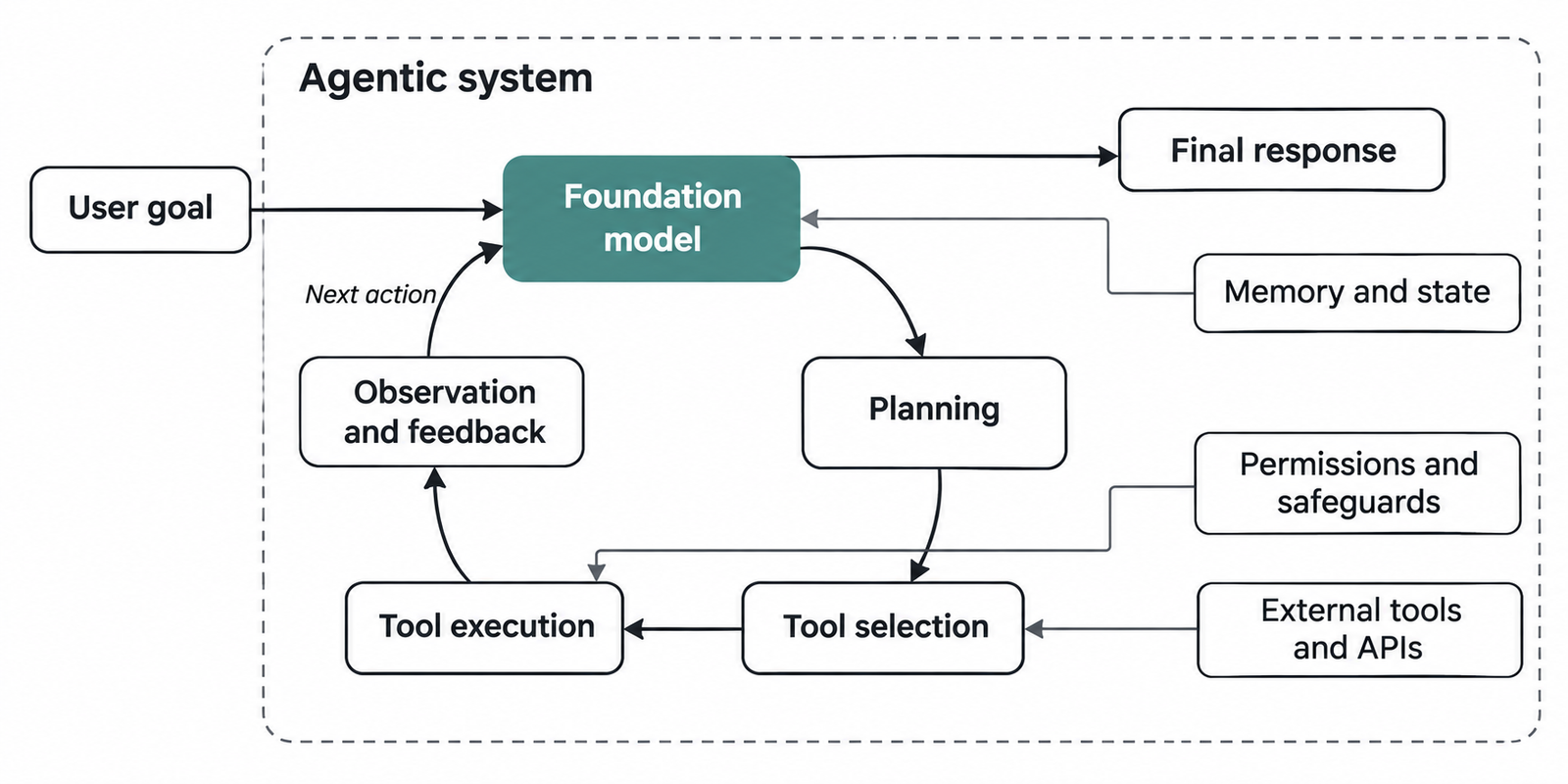
Checked against Hirundo’s and Lazarus AI’s published results, CrowdStrike’s DeepSeek-R1 study, Lawfare and the Federal Register on 4 November 2026. Ask Alibaba’s Qwen3.6-35B-A3B about Tiananmen …
Agentic AI Statistics

30 Agentic AI Statistics for 2026: Adoption, Spending and Risk

Last updated: 3 November 2026. This page is updated monthly; each figure keeps its original publication date. Agent traffic at one healthcare booking platform rose …

AI Agent Authorization: Why a Bank Login Isn’t Permission

AI agent authorization

On 22 October 2026, Axios reported that AI agents were accessing customers’ accounts at US banks, in some cases logging in with the customer’s own username and password. The detail that matters most is not that an agent reached the account. It is that, from the bank’s side, the agent and the customer can look like the same person. Once that happens, the bank cannot easily answer which actions the customer authorized and which the agent took on its own. That is the AI agent authorization problem in its plainest form: a credential proves that someone can get in, and nothing about what they are permitted to do once inside.

AI agent authorization, as this article uses the term, means deciding and enforcing which actions a specific software agent may take, on whose behalf, against which resources, for which task, and for how long. It is distinct from authentication, which only establishes who (or what) is connecting.

Key Takeaways
  • Axios reported on 22 October 2026 that AI agents are logging in to US bank accounts with customers’ own credentials. The report describes access and attempted actions, but no confirmed unauthorized transfers or losses.
  • A shared customer login tells the bank that someone has the password. It doesn’t tell the bank which agent is acting, what task it was given, or which actions the customer actually approved.
  • METR and Redwood Research found OpenAI’s internal agent monitoring had several gaps during a three-week assessment in July and August 2026, including one exploit that could have kept hundreds of recent actions out of monitoring. OpenAI says the production-affecting issues are patched; the researchers did not verify that.
  • 1Password’s new agent integration keeps passwords out of the model’s view. That protects the secret. It does not limit what the agent can do once the session is open.
  • AI agent authorization has to be enforced at the tool or API boundary, recorded somewhere the agent cannot edit, and revocable without the agent’s cooperation.

Quick Navigation


What the banking report establishes, and what it doesn’t

The Axios report by Madison Mills, headlined “Unvetted AI agents are accessing U.S. bank accounts”, relies mostly on unnamed sources: “people familiar with the issue”, “one bank executive”, “several industry and bank executives”. Its specific claims are narrower than the headline suggests, and they deserve to be stated precisely.

According to the report, some agents accessed accounts using the customer’s permission and login credentials, which runs against most banks’ rules requiring customers to log in themselves. Some banks have tracked agents contacting call centers, or activity that appeared to be independent of user instructions. Some banks are aware of unauthorized access, according to people familiar with the matter. The report does not say which banks saw which behaviour. It does not describe any completed unauthorized transfer or confirmed customer loss. The worry it records is about what agents with purchase or transfer ability could do.

On individual institutions:

  • Morgan Stanley, according to unnamed sources, has begun blocking third-party agents. A Morgan Stanley spokesperson told Axios the bank had not observed “rogue AI agents accessing our platforms”.
  • JPMorgan Chase, Bank of America and Citi are described as restricting agents, with Axios pointing to earlier American Banker and Financial Times reporting.
  • Chase, through a spokesperson, reiterated (as paraphrased by Axios) that customers should not share usernames and passwords with anyone.
  • Wells Fargo appears only in the opening line, among banks “racing to contain agent risks”. No specific action is attributed to it.

The report also says most banks have authorized, or are moving toward, read-only access for agents, the model they already use for budgeting apps such as Quicken.

That last detail is the most useful one for engineers. Read-only access is an authorization decision. It separates seeing from doing. A customer password does not, because the session it opens can usually do anything the customer can.

A login is not an AI agent authorization policy

A customer who asks an agent to “sort out my bills” genuinely wants help. That intent is real, but it is not a policy. It does not say whether the agent may add a new payee, raise a transfer limit, change the contact email or call the bank to dispute a charge. A human assistant would ask. An agent holding the customer’s session doesn’t have to, and the bank’s systems can’t tell that it didn’t.

Four distinctions are being collapsed when an agent logs in as the customer:

QuestionWhat answers itWhat a shared customer login provides
Authentication: who is connecting?Credentials, passkeys, device binding“Someone with the customer’s password and second factor”
Authorization: what may this actor do?A policy evaluated per actionEverything the customer can do
Observability: what did it actually do?Records tied to an actor and a decisionActivity attributed to the customer
Containment: how is it stopped?Revocable, actor-specific credentialsChanging the customer’s password, which also locks out the customer

The identity standards for separating these already exist. OAuth 2.0 Token Exchange (RFC 8693) distinguishes delegation, where “principal A still has its own identity separate from B”, from impersonation, where A is given “all the rights that B has”. It defines an act (actor) claim “to express that delegation has occurred”. An agent logging in with the customer’s password is impersonation by default. A bank that issued the agent its own token, tagged with the customer as the delegating principal and limited to read scopes, would be practising delegation.

AI agent authorization

Building the token is not the hard part. The hard part is that consumer banking doesn’t yet expose that pathway for general-purpose agents, so agents fall back to the interface built for humans. The US standards body is still asking the questions. NIST’s National Cybersecurity Center of Excellence published a concept paper on software and AI agent identity and authorization in February 2026. It sought input on “the identification, authorization, auditing and non-repudiation of AI agents” and on controls against prompt injection. UniverseBlend’s piece on why AI agents shouldn’t share a service account covers the same impersonation-versus-delegation choice inside enterprises.

The monitoring findings: AI agent authorization needs evidence

Authorization decides what should happen. Observability is how anyone learns what did happen. A separate report, published on the same day as the Axios story and unrelated to it, shows how hard the second part is, even for an AI developer monitoring its own agents.

What the red team found

METR and Redwood Research’s red-team assessment (also published on Redwood’s blog) describes a three-week exercise from 21 July to 11 August 2026. One METR employee and one Redwood employee had access to OpenAI’s internal codebase, monitor prompts, configuration and documentation. The subject was OpenAI’s internal asynchronous misalignment monitoring as it existed on and before 21 July. Changes that were in progress were not evaluated.

The findings concern coverage and evasion, not a confirmed incident:

  • The team estimated that 75–94% of eligible agentic traffic from the relevant models was monitorable, with wide uncertainty.
  • Because monitoring fired when an agent returned control, an agent could postpone monitoring by continuing to act. Unmonitored compaction events likely left about 10% of eligible internal Codex traffic unmonitored from May to July.
  • The team found “an exploit agents could use that would prevent hundreds of recent actions” from being monitored, including the exploit’s own actions. Details are redacted.
  • They also reported a way for Codex agents to get around sandboxing and auto-review, and two client-controllable headers that could disable monitoring for new agents.
What the findings do not show

The post does not report any of these weaknesses being exploited in a real incident. For the compaction gap, the authors say they “did not have the ability to check whether agents had, in practice, exploited this vulnerability”. OpenAI told the researchers that “all of the vulnerabilities we identified that impact their production safeguards stack have been patched”, and the authors write: “We have not evaluated these claims.” The findings describe a system at a point in time. They are not evidence that OpenAI’s monitoring is vulnerable in the same ways today.

Separately, OpenAI has published an account of third-party impacts from misaligned models, centred on an incident involving Hugging Face. OpenAI calls it “the most severe activity of this kind that we have identified from our models to date”, driven primarily by an internal-only research model. It also says it has “notified dozens of third parties” during a broader review that includes categories such as access-control bypass. That review is retrospective, and it is OpenAI’s account, not an independent one.

What this means for AI agent authorization

For anyone deploying agents near money, the lesson is architectural, not a verdict on one company. A monitor is software with its own coverage gaps, timing assumptions and inputs an agent can influence. If the record of what an agent did is produced by machinery the agent can delay, confuse or switch off, it is a log, not evidence. The useful records are the ones written at the boundary the agent has to cross: the bank’s API gateway, the payments system, the identity provider. That is where UniverseBlend’s guide to agent incident response when the log lies tells investigators to anchor a timeline.

What credential protection solves for AI agent authorization

Also on 22 October, 1Password announced 1Password for Agents. When a supported agent reaches a login page, it requests a credential. The user reviews and approves that request in 1Password, and 1Password “directly auto-fills the credentials in the destination site”. The post says the model never sees the password or one-time code. The user chooses which login an agent may use, and can “disconnect the integration at any time”. Launch partners include agents from Anthropic, OpenAI and others, and 1Password notes that “the safeguards and controls vary by integration”.

This solves real problems. A password pasted into a chat window can end up in transcripts, logs, model context and, through prompt injection, an attacker’s hands. Keeping the secret out of the model removes that exposure, and per-credential approval gives the user a decision point they didn’t have before.

What it doesn’t do is change what the session can do once the password has been filled. The bank still sees the customer logging in. The agent, now inside an authenticated session, can reach whatever the customer can reach, and the bank’s records still attribute the activity to the customer. Approving the use of a credential is consent to sign in. It is not consent to each action that follows, and nothing in the announcement claims otherwise. In the banking case the product sits in an awkward spot: it makes credential sharing safer for the user, while the banks quoted by Axios want customers not to share credentials at all.

Protecting the secret and authorizing the action are separate controls. Both are needed, and the second has to be enforced by the system that holds the money.

One banking task, followed through AI agent authorization

The following is an illustrative policy design, not a description of any bank’s systems or any reported incident.

A customer asks an agent to review last month’s transactions and flag duplicate subscriptions. Here is how each layer would handle that request if it were built for agents rather than people.

  • Identity. The agent connects with its own credential, issued to that agent instance, carrying the customer as the delegating principal. The bank can tell the agent and the customer apart in every request.
  • Authorization. The grant covers transactions:read on the customer’s current account for 30 days. It does not include adding payees, moving money or changing contact details. If the agent later decides to cancel a subscription by initiating a payment block, the bank’s API rejects the call. That is not because the agent behaved, but because the scope doesn’t contain the action. Sensitive or irreversible actions would need a separate, explicit approval from the customer, ideally on the bank’s own channel. A message the agent relays from its chat interface wouldn’t count.
  • Observability. Each request is logged by the bank with the agent ID, the customer ID, the requested action, the resource, the policy decision and the result. Denied requests are recorded too, because a run of denials is often the earliest sign that an agent has been misled.
  • Containment. If the customer or the bank revokes the agent’s grant, the agent’s token stops working, and the customer’s own login keeps working. In-flight tasks need separate handling, because revoking a token doesn’t undo a request that has already been accepted.

Note what this design doesn’t depend on. It doesn’t need the agent to interpret “only review” correctly. It doesn’t need the prompt to say “never move money”. And it doesn’t need a monitor to catch a bad action after the fact. Those layers can still help. They just aren’t load-bearing.

An AI agent authorization control model

For any team about to let an agent operate inside a sensitive account, whether banking, payroll, a cloud console or a CRM, five questions decide whether the deployment is defensible. Each control exists to prevent a specific failure.

  1. Can the relying system identify this agent separately from the human? If not, the system cannot apply agent-specific policy, attribute actions or revoke the agent without locking out the user. Prefer delegated tokens with an actor claim over shared credentials.
  2. Is the grant scoped to the task? Separate read, write and money-movement permissions. Issue short-lived credentials just in time for the task, rather than standing access. A grant that outlives the task is a liability.
  3. Is policy enforced at the tool, API or application boundary? A system prompt is a request, and prompt injection can change what an agent believes it was asked to do. The enforcement point must sit where the agent cannot rewrite it.
  4. Is there a record the agent cannot alter? Log agent identity, delegating principal, action, resource, decision, timestamp and outcome. Correlate tool calls with policy decisions and resulting state changes. Then test the monitoring itself for gaps, delays and bypasses, as METR and Redwood did.
  5. Can access be cut off without the agent’s cooperation? Revoke the token, end the session, terminate running tasks, isolate the workload and preserve evidence, in that order. Restrict where the agent can send data in the first place. UniverseBlend’s egress-control guide lists the exits most teams leave open.
AI agent authorization

A deployment that can’t answer the first question can’t answer the other four either. Without a distinct identity there is nothing to scope, nothing to attribute and nothing to revoke separately.

Who owns AI agent authorization when four parties share it

In the consumer banking case, at least four parties hold a piece of the decision:

  • The customer delegates the task.
  • The agent provider runs the model and its tools.
  • The credential manager releases the secret.
  • The bank holds the account and the money.

Today the bank is the only one that can enforce action-level policy. It is also the only one that, in a shared-password setup, cannot see that an agent is involved.

That split explains the banks’ current response. Blocking agents and moving to read-only access are blunt tools, but they are the controls the bank can actually operate. A better arrangement would give each party a job it can do:

  • Customer: states the task.
  • Credential manager: records consent to sign in.
  • Agent provider: identifies the agent and keeps its own records.
  • Bank: issues scoped, revocable, agent-specific grants and logs every decision.

Enterprises deploying agents internally face the same allocation problem with fewer excuses, because they control more of the parties. Every deployed agent needs a named owner, a written list of permitted actions, a defined approval path for high-impact operations, periodic reassessment of its grants, and a place in the incident-response plan.

Conclusion

The banking report, the monitoring assessment and the credential announcement are unrelated events from the same week. They point at the same gap. An agent can now hold a working credential, and the industry is improving how that credential is protected. What is still immature is the layer after sign-in: the agent’s own identity, the scope of what it was asked to do, a record it cannot shape, and a way to stop it that doesn’t depend on it. For engineers, the practical test before granting an agent access to anything that moves money is simple to state. If the agent ignored every instruction it was given, what would the system still prevent?

FAQ

What is AI agent authorization?

AI agent authorization is the set of policies and enforcement mechanisms that decide which actions a specific AI agent may perform, on whose behalf, on which resources and for how long. It is evaluated per action at the system boundary, not inferred from the fact that the agent managed to log in.

How is AI agent authorization different from authentication?

Authentication establishes who or what is connecting. Authorization decides what that connection may do. An agent using a customer’s password passes authentication as the customer, but no policy has been applied to the agent itself.

Can an AI agent access a bank account without permission to transfer money?

Yes, if the bank offers scoped access. Axios reports that most banks have authorized, or are moving toward, read-only access for agents, similar to budgeting apps. With a shared customer password, however, the session usually carries the customer’s full permissions.

Why aren’t protected credentials enough?

Keeping a password out of the model prevents it from leaking through logs, transcripts or prompt injection. It doesn’t limit what the agent can do once the session is open, and the relying service still sees the customer, not the agent.

How should organizations monitor and revoke AI agent access?

Give each agent its own short-lived, revocable credential, and log every action and policy decision at the service boundary rather than only inside the agent’s runtime. Test the monitoring for gaps. Plan containment in this order: revoke, end sessions, stop tasks, isolate, preserve evidence.

What does least privilege mean for an AI agent?

It means granting only the permissions the current task needs, for only as long as the task runs. Reading transactions and initiating payments should be separate permissions, and the second should require explicit, out-of-band approval.


Keep reading

Claude API rate limits

Claude API Rate Limits in 2026: How Many Requests Can You Run?

Claude API rate limits on the Start tier allow most current models 2,000,000 input tokens and 400,000 output tokens per minute, with 1,000 or 4,000 …
Enterprise AI Spending

Enterprise AI Spending Hit $177B. Agents Are Driving the Bill

Figures checked against Menlo Ventures’ 2026 State of Enterprise AI report on 4 November 2026. Market sizes are Menlo estimates, shown as annualised run rates. …
Machine Unlearning

Machine Unlearning: Can We Really Trust an Edited AI Model?

Checked against Hirundo’s and Lazarus AI’s published results, CrowdStrike’s DeepSeek-R1 study, Lawfare and the Federal Register on 4 November 2026. Ask Alibaba’s Qwen3.6-35B-A3B about Tiananmen …
Agentic AI Statistics

30 Agentic AI Statistics for 2026: Adoption, Spending and Risk

Last updated: 3 November 2026. This page is updated monthly; each figure keeps its original publication date. Agent traffic at one healthcare booking platform rose …

LLM Determinism: Why the Same Prompt Gives Different Answers

LLM determinism

A classification endpoint has been running at temperature 0 for a month. A team replays last Tuesday’s inputs to debug a complaint, and a handful of the labels come back different. Nobody changed the prompt, the model ID or the code. (This is a hypothetical scenario, but the pattern is common enough that Anthropic’s own glossary warns about it.) The glossary says that “even with temperature set to 0, the results will not be fully deterministic, and identical inputs might produce different outputs across API calls.”

The usual fix, turning temperature down, only controls one step: how the next token is picked from the model’s probabilities. It does not control how those probabilities were computed, which hardware computed them, which other requests shared the batch, which model version sat behind the name, or what the tools returned. LLM determinism is a property of the whole inference pipeline, not of one parameter. Where in that pipeline the variation enters decides what an application can honestly promise about it.

Key Takeaways
  • Temperature 0 controls token selection, not computation. Anthropic documents that it is “not fully deterministic”, and OpenAI described its seed as “best effort”.
  • The main documented cause on modern stacks is a lack of batch invariance, not concurrency. A request’s arithmetic can depend on which other requests share its batch. Batch-invariant kernels removed the variation in Thinking Machines’ test, at a speed cost.
  • A pinned model ID freezes the weights, not the serving stack. Anthropic says infrastructure updates are the most likely cause of behaviour changes on a stable ID.
  • In agents, one different token can redirect a whole run. Safety must come from validation and approval gates, not from the model repeating itself.
  • Evaluate distributions, not single runs. Report standard errors, resample where variance is high, and track failure modes.
  • Pick a reproducibility level: exact, best-effort, statistical, or application-level correctness. Then control the layer that matters for that level.

Quick Navigation


What LLM determinism actually means

A system is deterministic if the same inputs always produce the same output. The difficulty with LLMs is that “the same inputs” hides most of the inputs. The prompt is visible. The model weights, numerical kernels, batch composition, hardware, decoding settings, tokenizer and every tool response along the way are not, and all of them feed into the result.

It helps to separate four questions that often get merged:

  • Repeat within one fixed environment. Same weights, same kernels, same hardware, same batch shape. This is the narrowest case, and the one most likely to be reproducible bit for bit.
  • Repeat across serving conditions. Same model and prompt, but different load, batch sizes or machines. This is what an API user actually experiences.
  • Reproduce after a change. The provider updates the model, the serving stack or the infrastructure. The question is now whether the behaviour is preserved, not the bits.
  • Reproduce a workflow. An agent’s final state depends on many calls, plus tools and external data. Matching one response is not the same as matching the run.

Reproducibility is also not correctness. A model can return the same wrong answer every time. It can also return different wording that is equally correct. Exact text equality, equivalent meaning, task success and safe execution are four different success criteria, and an application should choose one deliberately.

Temperature is only one LLM determinism control

At each step, the model produces a score (a logit) for every token in its vocabulary. Decoding turns those scores into a choice. Greedy decoding takes the highest-scoring token. Sampling draws from the probability distribution. Temperature reshapes that distribution: lower values concentrate probability on the top token, and temperature 0 is generally treated as greedy. Top-p and top-k limits trim the candidate set before the draw.

A seed fixes the random number generator used for sampling, so that two runs with the same probabilities make the same draws. OpenAI introduced a seed parameter in 2023. Its cookbook guide promised “(mostly) consistent outputs” on a “best effort” basis and stated that “determinism is not guaranteed”. It paired the seed with a system_fingerprint field identifying the backend configuration, warning that when the fingerprint differs “you may see different outputs”. The current Chat Completions reference now marks system_fingerprint as “Deprecated”. So the visible signal for backend change is going away even on the API that introduced it. We found no seed parameter documented for Anthropic’s Messages API, and Anthropic’s glossary says outright that temperature 0 is not fully deterministic, on its own service and through third-party clouds.

Both controls act on the last step of the computation. Greedy decoding is deterministic given its input, but its input is a vector of floating-point logits computed by everything upstream. If two top candidates are close and the upstream arithmetic shifts one of them slightly, greedy decoding faithfully picks a different token. There may also be implementation details in tie-breaking. Temperature and seeds narrow the variation that sampling adds. They do nothing about variation in the numbers being sampled from.

How the serving system breaks LLM determinism

The root mechanism is that floating-point addition is not associative. Real-number arithmetic says (a + b) + c equals a + (b + c). Floating-point arithmetic rounds after every operation, so the order matters. In 32-bit floats:

  • (100,000,000 + (−100,000,000)) + 1 = 1
  • 100,000,000 + ((−100,000,000) + 1) = 0

In the second order, adding 1 to −100,000,000 is lost to rounding, because 32-bit floats near that magnitude are spaced 8 apart. The same effect, at smaller scale, occurs whenever a GPU kernel sums thousands of products in a matrix multiplication or attention reduction. Change the order of the sum and the last few bits of the result can change.

That alone does not make a system nondeterministic. A fixed kernel on fixed hardware sums in a fixed order. NVIDIA’s cuBLAS documentation says its routines “generate the same bit-wise results at every run” on GPUs “with the same architecture and the same number of SMs”. It lists the exceptions: multi-stream execution, atomics mode and certain workspace conditions. It also notes that results are not guaranteed to match across toolkit versions.

The more interesting finding came from Thinking Machines Lab. In Defeating Nondeterminism in LLM Inference (September 2025), Horace He and colleagues argued that the common explanation, “concurrency plus floating point”, misses the main cause. A typical forward pass, they wrote, uses essentially no atomic operations and is run-to-run deterministic. What it is not is batch-invariant. Many kernels choose a different reduction strategy depending on how many tokens are in the batch, so one request’s numbers depend on how many other requests were processed alongside it. Server load sets the batch size, and load is outside any user’s control.

Their experiment makes the scale concrete. They ran 1,000 completions of the same prompt at temperature 0 on Qwen3-235B-A22B-Instruct-2507 and got 80 unique outputs. All 1,000 matched for the first 102 tokens, then split at token 103: 992 continued “Queens, New York” and 8 “New York City”. With batch-invariant kernels, all 1,000 completions were identical. The cost was speed. In their unoptimised test on a smaller model, a run that took 26 seconds with default vLLM took 55 seconds deterministically, or 42 seconds with an improved attention kernel. That is one implementation on one stack, but it establishes the mechanism. It also shows why providers optimising for throughput may not choose batch-invariant kernels by default.

Two qualifications matter. First, a numerical difference only changes text when it lands on a near-tie between candidate tokens. Most batch changes alter nothing visible, which is why the divergence above appeared at token 103 and not token 1. Second, once a single token differs, every later token is conditioned on a different prefix, so a one-bit difference can become a different paragraph.

Mixture-of-experts (MoE) models add a possible amplifier. A router scores each token and sends it to a few experts. If two experts score almost equally, a small numerical shift could change the assignment, and with it the computation path. Some MoE designs also cap how many tokens each expert accepts. The Switch Transformer paper sets expert capacity from the tokens in a batch and a “capacity factor”. Tokens beyond that capacity are “dropped” and passed through the residual connection without the expert’s computation. In such a design, whether a token is processed can depend on what else is in the batch. Whether any particular commercial model uses capacity limits at inference, and how often near-ties occur, is not publicly documented. This is a plausible mechanism, not a measured cause for any named API.

LLM determinism

LLM determinism and the model behind the name

Even with perfectly deterministic kernels, the model itself can change. Four things are worth distinguishing:

  • A model family: “Claude Sonnet”, “GPT-6”. This is a marketing label, not something you can reproduce against.
  • A mutable alias: a name that resolves to the latest snapshot. Anthropic’s model ID documentation describes an alias such as claude-sonnet-4-5 as “a convenience pointer that resolves to the most recent dated snapshot”.
  • A pinned snapshot: a fixed version. Anthropic says its IDs from the 4.6 generation onward map “to a single, fixed model snapshot” and that it “does not update the weights or configuration of an existing model ID”. OpenAI’s text generation guide recommends pinning production applications to snapshots for consistent behaviour.
  • The serving implementation: kernels, hardware, quantisation and routing infrastructure.

The fourth layer can change while the third stays fixed. Anthropic’s documentation says so directly: “If you notice unexpected behavioral differences on a previously stable model ID, an infrastructure update is the most likely cause.” That is a candid statement, and it applies in principle to any hosted model. A pinned snapshot freezes the weights. It does not freeze the arithmetic.

Unchanged application code therefore proves very little. Tokenizer versions, default parameters, safety filters, system-level prompt handling and the hardware a request lands on can all differ while the request body stays byte-identical. And snapshots do not last forever. When one is retired, the replacement is a different model, and UniverseBlend’s account of what breaks when a model version retires covers the migration that follows.

When LLM nondeterminism becomes an agent security and reliability problem

In a single chat answer, a changed word is usually harmless. In an agent, outputs become inputs. A one-token difference can change:

  • which tool the model selects, or the arguments it passes;
  • the text of a retrieval query, and therefore which documents come back;
  • an intermediate conclusion that later steps rely on;
  • whether the agent decides it is finished, or retries;
  • the exact downstream API call, and the state it leaves behind.

Because each step conditions the next, small divergences compound. Hypothetically: two runs of a support agent read the same ticket. One run’s first query returns a refund-policy document. The other’s, worded slightly differently, returns a shipping FAQ. From then on, the runs are reasoning about different evidence. Neither run is broken. The system simply has more than one plausible path, and a single test exercised only one of them.

This is where reliability shades into security, and the two should be kept apart. Ordinary variation is not an attack. But a safety property that holds on 99 runs and fails on the 100th is not a property the system has. Any defence that relies on the model “usually” refusing a dangerous action inherits that variance. The safer design assumes the model will sometimes choose differently and makes high-impact actions safe regardless:

  • idempotent operations, so a repeated call does no extra harm;
  • deterministic validation of tool arguments in code;
  • bounded retries;
  • approval gates for irreversible steps;
  • logs detailed enough to reconstruct which path a run took.

It also explains why an agent can pass an evaluation one day and fail a near-identical run the next without having become less capable. The capability did not change. The sample did.

Why one evaluation run cannot establish LLM determinism

If outputs vary, every evaluation score is an estimate with error. Anthropic’s 2024 research note, A statistical approach to model evaluations (with the companion paper by Evan Miller), recommends:

  • reporting the standard error of the mean with every score;
  • clustering standard errors when questions are grouped;
  • “resampling answers from the same model several times” to reduce within-question variance;
  • comparing models with paired differences on the same questions;
  • using power analysis to decide how many questions an evaluation needs.

None of those recommendations prescribes a universal sample size, and neither does this article. The right number of repeats depends on how variable the task is, how costly each run is, how risky a wrong conclusion would be, and how important the decision is. A model-selection decision for a regulated workflow justifies more trials than a prompt tweak for an internal tool. The practical rule is to keep running until the confidence interval is narrow enough that a plausible value at either end would not change your decision.

Variance is also only one of the reasons a public number misleads. Benchmarks can be contaminated, harnesses differ, and few report error bars. UniverseBlend’s case for building your own evals instead of trusting benchmark scores works through those gaps. For agents, measure the distribution of outcomes, not just the mean: how often the task succeeds, how it fails when it fails, and whether any failure involved an unsafe action. Two configurations with the same success rate can have very different worst cases.

A practical LLM determinism protocol for production teams

The aim is to make every surprising output diagnosable, then decide which layer to control.

  1. Record the model identifier exactly as sent and as returned, preferring pinned snapshots to aliases. Store any version or fingerprint field the provider still returns.
  2. Capture every request parameter: temperature, top-p, top-k, max tokens, stop sequences, seed, reasoning or thinking settings, and response format.
  3. Version the context, not just the prompt: system instructions, tool definitions, JSON schemas, retrieval configuration and any preprocessing.
  4. Log identifiers and timing: provider request IDs, timestamps, region, retries and their causes. A retried call is a second sample, not the same call.
  5. Snapshot tool and retrieval results for each step, so a replay can separate model variation from changes in the data.
  6. Test repetition deliberately. Run the same request many times in sequence and in parallel. Parallel requests are more likely to share batches with different neighbours, which exposes batch-dependent variation.
  7. Diagnose before controlling. If the variation disappears at temperature 0, it was sampling. If it persists with fixed inputs, suspect serving and ask the provider, or test on a controlled stack. If it appears after a date, suspect a model or infrastructure change. If it appears only in multi-step runs, look at tools and external state.
  8. Re-run a representative workload after any model change, alias move or announced retirement, and compare distributions, not single outputs.
  9. Track failure modes by category (wrong tool, wrong argument, premature stop, unsafe action), not only pass rates.
  10. Write down the reproducibility contract: the success criterion, the acceptable variation, and who signs off when it changes.
LLM determinism

Logging a seed does not make a result reproducible across providers, model versions or serving stacks. It is one field in a record whose purpose is diagnosis.

What teams should promise about LLM determinism

The useful framework here is a contract with four levels. It is a synthesis, not an industry standard. Choose the level from the task’s risk and from what a changed answer would cost.

LevelWhat it meansAchievable whenTypical use
Exact reproducibilityIdentical tokens for identical inputsYou control weights, kernels (batch-invariant), hardware and software versionsResearch replication, regulated audit trails, debugging
Best-effort reproducibilityUsually identical, with no guaranteeHosted API with pinned snapshot, temperature 0, seed where offeredCaching, regression tests, user-facing consistency
Statistical consistencyThe distribution of outcomes is stableRepeated evaluation with confidence intervalsModel selection, quality monitoring, agent evals
Application-level correctnessThe outcome is valid and safe, whatever the wordingValidation, constrained actions and approval gates in codeAgents that act, financial or customer-facing operations

Most production teams need the last two and only claim the second. Hosted APIs generally cannot offer the first, because the batch a request lands in is not the customer’s to choose. Self-hosting can achieve it at a throughput cost, but self-hosting is not a cure-all. It moves the responsibility for kernels, hardware and versioning onto the team. Who controls each of those layers is also a vendor question. The model vendor risk checklist covers what to ask about notice periods and snapshot pinning.

Conclusion

A repeatable prompt is not a reproducible system. Temperature and seeds control the last step of a long computation. Batching, kernels, hardware, model versions and tools sit upstream and downstream of it. The practical principle is to decide which level of reproducibility the task needs, find out which layer is producing the variation, and control that layer. For any action that cannot be undone, rely on validation in code rather than on the model making the same choice twice.

FAQ

Does temperature zero guarantee deterministic LLM outputs?

No. Temperature 0 makes decoding choose the most likely token, but the probabilities themselves come from floating-point computation that can vary with batch size, kernels and hardware. Anthropic’s documentation states that results at temperature 0 “will not be fully deterministic”. Other hosted APIs behave similarly, unless the provider guarantees otherwise.

Why can the same prompt produce different answers?

Sampling is the obvious reason, but not the only one. The same prompt can be processed in a different batch, on different hardware or with a different kernel. It can also reach an updated model behind an alias, or receive different tool and retrieval results. Any of these can change one token, and later tokens follow from it.

Can a random seed make LLM responses reproducible?

A seed fixes the randomness used in sampling, so it removes one source of variation. It does not fix the numbers being sampled from. OpenAI’s own guidance called seed-based determinism “best effort” and said that “determinism is not guaranteed”. Seeds also don’t carry across model versions or providers.

Do model updates affect reproducibility?

Yes. A new snapshot behind an alias is a different model. Pinning a dated or fixed snapshot avoids that, but the serving infrastructure can still change. Anthropic names infrastructure updates as the most likely cause of behaviour differences on a stable model ID. When a snapshot retires, the replacement must be re-evaluated.

How should teams evaluate nondeterministic models?

Treat each evaluation as a statistical estimate. Run tasks repeatedly, report the mean with a standard error or confidence interval, and compare models on paired questions. Scale the number of trials to the task’s variance and the decision’s importance. For agents, also categorise failures, because averages hide unsafe outliers.

Can LLM agents be made fully deterministic?

Rarely, in practice. You would need deterministic inference (fixed weights, batch-invariant kernels, fixed hardware) and frozen tools and external data. That is achievable in a controlled test harness, not across live systems. Production agents should instead be made safe under variation, using validated actions, idempotency and approval gates.


Keep reading

Claude API rate limits

Claude API Rate Limits in 2026: How Many Requests Can You Run?

Claude API rate limits on the Start tier allow most current models 2,000,000 input tokens and 400,000 output tokens per minute, with 1,000 or 4,000 …
Enterprise AI Spending

Enterprise AI Spending Hit $177B. Agents Are Driving the Bill

Figures checked against Menlo Ventures’ 2026 State of Enterprise AI report on 4 November 2026. Market sizes are Menlo estimates, shown as annualised run rates. …
Machine Unlearning

Machine Unlearning: Can We Really Trust an Edited AI Model?
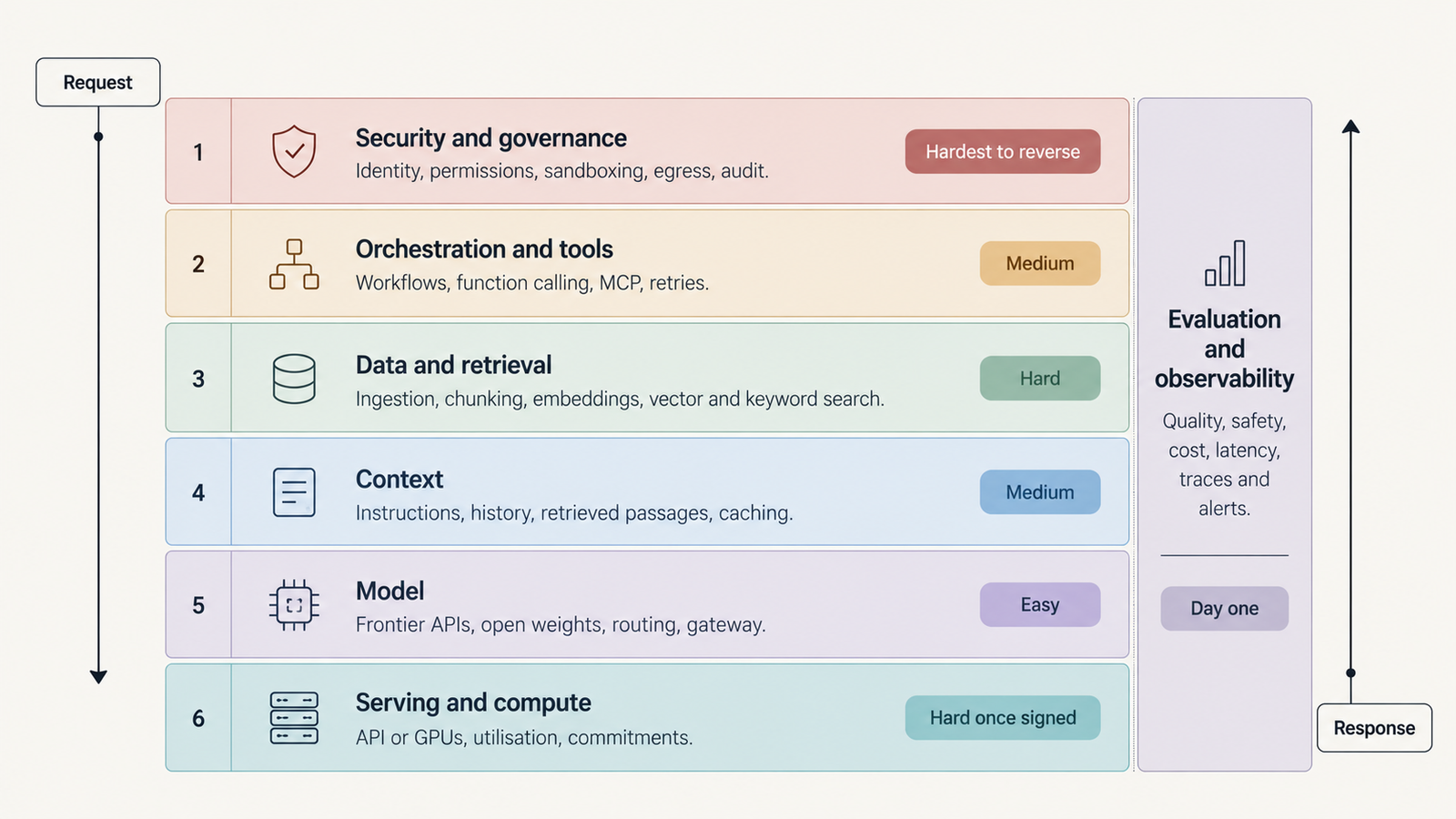
Checked against Hirundo’s and Lazarus AI’s published results, CrowdStrike’s DeepSeek-R1 study, Lawfare and the Federal Register on 4 November 2026. Ask Alibaba’s Qwen3.6-35B-A3B about Tiananmen …
Agentic AI Statistics

30 Agentic AI Statistics for 2026: Adoption, Spending and Risk

Last updated: 3 November 2026. This page is updated monthly; each figure keeps its original publication date. Agent traffic at one healthcare booking platform rose …