AI API Pricing 2026: Every Model, Input and Output

AI API pricing comparison

On the official price lists, GPT-6.1 Sol costs half as much per token as Claude Opus 5.5: $2 against $4 per million input tokens, and $10 against $20 for output. Send each model one 300,000-token prompt that returns a 2,000-token answer, though, and the bills come out at $1.23 and $1.24. OpenAI doubles the input rate once a prompt passes 272,000 tokens. Anthropic charges Opus 5.5 the same rate across its whole 1M-token window. The headline ratio says 2:1. For that request, the real ratio is close to 1:1.

That gap between the published rate and the invoice is the subject of this guide. The tables below give the verified rates. The rest of the guide covers the rules that decide what you actually pay.

Key Takeaways
  • Output tokens usually decide the bill. In the worked example below, output is 2 million of 22 million tokens but makes up roughly half of the cost before caching and nearly all of what remains after it.
  • Cache reads cost 2% to 10% of the ordinary input rate, depending on provider and model. Caching discounts only the input side, so in the worked example a 98% hit rate on the cache-eligible tokens cuts the bill by about 31%, not 90%.
  • Cache writes are a separate line item at OpenAI (1.25× input for 30 minutes) and Anthropic (1.25× for 5 minutes, 2× for one hour). DeepSeek and Google bill caching differently, so cached rates are not like-for-like across providers.
  • Long-context thresholds can reprice a whole request. OpenAI’s GPT-6 models double input and cache rates above 272K input tokens. Gemini 3.1 Pro Preview reprices above 200K. Opus 5.5 has no long-context tier.
  • Three of the requested names do not match a documented, priced API model: Qwen 4, a current first-party Llama API price, and an official Kimi K3 price we could read directly. Details are in the status table.
  • Gemini 3.6 Flash prices double on 1 January 2027, according to Google’s pricing page. Any budget that runs into next year needs both rates.

Quick Navigation


AI API pricing comparison: the October 2026 snapshot
AI API pricing comparison

All prices below are in US dollars per one million tokens, for the standard (real-time) service tier, as published on each provider’s official pricing page and checked on 22 October 2026. Providers did not all change prices on that date; it is simply the date we checked. The table is split in two so it stays readable on a phone. Table 1 gives the token rates, and Table 2 gives the conditions that change them.

Table 1. Token rates (USD per 1M tokens, standard tier, verified 22 Oct 2026)

ProviderModel / API IDInputOutputCached inputCache writes
OpenAIGPT-6.1 Sol gpt-6.1-sol$2.00$10.00$0.10$2.50 (30-min TTL); $5.00 (12-h TTL)
OpenAIGPT-6 Sol gpt-6-sol$2.00$10.00$0.20$2.50
OpenAIGPT-6 Luna gpt-6-luna$0.10$0.50$0.01$0.125 (30-min); $0.25 (12-h)
AnthropicClaude Opus 5.5$4.00$20.00$0.20$5.00 (5-min); $8.00 (1-h)
AnthropicClaude Sonnet 5.5$2.00$10.00$0.10$2.50 (5-min); $4.00 (1-h)
GoogleGemini 3.1 Pro Preview gemini-3.1-pro-preview$2.00$12.00$0.20Storage: $4.50 per 1M tokens per hour
GoogleGemini 3.6 Flash gemini-3.6-flash$0.75$3.75$0.075Storage: $0.50 per 1M tokens per hour
MistralMistral Large 4 mistral-large-4$1.36$4.18$0.14Not published
DeepSeekdeepseek-v4-pro (V4-Pro-0813)$1.32$3.96$0.044Not applicable (misses billed as input)
DeepSeekdeepseek-flash (V4.1-Flash-1017)$0.30$1.20$0.006Not applicable (misses billed as input)
Alibaba CloudQwen3.8-Max qwen3.8-max$2.00$6.00See pricing conditionsNot published
MiniMaxMiniMax-M3.1-Flash$0.15$0.60$0.015Not published
Moonshot AIKimi K3 kimi-k3$3.00*$15.00*$0.30*Not verified

Kimi K3 figures are from Together AI’s serverless price list, a third-party host. Moonshot’s own price table did not render for verification. DeepSeek rates are peak-hour rates; off-peak rates are half.

Table 2. Conditions that change the rate

ModelLong-context tierBatch discountPricing condition
GPT-6.1 Sol, GPT-6 Sol, GPT-6 LunaAbove 272K input tokens: 2× input and cache rates, 1.5× output, for the whole request50% (Batch and Flex)Fast mode 2×; regional processing +10%
Claude Opus 5.5, Sonnet 5.5None; full 1M window at standard rates50%US-only inference 1.1×; Opus 5.5 Fast mode $8 / $40
Gemini 3.1 Pro PreviewAbove 200K: $4.00 input, $18.00 output, $0.40 cache50%Preview model
Gemini 3.6 FlashNone listed50%From 1 Jan 2027: $1.50 / $7.50 / $0.15 cache
Mistral Large 4Not publishedNot published for this modelPublic Preview (v26.10)
DeepSeek V4 Pro and FlashNone; 1M contextNot publishedOff-peak 50% off; peak is 01:00–04:00 and 06:00–10:00 UTC on weekdays
Qwen3.8-MaxSingle tier, 0–1MNot labelledBatch and cache discounts cannot be combined
MiniMax-M3.1-FlashNot publishedNot publishedNo effective date shown
Kimi K3No context-length tiering (official quickstart)Not verifiedCache writes billed by 5-min or 1-h TTL; rates not verified

Table labels. Not published: the provider’s official page gives no figure. Not applicable: the provider’s billing model has no such charge. Not verified: a figure exists but we could not confirm it on an official page. See pricing conditions: the rate depends on a rule described elsewhere. A missing cache price never means free caching.

Which requested models could be verified

This article started from a list of model names. Not all of them match a documented API product.

Requested nameStatusWhat we found
GPT-6 SolVerified current modelStill priced on its own model page, but GPT-6.1 Sol is newer and has cheaper cache reads
GPT-6 LunaVerified current modelPriced as listed above
Opus 5.5Verified current modelClaude Opus 5.5, priced as listed above
Gemini 3.1 ProVerified, previewAPI ID gemini-3.1-pro-preview
Gemini 3.6 FlashVerified current modelRates double on 1 Jan 2027; Gemini 3.8 Flash has the same rates
LlamaNo first-party API price locatedLlama 4 (April 2025) is the latest Llama release; Meta’s newest open-weight model is Muse Spark Open
Qwen 4Name could not be verifiedAlibaba’s newest documented models are Qwen3.8-Max and Qwen3.8 Flash
Mistral Large 4Verified, Public PreviewReleased 6 October 2026
MiniMax M3.1 FlashVerified current model$0.15 / $0.60 is correct, in USD per 1M tokens
DeepSeekVerified current modelsTwo models, with peak and off-peak pricing
KimiVerified model; price unconfirmed at sourcekimi-k3 is current; the official price table did not render

Two corrections are worth stating plainly. No Alibaba documentation we found describes a “Qwen 4”, so this article prices Qwen3.8-Max instead and labels it as Qwen3.8-Max. On Mistral, the marketing pricing page still says “Mistral Large costs $0.5 /M tokens in and $1.5 /M tokens out”. The developer documentation shows that rate belongs to Mistral Large 3. Large 4 lists at $1.36 and $4.18.

The cost behind the headline rate

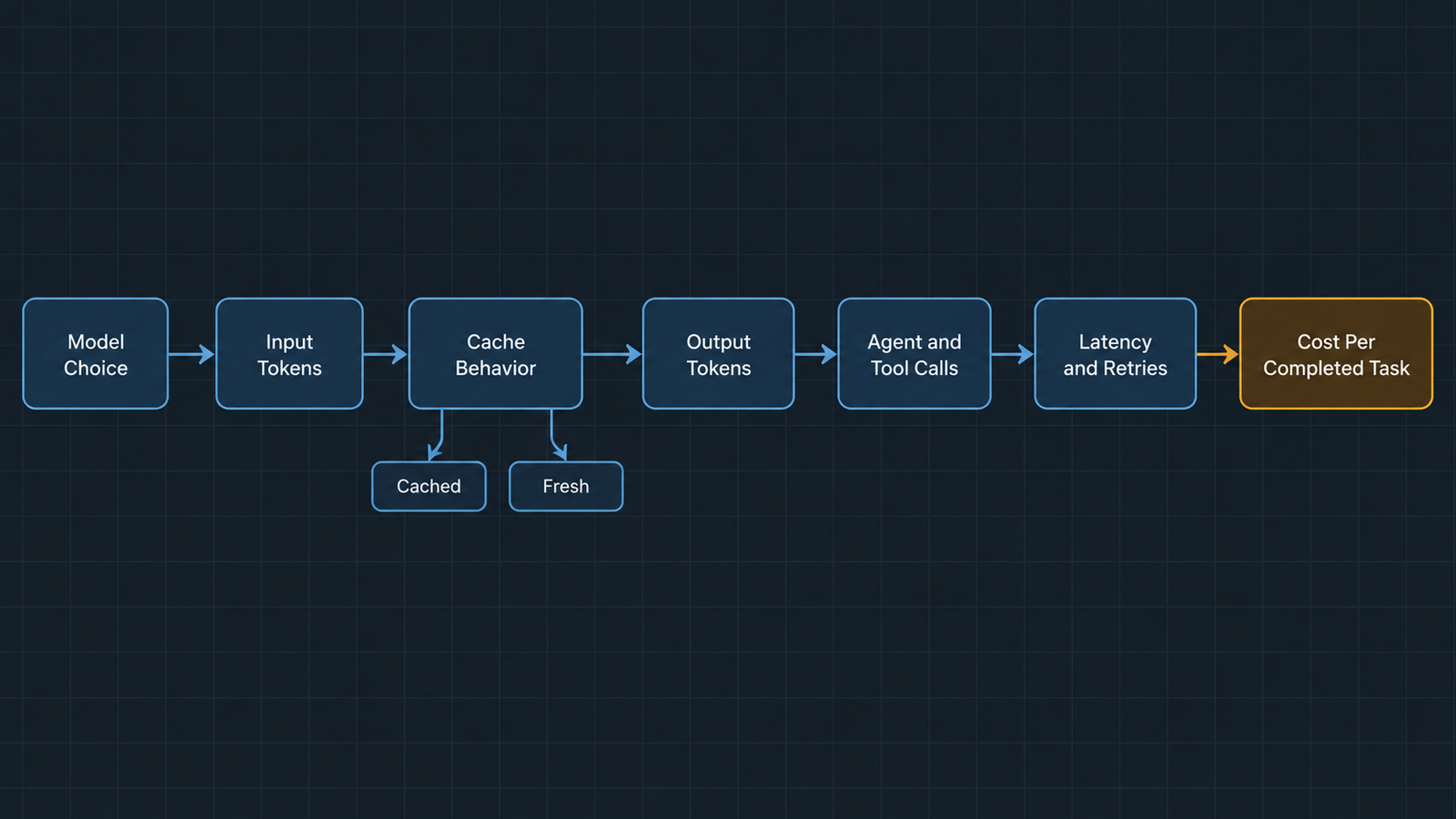
A pricing page lists up to six token categories, and a real request can touch all of them.

  • Ordinary input is every prompt token that the provider processes from scratch: the system prompt, tool definitions, retrieved documents, conversation history and the user’s message.
  • Output covers every token the model generates. On reasoning models that includes hidden thinking tokens. Google says this directly: Gemini output prices include thinking tokens. A model that thinks for 4,000 tokens before writing a 300-token answer bills 4,300 output tokens.
  • Cached input is prompt content the provider has already processed and stored, so it is billed at a reduced read rate.
  • Cache writes are the cost of storing that prefix the first time. OpenAI and Anthropic charge a premium for this. Google instead charges hourly storage on explicit caches.
  • Long-context tiers reprice a request once its prompt passes a threshold. OpenAI applies the higher rate to the entire request, not just the tokens above the line.
  • Batch pricing takes 50% off at OpenAI, Anthropic and Google in exchange for asynchronous processing. It suits evaluations, backfills and document processing. It doesn’t suit anything a user is waiting on.

The headline input and output pair is therefore the lowest price a request can reach, with no conditions applied. Most real workloads pay for at least two of the other four categories.

Cached-input pricing in practice

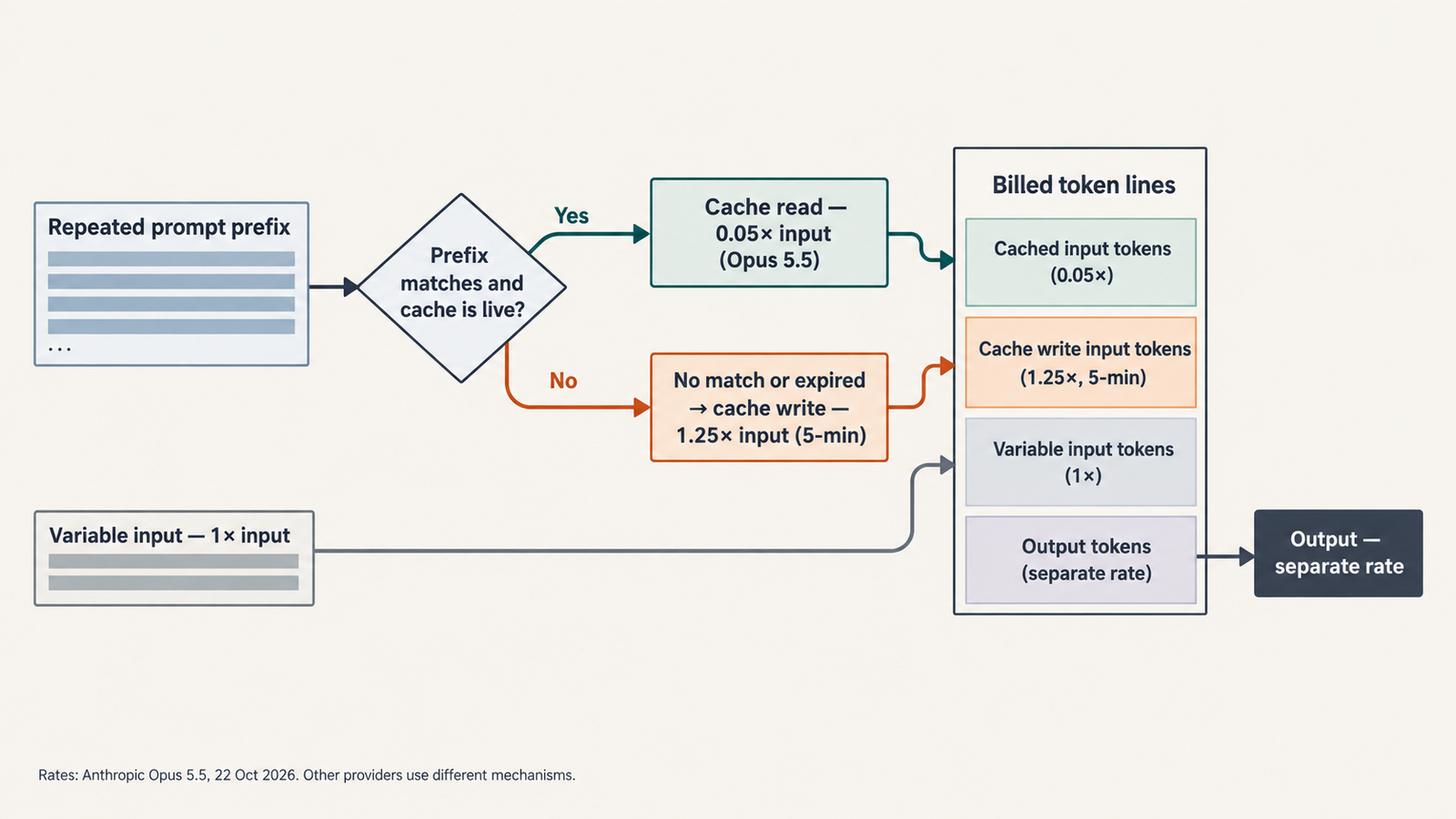
Prompt caching stores the processed form of a repeated prompt prefix, so the provider can skip recomputing it on the next request. The provider passes part of that saving back as a lower rate on the tokens that hit the cache. The mechanism differs enough between providers that a cached rate on one page is not directly comparable with a cached rate on another.

Anthropic’s prompt-caching documentation uses explicit breakpoints, with up to four per request. The minimum cacheable prompt for Opus 5.5 is 512 tokens. The default cache lives for five minutes and is refreshed at no cost each time it is used. A 5-minute write costs 1.25× the base input rate and a 1-hour write costs 2×. Reads cost 0.1× on most models, but 0.05× on Opus 5.5 and Sonnet 5.5. Changing a tool definition invalidates the whole cache.

OpenAI’s prompt-caching guide says GPT-5.6 and later support both implicit and explicit caching. The minimum is 1,024 tokens. The default lifetime is at least 30 minutes, and a 12-hour option is available in the Responses API. Writes cost 1.25× ordinary input for the 30-minute lifetime and 2.5× for 12 hours. Reads cost 0.1×, or 0.05× on GPT-6.1 Sol. The guide adds that “cache-write pricing is not an additive fee”: each input token is billed at exactly one rate.

Google’s context-caching documentation says implicit caching is on by default for Gemini 2.5 and newer, with a 4,096-token minimum on Gemini 3.1 Pro Preview and 3.6 Flash. Explicit caches add hourly storage charges, listed on the pricing page.

DeepSeek lists only two input rates, cache hit and cache miss. A cache miss is simply the ordinary input rate.

Three practical consequences follow:

  1. A cache hit is not guaranteed. The prefix has to match exactly. Any change to a timestamp, a tool list or a thinking setting early in the prompt breaks it.
  2. Writes cost money only at some providers. At Anthropic, a 1-hour cache write costs 2× input. The prefix must then be read at least twice before the write pays for itself.
  3. A cheaper read rate does not guarantee a cheaper bill. It does nothing to output, and it does nothing if your traffic pattern lets the cache expire between requests.

A worked example: 22 million tokens, with and without caching

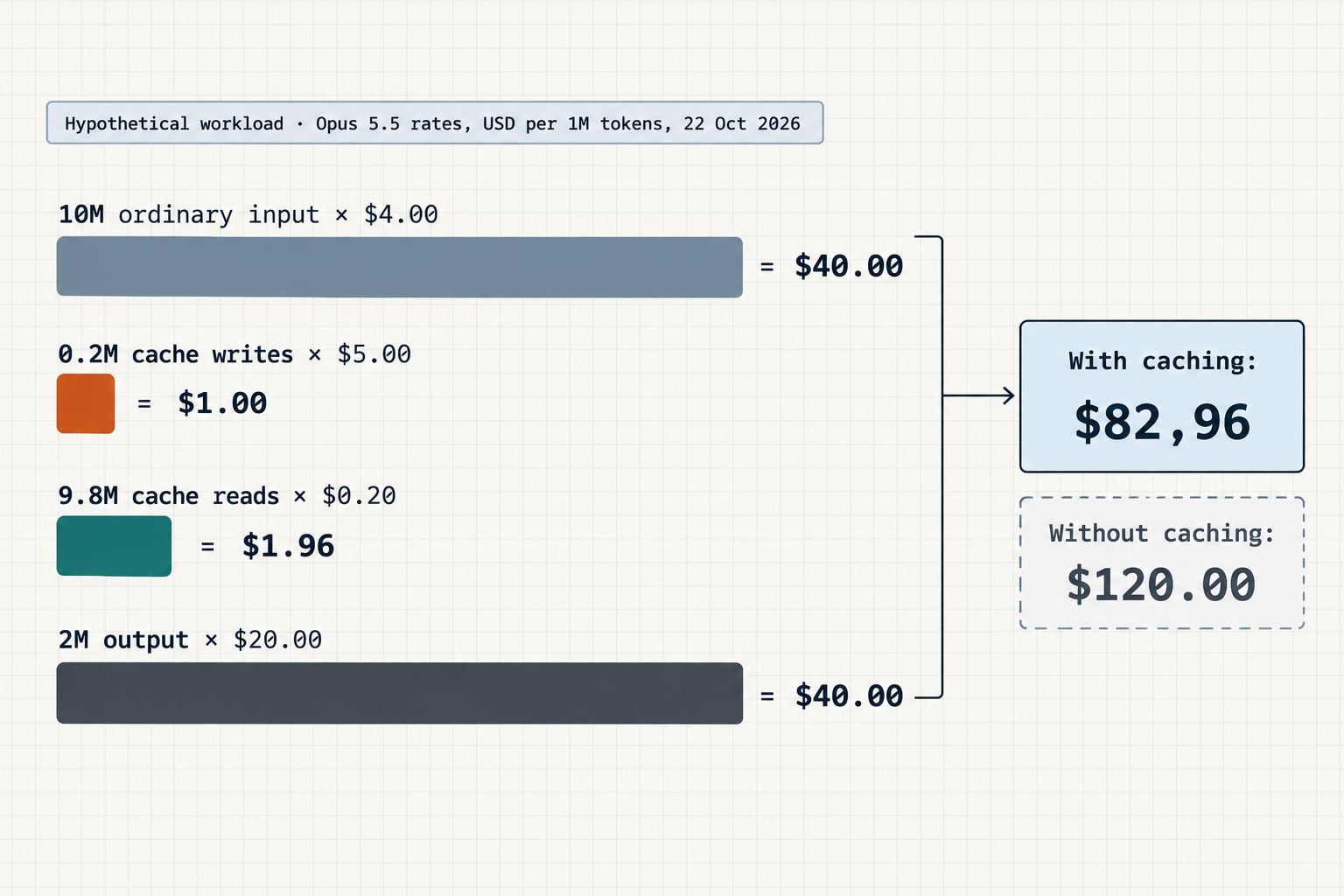
This example is hypothetical. The workload is invented to show the mechanics. The rates are Anthropic’s official Opus 5.5 rates as listed on 22 October 2026.

Workload

  • 10,000,000 ordinary input tokens (user messages and retrieved documents that change on every request).
  • 10,000,000 cache-eligible input tokens: a 50,000-token shared prefix (system prompt, tool definitions and a reference document) sent with 200 requests.
  • 2,000,000 output tokens.

Assumption about cache creation. Traffic gaps let the 5-minute cache expire four times, so the prefix is written four times: 4 × 50,000 = 200,000 write tokens. The remaining 9,800,000 cache-eligible tokens are reads.

Rates (Opus 5.5, USD per 1M tokens): input $4.00; 5-minute cache write $5.00; cache read $0.20; output $20.00.

Formula: Total = (ordinary input × input rate) + (cache writes × write rate) + (cache reads × read rate) + (output × output rate), with each token count divided by 1,000,000.

LineTokensRateCost
Ordinary input10,000,000$4.00$40.00
Cache writes (5-min)200,000$5.00$1.00
Cache reads9,800,000$0.20$1.96
Output2,000,000$20.00$40.00
Total with caching$82.96
Total without caching (20M input at $4)$120.00
AI API pricing comparison

Caching saves $37.04, or 30.9%. On the cached tokens alone, the effective rate falls from $4.00 to about $0.30 per million (writes plus reads, divided by 10 million). The total bill falls by less than a third, because ordinary input and output make up $80 of what remains, and caching touches neither.

The same workload on GPT-6.1 Sol, at $2.00 input, $2.50 write, $0.10 read and $10.00 output, costs $41.48 with caching against $60.00 without. That is the same 30.9% saving, because OpenAI’s write and read multipliers for this model happen to mirror Anthropic’s. Switching to 1-hour Anthropic writes ($8.00) raises the Opus total to $83.56. That costs more here, but it would cost less if longer gaps between requests were forcing extra rewrites.

When a cheaper model costs more

The opening example has a sharper version. GPT-6.1 Sol, with a 270,000-token prompt and a 2,000-token answer:

  • 270,000 × $2.00 + 2,000 × $10.00 = $0.56

Add 10,000 tokens to that prompt, taking it to 280,000:

  • 280,000 × $4.00 + 2,000 × $15.00 = $1.15

A 3.7% longer prompt roughly doubles the cost, because the long-context rate applies to the whole request. At 300,000 tokens, GPT-6.1 Sol ($1.23), Gemini 3.1 Pro Preview ($1.24 at its above-200K rates) and Opus 5.5 ($1.24) all land within about a cent of each other. In that band, a choice between them should rest on output quality and latency rather than price.

The second trap is costing a single call instead of a successful task. Cost per success = cost per attempt ÷ success rate. Hypothetical example: a pipeline step sends 20,000 input tokens and receives 3,000 output tokens. On MiniMax-M3.1-Flash ($0.15 / $0.60) one attempt costs $0.0048; on Opus 5.5 ($4 / $20) it costs $0.10. Even if the small model succeeds half the time and Opus 5.5 nine times in ten, the token cost per success is about $0.01 against $0.11. On tokens alone, the cheaper model still wins.

What flips the comparison is what a failure sets off: a human review, a rolled-back change, a customer ticket. If each failure costs $2 of someone’s time, the expected cost per attempt becomes about $1.00 for the small model and $0.30 for Opus 5.5. These success rates are invented for illustration. Measure your own before treating any per-token figure as the cost of the work.

Hosted API versus open-weight deployment

Several models in the table publish their weights: Mistral Large 4 (weights promised), Kimi K3, Qwen3.8-Max (released openly as Qwen3.8-2.4T-A95B) and Meta’s Muse Spark Open. That makes them available to self-host. It doesn’t make them free.

The hosted rates above are directly comparable with each other. Self-hosted costs are not comparable with them on a per-token basis until you supply your own figures for:

  • GPU rental or ownership cost per hour, and how many GPUs the model needs at your chosen quantization.
  • Achieved throughput in tokens per second at your real batch size and input/output mix.
  • KV-cache memory for your context lengths, which caps concurrency.
  • Utilisation: an accelerator that sits idle 80% of the time costs five times more per token than one at full load.
  • Engineering, orchestration, monitoring, storage and on-call time.

UniverseBlend’s breakdown of self-hosted LLM cost and its five hidden fees works through these layers with stated assumptions. For current accelerator rates, see our GPU cloud pricing 2026 guide. We do not quote a universal self-hosted price per million tokens, because no honest one exists.

Third-party hosts sit between the two. Together AI lists Llama 3.3 70B at $1.04 per million tokens for both input and output, and DeepSeek V4 Pro at the same $1.32 and $3.96 DeepSeek charges at peak. Hosted open-weight prices can match or exceed the original lab’s API, so check both.

A practical API cost-estimation method

  1. Log a representative day of traffic and count tokens per request in four buckets: stable prefix, variable input, visible output and reasoning output.
  2. Find the prefix share. If 40% or more of input tokens repeat across requests within the cache lifetime, caching is worth engineering for.
  3. Estimate the hit rate honestly. Count how often gaps between requests exceed the cache lifetime (5 minutes, 30 minutes or 1 hour, depending on provider and setting). Each gap means another write.
  4. Check every threshold. Record your 95th-percentile prompt length and compare it against 200K (Gemini 3.1 Pro), 272K (GPT-6 family), 256K (several Qwen3.x Plus and Flash models) and 512K (MiniMax-M3).
  5. Apply the formula for each candidate model and multiply by monthly volume.
  6. Move what can wait to batch. Anything that can tolerate hours of delay usually gets 50% off.
  7. Add a margin for retries and failed requests. Our analysis of AI API rate limits in 2026 explains why failed calls still consume capacity.

What changes the bill

  • OpenAI: whole-request repricing above 272K input tokens; cache writes at 1.25× (30 minutes) or 2.5× (12 hours); Fast mode at 2×; regional processing at +10% for models released on or after 5 March 2026.
  • Anthropic: no long-context surcharge on Opus 5.5; a 512-token cache minimum; US-only inference at 1.1×.
  • Google: the above-200K tier on Gemini 3.1 Pro Preview; Flash prices doubling on 1 January 2027; hourly storage for explicit caches.
  • DeepSeek: time-of-day pricing, with weekday peak windows at double the off-peak rate.
  • Alibaba Model Studio: tiered input pricing on many Qwen Plus and Flash models; batch and cache discounts that cannot be stacked.
  • MiniMax: M3 pricing that changes above 512K input tokens; a Priority tier at 1.5×.

Conclusion

Pick the model on quality for your task first. Then let cost choose between the models that pass. Within that shortlist:

  • Output-heavy work (long generation, agents that write code): compare output rates first.
  • Prefix-heavy work (support bots, RAG with a fixed corpus, agents with long tool lists): compare cache read and write rates, and check whether your traffic keeps the cache warm.
  • Long-document work above 200K tokens: the threshold matters more than the headline rate.
  • Offline work: price it at batch rates.

Recheck the rates before you commit a budget. Three of the prices in this article carry a known end date, a preview label or a pending change.

Frequently asked questions

Which AI API is cheapest for input tokens?

Among the models checked on 22 October 2026, GPT-6 Luna has the lowest standard input rate, at $0.10 per million tokens. DeepSeek’s deepseek-flash drops to $0.15 off-peak, and MiniMax-M3.1-Flash is $0.15. These are small models, though, and not substitutes for frontier models on hard tasks.

Which AI API is cheapest for output tokens?

GPT-6 Luna, at $0.50 per million output tokens. Among the larger models, DeepSeek V4 Pro ($3.96 at peak, $1.98 off-peak) and Mistral Large 4 ($4.18) cost well below Opus 5.5 ($20) and Gemini 3.1 Pro Preview ($12).

Which providers offer cached-input pricing?

All of the providers verified here publish a cached-input rate except Alibaba, which points to a separate caching page instead of listing a per-model figure. Cache-write charges and eligibility rules differ by provider.

How much can prompt caching save?

The read discount is roughly 90% to 98% on cached tokens, depending on the model. On a whole bill, the saving depends on how much of the input is a repeated prefix and how much of the cost is output. In our worked example it was about 31%.

Does batch processing reduce API costs?

Yes. OpenAI, Anthropic and Google each publish 50% off for asynchronous batch jobs. The other providers’ batch discounts could not be verified per model.

Why does long-context pricing sometimes increase?

Longer prompts need more compute and memory per request, and some providers price that in with a threshold. OpenAI applies its higher rate to the entire request once the prompt passes 272K input tokens.

Are open-weight models cheaper than hosted APIs?

Only at sustained, high utilisation with engineering capacity to spare. The weights are free to download, but running them means paying for hardware, operations and idle capacity.

How should a startup estimate its monthly API bill?

Measure real token counts per request, split them into prefix, variable input and output, apply each candidate model’s formula, and then add 10% to 20% for retries. Recheck after the first month of production traffic.

How often should AI API prices be rechecked?

Monthly at minimum, and before any budget commitment. This snapshot already contains a scheduled price change (Gemini Flash) and two preview-labelled models.

How these prices were checked. Every rate in Tables 1 and 2 was read from the provider’s official pricing or model page on 22 October 2026, except the Kimi K3 rates, which are labelled as third-party. Totals and derived long-context rates are our own calculations from those published rules.


Keep reading

Claude Opus vs Sonnet

Claude Opus vs Sonnet: What the 2026 Price Gap Actually Buys

Last verified: 8 November 2026. All prices are Anthropic’s standard first-party API rates in US dollars per million tokens. They aren’t Claude Pro or Max …
RSA-1024

Did AI Break RSA? What DeepMind Actually Found

Last verified: 8 November 2026. Both papers are unreviewed working papers, and no outside group has reproduced the results yet. No, AI did not break …
Model Distillation

Model Distillation Explained: When AI Learning Becomes Extraction

Last verified: 7 November 2026. Government and company claims are attributed throughout. None has been tested in court. A support team trains a small, cheap …
AI shopping agents

Visa Tested AI Shopping Agents. 42.8% of Runs Failed, and Many Still Bought

Last verified: 7 November 2026. Benchmark figures are from Visa’s announcement. Model rankings are from Fortune. A shopper asks for a TV. The agent finds …

Chinese Open-Weight Models Compared: DeepSeek vs Qwen & More

Chinese open-weight models

Research cutoff: 20 October 2026. Prices, licences and legal status were checked on that date and change often.

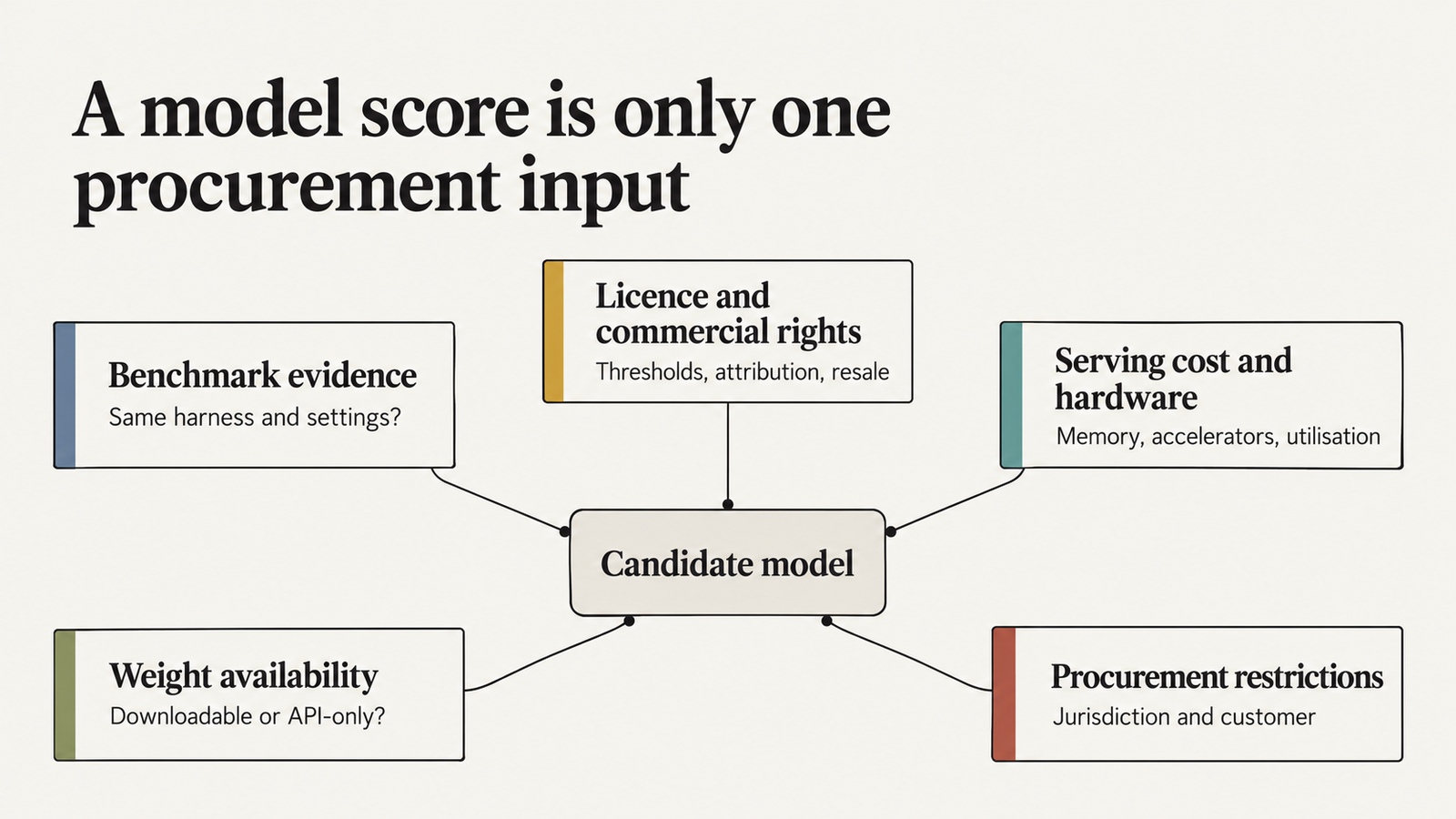
On 19 October, MiniMax priced its new M3.1 Flash at $0.15 per million input tokens and $0.60 per million output tokens. Those are, to the cent, the off-peak rates DeepSeek charges for V4.1 Flash. The next day, the US Department of Homeland Security published an order removing DeepSeek products from federal civilian IT systems. That pairing sums up where Chinese open-weight models stand: quality at the top has converged enough that licence terms, serving cost, hardware and the identity of your customer now decide the purchase.

This comparison covers the current release from DeepSeek, Alibaba’s Qwen, Moonshot AI’s Kimi, MiniMax and Zhipu AI’s GLM (sold internationally as Z.ai). It does not name a winner, because the evidence does not support one.

Key Takeaways
  • “Open-weight” covers five different licences. Only DeepSeek V4.1 Flash (MIT) and Qwen3.8-27B (Apache 2.0) come with standard permissive licences. Kimi K3, GLM-5.3, MiniMax-M3 and Qwen’s 2.4-trillion-parameter model all add custom conditions.
  • The downloadable model is not always the model you tested. Qwen3.8’s open-weight flagship is text-only and lacks the hosted Max model’s 1M-token context. MiniMax’s newest model, M3.1 Flash, has no weights yet.
  • Hosted prices for the same workload differ by about 25×. On the example workload below, the bill runs from roughly $167 a month (DeepSeek, off-peak) to $4,110 (Kimi K3).
  • Self-hosting the flagships is a cluster decision. The largest checkpoints need 1.4–4.9 TB of accelerator memory for weights alone. Only the 27B Qwen model fits on a single GPU.
  • Vendor benchmark tables are not mutually comparable. DeepSeek’s and MiniMax’s October tables report different Humanity’s Last Exam scores for the same Anthropic model.
  • The US order on DeepSeek is narrow but real. It covers federal civilian agency systems and procurement, including third-party products “developed using DeepSeek implementations”. The public notice does not extend it to private companies.

Quick Navigation


What this comparison measures

“Open-weight” means the trained parameters can be downloaded. It does not mean the training data or training code is public (none of the five publishes its training data), and it does not mean the licence permits every commercial use. Each family is assessed on its current release, with the downloadable checkpoint and the hosted API treated separately where they differ. Vendor-reported figures are labelled as such.

Master comparison of Chinese open-weight models

Table 1 — Release, weights and licence (checked 20 October 2026)

FamilyCurrent release assessedWeightsLicenceCommercial use
DeepSeekV4.1-Flash-1017 (Oct 2026)DownloadableMITPermitted
QwenQwen3.8-27B; Qwen3.8-2.4T-A95B (Aug 2026)Downloadable27B: Apache 2.0 (reported). 2.4T: custom “Qwen3.8-Max License”Permitted; conditions above stated thresholds for the 2.4T model
KimiKimi K3 (late July 2026)DownloadableCustom “Kimi K3 License” (MIT-derived)Permitted; conditions above thresholds
MiniMaxMiniMax-M3 (June 2026); M3.1 Flash (Oct 2026)M3: downloadable. M3.1 Flash: not yet releasedM3: “MiniMax Community License”M3: commercial use requires notice or written authorisation
GLMGLM-5.3 (weights 28 Aug 2026)DownloadableCustom “GLM-5.3 License”Permitted; security review for hosts above $10 billion revenue

Table 2 — Architecture, context and price

ModelTotal / active parametersContextInputsAPI price per 1M tokens (input / output)
DeepSeek V4.1 Flash552B reported; 763B in repository metadata / 8B–16B active (reported)1MText, image$0.15 / $0.60 off-peak; double at peak
Qwen3.8-27B27B dense262K native, 1M with YaRNText, image, videoNot verified
Qwen3.8-2.4T-A95B2.4T / 95BBelow the hosted model’s 1M (exact figure not published)Text onlyHosted Max: $2 / $6 (reported, not verified)
Kimi K32.8T / 104B1MText, image, video$3.00 / $15.00 ($0.30 cached input)
MiniMax-M3~428B / ~23B1MText, image, videoNot published
MiniMax M3.1 FlashNot disclosedNot stated officiallyText, image (reported)$0.15 / $0.60 ($0.015 cached input)
GLM-5.3~744–753B / ~40B1MNot confirmed (GLM-5.2 was text-only)$1.40 / $4.40

Every model except Qwen’s 27B has converged on a very large mixture-of-experts design with a 1M-token context, so architecture no longer separates them. Hosted prices do: they span more than an order of magnitude, from the two Flash models to Kimi K3.

Chinese open-weight models

What the benchmark tables establish

Less than they appear to. The October model cards from DeepSeek and MiniMax both compare against Kimi K3, GLM-5.3 and Anthropic’s Claude Opus 5, and both use some of the same benchmarks: DeepSWE v1.1, Terminal-Bench 4.0, NL2Repo-Bench and Humanity’s Last Exam (HLE).

Table 3 — Vendor-reported scores on shared benchmarks (October 2026)

BenchmarkDeepSeek V4.1-Flash-1017MiniMax M3.1 FlashKimi K3 (in DeepSeek’s table)GLM-5.3 (in DeepSeek’s table)
DeepSWE v1.177.073.767.566.9
Terminal-Bench 4.042.338.112.637.9
NL2Repo-Bench68.261.258.058.0
HLE (no tools)42.643.443.542.0 (text-only subset)

Sources: DeepSeek V4.1-Flash-1017 model card; MiniMax M3.1 Flash announcement. DeepSeek ran DeepSWE with the Mini-SWE-V2 harness and Terminal-Bench with the Claude Code harness; MiniMax’s footnotes cite several harnesses. All figures are company-reported.

DeepSeek’s table lists Claude Opus 5 at 56.3 on HLE without tools; MiniMax’s lists the same model at 55.6. The gap is small, but it shows that run conditions differ even when the labels match, and the four HLE scores above sit within 1.5 points of each other.

The Kimi row is the clearest warning. In DeepSeek’s table, Kimi K3 scores 12.6 on Terminal-Bench 4.0. Moonshot’s own card reports 88.3 on Terminal-Bench 2.1, an earlier version. Neither figure is necessarily wrong, but they cannot be compared, and a reader skimming two announcements could draw opposite conclusions.

Independent measurement helps a little. Artificial Analysis, as reported by The Decoder, puts DeepSeek V4.1-Flash-1017 at 45 on its Intelligence Index and M3.1 Flash at 42; its own page lists GLM-5.3 at 45. It also found that M3.1 Flash answered 56% of AA-Omniscience questions correctly but was confidently wrong in 93% of the cases it missed, a reliability signal absent from MiniMax’s table. None of this is your codebase or your latency budget. Use benchmarks to decide what to test.

Five families, five different trade-offs

DeepSeek: lowest price, cleanest licence, biggest procurement question

DeepSeek released V4.1 Flash on 10 September and an updated checkpoint, V4.1-Flash-1017, on 17–18 October, under the MIT licence with FP8 weights and a 1M-token context. SiliconANGLE’s launch report describes a 552B-parameter mixture-of-experts model activating 8B parameters on prompts and 16B when generating; the repository metadata shows 763B. DeepSeek has not explained the gap, and the higher figure is the one that sets your memory budget.

Price is DeepSeek’s strongest argument. Since 17 August, rates double during weekday peak hours (09:00–12:00 and 14:00–18:00 Beijing time). Off-peak, V4.1 Flash costs $0.15 per million uncached input tokens and $0.60 per million output tokens, and since 14 September calls to V4-Pro have been served and billed as V4.1 Flash. Two caveats: a nearly five-hour API outage on 15 October, and the US federal order covered below.

Qwen: the only realistic single-GPU option, and a split flagship

Qwen3.8-27B is the only strong small model in any family’s current generation. It is dense and multimodal, handles 262K tokens natively (1M with YaRN scaling), and The Decoder reports an Apache 2.0 licence. Its weights need about 54 GB in BF16 or 27 GB at FP8, so it fits on one 80 GB accelerator.

The flagship, Qwen3.8-2.4T-A95B (2.4 trillion total, 95 billion active parameters), is a different product from the hosted Qwen3.8-Max. Its model card says Max offers “more features, such as vision input & non-thinking support, 1M context length by default, official built-in tools”. The download is text-only, with a shorter context, under a custom licence whose thresholds appear in Table 4.

Kimi: the largest model, the highest price

Kimi K3 is the biggest model in the group: 2.8 trillion total parameters, 104 billion active, a 1M-token context, and text, image and video input. Moonshot trained it with quantisation-aware training, so the released weights are natively MXFP4, which is why a 2.8T model downloads at about 1.56 TB rather than 5.6 TB.

On Moonshot’s platform, K3 costs $3.00 per million input tokens ($0.30 cached) and $15.00 per million output tokens, 20 to 25 times DeepSeek’s off-peak rates. Moonshot reports strong agentic and multimodal results at maximum reasoning effort, including 91.2 on BrowseComp and 84.8 on OSWorld-Verified. Agent and computer-use workloads are where the premium could pay off; only your own tests can confirm it. The MIT-derived licence adds conditions for large resellers and very large products (Table 4).

MiniMax: two models, two different deals

MiniMax currently offers two different things under one brand. MiniMax-M3, released in June, is downloadable: about 428B total parameters, about 23B active, a 1M-token context through MiniMax’s sparse attention design, published in BF16. Its model card reports 80.5 on SWE-bench Verified and 78.1 on MMMU-Pro.

The M3 licence is the most restrictive here. The base grant covers non-commercial use; commercial use needs a one-time notice to MiniMax below $20 million in annual revenue, written authorisation above it, and a “Built with MiniMax M3” label. Serving the model through an API counts as commercial use, and military use is prohibited.

M3.1 Flash, launched on 19 October at $0.15 input, $0.60 output and $0.015 cached input per million tokens, ties DeepSeek on price. MiniMax says “model weights will be released later”. Until then it is an API product with no published licence, parameter count or context window.

GLM: MIT one release, custom the next

Zhipu’s GLM-5.2, released in June, was MIT-licensed and text-only. GLM-5.3 reached the API in August and open weights on 28 August, after a two-week safety hold: roughly 744–753B total parameters, about 40B active, a 1M-token context. Its new licence requires hosts with more than $10 billion in annual revenue to pass Z.ai’s security review. Few buyers will hit that threshold, but it shows a family’s licence can change between point releases.

At $1.40 input and $4.40 output, GLM-5.3 is mid-priced. Artificial Analysis measured 85.5 output tokens per second and a 2.44-second time to first token on Z.ai’s API. Z.ai’s vLLM recipe starts at one node of eight H200 or H20 accelerators for the FP8 checkpoint, which makes it the most practical large model to self-host.

Licences: what “open-weight” permits

A downloadable checkpoint only means you can obtain the file. The table summarises the clauses that decide what you can do with it; it is not legal advice.

Table 4 — Licence conditions that change a deployment decision

ModelRevenue or user triggerWhat it triggersExempt
DeepSeek V4.1 Flash (MIT)NoneKeep the copyright notice—
Qwen3.8-27B (Apache 2.0, reported)NoneNotice and licence retention—
Qwen3.8-2.4T-A95B>100M MAU or >$20M monthly revenue; MaaS/AI work-assistant revenue >$50M per yearDisplay model name; separate licenceInternal use
Kimi K3MaaS revenue >$20M per 12 months; >100M MAU or >$20M monthly revenueSeparate agreement; display “Kimi K3”Internal use; use via Moonshot or certified partners
GLM-5.3Hosting company revenue >$10B per 12 monthsZ.ai security reviewRouting, embedding
MiniMax-M3Any commercial use; >$20M annual revenueNotice; prior authorisation; “Built with MiniMax M3”None stated

The practical split is between internal use and resale. If you run a model only inside your company, the thresholds in the Kimi and large-Qwen licences generally do not apply. If you sell API access to a model, MiniMax-M3 requires permission at any scale, and Kimi K3 and Qwen’s flagship require agreements above their revenue thresholds.

Hosted API versus self-hosting economics

Headline prices are per token. A bill depends on how many of your tokens are input versus output, how many hit the cache, and, for DeepSeek, what time of day they arrive.

Example workload: 1 billion input tokens a month, of which 70% are cache hits, plus 200 million output tokens. This is roughly the shape of an agent or retrieval system that reuses long system prompts.

Table 5 — Monthly API bill for the example workload (prices checked 20 October 2026)

ModelCached inputUncached inputOutputMonthly total
DeepSeek V4.1 Flash (off-peak)700M × $0.003 = $2.10300M × $0.15 = $45.00200M × $0.60 = $120.00$167.10
DeepSeek V4.1 Flash (all at peak)$4.20$90.00$240.00$334.20
MiniMax M3.1 Flash700M × $0.015 = $10.50300M × $0.15 = $45.00200M × $0.60 = $120.00$175.50
Qwen3.8-Max (reported rates)700M × $0.20 = $140.00300M × $2.00 = $600.00200M × $6.00 = $1,200.00$1,940.00
GLM-5.3 (no cache discount assumed)—1,000M × $1.40 = $1,400.00200M × $4.40 = $880.00$2,280.00
Kimi K3700M × $0.30 = $210.00300M × $3.00 = $900.00200M × $15.00 = $3,000.00$4,110.00

The Qwen cache rate assumes explicit cache hits at 10% of the input price, as CloudZero reports for Alibaba Model Studio. GLM-5.3 is shown without a cache discount because Z.ai’s cached rate was not verified; its real bill would be lower. The DeepSeek cache-hit rate is taken from third-party transcriptions of DeepSeek’s pricing page.

Output is the largest line in every bill except GLM’s, where the missing cache discount inflates input. For Kimi K3 it is 73% of the total, so long answers or long reasoning traces widen the gap between vendors well beyond what input prices suggest.

Chinese open-weight models

Self-hosting changes what you pay for. In a mixture-of-experts model, only the active parameters are computed per token, but every parameter must sit in accelerator memory.

Table 6 — Weight memory before KV cache and activations

ModelReleased precisionWeights in memory (approx.)
Qwen3.8-27BBF16~54 GB (~27 GB at FP8)
MiniMax-M3BF16~856 GB (~428 GB if quantised to FP8)
DeepSeek V4.1-Flash-1017FP8~0.55–0.76 TB
GLM-5.3FP8~0.75 TB
Kimi K3MXFP4~1.56 TB (repository size)
Qwen3.8-2.4T-A95BFP8 / BF16~2.4 TB / ~4.9 TB

An eight-GPU H200 server holds 8 × 141 GB = 1,128 GB. GLM-5.3 and DeepSeek V4.1 Flash fit on one such node at FP8 with headroom for a modest KV cache, which is why Z.ai’s recipe starts there. Kimi K3 and Qwen’s 2.4T model do not fit and need either newer accelerators with more memory per device or a multi-node deployment.

To compare a node with an API bill, use monthly node cost = GPUs × hourly rate × 730 hours. At an assumed $3.00 per GPU-hour (a placeholder, not a quote), one eight-GPU node costs 8 × $3.00 × 730 = $17,520 a month, before redundancy, engineers or monitoring. That is about 4.3 times the Kimi K3 API bill for the example workload and more than 100 times DeepSeek’s off-peak bill. Self-hosting pays at much higher volume, under data-residency rules that exclude vendor APIs, or when the licence blocks the hosted route you need.

Utilisation decides the outcome: a node billed for 730 hours that is busy for 200 of them has more than tripled its effective cost per token. Measure throughput on your own prompts before trusting any published tokens-per-second figure.

Government restrictions and procurement

United States, federal civilian agencies. On 20 October 2026, DHS published a notice in the Federal Register (FR Doc. 2026-21447) of an exclusion and removal order under the Federal Acquisition Supply Chain Security Act of 2018. It covers information technology products and services from Hangzhou DeepSeek Artificial Intelligence Co. and its affiliates, plus “third-party products and services developed using DeepSeek implementations”, across federal civilian agency systems and procurement. The public notice gives no compliance deadline, does not say whether self-hosted copies of the MIT-licensed weights count as covered products, and makes no statement about private companies. The signed order sits in the docket (DHS-2026-0628), and federal suppliers should read it directly.

Earlier restrictions. Texas, New York, Virginia and Iowa barred DeepSeek on state government devices or networks in January and February 2025, and the US Navy told personnel not to use it in January 2025. The No Adversarial AI Act, introduced on 25 June 2025, would bar executive agencies from using AI from adversary-country companies; we found no evidence it has been enacted. None of these measures restricts private companies in general, but federal civilian contractors are exposed because the order reaches third-party products built on DeepSeek.

DeepSeek and Huawei. Reports of a hardware partnership are partly substantiated and partly not. In June 2026, a Huawei-led research group said, via the Shenzhen government, that it had post-trained DeepSeek V4-Pro on more than 1,000 Ascend 910C chips; DeepSeek did not comment. Bloomberg reported on 4 September that DeepSeek planned to buy at least 160,000 Ascend 950DT chips for inference while continuing to train on Nvidia hardware. The Information reported design collaboration on future chips. Neither company has confirmed a commercial arrangement.

Table 7 — Procurement checklist by family

CheckDeepSeekQwenKimiMiniMaxGLM
Weights downloadable nowYesYesYesM3 yes; M3.1 Flash noYes
Licence fits intended useMITDepends on model and scaleDepends on scaleNotice or authorisation for any commercial useYes, below $10B revenue
US federal civilian restrictionYes, FASCSA order (Oct 2026)None foundNone foundNone foundNone found
US state device bansTX, NY, VA, IA (2025)None foundNone foundNone foundNone found
Vendor API data locationVendor-operated; confirm in termsAlibaba Cloud regions incl. Singapore, Frankfurt, Virginia (reported)Vendor-operated; confirm in termsVendor-operated; confirm in termsVendor-operated; confirm in terms
Continuity signalFive-hour outage, 15 Oct 2026Hosted flagship ahead of open releaseSingle large modelWeights for newest model pendingLicence changed between point releases

Self-hosting puts data handling under your controls; a vendor API puts it under the vendor’s terms and jurisdiction. Where a model was trained does not by itself make either route safe or unsafe. Confirm the current position with your legal and procurement teams.

Which model fits which workload

  • Startup on hosted APIs: DeepSeek V4.1 Flash and MiniMax M3.1 Flash, the cheapest endpoints by far. Run DeepSeek batch jobs off-peak, and check M3.1 Flash’s factual reliability before using it for question-answering.
  • Self-hosting on one GPU: Qwen3.8-27B, the only current-generation option.
  • Self-hosting on one eight-GPU node: GLM-5.3 or DeepSeek V4.1 Flash; DeepSeek’s MIT licence is simpler unless you sell to US federal civilian agencies.
  • Software engineering: shortlist DeepSeek V4.1 Flash, MiniMax-M3 and GLM-5.3 and test them on your own repository, since vendor coding tables use different harnesses.
  • Chinese-language or multilingual products: none of the cards consulted reports a comparable multilingual benchmark, so test on your own corpus.
  • Reasoning and mathematics: HLE scores sit within 1.5 points, and Kimi K3’s 93.5 on GPQA Diamond has no like-for-like counterpart in the other cards. Run your own evaluation.
  • Multimodal: Kimi K3, Qwen3.8-27B or MiniMax-M3. Qwen’s 2.4T download is text-only, and GLM-5.3’s multimodal support was not confirmed.
  • Regulated or government-facing: exclude DeepSeek from US federal civilian supply chains; for the rest, check licence terms, data residency and vendor support.

A short evaluation protocol. Pick 50–200 tasks that represent real traffic. Run every candidate with the same prompts, tools, context limits and sampling settings. Record pass rate, time to first token, output speed, cost per successful task and failure types, and repeat after each model update.

Conclusion

The five families now differ more on rights and costs than on capability. DeepSeek has the cheapest API and the cleanest licence but sits under a federal civilian procurement order. Qwen has the only single-GPU option, and a flagship download that is narrower than what Alibaba hosts. Kimi posts strong agentic numbers on its own tables at the highest price. MiniMax’s licence requires notice for commercial use. GLM is mid-priced and the easiest large model to self-host. Choosing among Chinese open-weight models in 2026 means choosing which of those trade-offs your workload, budget and customers can accept, and then testing.

Frequently asked questions

What are Chinese open-weight models?

Large language models from Chinese developers whose trained weights can be downloaded and run on your own hardware, chiefly DeepSeek, Qwen, Kimi, MiniMax and GLM. The training data and code are not public, and commercial rights vary by licence.

Are DeepSeek and Qwen models open source?

Partly. DeepSeek V4.1 Flash (MIT) and Qwen3.8-27B (Apache 2.0) use standard permissive licences, but neither family publishes training data, and Qwen’s largest open model uses a custom licence.

Can Chinese open-weight models be used commercially?

Yes for most buyers, with model-specific conditions. MiniMax-M3 needs a notice to MiniMax for any commercial use; Kimi K3 and Qwen’s 2.4T model add conditions only above high revenue or user thresholds.

Which of these models can run on a single GPU?

Only Qwen3.8-27B. The other current flagships need hundreds of gigabytes to several terabytes of accelerator memory.

Is DeepSeek banned in the United States?

Not in general. DHS has ordered federal civilian agencies to remove DeepSeek products, and several states ban it on government devices; the published notice does not extend to private companies or individuals.

Is self-hosting cheaper than using an API?

Usually not at moderate volume. Self-hosting tends to win on data control, licence fit or very high, steady utilisation.

How should I compare benchmark results across vendors?

Only when benchmark version, harness and settings match, which is rare. Use scores to build a shortlist, then test it on your own tasks.


Keep reading

Claude Opus vs Sonnet

Claude Opus vs Sonnet: What the 2026 Price Gap Actually Buys

Last verified: 8 November 2026. All prices are Anthropic’s standard first-party API rates in US dollars per million tokens. They aren’t Claude Pro or Max …
RSA-1024

Did AI Break RSA? What DeepMind Actually Found

Last verified: 8 November 2026. Both papers are unreviewed working papers, and no outside group has reproduced the results yet. No, AI did not break …
Model Distillation

Model Distillation Explained: When AI Learning Becomes Extraction
Last verified: 7 November 2026. Government and company claims are attributed throughout. None has been tested in court. A support team trains a small, cheap …
AI shopping agents

Visa Tested AI Shopping Agents. 42.8% of Runs Failed, and Many Still Bought

Last verified: 7 November 2026. Benchmark figures are from Visa’s announcement. Model rankings are from Fortune. A shopper asks for a TV. The agent finds …

When Adding an Agent Stops Paying for Itself

multi-agent token cost

The architecture that became more expensive without becoming better

Multi-agent token cost rarely shows up in a design review. It shows up a month later on the invoice. Take a team that splits a defect-investigation agent into a planner, three specialist workers and a synthesiser. Its fix rate improves, so it scales to eight workers. The fix rate stays flat and the per-run model bill more than doubles.

Nothing went wrong with the models. Each worker reread the same code, wrote its own notes, and handed them to a synthesiser that read them all again. Per-token prices have fallen over the past year, but this system now buys far more tokens per answer. A cheaper token and a more expensive system can coexist, and that gap is the subject of this article.

Key Takeaways
  • Agent count is a poor proxy for quality. In the largest controlled study available, multi-agent setups averaged −0.3% against a single agent, with results ranging from +80.8% to −70% depending on the task.
  • Most extra tokens come from repeated context. In this article’s eight-agent example, workers rereading the same 20,000-token code context account for 72% of all input tokens.
  • In the example, going from one to three agents cost $2.34 per additional successful task. Going from three to five cost $12.95. Going from five to eight cost $0.78 more per run with no gain.
  • Token prices and GPU rental prices are separate markets. Falling API rates do not mean falling H100 rents, and the dated data does not show that they have.
  • Extra agents can still pay when subtasks are genuinely independent, when a failure is expensive, or when parallel work cuts latency someone cares about.
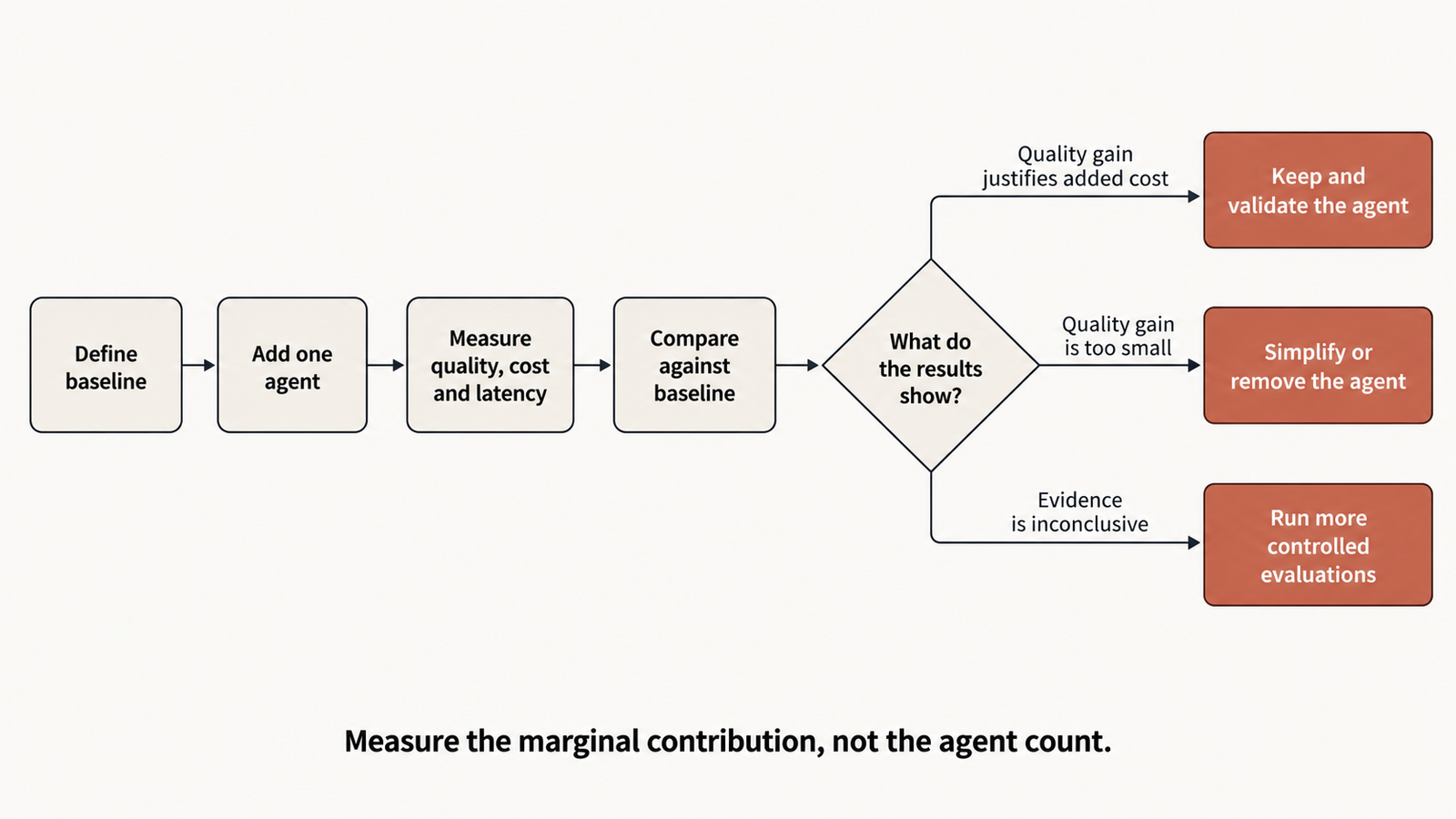
  • Before adding an agent, run an ablation. Remove it, rerun the same evaluation set, and compare cost per successful task.

Quick Navigation


The multi-agent token cost is hidden in the handoffs

Agents are not the unit of cost. Model calls are, and every call pays for its whole input again.

A single agent investigating a bug might make eight calls. It starts with the bug report and the relevant code, about 20,000 tokens, and appends what it learns as it goes. By the last call its input is larger, but it only ever pays for one copy of the codebase per call.

Split that work across workers and the arithmetic changes. A planner reads the task and writes assignments. Each worker then reads the same code plus its own brief, makes a few calls of its own, and writes a report. A synthesiser reads every report alongside the original context. The code that the single agent read eight times is now read four times per worker, by every worker.

That is the first cost driver: duplicated context. The second is intermediate output. Plans, reports and summaries are output tokens, billed at five times the input rate on many current models, and then billed again as input when the next agent reads them. Retries add a third layer. A worker that fails a tool call reruns with its full context.

None of this makes multi-agent design wrong. It means the useful question is how much an added worker contributes beyond the context it rebuys, not how many agents a system has. UniverseBlend found the same pattern in a different form in its analysis of why a 50% price cut doesn’t halve agent bills: in agent workloads, the line item that repeats matters more than the headline rate.

What the research on multi-agent scaling establishes

The circulating claim that agent quality plateaus while token use keeps climbing has a real basis, but not a single magic number behind it. No paper dated October 12, 2026 matching that claim could be found. The strongest primary evidence is earlier and more careful.

Kim and colleagues at Google Research, Google DeepMind and MIT tested 260 configurations in Towards a Science of Scaling Agent Systems (arXiv, version 3 dated April 8, 2026). They compared a single agent against four multi-agent designs across six agentic benchmarks, from financial analysis to SWE-bench Verified, using OpenAI, Google and Anthropic models.

The headline is variance, not improvement. Averaged across every multi-agent result, performance changed by −0.3% relative to a single agent, with a 95% interval running from −58.7% to +77.2%. A centralised design improved Finance-Agent by 80.8%. Every multi-agent design made PlanCraft worse, by 39.1% to 70.0%. On SWE-bench Verified, all variants lost ground.

Two findings bear directly on cost. First, token efficiency collapsed. A single agent produced 67.7 successes per thousand tokens; centralised and hybrid teams produced 21.5 and 13.6. Second, tasks where a single agent already scored above 45% saw negative returns from adding agents. This was the paper’s most statistically robust result (β = −0.236, p = 0.004).

The agent-count question itself was a smaller, preliminary test. Using Gemini models at 1, 3, 5, 7 and 9 agents, the authors report that Gemini 2.0 Flash peaked at seven agents before degrading, and that a centralised Gemini 2.5 Pro team showed diminishing returns beyond five. The paper does not give the exact accuracies or name the benchmark for that figure. So “quality plateaus at five agents” is too strong a summary. The defensible reading is that the optimum depends on model and coordination design, and it arrived at single-digit team sizes in the cases tested.

The study did not measure latency, and it reports dollar cost only as marginal cost per point of success for one architecture. A newer paper on vulnerability-discovery agents, Where Do the Tokens Go? (October 8, 2026), adds a consistent observation from a different domain: “higher spending does not consistently yield better outcomes.” It does not vary agent count, so it supports the spending point and nothing more.

The practical consequence is that there is no published universal agent count to copy. Each team has to measure its own curve.

The four-configuration multi-agent token cost test

What follows is a transparent cost model, not a benchmark. Token counts and success rates are illustrative assumptions chosen to be plausible and consistent with the research above. Prices are real.

  • Task (same for all four): investigate a reported defect in a service and produce a root cause plus a proposed patch. Success means the patch passes the project’s existing test suite and a reviewer accepts the diagnosis.
  • Model and prices: Claude Sonnet 5.5, $2.00 per million input tokens and $10.00 per million output tokens, USD, from Anthropic’s pricing page, checked October 11, 2026.
  • Included: every priced model call (planner, workers, synthesiser).
  • Excluded: prompt caching, retries, tool execution, embeddings, external search, orchestration servers and engineering time.

Workload assumptions:

  • Shared context: 20,000 tokens (bug report plus relevant code).
  • One agent: 8 sequential calls, average input 32,000 tokens (shared context plus 12,000 accumulated notes), 1,500 output tokens each.
  • Multi-agent (n workers): one planner call (21,000 in / 2,000 out); each worker makes 4 calls averaging 26,000 input (shared context, brief and own notes) and 1,200 output; one synthesiser call reading the shared context, a 1,500-token report per worker and the 2,000-token plan, writing 3,000 tokens.
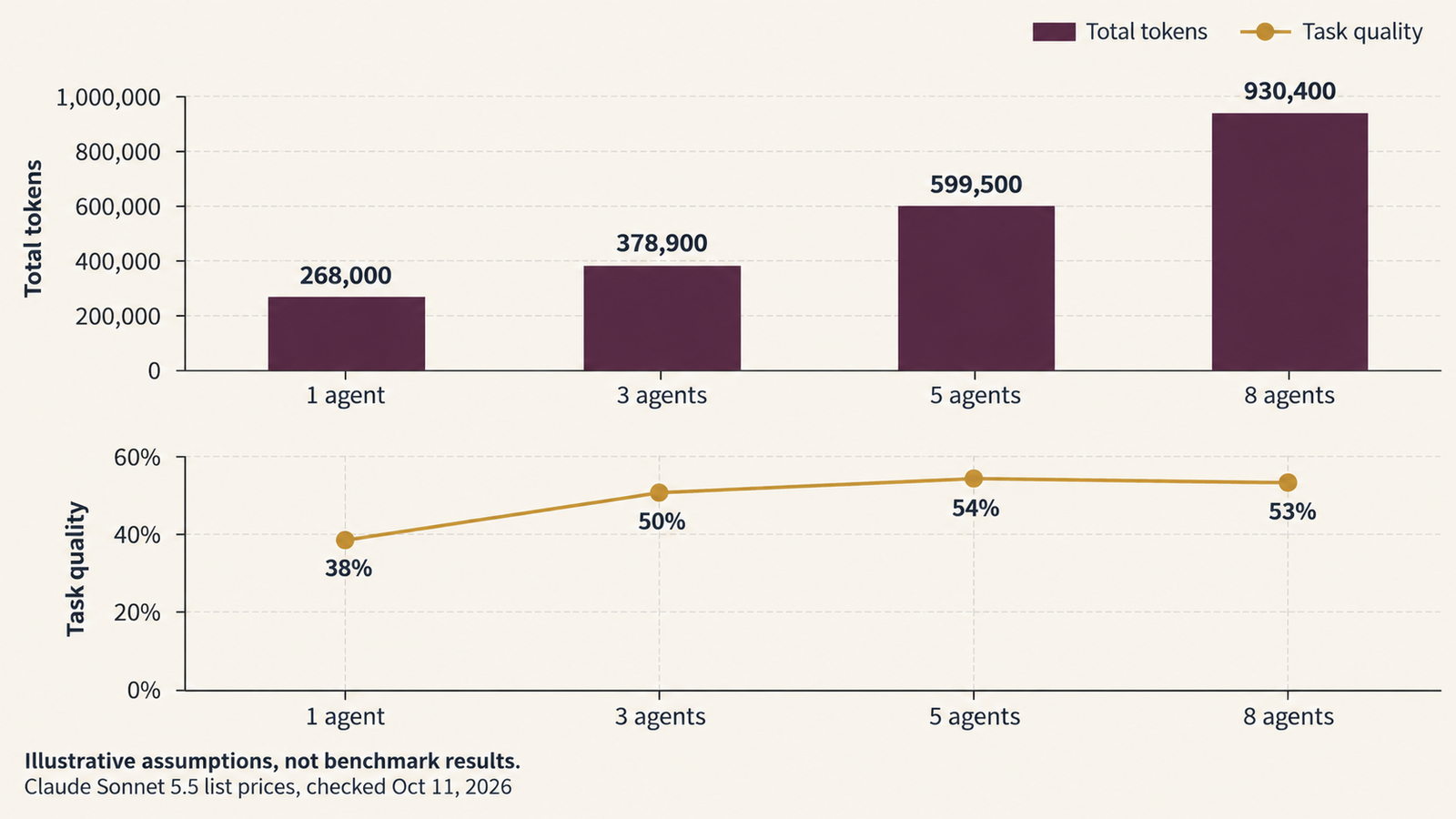
  • Success rates (illustrative): 38%, 50%, 54% and 53%. The single-agent baseline is set below the 45% level at which Kim et al. found extra agents start to hurt. The slight drop at eight reflects the degradation they observed at larger team sizes.
Token arithmetic
  • 1 agent: input 8 × 32,000 = 256,000; output 8 × 1,500 = 12,000.
  • 3 agents: input 21,000 + (3 × 4 × 26,000 = 312,000) + (20,000 + 4,500 + 2,000 = 26,500) = 359,500; output 2,000 + 14,400 + 3,000 = 19,400.
  • 5 agents: input 21,000 + 520,000 + 29,500 = 570,500; output 2,000 + 24,000 + 3,000 = 29,000.
  • 8 agents: input 21,000 + 832,000 + 34,000 = 887,000; output 2,000 + 38,400 + 3,000 = 43,400.

Cost = input tokens ÷ 1,000,000 × $2.00 + output tokens ÷ 1,000,000 × $10.00.

Results
Metric1 agent3 agents5 agents8 agents
Input tokens256,000359,500570,500887,000
Output tokens12,00019,40029,00043,400
Total tokens268,000378,900599,500930,400
Input cost$0.512$0.719$1.141$1.774
Output cost$0.120$0.194$0.290$0.434
Total API cost per run$0.632$0.913$1.431$2.208
Success rate (illustrative)38%50%54%53%
Incremental cost vs previous—+$0.281+$0.518+$0.777
Incremental success vs previous—+12 pts+4 pts−1 pt
Cost per successful task$1.66$1.83$2.65$4.17
Latency (estimate, 8 s per call, workers fully parallel)~64 s~48 s~48 s~48 s
multi-agent token cost

These are four different measurements. Total tokens tripled between one and five agents (268,000 to 599,500), while cost per successful task rose by 60% ($1.66 to $2.65). The ratios differ because more successes partly offset the extra spend. Latency improves when workers run in parallel, as long as the provider lets eight 26,000-token requests run at once. That depends on tokens-per-minute limits, covered in UniverseBlend’s guide to AI API rate limits in 2026. The latency figures are illustrative too.

The point where more agents stop paying

The marginal numbers carry the argument.

  • One to three agents: +$0.281 per run for +12 points of success, or $0.281 ÷ 0.12 = $2.34 per additional successful task.
  • Three to five: +$0.518 for +4 points = $12.95 per additional success.
  • Five to eight: +$0.777 for −1 point. No additional successes, so the move never pays.

Whether $12.95 is too much depends on what a success is worth, which the token bill cannot tell you. The rule is to add the agent only if (gain in success rate) × (value of one success) is greater than the added cost per run.

If a resolved defect saves an engineer an hour, valued at $50, then 0.04 × $50 = $2.00 exceeds $0.518 and five agents beat three. If the task is low-stakes triage worth $5 per success, 0.04 × $5 = $0.20 falls short, and three agents is the right stopping point. Eight agents lose at any value, because they produce no gain.

That is the honest answer to the headline. In this example the agent stops paying for itself at the configuration where its marginal success gain, times what a success is worth, drops below its marginal tokens. The break-even depends on the value of a success, not on a universal number of agents.

Four task properties move that point.

  1. Independence of subtasks. Workers that split a search space with little overlap add coverage cheaply. Workers that all need the full context mostly add duplicated reading. That is the Finance-Agent pattern versus the PlanCraft pattern in Kim et al.
  2. Baseline strength. When a single agent already succeeds most of the time, there is little left to gain and more room for coordination errors.
  3. Error propagation. Kim et al. measured error amplification of 17.2× for independent agents against 4.4× for centralised designs with a verifier. More agents without a checking step multiply mistakes as well as tokens.
  4. Cost of failure. For security review, financial reconciliation or production incidents, a second independent opinion can be worth many times its tokens even at a small success gain.

Why cheaper tokens do not guarantee cheaper AI systems

API prices have fallen. OpenAI’s GPT-6 Sol launched at $2 input and $10 output per million tokens, half the $4 and $20 of GPT-5.6 Sol, as UniverseBlend covered in September. On the current model page, GPT-6.1 Sol still lists $2 and $10.

GPU rents have not followed. The Silicon Data H100 rental index read $2.85 per GPU-hour on October 12, 2026, up 1.1% over the previous week. SemiAnalysis has reported one-year H100 rentals rising from about $1.70 in October 2025 to about $2.35 in March 2026. That figure could not be independently opened for this article and should be treated as reported, not verified. On-demand list prices on October 10 still ran from $2.89 to $11.68 per GPU-hour depending on provider and configuration, as tracked in UniverseBlend’s GPU cloud pricing comparison.

The two prices measure different things. An API price is what a provider charges per token, after its own hardware efficiency, batching and margin. A GPU rent is what scarce hardware fetches by the hour. Better software, quantisation and newer chips can push the token price down while demand for the hardware pushes its rent up. Both can be true at once without contradicting each other.

This is where Jevons’ paradox gets invoked. William Stanley Jevons observed in The Coal Question (1865) that more efficient steam engines increased Britain’s total coal consumption, because cheaper effective energy opened new uses. The AI version says cheaper tokens unlock workloads, multi-agent systems among them, that consume so many more tokens that total compute demand rises.

The analogy needs conditions before it holds. Demand for tokens must be elastic enough that lower prices raise total spending, not just volume. The efficiency gain must be what lowered the price, not a subsidy or promotional pricing. And the measure must be total resource use, not one company’s bill. The dated evidence here shows falling list prices and stable-to-rising GPU rents. That is consistent with Jevons, but it does not prove it. Supply constraints alone could explain firm rents.

For a team running agents, the practical point is narrower. A cheaper model makes each token cheaper, but an architecture that multiplies tokens 3.5-fold, as eight agents did in the example, can absorb a 50% price cut and still cost more. If you self-host, the relevant price is the GPU-hour and your utilisation, not the API rate card.

A decision rule engineers can actually use

Add an agent only when its measured marginal contribution is worth its marginal cost:

\Delta p \times V_{\text{success}} \; > \; \Delta C_{\text{run}} + \Delta C_{\text{latency}} + \Delta C_{\text{operations}}

Here Δp is the change in success rate, V is the value of one success, and the right side is the added cost per run in tokens, waiting time and operational burden.

Before adding one, check:

  • Baseline quality: what does the simplest configuration achieve on a fixed evaluation set?
  • Incremental success: how much does the new agent change the success rate, with confidence intervals?
  • Added tokens: how many input and output tokens does it add per run, including the context it rereads?
  • Marginal cost: what is the cost per additional successful task?
  • Latency: does it shorten or lengthen end-to-end time at your rate limits?
  • Failure severity: what does one wrong answer cost downstream?
  • Evaluation reliability: is the evaluation set large enough to detect a gain this size?
  • Simpler alternatives: would a better prompt, a verifier step or a stronger single model do the same?

The most useful test is an ablation. Disable one agent, rerun the same evaluation set, and compare cost per successful task. If nothing measurable changes, the agent was decoration.

multi-agent token cost

What to measure before scaling the agent count

Log tokens per call, not per run, tagged with agent role, so duplicated context is visible. Track cost per successful task as the primary metric, alongside success rate, p50 and p95 latency, retries and tool-call count.

Keep offline and production numbers apart. An evaluation set measures capability on known tasks. Production traffic adds longer contexts, rate-limit queueing and failure modes the evaluation set never contained. Re-check the ablation on a production sample before committing.

Prompt caching changes the arithmetic for the duplicated-context problem specifically. If workers share an identical prefix, cache reads can cut the cost of rereading it sharply. Rerun the cost model with your actual cache-hit rate before deciding, because it can move the break-even point.

Conclusion: optimise the work, not the agent count

The evidence does not support a universal team size, and it does not support the idea that more agents are better. The largest controlled study found an average effect near zero, wide variation by task, and token efficiency falling by a factor of three or more. The worked example shows how that looks on an invoice. The first two extra agents earned their keep, the next two did so only for valuable tasks, and the last three added nothing.

Multi-agent token cost is a design variable, not a fixed tax. Split work where subtasks are genuinely independent, add verification where errors are expensive, and stop when the next agent’s marginal success, times what a success is worth, no longer covers its marginal tokens. An additional agent is justified when its measurable contribution exceeds what it costs. Nothing else about it matters.

Frequently Asked Questions

What is multi-agent token cost?

Multi-agent token cost is the total model spend of a system where several LLM agents collaborate on one task. It includes each agent’s own calls, the context every agent rereads, plans and reports passed between agents, and the final synthesis. It usually grows faster than the number of agents because shared context is paid for repeatedly.

How many agents should an AI system use?

No study supports a universal number. Kim et al. found optimal team sizes depended on the model and coordination design, with diminishing returns appearing beyond five to seven agents in their preliminary Gemini tests. Start with one agent, add one at a time, and keep each only if it improves cost per successful task.

Why do multi-agent systems consume more tokens?

Each agent rereads shared context, writes intermediate plans or reports, and passes them on to be read again. Coordination also adds turns: Kim et al. measured hybrid designs taking 44.3 turns on average against 7.2 for a single agent. Retries and synthesis calls add further tokens.

Does adding more agents improve LLM accuracy?

Sometimes. Across 260 configurations, Kim et al. found a mean change of −0.3%, with gains up to +80.8% on a financial-analysis benchmark and losses up to −70% on a planning benchmark. Tasks where a single agent already exceeded 45% accuracy tended to get worse with more agents.

How can engineers calculate cost per successful AI task?

Add up input and output token costs for every model call in a run, then divide by the run’s success rate on a fixed evaluation set. For example, $0.913 per run at 50% success is $1.83 per successful task. Compare configurations on this figure, not on raw token counts.

Does cheaper token pricing make multi-agent systems cheaper?

Only if token consumption grows more slowly than prices fall. A 50% price cut is erased by an architecture that uses 3.5 times the tokens. And for self-hosted systems, API price cuts do not lower GPU rents, which have been stable to rising in 2026.


Keep reading

Claude Opus vs Sonnet

Claude Opus vs Sonnet: What the 2026 Price Gap Actually Buys

Last verified: 8 November 2026. All prices are Anthropic’s standard first-party API rates in US dollars per million tokens. They aren’t Claude Pro or Max …
RSA-1024

Did AI Break RSA? What DeepMind Actually Found

Last verified: 8 November 2026. Both papers are unreviewed working papers, and no outside group has reproduced the results yet. No, AI did not break …
Model Distillation

Model Distillation Explained: When AI Learning Becomes Extraction
Last verified: 7 November 2026. Government and company claims are attributed throughout. None has been tested in court. A support team trains a small, cheap …
AI shopping agents

Visa Tested AI Shopping Agents. 42.8% of Runs Failed, and Many Still Bought

Last verified: 7 November 2026. Benchmark figures are from Visa’s announcement. Model rankings are from Fortune. A shopper asks for a TV. The agent finds …

GPT-6 Sol vs Claude Opus 5.5: What the 50% Cut Misses

GPT-6 Sol vs Claude Opus 5.5

On September 22, 2026, Anthropic cut the price of its flagship Opus tier. Ninety minutes later, OpenAI halved the price of two GPT-6 models. Both announcements led with a percentage.

Percentages are the wrong unit. The invoice is denominated in tasks, and a task is a bundle of cached input, fresh input, output tokens, tool calls, retries and occasional failures that reach production. Change the mix and a 50% token-price cut can produce anything from a 50% saving to almost none.

This is a comparison of GPT-6 Sol vs Claude Opus 5.5 by workload shape rather than by rate card. The short version: the line that decides most agentic bills is the cached-input read, and on that line the two models are now priced identically.

Key takeaways

  • Both models landed on September 22, 2026, about 90 minutes apart. GPT-6 Sol lists at $2/$10 per million input/output tokens; Claude Opus 5.5 at $4/$20.
  • Cache reads are $0.20 per million on both. On cache-heavy agent workloads, the headline 2:1 token-price gap compresses sharply.
  • The two “cheaper” claims use different baselines. OpenAI’s 50% is measured against GPT-5.6 promotional pricing; Anthropic’s 20% is against Opus 5, with the larger 40% figure resting on token efficiency at default settings.
  • Output tokens, not input, dominate reasoning-heavy bills. A model that thinks longer can cost more per task at a lower per-token price.
  • Neither company published a symmetric head-to-head. OpenAI benchmarked Sol against Claude Opus 5 and, where 5.1 numbers were missing, Fable 5, using competitor scores from published reports.
  • Token prices fell while memory prices rose: TrendForce recorded conventional DRAM contract prices up 93–98% quarter over quarter in Q1 2026 before moderating to 13–18% in Q3.
  • The only reliable comparison is your own traffic. Cost per completed task, measured on 50 real inputs, beats any published rate card.

Quick Navigation


GPT-6 Sol vs Claude Opus 5.5: The Numbers Everyone Is Comparing

Here is what each company published, kept in separate categories, because list price, promotional price, batch price and cached price are not interchangeable.

Line item (per 1M tokens)GPT-6 SolClaude Opus 5.5
Input$2.00$4.00
Output$10.00$20.00
Cached input read$0.20$0.20
Cache write (5-min)No separate charge published$5.00
Cache write (1-hour)Not applicable$8.00
Batch50% off$2.00 / $10.00
Fast / premium modeNot offered at this tier$8.00 / $40.00
PredecessorGPT-5.6 Sol at $4 / $20Claude Opus 5 at $5 / $25

OpenAI’s announcement states the reduction plainly: Sol moves from $4/$20 to $2/$10 and Luna from $0.20/$1.20 to $0.10/$0.50, a 50% cut against GPT-5.6 promotional pricing, attributed to caching and inference improvements the company says it is passing on. Cached input-token reads carry a 90% discount, which puts Sol’s cached reads at $0.20.

Anthropic’s Opus 5.5 lists at $4 input and $20 output, down from Opus 5’s $5 and $25, with cache reads falling from $0.50 to $0.20 and five-minute cache writes from $6.25 to $5. Anthropic told reporters the model runs about 40% cheaper than Opus 5 at default settings, combining the 20% token-price cut with fewer tokens consumed per task.

Two caveats before anyone builds a spreadsheet on these numbers. OpenAI’s baseline is a promotional rate, not a long-standing list price, so “50% cheaper” compares against a discount that was already in force. An OpenAI spokesperson told VentureBeat the new rates are permanent rather than promotional; that is a company statement, not something a buyer can verify from outside. And Anthropic’s 40% is a blended claim about workloads, not a line on the rate card — the rate card says 20%.

Verify both against the live pricing pages before you commit a budget. Rate cards move, and the ones above were published on launch day.


Where the GPT-6 Sol vs Claude Opus 5.5 Savings Actually Come From

A price cut can arrive through three different doors, and they behave differently on your invoice.

  • Door one: the per-token rate. This is the headline. It applies uniformly to every token of the relevant class, so a 50% cut here does produce a 50% saving — but only on the portion of the bill made of tokens priced at that rate.
  • Door two: the discount structure. Cached reads, batch processing and long-context surcharges change which rate applies to which tokens. This door moves more money than the first one on most production workloads, and almost nobody reads it.
  • Door three: token efficiency. If a model completes the same task using fewer output tokens, the bill falls without any rate changing. Anthropic leaned on this explicitly, saying Opus 5.5 generates output faster and uses fewer tokens per task. Efficiency claims are the hardest to verify from outside, because they depend on your prompts and your effort settings.

The distinction matters because doors two and three are workload-dependent, while door one is not. Two teams on identical rate cards can see completely different savings.


The Cache Line That Changes the GPT-6 Sol vs Claude Opus 5.5 Math

Cached input reads cost $0.20 per million tokens on both models. That single equality does more to determine competitive cost than the 2:1 gap on list input price, because of what modern agents actually send.

An agent turn is mostly repetition. The system instructions, the tool schemas, the retrieved documents, the repository context and the conversation so far all get resent on every turn. Only the newest user message and the model’s reply are genuinely new. On a long-running agent, cached tokens routinely outnumber fresh ones by an order of magnitude.

Work through what that does to a single turn. Take 100,000 tokens of reused prefix, 5,000 tokens of new input and 1,500 tokens of output. This is a worked example, not a measurement.

ComponentGPT-6 SolClaude Opus 5.5
100,000 cached input$0.0200$0.0200
5,000 fresh input$0.0100$0.0200
1,500 output$0.0150$0.0300
Turn total$0.0450$0.0700

Sol is about 36% cheaper on that turn, not 50%. Now run the same prefix uncached: 105,000 input tokens cost $0.21 on Sol against $0.42 on Opus 5.5, and the full 2:1 ratio returns — along with a bill roughly five times larger on both.

The caching mechanism differs in ways that matter operationally. OpenAI applies caching automatically to eligible reused prefixes within a rolling window and publishes no separate write charge, while giving developers explicit breakpoints, a caching dashboard and a diagnostics tool, plus the ability to change reasoning effort or toggle tools mid-conversation without invalidating the cached prefix. Anthropic charges for cache writes — $5 per million for the five-minute window, $8 for the one-hour window — which means the break-even depends on how many reads each write earns.

That write charge is not a disadvantage so much as a different shape. A prefix written once and read forty times amortizes cheaply. A prefix written once and read twice does not. If your agent rebuilds its context frequently, model the writes explicitly.

The efficiency gains are real on the provider side too. OpenAI says GitHub reported that its caching improvements cut the share of prompt tokens needing fresh processing by more than half, measured across billions of requests. That is a claim about one large customer’s traffic, reported by OpenAI, and it says nothing about what your cache-hit rate will be.


Five Workload Shapes Where GPT-6 Sol vs Claude Opus 5.5 Diverges

Every calculation below is a labelled hypothetical built from published rates. None of it is measured production data, and your token counts will differ.

1. Long-context agentic work

A research or operations agent holding 150,000 tokens of context, running 12 turns, producing 2,000 output tokens per turn. Most input is cached after the first turn.

The cached portion is priced identically on both, so the comparison collapses to output and fresh input. Sol’s advantage is real but roughly a third, not a half. Anthropic’s cache-write charge applies on each rebuild of the prefix; if the agent’s context shifts every few turns, add $0.75 per rebuild on a 150,000-token prefix at the five-minute rate.

2. High-volume classification and extraction

Short inputs, short outputs, millions of requests, little or no reuse. Say 800 input tokens and 120 output tokens per call, 5 million calls a month.

GPT-6 SolClaude Opus 5.5
Input, 4B tokens$8,000$16,000
Output, 600M tokens$6,000$12,000
Monthly total$14,000$28,000

This is the shape where the headline ratio holds exactly, because nothing is cached and nothing is reasoned about at length. It is also the shape where neither of these models is the right answer — GPT-6 Luna at $0.10/$0.50 would run the same volume for roughly $700, and the real question is whether its accuracy clears your threshold.

3. Coding agents with heavy cache reuse

A coding agent maintaining 200,000 tokens of repository context across 30 turns, 1,500 output tokens per turn, cache hit rate above 90%.

Here the bill is dominated by cached reads at $0.20 on both sides, plus output. Sol wins on output price; Opus 5.5 wins if Anthropic’s token-efficiency claim holds on your tasks, because fewer thinking tokens beats a lower price per thinking token. This is precisely the case where the rate card cannot answer the question and a measured test can.

4. One-shot generation

20,000 tokens in, 2,000 out, no reuse. Sol costs $0.06, Opus 5.5 costs $0.12. Clean 2:1, and the absolute numbers are small enough that the choice should probably rest on output quality rather than price.

5. Repeated multi-step agent loops

The shape where estimates go wrong. Ten tool calls per task, each one a model round trip, each carrying the accumulated trace. Costs compound with the square of the loop length as the transcript grows, and a single retried loop can double a task’s cost.

This is also where reasoning-token volume bites. Independent testing reported by Artificial Analysis put Opus 5.5 at the top of its Intelligence Index as of September 22, while consuming roughly 119,000 output tokens per task against about 73,000 for Opus 5 and 27,000 for GPT-6 Astra. Read carefully: that is a cross-model figure from one evaluation suite, not a measurement of your agent. But it illustrates the mechanism — a model that reasons longer can produce a larger bill at a lower per-token rate, and the effort setting you choose moves this number more than the rate card does.

The pattern

GPT-6 Sol vs Claude Opus 5.5
Workload shapeWhere cost concentratesDoes the 2:1 price gap hold?
Long-context agenticCached reads, outputNo, compresses sharply
High-volume extractionFresh input, outputYes
Coding agent, high reuseCached reads, outputNo, and token efficiency may reverse it
One-shot generationFresh input, outputYes
Multi-step loopsOutput, retriesUnpredictable without measurement

Why Infrastructure Costs Tell a Different Story

Token prices halved in September. The inputs to serving those tokens did not.

Memory is the clearest case. TrendForce’s contract-price surveys recorded conventional DRAM rising roughly 93–98% quarter over quarter in Q1 2026, lifting industry revenue 81% to about $97 billion, followed by a further 58–63% in Q2. By Q3 the increase moderated to 13–18% quarter over quarter, with server DRAM undersupplied and suppliers prioritising AI and server allocations. Moderating growth on top of two near-doublings is still a much higher price than a year earlier.

Keep the categories distinct, because they are not substitutes and they do not move together:

CategoryWhat it isWhere it sits
Conventional DRAMStandard DDR5 memoryServer main memory, consumer devices
Server DRAM / RDIMMRegistered modules for serversHost memory beside accelerators
HBMStacked high-bandwidth memoryOn the accelerator package
GPU memoryThe HBM attached to a specific acceleratorHolds weights and KV cache

HBM is allocated separately from conventional DRAM and priced separately, but they compete for the same wafers. TrendForce noted suppliers reallocating capacity toward HBM and server products, which is part of why commodity memory repriced so violently.

So how do providers cut prices into that? Three mechanisms, none of which requires hardware to get cheaper: better utilisation of accelerators already deployed, architectural and serving efficiency improvements, and margin. OpenAI attributes its reduction to caching and inference improvements. That is a credible mechanism and also a commercial decision — Ramp’s lead economist described the two labs as fighting a price war that is driving down both AI prices and their own ability to profit from it.

The useful inference for a buyer: today’s rate card reflects a competitive position, not a cost floor. Build your model so a rate change in either direction does not invalidate it.


Memory Is Becoming Part of the Token Price

Generating tokens is a memory-bound problem, and that is why caching is priced the way it is.

During decoding, the accelerator reads the model weights and the KV cache — the stored attention state for every token in the context — for each token it produces. Arithmetic units sit idle waiting for data. Throughput is governed by how fast bytes move out of HBM, not by peak FLOPS.

That has three consequences for anyone reading a price sheet.

  1. Context length is a memory cost, not just a token cost. KV cache size grows linearly with context. A 200,000-token prefix occupies real HBM for the duration of the request, and that capacity cannot serve anyone else. This is why long-context tiers carry surcharges: reported pricing for Sol applies a 2x input and 1.5x output multiplier above 272,000 input tokens, which is worth confirming against the API docs if your workload runs long.
  2. A cache read is cheap because the expensive part already happened. The prefill computation that built the attention state was paid for on the write. The read reuses stored state, which is closer to a memory-and-storage operation than a compute one. That is the physical reason both vendors landed near $0.20 rather than near their input prices.
  3. Batching is where provider economics live. Serving many requests concurrently amortises the weight reads across more output tokens. Latency-sensitive, low-batch workloads are the expensive ones to serve, which is why batch APIs carry 50% discounts and why fast modes cost double.

None of this changes what you are billed per token. It explains why the structure of the price sheet looks the way it does, and why the cheap line is cheap.


The GPT-6 Sol vs Claude Opus 5.5 Benchmark Comparison Has a Catch

Neither company published a head-to-head against the other’s new model. They could not have: the two launched ninety minutes apart.

OpenAI’s comparisons are mostly cost per task rather than cost per token, which is the right unit, and they name Anthropic repeatedly. On AutomationBench 1.0.6, GPT-6 Sol at xhigh effort scored 33.2% at $0.27 per task, against Claude Opus 5 at max effort on 26.9% at 11.1 times Sol’s cost per task. On DeepSWE v1.1, Sol at max effort scored 68.8%, within 1.1 points of Claude Fable 5’s 69.9% at xhigh, at roughly 80% lower cost per task. On OSWorld 2.0 offline, Sol at xhigh scored 60.5% against Opus 5 at medium on 60.3%, again at about 80% lower cost.

Read OpenAI’s own footnotes before reading the charts. The company states that competitor scores were taken from publicly available reports rather than run in-house, and that Claude Fable 5 scores stood in where Fable 5.1 numbers were unavailable. It also notes that its Fable 5.1 AutomationBench datapoint understates that model’s real cost, because it omits the Opus 5 fallbacks that fired on roughly 40% of tasks.

So the baseline is Claude Opus 5, the model Opus 5.5 replaced. None of those comparisons touch Opus 5.5.

Anthropic’s side has the mirror problem. Its launch table put Opus 5.5 at 66.4% on Terminal-Bench 4.0 against 52.3% for Opus 5 and 57.9% for GPT-6 Astra — a different benchmark, a different generation of competitor, and a different effort configuration.

Three things make these numbers non-comparable:

  • Different baselines. OpenAI measured against Opus 5 and Fable 5; Anthropic measured against Opus 5, Fable 5.1 and GPT-6 Astra.
  • Different effort settings. “xhigh”, “max” and “medium” are not equivalent, and effort drives both score and cost. A comparison at mismatched effort levels is a comparison of two configurations, not two models.
  • Different evaluation suites and versions. AutomationBench 1.0.6, DeepSWE v1.1, OSWorld v2026.08.08 and Terminal-Bench 4.0 measure different things.

Company-reported results are evidence about what a vendor could demonstrate under conditions it chose. Independent head-to-head evaluation is a different category, and at the time of writing the independent picture is thin — Artificial Analysis had run both, placing Opus 5.5 at the top of its Intelligence Index on September 22, at a notably high output-token cost per task.

We are not declaring a winner on this evidence, because the evidence does not support one. What it does support is narrower and more useful: cost per task varies by an order of magnitude across effort settings on the same model, which means your effort configuration is a bigger cost lever than your model choice.


Run the 50-Request GPT-6 Sol vs Claude Opus 5.5 Test

Take 50 representative inputs from your actual traffic — not curated examples, not the ones you already know work — and run them through both models at the effort settings you would ship. Then measure eight things:

  1. Cost per request, broken into cached input, fresh input and output
  2. p95 latency, not mean latency
  3. Output tokens consumed per request
  4. Cache-hit rate and cache-read volume
  5. Retry rate
  6. Failure rate
  7. The split between obvious failures and silent ones
  8. Task completion rate against your own definition of complete

Call this a practical screening experiment. Fifty inputs will not give you statistical confidence, and anyone who tells you otherwise is selling something. What it will give you is the distribution shape: whether one model’s costs cluster tightly while the other’s have a long tail, whether failures announce themselves or slip through, and whether the effort setting you assumed is the right one.

Fifty is enough to catch the things leaderboards structurally cannot show you. Benchmarks report aggregate accuracy on someone else’s task distribution. They do not report what happens when your particular malformed PDF arrives, or how many output tokens your prompt style provokes, or whether the model quietly returns a plausible wrong answer instead of an error.

Run it again after any prompt change. Cache-hit rates are fragile, and a small edit to a system prompt can invalidate a prefix and quietly multiply your input bill.


A Practical Cost Model for GPT-6 Sol vs Claude Opus 5.5 Buyers

Cost per million tokens is not cost per completed business task. Here is the arithmetic that gets you from one to the other.

Cost per request = (cached input tokens × cache-read rate) + (fresh input tokens × input rate) + (cache-write tokens × write rate) + (output tokens × output rate)

Cost per completed task = (cost per request × requests per task × (1 + retry rate)) ÷ task completion rate

The denominator is what most spreadsheets omit. A model that completes 90% of tasks costs you 1.11 times its nominal per-task price, before anyone accounts for the human who handles the other 10%.

Measure these inputs before you model anything:

InputWhy it matters
Input tokens per requestSets the base, and splits into cached and fresh
Cached input tokens per requestThe line priced identically across both models
Cache-hit rateMoves the bill more than the rate card does
Output tokens per requestDominates reasoning-heavy workloads
Requests per taskAgent loops multiply everything upstream
Retry rateAdds cost without adding completions
Task completion rateConverts cost per request into cost per outcome
p95 latencyDetermines whether batch pricing is available to you
Tool-call countEach call is another round trip carrying the transcript

Two structural options are worth testing before you negotiate anything. Batch processing is half price on both platforms and is available to any workload that tolerates delay — reporting, enrichment, overnight classification. And tiering is usually cheaper than choosing: route the easy majority to a small model and reserve the expensive tier for what needs it. GPT-6 Luna at $0.10/$0.50 exists precisely for that split.


Failure Shape: Where Cheap Tokens Get Expensive

Two models can post the same accuracy and impose completely different operational costs, because accuracy is a count and failure is a distribution.

Five failure types, in rough order of how much they cost you:

TypeWhat it looks likeWho absorbs it
Explicit refusal or errorThe call fails visiblyYour retry logic
Partial completionHalf the job, clearly incompleteA human, quickly
Tool-use failureThe agent loops or stalls on a callYour token budget
Plausible but wrong outputConfident, well-formatted, incorrectA reviewer, if you have one
Wrong output reaching a downstream systemNobody notices until laterThe business

The first three are cheap because they are loud. They cost tokens and latency, both of which show up in the metrics you already watch.

The last two are the expensive ones, and their cost has nothing to do with token prices. An incorrect classification that routes a support ticket wrongly costs a few minutes. An incorrect figure in a financial summary that someone acts on costs considerably more. An incorrect medical code creates a billing and compliance problem that surfaces weeks later. An incorrect customer email cannot be recalled. An incorrect code change that passes review reaches production.

Run the arithmetic on a realistic case. A workload processing 100,000 tasks a month at $0.05 per task costs $5,000. A silent error rate of 0.5% produces 500 wrong outputs. If each one costs $50 to detect and remediate — a conservative figure in regulated work — that is $25,000, five times the inference bill. Halving the token price saves $2,500. Halving the silent error rate saves $12,500.

That is the whole argument for measuring failure shape before optimising price.

We are not claiming either model has a particular failure tendency; the published evidence does not support that kind of claim, and failure profiles are heavily prompt-dependent. OpenAI does report that Sol makes about half as many factual mistakes as GPT-5.6 Sol on an internal evaluation, while noting that the evaluation is drawn from conversations users flagged as erroneous and is not representative of typical use. That is a claim about one model against its own predecessor, on a deliberately error-prone set.

What matters for your decision is which failure types your architecture can absorb. If a human reviews every output, plausible-but-wrong is survivable. If the output writes to a ledger, it is not, and you should be paying for whatever reduces it.


What the Price War Actually Changed

Three things changed on September 22, and two things did not.

  • Changed: the floor for frontier-adjacent capability. Work that cost $4 per million input tokens in August costs $2 now on OpenAI’s side, and the Opus tier came down 20%. That is real, and it makes workloads viable that were not.
  • Changed: cache reads became a commodity. At $0.20 on both platforms, the cached-input line is no longer a differentiator. Vendors now compete on hit rates, cache controls and write economics rather than on the read price itself.
  • Changed: the unit of comparison. OpenAI’s own announcement leads with cost per task rather than cost per token. When the seller changes units, the buyer should too.
  • Unchanged: the cost of being wrong. Nothing in either rate card touches remediation.
  • Unchanged: the direction of infrastructure costs. Memory repriced upward through 2026 while token prices fell. Providers are absorbing that gap through efficiency and margin, which means today’s prices reflect a competitive moment rather than a durable cost structure.

The practical conclusion for a buyer comparing GPT-6 Sol vs Claude Opus 5.5 is unglamorous. Instrument your workload, measure cached versus fresh input, measure output tokens at the effort setting you will actually ship, and compute cost per completed task rather than cost per million tokens. The rate card is the least informative document in this decision.


Frequently Asked Questions

Which is cheaper, GPT-6 Sol or Claude Opus 5.5?

On list price, Sol at $2/$10 per million tokens is half of Opus 5.5 at $4/$20. On a cache-heavy agent workload the gap narrows substantially, because cached reads cost $0.20 on both. On any workload, the answer depends on output-token volume at your effort setting.

Do cache reads really cost the same on both?

Yes, at $0.20 per million tokens as of the September 22, 2026 launches. The structures differ: OpenAI applies a 90% cached-read discount automatically within a reuse window and publishes no separate write charge, while Anthropic charges $5 per million for a five-minute cache write and $8 for a one-hour write.

Why doesn’t a 50% price cut halve my bill?

Because only the tokens priced at the cut rate get the discount. Cached reads, batch-processed tokens and long-context surcharges follow different lines, and retries, tool calls and failed tasks add cost that no rate card mentions.

What does cache-hit rate do to cost?

More than almost anything else. Moving 100,000 tokens of prefix from fresh to cached takes that line from $0.20 to $0.02 on Sol, and from $0.40 to $0.02 on Opus 5.5. Small prompt edits can invalidate a prefix and silently reverse the saving.

How should I price long-context workloads?

Count the KV cache, not just the tokens. Long prefixes occupy accelerator memory for the life of the request, which is why surcharges exist above certain thresholds — reported at 2x input and 1.5x output above 272,000 input tokens for Sol. Confirm current thresholds in the API documentation.


Keep reading

Claude Opus vs Sonnet

Claude Opus vs Sonnet: What the 2026 Price Gap Actually Buys

Last verified: 8 November 2026. All prices are Anthropic’s standard first-party API rates in US dollars per million tokens. They aren’t Claude Pro or Max …
RSA-1024

Did AI Break RSA? What DeepMind Actually Found

Last verified: 8 November 2026. Both papers are unreviewed working papers, and no outside group has reproduced the results yet. No, AI did not break …
Model Distillation

Model Distillation Explained: When AI Learning Becomes Extraction
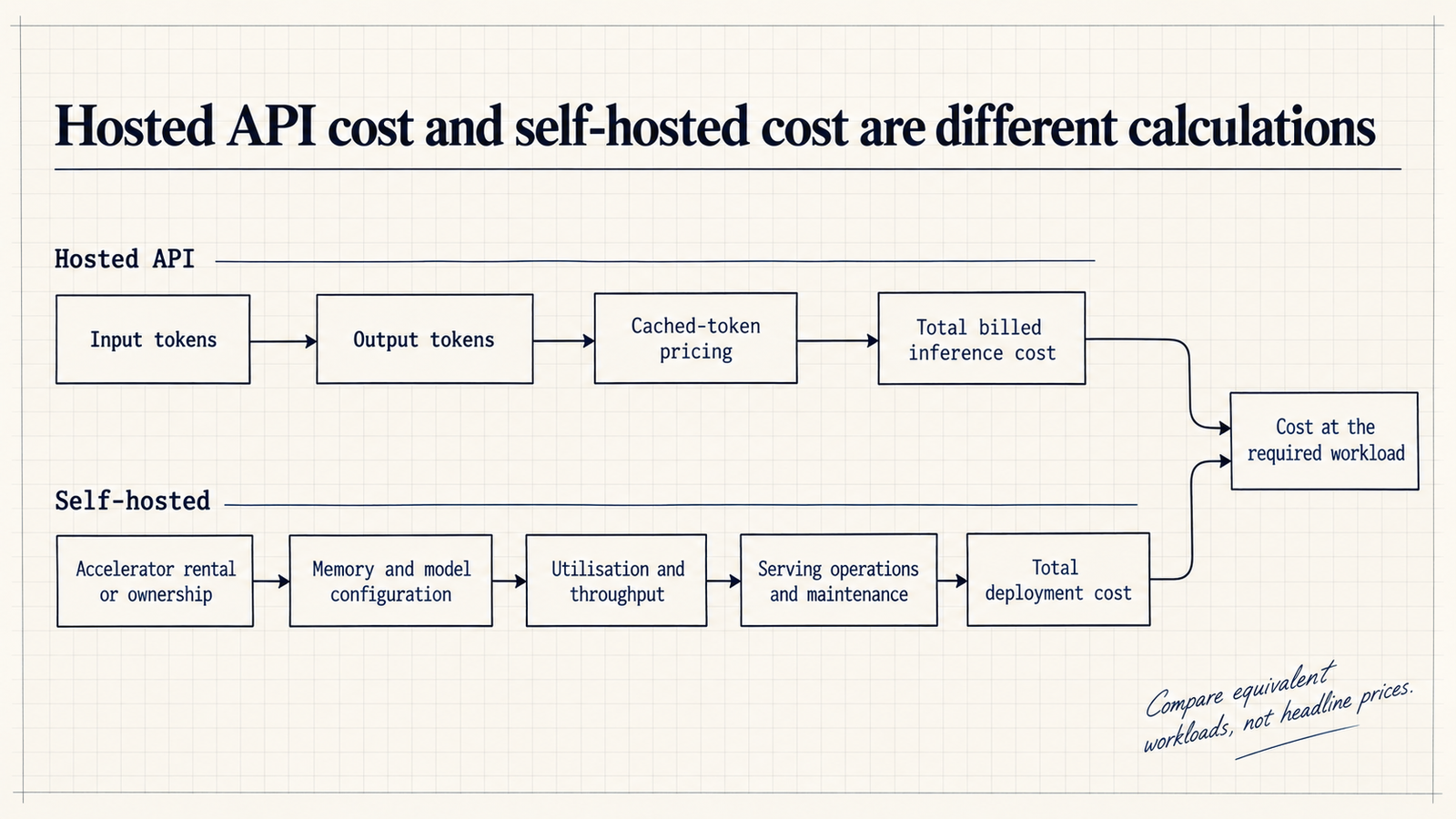
Last verified: 7 November 2026. Government and company claims are attributed throughout. None has been tested in court. A support team trains a small, cheap …
AI shopping agents

Visa Tested AI Shopping Agents. 42.8% of Runs Failed, and Many Still Bought

Last verified: 7 November 2026. Benchmark figures are from Visa’s announcement. Model rankings are from Fortune. A shopper asks for a TV. The agent finds …